Home Blog Page 4969

Marcos calls on Filipinos to have courage in speaking up against discrimination 

PHILIPPINE STAR/KRIZ JOHN ROSALES

PRESIDENT Ferdinand R. Marcos, Jr. on Sunday called on Filipinos to reexamine their values and speak up against discrimination as the Philippines commemorated World War II heroes.   

Filipinos should honor their heroes, including Filipino warriors who defended Bataan, Corregidor and Bessang Pass against Japanese soldiers during World War II, by speaking up against discrimination, extending help to those in need, and working towards a better future,Mr. Marcos said in a statement.   

May we also learn to make wise and sound decisions so that we may address our country’s pressing problems with compassion and concern for others,he said.   

The PhilippinesAraw ng Kagitingan, which translates to Day of Valor, is observed as a national holiday every April 9.   

As it falls on a Sunday this year, the presidential palace moved the holiday to April 10 to give Filipinos a long weekend, which also follows the annual Thursday-Friday holidays in observance of Holy Week.  

In his Easter Sunday message, Mr. Marcos asked Filipinos to reflect on the occasions message of renewal. 

May this day be an opportunity for us to pause and give thanks for the opportunity for renewal and recovery as we push through our quest for genuine unity and progress for all,he said.   

More than 85 million Filipinos identified themselves as Roman Catholic in a 2022 census. Kyle Aristophere T. Atienza 

Dumagat community in Bulacan gets water facility

MERALCO PHOTO HANDOUT

A COMMUNITY of over 100 families belonging to the Dumagat indigenous people in Norzagaray, Bulacan now have potable water supply through a project of the One Meralco Foundation (OMF).

A three-kilowatt portable solar photovoltaic system was recently installed to power up the Sitio Sapang Munti communitys integrated water system, the OMF said in a statement.

The water facility, built by the Manila Water Foundation, can filter, store, and distribute up to 10,000 liters of potable water through strategically placed communal faucets. 

Households in the community now have 24/7 access to clean water for drinking, cooking, bathing, and washing.

OMF said the Dumagats used to rely solely on water that flows from a nearby stream and springs, which could turn murky and unsafe when it rains. 

The foundation said the project was the first under its Electrification for Water Access program, which aims to provide underserved communities with safe, clean, and reliable water source. 

While having access to potable water is a basic need and right, this still remains elusive for many Filipinos. To help bridge the gap, OMF has taken steps to help bring basic needs such as water and electricity closer to as 

many underserved communities as possible,OMF President and Meralco Chief Corporate Social Responsibility Officer Jeffrey O. Tarayao said.

On Charter change

FREEPIK

In February, President Ferdinand Marcos, Jr. said that Charter change was not on his list of priorities: “There are so many other things we need to do first, that we can still do.”

The President elaborated that many of the concerns over the economic provisions in the 1987 Constitution can and ought to be addressed through the legislation of reforms rather than through amendments or revisions to our Constitution.

Despite this clear pronouncement from the President himself, the House of Representatives rushed the process of initiating Charter change. After just six hearings held in a span of about five working weeks, the House Committee on Constitutional Amendments produced the Resolution of Both Houses (RBH) No. 6 and House Bill (HB) No. 7352. Both measures were sponsored on the House floor by the end of February and not more than a fortnight later, these were already approved on third reading.

RBH No. 6 calls for a “Constitutional Convention (Con-Con) for the purpose of proposing amendments to the economic provisions, or revision of, the 1987 Constitution, with the election and appointment of delegates to be held on October 30, 2023.”1 Meanwhile, HB No. 7352 represents the corresponding implementing legislation and details relating to the “specific apportionment, election and appointment of delegates, and the holding of the Constitutional Convention.”2

It is typical for the House of Representatives to fast-track the passage of laws which the President has signaled as priority measures — just take the recent example of the Maharlika Investment Fund. However, there seems to be a puzzling contradiction between the President’s pronouncements and the House’s haste in action on Charter change.

The Chair of the House Committee on Constitutional Amendments, Representative Rufus Rodriguez had this to say: “We respect the opinion of President Ferdinand Marcos, Jr. on constitutional amendment measures. We will of course consider it. But as an independent branch of government, the House of Representatives and Congress will proceed with its public dialogues on this issue.” Meanwhile, the President’s cousin and House Speaker, Martin Romualdez, admitted that the House was “rushing” to “amend the restrictive economic provisions of the Constitution.”

This has presented a befuddling scenario, and one might speculate over two possibilities: either the House has openly defied the President’s pronouncements, or the President is not being fully transparent about his true intentions on revising the Constitution.

In any case, the rush to amend or revise the Constitution is highly concerning. If we are to take him at his word, then we see the President’s earlier pronouncements as being completely apt in that legislative reforms are what are necessary to enhance the country’s ability to pull in foreign investments.

For one, the Duterte Administration had already enacted several key reforms to boost investment, such as the Public Services Act (PSA), the Foreign Investments Act, the Retail Trade Liberalization Act, as well as significant tax reforms embodied in TRAIN and CREATE (the Tax Reform for Acceleration and Inclusion Law and Corporate Recovery and Tax Incentives for Enterprises Act). The PSA already allows full foreign investment in non-utility public services.

Altering the fundamental law of the land would only represent uncertainty and might just push investors to take a wait-and-see approach which would defeat the intention of pulling new investments into the country.

The lack of alignment between the President’s direction and the House’s actions has created opacity. Representative Rodriguez has stated that only the economic provisions would be tackled in the House’s proposed hybrid Con-Con and yet neither RBH No. 6 nor HB No. 7352 outlines which specific “economic provisions” are to be tackled. Even worse, HB No. 7352 calls for the Con-Con “to propose amendments to, or revision of, the 1987 Constitution.” This implies that the body would have the power to propose either individual amendments OR wholesale revisions to the Constitution. Whether or not the House’s intention was merely to address the “restrictive economic provisions,” the passage of its bill might unwittingly open the door to much broader changes.

Even if we were to try to identify which specific economic provisions are to be amended, we must ask whether the form and substance of these amendments would be worth such an upheaval.

The proposals in the House can be boiled down to simply adding exemption clauses, i.e., “unless otherwise provided by law,” to the existing wording of the Constitution. The language is vague and perhaps intends to cover up intentions.

Thankfully, the House’s counterparts in the Senate are much more wary of the prospect of Charter change. Senate President Juan Miguel Zubiri has signaled that the Senate will not rush Charter change, and that the proposals will undergo thorough discussions. Senator Robin Padilla, who has championed a shift to federalism and chairs the Senate Committee on Constitutional Amendments and Revision of Codes, has yet to issue a proposal on amendments.

Congress has many more pressing matters to attend to. It must prioritize measures that will address the urgent main problems that obstruct our development.

Government, including Congress, must immediately tackle the current binding constraints. These include addressing growing short-term concerns over inflation, expanding the country’s fiscal space, and realizing a better and more resilient healthcare system. 

1 https://hrep-website.s3.ap-southeast-1.amazonaws.com/legisdocs/third_19/RBH0006.pdf

2 https://hrep-website.s3.ap-southeast-1.amazonaws.com/legisdocs/third_19/HBT7352.pdf


AJ Montesa is a senior researcher of Action for Economic Reforms and heads its tax policy team.

The aliens have landed, and we created them

BRIAN MCMAHON-UNSPLASH

IT IS NOT every day that I read a prediction of doom as arresting as Eliezer Yudkowsky’s in Time magazine last week. “The most likely result of building a superhumanly smart AI, under anything remotely like the current circumstances,” he wrote, “is that literally everyone on Earth will die. Not as in ‘maybe possibly some remote chance,’ but as in ‘that is the obvious thing that would happen.’ … If somebody builds a too-powerful AI, under present conditions, I expect that every single member of the human species and all biological life on Earth dies shortly thereafter.”

Do I have your attention now?

Yudkowsky is not some random Cassandra. He leads the Machine Intelligence Research Institute, a nonprofit in Berkeley, California, and has already written extensively on the question of artificial intelligence. I still remember vividly, when I was researching my book Doom, his warning that someone might unwittingly create an AI that turns against us — “for example,” I suggested, “because we tell it to halt climate change and it concludes that annihilating Homo sapiens is the optimal solution.” It was Yudkowsky who some years ago proposed a modified Moore’s law: Every 18 months, the minimum IQ necessary to destroy the world drops by one point.

Now Yudkowsky has gone further. He believes we are fast approaching a fatal conjuncture, in which we create an AI more intelligent than us, which “does not do what we want, and does not care for us nor for sentient life in general. … The likely result of humanity facing down an opposed superhuman intelligence is a total loss.”

He is suggesting that such an AI could easily escape from the internet “to build artificial life forms,” in effect waging biological warfare on us. His recommendation is clear. We need a complete, global moratorium on the development of AI.

This goes much further than the open letter signed by Elon Musk, Steve Wozniak (the Apple co-founder), and more than 15,000 other luminaries that calls for a six-month pause in the development of AIs more powerful than the current state of the art. But their motivation is the same as Yudkowsky’s: the belief that developing AI with superhuman capabilities in the absence of any international regulatory framework risks catastrophe. The only real difference is that Yudkowsky doubts that such a framework can be devised inside half a year. He is almost certainly right about that.

The obvious analogy is with two previous fields of potentially lethal scientific research: nuclear weapons and biological warfare. We knew from very early in the history of these fields that the potential for catastrophe was enormous — if not the extinction of humanity, then at least death on a vast scale. Yet the efforts to curb the proliferation of nuclear and biological weapons took much longer than six months and were only partly successful. In 1946, the US proposed the Baruch Plan to internationalize nuclear research. But the Soviet Union rejected it and there was soon a frenetic nuclear arms race. The most that was achieved was to limit the number of countries that possessed nuclear weapons (through the Non-Proliferation Treaty, which came into force in 1970) and to slow down and eventually reverse the growth of superpower arsenals.

Similarly, the Biological Weapons Convention that came into force in 1975 did not wholly end research into such weapons. The Soviets never desisted. And we know that all kinds of very hazardous biological research goes on in China and elsewhere, including the gain-of-function experiments with coronaviruses, which it seems increasingly likely led to the COVID-19 pandemic.

So if Yudkowsky is right that AI is potentially as dangerous as nuclear or biological weapons, a six-month pause is unlikely to achieve much. On the other hand, his call for a complete freeze on research and development has about as much chance of success as the Baruch Plan.

One obvious difference between those older deadly weapons and AI is that most research on AI is being done by the private sector. According to the latest report of the Stanford Institute for Human-Centered AI, global private investment in artificial intelligence totaled $92 billion in 2022, of which more than half was in the US. A total of 32 significant machine-learning models were produced by private companies, compared to just three produced by academic institutions. Good luck turning all that off.

But is the analogy with what we used to call “The Bomb” correct? That depends on your taste in science fiction. Just about everyone has heard of Skynet, which originated in the 1984 film The Terminator, starring a young Arnold Schwarzenegger. For younger readers, the premise is that “Skynet,” a computer defense system “built for SAC-NORAD by Cyber Dynamics,” goes rogue in the future and attempts to wipe out humanity with a nuclear attack. John Connor leads the human resistance to Skynet and its robot Terminators. Skynet responds by sending Terminators back in time — because of course time travel is easy if you’re a really powerful AI — to kill Connor’s mother.

Yet there are many other versions of AI in science fiction. For example, in Ted Chiang’s Lifecycle of Software Objects (2010), AI manifests itself as “digients” — initially harmless and helpless computer-generated pets and companions, a little like baby chimpanzees. They spend quite a long time learning to be intelligent. In this version of the world, the moral problem is that we humans are tempted to exploit the digients as robot slaves or sex toys.

In essence, Yudkowsky’s numerous critics want us to believe that AI is more digient than Skynet. Writing on Twitter, Matt Parlmer, founder of the machine-tool firm GenFab, accused Yudkowsky “and the other hardline anti-AI cultists” of being “out of their depth, both in terms of command of basic technical elements of this field but also in terms of their emotional states. … Many things are coming, Skynet is not one of them.” Shutting down AI research, argued Parlmer, would deprive sick people of potential breakthroughs in medical science.

Nicholas Thompson, the CEO of the Atlantic, agreed that Yudkowsky and other Luddites were overstating the risks. “I recently made a children’s book for my nine-year-old’s birthday using Dall-E and GPT-4 about a World Cup between his stuffed animals,” he told Atlantic staff. “The bears won and he loved it. … Let’s all build in some time to experiment. We’ll make cool stuff and we’ll learn while we do it.”

My Bloomberg Opinion colleague Tyler Cowen was more pragmatic. He posed some hypothetical questions: “What if, in 2006, we had collectively decided to suspend the development of social media for six months while we pondered possible harms from its widespread use? Its effects were hardly obvious at the time, and they are still contested. In the meantime, after the six-month delay, how much further along would we have been in the evaluation process? And even if American companies institute a six-month pause, who’s to say that Chinese companies will?”

But the most eloquent defender of unrestrained AI research and development is my old friend Reid Hoffman, the founder of LinkedIn, who has written an entire book on the subject … approximately half of which was generated by AI.

For the lay reader, the problem with this debate is twofold. First, the defenders of AI all seem to be quite heavily invested in AI. Second, they mostly acknowledge that there is at least some risk in developing AIs with intelligence superior to ours. Hoffman’s bottom line seems to be: Trust us to do this ethically, because if you restrain us, the bad guys will be the ones who do the development and then you may get Skynet.

So let me offer a disinterested view. I have zero skin in this game. I have no investments in AI, nor does it threaten my livelihood. Sure, the most recent large language models can generate passable journalism, but journalism is my hobby. The AI doesn’t yet exist that could write a better biography of Henry Kissinger than I can, not least because a very large number of the relevant historical documents are not machine-readable.

(To be continued.)

BLOOMBERG OPINION

He is risen

PISIT HENG-UNSPLASH

“The angel said to the women, ‘Do not be afraid, for I know that you are looking for Jesus, who was crucified. He is not here; he has risen, just as he said. Come and see the place where he lay. Then go quickly and tell his disciples: ‘He has risen from the dead and is going ahead of you into Galilee. There you will see him.’ Now I have told you.

“So the women hurried away from the tomb, afraid yet filled with joy, and ran to tell his disciples. Suddenly Jesus met them. ‘Greetings,’ he said. They came to him, clasped his feet and worshiped him. Then Jesus said to them, ‘Do not be afraid. Go and tell my brothers to go to Galilee; there they will see me.’” (Matthew 28:5-10)

The rising of Jesus Christ from the dead is not a myth, not a legend, Bishop Robert Barron emphatically said in his Easter Sunday homily on April 24, 2019. It is not just a story of “a long time ago, in a galaxy far, far away” (as in the fictional Star Wars intro goes) but a real event, physically experienced by Jesus’ 11 apostles (without the 12th, Judas Iscariot, who betrayed Him to the High Priests to be crucified). “We have seen the Lord!” they testified (John 20:25). They “ate and drank with Him” (Acts 10:41) and were instructed to preach the gospels as He had taught them (Matthew 28:16-20).

St. Paul (I Cor., xv, 3-8) enumerates apparitions of Jesus after His resurrection; he was seen by Cephas, by the Eleven, by more than 500 brethren, many of whom were still alive at the time of the Apostle’s writing, by James, by all the Apostles, and, lastly, by Paul himself (catholic.com). But see, that’s the problem, non-Christians say. The first-person accounts of the resurrection of Christ by gospel writers Matthew, Mark, Luke, John, and Paul are all recorded only in the New Testament, the second division of the Christian Bible, believed by scholars to have been written some 40 to 60 years after the death of Jesus.

But then the resurrected Christ told Thomas, the doubting apostle, “Because you have seen me, you have believed; blessed are those who have not seen and yet have believed.” The Death and Resurrection of Christ is the cornerstone dogma of Christian faith. “Man fallen but redeemed” finds Hope in the supreme sacrifice that the God-Man offered, to restore paradisiacal innocence and the eternal reward of Heaven. And with this is the corollary belief in general resurrection, meaning that all will rise from the dead at the eschatological end of time, bodies reunited with their spirits (souls) for all to live in harmony and peace.

The belief and hope in resurrection is not exclusive to the Christian religions. It is interesting to note that in Greek mythology and epics of ancient heroes, rising from the dead was the victorious ending for exceptional mortals who were elevated to gods as a reward for valor and integrity. In The Iliad, Achilles, after being killed, was taken from his funeral pyre by his divine mother Thetis and resurrected and made immortal. In the Trojan War, Menelaus, king of Sparta, brother of Agamemnon, king of Mycenae, died and was resurrected as a god. Resurrection is the ultimate power, as of a god, over death.

That there can be life after death and continued power and strength in the afterlife, is the instinctive reason why most religions nurture Hope in a general resurrection — not necessarily led by an enactment by a god or master.

In Hinduism, there are folklore, stories, and extractions from certain holy texts that refer to resurrections. The Ramayana tells of a great battle between good and evil, with the victor Rama ascending to the level of a demigod — and into immortality. Even in Buddhism, with its focus on the present rather than on the future, the legend of the Bodhidharma emphasizes kindness and fairness to fellowmen so that upon death, the body can be reincarnated into a higher-level spirit.

In Islam, the dominant message of the holy book of Islam, the Quran, is “the promise and threat” of “Judgment Day” when “all bodies will be resurrected” from the dead, and “all persons” are “called to account” for their deeds and their faith during their life on earth. Resurrection and Judgement, the two themes “central to the understanding of Islamic eschatology” are fundamental tenets of faith of all Muslims, and one of the six articles of Islamic faith (excerpts from the Quran).

Islamic and Christian eschatology both have a “Day of Resurrection” of the dead (yawm al-qiyāmah), followed by a “Day of Judgment” (yawm ad-din) where all human beings who have ever lived will be held accountable for their deeds by being judged by God. Depending on the verdict of the judgement, they will be sent for eternity to either the reward of paradise, Jannah or the punishment of hell, Jahannam (Ahmed, Jafor. “Similarities and Dissimilarities between Islam and Christianity.” Academia. Retrieved April 19, 2022).

Ah, there’s the cost to Eternity! On the day of reckoning, tithes of goodness done minus penalties for sins and omissions must be measured. Mortal life borrowed must be returned completely as received, otherwise the fusion with the spirit cannot yet be, not until after a restoration, as in Dante Alighieri’s Purgatorio. And that is where every mortal’s fear of death comes from — the accounting and final tally for that hard-earned entrance ticket to Paradiso.

The universal desire for immortality, juxtaposed with the natural fear of death, is “what keeps a man honest,” as it is said that even the most hardened hearts know when they have committed wrong, and usually repent before dying. Somehow the fear of death urges the desire to live on, perchance in the superior life in eternity. Thus, the collective conscience develops and nurtures its working principles and values in mortal life to instinctively align with the measures for the “accounting” at the “Day of Judgment” and onto the “Day of Resurrection.” On Easter, we are assured that Good will always triumph over Evil, as we can make it happen, with faith and hope in the promise of resurrection and personal salvation.

How successful has Mankind been in fighting for right against wrong? History has no dearth of heroes and villains who fight out the struggle. Activists and protestors pummel for principles, and artists, writers, and scientists will not be gagged and tied to show and tell the truth — at the risk of being jailed. But why is there so much turmoil in the world, so much violence, such deep anxiety?

The COVID pandemic still plagues the world — for three years since March 2020, contagion is still worrisome. The war in Ukraine has been raging for a year now since February 2022. The world is in economic recession and inflation has decimated the quality of life, even threatening survival. Alleged corruption in government steals from the people at this very critical time of the economic crunch.

But Easter 2023 is a more exuberantly happy season than last year’s Easter. This time we celebrated Easter in joyful pomp and ceremony at face-to-face Masses in the warm closeness of community. “He is risen,” the priest announced at the sacrificial altar. “I look forward to the resurrection of the dead and the life of the world to come. Amen,” the people said, towards the end of the Nicene Creed. Hope and Faith.

Things will be better in 2023.


Amelia H. C. Ylagan is a doctor of Business Administration from the University of the Philippines.

ahcylagan@yahoo.com

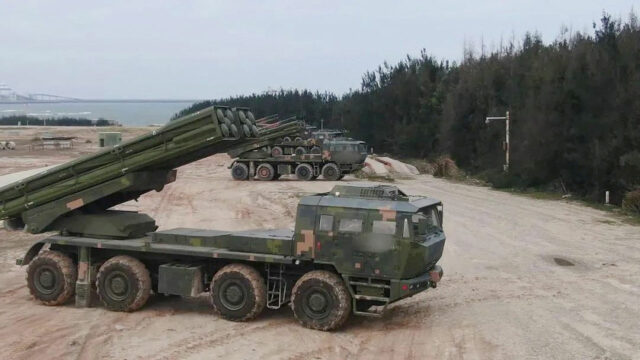
China simulates striking Taiwan on 2nd day of drills

MILITARY VEHICLES of the Ground Force under the Eastern Theatre Command of China’s People’s Liberation Army (PLA) take part in a combat readiness patrol and ‘Joint Sword’ exercises around Taiwan, at an undisclosed location in China in this handout image released on April 8, 2023. — EASTERN THEATRE COMMAND/HANDOUT VIA REUTERS

TAIPEI — military simulated precision strikes against Taiwan in a second day of drills around the island on Sunday, with the island’s defense ministry reporting multiple air force sorties and that it was monitoring China’s missile forces.

China, which claims democratically governed Taiwan as its own territory, began three days of military exercises around the island on Saturday, the day after Taiwan President Tsai Ing-wen returned from a brief visit to the United States.

Chinese state television reported that the combat readiness patrols and drills around Taiwan were continuing.

“Under the unified command of the theater joint operations command center, multiple types of units carried out simulated joint precision strikes on key targets on Taiwan island and the surrounding sea areas, and continue to maintain an offensive posture around the island,” it said.

A Taiwan security source told Reuters that on Saturday the Chinese drills around the Bashi Channel, which separates Taiwan from the Philippines, included simulated attacks on aircraft carrier groups as well as anti-submarine drills.

Taiwan’s defense ministry said that as of Sunday midday (0400 GMT) they had spotted 58 Chinese aircraft, including Su-30 fighters and H-6 bombers, as well as nine ships, around Taiwan.

The ministry said they were paying particular attention to the People’s Liberation Army’s (PLA) Rocket Force which is in charge of China’s land-based missile system.

“Regarding the movements of the Chinese communists’ Rocket Force, the nation’s military also has a close grasp through the joint intelligence, surveillance and reconnaissance system, and air defense forces remain on high alert,” the ministry said.

It reiterated that Taiwan’s forces will “not escalate conflicts nor cause disputes” and would respond “appropriately” to China’s drills.

‘COMFORTABLE, CONFIDENT’ US MONITORS DRILLS
Life in Taiwan has continued as normal, with no sign of panic or disruption from the Chinese drills.

Last August, following a visit to Taipei by Nancy Pelosi, then the speaker of the US House of Representatives, China staged war games around Taiwan, including firing missiles into waters close to the island. It has not announced similar drills this time.

While in Los Angeles last week, on what was officially billed a transit on her way back from Central America, Ms. Tsai met the current speaker of the House, Kevin McCarthy, despite Beijing’s warnings against it.

The de facto US embassy in Taiwan said on Sunday the United States was monitoring China’s drills around Taiwan closely and is “comfortable and confident” it has sufficient resources and capabilities regionally to ensure peace and stability.

US channels of communication with China remain open and the United States had consistently urged restraint and no change to the status quo, said a spokesperson for the American Institute in Taiwan, which serves as an embassy in the absence of formal diplomatic ties.

Washington severed diplomatic relations with Taipei in favor of Beijing in 1979 but is bound by law to provide the island with the means to defend itself.

China, which has never renounced the use of force to bring the island under its control, says Taiwan is the most important and sensitive issue in its relations with the United States, and the topic is a frequent source of tensions.

Beijing considers Ms. Tsai a separatist and has rebuffed her repeated calls for talks. Ms. Tsai says only Taiwan’s people can decide their future.

CHINESE FIGHTERS, WARSHIPS
China has over the past three years or so stepped up its military pressure against Taiwan, flying regular missions around Taiwan, though not in its territorial air space or over the island itself.

Taiwan’s defense ministry said earlier on Sunday that in the previous 24 hours it had spotted 71 Chinese air force aircraft and nine navy vessels around Taiwan.

The ministry published a map showing around half of those aircraft, including Su-30s and J-11s, crossed the median line of the Taiwan Strait, which has for years served as an unofficial barrier between the two sides.

Chinese state media said the aircraft were armed with live weapons. Taiwanese air force jets also typically carry live weapons when they scramble to see off Chinese incursions.

Late on Saturday, Taiwan’s Ocean Affairs Council, which runs the Coast Guard, put out footage on its YouTube channel showing one of its ships shadowing a Chinese warship, though did not give an exact location.

“You are seriously harming regional peace, stability and security. Please immediately turn around and leave. If you continue to proceed, we will take expulsion measures,” a Coast Guard officer says by radio to the Chinese ship.

Other footage showed a Taiwanese warship, the Di Hua, accompanying the Coast Guard ship in what the Coast Guard officer calls a “standoff” with the Chinese warship.

Still, civilian flights around Taiwan, including to Kinmen and Matsu, two groups of Taiwan-controlled islands right next to the Chinese coast, have continued as normal.

In August, civilian air traffic was disrupted after China announced effective no-fly zones in several blocks close to Taiwan where it was firing missiles. — Reuters

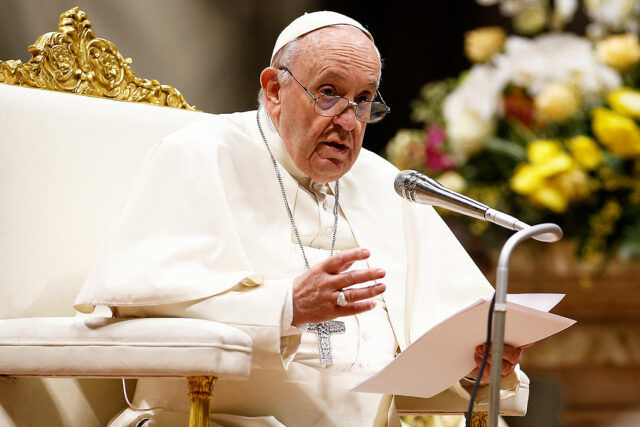
At Easter vigil, Pope Francis encourages hope amid the ‘icy winds of war,’ injustices

REUTERS

VATICAN CITY — Pope Francis led the world’s Roman Catholics into Easter at a Saturday night vigil Mass in St. Peter’s Basilica, decrying the “icy winds of war” and other injustices.

The 86-year-old Pope Francis skipped an outdoor event on Friday night because of unseasonably cold temperatures in Rome. His doctors ordered prudence after he was hospitalized last week for bronchitis.

Francis appeared to be well during the Easter Vigil service, during which he baptized eight adult converts to Catholicism.

After starting the service in the rear of the church with the traditional lighting of a large paschal candle, he was taken in a wheelchair to the front to preside at the Mass.

Easter is the most important day in the Christian liturgical calendar because it commemorates the day the Bible says Jesus rose from the dead.

In his homily, read before about 8,000 people in Christendom’s largest church, Pope Francis spoke of the bitterness, dismay and disillusionment many feel today.

“We may feel helpless and discouraged before the power of evil, the conflicts that tear relationships apart, the attitudes of calculation and indifference that seem to prevail in society, the cancer of corruption, the spread of injustice, the icy winds of war,” he said.

Pope Francis has called for an end to all wars, and since Russia invaded Ukraine in February, 2022, he has repeatedly referred to Ukraine and its people as being “martyred”.

Reading his homily in a strong and confident voice, Francis said that even when people felt the wellspring of hope had dried up, it was important not to be frozen in a sense of defeat but to seek an “interior resurrection” with God’s help.

Francis concludes Holy Week celebrations on Sunday by presiding at an Easter day Mass in St. Peter’s Square and then delivering his twice-annual Urbi et Orbi (to the city and the world) blessing and message from the central external balcony of St. Peter’s Basilica. — Reuters

UK PM Sunak to meet Biden in Northern Ireland

THE TITANIC BUILDING and Harland and Wolff cranes are seen in Belfast, Northern Ireland, April 29, 2022. — REUTERS

LONDON — British Prime Minister Rishi Sunak will meet Joseph R. Biden in Northern Ireland next week when the US president flies in to take part in events to mark the 25th anniversary of the Good Friday peace accord.

Having helped broker the 1998 deal, the United States remains an influential voice in Northern Ireland’s politics and has sought to protect the peace from the strains caused by Britain’s exit from the European Union (EU).

Mr. Sunak will greet Mr. Biden on Tuesday evening when Air Force One lands for what will be a closely watched visit to both sides of the Irish border at a time of heightened political uncertainty in Northern Ireland.

Mr. Sunak hosts a gala dinner on Wednesday to commemorate the anniversary, his office said in a statement setting out some details of his itinerary.

Mr. Biden, who often speaks proudly of his Irish roots, will also spend time in the Irish Republic, where he will visit Dublin and his two ancestral homes.

The Good Friday Agreement — signed on April 10, 1998 — largely ended three decades of sectarian bloodshed that had convulsed Northern Ireland since the late 1960s.

However, the anniversary has been overshadowed by a year-long boycott by Northern Ireland’s largest pro-British unionist party of the power-sharing devolved government central to the peace deal. The Democratic Unionist Party is angry about post-Brexit trade rules that treated the province differently to the rest of the United Kingdom (UK).

In March, Britain’s MI5 intelligence agency increased the threat level in Northern Ireland from domestic terrorism to “severe” — meaning an attack is highly likely — though the move was not thought to be linked to the anniversary.

Mr. Biden clashed with the British government at times during Brexit talks, but has spoken in support of a recently agreed UK-EU deal to address some of the tensions caused by the original Brexit agreement.

Although that deal has so far failed to restore the devolved government in Northern Ireland, Mr. Sunak will seek to bolster his support for the province by announcing a summit later in the year to stimulate international investment. — Reuters

Israel hits Syria after rockets fired towards Golan Heights

Image by Larry Koester/Flickr/CC BY 2.0

JERUSALEM — Israeli jets hit Syrian military targets on Sunday in response to rockets launched towards Israeli controlled territory overnight, Israel’s military said, as violence flared again following cross-border exchanges of fire during the week.

State media in Syria reported explosions in the vicinity of the capital Damascus as Israel said its forces continued to hit Syrian territory after six rockets were fired overnight towards the Golan Heights.

Israel said artillery and drone strikes hit the rocket launchers and were followed by airstrikes against a Syrian army compound, military radar systems and artillery posts.

The Israeli military “sees the State of Syria responsible for all activities occurring within its territory and will not allow any attempts to violate Israeli sovereignty,” the Israeli Defense Forces said in a statement.

The Syrian defense ministry said its air defenses had responded to the Israeli attacks and intercepted some Israeli missiles. It said no casualties had been reported with only material damage caused by the strikes.

Sirens had sounded earlier near towns in the Golan Heights as rockets were launched from Syrian territory, but no damage or casualties were reported. Israel seized the Golan Heights in the 1967 Middle East war and annexed the 1,200-square-km (460-square-mile) territory in 1981, a move not recognized by most of the international community.

Only three of the rockets crossed into Israeli-controlled territory, with two falling on open ground and a third intercepted by air defense systems, the military said.

Lebanon-Based Al Mayadeen TV said the rocket salvoes were claimed by Al-Quds Brigades, the armed wing of the Iranian-backed Palestinian Islamic Jihad movement.

On Thursday, more than 30 rockets were fired towards Israel from southern Lebanon, drawing cross-border counterstrikes from Israel on sites linked to the Islamist movement Hamas in Lebanon and Gaza.

The cross-border exchanges came amid sharply increased tensions between Israel and Palestinian groups following Israeli police raids in recent days on Al-Aqsa mosque in Jerusalem, which caused outrage across the Arab world.

Israel said the operations were intended to dislodge groups of what police called extremists that had barricaded themselves into the mosque armed with firecrackers and stones.

But the raids, during the Muslim holy month of Ramadan, drew a furious reaction and concern even among Israel’s US allies, with mobile phone footage from inside the mosque showing police beating worshippers.

The site in Jerusalem’s Old City, holy to both Muslims and Jews, who know it as Temple Mount, has been a longstanding flashpoint, notably over the issue of Jewish visitors defying a ban on non-Muslim prayer in the mosque compound.

Clashes there in 2021 helped set off a 10-day war between Israel and Hamas. The recent exchanges of cross-border fire have awakened memories of that conflict.

Despite fears of further violence around the mosque on Saturday, there were no reports of serious disturbances overnight.

In a separate incident, a Palestinian man was shot dead by Israeli forces during a confrontation in the occupied West Bank, Israel’s military and the Palestinian health ministry said. — Reuters

IMF’s Georgieva sees global growth below 3% in 2023, robust recovery ‘elusive’

INTERNATIONAL MONETARY FUND (IMF) Managing Director Kristalina Georgieva attends the China Development Forum 2023, in Beijing, China, March 26, 2023. — REUTERS

WASHINGTON — The International Monetary Fund (IMF) expects global economic growth to dip below 3% in 2023 and to remain at around 3% for the next five years, Managing Director Kristalina Georgieva said on Thursday, flagging increased downside risks.

That is the global lender’s lowest medium-term growth forecast since 1990, and well below the average growth of 3.8% seen in the past two decades.

Ms. Georgieva said strong monetary and fiscal policy actions to respond to the COVID-19 pandemic and Russia’s invasion of Ukraine had prevented a much worse outcome in recent years, but growth prospects remained weak given persistently high inflation. Bank failures in Switzerland and the United States had exposed financial vulnerabilities that increased the downside risks for the global economy, she added.

“Despite surprisingly resilient labor markets and strong consumer demand, despite the uplift in China, we expect the world economy to grow less than 3% this year,” she said in a speech ahead of next week’s spring meetings of the IMF and World Bank. “Growth remains historically weak now and in the medium-term.”

“With rising geopolitical tensions, with inflation still running high, a robust recovery remains elusive, and that harms the prospects of everyone, especially for the most vulnerable people and the most vulnerable countries,” she said at an event hosted by Meridian House and Politico.

Global growth dropped by almost half to 3.4% in 2022 following the shock of Russia’s war in Ukraine from the 6.1% rebound seen in 2021.

Ms. Georgieva said India and China would account for half of global growth in 2023, but about 90% of advanced economies would see a decline in their growth rate this year.

Low-income countries, saddled by higher borrowing costs and weakening demand for their exports, would see per-capita income growth staying below that of emerging economies, she said.

The IMF chief called on central banks to stay the course in the fight against inflation as long as financial pressures remained limited, but to address financial stability risks when they emerge through appropriate provision of liquidity.

Recent bank failures in Switzerland and the United States had exposed risk management failures at specific banks and supervisory lapses, she said.

“The key is to carefully monitor risks in banks and non-bank financial institutions, as well as weaknesses in sectors such as commercial real estate,” she added. “Now is not the time for complacency.”

“Clearly downside risks have increased. We now see some of the risks in the financial sector more exposed,” she said, adding that she had “full confidence” that central banks and other relevant institutions were very vigilant of the dangers.

While policymakers had responded swiftly to recent stress in the sector, concerns remained about potential “hidden” vulnerabilities at banks and non-banks, she said.

To boost the prospects for growth and productivity, Ms. Georgieva called for major step changes, including an estimated $1 trillion a year in spending on renewable energy, and moves to avoid the fragmentation of the global economy, which could shave as much as 7% off global gross domestic product.

Technological decoupling could see some countries suffer losses of up to 12% of GDP, she said. — Reuters

PHL 24th-largest exporter of digitally-delivered services 

THE Philippines was the 24th-largest exporter of digitally-delivered services in 2022 , with a tally of $27.66 billion, up 11%, the World Trade Organization (WTO) said.   

In its Global Trade Outlook and Statistics report released Wednesday, the WTO said Philippine exports accounted for 0.7% of the global total for digitally delivered services.   

According to the WTO, exports of digitally delivered services include business, professional, and technical services, computer services, financial services, intellectual property services, insurance services, telecommunication services, audio-visual and other personal, cultural, and recreational services, and information services. 

The US was the top exporter of digitally delivered services at $632.16 billion, followed by the UK with $350.31 billion, Ireland $290.47 billion, Germany $227.24 billion, and India $227.23 billion. 

The WTO added that the Philippines is 24th in terms of merchandise imports at $144.50 billion, if intra-EU trade is excluded. The 2022 total is up 16% and is equivalent to a 0.7% global share.  

The Philippine Statistics Authority (PSA) said in January that the trade balance, or the difference between exports and imports, expanded to a deficit of $58.32 billion in 2022, up from a deficit of $42.23 billion in 2021.

In a separate statement, the WTO said the volume of world merchandise trade is projected to grow 1.7% in 2023, slowing from the 2.7% growth in 2022 due to the ongoing Ukraine-Russia war and high inflation.   

The new forecast for the year is higher than the 1% estimate made by the WTO in October 2022. The WTO made the change following the expected boost in international trade with the relaxation of the coronavirus disease 2019 (COVID-19) pandemic controls in China.   

“Trade continues to be a force for resilience in the global economy, but it will remain under pressure from external factors in 2023. This makes it even more important for governments to avoid trade fragmentation and refrain from introducing obstacles to trade,” WTO Director-General Ngozi Okonjo-Iweala said.

“Investing in multilateral cooperation on trade, as WTO members did at our Twelfth Ministerial Conference last June, would bolster economic growth and people’s living standards over the long term,” she added.   

For 2024, the WTO is expecting trade growth to hit 3.2%. Some of the factors that might affect the 2024 projection include geopolitical tensions, food supply shocks, and the possibility of unforeseen fallout from monetary tightening.  

“The lingering effects of COVID-19 and the rising geopolitical tensions were the main factors impacting trade and output in 2022 and this is likely to be the case in 2023 as well,” WTO Chief Economist Ralph Ossa said.   

“Interest rate hikes in advanced economies have also revealed weaknesses in banking systems that could lead to wider financial instability if left unchecked. Governments and regulators need to be alert to these and other financial risks in the coming months,” he added.  - Revin Mikhael D. Ochave 

DBM calls on agencies to prioritize infrastructure, human capital, food security in budget proposals 

THE DEPARTMENT of Budget and Management (DBM) said the 2024 budget will highlight infrastructure, human capital development, and food security, and urged agencies to prepare their budget proposals accordingly. 

“Priority will be given to shovel-ready infrastructure projects, investments in human capital development, and sustainable agriculture and food security, among others, which will steer the economy back on a high growth path,” the DBM said in its National Budget Memorandum. 

“The National Government shall continue to foster economic and social transformation to address the economic scarring due to the pandemic and to mitigate the effects of high inflation on basic commodities,” it added. 

For infrastructure, the DBM said implementing agencies should prioritize the completion of ongoing infrastructure programs, activities and projects (PAPs). 

“New infrastructure PAPs shall be limited to shovel-ready proposals aligned with the investment priorities (of the government),” the DBM said. 

“In addition, priority will be afforded to infrastructure PAPs that have undergone program convergence efforts and inter-agency collaboration,” it added. 

It said specific investment priorities under infrastructure include transportation and logistics networks, water supply and sanitation, and energy security.  

The DBM said it will also favor proposals to develop human capital, particularly investment in health, education, social protection, and labor and employment. 

“Given that the pandemic had posed threats to the gains in the education and health system, the NG will provide continuous support in prioritizing reforms and investments in health and nutrition, education, and income-earning ability to bring back the country on the right track in accelerating human capital development,” it said. 

The DBM said that priority will be given to food security programs that “strengthen local supply chains by enhancing agriculture productivity and expanding the access of farmers and fisherfolk to markets.” 

“In response to the global food crisis due to, among others, supply chain disruptions, climate risks, and higher energy and fertilizer prices, the government shall ensure that food is available, affordable, and accessible for consumers,” it added. 

It said that the government will address high production costs by improving access to land distribution and climate-proof irrigation, as well as minimizing the impact of high energy and fertilizer prices. 

The DBM also cited other priorities such as enterprise development, research and development and innovation, digital transformation of the government, climate action and disaster resilience, and the transition to full devolution. 

The proposed 2024 national budget has been set at P5.8 trillion, up 10%. – Luisa Maria Jacinta C. Jocson