Home Blog Page 4966

The grant and taxation of public service franchises

On March 21, 2022, RA No. 11659, otherwise known as an Act Amending CA No. 146 or the Public Service Act, was signed into law, thereby amending the decades-old Public Service Act. With the end view of attracting foreign investment to boost market competitiveness, foster innovation, and create high-quality jobs, other public service businesses such as airports, railways, and expressways may now be owned 100% by foreign entities subject to the grant of administrative franchise by the agency tasked to oversee or regulate these undertakings.

As required under the law, the National Economic and Development Authority (NEDA) passed the implementing rules and regulations (IRR) on March 20, 2023. With these recent reforms, one must ascertain a public service franchise is required and its peculiar tax consequence.

PUBLIC UTILITIES VIS-À-VIS PUBLIC SERVICE BUSINESSES WITH PUBLIC INTEREST
Section 11, Article XII of the 1987 Philippine Constitution expressly provides that, “No franchise, certificate, or any other form of authorization for the operation of a public utility shall be granted except to citizens of the Philippines or to corporations or associations organized under the laws of the Philippines at least 60 per centum of whose capital is owned by such citizens, nor shall such franchise, certificate, or authorization be exclusive in character or for a longer period than 50 years.”

With the amendment under RA No. 11659 and Rule III Section 10 of its IRR, public utility refers to a public service that operates, manages, or controls for public use any of the following:

1. Distribution of electricity;

2. Transmission of electricity;

3. Petroleum and petroleum products pipeline transmission systems;

4. Water pipeline distribution systems and wastewater pipeline systems, including sewerage pipeline system;

5. Seaports; and,

6. Public utility vehicles (PUVs).

As public utilities, foregoing industries are still governed by the constitutional rules on Filipino ownership of 60% while foreigners may own up to 40% of the capital whether directly or indirectly. A public service business not included in the foregoing enumeration may be owned 100% by foreign nationals except if it is considered critical infrastructure, as is telecommunications, or otherwise identified as such by the President pursuant to NEDA’s recommendation.

LOCAL TAX OBLIGATION OF A FRANCHISE GRANTEE
As enunciated under the Act and its IRR, while the administrative agencies will no longer impose any citizenship requirement for those public service businesses not listed as public utilities, they are still empowered to grant administrative franchises and monitor and audit the public service entities. Now, what are the peculiar tax considerations that these grantees should take into consideration?

In New Vision Satellite Network, Inc. v. Province of Cagayan, G.R. No. 248840, July 5, 2021, our High Tribunal clarified on the distinction between a franchise and a secondary license or permit. For a franchise grantee, it follows that the local government (province or city) may impose the franchise tax thereon in addition to other national tax obligations. 

The Supreme Court explained this distinction as such:

First, a survey of franchises recognized in jurisprudence shows that they involve: (i) public utilities and common carriers; (ii) economic activities which are in the nature of natural monopolies, or industries where the most efficient number of operators is one or only a few; (iii) industries where the first entrants or incumbents have near monopoly status because of prohibitive fixed costs, economies of scale, and network effects, such that the first entrants or incumbent market players have a high degree of market dominance that impose an insurmountable barrier on potential entrants to enter the market and compete; and (iv) industries that require the use of natural resources or other scarce resources  (such as the airwaves), which utilization thereof necessitates the exclusion of other persons or entities. Second, economic activities covered by franchises are typically charged with public use. Third, the delegation of the authority to exercise the sovereign power of eminent domain is unmistakably a grant of franchise. This is typical in public utilities where certain public infrastructure facilities require the compulsory sale of lands and acquisition of right of way and other properties to give way to public use.

As such, tollway operators, broadcast systems, telecommunication systems and light railway operators require the grant of franchise given the nature of their business as opposed to virtual currency platform operators, pawnshops, financing or lending companies, which only need to secure a secondary license or permit. The Supreme Court notes that in the case of a financing company, lending company, virtual currency exchange operator, pawnshops, and other similar regulated entities requiring a secondary license in addition to general business and local permits, there can be as many market players as are qualified and eligible under the specific laws regulating the business activity. This is because these entities are not engaged in industries which are natural monopolies, or industries where first entrants do not have monopoly or near-monopoly status. Succeeding market players are free to enter the market as long as they comply with the requirements for the issuance of the administrative license to operate these businesses. Moreover, the requirement of obtaining government permits to operate these businesses is merely within the dictates of general welfare, and not because the economic reality of the industry involves scarce resources.

Hence, other than the license or permit to operate, it is crucial for public service companies to secure administrative franchises with the relevant governing agency and pay the local franchise tax. It must be noted that public service franchise grantees are subject to national taxes under the Tax Code except if it is a franchise grant allowing payment of a fixed national franchise tax in lieu of other taxes.

If implemented properly, this landmark reform could usher in a new economic era of public services in the Philippines that are world class and globally competitive, along the way strengthening the fiscal standing of local government units via the local taxes collected from administrative franchise grantees.

Let’s Talk Tax is a weekly newspaper column of P&A Grant Thornton that aims to keep the public informed of various developments in taxation. This article is not intended to be a substitute for competent professional advice.


Kim M. Aranas is a senior manager from the Tax Advisory & Compliance division at the Cebu office of P&A Grant Thornton, the Philippine member firm of Grant Thornton International Ltd.


pagrantthornton@ph.gt.com

Injured RR Pogoy is out of Gilas squad for SEA Games Cambodia

RR POGOY — PBA MEDIA

GILAS Pilipinas will embark on its redemption drive in the coming Southeast Asian Games (SEAG) in Cambodia without ace gunner RR Pogoy.

TNT’s Mr. Pogoy sustained a fractured finger in Game 3 of the PBA Governors’ Cup finals last Friday and has to undergo surgery, making it impossible for him to join the Gilas quest for the lost gold in the May 5-17 SEAG.

RR Pogoy, who showed up in Sunday’s Game 4 in street clothes and wearing protected dressing on his broken right pinky.

Mr. Pogoy is waiting for a hand specialist’s recommendation on whether to stay in the country or go overseas for the operation on the finger, which he fractured when he tried to poke the ball away from Ginebra’s Christian Standhardinger.

The Cebuano hotshot couldn’t give a definite timetable for his return but teammate Calvin Oftana, who had a similar injury before, shared it would need a healing period of two to three months.

Mr. Pogoy is one of only two holdovers from the ill-fated delegation in Vietnam who are still part of the 28-man “Redeem Team” pool for the Cambodia SEAG. Six-time MVP June Mar Fajardo of San Miguel Beer is the other. But even Mr. Fajardo himself is doubtful for this trip as he’s still on the road to recovery.

“The Kraken” tore an MCL during the Beermen’s game against Japanese heavyweight Ryukyu Golden Kings in the East Asia Super League Champions Week last March 2 and hasn’t played since.

Naturalized player Justin Brownlee, meanwhile, is tipped to lead Gilas’ bring-back-the-gold mission in Phnom Penh along with the healthy mainstays of the pool like  Mr. Standhardinger, Scottie Thompson, Jamie Malonzo, CJ Perez, Mr. Oftana, Mikey Williams and Chris Newsome. — Olmin Leyba

Heat topple Bucks in Game 1 amid injuries to Antetokounmpo, Herro

JIMMY BUTLER — MICHAEL MCLOONE-USA TODAY SPORTS

JIMMY Butler had 35 points and 11 assists and the visiting Miami Heat defeated the Milwaukee Bucks — who played most of the game without Giannis Antetokounmpo — 130-117 in Game 1 of an Eastern Conference first-round playoff series Sunday.

Bam Adebayo scored 22 points for the eighth-seeded Heat, who were playing less than 48 hours after qualifying by beating Chicago in a play-in elimination game. Kevin Love had 18, Caleb Martin and Gabe Vincent added 15 apiece and Tyler Herro scored 12 before being sidelined for good in the second quarter because of a broken right hand.

Mr. Antetokounmpo suffered a lower back contusion when he fell to the floor in the first quarter. He stayed in the game for a bit before going to the locker room and returned briefly early in the second quarter before leaving the game for good. He finished with six points and three rebounds in 11 minutes.

The top-seeded Bucks clearly missed his scoring, but the Heat already had set the tone before he was sidelined.

Khris Middleton led Milwaukee with 33 points, Bobby Portis Jr. had 21 points, Jrue Holiday added 16 points and 16 assists, Grayson Allen scored 12 and Brook Lopez had 10.

Game 2 is Wednesday night in Milwaukee.

The Bucks trailed by 13 at halftime but used an 11-0 run to get within 78-75 midway through the third quarter.

Mr. Adebayo and Mr. Martin both converted three-point plays, Mr. Love made two 3-pointers and Duncan Robinson added a late trey to help Miami score 24 points in the final 4:49 to open a 102-88 lead at the end of the third quarter.

Milwaukee closed within eight points five times in the fourth quarter but didn’t get any closer.

Mr. Butler scored 14 points as Miami took a 33-24 lead at the end of the first quarter.

Mr. Middleton scored 10 points, Mr. Portis added six and the Bucks closed within 43-42. The Heat scored the next seven points and opened a 55-44 lead on a 3-pointer by Mr. Love.

Mr. Butler and Mr. Vincent each scored four more points as Miami increased the lead to 68-55 at halftime.

In the final minute of the first half, Mr. Herro dove for a loose ball but did not beat his opponent to it. Mr. Herro hit his hand on the court while sliding past the spot of the ball. Though in visible pain, he stayed in the game and attempted a shot before subbing out. The Heat later announced he had broken his hand. — Reuters

Jackie Buntan feels proud to represent PHL in ONE Championship’s US debut

JACKIE BUNTAN

JACKIE Buntan may have been born and raised in the United States, but she is proud to represent her Filipino heritage on the global stage of combat sports.

The 25-year-old heroine from Redondo Beach, California will get another chance to do so on May 5th as part of the historic ONE Fight Night 10 card — ONE Championship’s maiden offering on American soil.

She is scheduled to take on Australia’s Diandra Martin in a three-round strawweight Muay Thai clash in a bout lineup consisting of 11 matches and featuring 22 individuals from 14 different countries.

Being the lone Filipina at the aforementioned live event gives Ms. Buntan some sense of pride and motivation to fly her motherland’s flag proud and high to the best of her ability.

“I think it’s extremely important. Not just for me, or being in Muay Thai or being an athlete, that goes for whatever a Filipino-American is doing,” she stated.

“Whether you’re an athlete or a non-athlete, we all have it in our hearts that we’re all very passionate. Filipinos are very passionate. They show their hearts on their sleeves, they have heart and they have grit. When you mix the two with combat sport, that’s where you’ll find greatness,” Ms. Buntan continued.

“Like [Manny] Pacquiao, [he’s] the number one example, he has all of that, passion, grit, determination, resilience, I think it’s embedded in all of us.”

For Ms. Buntan, it is more than a fight as she desires to inspire with the providential platform she has right now.

“Any kind of job, the fact that you’re able to immigrate here, get accustomed to the new lifestyle, the American lifestyle, make it work for you and be successful at that, that’s such a tall order and I think it’s super important to have more role models showcasing that whether in sports, the medical field, the business field, wherever,” she said.

“The fact that we all have similarities and know that someone like us can do it inspires more people, more young people in the world to believe in themselves, challenge themselves and be able to go after things that are hard,” Ms. Buntan continued.

On May 5, it’s a must-win juncture for Ms. Buntan as a victory could move her an inch closer to a potential rematch with Smilla Sundell for the ONE Strawweight Muay Thai World Championship.

With an opponent like Ms. Martin who’s known for her pressure offense, Ms. Buntan sees an opportunity to tighten her grip on the next shot at 26 pounds of gold.

“My fast hands will definitely be there, but I think they can just expect me to be an exciting fighter, I believe I am, so they can expect more excitement for this bout because I have new tools in my arsenal, a new style,” she shared.

“I expect you guys to see the same Jackie with a different mode of style in between.”

Filipino fight fans will get to enjoy the action from ONE Fight Night 10 on May 6 at 8:00 AM with its live broadcast at watch.onefc.com, as well as at One Sports and One Sports+ on Philippine television.

Manchester United up to third place after Antony, Diogo Dalot goals secure win at Nottingham Forest

NOTTINGHAM, England — Manchester United’s Antony scored and set up a Diogo Dalot goal to lead the injury-hit visitors to a 2-0 victory at Nottingham Forest on Sunday as Erik ten Hag’s side climbed to third place in their quest for a berth in next season’s Champions League.

United have 59 points from 30 games, three points in front of fourth-placed Newcastle United and six ahead of Tottenham Hotspur, who have played 31 matches.

Steve Cooper’s struggling Forest side, who are now without a win in 10 consecutive league games, are third from bottom, level on 27 points with 17th-placed Everton.

Mr. Antony scored in the 32nd minute at the City Ground, sliding in to poke home a rebound after goalkeeper Keylor Navas’s brilliant save kept out Anthony Martial’s shot.

Mr. Dalot found the net in the 76th minute, scoring his first Premier League goal in his 100th appearance for United, running onto a pinpoint through ball from Mr. Antony.

“It was special. At that moment, the goal was important as well,” Mr. Dalot told Sky Sports. “I think with 2-0 we were a bit more comfortable in the game. It’s always special to score for this club but I’m more happy with the result.”

United, who were already missing striker Marcus Rashford and defenders Raphael Varane and Lisandro Martinez, lost midfielder Marcel Sabitzer when he injured his groin in the warm-up.

Mr. Rashford and Mr. Varane are out for a few weeks, while Mr. Martinez will be sidelined the rest of the season with a foot injury.

UNITED CALM
“Inside the dressing room, I think we were calm,” added Mr. Dalot. “We knew through the season that we weren’t only 11 players. We’ve shown this in the past, this season, so today was one more game.

“Players get injured, this is football, but everybody was ready. And I think today we showed that we are a proper squad, and we are very happy with the game.”

Christian Eriksen replaced Mr. Sabitzer, who scored twice in the 2-2 draw at home to Sevilla in United’s Europa League quarter-final, first leg in midweek, and the Dane said he learned moments before kickoff that he would be starting.

Mr. Navas ensured the result was not more emphatic with a string of fantastic saves in a game dominated by United.

Bruno Fernandes did everything but score, missing numerous chances including a header seconds before halftime from a curling cross by Mr. Eriksen that he sent just wide of the post.

In the 56th minute, Mr. Fernandes hit a vicious shot on the run that Mr. Navas leapt to push out of danger before diving to keep out another shot by the Portugal midfielder four minutes later.

“The result is the most important for me,” said Mr. Fernandes. “I want to get points because we want to be in the Champions League next season … and I want to get my goals, but the team comes always first.”

United can now focus on their Europa League quarterfinal second leg in Seville on Thursday. — Reuters

Russian Andrey Rublev gets long-awaited reward with Monte Carlo Master title

ANDREY Rublev made the most of Holger Rune’s nerves to win a see-saw Monte Carlo final 5-7 6-2 7-5 on Sunday, as the Russian’s talent was finally rewarded with a Masters title.

The fifth seed stayed composed when it mattered to eventually run down his 19-year-old opponent and claim the most prestigious title of his career.

Mr. Rublev, 25, was 4-1 down in the decider but ground his way back into the contest to prevail on his second match point with an ace at a sun-drenched Monte Carlo Country Club.

It was Mr. Rublev’s third attempt in a Masters final after failing at the final hurdle here in Monte Carlo and in Cincinnati in 2021.

“I don’t know what to say, I’m just happy, I struggled so much to get this title,” said Mr. Rublev.

Mr. Rune, who burst into the limelight at last year’s French Open when he reached the quarterfinals, needed nearly three hours to beat Italian Jannik Sinner in the semifinals.

Mr. Rublev also needed three sets to beat American Taylor Fritz, and fatigue was a factor in Sunday’s showdown.

Mr. Rune, the youngest Monte Carlo finalist after Rafael Nadal in 2005, opened a 4-2 lead in the first set on his second opportunity to break, only for an unforced forehand error to allow Mr. Rublev to break right back.

The Russian, however, bowed under pressure in the seventh game as he sent a forehand long to lose his second service game and give Mr. Rune the opening set.

After an early exchange of breaks, Mr. Rune netted a routine shot to drop serve again before Mr. Rublev held for 4-2 in the second set.

The Russian then broke to love and leveled the contest on serve as Mr. Rune seemed to lose his composure.

The Dane, however, found gravity-defying angles to break first in the decider, moving 3-0, and 4-1 ahead.

But Mr. Rublev did not surrender and after breaking in the seventh game, he broke Mr. Rune’s serve again as the Dane received a warning for angrily sending the ball into the crowd in the 11th game. — Reuters

Jittery Arsenal losing their grip with summit in sight

LONDON — Even when Arsenal were building a daunting lead at the top of the Premier League and excitement was building in north London, there were those who questioned whether Mikel Arteta’s side would be able to cope when Manchester City turned up the heat.

Until a week ago it appeared they were taking it all in their stride as they arrived at Anfield on a seven-match winning run in the league and then went 2-0 ahead against Liverpool inside a scintillating half an hour.

Perhaps then the enormity of what was looming on the horizon — a first league title since 2004 — began to sink in.

Liverpool roared back to draw 2-2 and were unlucky not to claim all three points as Arsenal visibly shrank.

When the Gunners went 2-0 ahead at West Ham United on Sunday, this time inside 10 minutes, it seemed they had recovered their poise after the trauma of last weekend on Merseyside.

But, again, Arsenal stopped doing what they have done so well all season as the weight of expectation weighed on their shoulders and West Ham, just like Liverpool, took advantage to seize control having been initially outplayed.

City, who have won six league games in a row and are four points behind Arsenal with a game in hand and a home match to come against Mr. Arteta’s side, certainly do not need any help to win titles.

But Arsenal have offered up the sort of gifts that Pep Guardiola’s ruthless side are unlikely to reciprocate as they seek a fifth Premier League crown in six seasons.

Mr. Arteta’s face at the final whistle said it all and he knows that Arsenal have lost control of the title race. — Reuters

MAP campaign against malnutrition and child stunting

JCOMP-FREEPIK

This article was lifted from the speech of the author, who is the President of the Management Association of the Philippines (MAP), at the April 12 press conference on the MAP Campaign against Malnutrition and Child Stunting.

We in the Management Association of the Philippines (MAP) recently launched our campaign against malnutrition and child stunting as part of our mission to create a positive impact on nation-building.

Our initiatives in getting our message out there about the urgency of addressing this problem are captured in three main tracks:

1. Educate – Widen awareness, understanding and sense of urgency on the problem;

2. Encourage – Advocate and pursue strategic policy reforms; and,

3. Engage – Foster coordinated actions on the ground at the local, community, and family levels.

We want to raise the level of awareness and be part in Educating the public about this big problem of malnutrition and child stunting facing us, its adverse effects, and what can be done to reverse the trend.

We identified four important segments, and our messaging will be targeted to their specific concerns and sphere of influence. We will work with the media in promoting awareness among the general public. We will work with the academe and the health sector so they can contribute to providing advice, guidance and technical assistance to our real target population — the mothers, the families and the communities — who together are at the frontline of raising children.

Beyond awareness, we must work with institutions that can create and sustain an enabling environment to promote better nutrition. The goal is to campaign for stronger advocacy and support for our initiatives to fight malnutrition and child stunting. We want to Encourage the private sector, for instance, to include in their CSR programs direct initiatives, such as feeding programs and skills building that many of them are doing now anyway. We hope they will do more.

The academe and research groups can enhance our know-how by continuing research that will give us information on where and how we can do better.

Pushing for policy reforms and legislations that will holistically address malnutrition and child stunting will also help create longer-term solutions to embed nutrition as a continuing agenda for national development.

Last March, President Ferdinand R. Marcos, Jr. called on lawmakers to support the national effort to end malnutrition when he launched a World Bank-funded nutrition program that will be rolled out in over 200 towns nationwide. We can help. We have a deep bench of experts who can join our legislators in crafting the needed legislation.

We can complement the Philippine Multi-Sectoral Nutrition Project initiatives through the programs and activities that we will undertake.

Finally, Engagement is what matters most. We want to engage our members, the whole businesses sector, and other sectors to help address this campaign through responsible practices and choices — from producing and providing nutritious goods and services; to the conduits that actually go on the ground to implement; to those that can track, evaluate, and monitor progress of implementation; and to the national and local authorities who are mandated to undertake and oversee the implementation of these meaningful programs.

MAP will collaborate and partner with all these key players to complement their efforts and initiatives. In the days to come, we shall share more concrete details of our activities through the three internal teams we organized to monitor each track. Educate, Encourage, Engage.

Preventing child stunting matters and it is a global concern. We should be worried and do something urgently because if we don’t, chronic malnutrition will leave 130 million children stunted around the world by 2025 — and that is just two years away.

MAP intends to reach out to the agencies overseeing the national malnutrition program, such as the Department of Health, the National Nutrition Council, and the Department of Social Welfare and Development, on how the private sector can further support the Philippine Multi-Sectoral Nutrition Program funded by the World Bank in reversing the child stunting trend in the country. We offer our members’ collective strength to be a strategic partner in the business sector.

We can help. And we hope to do more, if given the chance, through MAP’s inclusion in the National Nutrition Council as an independent private sector representative.

Each of us is called to action and help save a generation. Being the stewards of our future generation, child stunting is a shared responsibility of each and every one of us.

We tend to think in terms of big contributions, but in the end, the big is a collection of the small — and if we do our parts, every effort will count towards changing our numbers and defining a new future for all of us and those who will come next.

We invite you to join us and be engaged.

The future of our children and our country matters to us — and we certainly hope it matters to all of you, too. Thank you in advance for your contribution in making this initiative work.


Atty. Benedicta “Dick” Du-Baladad is the founding partner and CEO of Du-Baladad and Associates (BDB Law).

map@map.org.ph

dick.du-baladad@bdblaw.com.ph

How America should support Taiwan

LEGEND-CLASS US Coast Guard National Security Cutter Munro (WMSL 755) and US Navy Arleigh Burke-class guided-missile destroyer USS Kidd (DDG 100) pass during a routine transit of the Taiwan Strait on Aug. 27, 2021. — US NAVY PHOTO BY MASS COMMUNICATION SPECIALIST 3RD CLASS KAYLIANNA GENIER

THE STERN WARNINGS issued by China ahead of Taiwanese President Tsai Ing-wen’s tour of the United States and Central America have highlighted the threat that intensifying Chinese pressure poses to the island’s security and stability. But the warnings also underscored the degree to which the ongoing US efforts to “on-shore” semiconductor manufacturing could cripple Taiwan’s economy at a critical time.

Taiwan’s security rests on two main pillars: self-governance and economic prosperity. Maintaining de facto sovereignty is non-negotiable, which rules out an accommodation that would placate China, at least under the current Chinese leadership. Even in the face of economic and diplomatic coercion, Taiwan is unlikely to relinquish its democratic system.

Taiwan’s dominance in semiconductor manufacturing is critical to its economic security. Taiwan currently produces over 60% of the world’s semiconductors and more than 90% of all high-end chips. But the current US efforts to promote domestic semiconductor manufacturing — reflected in the $280 billion CHIPS and Science Act — threatens to undermine the long-term competitiveness of the Taiwan Semiconductor Manufacturing Co. (TSMC), severely threatening the island’s so-called Silicon Shield.

The US semiconductor manufacturing push has inspired nervousness in Taiwan. TSMC founder Morris Chang recently backed the Biden administration’s imposition of sweeping export controls to curb Chinese advanced-chip production. But Chang says that he does not understand why the administration wants to move manufacturing from efficient Asian sites to the US.

Nevertheless, in an effort to escape a geopolitical quagmire, TSMC announced plans last year to invest $40 billion in a new fabricating plant in Arizona, which will drive up costs and could limit the company’s ability to make the massive investments in research and development needed to retain industry leadership. It is already clear that production costs are significantly higher in Arizona than in Taiwan, forcing TSMC to pass its additional costs to customers or accept lower profit margins, implying higher prices, reduced innovation, or both.

Moreover, the administration’s on-shoring and “friend-shoring” drive implies that the US does not view Taiwan as a reliable partner. As US Secretary of Commerce Gina Raimondo put it last year, “America buys 70% of its most sophisticated chips from Taiwan … [That is] downright scary and untenable.”

Drumming up fears that Taiwan is in danger undercuts business confidence and could undermine Taiwan’s economic prosperity and hurt global chip production. The global semiconductor supply chain would be more resilient with a prosperous, innovative TSMC. But that requires the US to stop eroding Taiwan’s strategic position as a tech powerhouse.

To be sure, US politicians have been increasingly vocal in their support for Taiwan in recent years. But this newfound enthusiasm is largely symbolic and intended for domestic consumption by voters who favor a more aggressive US stance toward China. Such political posturing does not help Taiwan. Provocative acts, like former Speaker of the House Nancy Pelosi’s visit to Taiwan last year and the April 5 meeting between Tsai and current House Speaker Kevin McCarthy, threaten the delicate status quo that has enabled Taiwan to maintain its de facto sovereignty and protect its way of life.

Chinese leaders have long asserted the mainland’s sovereignty over Taiwan and insisted that reunification is inevitable. Paradoxically, it is the US government’s endorsement of and adherence to this official “one China” narrative that has kept Taiwan safe. Dropping the façade, ostensibly in support of Taiwan, would make the island’s geopolitical position even more tenuous.

Instead of grandstanding, what Taiwan needs from the US is a bilateral free-trade agreement and support for Taiwan’s membership in regional trade agreements such as the Indo-Pacific Economic Framework for Prosperity and the Comprehensive and Progressive Agreement for Trans-Pacific Partnership.

There are also steps that Taiwan could take on its own, like continuing to invest in asymmetrical defense capabilities, cyber and critical infrastructure, and military training. Economically, the island could benefit from the ongoing decoupling between China and Western countries by positioning itself as one of the world’s largest manufacturing powerhouses.

But first, Taiwan needs to buy itself some time. The current tug-of-war between the US and China leaves Taiwanese policymakers with little room for maneuver. At present, there is no scenario in which the “Taiwan question” is resolved in a way that satisfies the needs of all parties. While it is vitally important that Taiwan remains a prosperous tech hub and a democratic society, this outcome is far from guaranteed.

The US intelligence community believes that China will invade Taiwan by 2027. With the right policy response, however, the US can prevent this catastrophe and push the resolution of the “Taiwan question” far into the future. But a shift in US policy toward “containing” China would invite rather than postpone the island’s day of reckoning, and could lead Taiwan — and the world — down a perilous path.

PROJECT SYNDICATE


Chang-Tai Hsieh is professor of Economics at the University of Chicago Booth School of Business. JASON HSU, a former at-large member of Taiwan Legislative Yuan (parliament), is a senior research fellow at the Ash Center for Democratic Governance and Innovation at Harvard Kennedy School and a visiting scholar at the Paul Tsai China Center at Yale Law School.

More on Meralco distribution charges and energy transition

At the onset, I want to recognize Alfredo J. Non, a former Energy Regulatory Commission (ERC) Commissioner who made some clarifications in his “Letter to the Editor” last April 13, in response to my column “Low power supply and Meralco distribution cost” last April 3. Thank you for your letter, Sir.

Mr. Non insisted on over-billing by Meralco from 2012 to present of around P100+ billion, of which P48 billion has been refunded to customers over the last two years. The refund is good but I am not sure if Mr. Non should get the credit for this because from what I know, the proposal to conduct a true-up of distribution charges came from Meralco itself.

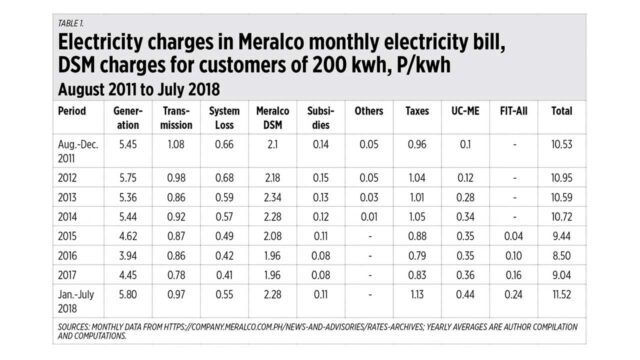
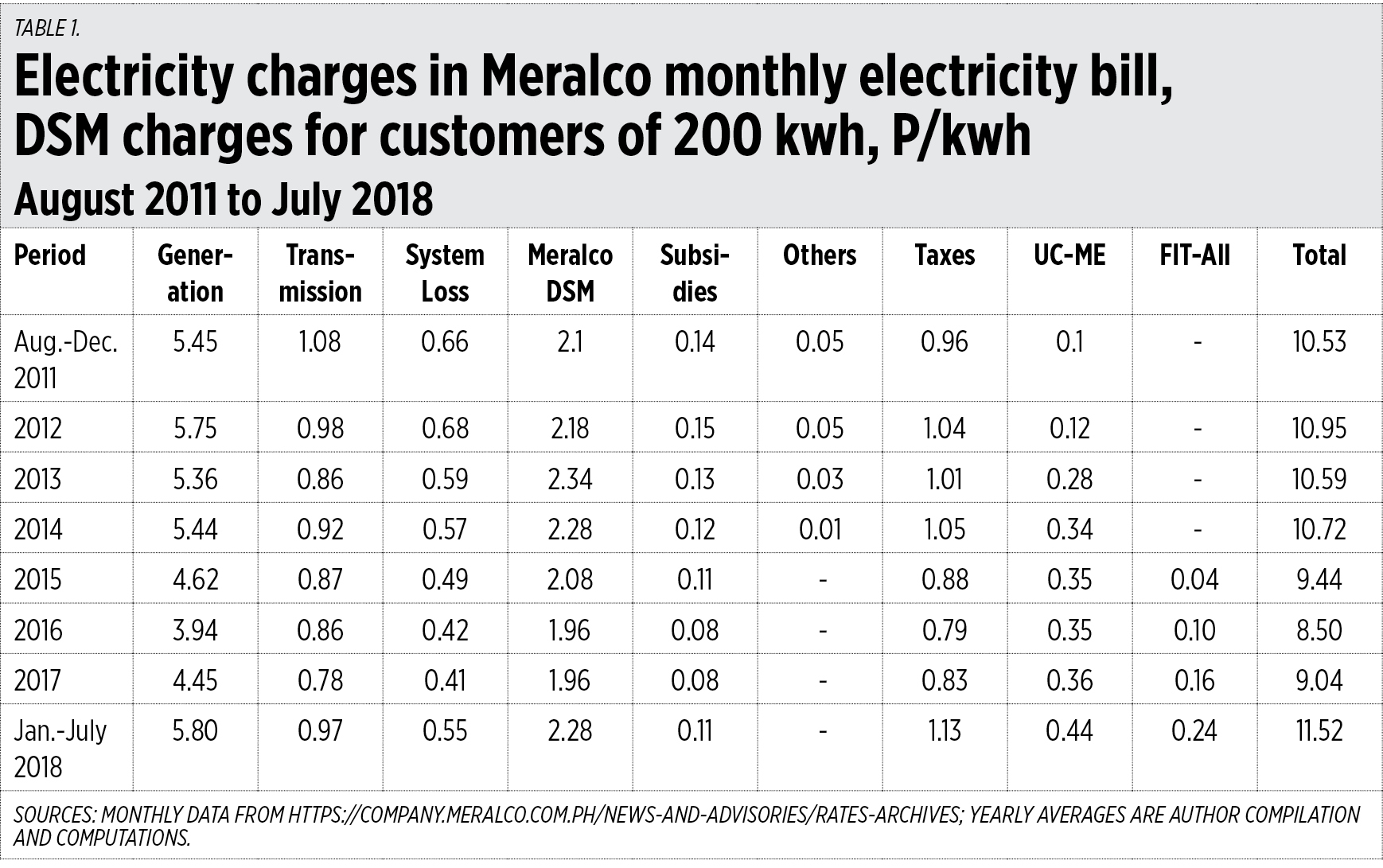
Below is a disaggregation of the total charges from August 2011 to July 2018. I chose this period because this is the time that Mr. Non was ERC Commissioner and he had oversight function for Universal Charge in Missionary Electrification (UC-ME) and Feed-in Tariff Allowance (FIT-All). UC-ME is a subsidy to customers of off-grid islands and provinces while FIT-All is subsidy to renewable energy (RE) companies that provide intermittent power like solar and wind under the RE law of 2008 (RA 9513).

It turns out that generally there are flat rates for generation, transmission, and distribution-supply-metering (DSM) charges. Even for system loss, subsidies to lifeline rate customers, and taxes were generally flat.

What significantly increased were UC-ME, from only 10 centavos in 2011 to 44 centavos in 2018; and FIT-All, from 4 centavos in 2015 to 24 centavos in 2018 (Table 1).

Seven years ago, I wrote in this column, “Expensive electricity via Feed-in-tariff: which company received how much?” (July 6, 2016). I showed that there were millions and billions received by many RE companies. Then I wrote to Transco asking if my estimates were correct, they replied and I wrote about it, “Transco replies to queries about feed-in tariffs” (July 20, 2016).

So, I revised my computations based on Transco’s reply and it showed that of the P10 billion that RE companies received from FIT in 2015, the bulk went to EDC Burgos Wind (Lopez) P2.36 billion, Northern Luzon UPC wind (Ayala) P1.73 billion, Trans Asia Renewable Guimaras wind (Phinma) P0.66 billion, and Alternergy Pililla wind P0.46 billion.

The beneficiaries of “expensive subsidized wind-solar to save the planet” are not really small poor companies, and that data was for 2015 alone.

I recognize that Mr. Non has a point in limiting Meralco revenues to only distribution revenues and not gross revenues that include collections for generation and transmission charges, among others.

But while Mr. Non seems obsessed with Meralco when it comes to performance based regulation-related pricing, he seems silent on performance based regulation for the only remaining private monopoly nationwide — the National Grid Corp. of the Philippines (NGCP) — other distributors like private distribution utilities (DUs) and electric cooperatives (ECs), and generation companies (gencos) that do not know how to honor their supply contracts with Meralco.

On this, please notice these recent reports in BusinessWorld: “NGCP warns of power interruptions” (March 28), “ERC announces caps for grid market share, generating capacity” (April 3), “Meralco gains de-loading capacity” (April 4), “CA upholds ruling favoring San Miguel units” (April 5), “ERC, NEDA discuss ‘affordability index’ for power” (April 5), and, “Regulator to act on NGCP’s AS appeal this month” (April 16).

We are still being warned about power interruptions, even today, 33 years since the big blackouts started in 1990. Meralco has to enlist the support of big companies to turn on their fossil fuel-using generator sets to run in cases of high demand and low power supply. Two San Miguel gencos dishonored their supply contracts with Meralco, plus two more gencos are terminating their separate supply contracts.

Writers and columnists from other newspapers also pound on “non-affordable electricity” and the proposed electricity affordability index by the National Economic and Development Authority (NEDA) and ERC. Power security should trump power affordability because “cheap but not available” power — blackouts — is anti-consumers. The main reason why prices are high is because supply is tight and low relative to demand. Technically, P10-P15/kwh electricity is still cheaper and safer compared to using candles or gensets during blackouts.

Consider these two quotes from two articles here in BusinessWorld, nine years apart:

“… ensuring that the systems operator National Grid Corporation of the Philippines (NGCP) fully contracts what the system requires. The establishment of a reserve market has been long delayed.” — Romeo Bernardo, “The way forward for the power industry” (Jan. 26, 2014).

“… hundreds of MW of available capacity that remain stranded in various parts of the country as there are no transmission and/or distribution lines to bring them to the cities and the industries that need it badly.” — Romeo Bernardo, “Summer Cycles” (April 16, 2023).

So, this would be a challenge for Mr. Non and other electricity consumer advocates. Target them all for accountability — all or most DUs, ECs, gencos, FIT-entitled RE companies, and the NGCP. The NGCP, in particular, still fails to contract adequate and long-term reserves. I heard it even requires some gencos to advance the cost and effort to connect to the grid, and fails to complete its planned infrastructure on time. The Mindanao-Visayas Interconnection Project (MVIP) was originally set for completion in December 2020, this was moved to 2021, 2022, and hopefully it will be really operational by June 2023.

Many gencos were investigated in the past for supposed “withholding of capacity” and now gencos that blatantly dishonor supply contracts and withhold contracted capacity and somehow escape investigation. And there are provincial ECs that charge their hapless consumers up to P18-P23/kwh.

Finally, on “energy transition” from fossil fuels to renewables, especially solar and wind (S+W). I construct this table (Table 2) covering only three countries due to space constraints. I also introduce the concept of Coal/(S+W) ratio or CSWR to measure the dominance or non-dominance of coal over the two favored RE. The figures show the following:

In UK, there is no energy transition, only energy distortion where, as more S+W is added into the grid, the overall power generation declines. The CSWR has been low even since 2010.

In China and Vietnam, there is also no energy transition, only RE addition to rising coal and other non-RE power. The result is rising overall power generation and CSWR is high, especially in Vietnam.

While the UK and many European countries that embrace energy transition have very low anemic growth, China and Vietnam have very fast growth, which allows them to provide more jobs and businesses to their people.

So, government- and UN-directed “energy transition” is a deeply fictional and hypothetical narrative — it is not happening and will not happen.

The ones who should set any energy mix, any energy transition, should be the consumers. Not governments, not the UN, not environment and climate groups, not media, not climate consultants.


Bienvenido S. Oplas, Jr. is the president of Bienvenido S. Oplas, Jr. Research Consultancy Services, and Minimal Government Thinkers.

minimalgovernment@gmail.com

In an age of catastrophe is there still a place for utopian dreams? Or might our shared vulnerability be the key?

JAVARDH-UNSPLASH

As utopian oases dry up, a desert of banality, and bewilderment spreads …
— Jürgen Habermas (1986)

THE LAST FEW YEARS have been truly catastrophic. One might easily argue that, during “The COVID Years,” we have witnessed more dramatic social and political change than at any time since 1939-1945. In terms of its scale and duration, we should call this pandemic a catastrophe rather than merely a disaster in terms of the loss of life and more mundane issues such as the reorganization of work and city life.

We have also grappled with the Russian invasion of Ukraine, the increasing possibility of nuclear catastrophe, the spread of monkey-pox, food shortages in Africa, a drought across much of Europe, a potential Chinese invasion of Taiwan, North Korean missile tests, rising authoritarianism in eastern Europe, the threat of civil unrest in the United States, and the terrible earthquake in Turkey and associated crisis in Syria. This has been a cascade of catastrophes.

If we believe we are “all doomed” (to quote a signature line from the TV series Dad’s Army) what should one do? Do any credible utopian dreams paint an optimistic future? Or is the prospect of human happiness ruled out by the scale of our contemporary problems?

A response to this challenge is to consider the various attempts to defend hope and optimism in the face of previous catastrophes, and pessimistic prescriptions. One modest way forward is the pursuit of intergenerational justice with respect to climate change. What steps might we take to protect or to improve the prospects of future generations?

In many respects, contemporary analysis of catastrophe and utopian hope continues to return to the legacy of Thomas More (1478-1535), whose book Utopia, first published in 1516, has enjoyed a remarkable longevity. In Utopia, More envisioned a society without private property or a propertied class. The population would enjoy the benefits of a welfare state, living a sober and simple lifestyle. They would loathe fighting and any form of violence, hence the death penalty would be banished.

Utopia is often thought to have been a socialist response (before the advent of socialism), to the difficulties of the age in which More lived. But More was a devout Catholic statesman — in 1886 he was beatified by Pope Leo XIII. Utopia reflected the place of monasticism in the Catholic tradition.

Indeed, socialist and Christian utopias have often historically been intertwined. This convergence is important — any contemporary utopian vision might also draw on a Christian belief in a world to come and a socialist vision of a land of plenty, shared by all.

While More’s perfect society was a fiction, there have been many attempts to create actual utopian societies. The Oneida Community, a religious perfectionist commune founded by preacher, philosopher, and radical socialist John Humphrey Noyes in New York state, survived from 1848 to 1881. It folded due to conflicts over power, wealth, and sexuality.

More recent utopian societies developed in Southern California in the 1950s and 1960s as hippie communes promoting pacifism and alternative lifestyles involving experiments with drugs and sex. Another example is the Israeli kibbutz movement, which emerged with socialist Zionism in the early 20th century.

In the realm of fiction, many believe that if a utopian tradition continues at all today, it is confined to science fiction. Feminist authors have opted for dystopian visions, famously in Margaret Atwood’s The Handmaid’s Tale (1985) and less so, in Octavia Butler’s 1993 novel The Parable of the Sower. The latter depicts 21st century California in a state of collapse; the streets are militarized and the rich live behind walls. This apocalyptic vision is intended to act as a call to communal action though whether it does so is questionable.

Still, the key issue for much contemporary thinking about utopia is the failures of socialism and the survival of capitalism in its various forms. Indeed, many radical sociologists, such as Zygmunt Bauman, have concluded we live in post-utopian times.

If utopia is no more, are we left only with melancholy in the face of so many modern catastrophes? If discussing melancholy, we must also consider nostalgia. These emotional dispositions — nostalgia, melancholy, pessimism — are hardly new. For instance, Robert Burton’s The Anatomy of Melancholy (first published in 1621) went through many reprints. He rejected what he called unlawful remedies, relying ultimately on “our prayer and physic both together.”

Debate about melancholy was also a basic aspect of psychology in the earlier, Tudor period. Timothe Bright’s A Treatise of Melancholie in 1586 provided the basis for Shakespeare’s Hamlet, whose inability to take decisive action was treated as a key indicator of melancholy.

Such historical details remind us that disease categories tell us a lot about social and political conditions. In the history of medical thought, for instance, melancholy was once seen to be the specific companion of intellectuals and monks, who suffered from isolation, contemplation, and inactivity.

Modern day thinkers, in particular, may suffer from what Antonio Gramsci called “pessimism of the intellect, optimism of the will.” He meant often rational reflection on our problems leads to pessimism, but we need to counter that by action. Getting involved is more likely to result in a renewed optimism and confidence about the future.

Germany has a well-established vocabulary for unhappiness and melancholy. The word weltschmerz means “world weariness” or “world pain.” The idea that the world, as it is, cannot satisfy the needs of the mind, became part of the regular currency of romanticism. Philosopher Friedrich Nietzsche promoted nihilism as response to the meaninglessness of existence. Sigmund Freud saw human evil as unavoidable and ubiquitous, rooted in the basic instincts of our nature.

German sociologist Wolf Lepenies, in his 1992 book Melancholy and Society, traces the origins of weltschmerz to the peculiar status of the bourgeois class, who were permanently excluded from entry into the world of the prestigious elite. However, the driving force in Germany after both world wars was the sense of suffering and loss from warfare with no tangible or beneficial outcome.

Another German sociologist, Max Weber, is a major figure in understanding German pessimism. In 1898, Weber suffered from severe neurasthenia due to years of overwork. The condition forced him to withdraw from teaching in 1900. In the two years between the end of the first world war and the Treaty of Versailles, Weber had time to write some of his most provocative reflections on the fate that had befallen Germany. “Not a summer’s bloom lies ahead of us,” he wrote, “but rather a polar night of icy darkness and hardness.”

German social theorist Jürgen Habermas has argued utopian traditions, which imaginatively open up new alternatives for action, are now more or less exhausted. While Habermas has a basically secular view of history, many modern philosophers have turned to religion to extract some hope for the future.

Contemporary secular philosophers such as Alain Badiou have been struck by Paul the Apostle’s proclamation of universalism in the Bible: “there is neither Jew or Greek, slave nor free, male nor female” but all are gathered together in Jesus Christ. Paul’s universal gospel had world-changing consequences.

What Badiou calls “truth-events” are major disruptions to our lives out of which we emerge as different beings. Out of these disruptions, he argues, there are grounds for hope. Hope, he concludes, “pertains to endurance, to perseverance, to patience […]” — qualities that characterized Paul’s personality in the face of many trials and tribulations.

In the west, these two utopian traditions — the Judeo-Christian and the secular socialist-Marxist — have in fact merged. Both traditions have equated the coming of a new order with the overthrowing of powerful rulers and the uprising of the poor, the needy, and the oppressed.

The crucifixion of Christ was interpreted by Paul in the New Testament as the overthrow of the military and political might of the Roman Empire. For Marx, the class struggle would overthrow the power and privilege of the capitalist class, ushering in an age of equality and justice. But are these utopian traditions exhausted?

Marx had a utopian picture of large-scale change, indeed the emergence of new societies. Unfortunately, the revolutionary movements of recent history — from the Russian Revolution of 1917, to the Iranian Revolution in 1979, and the Arab Spring(s) of 2011-2019 — did not have the lasting or desired outcomes of the young protesters. (These apparent failures contrast with more lasting outcomes from radical movements in South America, for instance.) Widespread protest movements in modern day Iran suggest hope for social and political change has not been extinguished. Similarly, Israel has recently been swamped by protest movements in support of democratic institutions.

Sociologist Ulrich Beck argues that even the worst catastrophes, such as the Tohoku earthquake and tsunami in Japan in 2011, can have emancipatory consequences. Destroyed communities can still experience collective hope and regeneration. Towns are rebuilt and communities pull together.

Significant beneficial changes to society do not have to be on a large scale or involve political revolutions. We may, for instance, be able to manage further global pandemics by improvements in vaccination and advanced planning. Scientific organizations, such as the Coalition for Epidemic Preparedness and Innovation, have been established to be better prepared to confront the next pandemic. The future spread of new, zoonotic diseases can also be addressed, just as medical science has contained the spread of polio, especially in Africa.

There are modest changes we can make that might limit the effects of climate change and environmental degradation: such as weaning ourselves off petrol-driven engines in favor of electric cars and bicycles.

Of course, activists in green politics with a radical agenda will probably dismiss such “remedies” as pathetic and pointless. In response, we might say that large scale solutions in the climate-change agenda, such as the end of dependence on fossil fuels, show no sign of being enthusiastically embraced by most western governments.

Perhaps we need a compelling moral argument to engage “ordinary” citizens in green thinking. Pragmatic responses are reasonable, but they fail to address the compelling ethical issue that confronts those who have survived the catastrophes of recent history, namely the issue of inter-generational justice.

It is here that the question of climate change gains in urgency. Acting on climate change now can have no benefit for me, because the consequences of taking action may have no positive effect until after I am dead. So why take action?

One line of argument was developed by Amartya Sen in The Idea of Justice. He refers to the Buddha’s teaching that we have a responsibility towards animals precisely because of the asymmetry of power. The Buddha illustrated his argument by referring to the relationship between mother and child. The mother can do things to influence the child’s life the child cannot do for itself.

The mother receives no tangible reward, but she can, in an asymmetrical relationship, undertake actions that can make a significant difference to the child’s wellbeing and future happiness. Acting now on climate change can reasonably be expected to enhance the benefits of future generations to come, so it is reasonable to do so. Such actions can be seen to be “justice enhancing” in Sen’s terms.

If the utopian dreams of yesteryear, from More to Marx, are exhausted and the generation that fueled the communal experiments of the 1960s is now in retirement, then Sen’s idea of justice may be better suited to our times.

The decline of natural resources and the accumulation of waste are problems that affect everybody regardless of their wealth and status. What is required, however, is a deeper and more compelling notion of what it is to be human.

The idea of the “dignity of the human being” that underpins human rights is not necessarily adequate, because of its obvious cultural baggage. An alternative is to consider the vulnerability of human beings, namely that in the long run, we are all condemned to ageing, disease, and death. That is our lot as humans, which we all share.

Climate change perfectly illustrates the shared vulnerability of all human beings and the need for common action to secure a future, not for us, but for our children.

THE CONVERSATION VIA REUTERS CONNECT


Bryan Stanley Turner is a professor of Sociology at the Australian Catholic University. His book A Theory of Catastrophe is published by De Gruyter Contemporary Social Sciences.

At China’s largest trade fair, Exporters worry about world economy

Staff members work at a booth for lighting products at the China Import and Export Fair, also known as Canton Fair, in Guangzhou, Guangdong province, China April 15, 2023. — REUTERS/ELLEN ZHANG

GUANGZHOU — Chinese exporters exhibiting their products at the country’s largest trade fair said the weak global economy was hurting their businesses, with many freezing investments and some cutting labor costs in response.

The subdued mood at the Canton Fair in the southern city of Guangzhou suggests China’s unexpected jump in exports in March may have reflected exporters catching up with orders delayed last year by COVID curbs rather than renewed economic strength.

The first major trade event since China abruptly dropped COVID restrictions and re-opened its borders comes as sharply higher borrowing costs in the United States and Europe hit demand for Chinese-made goods.

Kris Lin, a representative from Christmas light producer Taizhou Hangjie Lamps, said this year’s orders so far are down 30% from last year.

“The difficulties last year came from logistics and production disruptions, but the local government helped solve the problems. That’s an internal issue. Now we have external problems. We can’t solve those,” Mr. Lin said.

“This year will be the hardest for us,” he said, with higher electricity costs caused by the war in Ukraine reducing demand for his decorations even further.

Mr. Lin said the company cannot afford to sell at lower prices, but it may look to reduce labor costs. The firm relies on contract workers who get released in September to October after the delivery of Christmas orders.

“If orders are weak this year, I will set my workers free earlier.”

Huang Qinqin, sales director at Zhong Shan Shi Limaton Electronics, a producer of exhaust fans, has similar thoughts on cutting costs after orders halved in the first quarter. “In our factory, workers come to work when there are orders,” Ms. Huang said. This used to mean working overtime even on weekends, but it is more common this year for workers to take weekends off, she said.

A producer of shaving devices from the eastern city of Ningbo, who asked to remain anonymous to unveil future plans, said the firm had already laid off workers and will lower prices in coming months if orders don’t improve.

The worsening outlook for workers in the manufacturing industries will raise concerns among policymakers, who target 12 million new jobs across China this year, up from last year’s goal of 11 million.

Dozens of Chinese suppliers told Reuters they did not intend to spend much on improving production lines this year given the weak demand.

“We have no plan to increase investment,” said Luna Hou, sales representative at Topgrill, which makes outdoor grills and has cut prices by 5% to lure buyers.

Vicky Chen, foreign trade manager at socket producer Qinjia Electric, said she did not expect a big sales boost at the fair, which runs until May 5.

“The whole global economy is faring poorly at the moment, and the fair won’t change that.” — Reuters