Home Blog Page 4965

Police chief warns Interior secretary of dubious intel on drug bust cover-up

PNP FACEBOOK PAGE

NATIONAL police chief General Rodolfo S. Azurin on Monday cautioned Interior Secretary Benjamin C. Abalos, Jr. against sources who could be giving him wrong information about allegations of high-ranking cops linked to the illegal drug trade.  

“I now appeal to our secretary of the interior and local government, let us focus on our real enemy,” the police chief told a livestreamed news briefing.   

“Take a second look on the people who may be feeding him misinformation to cast doubt on the integrity of the Philippine National Police (PNP), which is also under his authority.”  

He said high-ranking officers recently linked to an alleged attempt to cover up their involvement in a buy-bust operation that yielded 990 kilograms of crystal meth, locally known as shabu, should be allowed to defend themselves in court. 

Last week, Mr. Abalos said police officials attempted to conceal the arrest of Sergent Rodolfo B. Mayo, Jr., a former intelligence officer of the PNP-Drug Enforcement Group, who was dismissed on March 21 after police found that the shabu was kept at a lending firm he owned.  

Mr. Azurin denied the allegations of a cover-up, saying there is no evidence to support the claim.  

“He (Mr. Abalos) just needs to trust the PNP because I know that I would not abuse the trust given to me,” the police chief said. “Everything, especially our work on illegal drugs should be based on trust.”  

Senator Ramon “Bong” B. Revilla last week filed a resolution to conduct a probe on PNP officers and the alleged attempt to cover up their involvement in the drug operation last year that yielded drugs worth P6.7 billion. 

“While I join the good secretary of interior and local government in the fight against erring personnel in the police force, let us focus on the real enemy here, which is the shabu and the drug syndicates,” Mr. Azurin said. “We really need to observe due process.” John Victor D. Ordoñez

Ex-jail chief urged to surrender

Former Bureau of Corrections chief Gerald Q. Bantag gives a thumbs up sign to the media after attending the preliminary investigation on the murder of broadcast journalist Percy Lapid on December 5, 2022 at the Department of Justice in Manila. — PHILIPPINE STAR/KRIZ JOHN ROSALES

NATIONAL police chief Rodolfo S. Azurin, Jr. on Monday urged former Bureau of Corrections director Gerald Q. Bantag to surrender to authorities after a Muntinlupa court ordered his arrest over the murder of a broadcaster.  

“To make it easier for everyone, why dont you just surrender?” the police chief told a livestreamed news briefing.  

He said Mr. Bantag is considered a fugitive and the police is on a manhunt for him and his deputy, who is also subject to an arrest warrant over the murder of radio broadcaster Percival C. Mabasa. 

The former prison chief had denied his involvement in the murder, saying he had nothing to gain from it.  

Last month, government prosecutors indicted the ex-prison chief, his deputy, the self-confessed gunman and a former inmate of the national penitentiary after they found probable cause to charge them with the murder.    

Mr. Azurin said the Philippine National Police is ready to provide security to Mr. Bantag if he is concerned about his safety. 

Two gunmen on a motorcycle killed the 63-year-old broadcaster on his way home in Las Piñas City on the evening of Oct. 3 last year.   

The late broadcasters YouTube channel, which had more than 200,000 subscribers, showed that he had been critical of former President Rodrigo R. Duterte and some sitting officials. John Victor D. Ordoñez

Congress urged to pass measures on food security to achieve SDGs

PHILIPPINE STAR/MIGUEL DE GUZMAN

CONGRESS must pass laws that will address food security to help the Philippines meet its commitment to the United Nations Sustainable Development Goals (SDGs) as the country lags the most in the zero hunger target, an official from the National Economic and Development Authority (NEDA) told the Senate on Monday.  

The country is lagging behind the most in food security, most especially in meeting the 100% recommended energy intake of the Filipinos,Reverie Pure G. Sapaen, head of secretariat of the Development Budget Coordination Committees SDG subcommittee under NEDA. 

Ms. Sapaen, speaking before the Senate Committee on Sustainable Development Goals, Innovation and Futures Thinking, urged Congress to pass the urban agriculture law, which aims to promote vertical farming and urban agriculture as an instrument to contribute to attaining food security. 

She also called for the passage of a measure that will ban unhealthy food in schools to prevent obesity among children as well as amendments to Republic Act No. 8976 or the Food Fortification Law to enhance support for the local salt industry. 

NEDA also called on lawmakers to amend Presidential Decree No. 1569 or strengthening the Barangay Nutrition Scholars, and to expand local nutrition offices.  

Ms. Sapaen said the Philippines is also regressing in SDGs on gender equality, affordable and clean energy, decent work and economic growth, industry, innovation and infrastructure, reduced inequalities, sustainable cities and communities, and climate action.  

We really need to work more purposively and proactively towards achieving our SDG commitments,Ms. Sapaen said.  

She said that the Philippines is the top country for SDG 12 or responsible production and consumption, citing the UN Asia and the Pacific SDG progress report for 2023.  

The SDGs comprise of 17 goals and targets adopted by the UNs member countries in 2015 to eradicate poverty and hunger, protect the environment, and ensure equality. Beatriz Marie D. Cruz 

4 wounded in Sultan Kudarat bus bombing 

FOUR passengers were hurt when a home-made bomb exploded inside a double-decker unit owned by Husky Bus Company in Isulan, Sultan Kudarat at about noontime Friday, the police reported on Monday.   

Police Region 12 Director Jimili L. Macaraeg said the victims sustained shrapnel wounds in different parts of their bodies. 

They were identified as Hamsa Alilaya, 60; Norodin Ibrahim, 63; Norfatima Makaanta, 25; and Edgar Cochoco, 75.  

The improvised explosive device used in the attack was reportedly placed inside the bus, detonated from a distance using a mobile phone while the vehicle was parked at a terminal. 

Local executives, Philippine Army and police intelligence officials are convinced either the Dawlah Islamiya or the Bangsamoro Islamic Freedom Fighters could be responsible for the bombing.  

Both groups have previously been involved in bombing public transportation and commercial establishments whose owners refuse to shell out “protection money” on a monthly basis. John M. Unson

Shares rise as market eyes Fed, BSP decisions

BW FILE PHOTO

LOCAL SHARES climbed on Monday on the back of a pickup in buying as investors await more data and hints on the US Federal Reserve’s and Bangko Sentral ng Pilipinas’ (BSP) next moves and amid a shortened trading week.

The benchmark Philippine Stock Exchange index (PSEi) rose by 23.71 points or 0.36% to close at 6,505.62 on Monday, while the broader all shares index went up by 8.77 points or 0.25% to end at 3,489.54.

“Philippine shares started the shortened trading week in the green with a new batch of economic data likely to dictate market sentiment. The key economic data release stateside is the Philadelphia Fed manufacturing index on Thursday… [and] a relatively quiet week ahead here at home with the February cash remittances,” Regina Capital Development Corp. Head of Sales Luis A. Limlingan said in a Viber message.

Philippine financial markets will be closed on April 21 due to a nonworking day for Eid al-Fitr.

Money sent home by overseas Filipino workers rose by 2.4% year on year to $2.57 billion in February, data released by the BSP on Monday showed.

This was lower than the $2.762 billion seen in January.

The value of cash remittances was also the lowest in nine months or since the $2.42 billion in May 2022.

For the first two months of the year, cash remittances grew by 3% year on year to $5.331 billion.

The BSP expects remittances to grow by 3% this year.

“We are slowly seeing investors buying this market as the index closed a little above 6,500. Investors are still awaiting the Fed’s decision whether they will pause or continue its rate hike,” Mercantile Securities Corp. Head Trader Jeff Radley C. See said in a Viber message.

“With the recent announcement of the CPI (consumer price index) locally and abroad, there are signs that the inflation is already topping out and may continue to slowly go down. The BSP signaled that they might pause on their rate hike,” Mr. See added.

The Fed will hold its next policy meeting on May 2-3, while the BSP will have its own review on May 18.

Most sectoral indices climbed on Monday except for financials, which declined by 15.01 points or 0.82% to 1,795.24, and mining and oil, which fell by 39.89 points or 0.35% to 11,072.03.

Meanwhile, holding firms went up by 57.82 points or 0.91% to 6,358.29; industrials increased by 67.15 points or 0.72% to 9,319.86; property climbed by 11.32 points or 0.41% to 2,727.60; and services rose by 3.23 points or 0.2% to 1,607.65.

Value turnover went down to P4.39 billion on Monday with 1.07 billion shares changing hands from the P4.62 billion with 981.38 million issues traded on Friday.

Decliners outnumbered advancers, 98 versus 82, while 61 names closed unchanged.

Net foreign selling stood at P59.57 million on Monday versus the net buying worth P286.76 million seen on Friday. — A.H. Halili

Peso sinks to 3-month low on hawkish Fed comments

BW FILE PHOTO

THE PESO weakened to an over three-month low against the dollar on Monday following hawkish comments from a US Federal Reserve official.

The local currency closed at P55.85 versus the dollar on Monday, declining by 64 centavos from Friday’s P55.21 finish, data from the Bankers Association of the Philippines’ website showed.

This was the peso’s worst close in more than three months or since its P55.91 finish on Jan. 4.

The peso traded weaker than its Friday close the entire day, opening Monday’s session at P55.35 per dollar, which was already its intraday best. Its worst showing was at P55.87 versus the greenback.

Dollars traded inched down to $1.375 billion on Monday from the $1.39 billion recorded on Friday.

“The peso weakened significantly amid hawkish policy remarks from Fed official Waller about the need to tighten monetary policy toward its inflation target,” a trader said in an e-mail.

Despite a year of aggressive rate increases US central bankers “haven’t made much progress” in returning inflation to their 2% target and need to move interest rates higher still, Federal Reserve Governor Christopher J. Waller said on Friday, Reuters reported.

Important measures of underlying inflation have “basically moved sideways with no apparent downward movement,” Mr. Waller said in remarks that continue the Fed’s steady discounting of the immediate economic risks posed by recent bank failures.

Though Mr. Waller said it remains unclear whether bank stress would lead to an unexpected tightening of lending and credit and slow the economy more than needed, the apparent stability in financial markets showed the Fed was right to raise rates at its last meeting and keep the focus of monetary policy on fighting inflation.

“Monetary policy needs to be tightened further. How much further will depend on incoming data on inflation, the real economy, and the extent of tightening credit conditions,” Mr. Waller said in remarks prepared for delivery at the Graybar National Training Conference in San Antonio, Texas.

The Fed’s next policy meeting is on May 2-3.

The US central bank has hiked borrowing costs by a total of 475 basis points since March 2022, with the fed funds rate now at a between 4.75% and 5%.

The peso also declined as the dollar hit a one-month high against the yen on Monday, Rizal Commercial Banking Corp. Chief Economist Michael L. Ricafort said in a Viber message.

The dollar climbed to a one-month high against Japan’s yen on Monday as traders eyed up another interest rate hike from the Federal Reserve, while the Bank of Japan stuck to its easy money policies.

The dollar rose to 134.22 yen earlier in the session, the highest level since March 15. It was last up 0.12% at 133.9.

Meanwhile, the dollar index — which measures the currency against six major peers — was little changed at 101.64. It touched a one-year low of 100.78 on Friday before rebounding somewhat.

For Tuesday, the trader said the peso could rebound on a potentially upbeat Chinese gross domestic product report, “which might spur optimistic views on global growth prospects.”

The trader sees the peso moving between P55.70 and P55.95 against the dollar on Tuesday, while Mr. Ricafort sees it trading from P55.75 to P55.95. — A.M.C. Sy with Reuters

No need for legislation to effect LANDBANK, DBP merger — GCG

THE Governance Commission for GOCCs (GCG) said that the merger of the Land Bank of the Philippines (LANDBANK) and the Development Bank of the Philippines (DBP) does not require legislative intervention.

The GCG, which oversees government-owned and -controlled corporations (GOCCs), said it conducted a study on the issues raised by the merger, and found that the banks can be combined even though they both received their charters from Congress.

“The study aims to resolve the legal issues raised by the DBP Chairman and the Secretary of Finance in a sectoral meeting held at the Office of the President,” the GCG said in a statement on Monday.

In March, President Ferdinand R. Marcos, Jr. gave the go signal for the merger of the state-run banks. The merger is expected to be completed by the end of the year.

The GCG said that concerns were raised by the DBP that “both banks were statutorily created and must therefore be merged through legislation.”

“In order to resolve the issue, GCG sought answers through the provisions of statutes and applicable jurisprudence on the matter,” GCG Chairman Alex L. Quiroz said.

The study concluded that the President can go ahead with a merger “without waiting for Congress to file and pass related bills.”

It also found that the GCG has adequate authority to merge GOCCs.

“The GCG has the power to ascertain the manner of the merger — either de jure merger or de facto merger,” Mr. Quiroz added. — Luisa Maria Jacinta C. Jocson

LNG prices seen hindering growth in use of gas in Asia

ENERGY.AGPGLOBAL.COM

VOLATILE PRICES of liquefied natural gas (LNG) will hold back demand in Asia in the next few years, with new supply coming onto the market by 2025, the Institute for Energy Economics and Financial Analysis (IEEFA) said on Monday.

“Emerging Asian economies are widely forecasted to be the largest growth market for LNG demand globally over the next several decades. However, IEEFA expects that tight global markets and elevated prices may continue to restrain Asia’s LNG demand growth,” IEEFA said.

The Philippines is transitioning to gas imports with the depletion of the Malampaya field. Various companies are building LNG receiving terminals to service the import market.

San Miguel Global Power Holdings Corp. is expecting an LNG shipment to arrive this month. Its supplier, Vitol Asia Pte. Ltd., said it is on track to deliver the Philippines’ first LNG cargo.

“We are pleased and excited to have worked closely with our partner San Miguel Global Power on this historic and first LNG cargo into the Philippines,” Vitol Asia said on its website.

To date, seven LNG terminal projects have been approved by the Department of Energy, two of which are expected to come online in the first half of 2023.

The LNG terminals of First Gen Corp. and Linseed Field Power Corp., a unit of Atlantic Gulf & Pacific Co., are expected to become operational this year.

In the first quarter, IEEFA said that LNG demand is declining despite a downturn in global prices for the fuel.

Jephraim C. Manansala, chief data scientist at the Institute for Climate and Sustainable Cities, said that while Asian LNG spot prices are currently at their lowest in 21 months, they remain much higher than pre-pandemic levels of around $3 per million British thermal units (mmBtu).

LNG prices have now declined to $12.50 per mmBtu from a peak of $70.50 in August, Reuters reported.

“This highlights the high costs and inherent volatility of LNG prices in the global market, which may have implications for the Philippines’ electricity prices and economic sustainability,” Mr. Manansala said.

He said dependence on imports leaves the Philippines vulnerable to price fluctuations and external forces.

“We have not felt the impact of spiking LNG prices yet since the first LNG terminals are still to be commissioned this year, but the volatility of LNG prices remains a concern,” Mr. Manansala added. — Ashley Erika O. Jose

Budget release rate hits 81.9% at end of March

BW FILE PHOTO

THE Department of Budget and Management (DBM) said it had released P4.31 trillion or 81.9% of the 2023 national budget at the end of March.

Some P954.4 billion of the P5.268-trillion budget for this year remains undistributed, according to the DBM Status of Allotment Releases report.

The pace of releases was ahead of the 69.4% rate at the end of March 2022.

Releases to government agencies and departments amounted to P2.95 trillion, for a utilization rate of 93.8%.

Special Purpose funds released totaled P147 billion or 28.6% of the budgeted funds for the year.

Releases for Automatic Appropriations stood at P1.07 trillion, or 66.4% of the total.

These include the P240.76 million for retirement and life insurance premiums of various National Government agencies and P10 billion for the Rice Competitiveness Enhancement Fund. — Luisa Maria Jacinta C. Jocson

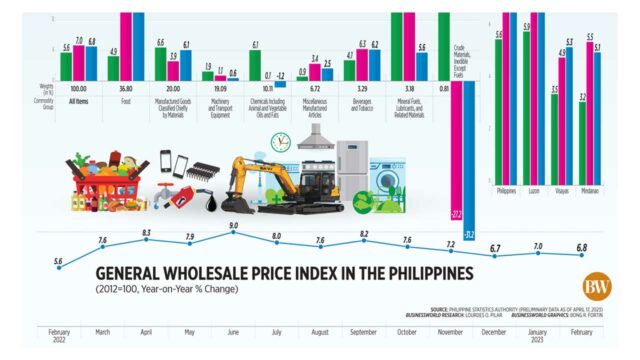
General Wholesale Price Index in the Philippines

WHOLESALE PRICE growth slowed to 6.8% in February, the Philippine Statistics Authority (PSA) reported on Monday, with the central bank’s monetary tightening starting to take effect to contain inflation, analysts said. Read the full story.

General Wholesale Price Index in the Philippines

Wholesale price growth eases in Feb. as inflation slows

PHILIPPINE STAR/ MICHAEL VARCAS

WHOLESALE PRICE growth slowed to 6.8% in February, the Philippine Statistics Authority (PSA) reported on Monday, with the central bank’s monetary tightening starting to take effect to contain inflation, analysts said.

Preliminary data from the PSA indicated that the general wholesale price index (GWPI) rose by the lowest rate in two months or since the 6.7% posted in December.

The February reading was below the 7% reported in January but higher than the year-earlier 5.6%.

General Wholesale Price Index in the Philippines

In the year to date, the GWPI averaged 6.9%, well up on the 5.1% posted a year earlier.

In an e-mail, ING Bank N.V. Manila Senior Economist Nicholas Antonio T. Mapa said rate hikes by the Bangko Sentral ng Pilipinas (BSP) to counter inflation probably “sapped” demand, which led to slower price growth in February.

Prices of mineral fuels, lubricants and related materials contributed to the GWPI slowdown, rising 5.6% in February from the 14.2% reported in January.

“Moderating global energy prices may be surfacing onshore, leading to the dip to 5.6%,” he added.

Among the eight commodities in the index, six posted slower growth. Price growth in crude materials, inedible except fuels slowed to -31.2% in February from -27.2% in January, as did that of chemicals including animal and vegetable oils and fats (-1.2% from 0.1%).

Manufactured goods classified chiefly by materials posted 6.1% price growth in February from 3.9% in January.

In a Viber message, Asian Institute of Management Economist John Paolo R. Rivera said that the slowdown in the GWPI reflects the delayed impact of monetary tightening by the BSP.

“We are now seeing the expected effects of policy adjustments. It may have taken time due to sticky prices and slow adjustments of economic agents or market players,” he said.

Among the major island groups, wholesale price growth in Luzon and Mindanao slowed to 7% in February from 7.2% in January, and to 5.1% from 5.5%, respectively.

Price growth in the Visayas came in at 5.3% in February from 4.9% a month earlier. This was the highest reading since the 5.6% posted in December.

In Luzon, six commodities also posted slower price growth led by mineral fuels, lubricants and related materials, which came in at 5.4% from 14.8% the previous month.

Price growth slowed for one commodity in the Visayas (mineral fuels, lubricants and related materials at 5.1% in February from 8.6% in January), while two commodities posted slower growth in Mindanao (Food at 8.8% from 10.3%, and chemicals including animal and vegetable oils and fats at 0.4% from 0.5%).

Inflation fell to 7.6% in March from 8.6% in February. This was the lowest reading since the 6.9% posted in September.

Core inflation remained high at 8%, the highest level since the 8.2% posted in December 2000.

Analysts said the market has still not resolved the issues that are keeping prices high.

“The problems in supply chain and production (are) still persistent. These have to be addressed because monetary tightening can only do so much and may harm the economy in the long run,” Mr. Rivera said.

“We can see a downward trajectory for prices although we believe inflation should remain sticky and return to BSP’s target only by the end of the year,” ING Bank’s Mr. Mapa said. — Bernadette Therese M. Gadon

Metro Manila’s construction materials retail price index

GROWTH in the wholesale price of construction materials in Metro Manila came in at a seven-month low in March as inflation eased with interest rates driven higher, an analyst said. Read the full story.

Metro Manila's construction materials retail price index