Home Blog Page 4874

vivo smartphones with Photochromic technology

Popularly known as a smartphone brand that develops innovative products, vivo has always been on top of its game when it comes to providing customers with good-performing phone devices that have eye-candy and stylish designs.

vivo is the first-ever smartphone brand in the world to bring in the concept of elevating cameras, which later on becomes a big hit among customers. It was also the first one to globally introduce the world’s first half-screen in-display fingerprint scanning technology which truly changes how phones operate today.

To continuously cater to the ever-increasing demands of people for future smartphone style and design, vivo has integrated another innovation on some of their phone units known as “Photochromic Technology”.

Photochromic Technology is a first-of-its-kind innovation that allows smartphones’ backplates to seamlessly change color in mere seconds when exposed to ultraviolet (UV) light or sunlight.

vivo’s latest Photochromic Technology adds layers of color grading effect, thanks to the anti-glare and scratch-resistant glass on the back panel.

Unlike any other smartphone brand that just typically offers varieties of colorways for a specific phone, the color-changing effect of vivo enables users to have two different colors on one phone, which makes it more appealing, unique, and stylish.

Photochromic Technology is exclusive to vivo’s V Series, particularly V27 5G, V25 5G, V25e, V25 Pro, and V23.

vivo V27 5G

vivo V27 5G was launched in March 2023. It has the Photochromic 2.0 version on its Emerald Green colorway, which can change to a darker green color when hit by sunlight or UV light.

Since it has the latest technology, its color-changing effect is much faster than its predecessor. It is more reactive and sensitive to light.

Along with Photochromic 2.0, vivo V27 also has 12GB RAM + 256GB ROM, 120Hz refresh rate, 3D curved screen, EIS + OIS Dual-ultra stabilization, Aura portrait algorithm, and Sony IMX 766V sensor.

vivo V25 Series

The vivo V25 series, which is composed of the vivo V25e, V25, and V25 Pro, was made available in September 2022. It also has the Photochromic 2.0 version.

For vivo V25e, it has a back panel covered by fluorite anti-glare glass which changes color from gold to orange. Besides the color-changing effect, it is equipped with a 6.44-inch FHD+ AMOLED display with a 90Hz refresh rate, 64MP + 2MP + 2MP triple rear cameras with OIS, and a 32MP selfie camera. On top of that, it is powered by MediaTek Helio G99 chipset with 8GB of RAM, Android 12 OS, and Funtouch OS 12 interface.

The vivo V25 5G, which has a 64MP OIS ultra-sensing camera and 12GB RAM + 8GB extended RAM, is available in three colorways – Aquamarine Blue, Sunrise Gold, and Diamond Black. Among these available colorways, the Sunrise Gold has the photochromic effect, which transforms into a pleasant orange-red hue that is definitely striking and matches perfectly the user’s classy style.

Meanwhile, vivo V25 Pro is capable of changing color from different angles. From light blue color, it automatically changes into a darker shade of blue when exposed to sun or UV light. It is available in two colors, which are Surfing Blue and Starlight Black.

Moreover, it has a 6.56-inch FHD+ curved-edge display with a 120Hz refresh rate, 64MP + 8MP + 2MP triple rear cameras with OIS, and a 32MP selfie camera with eye autofocus. It is also powered by MediaTek Dimensity 1300 chipset with 12GB of RAM, Android 12 OS, and Funtouch OS 12 interface.

vivo V23

Lastly, vivo V23 has the Photochromic 1.0 version. Since it is the first-ever Photochromic Technology, the color-changing effect is a little bit longer. Nevertheless, it still offers the same experience as the other vivo phones with photochromic effects. It is comfortable to hold and has a modern design.

Powered by the Octa-Core CPU and runs on Android, the V23 features a 6.44 display, 64 + 8MP back camera, 50 + 8MP front camera, and a 4200mAh battery capacity.

vivo’s Photochromic Technology 

With the integration of Photochromic technology into vivo’s products, it has truly been an ultimate game changer in the smartphone industry.

With this innovation, vivo phones instantly provide a different mood and feel when navigating the phone. Customers can now customize and even create different patterns from the backplate of their phones.

See for yourself the magic of photochromic technology. Get your own color-changing vivo phone now!


Spotlight is BusinessWorld’s sponsored section that allows advertisers to amplify their brand and connect with BusinessWorld’s audience by enabling them to publish their stories directly on the BusinessWorld Web site. For more information, send an email to online@bworldonline.com.

Join us on Viber at https://bit.ly/3hv6bLA to get more updates and subscribe to BusinessWorld’s titles and get exclusive content through www.bworld-x.com.

Get-rich-quick schemes, pyramids and ponzis: five signs you’re being scammed

STOCK PHOTO | Image by Markéta (Machová) Klimešová from Pixabay

SOURCE: THE CONVERSATION

Consumers are under a lot of financial strain. The World Economic Forum reports that the cost-of-living crisis is affecting people across the globe. With food and fuel prices rising, it’s becoming increasingly difficult to keep financially afloat. On top of that, salaries aren’t keeping up with inflation, making it more difficult to save and build wealth.

It’s during such times of economic difficulty and uncertainty that fraudsters lure unsuspecting consumers into “getrichquick schemes, offering an avenue to make easy money by investing in a “lucrative” financial opportunity.

Nothing beats the prospect of making easy money, and every now and again there seems to be a “getrichquick” scheme circulating on WhatsApp or on social media that seems legitimate. But it’s not.

Our research interests centre on financial systems in emerging economies, and we advocate for financial inclusion and empowering marginalised communities through financial literacy and financial planning. We use our academic platform to share our expertise on finance, including common financial traps people should steer clear of.

Getrichquick schemes are one such trap. They’re also sometimes called ponzi or pyramidschemes. The schemes are a form of financial fraud. The people running them take money through deception: the misrepresentation of information and identity. They promise financial benefits that don’t exist.

You should avoid them because, more often than not, they are bogus and fraudulent business ventures.

There have been some massive fraud schemes over the past 30 years. In the early 1990s, MMM Global – one of the world’s largest and most notorious ponzi schemes – defrauded up to 40 million people, who lost an estimated $10 billion. Ponzi schemes have since resurfaced in different forms in South Africa, Nigeria, Zimbabwe, Kenya, Ghana and several other African countries.

There are five tell-tale signs of a “getrichquick” scheme. Watch out for them.

Firstly, they offer exaggerated and above-market returns within a short period of time, with the promise of little to no risk.

There are two golden rules when it comes to investing. The first is that it takes time to make money. Amassing a small fortune within a short space of time should raise questions about the scheme.

The second rule is: the higher the risk, the higher the return. In other words, no investment is risk free or can guarantee significant returns. There is always some risk involved. An investment that promises substantial returns tends to be quite risky, which repels most people with a low appetite for risk.

Secondly, new members are constantly recruited to join the scheme.

Typically, such schemes are sustained by relying on the investments of new members to pay existing members. Once the number of existing members exceeds new members, the scheme goes “belly-up”. At best you lose out on the returns you were promised. At worst you lose all the money you’ve invested.

When the scheme collapses, it is almost impossible to recover the money you’ve lost because you’ve technically given it to a stranger (remember, the definition of financial fraud encompasses the misrepresentation of identity).

Thirdly, there is urgency to join the scheme and no clarity on how the scheme works.

This is a classic characteristic of a “getrichquick” scheme. There is usually no clear answer about the nature of the scheme, what it invests in, how it generates its returns or the credentials of the organisation.

Legitimate investments are transparent and can provide investors with all the information they need to help them decide whether to invest. Unsurprisingly, a proper check of “getrichquickschemes will unmask their fraudulent nature. This is why there’s always the urgency and coercion to make an immediate financial commitment under the guise of missing a once-in-a-lifetime opportunity to get rich.

Fourthly, the scheme is not registered with or regulated by any recognised authority.

Regulatory authorities are important because they monitor the conduct of financial service providers and protect consumers by keeping their best interests in mind. The protection provided by financial regulators also instils confidence in financial systems.

Getrichquick schemes are not registered and operate outside the framework of regulatory bodies. This makes investors more vulnerable to loss and makes it more difficult to seek legal recourse when the loss occurs.

Legitimate investments in South Africa are offered by authorised financial service providers and regulated by the Financial Sector Conduct Authority. You can search for any authorised financial service provider on the authority’s website.

Fifthly, they use the testimonies from existing members who’ve earned big bucks to promote the scheme.

At the initial stages, the scheme tends to pay out to those who have invested early, and these members are encouraged to share the news of their wealth (which travels fast and far) to promote the scheme.

But this is a tactic used to create the impression that you too can earn returns in the double digits. These schemes are both unsustainable and unethical as one person gets wealthy through someone else being deceived.

It’s worth repeating that if it sounds too good to be true, then it probably is.

Wealth comes from a sound investment strategy and decisions made over time. Any promise to “get rich quick” should be treated with the cynicism it deserves. It will ultimately reveal its fraudulent nature. Recognising the signs of “getrichquick schemes can save you from unnecessary financial distress.

It’s always a good idea to do your own investigation before committing your finances into any investment. You can find more information on the various types of scams through the South African Banking Risk Information Centre’s website and report them to the South African Fraud Prevention Service. – Reuters

US fines LATAM Airlines $1 mln over delayed ticket refunds

 – The US Transportation Department (USDOT) said on Monday it fined LATAM Airlines Group SA $1 million after the airline and affiliates routinely failed to provide timely refunds to passengers for US flights.

The department said since March 2020, it received more than 750 complaints alleging LATAM, the biggest carrier in Latin America, failed to provide timely refunds after cancelling flights to or from the United States. USDOT said it took LATAM more than 100 days to process thousands of refund requests to payment.

LATAM said in a statement it agreed to the $1 million fine as part of a consent order. It added the fine was “part of an ongoing USDOT audit of numerous airlines that operate into or within the US that have been fined for the same reason, delays in refunds for unused tickets on flights canceled during the pandemic.”

LATAM invested $2 million in a new digital platform to process refunds faster and is investing another $2 million this year on refund processing efforts.

Because of COVID-19, LATAM had to cancel more than 1,100 flights daily and saw refund requests quadrupled, the airline told USDOT noting it filed for Chapter 11 bankruptcy and radically downsized the company, resulting in layoffs of thousands of employees.

LATAM issued more than $62 million in refunds since the beginning of the pandemic for canceled flights, the company told USDOT.

In January, USDOT said it planned to seek higher penalties for airlines violating consumer protection rules, saying they were necessary to deter future violations. USDOT vowed to “deter future misconduct by seeking higher penalties that would not be viewed as simply a cost of doing business.”

USDOT fines for airline consumer violations have often been a fraction of potential penalties. Last year, Air Canada AC.TO agreed to a $4.5 million settlement to resolve a USDOT investigation into claims thousands of air passenger refunds had been delayed. USDOT initially sought a $25.5 million penalty.

Air Canada got $2.5 million credited for passenger refunds and paid $2 million in fines.

In November, USDOT imposed penalties on another six airlines totaling just $7.25 million after they agreed to issue $622 million in passenger refunds. – Reuters

Biden, McCarthy meeting ends with no deal on debt ceiling

US President Joseph Biden, Jr. (left) and Republican House Speaker Kevin Mccarthy (right)

 – President Joe Biden and House Speaker Kevin McCarthy could not reach an agreement Monday on how to raise the US government’s $31.4 trillion debt ceiling with just 10 days before a possible default that could sink the US economy, but vowed to keep talking.

The Democratic president and the top congressional Republican have struggled to make adeal, as Mr. McCarthy pressures the White House to agree to spending cuts in the federal budget that Mr. Biden considers “extreme,” and the president pushes new taxes that Republicans have rejected.

Both sides stressed the need to avoid default with a bipartisan deal after Monday evening’smeeting, however, and signaled that they’d be talking regularly in coming days.

A source familiar with the situation said that White House negotiators were returning to Capitol Hill on Monday night to resume talks.

“We reiterated once again that default is off the table and the only way to move forward is in good faith toward a bipartisan agreement,” Mr. Biden said in a statement after the meeting, which he called “productive.”

Mr. McCarthy told reporters after over an hour of talks with Biden that negotiators are “going to get together, work through the night” to try to find common ground.

“I believe we can still get there,” Mr. McCarthy said. He is not willing to consider Biden‘s plan to cut the deficit by raising taxes on the wealthy and closing tax loopholes for the oil and pharmaceutical industries, he said, and is focused on reducing spending in the 2024 federal budget.

Democrats and Republicans have until June 1 to increase the government’s self-borrowing limit or trigger an unprecedented debt default that economists warn could bring on a recession.

Treasury Secretary Janet Yellen on Monday offered a sobering reminder of how little time is left, saying the earliest estimated default date remains June 1 and that it is “highly likely” that Treasury will no longer be able to pay all government obligations by early June if the debt ceiling is not raised.

Republican Representative Patrick McHenry, who was in the White House meeting, ruled out any partial budget agreement to raise the debt ceiling. “No one’s going to agree to anything until we have a finalized deal,” he said.

He said the tone in the Mr. Biden meeting was the most positive yet.

Any deal to raise the limit must pass both chambers of Congress, and therefore hinges on bipartisan support. Mr. McCarthy‘s Republicans control the House 222-213, while Mr. Biden‘s Democrats hold the Senate 51-49.

A failure to lift the debt ceiling would trigger a default that would shake financial markets and drive interest rates higher on everything from car payments to credit cards.

US markets rose on Monday as investors awaited updates on the negotiations.

It will take several days to move legislation through Congress if and when Mr. Biden and Mr. McCarthy come to an agreement. Mr. McCarthy said that a deal must be reached this week for it to pass Congress and be signed into law by Mr. Biden in time to avoid default.


CUTS AND CLAWBACKS

Republicans want discretionary spending cuts, new work requirements for some programs for low-income Americans and a clawback of COVID-19 aid approved by Congress but not yet spent in exchange for a debt ceiling increase, which is needed to cover the costs of lawmakers’ previously approved spending and tax cuts.

Democrats want to hold spending steady at this year’s levels in 2024, while Republicans want to return to 2022 levels next year and cap spending growth in the years ahead. A plan passed by the House last month would cut a wide swath of government spending by 8% next year.

Mr. Biden, who has made the economy a centerpiece of his domestic agenda and is seeking re-election, has said he would consider spending cuts alongside tax adjustments but that Republicans’ latest offer was “unacceptable.”

The president tweeted that he would not back “Big Oil” subsidies and “wealthy tax cheats” while putting healthcare and food assistance at risk for millions of Americans.

Both sides must also weigh any concessions with pressure from hardline factions within their own parties.

Some far-right House Freedom Caucus members have urged a halt to talks, demanding that the Senate adopt their House-passed legislation, which has been rejected by Democrats.

Mr. McCarthy, who made extensive concessions to right-wing hardliners to secure the speaker spot, may risk being removed by members of his own party if they do not like the deal he cuts.

Former President Donald Trump, a Republican who is seeking another term after losing toBiden in the 2020 election, has urged Republicans to force a default if they do not achieve all their goals, downplaying any economic consequences.

Liberal Democrats have pushed back against any cuts that would harm families and lower-income Americans. Hakeem Jeffries, the top House Democrat, accused Republicans of running a “hostage negotiation” with the talks and said he is seeking Republican votes for a discharge petition that could raise the debt ceiling on its own.

Mr. Biden has offered to freeze spending at this year’s levels, Mr. Jeffries said, an offer that was rejected by Republicans. – Reuters

Brazil concerned bird flu vaccination would raise trade barriers

STOCK PHOTO | Image by Bohdan Chreptak from Pixabay

Brazil does not favor vaccination as a way to control bird flu because it would inevitably lead to trade barriers, one of its senior officials said on Monday.

The world’s largest poultry exporter has confirmed eight cases of highly pathogenic avian influenza (HPAI), commonly called bird flu, in wild birds, including one in the state of Rio de Janeiro on Monday, but not in a commercial flock.

“Currently Brazil is free from HPAI. If our epidemiological status shifts and we eventually decide to vaccinate … we have a strong feeling that we would be submitted to some trade barriers,”Brazil‘s delegate Eduardo Cunha told the general session of the World Organisation for Animal Health in Paris.

Nearly $10 billion of chicken exports would be at risk if bird flu infects commercial flocks inBrazil, which has taken on a growing role in supplying the world’s poultry and eggs as importers ban chicken and turkey meat from countries with the virus.

Brazil‘s meat trade lobby ABPA, which represents poultry and pork processors, told Reuters in a statement it supports studies for vaccination against avian influenza, in line with ideas defended by the International Poultry Council (IPC) and the International Egg Council. ABPA opposes the imposition of trade barriers on countries that adopt a vaccination strategy.

The severity of the current outbreak of bird flu has led some governments to reconsider vaccinating poultry, but others such as the United States, remain reluctant mainly because of the trade curbs this would entail.

Brazil exports poultry and poultry products to more than 130 countries, which would make negotiations with these importers to accept its vaccinated products “quite a challenge,” said Cunha, who is also director of the Department of Animal Health at Brazil‘s Ministry of Agriculture and Livestock. – Reuters

China’s Micron ban highlights chipmakers’ dilemma as Sino-U.S. tensions grow

STOCK PHOTO | Image by Dmitry Steshenko from Pixabay

China’s ban on the use of US-based Micron Technology’s MU.Ochips in certain sectors, announced on Sunday, is a stark reminder of risks facing the global chip industry as it braces for escalating SinoUS trade tensions.

China’s move against Micron, the biggest US memory chipmaker, was widely seen as retaliation for Washington’s efforts to restrict Beijing’s access to key technology. It came just a day after the Group of Seven (G7) rich nations agreed they would look to “de-risk, not decouple” from China, and as Washington pressures its allies to join it in restricting chip equipment exports to China.

Micron, which makes DRAM and NAND flash memory chips, is the first US chipmaker to be targeted by Beijing after Washington over the past year unveiled a series of export controls to block certain chips and chipmaking technologies being used to advance China’s military capabilities.

While the move could benefit Micron‘s key rivals – South Korea’s Samsung Electronics and SK Hynix – in the near term, analysts said the growing geopoliticaltensions cast a shadow over the industry as firms need to navigate rising uncertainties that could impact investment and supply chain management.

Such tit-for-tat policies will make investment decisions difficult for all chipmakers, said Kim Sun-woo, analyst at Meritz Securities in Seoul. “Companies have to address both production and sales. It would be better if production and sales happened in the same place, but this will keep dividing the two sides,” he said.

Just days before the ban, Micron announced a plan to invest up to 500 billion yen ($3.7 billion) in Japan in extreme ultraviolet technology, becoming the first chipmaker to bring the advanced chipmaking technology to Japan. Tokyo is striving to reinvigorate its chip sector, while the United States is increasingly urging its allies to work together to counter China’s chips and advanced technology development.

Micron, which generated around 11% of its revenue from chip sales in mainland China in the last fiscal year, said it looks forward to continuing to engage in discussions with Chinese authorities, without commenting on whether Beijing’s decision might also affect the company’s investment plans for Japan in any way.

“It takes huge amounts of pre-emptive investment to be a chipmaker, and it takes five years, 10 years to break even on those investments, so putting predictability into jeopardy makes investments difficult,” said Changhan Lee, vice chair of the Korea Semiconductor Industry Association.

“In the long term, this won’t help anybody.”


STUCK IN THE MIDDLE

Although chip factories’ costs vary according to capacity, chip type and country, the industry is one of the most capital-intensive manufacturing sectors, requiring construction of clean rooms and purchase of sophisticated chip manufacturing tools. Samsung, for example, spent a total of about 60 trillion won ($45.4 billion) to build two of its chip plants in Pyeongtaek, South Korea.

In China, Samsung and SK Hynix, the world’s No.1 and No.2 memory chipmakers, have invested billions of dollars in their chip factories, which import some equipment such as etching machines from the United States. When Washington announced restrictions on chipmaking exports to China last October, it issued a one-year waiver for Samsung and SK Hynix so they can import tools without having to apply for a license, but whether that waiver will be extended is not clear.

“It’s better to set up the most efficient production base considering fixed costs and wages, but a big variable called regulation has been added. It’s more complicated,” Kim at Meritz said.

Analysts recommended accepting the rounds of SinoUS trade war as status quo, while roundabout ways of importing memory chips may emerge in response to any further geopolitical pressure.

The White House asked South Korea to urge its chipmakers, the world’s biggest memory-chip producers, not to fill any market gap in China if the sale of Micron products were restricted, according to a report by the Financial Times last month.

“(Korean chipmakers) are stuck in the middle and being bothered by all sides,” said Kim at Meritz.

Both Samsung and SK Hynix had no comment.

“The US-China hegemony war is here to stay,” said Lee Min-hee, an analyst at BNK Investment & Securities.

“Now it’s chips, later it will be rare earths, raw materials… This is going to continue.” – Reuters

Fitch upgrades PHL outlook to stable

PHILIPPINE STAR/MIGUEL DE GUZMAN
The Philippine economy is seen to grow by 6-7% this year. — PHILIPPINE STAR/MIGUEL DE GUZMAN

FITCH RATINGS affirmed the Philippines’ investment grade rating, while upgrading its outlook to stable from negative, reflecting its confidence in the economy’s continued recovery from the pandemic.

In a statement, the rating company kept the Philippines’ long-term foreign currency issuer default rating at “BBB.” A “BBB” rating indicates low default risk and adequate capacity to pay, although some unfavorable economic conditions could impede this.

“The revision of the outlook to stable reflects Fitch’s improved confidence that the Philippines is returning to strong medium-term growth after the coronavirus disease 2019 (COVID-19) pandemic, supporting sustained reductions in government debt/gross domestic product (GDP), after substantial increases in recent years,” it said.

A stable outlook indicates that the country’s rating is likely to be maintained rather than lowered or upgraded in the medium and long terms or over the next 18-24 months.

Fitch downgraded the Philippines’ outlook to negative in July 2021 due to the pandemic’s impact on the economy.

“Fitch’s latest rating action reflects the strong economic activity which can be fostered by the improved investment climate in the country,” Finance Secretary Benjamin E. Diokno said in a statement. “The country’s growth is further supported by the steady improvement of our labor and employment conditions.”

The Philippine economy expanded by 7.6% in 2022, and by 6.4% in the first quarter. The government is targeting 6-7% GDP growth this year.

Fitch expects the Philippines’ real GDP growth at above 6% in the medium term, which is “considerably stronger” than the “BBB” median of 3%.

“The (outlook) revision also reflects our assessment that the Philippines’ economic policy framework remains sound and in line with ‘BBB’ peers, despite its low scores on World Bank Governance indicators,” it said, noting weak scores in political stability and rule of law “may overstate relative weaknesses for creditworthiness.”

The credit rater said it had upgraded the outlook to stable despite “some relative deterioration over the last years in credit metrics that previously had been strengths, including in government debt/GDP and net external debt/GDP.”

Fitch expects the general government (GG) deficit to narrow to 2.8% of GDP in 2023 and 2024, and the budget deficit to 5.7% of GDP by 2024.

While debt remains high, this is expected to come down in the near term.

“We project GG debt/GDP will decline to about 52% by 2024 on strong nominal GDP growth and narrowing fiscal deficits, after inching up to 54% in 2022. This is broadly in line with our projections for the ‘BBB’ median, although the Philippines used to be stronger than the median,” it said. 

On the other hand, it sees the central government’s debt-to-GDP ratio ease to 59% by 2024.

At the end of March, the National Government’s debt-to-GDP ratio stood at 61%, still slightly above the 60% threshold considered manageable by multilateral lenders for developing economies.

The government aims to cut the debt-to-GDP ratio to less than 60% by 2025, and further to 51.5% by 2028.

Fitch also expects the current account (CA) deficit to narrow to 2.3% of GDP next year, “reflecting mainly a falling hydrocarbon import bill, which accounted for the spike in the current account deficit in 2022.”

“Small structural current account deficits will likely persist in the medium term, even as the commodity shock subsides, on strong domestic demand and the government’s infrastructure buildout. Before 2019, Philippines had a long record of CA balances and surpluses, distinguishing it from the ‘BBB’ median,” it added. — Luisa Maria Jacinta C. Jocson

UK’s BII sees Philippines as priority for climate finance

A British pound banknote is displayed on US Dollar banknotes in this illustration taken Feb. 14, 2022. — REUTERS/DADO RUVIC/ILLUSTRATION

By Luisa Maria Jacinta C. Jocson, Reporter

BRITISH INTERNATIONAL Investment (BII) considers the Philippines as one of its priority markets in Southeast Asia for climate finance.

“The Philippines is an important country of destination. We definitely want to support the entrepreneurs in the country who are willing to generate renewable energy (RE),” BII Managing Director and Head of Asia Srini Nagarajan told BusinessWorld in an interview on May 17.

The United Kingdom’s development finance institution is looking to partner with businesses involved in mitigating and increasing resilience to the impact of climate change, he said.

“I think the Philippines is definitely seen as the bright spot today, given the more recent 100% foreign investments allowed in the (RE) sector,” Mr. Nagarajan said.

Last year, the Philippine government opened the RE sector to full foreign ownership, as it aims to increase its share to the power generation mix to 35% by 2030 and 50% by 2040.

Meanwhile, BII on Monday announced it had reentered Southeast Asia through a $15-million commitment to the SUSI Asia Energy Transition Fund (SAETF).

The Southeast Asia energy transition infrastructure fund would also support investments in solar energy in the Philippines.

“SAETF targets infrastructure investments across the energy transition spectrum, including renewable energy, energy efficiency, and energy storage projects, and focuses on emerging economies in Southeast Asia, including the Philippines,” BII said in a press release.

In the Philippines, the fund will invest in the development of a ground-mounted solar photovoltaic plant through a joint venture with Pacific Impact. This project is in the early development stage.

It has also committed to finance future rooftop solar photovoltaic projects through a joint venture with Entoria Energy.

For the Indo-Pacific region, the BII has committed £500 million ($623 million) for climate finance.

“The whole idea behind this £500-million commitment is that it will be invested in climate-related assets. That includes utility, commercial and industrial (C&I), water, electric vehicles, waste management, and energy type projects. Biofuels are also something we should explore,” Mr. Nagarajan said.

The latest investment is also under the British Investment Partnerships (BIP) in the Philippines, which aims to “mobilize capital and technical expertise to support sustainable infrastructure development and the transition to clean energy in the Philippines.”

Mr. Nagarajan said there are many opportunities in the commercial and industrial sector in the Philippines.

“BII is very interested in developing the C&I market in the Philippines and neighboring countries. The cost of storage is still very high. Eventually, if you want to move more away from carbon-emitting sectors like coal, we have to get storage, so C&I is an important part of what we focus on,” he added.

However, Mr. Nagarajan noted that Asia still has to create more “bankable opportunities.”

“That’s probably what we can bring to the table — our ability to create those bankable opportunities because we’re willing to take greater risks, as opposed to a more conventional player,” he added.

He said having adequate transmission and distribution infrastructure will be crucial for climate projects.

“The Philippines does better on transmission distribution than many other emerging markets in Asia. But it’s also difficult to reach remote parts of the country,” he said.

Distributed generation can be one solution for the Philippines due to its geography.

“For example, if you want to stop burning diesel in the islands to protect the environment, we need a solution that is locally driven, such as tidal energy or any other form of renewable energy, where it does not depend on the central grid,” he added.

Mr. Nagarajan also noted the importance of a stable policy and regulatory environment if the country wants to attract foreign investors.

He recommended more transparent mechanisms like reverse bidding or electronic bidding and implementing offtake agreements.

“One of the things the government could do is to bring in a more transparent system of bidding,” he said.

Governments should also strike a balance between economic growth and meeting climate goals, the BII executive said.

“Gradually, we have to shift this capacity from coal and carbon-emitting sectors to renewable sectors. But the journey has to be gradual, so that it doesn’t hurt economic growth. BII is very committed to climate change. We do not support coal-related projects,” he said.

The Philippines has committed to a 75% greenhouse gas emission reduction and avoidance by 2030.

BSP still has room for one more rate increase

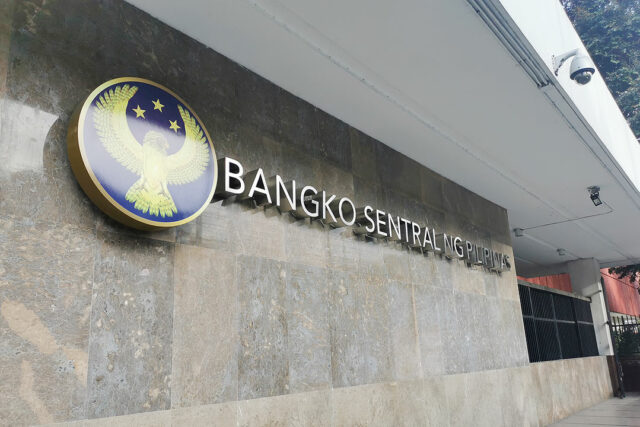
Bangko Sentral ng Pilipinas main office in Manila. — BW FILE PHOTO

THE PHILIPPINE central bank still has room for one more rate hike as the pace of disinflation is expected to slow in the next few months, according to Fitch Solutions unit BMI.

On the other hand, HSBC Global Research expects the BSP to keep rates steady for a “prolonged period of time.”

In a commentary released on Monday, BMI said the Bangko Sentral ng Pilipinas (BSP) decision to leave its key policy rate untouched at 6.25% at its May 18 meeting is only a “pause, rather than an end to the monetary tightening cycle.”

“For now, we are holding on to our forecast for the policy rate to be hiked at least once more by 25 bps to a terminal rate of 6.5%,” it said.

BMI expects the Monetary Board to hike rates again at its June 22 meeting.

“While we think that inflation will remain on a broad downward trend through end-2023, the pace of disinflation will likely slow,” it said.

Inflation has been on a downtrend since the peak of 8.7% in January. In April, inflation eased to 6.6% from 7.6% in March. This brought the four-month average to 7.9%, well above the central bank’s 2-4% target.

Last week, the BSP cut its inflation rate projections to 5.5% this year from 6% previously.

BMI said inflation would only likely subside by the fourth quarter of this year.

“On the downside, if inflation remains on a downward trend and the US Federal Reserve pauses its rate hiking cycle, the BSP may decide to keep rates on hold for the rest of the year,” it said.

BMI also flagged growing upside risks to inflation, such as the looming El Niño weather event that may disrupt food supply and push prices higher.

The state weather bureau forecasts that the El Niño weather pattern has a high likelihood of occurring in the next three months and will persist until the first quarter of next year.

“Furthermore, currency weakness induced by the US Federal Reserve’s aggressive tightening cycle partially drove the BSP towards steep rate hikes in 2022 to safeguard currency stability, and we think that this concern may resurface again in the near term,” BMI said.

The Fitch Solutions unit expects the Fed to deliver a 25-bp rate hike at its June 13-14 meeting, bringing its policy rate to 5.5%.

BMI said slower economic growth could “set the stage for the policy rate to be left on hold.”

It projects the Philippine economy to grow by 5.9% this year, slower than 7.6% in 2022 and below the government’s 6-7% target.

“We think the economic slowdown will be driven by lackluster global demand and the lagged impact of domestic monetary tightening,” it added.

PROLONGED PAUSE
In a report, HSBC economist for ASEAN Aris Dacanay said the BSP would “only begin cutting rates after keeping monetary policy steady for a year.”

“More specifically, we expect the BSP to cut the policy rate by 25 bps to 6% in the third quarter of 2024 and by another 25 bps to 5.75% in the fourth quarter of 2024,” he added.

Last week, BSP Governor Felipe M. Medalla signaled a long, extended pause on interest rates, saying the pressure to cut “is not so high.”

“Furthermore, the pause seems to be a hawkish one. Although Mr. Medalla said that the BSP will ‘unlikely cut or raise rates’ in the next two to three meetings, the BSP also said in the official press release that it stands ready to tighten monetary policy further if threats to inflation emerge,” Mr. Dacanay added.

He said the BSP is unlikely to cut rates earlier than the Fed because this might “put downward pressure on the peso and in turn, fuel inflationary pressures.”

“The national saving rate has not yet normalized. As previously argued, the saving rate has not yet recovered to pre-pandemic levels. Keeping a tight monetary stance for a prolonged period of time should help incentivize saving, which in turn could bring back domestic and external balance,” he added.

HSBC also expects the BSP to cut banks’ reserve requirement ratio by 200 bps to 10% in July.

Mr. Medalla earlier said the BSP is considering cutting banks’ reserve ratios within the year to help loosen monetary conditions.

The BSP is targeting to bring down the ratio for big banks to single digits this year. 

The ratio for big banks is 12%, one of the highest in the region. Reserve requirements for thrift and rural lenders are 3% and 2%, respectively. — Luisa Maria Jacinta C. Jocson

Marcos vows to make gov’t infrastructure projects climate-proof

President Ferdinand R. Marcos, Jr. talks to Asian Development Bank (ADB) President Masatsugu Asakawa during his visit to the ADB headquarters in Mandaluyong City, May 22, 2023. — PHILIPPINE STAR/KRIZ JOHN ROSALES

THE PHILIPPINES would ensure that all phases of its ambitious “Build, Better, More” infrastructure program are sustainable, climate resilient and disaster-proof, President Ferdinand R. Marcos, Jr. told the Asian Development Bank (ADB) on Monday.

“As we ramp up annual public infrastructure spending to 6% of GDP (gross domestic product) consistent with the ‘Build, Better, More’ program, we will incorporate the elements of sustainability, climate resilience and disaster proofing in all phases of societal and infrastructural planning, design, construction up to operation and maintenance,” he said in a speech during his visit to the ADB headquarters in Mandaluyong City.

Mr. Marcos said this would be implemented in projects involving water supply, sanitation, energy, transportation, agriculture and other essential areas.

The Marcos administration aims to sustain infrastructure annual spending at 5-6% of GDP through 2028. In 2022, infrastructure spending was equivalent to 5.8% of GDP.

Mr. Marcos said climate change continues to pose a threat to the Philippines, along with the El Niño phenomenon and a possible major earthquake.

The Philippines had the highest disaster risk, followed by India and Indonesia, according to the World Risk Index 2022.

“If we don’t act, climate change can, will and already is unleashing nature’s fury upon our communities and our people… Climate change will be the lodestar for our integral national policies and investment decisions,” the president said.

Mr. Marcos said that in his nine-month tenure so far, there have been three strategic programs signed with the ADB, with more in the pipeline.

The government signed three ADB loans worth $1.1 billion in the first nine months of the Marcos administration.

He said the Philippine government is awaiting the release of ADB’s Country Partnership Strategy for 2024-2029, which will spell out the regional bank’s recommended medium-term development agenda for the Philippines.

The strategy’s theme, “Investing in Climate, Filipinos and the Future,” is in line with the Philippine Development Plan, Mr. Marcos said. 

He said the government is looking at the ADB as a key partner in rolling out climate-related projects.

The Philippine Development Plan identified 3,770 infrastructure priority programs and projects with an indicative total investment requirement of P17.3 trillion through 2028.

Meanwhile, Mr. Marcos said the government has sought ADB funding assistance for the proposed food stamp program of the Department of Social Welfare and Development (DSWD).

“One of the things that is in the pipeline, that is being developed, that is going to be of great assistance to our people is the proposal by the DSWD for a food stamp program, which I’m surprised that we have never had, but it is something that we can see that has been effective in other countries,” Mr. Marcos told reporters when asked about his meeting with ADB President President Masatsugu Asakawa and other senior officials.

In February, Social Welfare Secretary Rexlon T. Gatchalian said his leadership is considering reviving the food stamp program.

Mr. Marcos said he also discussed possible partnerships on digitalization between the ADB and government agencies such as the Technical Education and Skills Development Authority and the Civil Service Commission.

“Now the scope of the ODA (official development assistance) that we get through ADB has now increased and we are now talking about agriculture, re-skilling and retraining, and climate change and its mitigation and adaptation,” he said.

In 2022, the ADB was the Philippines’ top source of active ODA among 20 development partners. Its annual loan financing for the Philippines averaged at $1.4 billion from 2010 to 2022. — Kyle Aristophere T. Atienza

EU business groups optimistic of more investments in PHL

The Rizal monument is lit in the colors of the European Union flag as part of the Europe Day celebration in Manila, May 7, 2023. — PHILIPPINE STAR/MIGUEL DE GUZMAN

THE Philippines is expected to attract more European investments, as the Regional Comprehensive Economic Partnership (RCEP) enters into force next month.

“We are now seeing positive developments from the economic team under President Marcos Jr. that will surely improve the standing of the country as a destination for foreign direct investments (FDIs) from Europe. Being part of the RCEP will be significant benefit to the country,” European Union-ASEAN Business Council (EU-ABC) Executive Director Chris Humphrey said during a press conference in Makati City on Monday.   

He noted the Philippines has one of the fastest gross domestic product (GDP) growth rates in the region, as well as recent economic reforms conducive to foreign investments.

The Philippine government is targeting 6-7% GDP growth for 2023.

The RCEP trade deal is expected to take effect for the Philippines on June 2. The RCEP participating countries include the 10 members of the Association of Southeast Asian Nations (ASEAN), Australia, China, Japan, New Zealand, and South Korea.

“We see, at the council, huge potential for growing FDI into the Philippines from Europe, and for increasing trade relations,” Mr. Humphrey said.   

Lars Wittig, European Chamber of Commerce of the Philippines (ECCP) president, said that the Philippines should further leverage its status as the only ASEAN country beneficiary of the Generalized Scheme of Preferences Plus (GSP+) trade scheme.

“Certainly, there is much opportunity for Europe and the Philippines to strengthen their economic ties, especially in line with their longstanding trade and investment relations,” Mr. Wittig said.   

The GSP+, set to end by the end of the year, is an incentive arrangement that allows the Philippines to avail zero tariffs on 6,274 products or 66% of all EU tariff lines.

However, participating countries should commit to 27 international conventions related to human rights, labor, good governance, and environment in order to avail of the GSP+ benefits.   

The ECCP also supports the push for a free trade agreement (FTA) between the EU and the Philippines, which is “crucial for the Philippines to become a magnet for European investments,” Mr. Wittig added.

The last round of negotiations for the Philippines — EU FTA happened in 2017 after talks officially began in 2016.   

Meanwhile, Trade Secretary Alfredo E. Pascual said the Philippines is keen on restarting the FTA negotiations with the EU.   

The ECCP and the EU-ABC will hold the 2023 European-Philippine Business Dialogue on May 25 at Dusit Thani Manila. — Revin Mikhael D. Ochave

House of Investments sells more shares in EEI 

THE BOARD of directors of Yuchengco-led House of Investments, Inc. has approved the sale of 14.346% of EEI Corp.’s common shares to Industry Holdings and Development Corp. (IHDC).

“IHDC’s entry as a strategic partner is deemed beneficial to EEI’s growth plans and restructuring efforts,” the listed holding firm said in a regulatory filing on Monday.

“Aside from having a partner that will improve the performance of EEI, the proceeds will be used to increase the capitalization of a subsidiary by subscribing to preferred shares in ATYC, Inc.,” it added.

The company said the move is part of efforts to review its business interests and to consolidate other businesses from the Yuchengco group of companies into House of Investments. Its board approved the block sale of 148.66-million common shares at P7.23 each for about P1.08 billion.

The transaction comes after the company announced the sale of its 20% stake in EEI to the Romualdez family-led firm RYM Business Management Corp. for P1.25 billion at P6.03 each of the 207.26 million common shares.

As a result of both sell-downs, the Yuchengcos will now own about 20.9% of EEI, which will remain as a portfolio investment of the company. EEI is one of the largest construction and contracting firms in the Philippines.

IHDC is owned by a group headed by Francis Chua, a construction engineer with established business interests in construction supply including pre-cast concrete structures, cement and aggregates, as well as investments in the logistics and real estate sectors.

Its subsidiaries include Concrete Stone Corp., which primarily manufactures pre-cast concrete and trades cement products and aggregates, and Industry Movers Corp., a company engaged in freight handling and multiple vessel operations.

To date, no agreement between the two companies has been signed.

Meanwhile, House of Investment’s board approved the acquisition of preferred shares in its wholly owned subsidiary ATYC amounting to P1 billion in exchange for 10 million preferred shares priced at P100 apiece.

The firm said that the additional investment will be used to pay the loans of ATYC, which was incorporated in 2022 and owns the A.T. Yuchengco Centre in BGC, Taguig.

“This will reduce interest payment and exposure to market risk,” it added.

Also on Monday, House of Investments reported an attributed net loss of P8.02 million in the first quarter of the year, a reversal of its P373.88-million net income a year earlier.

It incurred a quarterly loss despite revenues growing 27.1% to P6.71 billion from P5.28 billion in the same period last year. General and administrative expenses increased during the first quarter, along with interest and finance charges.

On Monday, House of Investment shares fell by 2.1% or P0.10 to close at P4.66 apiece. EEI shares declined by 1.67% or P0.10 to P5.90 each. — Adrian H. Halili