NEW YORK — The top US securities regulator sued cryptocurrency platform Coinbase on Tuesday, the second lawsuit in two days against a major crypto exchange, in a dramatic escalation of a crackdown on the industry and one that could dramatically transform a market that has largely operated outside regulation.
The US Securities and Exchange Commission (SEC) on Monday took aim at Binance, the world’s largest cryptocurrency exchange. The SEC accuses Binance and its chief executive officer Changpeng Zhao of operating a “web of deception”.
If successful, the lawsuits could transform the crypto market by successfully asserting the SEC’s jurisdiction over the industry which for years has argued that tokens do not constitute securities and should not be regulated by the SEC.
“The two cases are different, but overlap and point in the same direction: the SEC’s increasingly aggressive campaign to bring cryptocurrencies under the jurisdiction of the federal securities laws,” said Kevin O’Brien, a partner at Ford O’Brien Landy and a former federal prosecutor, adding, however, that the SEC has not previously taken on such major crypto players.
“If the SEC prevails in either case, the cryptocurrency industry will be transformed.”
In its complaint filed in Manhattan federal court, the SEC said Coinbase has since at least 2019 made billions of dollars by operating as a middleman on crypto transactions, while evading disclosure requirements meant to protect investors.
The SEC said Coinbase traded at least 13 crypto assets that are securities that should have been registered, including tokens such as Solana, Cardano and Polygon.
Coinbase suffered about $1.28 billion of net customer outflows following the lawsuit, according to initial estimates from data firm Nansen. Shares of Coinbase’s parent Coinbase Global, Inc. closed down $7.10, or 12.1%, at $51.61 after earlier falling as much as 20.9%. They are up 46% this year.
Paul Grewal, Coinbase’s general counsel, in a statement said the company will continue operating as usual and has “demonstrated commitment to compliance.”
Oanda senior market analyst Ed Moya said the SEC “looks like it’s playing Whac-A-Mole with crypto exchanges,” and because most exchanges offer a range of tokens that operate on blockchain protocols targeted by regulators, “it seems like this is just the beginning.”
Leading cryptocurrency bitcoin BTC=BTSP has been a paradoxical beneficiary of the crackdown.
After an initial plunge to a nearly three-month low of $25,350 following the Binance suit, bitcoin rebounded by more than $2,000, exceeding the previous day’s high. It was trading just below $27,000 at 0410 GMT.
“The SEC is making life nearly impossible for several altcoins and that is actually driving some crypto traders back into bitcoin,” explained Oanda’s Mr. Moya.
BROKER, EXCHANGE CRACKDOWN Securities, as opposed to other assets such as commodities, are strictly regulated and require detailed disclosures to inform investors of potential risks. The Securities Act of 1933 outlined a definition of the term “security,” yet many experts rely on two US Supreme Court cases to determine if an investment product constitutes a security.
SEC Chair Gary Gensler has long said tokens constitute securities and has steadily asserted its authority over the crypto market, focusing initially on the sale of tokens and interest-bearing crypto products. More recently, it has taken aim at unregistered crypto broker dealer, exchange trading and clearing activity.
While a few crypto companies are licensed as alternative system trading systems, a type of trading platform used by brokers to trade listed securities, no crypto platform operates as a full-blown stock exchange. The SEC also this year sued Beaxy Digital and Bittrex Global for failing to register as an exchange, clearing house and broker.
“The whole business model is built on a noncompliance with the U.S. securities laws and we’re asking them to come into compliance,” Mr. Gensler told CNBC.
Crypto companies refute that tokens meet the definition of a security, say the SEC’s rules are ambiguous, and that the SEC is overstepping its authority in trying to regulate them. Still, many companies have boosted compliance, shelved products and expanded outside the country in response to the crackdown.
Kristin Smith, CEO of the Blockchain Association trade group, rejected Mr. Gensler’s efforts to oversee the industry.
“We’re confident the courts will prove Chair Gensler wrong in due time,” she said.
Founded in 2012, Coinbase recently served more than 108 million customers and ended March with $130 billion of customer crypto assets and funds on its balance sheet. Transactions generated 75% of its $3.15 billion of net revenue last year.
Tuesday’s SEC lawsuit seeks civil fines, the recouping of ill-gotten gains and injunctive relief.
On Monday, the SEC accused Binance of inflating trading volumes, diverting customer funds, improperly commingling assets, failing to restrict US customers from its platform, and misleading customers about its controls.
Binance pledged to vigorously defend itself against the lawsuit, which it said reflected the SEC’s “misguided and conscious refusal” to provide clarity to the crypto industry.
Customers pulled around $790 million from Binance and its US affiliate following the lawsuit, Nansen said.
On Tuesday, the SEC filed a motion to freeze assets belonging to Binance.US, Binance’s US affiliate. The holding company of Binance is based in the Cayman Islands.
“It’s important to note that recent regulatory actions are aimed at ensuring that companies operating in the cryptocurrency industry are complying with securities laws and protecting investors — this will always be their goal,” said Joshua Chu, group chief risk officer at blockchain technology firms XBE, Coinllectibles and Marvion.
“These events will ultimately lead to a more stable and trustworthy industry, which could help to attract more institutional investors and mainstream adoption.” — Reuters
VSTECS Phils., Inc., the leading distributor of innovative ICT solutions in the country, commemorates its 25th Year Anniversary with an extravagant gala event marked by a lavish gourmet sit-down dinner, breathtaking production numbers, and grandiose setup. Held on May 10 at the luxurious Shangri-La The Fort Hotel in Taguig City, the evening brought together the who’s who in the ICT industry, including top executives from VSTECS Holdings Headquarters, influential principals representing the largest ICT brands, leading figures from the banking community, valuable channel partners, respected reporters, select VSTECS employees, and an exceptional lineup of world-class talents.
Attended by over 1,000 guests, the gala event was a grand celebration of partnerships. As VSTECS reached this significant milestone, it was an opportunity to express gratitude to all the stakeholders who have contributed to its success over the past 25 years and an occasion to strengthen alliances.
In his welcome address, Jimmy D. Go, VSTECS Phils., Inc. president and CEO, reiterated the important role of IT to allow organizations to stay agile and resilient.
“As we move forward, we are fully aware of the rapidly evolving IT landscape and the constant disruptions that lie ahead. The future will require us to be agile, innovative, and strategic in our approach. We must continue to stay ahead of the curve and leverage the latest technologies to help our customers stay competitive.”
“To achieve this, partnership is essential. We need to work together to achieve the synergy of powers. We must collaborate and share our expertise and resources to deliver the best solutions and services to our customers. In our quest to be the best and most admired technology partner, VSTECS will continue to partner with the best brands in the industry to ensure that our channel partners can address diverse needs and grow their business,” he added.
The event was also graced by valuable channel partners who have played an integral role in VSTECS’ extensive distribution network representing the consumer/retail, corporate, commercial, enterprise, and mobility segments. They have been vital in expanding VSTECS’ reach, enabling the company to hasten technology transfer and provide innovative ICT solutions to a wider audience.
Top channel partners from Retail, Corporate/Commercial, Enterprise, Mobility, and Provincial segments were also awarded in recognition of their unwavering support and collaboration leading to mutual success.
The evening was made even more extraordinary with spectacular production numbers from Regine Tolentino, Jed Madela, and Jessica Sanchez. These world-class talents added an extra excitement and left the audience in awe with their breathtaking performances.
The gala event also provided a platform for networking and fostering new connections.
Attendees had the opportunity to engage with industry leaders, forge new partnerships, and rekindle old ties.
Cognizant to this age of never-ending shifts, VSTECS recommits itself to partner with the best brands in the industry to stay ahead of the curve.
“We cannot predict the future with certainty, but we can equip ourselves with the skills and mindset to navigate uncertainty and thrive in the face of challenges. At VSTECS, we will be relentless to explore all possibilities to enable our partners, transform business, and drive technology,” added Mr. Go.
VSTECS looks forward to the next chapter of its success story in the ICT industry. To learn more about the celebration, visit https://bit.ly/43AAA0i.
Spotlight is BusinessWorld’s sponsored section that allows advertisers to amplify their brand and connect with BusinessWorld’s audience by enabling them to publish their stories directly on the BusinessWorld Web site. For more information, send an email to online@bworldonline.com.
Join us on Viber at https://bit.ly/3hv6bLA to get more updates and subscribe to BusinessWorld’s titles and get exclusive content through www.bworld-x.com.
Escape to the tranquility and elegance of Bern, an exquisite vertical village by Brittany Corporation that will soon be rising on the idyllic side of Baguio, just four hours north of the metro.
A distinct kind of bliss and mystic charm will embrace you as soon as you set foot in beautiful Baguio City.
Set amid the cascading lush pine forests and the cool, refreshing mountain clime, the country’s “Summer Capital” easily brings you to a heavenly escape that is both idyllic and modern, quaint yet exciting. Whether you want a respite from the metro’s heat or a break from your usual grind, Baguio City will always be worth that drive up north, over and over.
How so? Besides the cold weather and the scenic views as you go up the winding roads of the Cordillera Mountain Range, Baguio City has so much more to offer. Its vibrant culture continues to draw local and foreign tourists to the City of Pines.
Residents can enjoy the magnificent panoramic views with Bern’s tranquil spaces specially designed for quiet escapes, such as jogging paths, serenity walk, pocket gardens, and dedicated areas for children’s play.
New and unique experiences year-round
Expect to revel in new and unique experiences every time you go to Baguio.
Its thriving homegrown restaurant scene will satisfy any craving you might have—whether you’re in the mood for Italian, American, Japanese, Chinese, Vietnamese, or Filipino cuisine or for some locally crafted beers and a piping hot chocolate drink. Brave the night market to score for yourself amazing pre-loved clothing, bags, and shoes or to simply enjoy street food.
Immerse yourself in the local art scene by visiting museums and art galleries here and in surrounding towns. You can also unwind and let loose at Baguio’s most famed attractions, like Burnham Park, or indulge in the revelries of the festivals here as well.
It’s thus easy to understand why Baguio City never fails to amaze anyone who comes its way.
Families and friends can spend quality time here, having relaxed, intimate conversations without needing to leave the building.
Swiss-inspired oasis
Soon, Baguio City will no longer just be a weekend getaway.
A quaint community is rising on the idyllic side of Baguio, offering a beautiful escape inspired by the picturesque capital city of Switzerland. It will undoubtedly prompt many discerning homebuyers and investors to get their hands on this Swiss-inspired oasis.
Bern, a four-tower high-end condominium development by Brittany Corp., will let you enjoy all the niceties and peculiarities of Baguio City while enabling you to enjoy the luxury and sophistication of a Swiss mountain lifestyle. This aspirational address will soon offer the same kind of Alpine paradise that the luxury residential arm of the country’s largest homebuilder Vista Land & Lifescapes Inc. has done for Tagaytay with the 100-ha Crosswinds, where you can find beautiful themed neighborhoods set amid over 35,000 towering pine trees.
Brittany’s first high-end condominium project in the City of Pines will undoubtedly emerge as a gem for many looking to revel in Baguio’s City’s tranquil, relaxing vibe all year.
Unique peak experiences
At Bern, one can relax, appreciate nature, and have a picturesque view of the city while enjoying coffee or bonding with family and friends.
Beyond that, however, Bern is bringing to Baguio exclusive, unrivaled experiences thanks to a host of curated lifestyle features, world-class facilities, and amenities at the peak of the four towers.
Time with family and friends becomes extra meaningful at the Eiger Tower, where you can find an imaginative, dedicated space featuring Jacuzzis and family lounges. It’s a perfect spot to relax and enjoy quality time with your loved ones. Those aspiring to keep their health in check and lead an active lifestyle will find their favorite amenities—including a gym, sauna, yoga, and pilates studio—at the Alpstein Tower.
Appenzell Tower gives you access to expansive mountain views and an entertainment space with a game room, view decks, lounges, and a fire pit that can be used exclusively by residents of Bern. Function rooms here can accommodate the residents’ private events and intimate celebrations.
Relax and appreciate nature at Via Nassa Tower, where you can find an indoor-outdoor bar, view deck, Jacuzzi, lounges, and fire pits. Get on the view deck to have a picturesque view of the city while enjoying the company of family and friends.
Spacious units
Bern offers generous and flexible spaces that let owners personalize their units to accommodate their lifestyles while they get to soak in the beautiful views of Baguio City from every angle.
Those looking to find a second home in Bern can choose from any of its spacious, flexible units. Whether you go for the 46-sqm one-bedroom suite, the 51-sqm one-bedroom corner suite, or the 101-sqm two-bedroom suite, you will enjoy Baguio’s sweeping mountain views or city skyline from every angle of your room.
What makes Bern more exclusive and private is the fact that there will only be four to eight units per floor, making it one of the most premium, low-density developments in Baguio.
Bern Baguio will undoubtedly be a luxurious indulgence, a great, sweet escape you can enjoy all year.
For more information on Brittany Corporation’s collection of luxury properties, visit www.brittany.com.ph. You may also follow them on Facebook, Instagram, and YouTube.
Spotlight is BusinessWorld’s sponsored section that allows advertisers to amplify their brand and connect with BusinessWorld’s audience by enabling them to publish their stories directly on the BusinessWorld website. For more information, send an email to online@bworldonline.com.
Join us on Viber at https://bit.ly/3hv6bLA to get more updates and subscribe to BusinessWorld’s titles and get exclusive content through www.bworld-x.com.
By Angela Kiara S. Brillantes, Special Features and Content Writer
Transportation, as it intends to bring people and goods from one point to another, is crucial for making individual lives easier and helping businesses become more efficient in their operations. However, the Philippines’ transportation infrastructure can become more of a barrier rather than an enabler of economic development if its lacks and inconveniences are not completely addressed.
Given how much transportation affects many people’s lifestyles and economic activities, there has been a lot of discussion on how infrastructure and urban mobility can improve the Philippine transport system and prevent it from getting worse as days pass by.
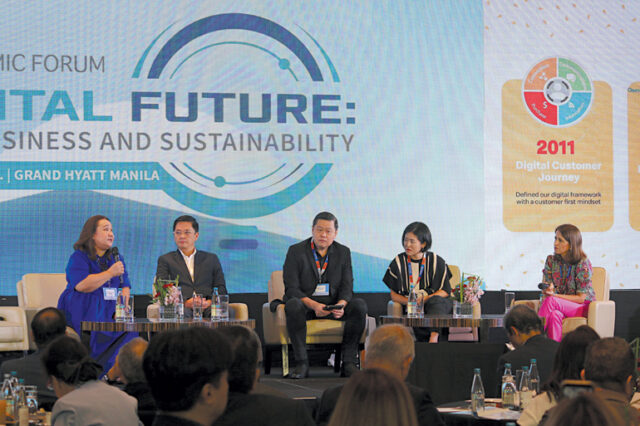
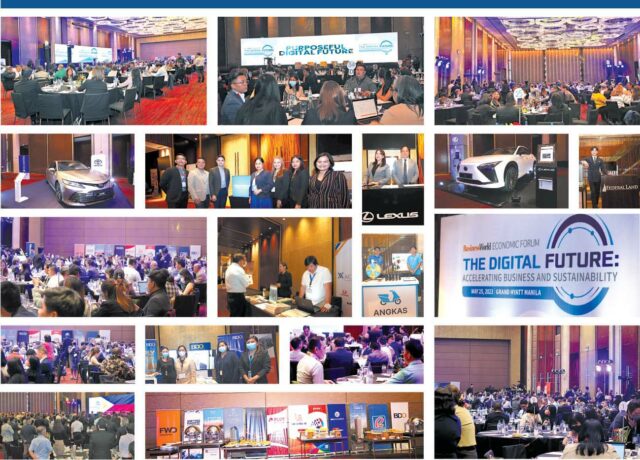
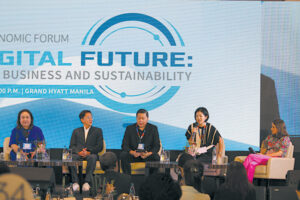
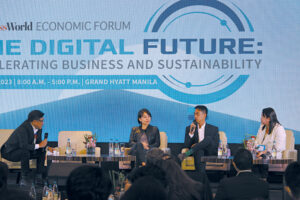
This year’s BusinessWorld Economic Forum, themed “The Digital Future: Accelerating Business and Sustainability,” gathered Aileen Anunciacion R. Zosa, president and chief executive officer of Bases Conversion and Development Authority (BCDA); EJ dela Vega, head of mobility at Grab Philippines, and Angeline Tham, founder of Angkas, to tackle how the country can further improve transport and mobility, and gear it further towards sustainability with the help of digitalization in the panel discussion themed “Redefining Transport and Mobility in the Digital World.”
As digitalization has accelerated across businesses, many sectors in the Philippines took advantage of digital technology as they recognized how it can positively impact business operations. In the transportation sector, both the public and private sector are seen to have been starting efforts, such as utilizing electric vehicles and shared mobility, to help improve the country’s transportation system and infrastructure.
Yet, as the panel agreed throughout the discussion, more than making operations more efficient, digitalization can also creat-e more job opportunities and expand customer options within transport.
For companies like Grab Philippines and Angkas, as Mr. dela Vega and Ms. Tham noted, they believe that technology is a tool in creating a transport system that will both serve consumers while also creating opportunities for service providers.
Mobility in a digital world has to be a whole-of-nation approach.
— EJ dela Vega, Director, Head of Mobility, Grab Philippines
Grab, Mr. dela Vega shared, has used digitalization to employ navigation solutions where customers can share their locations with family members, providing an alert to partner riders to their speed and work duration, and advising them to take a break when needed. In addition, Grab has also developed safety reports which are vital for preventing accidents in the future.
For Grab Philippines’ head of mobility, when Grab started going digital the company provided a more efficient transport system for both commuters and drivers in real-time.
“So, these changes where technology was able to come in, particularly with safety, that’s one thing. Now, even the simple ability to say ‘I’d like to share my ride with my family,’ we’ve kind of taken that with a press of a button. Everybody knows where you are, your friends or family know where you are, [and they] can trace the rides. So, I think those very small examples are the daily changes to the way you move around; those were all because we were able to employ technology,” Mr. dela Vega explained.
“We have built our own map solutions and navigation solutions. By doing that, we’ve improved the number of trips a driver can do by 7% in an hour. 7% seems small, but in the larger scheme of things that’s tens [to] hundreds of thousands of people served, just by having better maps,” he added.
He added, “We use telemetry data, for example in the car, using their smartphones to make it safer. Hopefully, we [will start] building safety reports. We understand driver behavior, but more than that we are trying to prevent accidents before they happen. 10%-20% of crashes are somehow related to fatigue, so something we’ve recently done is prompt drivers who have been online for too long, we say ‘Hey, maybe you need to take a break.’”
Our aim [at Angkas] is not to serve as many customers as possible but to support our [riders] to stand on their own two feet.
— ANGELINE THAM, Founder, ANGKAS
Ms. Tham of Angkas noted how the transport sector has used digitalization to provide customers another choice of how to get from one location to another.
“Digitalization is giving the customers the power to make more decisions for themselves. Before, if I wanted to go from point A to point B, I would’ve known how long it would take me to get a taxi or whether there’s going to be a long line for UV Express. So, [now, digitalization allows them to conveniently] use services that may be, in the past, something they have to do a lot of things to find. So, I think this helps them with efficiency; it really helps people to be more productive,” Ms. Tham said.
“Using digitalization, transportation is more convenient, customers can plan and use other services, and this helps them with efficiency and more productivity,” she also said.
The Angkas founder also notes that digitalization is giving companies the ability “to give the customers the power to make more decisions for themselves,” and as far as the motorcycle ride-hailing app is concerned, digitalization helps them fulfill an aim that goes beyond attracting customers.
“Our aim is not to serve as many customers as possible but to support our [riders] to stand on their own two feet,” she said.
As far as transport systems are concerned, the government needs to adapt a regulatory framework to make infrastructure more available to users.
— AILEEN ANUNCIACION
R. ZOSA, President and Chief Executive Officer, BASES CONVERSION AND DEVELOPMENT AUTHORITY
Meanwhile, BCDA’s Ms. Zosa stressed during the discussion that integrating technologies into transport is the way to a more efficient transportation system in the Philippines.
“Our objective on combining ICT (information and communications technology) on transport systems is to make our lives, our businesses more efficient. So, ICT and transport systems would mean accessibility, connectivity, and transforming our lives, improving the quality of our lives, whether you are a service provider or a customer,” Ms. Zosa explained.
According to Ms. Zosa, BCDA is focused on providing efficient infrastructure to the developments it covers. She shared BCDA’s recent projects regarding these efforts which include an integrated operations center, transit-oriented developments (TODs), and a subway system in Bonifacio Global City (BGC) in Taguig.
Ms. Zosa added that BCDA’s integrated operations center project is expected to be developed within the year. She added that the “cloud-based transport system” will include e-vehicles and electric-assisted bikes, as well as functions that will provide convenience for riders in using their phones to pay for rides, checking available vehicles, and scheduling for drivers.
BCDA’s TOD project, meanwhile, is expected to launch next year in BGC. Ms. Zosa said that this project will help in enhancing the area’s transportation system so that it will provide more “convenience, accessibility, and connectivity to a livable and more workable BGC.”
As BusinessWorld reported earlier in March, BCDA said in a statement that it signed a technical cooperation agreement with the Japan International Cooperation Agency for developing TODs in the Bonifacio area.
The said project is said to serve as a prototype for sustainable mixed-use communities with train access, and so it raises the potential of the two railway projects, namely the Metro Manila Subway and the North-South Commuter Railway, crossing the BCDA property in Metro Manila.
As much as it is being recognized as the key in shaping an inclusive and sustainable future, digitalization is also seen to have an immense capability of improving transport systems and infrastructure. But to fully realize such a goal, both private and public sectors should work hand-in-hand.
“Mobility in the digital world has to be a whole-nation approach, with us, other players of the industry, government stakeholders, Grab is always a committed partner to that,” Grab’s Mr. dela Vega said.
Transport players should also better understand the commuters they serve and aim to serve them better.
“It is important to pinpoint what are the outcomes we want for our stakeholders. It is important to look deeply into who you serve to be able to find out what would be really beneficial for them to make sure we can build a thriving ecosystem… and to build a stronger Philippines,” Ms. Tham of Angkas added.
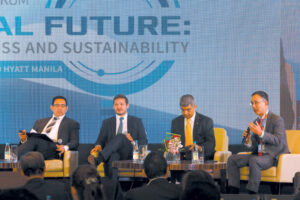
Panel Discussion 3 (from L-R): BDO Unibank SVP & Chief Compliance Officer Federico P. Tancongco, Binance Philippines General Manager Kenneth Stern, Sun Life Philippines Chief Operations & Digital Enterprise Officer Gaurav Mishra, and Bank of the Philippine Islands CFO & Chief Sustainability Officer Eric Roberto M. Luchangco
By Bjorn Biel M. Beltran, Special Features and Content Assistant Editor
In an increasingly digital world, it becomes ever more apparent how large a role the financial sector must play in building a more resilient future. The financial sector, as one of the world’s largest and most prominent industries, has the ability to direct resources toward environmentally and socially responsible investments.
In the panel on “Building and Expanding a Sustainable Digital Finance Ecosystem,” experts and financial industry leaders at the 2023 BusinessWorld Economic Forum held last May 25 attempted to reimagine the sector in a world where the barriers of the physical and the digital have begun to blur.
Eric Roberto M. Luchangco, chief finance officer and chief sustainability officer of the Bank of the Philippine Islands (BPI), enumerated the obvious benefits of the sweeping digitalization of banks all over the country.
It’s critical for us in the finance industry, not only to help finance, but to understand what are the kinds of projects that we should be encouraging our customers to support.
— ERIC ROBERTO M. LUCHANGCO, Chief Finance Officer and Chief Sustainability Officer, BANK OF THE PHILIPPINE ISLANDS
“For us, this was really an opportunity for us to make things more convenient for customers; and that has a lot of savings for them. There’s no need to travel to the branches. They can transact whenever they want to,” he said.
“We’re very close to 3,000,000 customers now that are digital customers, meaning they transact with us more digitally than they do non-digitally; and those are financial transactions where there’s actual movement of money. As a result, we’re seeing much better engagement with them.”
Mr. Luchangco said that this serves as an illustration of how the banking industry’s revenues are starting to move in favor of the digital customers and of how banks like BPI have been quite successful in migrating their existing customers to the digital space.
It follows then that the financial sector’s growth and stability depend on the development of a sustainable digital finance ecosystem. But, how does the Philippine financial industry achieve that goal?
In a global context, investors are increasingly valuing sustainability and demanding transparency and responsibility from corporations driving growth in the field of sustainable finance. Environmental, social, and governance (ESG) considerations are becoming requirements in making investment decisions.
Having been in business for over a century in the Philippines and given the long-term nature of the insurance business, Sun Life holds sustainability as a high priority, according to Gaurav Mishra, chief operations and digital enterprise officer at Sun Life Philippines.
The financial industry plays a huge role in sustainability… Digital is a key enabler to this because it makes products more accessible, and it allows us to provide a better end-to-end experience.
— GAURAV MISHRA, Chief Operations & Digital Enterprise Officer, SUN LIFE PHILIPPINES
“The concept is very familiar with us; and we understand the importance of staying in committed to our cause and seeing it through amid various challenges,” he said.
Mr. Mishra shared Sun Life’s five focus areas for pursuing for sustainability in its business: increasing financial security; fostering healthier lives; advancing sustainable investing; operating as a trusted and responsible business; and uplifting the communities in which they operate. He added that each of these focus areas supports at least one of the United Nations’ Sustainable Development Goals.
“In this journey, collaboration has been key for us. Internally, we work with our employees to create relevant solutions and redesign processes; while our advisors operate at the front end, engaging with our clients,” he said.
“At the same time, we also align with our initiatives and the sustainability vision which complements these initiatives. And as we work through, we bring more value to the people we serve and at the same time strengthen the country’s financial ecosystem.”
Digital technology, particularly emerging technologies like blockchain, can become the catalyst of change in the financial landscape. Kenneth Stern, general manager of Binance Philippines, said that a country like the Philippines that has a very young demographic, high internet usage, high mobile phone understanding and a burgeoning digital economy that is looking for investments has a lot of potential to uplift the lives of its citizens through technology.
Web3 opens up opportunities in the Philippines for more financial inclusion and for skilled Filipinos to work remotely for global companies without having to leave their families.
— KENNETH STERN, General Manager, BINANCE PHILIPPINES
There are three specific areas, Mr. Stern said, in which digital technology can propel the country towards a more sustainable future: financial inclusion, remittances, and job creation.
“Financial inclusion is very important here because it’s still 34 million people in the Philippines who are not financially included, and there’s a lot of technology out there that can help people get financially included. But there is trouble with education, with logistics, and with how we can actually give access to these people,” he said.
Technologies like cryptocurrency and other forms of digital money can also help Overseas Filipino Workers (OFWs) send remittances more cheaply, which can mean a lot for Filipino families struggling with poverty.
“More OFWs can invest back to the Philippine market. It’s roughly 10% of [gross domestic product], but I feel like if we can use cryptocurrency and digital technology, we can increase that number up to 20% to 30%,” Mr. Stern said.
Finally, Mr. Stern said that digital technology can help eliminate the “brain drain” that has happened in the country, “where our best talent do not need to leave the Philippines to go to the US or Canada or Europe to make international salaries.”
A mosaic of solutions
“Sustainability is a huge subject, and there are many facets of it,” Federico P. Tancongco, senior vice-president and chief compliance officer of BDO Unibank, pointed out.
Mr. Tancongco said that at BDO, they impose three disciplines on themselves when creating new products for their customers.
Financial inclusion for us is phygital — both physical and digital… To really serve the underserved, we believe it is still a physical world. We are at a transition. We are still learning.
“One, you do not develop products in an ivory tower. While you can see in articles emerging theories and trends, we also leverage heavily on our experience with our clients and our understanding of their context, the clients that we serve and the clients we want to serve,” he said.
“The second discipline is that we cannot be everything to everybody. We have to focus on what we are good at, and then we leverage on what we understand. Third, we have to respect and leverage the insight of the other players, because in sustainability, no one institution, no one industry can solve all of the problems. We will contribute to a mosaic of the solutions, and we have to understand and respect the solutions that are coming out in the market.”
The panel also noted that collaboration and the leveraging of new technologies like blockchain can enhance transparency, reduce costs, and improve efficiency in the financial industry of tomorrow. Furthermore, digital technology can facilitate sustainable investments, promote financial inclusion, and build a more resilient and equitable financial system that works for everyone.
Mr. Stern of Binance Philippines pointed out that technology can create possible solutions to many problems, from decreasing friction, to increasing efficiencies, to creating cross-border transactions real time.
“These are all real solutions that are being made right now. It’s all about getting the buy-in from these companies and large institutions to actually invest in the product, invest in the technology and actually put some initiatives behind these present projects and try it out,” he said.
Mr. Tancongco agrees. “Business moves where money is. If you put rules into lending and you use ESG criteria when you lend, when you issue bonds, or use ESG criteria whenever you make your investments,” he said.
“The principle is biblical, ‘Where your treasure is, there will your heart be also.’ Put the money there, and everybody else flocks to where the money is. In other words, actually like during the pandemic, the role of financial institution is mission-critical.”
BPI’s Mr. Luchangco echoed the sentiment, adding that the financial industry has the responsibility of keeping updated with the latest sustainability trends so that it can make better investment decisions.
“This is really driven by money, right? And a lot of the sustainability initiatives, they do require financing. That’s a critical way in which the financial sector can really help. I think it’s critical for us in the finance industry, not only to help finance, but to be on the cutting edge and understand what kinds of projects we should be encouraging our customers to support.”
“It’s our belief that every individual, every company and every country in fact needs to play its part in driving the transition to a more carbon-neutral economy,” Mr. Mishra of Sun Life concluded.
“Digital is a key enabler to this because it makes products and services easily accessible to our clients. It allows our employees and our advisors to engage with the clients and support their requirements remotely; and it also allows us to offer a very seamless end-to-end experience. I think we do have a big role to play in ensuring sustainability.”
By Chelsey Keith P. Ignacio, Special Features and Content Senior Writer
Everyone deserves a food on their plate, and a nutritious and sufficient one at that. But for many people, having the recommended amount of food and nutrients per day can be a challenge.
Apart from the lingering issue concerning nutrition, there are also problems with unsustainability in food production and processing, which not only affect the availability of food but also impact the planet. Innovations, however, can play a part to make food and its processing nutritious and sustainable.
Tackling these issues concerning food and the technologies serving as solutions are the focus of Kristine Go, general manager for nutrition at Unilever Southeast Asia, in her presentation on “Reinventing Food for Humanity” during the BusinessWorld Economic Forum last May 25.
“By 2050, there will be 10 billion people on the planet,” stressed Ms. Go, “and the reality is, our planet cannot feed that 10 billion people.”
This potential concern for the future is rooted in the limited type of plants and animals being consumed today. According to Ms. Go, only 12 plants and five animals made up 75% of the food that people intake, despite having a lot of types of produce and crops in the world.
“The problem with this is that it actually affects the soil. When people produce the same amount of vegetables and meat because that’s what we consume, it actually depletes our resources. That’s why there’s not enough food to feed the 10 billion people that will be inhabiting this Earth by 2050. So 50% of our soil has actually been lost. It’s been lost because it uses the same amount of nutrients,” Ms. Go explained.
“So, unless we actually rotate and unless we eat more or we diversify our diet, we actually end up destroying the soil. We end up using more water, we end up destroying the climate,” she said.
The food being produced at present is responsible for 30% of the greenhouse gas emissions, added Ms. Go.
For Unilever’s part in responding to the aforementioned situation, Ms. Go shared some of the company’s commitments for 2025, which involved investing €1.5 billion of its business to be made out of plant-based food. The company is also putting importance on providing positive nutrition; halving the food waste from its manufacturing until it reaches homes; and cutting down salt, sugar, and fat.
“At the center of all of these is regenerative agriculture,” she said.
“While we are in the business of nutrition, there is such a strong link between nutrition, innovation, and technology, and the way it actually affects the diets that we have,” she highlighted.
Technologies for food
Several technologies are being utilized nowadays to bring nutritious food for the people, as well as bring sustainability in the process and protect the environment.
People talk about sustainable agriculture, but it’s now evolved to regenerative agriculture.
— KRISTINE GO, General Manager – Nutrition, UNILEVER SOUTHEAST ASIA
Food manufacturers have been adding nutrients to food products through fortification.
“Because oftentimes it’s a lot harder to change people’s diets and habits, we try to change our products. Fortification exists already in a lot of products today,” Ms. Go said.
Among Unilever’s products that underwent fortification, according to the general manager, are Knorr cubes, which are fortified with iron as the Philippines deals with iron deficiency.
“And you may not know it — and we don’t talk about it because we all know that when it comes to food — we just want to talk about how delicious it is. And that’s why the onus is on us as companies to actually change the products that we give because our people need it,” said Ms. Go.
Technology is also used to produce plant-based meat products and make their texture and taste like that of actual meat.
“I know that we all want to eat healthy. But oftentimes, it’s very hard to say no to a beef burger or steak. And that’s why there are new protein solutions that actually, in a way, mimic and create texture that is similar to meat not only the taste, but also the texture,” shared Ms. Go.
Pancake House and Burger King are among the restaurant and fast-food companies that have begun to offer plant-based meat.
Meat products are being improved by technology as well in terms of producing more by imitating the fibrous texture of meat with the help of high moisture extrusion.
“It’s a concentrated solution towards giving you more meat… Even if normally, let’s say, a kilo of beef or pork creates eight patties, with this product, a concentrated meat powder, it actually increases it (patties created) by 50%. So, your ordinary one kilo of pork, which produces eight patties of meat, can now make 12,” Ms. Go explained.
Meanwhile, in terms of processing, digitalization helps provide transparency and efficiency in manufacturing. A manufacturing site that digitalizes everything end-to-end is what the World Economic Forum (WEF) call as lighthouse factories, said Ms. Go.
“Everything from dispensing to manufacturing to the movement of raw materials from one end to the production side is now digitized. And it helps all of us because it actually creates less waste. It also makes our production systems more efficient,” she said.
“Having a digitized factory allows you for better traceability, better efficiency, and to be more cost-effective,” she added.
Unilever currently has around six factories across the world that have been recognized as lighthouse factories by the WEF, according to Ms. Go.
Packaging should also be paid attention to when it comes to sustainability in food processing.
Hellmann’s, a Unilever mayonnaise brand, is also creating a bottle that would be able to denote the temperature of the refrigerator.
“This bottle tells you the right amount of temperature that’s required for your refrigerator,” Ms. Go explained. “So, this is quite a cool technology because the label that you have on pack changes color. It changes color when the temperature is too low or too high. It just gives you an optimal amount of temperature that obviously helps our planet as well.”
Meanwhile, on the side of agriculture, there is a system called regenerative agriculture, which seeks to rehabilitate the soil and protect the environment.
“People talk about sustainable agriculture, but it’s now evolved to regenerative agriculture,” said Ms. Go. “Regenerative agriculture is five things. It helps our soil; it’s less water; it’s better for the climate, so less greenhouse gases, so more net zero. It’s also good for biodiversity, the animals, the insects, that are around the farm. And finally, it’s better for livelihoods.”
An example of this is the creation of dwarf coconut trees in Indonesia and dwarf tamarind trees in the Philippines, shared Ms. Go, which makes it easier to harvest the yields than climbing the trees at their usual height.
She also shared that Unilever’s plantation in Pampanga has five to six feet of dwarf tamarind trees, along with life-size tamarind trees that could grow up to 30 feet.
Capping off the presentation, Ms. Go also showed Unilever’s Hive, the company’s foods innovation center at the Wageningen University & Research in the Netherlands. The campus is dubbed as the “Silicon Valley of Food.”
By Chelsey Keith P. Ignacio, Special Features and Content Senior Writer
In ensuring food security among communities, the agriculture sector serves an essential role, being the provider of food to the country.
As several Filipino households deal with food insecurity, Philippine agriculture also faces many challenges. The ongoing issues in the sector and the plans and initiatives to address these and to bring food security to Filipinos were delved into in a panel discussion on “Delivering Food Security and Sustainability” during the BusinessWorld Economic Forum on May 25.
“We continue to have lingering challenges: low productivity, low level of mechanization, weak research and development, extension services [are] very weak, weak linkage to the value chain, and so forth and so on,” said Mercedita A. Sombilla, an undersecretary at the Department of Agriculture (DA).
Among other challenges that agriculture faced in recent years were pests and diseases among plants and animals. Climate change is another concern that has to be addressed in the following decades.
Ms. Sombilla also pointed out the weak biosecurity, infrastructure, and connectivity, as well as the poor post-harvest facilities in the country.
A big portion of the issue of food security is the low productivity level… Majority of the subsectors of agriculture in the country have the same story. If we can improve technologies and practices, we can improve productivity in agriculture.
— JUAN VICTOR HERNANDEZ, President & CEO, Metro Pacific Logistics Company, Inc. and METRO PACIFIC AGRO VENTURES, INC.
Meanwhile, Metro Pacific Agro Ventures, Inc. (MPAV) President and CEO Juan Victor Hernandez showed the issues on the lower production in certain agricultural subsectors in the Philippines, compared to the yields in other countries.
Looking at the dairy segment, Mr. Hernandez shared that the average liters of milk per cow each day amounted to around eight to 11 liters in the country. This is way far off from the global average, which is at 40 liters.
Furthermore, the average shelf life of fresh milk was at seven days in the Philippines. Papua New Guinea, whereas, has 21 days of shelf life for its milk.
“In Papua New Guinea, our partners were able to achieve 21 days in terms of shelf life, just because it is fully automated from milking the cow all the way to getting the milk packaged. No human intervention, so there is no contamination, and they were able to increase the shelf life of their fresh milk products to 21 days,” Mr. Hernandez shared.
“[I]f Papua New Guinea can do it, the Philippines should be able to do it. If we study the technology and the practices, the plan is to bring it here to the Philippines. And from my perspective, even if we just doubled the production from 11 liters to 22, that will be fantastic already. If we’re able to increase shelf life from seven days to 14 days, that’s fantastic already,” he added.
The Philippines also lagged in coconut production, an area where it once led yet lost its position to Indonesia.
“We were still number one in terms of hectarage; but in terms of being the number one producer, Indonesia is now number one,” said Mr. Hernandez.
The coconut trees in the country can produce 45 to 50 nuts each, according to Mr. Hernandez. But other countries already have varieties that can yield 150 nuts for every tree. As such, for its coconuts, the Philippines needs to have a “massive” replanting strategy.
“What’s so interesting to me, personally, is that there are so many sectors that have the same story,” Mr. Hernandez said.
Government plans
Seeing the problems in the agriculture sector, some plans have nonetheless been drafted by the government.
Last year, the DA came up with the National Agriculture and Fisheries Modernization and Industrialization Plan for 2021 to 2030, which serves as a directional plan to transform the sector.
“Digitalization and sustainability are very much part of that [plan]. But I think we need a whole-of-nation collaboration for us to be able to do that,” DA’s Ms. Sombilla said.
We need real-time data to come up with intervention plans before the issue of food security comes about. I’m asking the assistance of development partners to put that database in place for our policy-making.
— MERCEDITA A. SOMBILLA, Undersecretary, DEPARTMENT OF AGRICULTURE
Ms. Sombilla also said the DA is concerned of the challenges in improving the food security in the country. Hence, the 10-year plan “puts towards that objective of having a food- and nutrition-secured Filipinos with empowered farmers and fisherfolks in terms of increasing their productivity and incomes,” she said. “So, we are trying our best to do that.”
In terms of weak biosecurity, Ms. Sombilla shared they are working on strengthening this area.
“We are now putting up the first border control, what we call the cold examination so that we can sort of prevent importation of foods that are supposed to be infected with diseases, pandemics that could have some dangers to our agricultural sector,” she shared.
Meanwhile, concerning investments in post-harvest facilities, Ms. Sombilla said that policies should be there to support the private sector for such facilities.
“This is supposed to be a private sector; all of these facilities are supposed to be. So, I think the policy aspect of that should be there to encourage the private sector. There are probably still some hindrances that don’t encourage the private sector to get into this,” she said.
Ms. Sombilla also shared that the DA is currently assessing what is lacking in cold storages and warehouses that farmers needed to support in marketing their produce.
President Ferdinand R. Marcos, Jr. has also instructed the DA to formulate a farm-to-market network plan, according to Ms. Sombilla.
“We need the connectivity from the farmers to the main thoroughfares that would lead to the markets and the manufacturing sector,” she said.
“What the President instructed DA to do recently is to come up with a farm-to-market network plan, wherein we geo-tag all the farm-to-market roads so that any additional farm-to-market road that would be constructed should connect to all this one,” she added.
Ms. Sombilla also touched on the need for policies to encourage the agriculture sector to fast-track the modernization.
“We need precision farming to overcome so many challenges in agriculture. We need real and fast data and information, so that we will be able to develop interventions needed before any of these challenges would affect the sector,” she said.
“And in order for us to do that, we need to increase investment in research and technology, and extension services,” she continued. “We need to capacitate our farmers to be able to make use of this technology. We may have the AI (artificial intelligence) and Internet of Things and all of these; but if our farmers are not able to make use of this, it will not be very useful.”
Initiatives from private, development sectors
Technology and modern farming practices play a part as well for players in the private sector like MPAV in addressing concerns seen in the country’s agriculture sector.
“We cannot solve the whole crisis; but we want to do our share, and we want to focus on the industry subsectors… [W]e think [that] if we apply new technologies and modern farming practices [to such areas], we can increase yield and quality,” MPAV’s Mr. Hernandez said.
Mr. Hernandez also talked about the significance of changing the way food is produced, seeing the need to grow more food in the next decades to feed the increasing population and the impact of traditional agriculture on the soil’s health.
“It goes without saying that the way to change the way we produce food will be enabled by digital. And in the agricultural world, digital starts by adopting modern farming practices and the latest farming techniques and technologies that promise to increase yield, increase quality, use less resources, and will be more mindful of the environment,” he said.
Mr. Hernandez also viewed the application of technology in agriculture as a way attract the younger generation, especially as the average age of Filipino farmer is almost 70 at present.
“Because there are new technologies that are being adapted, we think we can involve the younger generation to be part again of the ecosystem,” he said.
If we want to have big impacts on sustainability and food security, we have to look at staples.
— JOANNA KANE-POTAKA, Deputy Director General for Strategy, Engagement, and Impact, INTERNATIONAL RICE RESEARCH INSTITUTE
In the segment of rice, which is a staple food for Filipinos, science and technology are delivering potential advancements.
“What we’ve been able to do is identify the gene that makes rice low[er its] glycemic index. We found that gene in the gene bank, we’ve done all the testing [and] we’re doing the final testing now. When that’s released, that can be applied to any variety. Any of your high-yielding, highly resilient varieties, we can naturally add in that natural rice gene to make it a low glycemic index rice even when it’s refined,” shared Joanna Kane-Potaka, deputy director general for strategy, engagement, and impact at the International Rice Research Institute (IRRI).
This development in rice can be helpful for the Philippines, as 3.9 million Filipinos are affected by diabetes.
Ms. Kane-Potaka also shared that IRRI is looking to breed new varieties. “We’ve now got high-zinc varieties… and high-protein varieties. And what we’re looking at now is how you combine that,” she said.
“So, on the nutrition, we’re on the cusp of some really big breakthroughs,” she added.
IRRI is also addressing the impact of flooded fields, where rice is grown, on climate change.
“Rice traditionally wasn’t always grown in flooded fields. And it’s the flooding that actually causes the methane gas emissions; it’s not the rice. But when we flood the fields, the water attracts the bacteria, which has the greenhouse gas emissions,” she explained.
“The decades of breeding new varieties have all been done for flooded fields. So, what we’ve done is change a lot of the breeding programs to breeding especially for what we call dry seeded rice so you don’t have to grow it in flooded fields,” she said.
But while the dry-seeded rice approach already exists, Ms. Kane-Potaka said the rollout is challenging.
“This is where we need policy. This is where we need national systems. We only work in partnership, and it’s how you roll it out and get the adoption, which is always the challenge as well,” she said.
Ms. Kane-Potaka also shared about how one of IRRI scientists delved into AI and was able to create a new way to characterize the entire genetic material for rice.
“We’re looking for funding at the moment. Once we get that, the plan is to use the AI to characterize all of the genetic material for rice, not just some, and the way you need to then analyze that data to see what we can do from it,” she said.
“If we can use the AI and do the complete characterization, it’s going to be big what we can do,” she added.
She also noted the possibility of speed breeding with the help of AI, which can be helpful as the development of varieties in agriculture could take years.
“And so, rather than getting only one crop, [in] which you need to do your breeding to develop the new varieties, you can get two to six seasons of that crop. So, it saves years in scientific development. And every couple of years you save, it’s millions of dollars saved,” she said.
IRRI already uses speed breeding in its facilities in India, and the institute is about to establish the application of the said technique in the Philippines.
Approaches to food security
Ms. Kane-Potaka shared five approaches for the Philippines to achieve food security and sustainability.
The first of which is having a triple bottom line approach, which involves profit for the farmers; the planet, or having the solutions to address the impact of climate change; and the people, which meant having affordable and accessible healthy food.
“But that triple bottom line for food security often works in silos. The real solution will come when we have solutions that look at those three areas in unison,” Ms. Kane-Potaka said.
The second approach focuses on the staples, which can be impactful for food security and sustainability.
“Having smarter staples that exist now is what we need right now, and long-term we need to look at working on diversifying those staples,” Ms. Kane-Potaka said.
Having scientific developments, meanwhile, is the third approach. The fourth dealt with inclusiveness.
“We are only going to maximize the benefits if we maximize the inclusiveness of everybody to contribute to that,” said Ms. Kane-Potaka.
And to support the solutions, a policy is needed, which is the fifth approach.
“What’s the use of technology if you don’t have the policy to support it and vice versa? Any of the solutions need the policy as the base to support it, and it’s the critical part,” she said.
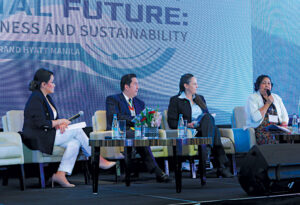
Panel Discussion 5 (from L-R): Multiverse.ph Publisher Santiago J. Arnaiz (moderator); Aboitiz Group of Companies FVP-Chief Sustainability & Reputation Officer Ana Margarita Hontiveros-Malvar; Securities and Exchange Commission Commissioner Kelvin Lester K. Lee; Ayala Corp. Group Risk Management and Sustainability Unit Head Ma. Victoria A. Tan; PLDT and Smart FVP & Chief Sustainability Officer Melissa V. Vergel De Dios; and Robinsons Land Corp. Chief Financial, Risk, & Compliance Officer Kerwin Max S. Tan
By Angela Kiara S. Brillantes, Special Features and Content Writer
There has been a growing awareness among organizations on the need to embrace sustainability in light of existing socioeconomic and environmental issues. In order for them to take part in this sustainability agenda, companies have further utilized frameworks such as the United Nations’ Sustainable Development Goals in setting their respective directions towards becoming sustainable companies.
At the same time, the adoption of digital technologies has accelerated among many businesses. While technology is improving work efficiency and productivity, businesses are also beginning to see that it can also bring more positive outcomes, including improved strategic planning and even reduced energy use and waste production. Digitalization, thus, is seen to have the power to further equip businesses and help them achieve sustainability in the “now normal.”
At this year’s BusinessWorld Economic Forum, a panel discussion with leading experts from both public and private fronts gave their thoughts on how corporate sustainability can be achieved with the help of technology-driven transformations.
Corporate leaders are at the forefront of opportunities to improve their operations and direct their companies into becoming more resilient and socially-responsible organizations. While embracing sustainability is the right thing to do, some might say that it still remains a hurdle.
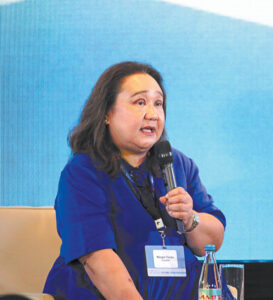
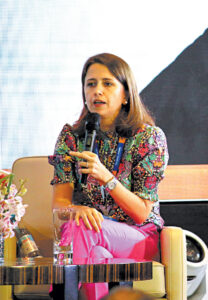
Yet, as Aboitiz Group of Companies First Vice-President and Chief Sustainability and Reputation Officer Ana Margarita “Ginggay” Hontiveros-Malvar pointed out, with the right technology, tools, and platforms corporate sustainability can be a key for companies to do their share in addressing the many challenges that the Philippines is currently facing.
Tech in sustainability can be an enabler if we all embrace it.
— ANA MARGARITA ‘GINGGAY’ HONTIVEROS-MALVAR, FVP – Chief Sustainability and Reputation Officer, ABOITIZ GROUP OF COMPANIES
“Sustainability really has a landing place within the business model. So, for us, it’s really embedding it to our business strategies. When you talk about sustainability, you also talk about stakeholder concerns, Ms. Hontiveros-Malvar said.
“There is a process within sustainability which is called materiality. It’s really talking about the issues and the challenges that are important to your stakeholders… and, at the same time, how they impact the business,” she explained. “The outcome of that process helps drive the input to our business strategies and drive the decisions that we make in terms of the focus areas we need to look into, especially the areas of ESG (environmental, social, and governance), considering stakeholders concerns that are important. We define our targets, as well as [set] the programs and initiatives that help us achieve those targets, and [then we measure our] performance against those targets, making sure we’re actually monitoring and evaluating.”
Sustainability is also becoming an essential component in building up business continuity, Ma. Victoria A. Tan, head of Ayala Corp.’s Group Risk Management and Sustainability Unit, said.
Just think that you are doing something for the future — for your children and grandchildren.
— MA. VICTORIA A. TAN, Head, Group Risk Management and Sustainability Unit, AYALA CORPORATION
Being one of the leading and diverse business groups in the country, Ms. Tan shared, Ayala Corp.’s secret to its successful sustainability journey so far is developing a commitment to the ESG framework, creating shared value to address societal challenges, and inserting innovative approaches to come up with business solutions.
Ms. Tan emphasized that at the core of Ayala Corp.’s sustainability efforts is the understanding that sustainability and business continuity are intertwined together.
“This sustainability philosophy guides our capital and resource allocations and our decisions. This also ensures that we remain a responsible organization and, at the same time, contribute positively to the societal and economic development of this country,” Ms. Tan said.
In its “transformative journey” toward the goal of creating a vibrant future by combining technology and sustainability, Robinsons Land Corp. (RLC) has been making the most out of such journey throughout the years.
RLC’s Chief Financial, Risk, and Compliance Officer Kerwin Max S. Tan shared that the real estate developer has already progressed in integrating sustainability within their organization as their sustainable activities have yielded “impressive results.”
Among its sustainable solutions include integrating solar energy across all Robinsons malls, transitioning to LED lights, revolutionizing workspaces, and embracing digital transformation by developing mobile applications and portals that will provide easy access of Robinsons’ products and services.
It should be a buy-in for everyone; you set a sustainability target that is achievable. It’s a group effort to make sustainability happen.
— KERWIN MAX S. TAN, Chief Financial, Risk and Compliance Officer, Robinsons Land Corporation
For Mr. Tan, technology plays a key role in their sector, providing better access to data, resources, products, and other resources.
Moreover, he also agrees that technology and sustainability are the perfect pair to transform businesses, in particular for managing risks and optimizing cost-efficiency purposes. Not only does technology can transform businesses, he added, but it also has the ability to boost financial inclusion in the broader market.
“At the end of the day, it should be a buy-in for everyone… It takes a group effort to make sustainability happen,” he added.
Speaking from the perspective of the public sector, Securities and Exchange Commission (SEC) Commissioner Kelvin Lester K. Lee stressed that the SEC is developing the practice of sustainability reporting to help businesses determine their ESG impact.
To recall, listed companies in the country are required to submit a sustainability report as part of their annual report each year. Such reports can be based either on an internationally recognized framework or a template offered by the SEC.
Mandating sustainability reporting among corporations, Mr. Lee added during the forum, also aims to embed sustainability into corporate governance culture of organizations.
The government is here to help you, both on the digitalization side and the sustainability side.
— KELVIN LESTER K. LEE, Commissioner, Securities and Exchange Commission
“We are looking to issue multiple regulations in relation to ESG and embedding ESG into your frameworks, and that’s something we’ve been looking at. We are also coordinating about possibly coming up with a bill in relation to requiring sustainability reporting and ESG disclosures of our publicly listed companies and public companies,” Mr. Lee shared.
More recently, the SEC is looking to introduce mandatory sustainability reporting for non-listed companies, particularly public companies and small enterprises, giving incentive to those who will abide.
‘Tone from the top’
For PLDT and Smart First Vice-President, Chief Sustainability Officer, and Head of Investor Relations Melissa V. Vergel De Dios, sustainability is regarded as the standard and the key pillar of business strategy.
As telecommunications service providers, PLDT and Smart have embodied their sustainability efforts by embedding sustainability in the corporate culture while also creating a safer and more reliable digital environment for Filipinos.
According to Ms. De Dios, PLDT and Smart’s sustainability journey continues to provide digital innovation and solutions through green technologies and nature-based climate solutions, and improved digital infrastructure that will help in connecting Filipinos and protecting the environment while doing business responsibly.
If there’s no common understanding in the organization, properly executing sustainability is impossible.
— MELISSA V. VERGEL DE DIOS, First Vice-President, Chief Sustainability Officer and Head of Investor Relations, PLDT AND SMART
“In PLDT, the products that we sell in connectivity and sustainability, in its broader definition, go beyond climate change and environment. Under the social pillar, the narrowing of the digital divide is basically part of the sustainability goal. So, in the offering of our services, in connecting people, we are actually operating sustainably; but it does not stop there,” Ms. De Dios explained.
“If you connect people, you are able to introduce them to this big wide world of business and entertainment and all that, but the other responsibility of a telecom provider is to make sure that the online environment for your customers is safe,” she continued. “So, cybersecurity is important for us. It’s a mission for us that our customers are protected while they enjoy the services.”
To create a better digital ecosystem, Ms. De Dios highlighted collaborating with the public sector to create smart cities and for better digital governance.
Within the private sector, meanwhile, she emphasized the need to incorporate the principles based on the United Nations Global Compact (UNGC) in supporting companies that share the same sustainability initiatives that align with human rights, environment, labor, and anti-corruption.
To properly embed sustainability within businesses, knowing and understanding what sustainability truly means is the right way to go forward, Ms. De Dios said.
“The first thing we need to [understand] is that everybody [in our organizations] should understand it (sustainability) the same way. Some people only think of it as climate; some people think of it as a CSR activity. If there’s no common understanding across the organization, then we cannot execute it in the same direction,” she explained.
Aside from common understanding, Ms. De Dios noted that the good way to start is to fully understand the role of the governing body of the companies in the sustainability agenda.
“For companies starting their sustainability journey, the key factors have to do with your board, president, or chairman embracing sustainability,” she said.
Sharing the same sentiment, Ms. Hontiveros-Malvar of the Aboitiz group pointed out the need for sustainable governance within companies.
“To companies who are starting their sustainable journey, you really need to have robust, very dynamic sustainability governance. It really helps to institutionalize ESG across the organization. Sustainability is a tone from the top; so, there is a direct oversight of the board of directors on anything that is sustainability,” she said.
“To further ensure that we fully embedded sustainability in business operations across the group, we have an ESG technical group which is composed of sustainability champions from the different business verticals that we have. That has really helped us progress and move forward in terms of our ESG performance. It’s having this very robust and very active governance structure,” she explained about their group’s practice of oversight.
By Bjorn Biel M. Beltran, Special Features and Content Assistant Editor
More than ever, businesses in today’s rapidly changing world must adopt cutting-edge digital practices to maintain competitiveness and satisfy ever-evolving consumer needs.
Recent developments in artificial intelligence (AI) have been one of the biggest trends in modern technology, so much that it has even broken into popular culture with various generative imaging and video editing apps based on sophisticated deep learning technologies. From automating mundane chores to creating unique experiences for each consumer, AI has the ability to completely change the way organizations function.
On the business side, we’re seeing content generation, summarization, code generation, and semantic search [as potentials of AI].
— PETER MAQUERA, CEO for Philippines, MICROSOFT ASIA PACIFIC
Giving his presentation at the 2023 BusinessWorld Economic Forum, Peter Maquera, CEO for Philippines of Microsoft Asia Pacific, cited an example of a recent concert by the popular Swedish group ABBA at the Abbott Theater in New York, which was digitally enhanced to create a better viewing experience for the consumers.
“This is the representation of how increasingly the digital and the real is converging,” he said during his presentation on ‘Digital Trends 2023: The Next Frontier in Digital.’
Mr. Maquera likened the digital concert to what is happening in the metaverse or in Web3, where “digital twins,” or a digital representation of an intended or actual real-world physical product, system, or process, becomes effectively as an indistinguishable counterpart of the actual item for practical purposes. This technology is only seen to become more prevalent, he said, as technology like AI develops.
Automation, and more importantly, employee upskilling, has become one of AI’s most important contributions to society. Driven by AI, workers today can complete mundane jobs faster and more accurately, allowing them more time to devote their attention to more strategic endeavors. Chatbots like ChatGPT, for instance, can answer common consumer questions and so free up human workers from that role. Production times and costs can be cut with the use of automated systems.
In addition, AI may tailor services to each individual client. AI-driven platforms can learn from customer behavior and generate personalized suggestions. Amazon’s recommendation engine, for instance, makes product suggestions based on a customer’s past purchases using machine learning algorithms. Customers are more likely to be satisfied and loyal to a brand that takes personalization to this degree.
Mr. Maquera’s example is the most commonplace — the AI-assisted predictive typing on most modern smartphones. Moving beyond that, the technology has evolved to a point that, simply typing in ingredients like sugar and flour into ChatGPT can allow AI to offer up recipes for baking cakes, even before you ask it to.
From a larger perspective, the massive amounts of data collected by enterprises may be understood more comprehensively with the help of AI. Insight into client habits, market tendencies, and other aspects crucial to running a business successfully can be gleaned through data analysis. For instance, businesses can use AI to sift through sales data and figure out what is popular and what is not. Decisions about stock and advertising tactics can be improved using this data.
“This, then, allows us to process all kinds of data, even unstructured data. And we can simultaneously solve complex problems at the same time. So, we’re moving beyond data. And now we’re actually analyzing, learning, drawing insights on things like videos and audio,” he said.
BusinessWorld President and CEO Miguel G. Belmonte (left) presented a token of appreciation to Microsoft Asia Pacific CEO for Philippines Peter Maquera (right) after his presentation.
Microsoft, he said, has been working with OpenAI, the company behind ChatGPT, since around 2019. Since then, the tech giant has committed over $10 billion to the venture, particularly around developing the language models the technology uses as well as developing supercomputers based on them.
“It was very convenient for us. It’s very complementary. So, here’s a group who wants to ensure AI benefits all of humanity. And that is very complementary to our mission, which is to empower every person and organization on the planet to achieve more,” he said.
“What makes this learning so powerful is it’s scouring billions of web pages on the Internet. Imagine, it’s our collective intelligence. We’ve created a program to learn the collective intelligence of 8 billion people. Why this thing is so smart is because it’s processing so much data.”
The most practical example of how businesses can use the power of AI is in empowering their workforce, whether by automating routine tasks, providing data-driven insights, assisting with workload management, or improving employee learning and performance.
Mr. Maquera brings up the example of customer service, where the typical length of a call is around 15 to 20 minutes. AI-powered chatbots can handle customer inquiries, or even help employees make better decisions by providing them with data-driven insights that can potentially lower that time to five minutes or less.
“Half of us feel like we’re going to lose our jobs,” he said, pointing out the real concerns of workers whose livelihoods are threatened by AI technology. “Fortunately, I think that most of us have a growth mindset. We’re willing to learn. We’re willing to pick AI up and try it.”
“Using AI for searching for answers and having that dialogue on the search, summarizing the meetings, doing analytical work, especially the admin tasks… you can spend more time on your real work. If you don’t want to lose your job, you better learn it and learn how to adapt in the new realm.”
Another point is that AI can assist employees learn new skills and improve their performance. AI-powered training programs can provide personalized learning experiences, adapting to each employee’s individual learning style and pace, which can help upskill employees more quickly and more effectively. AI can also provide real-time feedback to employees, allowing them to adjust their performance and improve their productivity.
Mr. Maquera took this further and brought up the possibility of using AI to assist in improving the education system. AI, he said, has the potential to revolutionize education by providing personalized learning experiences, intelligent tutoring systems, automated grading and assessment, predictive analytics, and language learning tools.
“Let’s upskill and change, and look at our curriculum and how we teach,” he said. “This also applies in business, right? How do we upscale for development purposes, our very own employees so that they can thrive in the world of AI? Microsoft will be coming out and sharing a study on the impact of AI to the Philippines. So, the spoiler for you is we think it’s an uplift of $90 billion to GDP (gross domestic product). That’s a 20% uplift on our economy if we all work together and leverage this capability.”
“Digital intensity bends the curve… and it’s proven time and time again evidenced by Singapore, Malaysia, Thailand, Indonesia, Vietnam; digital intensity bends the curve for faster GDP growth and greater prosperity for all of us. So, Philippines, let’s bend the curve,” he concluded.
By Bjorn Biel M. Beltran, Special Features and Content Assistant Editor
Around 2009, Stefan Matthews, co-founder and executive chairman of global technology company nChain, had been given a whitepaper to read.
“I spent time discussing concepts and ideas with colleagues of mine [through] chats and whiteboard sessions. I made assumptions on a number of things based on my past experiences with similar topics. I was given a draft of a whitepaper to read; not just any whitepaper. This was the Bitcoin white paper,” he shared.
He recalled that the version he had received at the time was only two revisions prior to the final version that led to the launch of the technology.
Before the first Bitcoin craze shot the cryptocurrency into mainstream attention in 2016 and 2017, when it skyrocketed in value from being shy of $1,000 to over $19,000, Bitcoin and the technology behind it was relatively unknown to all but the most technical-minded innovators.
To Mr. Matthews at the time, it was simply another attempt at a new form of electronic cash, which was not particularly exciting.
“I didn’t have any magic moment with what I was seeing. It was nothing new to me at the time. I knew the intent was to launch a version of electronic cash. I thought it was just another version of electronic cash. We’d seen a number of attempts that have all failed in the past years,” he said during his presentation at this year’s BusinessWorld Economic Forum held last May 25.
“Do you have moments in your life that you look back on and kick yourself; where you had an opportunity in your hands, big or small, but you didn’t seize it? How many of those moments have you had? How big an opportunity did you miss to do something great? Or how small something seemed that actually turned into something big?”
“I consider this one of the most significant regrets in my life,” he admitted. “Not having the time available or the interest to examine and to think about the extraordinary things that this technology would bring to our world.”
Bitcoin and blockchain technology have since revolutionized the global financial industry, creating brand new ways to transact and store value. At its core, blockchain technology, which is a decentralized and transparent ledger, promises an enabled, secure and efficient transactions without the need for intermediaries, such as banks.
Bitcoin, as the first and most well-known cryptocurrency, has introduced a new asset class that enables borderless and permission-less transactions.
Cryptocurrencies, or digital or virtual currencies underpinned by cryptographic systems, have been based on the bitcoin model to enable secure online payments without the use of third-party intermediaries.
Since their inception, the rising value of cryptocurrencies has boosted their demand as a medium of exchange and investment among investors. They are also used for some international money transfers.
“In late 2014, I started looking more closely into the actual technology of Bitcoin and its transformative capabilities. I had a pretty major ‘kick yourself’ moment. But, I was extremely fortunate. I was in a position to have a second chance — the opportunity to do what I should have done in 2008 and 2009,” Mr. Matthews said.
“This time, though, I made sure that I paid full attention, but not to the cryptocurrency chaos that was spawning across the industry, but instead to the details of the underlying technology that powers [this] peer-to-peer electronic cash system — blockchain.”
Mr. Matthews said that while many of the players in the industry were busy talking about how Bitcoin will change the world as electronic cash or as a store of value, they have started the actual work of making “the transformative technology drive the largest social impact happening movement our world has ever seen.”
Through technology, we can make a more transparent and impactful society, a society that automates and enables efficient processes, allowing us to focus more on what matters in life through technology that we have today.
— STEFAN MATTHEWS, Co-Founder and Executive Chairman, NCHAIN
nChain was founded with a focus on the blockchain research, with a group of scientists and researchers focused on understanding the technical capabilities of blockchain, what blockchain solutions can be built on it, and how its features can be leveraged to power the future of the world.
The fruits of their labor, nChain’s co-founder continued, were thousands of research papers about blockchain solutions and use cases, as well as many hundreds of intellectual properties that can be licensed today.
“We knew that we had to apply this research to action, walk the talk of Bitcoin blockchain, changing the world,” he said.
“Our mission to power peer-to-peer economy today and the future, enabling value exchange for everybody with an immutable, secure, transparent, efficient and scalable public blockchain that can handle millions of transactions with low and stable cost where governments, enterprises, devices, and individuals around the globe can efficiently exchange value from data to micro to nano payments, securely, privately and without any unnecessary third parties, giving users control of their own data, removing silos, and enabling data portability,” he explained.
Mr. Matthews further noted that as a goal, nChain seeks to “complete the Internet,” one that facilitates private peer-to-peer interactions of all kinds, and create an online ecosystem that can transform the current landscape from Web2 to Web3.
A decentralized third generation of the internet based on blockchain technology, digital currencies, and NFTs is referred to as Web3. Web3’s fundamental goal is to restore individual agency over their personal information and online activities.
With decentralized applications and protocols that enable peer-to-peer interactions without middlemen, this next generation of the internet has the potential to be more safe, transparent, and open than the existing internet.
The global tech firm has already begun its work in the Philippines, with the Bataan local government signing a memorandum of understanding (MoU) with them to set up a “framework for the establishment of a digital platform for the province” aimed at improving government services and becoming a blockchain hub in Asia.
The Authority of the Freeport Area of Bataan (AFAB) has formulated the Offshore Blockchain and Financial Technology Solutions Policy to promote and regulate the activities.
According to Mr. Matthews, blockchain technology has the potential to revolutionize many aspects of Bataan, including auditing and tracking, micropayments, agriculture, disaster management, digital money issued by the central bank, and automation.
He went on to say that blockchain technology can help increase the uptake of other cutting-edge innovations in the country, such as artificial intelligence, Internet of Things, and Internet Protocol version 6.
Additionally, nChain seeks to provide assistance in digitizing processes in universities and enterprises by building a nation of blockchain professionals, technical experts, consultants, entrepreneurs and educators. To this end, the company has also signed an MoU with the Ateneo de Manila University to help promote blockchain research and education.
“One of the most important roles we play is to educate our clients, partners and the wider ecosystem on blockchain and web. In this data transformation age, it is important to understand blockchain and web three and its impact on data in terms of privacy and ownership, it’s positive social impact on society, and the individual empowerment inherent in Web3,” Mr. Matthews said.
Mr. Matthews said that despite past regrets, he was fortunate enough to have had the opportunity to turn such regrets around “to help build a world driven by technology innovation and to continue doing so throughout my life.”
The nChain co-founder expressed his commitment to innovation and education in many cities and nations; to contributing in empowering business communities to transform how they navigate and operate their world today; and to allowing social interaction to drive and thrive in ways yet to be seen.
“Through technology that we have today, we can make an impact. Together, we can change the world for the better; and this can all start today. Your time is now. Embrace the greatest social impact movement of all time — blockchain and Web3,” he concluded.
Panel Discussion 1 (from L-R): McDonald’s Philippines Managing Director Margot Torres, 917Ventures Managing Director Vince Yamat, BusinessWorld columnist Donald Patrick Lim (moderator), Bain & Company Partner Yukiko Tsukamoto, and UnionBank Senior Executive Vice-President Ana Maria A. Delgado
By Chelsey Keith P. Ignacio, Special Features and Content Assistant Editor
Regardless of the brand, businesses now have to show their existence in the digital space. Hence, they set up their own websites, maintain a presence across social media, market through e-commerce, and maximize the variety of platforms available online.
Most of these efforts to digitalize are being made for customers. Besides, these people are the ones who browse through their online presence and purchase their products or services. And digitalization has generated new ways for customers to experience a brand.
Customers are also at the heart of the discussion of different brands in a talk on “Harnessing Digital Technology to Improve World-Class Brands, Marketing and Consumer Experiences” during this year’s BusinessWorld Economic Forum on May 25.
First, you need to collect the right data. You need to know about your customer. Then, you change how your organization works.
— YUKIKO TSUKAMOTO, Partner, BAIN & COMPANY
Digitalization is significant for customers, said Yukiko Tsukamoto, a partner at Bain & Company. “It’s because consumers, fundamentally, are very needy. And their expectation is going up.”
Nowadays, consumers want to get several services they need, such as shopping and banking, through digital platforms whenever and wherever they are. But to add to these, Ms. Tsukamoto noted that consumers also expect brands to know about their history and preference, as well as to treat them well.
“So, [there is] very high expectation from the consumer. And [fulfilling] these are not possible without digital solutions,” she said.
“We strongly believe digital and customer experience go hand in hand,” she added.
Ana Maria A. Delgado, senior executive vice-president, chief customer experience officer, and chief digital channels officer at Union Bank of the Philippines (UnionBank), implied that the transformation of brands to digital is for consumers’ experiences.
“It probably should not have been called a digital transformation. It should have been called a customer experience transformation. Because digital is just an enabler, technology is only an enabler,” Ms. Delgado said.
And since customer experiences should be at the center of digital transformation, McDonald’s Philippines Managing Director Margot Torres believed that marketers should take the initiative.
To marketers, you really have to take the lead. If there’s anyone in the organization that should know about digitalization, it should be marketing, because it’s really about the customer experience.
“To marketers, you really have to take the lead. If there’s anyone in the organization who will understand what we call digital transformation, it would be marketing,” she said. “Because in the end, it’s really about the customer experience.”
Ms. Torres emphasized further that it is not about the technology, but the people. And this includes the employees.
“No matter how wonderful or groundbreaking the technology will be if your own employees or consumers cannot adopt it, it will just all be a great idea that this is a groundbreaking technology,” she said.
Challenges of transformation
But even as brands have a full grasp on why digital is valuable to augment customer experience, the transformation to undertake might also involve challenges.
“The biggest challenge is really internal change,” Ms. Tsukamoto of Bain & Company said.
Although businesses may find it difficult to make changes, she shared that many companies were able to do it well. And these businesses tend to have a strong leadership team, as well as being prompt in ensuring that customers’ feedback reaches employees so that the latter are encouraged to change.
In relation to that, UnionBank’s Ms. Delgado considered changing the people’s mindset and getting them to do it could be a challenge. This is because doing so might be scary or uneasy for them for personal reasons, like the fear of losing their jobs because of technologies being adopted.
“So the first thing that needs to be overcome is how do you change people’s mindset and get by it,” she said.
Another challenge she and Ms. Torres of McDonald’s Philippines pointed out was having a “digital savior” in one’s organization, or someone to be depended on for the digital transformation.
“You cannot have a digital savior. Everybody in the organization has to buy in because customer experience is not delivered by one group. It is delivered by the combination of all the different touchpoints or moments across your brand, starting with people’s word of mouth, seeing your ads, going to your website or your store, all the way to customer service. So everybody in the organization has to understand their role in delivering on that. That’s why it would start with the mindset,” Ms. Delgado said.
“Don’t think that a digital savior will solve their problems. It’s not going to rest on one person,” said Ms. Torres. “For a service industry like ours, it really involves cutting across the organization.”
Businesses might also feel overwhelmed by transformation, another challenge observed by Ms. Torres.
“Companies will either get overwhelmed, like there are so many things I need to do,” she said. “So, we always embrace a progress-over-perfection philosophy.”
Starting the digital journey
Despite these challenges to be faced especially at the start, brands have to nonetheless begin their journey of digital transformation for their customers.
Digital technology is only an enabler. When we talk about world-class marketing, we need to start with a vision. Then, you work backwards on how to deliver that.
— ANA MARIA A. DELGADO, Senior Executive Vice-President, Chief Customer Experience Officer and Chief Digital Channels Officer, UNION BANK OF THE PHILIPPINES
While UnionBank’s Ms. Delgado believed that businesses could still get by without undergoing digitalization, she expounded on two reasons to get them started.
One of the reasons is that “digital has the ability to grow your business exponentially,” she said.
In addition, brands that would not be able to start their digitalization would be left behind, especially as technology has been rapidly advancing.
“Things are progressing so fast. You cannot go from zero digital to AI (artificial intelligence) even in the span of one year. It is a layering process of capabilities, making sure you have the infrastructure, the mindset, the learning, and the ability to unlearn. Those are all muscles that need to be built over time. So, if you haven’t started now, it’s time to start,” she said.
Businesses should also start to be online because a lot of consumers in the Philippines are there, said Vince Yamat, managing director of 917Ventures.
“The Philippines [has] 110 million Filipinos, 72% Internet penetration, 10 hours a day on the Internet… four hours of that one is on social media,” he said. “Last year, per the BSP (Bangko Sentral ng Pilipinas), 30% of payments is already digital. This year, we predict that it’s going to be 50% digital.”
According to the BSP, the share of digital payments in the total volume of retail transactions in the country rose to 30.3% in 2021.
BusinessWorld recently reported that BSP Deputy Governor and Payments and Currency Management Sector Head Mamerto E. Tangonan said that such share of digital payments last year was higher than the 30.3% seen in 2021 and that they are “confident” of reaching the 50% mark by this year.
To recall, the cental bank aims for 50% of all transactions both in volume and value to be taken up by digital payments by 2023.
According to DataReportal’s report earlier this year, the country’s Internet penetration was at 73.1% with 85.16 million Internet users. And Filipino Internet users aged 16 to 64 are spending an average of nine hours and 14 minutes using the Internet every day, the third highest amount of time spent on the Internet among countries globally. Filipinos also spend three hours and 43 minutes using social media daily.
Meanwhile, the central bank said last year that digital payments accounted for 30.3% of the total volume of retail transactions in 2021, up from its 20.1% share in 2020. The BSP targets to digitalize 50% of retail payments this year.
If Filipinos spend most of their waking time online, then everything should be online.
— VINCE YAMAT, Managing Director, 917VENTURES
“If you look at all of those stats, if Filipinos spend most of their waking hours online, every business should be on the Internet,” said Mr. Yamat.
In starting digitalization, Mr. Yamat said that businesses should figure out the purpose of this initiative.
“Always start with your why, your purpose, why are you doing things,” he said. “For us, we just really want to uplift the lives of Filipino people.”
Brands should also leverage data to enhance customer experience through digital.
“Maximize your data, whatever data you have. Have a look at it, use it to your advantage because the customers will not tell you what they want. You will have to talk to them, and literally see and observe why are they doing things,” Mr. Yamat said.
Meanwhile, for Ms. Torres of McDonald’s, businesses should start with a look at the most painful points among their customers, as well as employees and shareholders.
“You will probably identify already three pain points among those three stakeholders. Then you’ll know where to start. Or you’ll identify a lot of solutions, then you can map it out against how much resource you need to invest and how easy is it to execute. And that will already tell you how to prioritize and to sequence the initiatives, then commit to the journey,” she said.
“When you start and take off those initiatives and address the pain points, it doesn’t mean it’s done. It’s really continuous because technology gets updated and our customers’ needs change,” she added.
By Bjorn Biel M. Beltran, Special Features and Content Assistant Editor
The world is at a turning point. More than ever, leaders and visionaries must reimagine their roles in society and the future they seek to create.
Should they choose to carry on as they are, they risk being made obsolete in a rapidly-changing world as consumers, startups, and even governments adopt new technologies and practices geared towards an entirely new set of values.
Enabled by industry-spanning digitalization, sustainability has moved from being an ambiguous vision into an actionable target, backed by no less than the United Nations. How the Philippines is faring in this global transformation is the theme of this year’s BusinessWorld Economic Forum, titled “The Digital Future: Accelerating Business and Sustainability,” held at the Grand Ballroom of Grand Hyatt Manila in Bonifacio Global City, Taguig City on May 25.
The potential is there for the Philippines to utilize technologies to not only further drive business, but make Filipino lives better.
— MIGUEL G. BELMONTE, President and CEO, BUSINESSWORLD PUBLISHING CORP.
“Over the past decade, two key transformations have dominated these sorts of discussions in the business community, namely, digitalization and sustainability,” Miguel G. Belmonte, president and chief executive officer (CEO) of BusinessWorld, said in his opening remarks.
“The COVID-19 pandemic, which thankfully is now behind us, has served as a catalyst for many such conversations. It accelerated the adoption of new and emerging technology for many businesses, ours included, and have pushed consumers into thinking about broader concepts of sustainability,” he added.
Mr. Belmonte noted that the way organizations function is being significantly influenced by the relentless pace of digital technologies such as automation, artificial intelligence (AI), data analytics, blockchain, and the Internet of Things. Compounding the disruption is the accompanying effect of the pandemic on consumer consciousness.
“More people and businesses have discovered the benefits of going digital, whether it was the convenience, the efficiency, or the potential revenues the digital economy could bring,” he said.
“Meanwhile, people have also become more aware of socioeconomic challenges, like climate change, food and energy security, and labor issues in the face of technology; and they have as well been making demands for more sustainability from corporations across the world.”
“Digitalization and sustainability are now concepts that none of us can afford to ignore, as many now see them as the drivers of progress for both businesses and communities in the years to come,” he added.
Let us reflect on how we can upskill and upgrade our countrymen to adapt to the inevitable changes brought about by technology.
— IVAN JOHN E. UY, Secretary, DEPARTMENT OF INFORMATION AND COMMUNICATIONS TECHNOLOGY
Ivan John E. Uy, secretary of the Department of Information and Communications Technology (DICT), emphasized these changes in his keynote address on “Enabling Digital Transformation for an Inclusive, Sustainable Future,” noting that the rapid evolution of technology is “constantly shaping things” and “making our world much smaller.”
“Technology is game-changing, and digital tools and platforms has enabled us to conduct business at unprecedented rate,” he said.
“Technology is here to stay, no matter what,” he continued, adding that as technology keeps evolving, organizations would have to embrace and include ICT in their operations and planning, or they will risk getting left behind by their competitors.
“Supercomputers are now taking companies by storm as well as artificial intelligence. It can predict trends such as buyers’ behaviors and even run mock situations to foresee how consumers will react to different scenarios so that they can plan and prepare ahead of time.”
Mr. Uy cites government data that found that in 2021, the Philippine digital economy generated $17 billion in revenue and is projected to be worth more than $25 billion by 2025.
The aggressive expansion of Internet access across the country, coupled with the increase of tech-savvy and young, bankable population in the Philippines, he said, will drive increased demand for fintech, digital payments and other mobile payment platforms; but these will also create some difficult challenges, particularly regarding the potential displacement of a large part of the workforce.
To prevent such issues from taking root, Mr. Uy brought up the concept of “jidoka” in manufacturing, which can be described as “automation with a human touch.”
“We can likewise adopt this way of doing business where we enable technology to be an instrument in increasing our productivity and efficiency, while still maintaining the human side of doing things by empowering our workers with the help of technology today,” he said.
“Let us reflect on how we can upskill and upgrade our countrymen to adapt to the inevitable changes brought about by technology. ICT should serve as a tool to make our everyday lives easier. After all, humans should take control of technology and not the other way around.”
The good news is that the Philippines is on the right track. The government has prioritized digitalization and financial inclusion in its policy agenda.
— RICCARDO PULITI, Regional Vice-President, Asia and the Pacific, INTERNATIONAL FINANCE CORP.
In his keynote speech on “Digital Technology as a Catalyst for Greater Financial Inclusion,” Riccardo Puliti, regional vice-president for Asia and the Pacific at the International Finance Corp. (IFC), echoes the same sentiment.
“Digital connectivity is no longer a luxury, but a necessity; and this address beaming to you from miles away demonstrates how much [this] is possible. The pandemic underscored how digital connectivity is becoming essential for access to good quality education, healthcare, daily work, and essential public services,” he said.
“The question is: As we move into the future, are we bringing everyone with us?”
The digital divide, or the gap between those who have access to the digital tools and the Internet, and those who do not, continues to pose a risk to the Philippines’ growth, Mr. Puliti said, pointing out that although the Philippines has high Internet usage, years of underinvestment means the Philippines lacks among regional peers in mobile broadband penetration, affordability, and service quality.
“More than half of the households lack reliable Internet access. The gap is particularly acute when you compare geographic areas and socioeconomic levels,” he said.
“The good news is that the Philippines is on the right track. The government has prioritized digitalization and financial inclusion in its policy agenda. It has freed up e-government projects such as the national ID, and is automating other services.”
Mr. Puliti mentioned that there is great potential for socioeconomic benefits for Filipinos as digital payments become more widely encouraged and even mandatory for payments to government.
“A strong digital infrastructure also helps achieve climate goals and underpins a climate-resilient economy. You cannot build smart, sustainable cities and smart energy grids without it,” he said. “Digital technologies could reduce carbon emissions by 20% by 2050 in the three highest emitting sectors, energy, materials and mobility.”
It is for this reason, Mr. Puliti continued, that the IFC is investing in the key elements of the country’s digital connectivity ecosystem, such as mobile network operators, broadband networks, independent tower companies and data center platforms.
The regional vice-president noted that the IFC’s approach is focused on making sure its investments contribute to green economic growth and to the equitable access to digital services.
“The Philippines has a highly educated and tech-savvy young workforce, a key advantage at a time when many other countries have a labor crunch; and with the World Bank projecting growth of 5.6% this year, one of the fastest rates in the region, you have the wind at your back,” Mr. Puliti highlighted.
“IFC will remain a steadfast partner to the Philippines; and with the reforms you are implementing, the country is on track to achieve its vision of being free of poverty by 2040. A digital and sustainable future is within reach,” he said.
Towards the digital future
Building on the first two discussions, the BusinessWorld Economic Forum led with the first panel of experts to talk on the theme, “Harnessing Digital Technology to Improve World-Class Brands, Marketing and Consumer Experiences.”
Panel Discussion 1 (from L-R): McDonald’s Philippines Managing Director Margot Torres, 917Ventures Managing Director Vince Yamat, BusinessWorld columnist Donald Patrick Lim (moderator), Bain & Company Partner Yukiko Tsukamoto, and UnionBank Senior Executive Vice-President Ana Maria A. Delgado — Photo by Earl State R. Lagundino
Sharing their insights were Yukiko Tsukamoto, partner at Bain & Company; Ana Maria A. Delgado, senior executive vice-president, chief customer experience officer, and chief digital channels officer at Union Bank of the Philippines (UnionBank); Margot Torres, managing director of McDonald’s Philippines; and Vince Yamat, managing director of 917Ventures.
Panel Discussion 2 (from L-R): BusinessWorld Editor Victor V. Saulon (moderator), Angkas Founder Angeline Tham, Grab Philippines Head of Mobility EJ dela Vega, and Bases Conversion and Development Authority President and CEO Aileen Anunciacion R. Zosa — Photo by Earl State R. Lagundino
Other panel discussions throughout the day-long conference tackled similar topics and themes. The second one, on “Redefining Transport and Mobility in a Digital World,” gathered Aileen Anunciacion R. Zosa, president and CEO of the Bases Conversion and Development Authority; EJ dela Vega, head of mobility at Grab Philippines; and Angeline Tham, founder of Angkas, to reimagine the future of the Philippines’ urban landscape and how digital technology can influence transportation and infrastructure.
Panel Discussion 3 (from L-R): BDO Unibank SVP & Chief Compliance Officer Federico P. Tancongco, Binance Philippines General Manager Kenneth Stern, Sun Life Philippines Chief Operations & Digital Enterprise Officer Gaurav Mishra, and Bank of the Philippine Islands CFO & Chief Sustainability Officer Eric Roberto M. Luchangco — Photo by Ernie Peñaredondo/The Philippine STAR
To talk about the financial sector and “Building & Expanding a Sustainable Digital Finance Ecosystem,” Eric Roberto M. Luchangco, chief finance officer and chief sustainability officer of Bank of The Philippine Islands; Gaurav Mishra, chief operations & digital enterprise officer at Sun Life Philippines; Federico P. Tancongco, senior vice-president & chief compliance officer at BDO Unibank; and Kenneth Stern General, manager at Binance Philippines, shared their thoughts.
Panel Discussion 4 (from L-R): One News Anchor Regina Lay (moderator); Metro Pacific Agro Ventures, Inc. President & CEO Juan Victor Hernandez; International Rice Research Institute Deputy Director-General for Strategy, Engagement, & Impact Joanna Kane-Potaka; and Department of Agriculture Undersecretary Mercedita A. Sombilla — Photo by Ernie Peñaredondo/The Philippine STAR
Sustainability was also the defining point of the Forum’s final two panels. The one on “Delivering Food Security and Sustainability” addressed a serious issue looming in the country’s horizon. Mercedita A. Sombilla, undersecretary at the Department of Agriculture, led the discussion with Joanna Kane-Potaka, deputy director general for strategy, engagement and impact at the International Rice Research Institute; and Juan Victor Hernandez, president & CEO at Metro Pacific Logistics Company, Inc. and Metro Pacific Agro Ventures, Inc.
Panel Discussion 5 (from L-R): Multiverse.ph Publisher Santiago J. Arnaiz (moderator); Aboitiz Group of Companies FVP-Chief Sustainability & Reputation Officer Ana Margarita Hontiveros-Malvar; Securities and Exchange Commission Commissioner Kelvin Lester K. Lee; Ayala Corp. Group Risk Management and Sustainability Unit Head Ma. Victoria A. Tan; PLDT and Smart FVP & Chief Sustainability Officer Melissa V. Vergel De Dios; and Robinsons Land Corp. Chief Financial, Risk, & Compliance Officer Kerwin Max S. Tan — Photo by Earl State R. Lagundino
“Achieving Corporate Sustainability through Technology Transformation” was the topic for the final panel with Kelvin Lester K. Lee, commissioner of the Securities and Exchange Commission; Melissa V. Vergel De Dios, first vice-president (FVP), chief sustainability officer, and head of investor relations at PLDT and Smart; Ma. Victoria A. Tan, head of group risk management and sustainability unit at Ayala Corp.; Kerwin Max S. Tan, chief financial, risk, and compliance officer at Robinsons Land Corp.; and Ana Margarita “Ginggay” Hontiveros-Malvar, FVP and chief sustainability and reputation officer at the Aboitiz Group of Companies.
Peter Maquera, CEO for Philippines of Microsoft Asia Pacific — Photo by Earl State R. Lagundino
To stimulate further conversation among the attendants, the Economic Forum also featured presentations from three experts to impart the latest digital trends and developments all over the world. The first presentation by Peter Maquera, CEO of Philippines Microsoft Asia Pacific, kick-started the discourse on “Digital Trends 2023: The Next Frontier in Digital.”
Stefan Matthews, co-founder & executive chairman of nChain
Meanwhile, the potential of emerging blockchain and Web3 technologies were explored by Stefan Matthews, co-founder and executive chairman of nChain, on his presentation on “Data Transformation: Understanding the Blockchain & Web 3.0.”
Kristine Go, general manager for nutrition at Unilever Southeast Asia — Photo by Ernie Peñaredondo/The Philippine STAR
The final presentation by Kristine Go, general manager of nutrition at Unilever Southeast Asia, expanded on the panel on food security by going into new ways technology is “Reinventing Food for Humanity.”
In his speech, Mr. Belmonte concluded by addressing the youth of the country and emphasizing how digital technology can help create a better future for all of them and the generations after.
“Who knows what the youngest and most enterprising among us can come up with when given new frontiers to explore, like Web3 and blockchain technology? More importantly, digital technology can play a role in revitalizing long-struggling industries such as agriculture and address critical concerns like food security, transportation, and logistics,” he said.
“The potential is there for the Philippines to utilize emerging technologies to not only further drive business, but make Filipino lives better.”
“Is that not the spirit of promoting sustainability for the country? By ensuring that our people continue to have opportunities to prosper in the present and in the future, in a way that is not harmful to the world we live in?” he added.
BusinessWorld Editor-in-Chief Wilfredo G. Reyes — Photo by Ernie Peñaredondo/The Philippine STAR
Meanwhile, synthesizing the event’s discussions in his closing remarks, BusinessWorld Editor-in-Chief Wilfredo G. Reyes pointed out that businesses should be clear with their direction and targets, as well as with how technologies can get them to those targets.
“When we push with digitalization and sustainability initiatives, the change of the mindset starts with the top. And in the end, it’s still about the customer,” he added.
One News Anchor Regina Lay, host of this year’s BusinessWorld Economic Forum — Photo by Ernie Peñaredondo/The Philippine STAR
BusinessWorld Economic Forum 2023 was presented by BusinessWorld Publishing Corp., with Gold sponsors Globe, GT Capital, Megaworld Corp., and Metro Pacific Investments Corp.; Silver sponsors Angkas, Ayala Corp., BDO, Federal Land, Inc., GCash, Grab, Meralco, Robinsons Land Corp., San Miguel Corp., and UnionBank; and Bronze sponsors Aboitiz Equity Ventures, Brittany Corp., FWD Insurance, Lazada, McDonald’s Philippines, nChain, PLDT Enterprise, the Quezon City government, Shang Properties, SGV, SM Investments Corp., Sun Life, Toyota Motor Philippines, Ovialand, Inc. and First Gen Corp.
The forum was also made possible with partner organizations Asia Society of the Philippines, the American Chamber of Commerce of the Philippines, the British Chamber of Commerce of the Philippines, the Bank Marketing Association of the Philippines, the Financial Executives Institute of the Philippines, FinScore, the French Chamber of Commerce and Industry of the Philippines, the Institute of Electronics Engineers of the Philippines, J. Legaspi Computer Graphics, LF Lending Services Corp., the Management Association of the Philippines, Makati Business Club, the Philippine Association of National Advertisers, the Philippine Chamber of Commerce and Industry, Philippine Franchise Association, and the Philippine Retailers Association; and media partners The Philippine Star and One News.




 “As we move forward, we are fully aware of the rapidly evolving IT landscape and the constant disruptions that lie ahead. The future will require us to be agile, innovative, and strategic in our approach. We must continue to stay ahead of the curve and leverage the latest technologies to help our customers stay competitive.”
 Attendees had the opportunity to engage with industry leaders, forge new partnerships, and rekindle old ties.




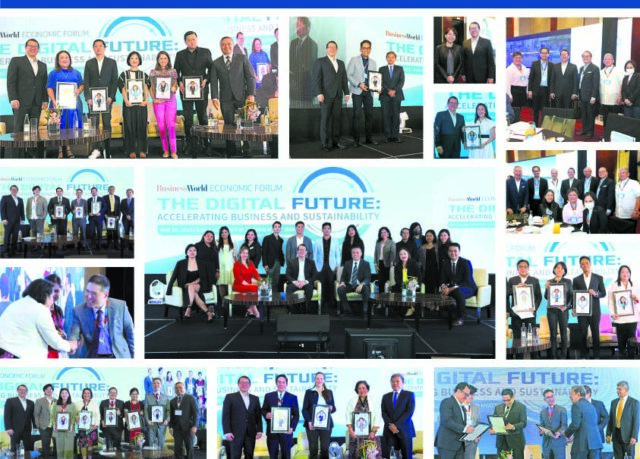
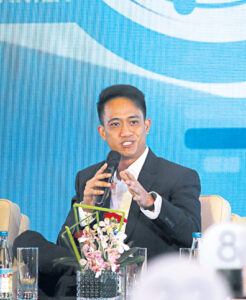

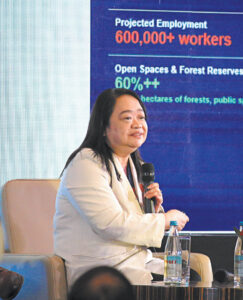


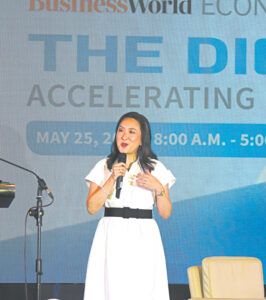
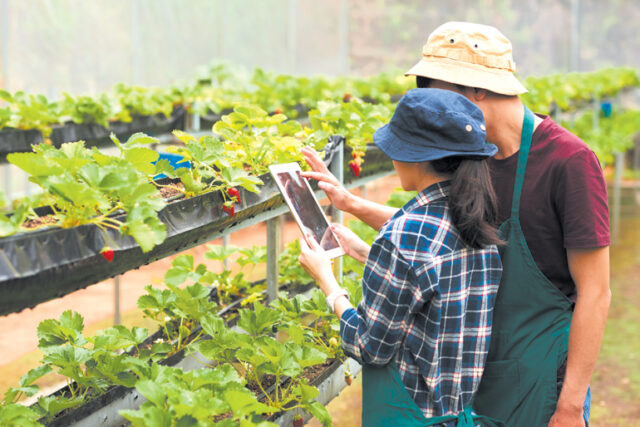


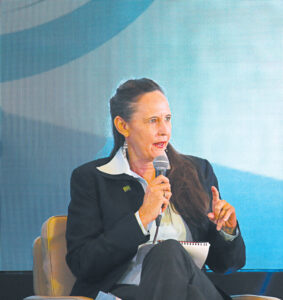
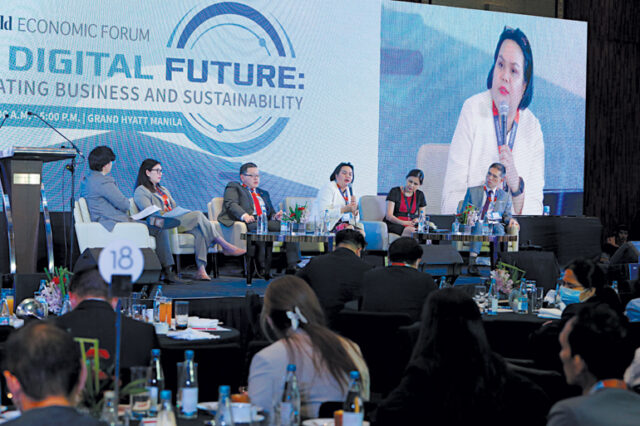

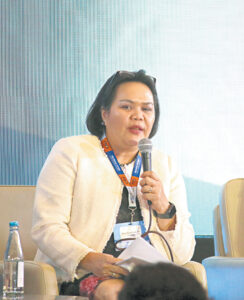
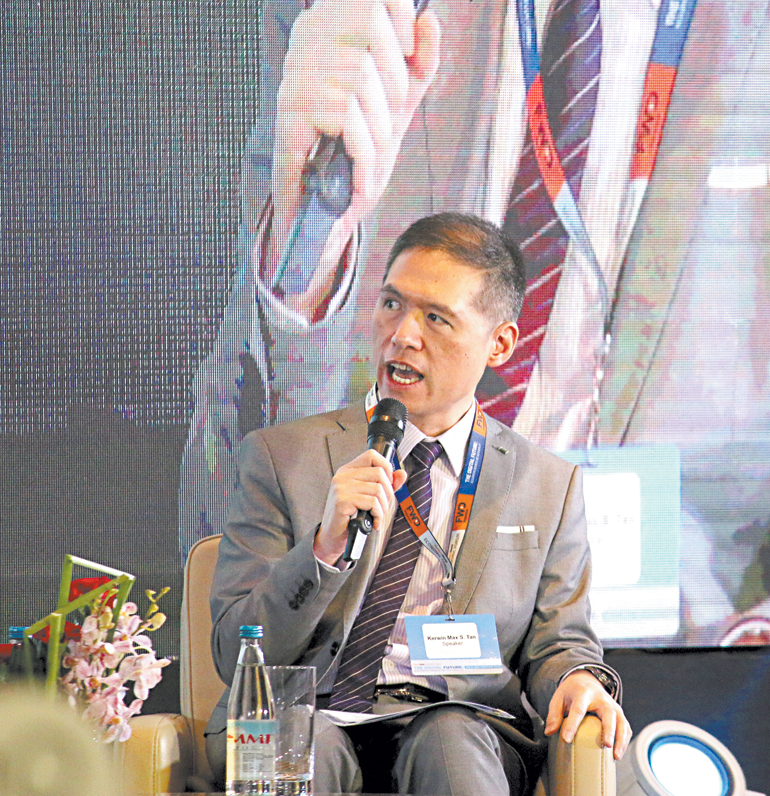
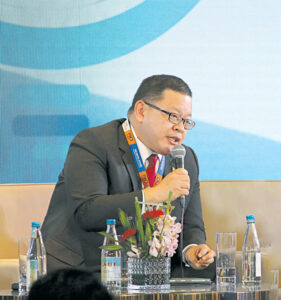
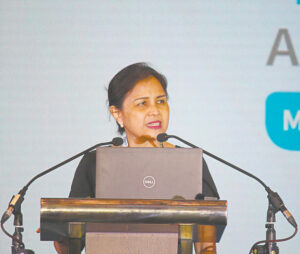

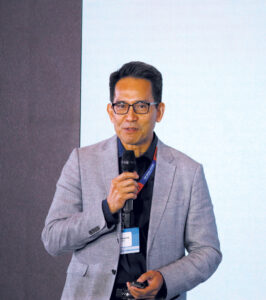
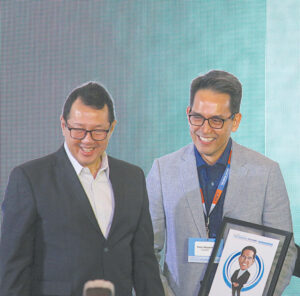


 Additionally, nChain seeks to provide assistance in digitizing processes in universities and enterprises by building a nation of blockchain professionals, technical experts, consultants, entrepreneurs and educators. To this end, the company has also signed an MoU with the Ateneo de Manila University to help promote blockchain research and education.