Home Blog Page 4707

FDI plunges on global recession fears

PEXELS-PIXABAY

By Keisha B. Ta-asan, Reporter

FOREIGN DIRECT investments (FDI) in the Philippines fell in March as recession fears and slower global trade dampened investor sentiment, the Bangko Sentral ng Pilipinas (BSP) said on Tuesday.

FDI net inflows declined by 30.7% to $548 million in March from $792 million a year earlier, data from the central bank showed.  These were 47.6% lower than $1.05 billion in February.

It was the lowest monthly FDI net inflow since $448 million in January.

Net Foreign Direct Investment“The decline resulted from lower net inflows across all major FDI components amid investor concerns over subdued global growth prospects,” the BSP said in a statement. 

Analysts attributed the decline in FDI net inflows to recession fears.

“The European Union has entered a technical recession already, which could affect companies’ interest in expanding,” China Banking Corp. Chief Economist Domini S. Velasquez said in a Viber message. “Likewise, conditions remain tight in export-driven economies such as Singapore.”

The gross domestic product (GDP) in the European Union fell by 0.1% in the first quarter after contracting by 0.1% a quarter earlier.

A country enters technical recession when it posts two straight quarters of economic contraction.

ING Bank N.V. Manila Senior Economist Nicholas Antonio T. Mapa said investment pledges made in the past months likely haven’t materialized yet, causing the decline in FDI inflows.

BSP data showed nonresidents’ net investments in debt instruments of local affiliates plunged by 37.2% from a year earlier to $389 million in March.

Investments in equity and investment fund shares also dropped by 7.3% to $159 million.

Nonresidents’ net investments in equity capital, excluding reinvestment of earnings, fell by 11.7% to $94 million.

Equity capital placements inched down by 2.5% to $115 million, while withdrawals surged by 80.3% to $21 million.

The equity placements were mainly from Singapore, Japan and the United States. These were invested mostly in the manufacturing, information and communication, and real estate industries.

Reinvestment of earnings slipped by 0.1% to $65 million year on year in March.

For the first quarter, total FDI net inflows fell by 19.6% to $2.04 billion from $2.54 billion a year earlier.

Foreign investments in debt instruments dropped by 22.1% year on year to $1.58 billion.

Investments in equity and investment fund shares likewise declined by 9.9% to $463 million.

Net foreign investments in equity capital went down by 15.9% to $261 million. Equity capital placements inched up by 6.9% to $377 million, while withdrawals more than doubled to $115 million.

Most of these placements were from Japan, Singapore and the United States.

Reinvestment of earnings dipped by 0.7% to $202 million during the quarter.

“Even with lower net FDI in the first quarter, we remain hopeful that hard-earned structural reforms will eventually boost investments to the country,” Ms. Velasquez said.

The government last year amended the Public Service Act to allow companies in sectors such as telecommunications, airlines, railways and shipping to be fully owned by foreigners.

Other measures that seek to attract more foreign investments into the Philippines include changes to the Retail Trade Liberalization Act and Foreign Investment Act.

“Even if 2023 and the first half of 2024 will be driven by bleaker-than-expected investor sentiment, investment potential in the Philippines remains strong in the medium to long term,” Ms. Velasquez added. 

Mr. Mapa expects a turnaround in investment inflows in the coming months as the Philippine economy remains robust.

Economic output grew by 6.4% in the first quarter, slower than 8% a year ago. Still, it was within the government’s 6-7% target for the year.

The central bank expects FDI net inflows to reach $11 billion this year.

May vehicle sales climb amid strong demand

PHILIPPINE STAR/MIGUEL DE GUZMAN

VEHICLE SALES increased by 44.8% year on year in May amid strong market demand across all segments, industry data released on Tuesday showed.

A joint report by the Chamber of Automotive Manufacturers of the Philippines, Inc. (CAMPI) and Truck Manufacturers Association (TMA) showed that vehicle sales rose to 38,177 units from 26,370 units sold a year earlier.

“The growth of new motor vehicle sales in May with a nearly 45% increase is definitively driven by high market demand, recording double-digit growths across all segments from the figures last year,” CAMPI President Rommel R. Gutierrez said in a separate statement. 

Auto salesCommercial vehicle sales rose by 46.3% to 28,385 units, contributing 74.35% to the May total. The segment’s sales were led by light commercial vehicles, which rose by 45.7% to 22,418 units, followed by multipurpose vehicles or Asian utility vehicles (AUVs), which jumped by 55.9% to 5,099 units sold. 

Passenger car sales made up the remaining 25.65% market share, with units sold rising by 40.6% to 9,792.

May vehicle sales were up by 24.6% compared with 30,643 units sold in April. Sales of commercial vehicles and passenger cars were also higher by 21.7% and 33.8% month on month. 

For the first five months, vehicle sales rose by 31.5% to 166,104 units from 126,273 units sold a year earlier, led by the commercial vehicle segment. 

Sales of commercial vehicles in January to May climbed by 31.2% to 124,242 units. The segment’s sales were headed by light commercial vehicles, which increased by 25.6% to 95,520 units, and multipurpose vehicles or AUVs, which went up by 64.3% to 24,408. 

Passenger car sales also rose by 32.7% to 41,862. 

Toyota Motor Philippines Corp. had the highest sales among car brands in the five-month period, with a 46.47% market share and 77,194 units sold. 

Other leading brands were Mitsubishi Motors Philippines Corp. with 30,200 units sold (18.18% share), Ford Motor Company Philippines, Inc. with 11,108 units (6.69%), Nissan Philippines, Inc. with 10,808 units (6.51%), Honda Cars Philippines, Inc. with 7,340 units (4.42%) and Suzuki Philippines, Inc. with 7,050 units (4.24%). 

Mr. Gutierrez said the improved performance of the local vehicle industry puts it on track to hit its sales target of 395,000 units for this year. 

“The steady year-on-year growth recorded in the first five months gives the industry a reason to be even more optimistic and grateful at the same time as attaining its growth forecast this year felt even closer to reality and proves rather possible,” he said. 

“The industry also welcomed the country’s sustained economic improvement in major economic sectors, which remains an important factor towards economic and market conditions that are favorable for the industry and consumers alike,” Mr. Gutierrez added. — Revin Mikhael D. Ochave

Maharlika fund has ample safeguards against risks, economic managers say

ANGIE REYES-PEXELS

THE MAHARLIKA Investment Fund (MIF) has “enough safeguards” in place to manage potential risks, the country’s economic managers said in a joint statement on Tuesday.

“Senate Bill No. 2020 imposes enough safeguards to minimize risks for shareholders and fund contributors, including the public sector,” according to the joint statement of the Bangko Sentral ng Pilipinas (BSP), Department of Finance, Department of Budget and Management (DBM), and National Economic and Development Authority (NEDA). “These are more than what an average investor would need to comply with.”

“The MIF is not only beneficial but necessary at this point in time. While the Philippines can offer investment opportunities, given that we are still a growing economy, we see that the cost of debt has risen, making the need to explore vehicles to attract equity financing such as MIF urgent,” they added.

Congress last month approved the bill creating the sovereign wealth fund, which is now awaiting President Ferdinand R. Marcos, Jr.’s signature.

The economic managers cited the fund’s adherence to the Santiago Principles, a set of 24 best practices for sovereign wealth funds.

The board members of the Maharlika Investment Corp. (MIC), which controls the fund, will also face stringent qualifications.

“A person who has pending cases relating to fraud, plunder, corrupt practices, money laundering, tax evasion, or any crimes involving misuse of money or breach of trust would be disqualified from being appointed to the board,” the economic managers said.

“Further, board members shall be bonded for the faithful performance of their duties and accounting of all funds and public properties in his/her custody,” they added, noting that board members must secure a fidelity bond worth P10 million. “The penalties for offenses were also increased to ensure that the same is commensurate with the gravity of the offense. Hence, the amended bill imposes imprisonment as a penalty for certain offenses.”

The MIC board will also create a risk management committee that ensures the fund will “achieve a prudent balance between risk and reward in both ongoing and new business activities, taking careful consideration of risk identification, measurement, assessment, mitigation, reporting and monitoring.”

There will also be an advisory body consisting of the Budget secretary, NEDA secretary and national treasurer, as well as a joint congressional oversight committee composed of seven members each from the House of Representatives and Senate.

The MIC will also make available to the public its investment policies, risk management plans, activities, terms and conditions with co-investors and joint venture partners, and financial statements, among other documents.

The economic managers also noted other safety provisions in the bill, such as preventing pension and social funds from contributing to the fund.

“This absolute prohibition is a fiscal risk management measure to ensure that fiscal resources, particularly pension and social funds managed by the Social Security System and Government Service Insurance System, and other pension and social funds are used solely for the purpose for which they were created (i.e., to cater to specific needs of the respective individual members,” they said.

As for the contributions of the National Government to the initial financing of the MIF, they said the money would not come from the budget.

“Prior to the inclusion of provisions on the funding of the MIF, the founding government financial institutions (GFIs), the National Government and the BSP were consulted on their financial viability to support the capitalization of the MIC in its initial years,” the economic managers said.

“The National Government contribution only pertains to the seed fund and the contributions of the National Government to the MIC shall not be taken from any of the programmed or even unprogrammed appropriations in the national budget,” they added.

Under the bill, the MIC will be funded by contributions from Land Bank of the Philippines (LANDBANK) worth P50 billion and Development Bank of the Philippines (DBP) worth P25 billion.

The National Government will also contribute P50 billion.

The BSP is also tasked to contribute 100% of its dividends in the first two years.

Funds may also be taken from Philippine Amusement and Gaming Corp.’s income and privatization proceeds.

The economic managers said the fund aims to boost returns and optimize government assets.

“The main advantage of the MIF over government financial institutions is that it can maximize returns because it is allowed to undertake more investment options. In contrast, investible funds of GFIs are concentrated in low-risk investments such as government securities which are less volatile but have low levels of return,” they said.

Investments in the MIC will allow GFIs such as LANDBANK and the DBP to obtain returns higher than their 10-year average return, they added.

“The public can remain confident in the stability of LANDBANK and DBP even, given their investment in the MIC. Limitations have also been established, i.e., investments should not exceed 25% of their net worth,” the economic managers said.

The fund will also “widen fiscal space” because it will help the government rely less on development assistance, borrowings and new taxes.

“Further, the MIC may invest in capital markets (with an emphasis on generating financial returns) or sectoral investments (with an emphasis on generating economic returns) as a matter of investment strategy and policy that the lawmakers wisely afforded to the MIF board,” they added.

The economic managers also clarified the objective of the fund, which is to “execute and sustain high-impact infrastructure and development projects, ease fiscal constraints and maximize expected returns for our country’s investments.”

Investments will be focused on financial instruments, real property, and physical and digital infrastructure, they added.

“By pooling the investible funds of select GFIs and channeling them into diversified financial assets and development projects, the MIF aims to obtain the optimal absolute return and achievable financial gains on its investments, preserve and enhance the long-term value of the fund and promote economic development,” they said.

They also cited some international entities that had expressed interest in the fund, including the Japan Bank for International Cooperation and several US investors.

Finance chief Benjamin E. Diokno earlier said the President would likely sign the bill before his second state of the nation address in July.

He also said the fund is expected to be fully operational by the end of the year. — Luisa Maria Jacinta C. Jocson

SBL hike may expose banks to more risks

ANDREA PIACQUADIO-PEXELS

INCREASING the single borrower’s limit (SBL) as part of efforts to boost sustainable finance could expose lenders to more risks, the Bangko Sentral ng Pilipinas (BSP) chief said on Tuesday.

BSP Governor Felipe M. Medalla said the central bank might raise the SBL to encourage banks to support sustainable initiatives. 

“The main concern there is by lifting the single borrower’s limit, we also expose the banks to bigger risks,” he said in his keynote speech during the BSP’s international research fair.

“We believe that by fostering trust and providing clear guidance, we can mitigate uncertainties and anchor expectations, thereby enhancing the effectiveness of policies,” he added.

The BSP wants to hike banks’ SBL by 15%, which will only be for loans meant to finance green projects, based on a draft circular released last week.

The SBL is a ceiling on the amount of loans, credit accommodations and guarantees a financial institution can extend to one borrower, which is meant to prevent over-concentration of risk.

Mr. Medalla said they are not keen on mandating banks to lend a certain amount for sustainable projects because the policy “does not work.”

“We mandated credit for agriculture [and] for lending to medium- and small-scale industries, but the banks just decided to pay the penalties. So clearly, there must be other ways of supporting sustainable finance,” he said.

Lenders are mandated by Republic Act 6977 or the magna carta for micro-, small-, and medium-sized enterprises to allocate 10% of their credit portfolio to small businesses.

Meanwhile, the Agri-Agra Credit Act of 2009 requires banks to lend 15% of their loan book to the agriculture sector, with a 10% quota set for agrarian reform beneficiaries.

However, banks have long opted to incur penalties for noncompliance instead of taking on the risks associated with lending to small businesses and the agri-agra sectors.

Mr. Medalla said it is important to address climate change because the Philippines is one of the most vulnerable to its adverse effects.

“So, we implemented our Sustainable Central Banking Strategy as part of our contribution to the whole-of-government approach to climate change,” he said.

The BSP launched its 11-point Sustainable Central Banking Strategy in January, which provides action points for integrating sustainability principles in its key operations and functions.

Any increase in banks’ SBL will lead to an equal increase in the risk exposure of banks, particularly in credit and concentration risks, Rizal Commercial Banking Corp. Chief Economist Michael L. Ricafort said in a Viber message.

“Thus, it is a delicate balancing act on the cost-benefit trade-offs between encouraging more lending to finance more sustainable projects while effectively managing the concentration/credit risks in the banking system,” he said.

Credit risk is the likelihood that a borrower may default on a loan, while concentration risks are those posed by exposures that have the potential to result losses large enough to threaten the operations of a bank.

“Another option would be allowing loans to finance sustainable projects for other alternative compliance,” Mr. Ricafort said. — K.B. Ta-asan

PLDT unit to raise $150-M fresh funds for Maya

PLDT Inc.’s Voyagers Innovations, Inc. is looking to raise up to $150 million in fresh funds this year to strengthen its integrated money platform, Maya, its chairman said.

“I think there’s an effort to raise some money, around $100-150 million,” said Manuel V. Pangilinan, who chairs the listed telecommunications company, on the sidelines of its annual stockholders’ meeting on Tuesday.

“I think the focus of attention is new stockholders but given market conditions, I think the existing stakeholders may have to participate for a portion,” he added.

Mr. Pangilinan said Voyager is currently negotiating with potential foreign investors to raise the funds, while PLDT is also expected to participate.

“Maya is under Voyager, so the fundraising will be done on the Voyager level. We don’t know yet how much money can be raised from third parties and from the existing stakeholders,” he said.

Aside from PLDT, existing investors in Maya include KKR & Co., Tencent Holdings Ltd., International Finance Corp. (IFC), IFC Emerging Asia Fund, IFC Financial Institutions Growth Fund, SIG Venture Capital, EDBI, and First Pacific Co. Ltd.

INITIAL PUBLIC OFFERING
Meanwhile, PLDT President and Chief Executive Officer Alfredo S. Panlilio said the market listing of Maya is being considered.

“Of course, the plan eventually is to consider that, but I think [we have to] really improve the fundamentals of the bank first,” said Mr. Panlilio.

“We are pushing very hard on deposits, loans, and loan books. They are coming out with micro-, small-, and medium-sized enterprise (MSMEs) offerings also, [and] some more offerings. But I think strengthening the bank first is the objective,” he added.

Mr. Pangilinan said Maya has been growing its deposits in recent months, especially in May and June.

“They have been growing their deposits in a significant way. Sometime in April, their deposit levels reached P26 billion. I’m sure in the months of May and June that continues to grow,” Mr. Pangilinan said.

“The problem has been really addressing their loan book although they have been increasing their loan disbursements in the recent months. It’s expected by year-end they should be earnings before interest, taxes, depreciation, and amortization (EBITDA) positive, the bank as a whole,” he said.

“As indicated, they need to develop more loan products that can address not only individuals but also MSMEs,” he added.

Meanwhile, the digital bank is expected to positively contribute to PLDT in the next two to three years.

“I think it will be led by the enterprise part of the business — merchant acquiring — and by the bank and that’s if they are able to grow that loan book because they had a problem growing their deposits level. They have a lot of money to lend, so they should be able to do that in time,” Mr. Pangilinan said said.

On Tuesday, PLDT shares slipped by 0.78% or P10 to P1,270 each.

Hastings Holdings, Inc., a unit of PLDT Beneficial Trust Fund subsidiary MediaQuest Holdings, Inc., has a majority stake in BusinessWorld through the Philippine Star Group, which it controls. — Justine Irish D. Tabile

Manifestations of chaos

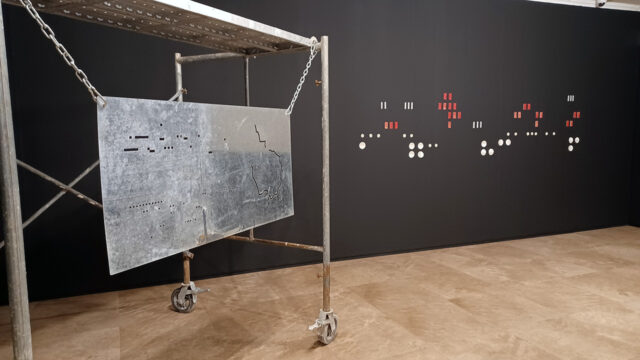
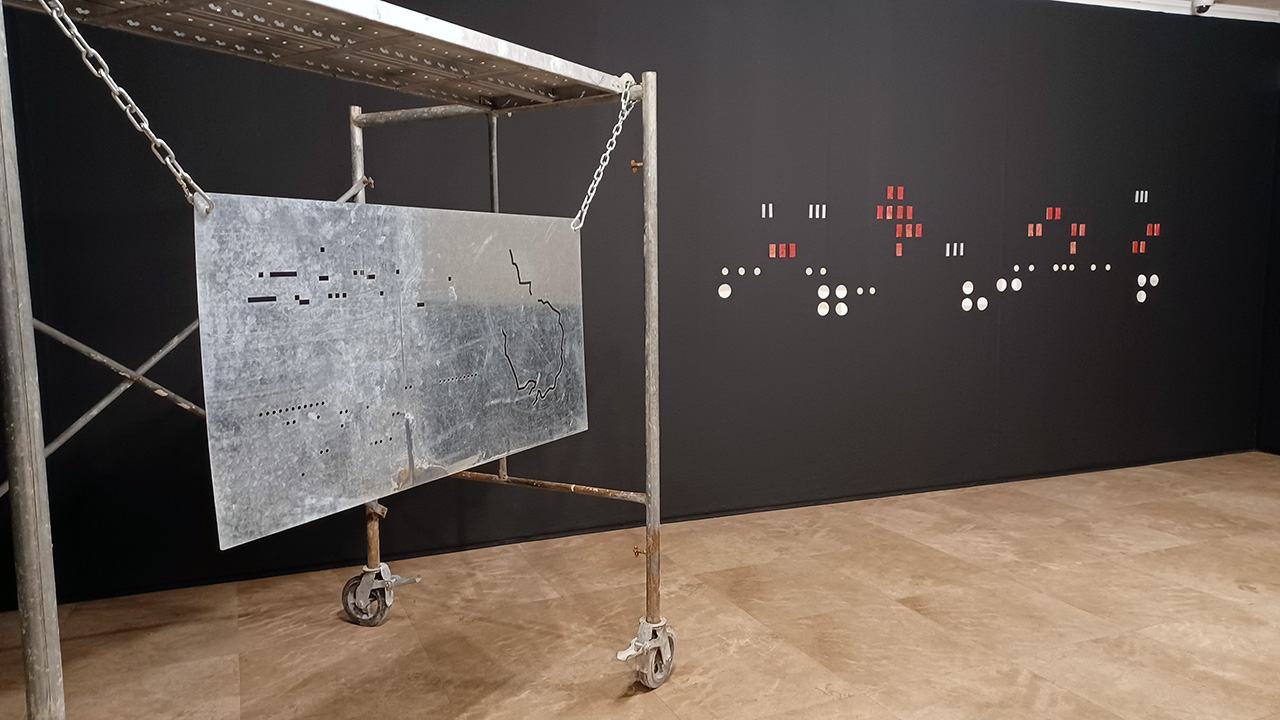
SOUND ARTIST Jett Ilagan’s “Animated_Landscape”. —BRONTË H. LACSAMANA

THE INTRICACIES of the world we navigate are difficult to convey, whether they exist largely in our heads or are at full force in the environment in which we move around. At the NCCA Gallery, visual and multi-sensorial representations of the chaos of the mind and of urban landscapes are on display.

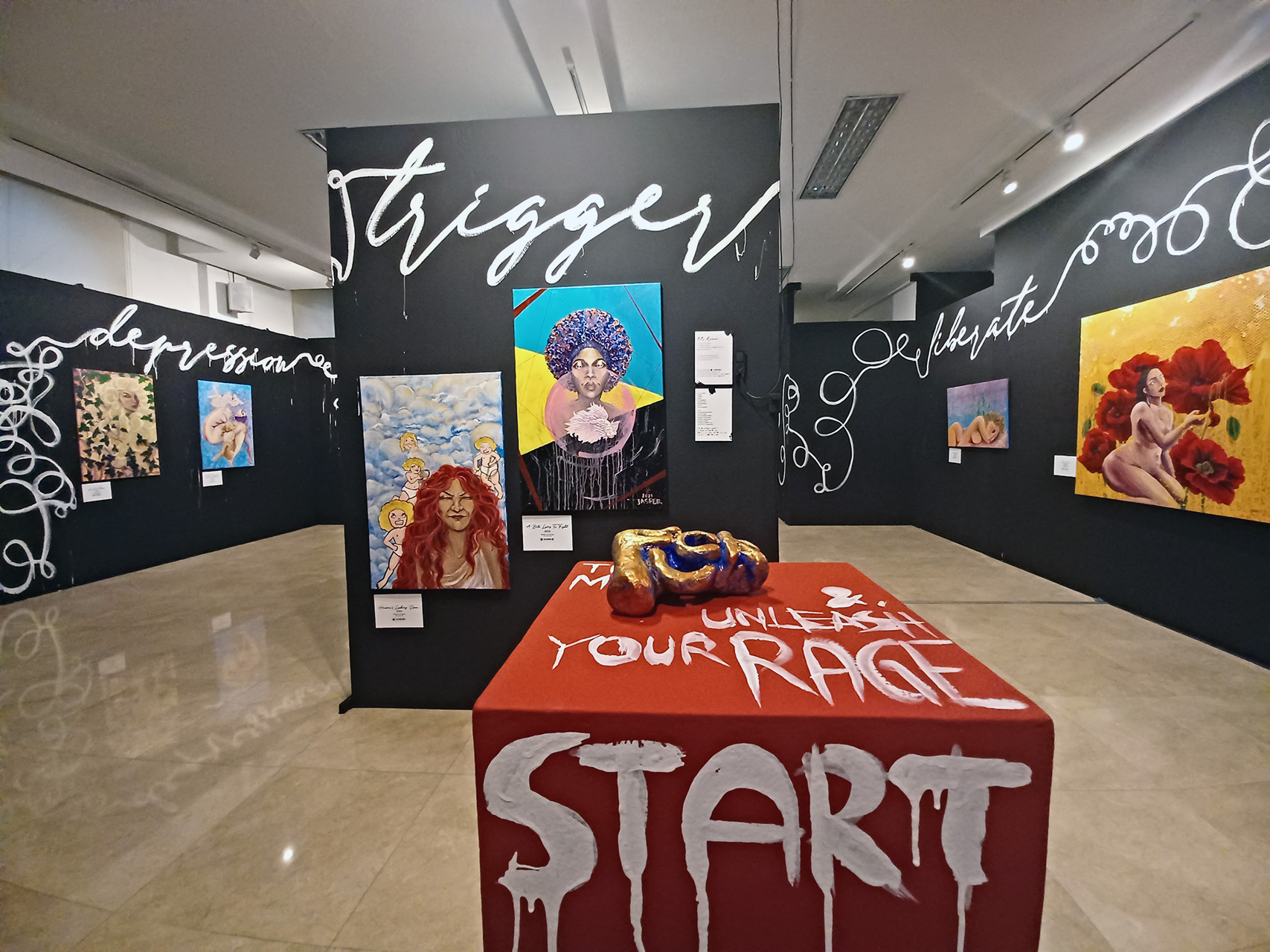
Titled “The Artist Is Alive,” contemporary artist Jasper Hannah Castro’s very first exhibit uses paintings, music, and sound to divulge both the scars and triumphs reflecting her experience of bipolar disorder.

Meanwhile, “Animated_Landscape” is sound artist Jett Ilagan’s exhibit that presents Manila’s sonic landscape through graphical notations — from busy streets to modes of transportation — visually communicating its urban rhythms.

These two featured artists were chosen a year ago under the Exhibition Grants Program of the National Commission for Culture and the Arts (NCCA), giving them the chance to execute their concepts. “My goal is empathy. People think if you get diagnosed [with bipolar disorder], life will end. Though it’s not a death sentence, it is a struggle and it is hard. I think that’s why there are more pieces that are sad than happy,” Ms. Castro said during the exhibit’s launch on June 7.

She plays with multiple forms to explore the nuances of the bipolar experience within the context of a gallery space. The poetry, music, and artworks bare her innermost thoughts, including swear words and sexual content.

Jokingly, she shared that her goal is for people to be moved to tears as they immerse themselves throughout the space.

“Those are the parts we try to hide but it’s also during those times we get to form really close relationships. If everyone was in tiptop shape and amazing with no vulnerabilities, we wouldn’t have a reason to depend on each other,” said Ms. Castro.

Meanwhile, Mr. Ilagan’s installation portrays the soundscape of Metro Manila based on recordings he took while cycling or during his commute. The abstract result conveys how challenging it is to move in the city.

“Each artwork is a different location in Metro Manila, like along Pasig River or right by the train. But instead of having sound works or audible works, I chose to explore visual works related to sound,” he said.

Because of his background as a music producer and sound artist, Mr. Ilagan felt that depicting the complex sonic environment through graphical notations was “an extension of his body of work.”

“It’s part of the exploration. I don’t consider it as a separate practice, but a result of my overall experience,” he explained.

The NCCA regularly offers exhibition space for artists to push the boundaries of their creative expression, with all curatorial support services covered.

“The Artist is Alive” and “Animated_Landscapes” are on view at the NCCA Gallery in Intramuros, Manila, until June 30.  Brontë H. Lacsamana

DMCI unit to spend P18.6B for property projects

DMCI Project Developers, Inc. (DMCI Homes) has set aside P18.6 billion for this year’s development and land acquisitions as it plans to build new formats for projects in acquired properties in Batangas, Bulacan, Laguna, and Pampanga, it said on Tuesday.

In a regulatory filing, Consunji-led DMCI Holdings, Inc. said its real estate subsidiary’s capital expenditure for 2023 will be higher by 18% than the P15.8 billion allotted in the previous year.

This year, DMCI Homes is planning to develop leisure, condotel and township projects after recording a 49% increase in its Luzon land bank to 96.9 hectares from 65.1 hectares the previous year.

The mid-segment property developer’s first leisure project will be Solmera Coast, a condotel set to launch this month in San Juan, Batangas.

“We recognized a demand for leisure properties and saw it as an opportunity to expand our product line. By offering quality and best value in this market, we hope to duplicate the success of our core residential line,” DMCI Homes President Alfredo R. Austria said in a statement.

The Asian tropical-inspired condotel project will be under the company’s DMCI Homes Leisure Residences segment and is expected to launch this month.

Under the condotel format, the condominium units will be owned by individual investors who will then rent out their units to guests, the company said.

“This business model allows the company to generate revenues from both the sale and rental of the units,” it said. “Buyers, in turn, can use the unit as a vacation home and receive a share in the rental revenue, which can help offset the cost of ownership.”

DMCI Homes is also set to launch a Japanese-inspired nature park in Laguna and a mountain resort in Benguet, under its leisure brand. It has yet to disclose details of the project.

“DMCI Homes Leisure Residences is for buyers who want to invest in premium properties that provide one-of-a-kind experiences and attractive returns,” Mr. Austria said.

In the first quarter, DMCI Homes’ capital spending reached P4.2 billion, a 27% rise from the P3.3 billion the previous year, which was mostly allotted for project development.

During the quarter, the company posted a 20% decline in net income to P1.16 billion from P1.45 billion in the same period last year.

Revenues fell by 18% to P4.85 billion from P5.95 billion due to higher sales cancellations and fewer prior-year sales that qualified for recognition.

DMCI Holdings has investments engaged in construction, real estate, coal and nickel mining, power generation, and water distribution. Its shares fell by 0.41% or four centavos to P9.67 apiece on Tuesday. — Adrian H. Halili

A rediscovery of Philippine history and heritage

THE CASA Manila Museum along General Luna St. in Intramuros

IT WAS a rainy Wednesday morning in Intramuros when media guests and casual tourists alike embarked on a cultural tour days ahead of the Philippines’ 125th Independence Day.

However, the rain didn’t stop people from exploring the Walled City, known as such for its 4.5-kilometer-long fortifications surrounding about 64 hectares.

Aside from being a trade center between Europe and Asia and the seat of the Roman Catholic Church in the country, it was (and still is) home to some government offices and well-known universities.

The city was named “Intramuros” which means “within the walls,” said the tour guides from the Intramuros Administration (IA).

Established in 1979 through Presidential Decree No. 1616, which declared the site a “monument to the Hispanic period of Philippine history,” IA is responsible for Intramuros’ restoration and development.

This is what led IA to partner with travel and leisure booking platform Klook to launch the Klook Intramuros Pass, a tour pass featuring many of the walled city’s iconic attractions, in time for Independence Day.

“Our mission is to protect and conserve the historical and cultural value and significance of Intramuros, as we believe in the importance of being knowledgeable of our nation’s history,” said lawyer Joan Padilla, administrator of Intramuros, at the press launch at Ilustrado Restaurant.

“Partnering with Klook gives not just Filipinos but foreigners access to the rich history of the different historical hotspots Intramuros has to offer,” she added.

The Klook Intramuros Pass lets one choose at least three and at most six of seven attractions in the city to visit. Depending on the package selected, it can cost anywhere from P215 to P1,350.

The options are:

* Fort Santiago
* Casa Manila Museum
* Museo de Intramuros
* Baluarte de San Diego
* Heirloom Filipiniana and Barong Rental; and,
* A premium add-on of either the BamBike Tour or White Knight Electric Chariot Tour.

Armed with umbrellas, the media guests visited the first three spots (which, with the pass, would cost just P215) amid the turbulent weather. Despite that, many other visitors were also still exploring the area to learn about their history, proving the beauty and allure of the sites.

As per the IA’s tour guides, this was standard and unsurprising since Intramuros attracts many people all year round, rain or shine. More than a million visitors explore Manila each year, many of whom go to the walled city, according to the Department of Tourism.

Michelle Ho, general manager of Klook Philippines and Thailand said that beyond leisurely benefits, travel has “the power to connect us to our roots, allowing us to delve deeper into the story of our ancestors, ultimately fostering a sense of national pride.”

“By bringing the Intramuros Pass online via the Klook platform, we aim to make it easier and even more convenient for everyone to explore more of Manila and the rich history behind these iconic walls around Intramuros,” she said.

Klook is offering a Buy 1 Take 1 promo for the first 100 customers availing of the new Klook Intramuros Pass from June 8 to June 18. — Brontë H. Lacsamana

Globe cautions public against rising OTT scam messages

By Justine Irish D. Tabile, Reporter

GLOBE TELECOM, INC. warned the public against the rising number of spam and scam messages using over-the-top (OTT) media services that are outside the scope of telecommunications companies’ filters.

“While spam and scam messages have seen a decline since the SIM (subscriber identity module) Registration Act was enforced, fraudsters continue to find new ways to target phishing victims, taking advantage of popular OTT platforms such as chat apps to evade telco filters,” said Globe in a press release.

“These fraudsters use both overseas and local numbers and mostly appear as business accounts with attractive profile photos to dupe people,” it added.

Cybercriminals now use the target’s full name and pretend to be messaging a missed connection or making various offers, the company said.

Anton Bonifacio, chief information security officer at Globe, said scammers are now capitalizing on the shift to a more digital lifestyle of consumers.

“Embracing the digital world comes with its own set of risks, so we must remain vigilant in safeguarding our online presence. As technology advances, so do the tactics of fraudsters and scammers. The best way to combat this is to never engage with these messages and to block such senders immediately,” Mr. Bonifacio said.

He added that because OTT messages are beyond the telcos’ scope, awareness remains to be the first line of defense of customers.

“By staying informed and adopting personal security measures, we can navigate the digital landscape with confidence and protect ourselves from evolving cyber threats,” he said.

Ivan John E. Uy, secretary of the Department of Information and Communications Technology (DICT), said OTT platforms have pros and cons such as being free and encrypted.

“The intent of their product is to assure secure communications. But of course, those secure communications are good, if they are used for good. But the criminal organizations are also utilizing those same communications, even the terrorist organizations are using these secure communications,” he said in a chance interview on Friday.

“So, the challenge really is for the government to work together. And we cannot do it with a single country. In fact, during my meeting with the ASEAN ICT ministers a few days ago, we tackled this very particular problem of OTT providers of communications and how these are being used for scams,” he added.

Mr. Uy said that what the ASEAN Information and Communications Technology (ICT) ministers observed is that when a country talks to an OTT platform individually, the problem raised is not being acted upon.

“So, with the ASEAN and European Union ICT ministers, we are working on a joint effort in coming out with a regional position where we are going to address this and talk to these OTT providers,” he said.

“We will have to nip this in the bud once and for all, and there are also other options being studied not just by our country but by all the different countries already,” he added.

One of the bargaining chips being considered by Mr. Uy and ASEAN’s ICT ministers is to ban an OTT platform in their areas if there will be no action done on its part.

“All the different governments are going to unify and address this, so there will be more force. Imagine if the whole ASEAN, which has 700 million population, will talk to a provider and say, ‘Either you step up and protect our citizens from all these cyber scams or we’re going to order a ban on your social media platforms across all ASEAN.’ That is the kind of bargaining chip that we are looking at because if we do it individually, it will not be addressed,” he said.

Allied Care Experts (ACE) Malolos Doctors, Inc. to hold Annual Stockholders’ Meeting on Aug. 15


Spotlight is BusinessWorld’s sponsored section that allows advertisers to amplify their brand and connect with BusinessWorld’s audience by enabling them to publish their stories directly on the BusinessWorld website. For more information, send an email to online@bworldonline.com.

Join us on Viber at https://bit.ly/3hv6bLA to get more updates and subscribe to BusinessWorld’s titles and get exclusive content through www.bworld-x.com.

Arts & Culture (06/14/23)


Toym Imao’s jeeps at Lucky Chinatown

Megaworld Lifestyle Malls’ Lucky Chinatown in Binondo, Manila features a giant jeepney installation from artist Toym Imao as part of its tribute to the 125th Independence Day of the Philippines. Originally intended as a heartfelt tribute to the resilient jeepney drivers impacted by the pandemic, the country’s biggest jeepney installation made out of yarn returns as a symbol of Philippine culture and perseverance — the perfect centerpiece for the mall’s grand Independence Day exhibit. The iconic jeepney is joined by more nostalgia-driven art pieces depicting Filipino traditional games from Project Hulmahan at the atrium of Lucky Chinatown. The exhibits will be on view until June 18.


Araneta City opens ‘Tanggulan’ exhibit for Pride Month

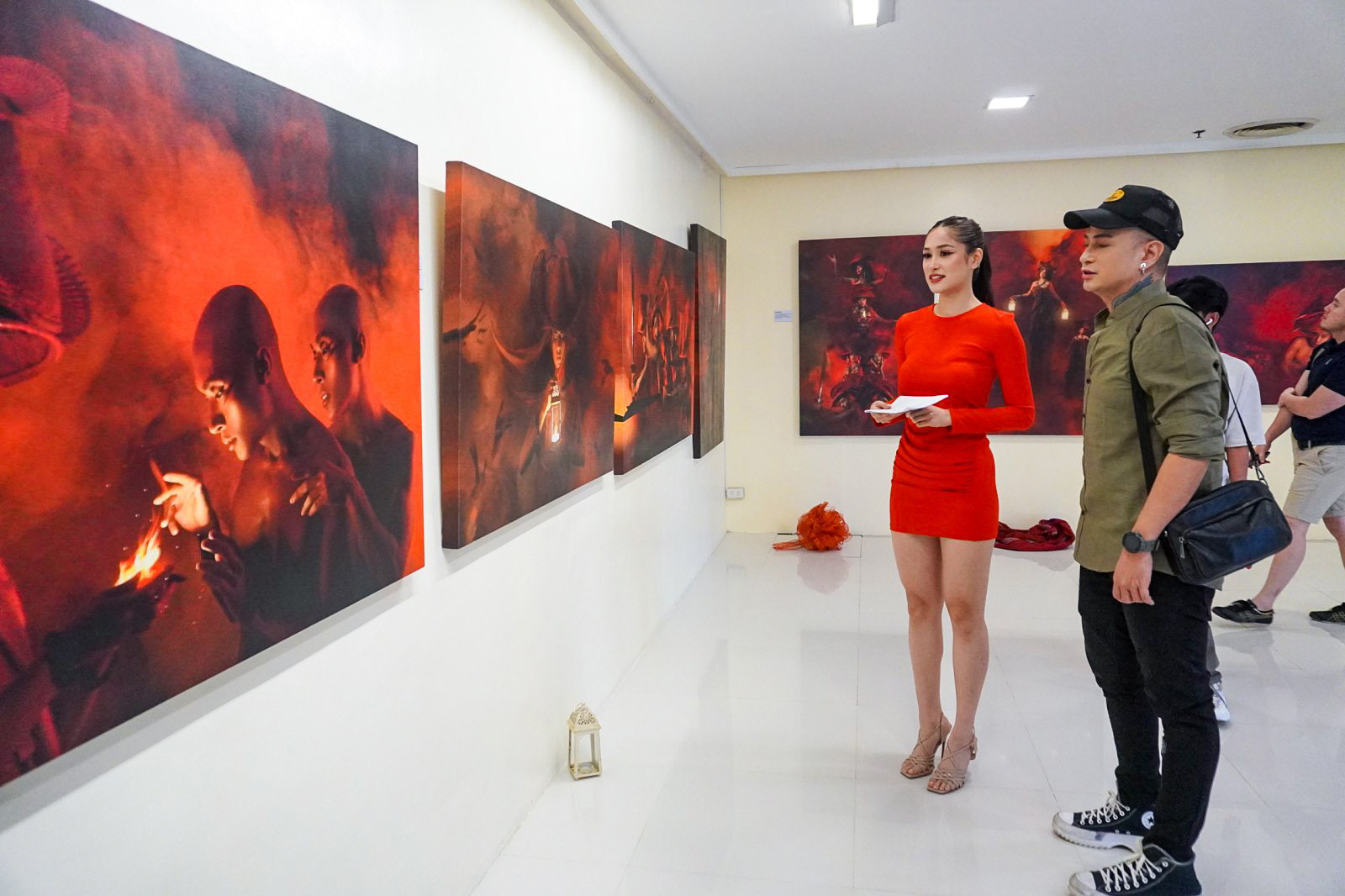
In line with the celebration of Pride Month, Araneta City brings the “Tanggulan” art exhibit to help raise HIV-AIDS awareness. The exhibit features 10 portraits of HIV-AIDS awareness advocates photographed by Niccolò Cosme, all printed on canvas and painted with emulsified HIV+ blood. It is on view at the Gateway Gallery Studio. The portraits depict the fight for the rights of people living with HIV, with the models wearing warrior-like ensembles interpreted by designer Myke Oropesa. They were styled with accessories like sarong fabrics, salakot headgear, and kampilan swords. Among the models are Binibining Pilipinas 2022 Miss International Nicole Borromeo, and Miss Universe 2015 Pia Wurtzbach-Jauncey. Mr. Cosme is a visual artist, conceptual photographer, and the founder of Project Headshot Clinic (HSC) a digital platform that utilizes thematic headshots to further featured advocacies. His art inspiration is rooted in the pain and sorrow in Christian iconography. He uses art to further LGBTQIA+ and HIV causes in the Philippines and abroad. The Gateway Gallery Studio is an antechamber of Gateway Gallery, the art museum of Araneta City that showcases the culture and history of the Philippines. The exhibit is open for public viewing until June 18. It will then be transferred to the Ali Mall Activity Area from June 19 to 22, and the Gateway Mall Activity Area from June 23 to 30.


Free amigurumi workshop opens to the public

Turning Over New Leaves, a free crochet art workshop for ages 16 and up, is slated for Saturday, June 17. The hybrid activity aims to introduce participants to amigurumi, the Japanese art of crocheting small stuffed creatures. A portmanteau of ami, which means knitted or crocheted, and nuigurumi, a tiny plush doll, the craft has become a significant part of the Japanese kawaii movement since the 1980s. It gained popularity in the West in the 2000s. Turning Over New Leaves is a walk-through into the fundamentals of amigurumi. The session will equip the learners with the skills and techniques in creating their very own dolls. They will work with simple patterns, which they can use to kickstart their own plush plant collection or business. The workshop is organized by the Museum of Contemporary Art and Design (MCAD) of the De La Salle-College of Saint Benilde. Turning Over New Leaves will be facilitated by crochet artist Sharon See, a former film and TV production designer, she started crocheting at age 11 and has not stopped since. Turning Over New Leaves is free and open to the public. It will be conducted onsite and online on June 17, 2 p.m. Interested participants may register through bit.ly/TurningOverNewLeaves. MCAD is located at the De La Salle-College of Saint Benilde Design + Arts Campus, Dominga Street, Malate, Manila.


Ballet Philippines presents Coppelia in August

Ballet Philippines will be performing the classic comic ballet Coppelia on Aug. 4 to 6, at The Theatre at Solaire. It tells the story of Professor Coppelius’ daughter, Coppelia, who is a mystery to everyone in their small town as she sits on the balcony all day with her books and never speaks to anyone. The ballet’s heroine, Swanilda, and a group of girls break into  the house to discover the truth about the mysterious Coppelia. As it turns out, Coppelia is a doll created by the mad scientist, Coppelius. Swanilda decides that to win the love of Franz, she would impersonate the beautiful, life-like doll. Chaos ensues, but concludes with joyful dancing. Tickets are available at TicketWorld (8891-9999).


Big names, newbies join cast of Rama, Hari

Some of the hottest names in today’s music and theatre scene are taking on major roles in the hit Filipino rock opera ballet, Rama, Hari, which features direction and choreography by National Artist Alice Reyes and music by National Artist Ryan Cayabyab, with lyrics and libretto by National Artist Bienvenido Lumbera, production design by National Artist Salvador Bernal and translations by National Artist Rolando Tinio. Gian Magdangal, fresh from his awarded run in 2022’s Carousel, and operatic star Arman Ferrer play Rama, with 2020 Gawad Buhay Awardee Vien King alternating. Musical theater stars Karylle Tatlonghari and Shiela Valderrama-Martinez take on the lead role of Sita, with Nica Tupas alternating. Tackling the role of demon king Ravana are Rak of Aegis star Poppert Bernadas and Los Angeles-based musical theater actor Mathew San Jose making his Manila debut. Jonel Mojico alternates. Theater icon Audie Gemora plays King Dasaratha in all shows. Also in the cast areMiah Canton, Raflesia Bravo, Katrine Sunga, Maron Rozelle Mabana, Paw Castillo and Jon Abella. Rama, Hari is based on the ancient Sanskrit epic Ramayana which follows Prince Rama from his marriage to Sita, their 14-year banishment, and their encounters with the evil Ravana and his sister Soorpanakha. Rama, Hari is presented by the Cultural Center of the Philippines (CCP) and features the artists of the Alice Reyes Dance Philippines and the CCP’s Professional Artist Support Program, with guests from Guang Ming College, and other regional schools. There will be performances on Sept. 15 and 16 at the Metropolitan Theater of Manila, and on Sept. 22 and 23 at the Samsung Performing Arts Theater in Circuit, Makati. Select performances will feature live music performed by The Orchestra of the Filipino Youth. For season subscriptions and ticket reservations, e-mail ardancephilippinesinc@gmail.com. For more information, check @ARDancePh on Facebook, Instagram, and TikTok.


Sun Tzu’s Art of War for Pinoys

The first Filipino translation of a world-renown classic The Art of War has been released. Sining ng Pakikidigma / The Art of War (2023) offers the ancient treatise on winning conflicts in Chinese, English, and Filipino. The Chinese original has been translated into more than 200 languages since it was first written 2,500 years ago by military general, strategist and philosopher Sun Tzu. It continues to be relevant as the go-to handbook for winning strategies in confrontation and conflict, real everyday challenges for individuals and nations alike.  It is required reading by students at the Philippine Military Academy. Translation work on Sining ng Pakikidigma begun decades ago, and involved nearly a dozen people — ages 24 to 76 — who worked from different time zones. Cousins Fernando Ang, Sr. and Chua Bun Pin had written an English translation that was serialized in a Manila newspaper in 1982.  Four decades later, Mr. Ang refashioned the manuscript into the present trilingual version — Filipino, English, Chinese — to reach a broader audience. Now retired, Mr. Ang wrote the present manuscript by hand. A team of editors collaborated to choose the best Filipino equivalent for concepts expressed in the original. One of them, Teresita Ang See, says, “For the very first strategy, many used the word ‘politics’ but we chose ‘governance’ to be more accurate.” “We worked so hard on it, reconciling the many interpretations to see to it that the translation hewed to the correct nuance of Sun Tzu’s strategy,” says Ms. Ang See.  She points to the treatise as a guide not just to military strategy but offering essential life lessons. One example she highlights is the admonition: “Choose your battles. The best battle is won without resorting to fighting.” Sining ng Pakikidigma / The Art of War (in Filipino, English and Chinese), is published by Kaisa Para Sa Kaunlaran, Inc. and Kaisa Heritage Foundation, Inc. It is available at Bahay Tsinoy Shopee online store and at Kaisa office. It is available for the promo price of P300 until June 15. Regular price is P350. For more information, e-mail info@kaisa.org.ph or text/Viber 0927-760-9638. The Kaisa-Angelo King Heritage Center is at 32 Anda corner Cabildo Sts., Intramuros, Manila.


Nona Garcia at Silverlens

Silverlens Manila has two exhibits by masters of their mediums. First there is “Overland,” paintings by Nona Garcia, which is on view until July 8. With an art practice that spans two decades, Ms. Garcia continues to be recognized as one of the most prolific artists who paints after the photographic image. In Overland, her latest solo exhibition for Silverlens, Baguio City — Garcia’s adopted homeland — receives an incredible tribute in which she demonstrates a deeper bond with the lay of the land: rocks, slopes, trees, and other objects that became one with it. Her attention to detail, her interpretation of actuality, along with a deep connection to subjects that might ordinarily escape the familiar view, attest to the power of deciphering the land for what it is: a memorialization that seeks its own beauty. Also on view is “Steps” by potter Jon Pettyjohn, on view until July 8. His third solo exhibition at Silverlens, the artist advances his pursuit of personal expression within the framework of traditions and techniques to which he has dedicated himself for close to 50 years. “It is a challenge and an honor for a potter like myself to be offered a space in a prime contemporary exhibition space like Silverlens.” says Mr. Pettyjohn. “I have attempted to use my pottery skills to go a little further and say something more.” With a new series of thrown, wall-mounted platters, Mr. Pettyjohn embraces the symmetry of the potter’s wheel without constraining himself to functional works. Within these cohesive, perfectly circular forms, he has populated a diverse array of glazes and textures to create painted and relief effects that embody a spectrum. The resulting contrast between cycles of perfection and imperfection, between symmetry and distortion, also captures the artist’s experience over the last few tumultuous years. Silverlens is at 2263 Don Chino Roces Ave. Ext., Makati.


Group show at Mo_ Space

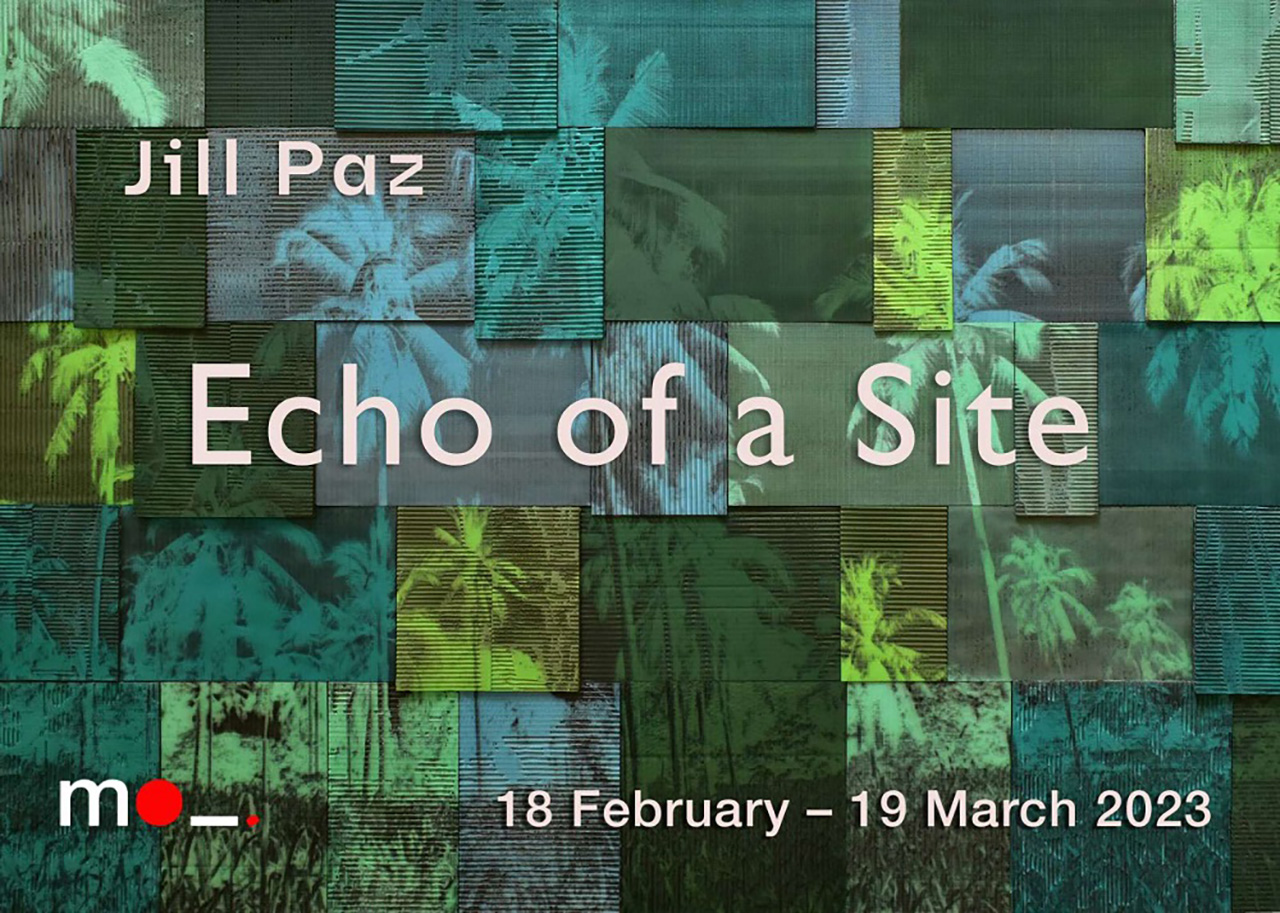
On view at Mo_Space’s Main Gallery and Gallery 2 is the group exhibit, “Live Take Feed Console Play,” curated by Cocoy Lumbao, and featuring the works of Poklong Anading, Vic Balanon, James Clar, Lena Cobangbang, Greys Compuesto, Mirjam Daline, Rico Entico, Miguel Inumerable, Cocoy Lumbao, Neo Maestro, Kaloy Olavides, Gary Ross-Pastrana, Tatong Torres, Derek Tumala, Miguel Lorenzo Uy, and MM Yu. The exhibit runs until June 10. The curator writes: “Since the late 1990s, a number of art spaces, artists, and galleries have started to organize and feature shows that focused on a medium which during that time had slowly gained prominence and interest among artists. When the world of portable video cameras and digital filmmaking found their way into the artist’s studio, it became for some an indispensable tool for exploring visual expressions. In gathering artists whose works span two decades of integrating video, film, and other digital technologies in their studio practice, the group exhibition, “Live Take Feed Console Play,” is an attempt to surveil how works on video and related formats have impacted the landscape of visual art in the Philippines, and how it could have created its own language to add to the whole taxonomy of moving-image practice across different disciplines.” The gallery, located at Bonifacio High Street, BGC, Taguig, is open daily from 10 a.m. to 7 p.m. 

SMC sees challenging year ahead

SAN MIGUEL Corp. (SMC) expects its businesses to face challenges for the rest of the year due to economic pressures and lower demand, its top official said on Tuesday.

SMC President and Chief Operating Officer Ramon S. Ang said that for the year, the company faces high inflation, fluctuating oil prices, as well as lower demand for power and food.

“Despite [these], because the company is doing everything that we can, our first-quarter [results are] still good,” he said. “If we can at least match the previous year’s performance then we would be very thankful,” Mr. Ang said during the company’s stockholders’ meeting.

Additionally, SMC Chief Financial Officer and Treasurer Ferdinand K. Constantino said that the company is optimistic about the operating environment this year.

“The general outlook is that raw material prices will be more stable this year,” Mr. Constantino said.

“With the pandemic winding down, we are also looking to sustain and further build on the gains we have already made,” Mr. Constantino added. 

During the first quarter, SMC reported a consolidated net income of P17.7 billion, up 27% from P13.9 billion in the same period last year, as it saw growth in its business segments. Its top line for the three months hit P346.7 billion, up 9% from P316.77 billion the previous year.

Meanwhile, SMC subsidiary Petron Corp. said in a regulatory filing that it set the dividend rates for its Series 4 follow-on offering at P1,000 per offer share.

Petron is offering up to 12.5-million preferred shares with an oversubscription option of 10 million shares. The company said the dividend rates are set to be issued into three subseries — series A preferred shares at 6.7079%, series B at 6.7972%, and series C at 7.0861%

It expects proceeds of up to P22.34 billion from the offer, assuming the oversubscription option is fully exercised. Proceeds will be used for the partial redemption of certain securities debt refinancing, and the purchase of crude oil.

Petron has also moved its offer period to June 15 to 17 from the initial start on June 14. The company expects to list its preferred shares on the main board of the Philippine Stock Exchange on July 7.

The company tapped China Bank Capital Corp. as the sole issue manager for the offer as well as joint lead underwriter and bookrunner alongside Bank of Commerce, Philippine Commercial Capital, Inc., PNB Capital and Investment Corp., and SB Capital Investment Corp.

On Tuesday, SMC shares declined by 0.57% or 60 centavos to P105 apiece, while Petron shares fell by 5.14% or 18 centavos to P3.32 apiece. — Adrian H. Halili