Home Blog Page 4668

Smart farming in Bukid Amara and the Agri mentors

The Agri Mentor Me Program was initiated in 2017 by Go Negosyo Founder Joey Concepcion with Arsenio “Toto” Barcelona, president of Harbest Agribusiness. Toto invited farmer friends to serve as mentors to new farmers. How ironic that farmers feed us but at times cannot even feed themselves. The farmer’s average age is now more than 60 years old, and their children don’t want to do farming anymore. So, who will feed us?

The Go Negosyo Agri mentors is a very active group. Prior to the coronavirus pandemic, Michael “Mike” Caballes, then Allied Botanical president, after a Vietnam visit reported that Vietnam is so much more productive in agriculture than us. That got all of us MAD — mad to “make a difference.”

Fast forward to last month, Go Negosyo Agri coordinator Abby Famadico organized a field trip to Bukid Amara, Mike’s new “baby” located in Lucban, Quezon. I went together with my “roommate” Atty. Ed, Baby Atanacio of Terra Verde, and Basil Bolinao, president of the Vanilla Industry Development Association. There we had a “reunion” with other Agri mentors: former Agriculture Secretary William Dar, now the senior adviser to “Kapatid Angat Lahat” (KALAP) as head of the agriculture program, Glen and Magel Villaroman, Alex Pasia, and Josephine Costales with son Reden, among others. Former Secretary Dar updated us on KALAP, its plans and the importance of agriculture in our economy. The issue of organic and non-organic also came up and a healthy discussion followed among the participants.

Bukid Amara is so picturesque, located in a valley surrounded by mountains with a man-made lake. It’s like a countryside idyllic Amorsolo painting, even more vibrant and colorful with so many lovely flowers in bloom. What’s amazing is Mike’s smart melon farming automated technology, the first in the Philippines, in coordination with the Department of Science and Technology.  I thought I was visiting another country using advanced technology as the watermelons were all uniform in size, in the same level, hanging from the vine in a greenhouse. The irrigation and plant nutrition are done using an automated dosing system that can be controlled remotely via the cloud. Climate sensors are installed, with climate data recorded and correlated to the growth rate of the crop.

What’s remarkable is that this dosing system was done by Alvin Valdez, Mike’s very own Go Negosyo mentee. Alvin is a computer engineering graduate from the Batangas State University. During the pandemic, Alvin helped his father in their farm, which opened his eyes to the challenges of farming, such as relying mainly on manual labor. He saw the need to support the community with his inventions that would revolutionize farming. Commendable, too, is Mike’s support to give a break to young inventors like Alvin. Atty. Ed had to ask Mike, “can we clone you?”

Another active member of the Agri group is Cherrie Atillano, UN Nutrition ambassador and AGREA Philippines CEO.  AGREA, focusing on sustainable agriculture recently teamed up with SODEXO On-site Services Philippines, a leading integrated facilities food company to uplift the livelihoods of local farmers by purchasing their produce directly. Sodexo is led by managing director Paul Depabrateem. Together, they created the Nourishing Workforce Sustainably- Sourced from Well-Nourished Farmers. Their plan is to purchase fresh produce of farmers all over the Philippines and supply these to commissaries preparing 50,000 healthy meals (designed by licensed nutritionists) daily for workers from BPOs, manufacturing and other service industries.

This initiative will hopefully also address the severe malnutrition issue affecting child stunting that can affect multiple generations, quality of life and economic development. It is so critical an issue that the Management Association of the Philippines, through President Dick Du-Baladad, urged the government to declare severe malnutrition to be in the national agenda as it has the effect of negating whatever demographic sweet spot advantage the Philippines has.   

Mike and Cherrie are two of the models of the Go Negosyo Agri mentors. There are many others who are “MAD”: Bernie Arellano, Ginggay Hontiveros-Malvar, Andry and Joji Lim, Mat Maderazo, Ed Canuto, Chit Juan, Sandy Montano, amd Eddie Guillen, among others. Thank you to Big Brother Joey and Toto for initiating the Agri mentors towards a better tomorrow.


Flor G. Tarriela was former chairman of Philippine National Bank. Former undersecretary of Finance and the first Filipina vice-president of Citibank N.A. She is PNB board advisor, Nickel Asia’s lead independent director, director of LT Group and FINEX. A gardener and an environmentalist, she founded Flor’s Garden in Antipolo.

Philippines keeps 99th place in FM Global Resilience Index 2023

The Philippines remained at the 99th place out of 130 countries with an overall score of 36.8 (out of a possible 100) in the 2023 edition of the FM Global Resilience Index by commercial property insurance company FM Global. The index ranks 130 countries’ business environments based on economic, risk quality, and supply chain data from a variety of sources. The Philippines was the third-least resilient compared with its Southeast Asian peers after Cambodia and Laos.

Philippines keeps 99<sup>th</sup> place in FM Global Resilience Index 2023

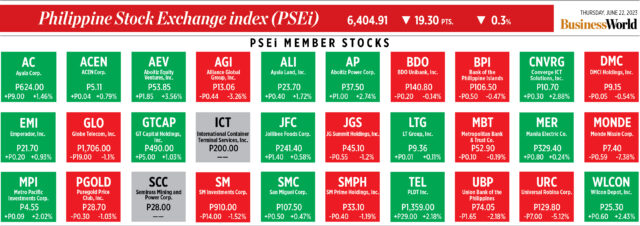
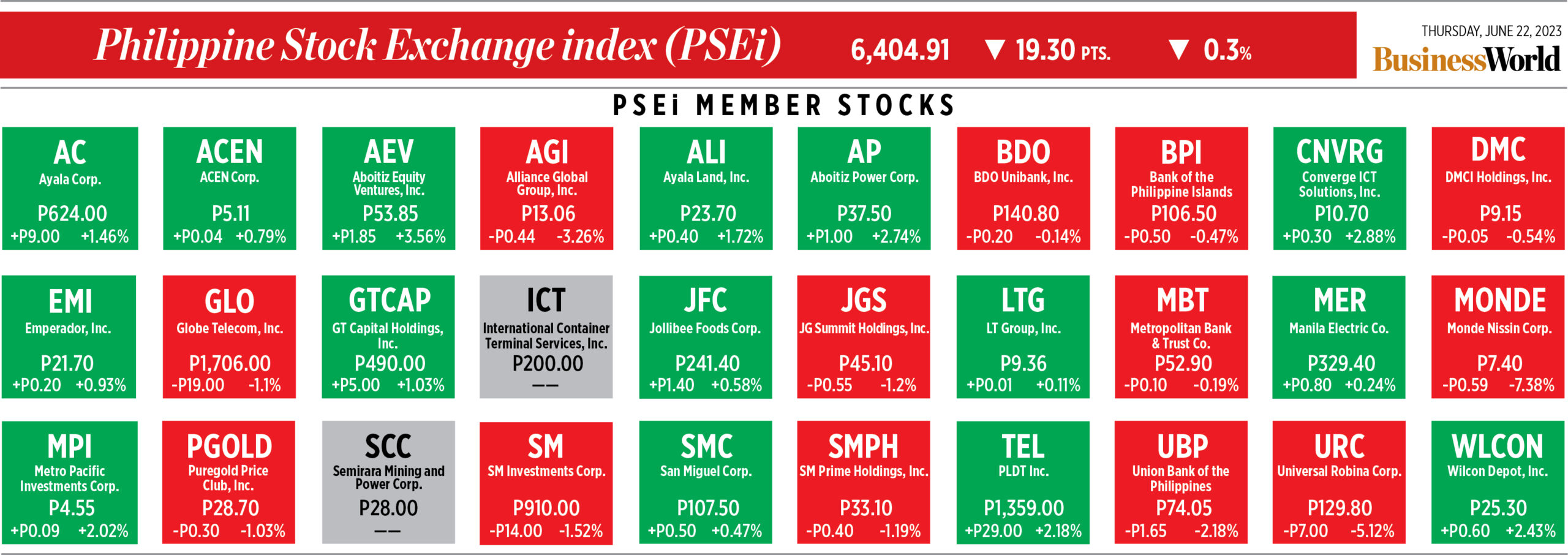
How PSEi member stocks performed — June 22, 2023

Here’s a quick glance at how PSEi stocks fared on Thursday, June 22, 2023.


Peso inches up versus the dollar

THE PESO inched higher against the dollar on Thursday after the Bangko Sentral ng Pilipinas (BSP) kept benchmark interest rates unchanged at its policy meeting.

The local currency closed at P55.62 versus the dollar on Thursday, rising by 2.50 centavos from Wednesday’s P55.645 finish, data from the Bankers Association of the Philippines’ website showed.

The local unit opened Thursday’s session at P55.57 per dollar. Its weakest showing was at P55.66, while its intraday best was at P55.53 against the greenback.

Dollars traded dropped to $747.4 million on Thursday from the $1.01 billion seen on Wednesday.

The peso rose after the BSP left rates untouched, Rizal Commercial Banking Corp. Chief Economist Michael L. Ricafort said in a Viber message.

The central bank kept its policy rate at 6.25% for a second straight meeting on Thursday, as expected by 15 economists in a BusinessWorld poll held last week.

Interest rates on the overnight deposit and lending facilities were likewise maintained at 5.75% and 6.75%, respectively.

The central bank had raised borrowing costs by 425 basis points from May 2022 to March 2023 to help bring down inflation.

“The peso strengthened amid expectations of hawkish remarks from the BSP monetary policy meeting today,” a trader added in an e-mail.

The BSP said in its policy statement that it remains vigilant of risks from elevated inflation and potential second-round effects and is prepared to hike rates again should new data warrant tightening.

The peso also rose after the central bank trimmed its 2023 inflation forecast to 5.4% from 5.5% previously.

For Friday, both the trader and Mr. Ricafort see the peso moving between P55.50 and P55.70 per dollar. — AMCS

Stocks decline further as BSP keeps rates steady

REUTERS

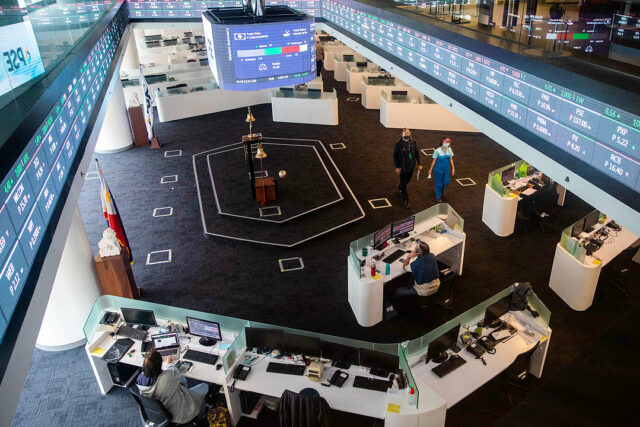
STOCKS continued to decline on Thursday as the Bangko Sentral ng Pilipinas (BSP) kept benchmark interest rates unchanged as expected and as US Federal Reserve Chair Jerome H. Powell began his two-day congressional testimony.

The Philippine Stock Exchange index (PSEi) fell by 19.30 points or 0.3% to end at 6,404.91 on Thursday, while the broader all shares index went down by 9.12 points or 0.27% to close at 3,417.69.

“Philippine shares logged another day of declines as [as investors] waited for the BSP meeting to conclude. Investors remained to be in a wait-and-see mode as they brace for the [Monetary Board’s] rate decision… and are keeping tabs on Powell’s testimonies,” Regina Capital Development Corp. Head of Sales Luis A. Limlingan said in a Viber message.

The BSP on Thursday kept its policy settings unchanged for a second straight meeting, as predicted by 15 economists in a BusinessWorld poll last week, as it expects inflation to continue easing and to return within its 2-4% target before the year ends.

AB Capital Securities, Inc. Vice-President Jovis L. Vistan said in a Viber message that the market continued to digests comments from Fed officials.

“The Fed believes that they have way to go in their goal of bringing inflation down to 2%,” Mr. Vistan added.

Further Federal Reserve rate increases are “a pretty good guess” of where the central bank is heading if the economy continues in its current direction, Mr. Powell said in remarks on Wednesday to lawmakers on Capitol Hill, Reuters reported.

In response to a question late in a three-hour hearing before the House Financial Services Committee, Mr. Powell said he would not characterize the Fed’s decision last week to hold interest rates steady as a “pause,” and noted the fact that a majority of policy makers see two more quarter-point rate increases as likely by the end of the year.

The majority of sectoral indices fell on Thursday except for services, which went up by 14.71 points or 0.96% to 1,544.17.

Meanwhile, industrials shed 113.60 points or 1.25% to end at 8,981.44; mining and oil declined by 59.44 points or 0.6% to 9,799.47; property fell by 12.88 points or 0.49% to 2,597.08; financials dropped by 7.85 points or 0.43% to 1,832.32; and holding firms went down by 8.35 points or 0.13% to 6,318.93.

Value turnover went up to P5.45 billion on Thursday with 926.13 million shares changing hands from the P5.17 billion with 598.87 million issues traded on Wednesday.

Decliners outnumbered advancers, 106 versus 73, while 47 names closed unchanged. — A.H. Halili with Reuters

General Retail Price Index in the National Capital Region

RETAIL price growth in Metro Manila eased for a third straight month in May to its lowest level in 11 months, the Philippine Statistics Authority (PSA) said on Wednesday. Read the full story.

General Retail Price Index in the National Capital Region

MUP pension proposal ditches indexation vs active-duty pay

PHILIPPINE STAR/ MICHAEL VARCAS

THE Department of Finance (DoF) said it is fine-tuning its proposal to reform military and uniformed personnel (MUP) pensions, with payouts to retirees now subject to annual review rather than escalating automatically under an indexation system.

The reformed pensions will also require MUPs to make contributions to their pension funds, the DoF said in a statement on Thursday.

“Our goal is to create a sustainable pension system for the military. We want to take care of soldiers from the day they enter service up to their retirement,” Finance Undersecretary Maria Cielo D. Magno said.

Under the current pension system, MUPs are automatically promoted one rank higher upon retirement and can receive their pension after 20 years’ service, with no minimum pensionable age. The monthly pension is also automatically indexed to the salary of active personnel.

The DoF has proposed that the MUP pension fund be managed by the Government Service Insurance System (GSIS), supervised by an oversight committee.

The committee will be composed of the Secretaries of Finance and Budget and Management, the Executive Secretary, and the President and General Manager of the GSIS as ex-officio members, as well as representatives from the MUP services.

Defense Secretary Gilberto C. Teodoro, Jr. also noted the need for “expert fund managers with good track records.”

The DoF has also proposed three options for claiming pension benefits, including a lump sum upon retirement, payment after five years, or upon reaching age 57.

The Bureau of the Treasury has reported that total unfunded pension liabilities have hit P9.6 trillion.

The DoF also estimates that accumulating pension liabilities will likely increase public debt by as much as 25% by 2030. — Luisa Maria Jacinta C. Jocson

DoE expects offshore wind rules to help bring down power rates

WORLDBANK.ORG

THE Department of Energy (DoE) said its policy framework for offshore wind (OSW) projects is ultimately expected to accelerate the industry’s development while reducing power rates.

This offshore wind policy and administrative framework identifies seven priority activities to accelerate the roll-out of projects, the DoE said in a statement.

The framework includes “a set of rules and procedures for permitting agencies with respect to the issuance of permits and licenses for OSW projects,” it added.

The DoE said the goal is “streamlined, effective and efficient permitting activity” that will lower the development costs of offshore wind resources which in turn will lower electricity rates.

The framework proposes the establishment of the Philippine Offshore Wind Databank to house all submitted information and documents on offshore wind projects. 

The framework calls for a review of current DoE guidelines on the awarding of offshore wind energy service contracts; a requirement on the network service provider to prepare a smart and green grid plan; and the drafting of foreshore lease regulations for the transmission system serving OSW projects.

The framework also directs the Philippine Ports Authority to prepare a long-term port development plan to accommodate vessels servicing the industry and ensure the security of offshore wind projects.

To date, the department said it had awarded 66 offshore wind contracts with a combined potential capacity of 53.85 GW, which it deems sufficient to service the country’s future energy demand.

Under the Philippine Offshore Wind Roadmap, the Philippines has a potential capacity of 178 GW from offshore wind resources. This is expected to help the Philippines meet its goal of increasing the share of renewables to 35% of the energy mix by 2030 and 50% by 2040.

Last month, the DoE issued the implementing rules and regulations for Executive Order 21, which governs offshore wind development.

The DoE will harmonize and streamline the process by integrating the processes in its Energy Virtual One-Stop Shop (EVOSS).

EVOSS is the DoE’s current system for expediting the processing of applications for energy projects. — Ashley Erika O. Jose

Imports raise inventory levels of dressed chicken at mid-June; demand still weak

REUTERS

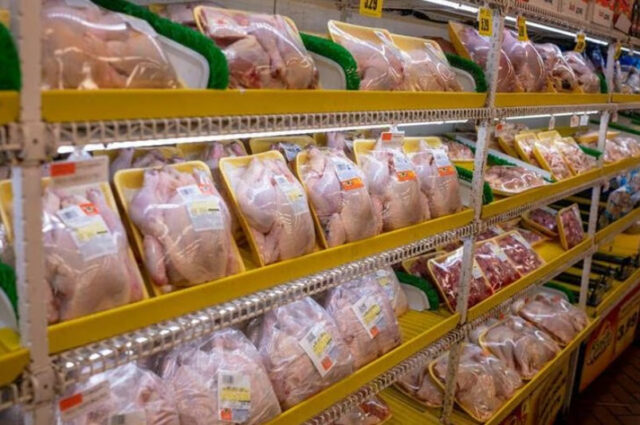
INVENTORY levels of dressed chicken rose in the second week of June, with imports accounting for most of the total, the National Meat Inspection Service (NMIS) said.

The NMIS said dressed chicken in cold storage as of June 12 hit 61,006.94 metric tons (MT), up 1.46% from a week earlier.

On a month-on-month basis, inventory rose 25.34%.

Imports accounted for 37,487.88 MT of the dressed chicken inventory while domestically grown poultry totaled 23,519.05 MT.

The NMIS noted that the report does not include fresh chilled chicken and mechanically deboned meat.

Cold storage facilities in Central Luzon had 17,699.97 MT or 29.01% of the total. This was followed by Calabarzon (16,790.69 MT), and the National Capital Region (8,856.34 MT).

“Supply continues to outstrip low demand conditions. Current inventory of imports is more than double of last year,” Elias Jose M. Inciong, president of the United Broiler Raisers Association, said in a Viber message. 

“This is concerning as it is indicative of both poor demand and displacement caused by imports,” he added.

The inventory of frozen pork during the period was 74,916.09 MT, up 6.30% from a week earlier. This was up 53.92% month on month.

Imports accounted for 70,534.63 MT, while domestically grown pork in cold storage totaled 4,381.46 MT, according to the NMIS.

The pork inventory in Calabarzon represented 21,837.7 MT or 29.14% of the total, followed by Central Luzon (17,058.59 MT) and the NCR (14,836.3 MT).

Alfred Ng, vice-president of the National Federation of Hog Farmers, Inc., said that the volume of imports has “caused the liveweight price to drop continuously, and at a much faster rate than retail prices.”

“As consumers still do not have disposable income to increase their pork consumption, market vendors are keeping their prices high to compensate for the lower volume of purchase to be able to earn enough for their families’ needs,” he said via chat.

“Other big integrator farms have also increased their hog production so local production is also more than enough to supply the market,” he added. — Sheldeen Joy Talavera

Agri dep’t says pork production trending upward

PORK meat products are sold at the Murphy Market in Cubao, Quezon City, Feb. 11, 2021. — PHILIPPINE STAR/ MICHAEL VARCAS

THE Department of Agriculture (DA) said its outlook on pork production remains positive, contrary to more pessimistic forecasts issued by the US Department of Agriculture (USDA).

“(The) growth rate for pork… has started to become positive (continuing from) the last quarter of 2022. It’s positive and continued in the first quarter, mas higit pa (deeper into positive territory),” Agriculture Undersecretary Mercedita A. Sombilla told reporters on Thursday.

Hog production rose 5.1% year on year to 437.99 thousand metric tons (MT) during the first quarter, according to the Philippine Statistics Authority (PSA).

The rise reverses a 1.2% drop a year earlier and outpaces the 3.4% gain in the fourth quarter of 2022.

The USDA downgraded its Philippine pork output forecast by 5.13% to 925,000 metric tons (MT), citing the continuous spread of African Swine Fever (ASF) in top-producing regions.

Ms. Sombilla said there is a chance production will revert to pre-ASF levels soon.

The Philippines was first hit by ASF in July 2019. The volume of hog production in 2018 was 2.3 million MT. Production was 1.74 million MT in 2022, according to the PSA.

“We’re hoping that all the programs that are being implemented now are going to be implemented well and be successful,” she said.

Among the programs implemented by the DA and its agencies is the Integrated National Swine Production Initiatives for Recovery and Expansion program — a repopulation program established in 2021.

“We hope that continues and it goes back to the point that we will be able to get that production level that we had before. That’s probably the time we will be seeing prices to go down but then again you have to take into consideration also the fluctuation in other inputs,” she said.

When asked about the increase in the price of corn, which is used as animal feed, she said “We cannot do anything, that is what the market dictates so we cannot really do anything.” — Sheldeen Joy Talavera

Metro Manila retail price growth at 11-month low in May

PHILSTAR FILE PHOTO

RETAIL price growth in Metro Manila eased for a third straight month in May to its lowest level in 11 months, the Philippine Statistics Authority (PSA) said on Wednesday.

The general retail price index in the National Capital Region (NCR) rose 4.9% year on year in May, against 5.4% in April, according to preliminary PSA data. The May reading remained higher than the year-earlier 4.1%.

May marked the third straight of retreat from the 14-year peak of 6.6% in February.

General Retail Price Index in the National Capital Region

It was also the lowest year on year since the 4.7% posted in June 2022.

In the five months to May, NCR average retail price growth hit 5.9%, still elevated relative to the 2.9% year-earlier average.

The PSA attributed the May slowdown to the heavily weighted food index, which eased to 10% from 10.6% in April.

The index of mineral fuels, lubricants and related materials also pulled down the May reading. It contracted 12.8% that month from an 8.4% drop in April.

Other indices which posted slower annual growth were machinery and transport equipment (1.3% in May from 1.5% in April) and beverages and tobacco (6.9% from 7%). — T.C.S. Migriño

Customs bureau raises P748 million from post-clearance audits

PHILSTAR FILE PHOTO

THE Bureau of Customs (BoC) said revenue generated from post-audit clearances rose 49% year on year to P748.4 million in the Feb. 13-May 12 period.

“The Post-Clearance Audit Group (PCAG) is responsible for conducting audit examinations, inspections, verifications, and investigations of importation records to ensure the accuracy of goods declaration of importers,” it said in an accomplishment report.

“As a result of their efforts, the PCAG has generated additional revenue from audit findings,” it added.

Public auctions of forfeited goods also generated P25.1 million, with the Port of Manila accounting for P23.6 million. This was followed by the Port of Davao (P1.25 million) and Manila International Container Port (P241,600).

“The successful conduct of public auctions by various ports has been instrumental in augmenting the collection performance of the BoC,” it said.

“The public auction acts as an additional means for the government to collect the rightful duties and taxes imposed on imports when importers fail to fulfill their obligations and comply with documentary requirements within the specified timeframe,” it added.

At the end of May, the BoC had collected P359.175 billion, exceeding its target for the period by 3.82%.

This year, the BoC has been set a target to collect P901.3 billion. — Luisa Maria Jacinta C. Jocson