Home Blog Page 4667

Global-Estate Resorts forecasts sustained growth

GLOBAL-ESTATE RESORTS, INC.

ANDREW L. TAN’S Global-Estate Resorts, Inc. (GERI) expects to sustain its growth momentum as tourism recovers, its president said on Monday.

GERI President Monica T. Salomon told stockholders during their annual meeting that her optimism was based on the “remarkable” performance of the economy, the favorable outlook for the property sector, and the resurgence of tourism and leisure.

“The company is confident that it would sustain its growth momentum in the succeeding years,” she said.

In line with the forecast, the company is banking on its tourism estate portfolio to drive its earning upward.

“The anticipated rise in tourist arrivals due to pent-up demand is expected to boost hotel occupancies and retail spending, benefiting the company’s tourism estates in Boracay and Batangas,” Ms. Salomon added.

She added that GERI’s Boracay Newcoast property is poised to capture the meetings, incentives, conferences and exhibitions or MICE market in the area.

The Boracay property, which is a 150-hectare integrated tourism and leisure estate, opened last year its Boracay Newcoast Convention Center that can accommodate 1,200 individuals.

Ms. Salomon said the site now can host large-scale business events.

“The company seeks to explore and develop different types of tourism, suitable for its tourism and leisure estates,” she said.

During the first quarter, GERI’s attributable net income rose by 40% to P479 million from the previous year’s P343 million. Its consolidated revenues increased by 56% to P2.1 billion from P1.3 billion previously.

A subsidiary of Megaworld Corp., GERI is primarily engaged in the development of integrated tourism and leisure estates, and integrated lifestyle communities with residential, retail, hotel, and leisure components.

Its wholly owned subsidiaries include Novo Sierra Holdings Corp.; Elite Communities Properties Services, Inc.; Savoy Hotel Boracay, Inc.; Belmont Hotel Boracay, Inc.; Twin Lakes Corp.; Megaworld Global-Estate, Inc.; Oceanfront Properties, Inc.; and Global Homes and Communities, Inc.

On Monday, its shares fell by 2.25% or two centavos to P0.87 apiece. — Adrian H. Halili

Young workers seen seeking better job benefits 

A BUSINESS process outsourcing firm has called on employers to modify their rewards and benefits based on the needs of employees as a survey has shown that Gen Z and millennials are prioritizing work-life balance.

“In these changing times, we should be deliberate about giving team members the support they need and allowing them to have a rewarding journey,” TELUS International Philippines Vice-President and Country Manager Anne Muñoz said in a statement on Monday.

Her stand comes as a recent survey by Deloitte says the top priorities for Gen Z and millennial respondents in choosing an employer are a good work-life balance and opportunities for learning and development.

“Having meaningful rewards is one part of the equation to engage Gen Z and millennial team members. These must also come with a work culture that emphasizes purpose and allows each team member to see the value of their contributions toward the overall goal of the organization,” Ms. Muñoz said. 

The Deloitte survey has also shown that the cost of living is the top concern among Gen Z and millennials who say they will be less anxious about their financial situation if employers offer financial wellness benefits.

In response, TELUS International Philippines has improved its monthly mobile load benefits, added nontaxable medical allowances, and increased the nontaxable allowances for rice subsidies and uniforms.

“We have set our sights on helping our team members achieve financial security through TIP S.A.F.E., a retirement benefits fund and savings program that enables our team members to allot a certain amount from their salary to be placed in an account that earns interest,” Ms. Muñoz said.

TELUS International Philippines also increased the number of paid time off conversions, as well as upgraded its site clinics by ensuring hospital-quality consultation wherein team members could get certificates and recommendations for lab work from health maintenance organization (HMO)-accredited doctors onsite.

“We encourage our team members to avail of our free teleconsultation services to help address their issues on health, family counseling, trauma counseling, or financial and legal counseling. All our team members have had access to our HMO plans since their first day,” Ms. Muñoz said.

“In addition to extending health benefits to family members, we have been providing degree and certificate courses to our team members and their loved ones through TELUS International University (TIU), with a significant discount of 50-80% on tuition fees,” she added.   

Ms. Muñoz said there should also be efforts to boost employee benefits to keep the young workforce satisfied, citing a survey by YPulse showing that games, co-working spaces, and team activities are some of the things Gen Z and millennials look for in the workplace.

“We’ve gone above and beyond by creating highly engaging themed meeting rooms and game rooms that inspire creativity, allowing our team members to do their best work while enjoying the things they love doing. We also have various special interest groups where they can bond over different interests,” Ms. Muñoz said. 

TELUS International Philippines has seven sites across Metro Manila and two sites in Iloilo. It is a leading Philippines-based provider of digitally enabled customer experience and business process solutions. — Revin Mikhael D. Ochave

National Book Store secures loan from Ramos holding firm

RAMOS-LED Anglo Philippine Holdings Corp. (APO) has approved a loan of up to P300 million to bookstore and learning supplies chain National Book Store (NBS) and Abacus Book & Card Corp. as additional funding for their operations. 

In a stock exchange disclosure on Monday, APO said the loan approved for NBS and Abacus will be at 90-day terms with an 8% per annum interest rate. NBS, which was affected by the pandemic, is also owned by the Ramos family.

“The credit line will provide short-term funding for the operations of NBS and Abacus,” the listed company said, adding that “APO recognizes this as an opportunity to manage group cash requirements by minimizing external debt risk as well as optimizing yields.”

“Should NBS/Abacus fully draw from the credit line, the same will not amount to 10% of APO’s total consolidated assets in order to be considered as a material related-party transaction,” it added.

Meanwhile, local consumer finance company BillEase said in a separate statement that it partnered with NBS to provide more payment options for easier customer shopping.

BillEase said the partnership will allow customers to shop and pay later in installments without a credit card across more than 230 NBS branches across the country.

“With this partnership, we’re not only making financial services more accessible, but we’re also underscoring the value of education. By offering an effective means to manage educational expenses, we’re essentially contributing to financial freedom, empowering individuals to invest in their learning journey,” BillEase Chief Executive Officer Georg Steiger said.

Under the partnership, NBS offline branches could now offer three cardless installment options at checkout such as pay later in 10 or 20 days; pay in four installments for small-to-medium ticket purchases; and pay monthly over three, six, nine, or 12 months for big purchases with interest rates between 0% and 3.49%.

“Our alliance with BillEase accelerates our journey, offering our customers financial freedom. Now, they can access essential educational resources and pay on their own terms, mitigating immediate financial pressures,” NBS President Adrian Paulino S. Ramos said.

Shares of APO at the local bourse were last traded on June 29 and were priced at P0.60 per share. — Revin Mikhael D. Ochave

Top Frontier finalizes share sale to Ang firm

TOP FRONTIER Investment Holdings, Inc. on Monday said that it had finalized the sale of P10.86-billion worth of shares to Ramon S. Ang’s Far East Holdings, Inc.

In a regulatory filing, the company said it had completed and closed the sale of 45 million common shares valued at P241.42 apiece to Far East Holdings where Mr. Ang holds a 100% stake. He is also the president and chief executive officer of Top Frontier.

The subscription price was based on the midpoint of the range under FTI Consulting, Inc.’s independent valuation of the common shares, which yielded a low-end price of P196.14 per share and a high-end price of P286.70 per share.

Top Frontier likewise said that Far East Holdings now owns about 11.91% of the listed firm’s outstanding common shares.

In a separate disclosure, the company said Mr. Ang currently owns 75,887 direct shares and 131.66 million indirect shares of Top Frontier, with a total stake of 34.86%.

Broken down, Mr. Ang owns about 49.8 million shares via Master Year Ltd. where he acts as the sole shareholder, and 36.86 million shares through Privado Holdings Corp. where he is the 100% owner. The two firms hold a combined stake of about 26.03% in the company, based on its ownership report on June 8.

Top Frontier said the listing of the shares will be presented to its shareholders for approval during its annual stockholders’ meeting on Aug. 3.

The company earlier disclosed that it had entered into a subscription agreement with Far East Holdings on June 7, which covered the subscription of 45 million shares out of its unissued common shares.

The agreement also included amendments to the terms and conditions of the perpetual securities of Top Frontier.

This includes the change in the distribution rates and the inclusion of a convertibility feature of the perpetual securities into common shares of Top Frontier at a conversion price of P289.70 per common share.

Earlier, the company’s board of directors approved the share sale at a subscription price of about P10.86 billion, which is to be fully paid in cash on or before June 30.

It added that sale proceeds were intended for general corporate purposes, which included the payment of financial obligations and distributions.

Top Frontier is the parent company and the owner of 61.77%, or the controlling stake, in San Miguel Corp. (SMC), one of the country’s largest listed conglomerates.

SMC is engaged in industries such as beverage, food, packaging, property, fuel and oil, energy, infrastructure, and banking. Mr. Ang is also the president and chief operating officer of SMC.

On Monday, Top Frontier shares rose 0.09% or 10 centavos to P110.10 apiece. — Adrian H. Halili

Xurpas set to convert P136.5-M shareholder advances into equity

XURPAS, Inc. is planning to convert into equity around P136.52 million worth of its founders’ advances to the listed technology firm.

In a disclosure to the stock market on Monday, the company said the move would provide Xurpas with capital to fund its pivot toward the enterprise market.

The advances came from the company’s co-founders Nico Jose S. Nolledo and Fernando Jude F. Garcia who offered the amount from 2017 to 2019.

“We have shown steady progress since we shifted our focus to the enterprise segment, and now have distinct products and services catering to customers both in the Philippines and increasingly, overseas,” said Mr. Garcia, who is also the company’s chief technology officer and treasurer.

Xurpas said the conversion of the advances to equity would improve and strengthen its balance sheet, “and reflects the founders’ confidence in the corporation’s ability to further expand its business.”

It said the final conversion price would be determined within 30 days subject to the conditions that it would be above market price and supported by a fairness opinion from a qualified third-party authority.

“We continue to grow not only our core software development and [information technology] staff augmentation businesses, but have introduced pre-packaged business solutions for [small and medium enterprises], Mr. Garcia said.

He also said Xurpas plans to offer artificial intelligence consulting and development services to local companies.

The company is set to submit an application to the Securities and Exchange Commission to confirm the transaction by securing a confirmation of valuation.

“The listing of the shares will also be subject to an application with the Philippine Stock Exchange,” it said.

Xurpas shares went up by 1.92% or P0.005 to P0.265 apiece on Monday. — Adrian H. Halili

MAP urges government to declare malnutrition and child stunting as top national agenda

JCOMP-FREEPIK

We in the Management Association of the Philippines (MAP) firmly believe that because of their huge human and economic costs, malnutrition and child stunting deserve to be among the country’s top national priorities, together with other urgent issues like poverty, climate change, and national security.

Malnutrition and child stunting must be addressed at national and local levels.

The government’s declaration of malnutrition and child stunting as a priority agenda will ensure that concrete measures will be taken, sufficient funds will be earmarked, and actions will be cascaded from the national all the way to the community level.

Severe malnutrition has remained a serious problem for nearly 30 years, with one in every three Filipino children below the age of five suffering from stunting, according to a World Bank (WB) study. The country ranks 5th among countries in the East Asia and the Pacific region with the highest prevalence of child stunting. Rural areas have more stunted children (30%) than in urban areas (26%), in direct proportion to the poverty levels in the provinces like Western and Southern Mindanao, Mindoro, Negros, Palawan, Samar, and the far north of Luzon. Stunting rates are the highest in Bangsamoro Autonomous Region in Muslim Mindanao (BARMM) (45%) and lowest in Manila and Central Luzon (23%).

Unstinting national support can enable future budgets to be allocated to initiatives and resources that can be made available to nutrition-sensitive programs that will holistically address key underlying determinants of proper nutrition. These include food security, access to nutritious food at cheaper prices, access to health and social services, as well as nutrition-specific interventions that deal with the immediate causes of maternal and child malnutrition, such as micronutrient deficiency and stunting.

ADVERSE EFFECTS CAN SPAN MULTIPLE GENERATIONS
The United Nations Children’s Fund (UNICEF) found that malnutrition contributed to child mortality, with 95 Filipino children dying every day and that 27 out of 1,000 do not get past their 5th birthday. A malnourished individual has deficient or excessive nutrient intakes, and, depending on the condition, can lead to wasting (low weight-for-height), being underweight, stunting, and obesity. It is malnutrition that directly causes child stunting, not only physically, but more so mentally, which needs to be addressed urgently because of its long-term and irreversible effect on children.

Most importantly, malnutrition adversely affects multiple generations. Today’s undernourished children will mature as poorly performing adults who will not have the necessary skills to better their lives and contribute to the country’s human development. This will make it harder for them to get out of the vicious cycle of poverty and poor health. It will be in this environment that they will raise their families and passing it on to the next generations, unless this issue is acted upon with urgency today.

EFFECTS ON HEALTH, QUALITY OF LIFE AND THE BURDEN ON THE HEALTH SYSTEM
The first 1,000 days of a child — from conception up to two years of age — are crucial. The World Health Organization (WHO) raised the concern that chronic malnutrition at this stage results in stunted growth development and impairment of children, rendering them vulnerable to infections and impaired cognitive development. Repeated bouts of illnesses can affect the health and quality of life of these children who will grow as sickly adults.

Compounded with poverty, sickly adults will lead to diseases that will burden an already resource-constrained health system. More financing will need to be allocated for curative services rather than prevention and health promotion. Needless to say, this will require bigger budget allocation just to plug the health requirements.

EFFECTS ON ECONOMIC DEVELOPMENT AND PHILIPPINE PROGRESS
Child stunting can impair a malnourished child’s cognitive ability that in turn will impact his/her development, ability to learn, and capacity to earn income. Failure to arrest malnutrition and child stunting will eventually lead to lowered capabilities, resulting in poor comprehension and lower educational attainment.

The extent of this problem is already evident in the deficient performance of Filipino students in the 2018 Program for International Student Assessment (PISA) where they ranked the lowest among 79 countries in mathematics, science, and reading.

The COVID-19 pandemic has even worsened the learning gap and if not immediately addressed, it will affect the country’s skilled labor force, make it unattractive to investors, and hamper economic growth. This will be detrimental to our future competitiveness and our progress as a nation.

MAP CAMPAIGN AGAINST MALNUTRITION AND CHILD STUNTING
To help solve this persistent societal problem and contribute to the effort to eradicate child stunting resulting from malnutrition, the MAP launched a campaign against malnutrition and child stunting in the country. Initiatives were laid out aimed at complementing the Government’s Philippine Multi-sectoral Nutrition Project (PMNP).

  We fully support the four-year PMNP which aims to lower the incidence of malnutrition by helping over 200 towns through primary healthcare services and nutritional support that will be provided to children and pregnant mothers.

• We urge the effective and judicious use of the PMNP’s P10-billion loan from the WB by the government to address the health and nutrition needs of poor mothers and their children.

• We recommend an active pursuit of tripartite partnerships — business sector, government, and community — for a whole-of-society approach in fighting malnutrition and child stunting.

We in the MAP hope to expand our role beyond fund generation and philanthropy to a shared responsibility in addressing malnutrition in the country, participating in the governance of nutrition strategies and interventions.

The MAP will welcome the opportunity to serve as one of the three private sector representatives in the National Nutrition Council (NNC) and contribute to its mandate to formulate national food policies and strategies for nutritional improvement.

We are worried, yet we are hopeful too, that we can solve this national problem by working together. Failure to address this problem in an urgent and decisive manner will place our country’s future in the hands of stunted children becoming adults whose capacity to be productive, competitive, and creative is limited. That will imperil national development and progress.

This Statement was released by MAP on June 19. Feedback at map@map.org.ph

Kia to address minivan order backlog this year 

KIA Philippines Motor Corp. is optimistic that it would resolve the order backlog for its Carnival minivan offering within the year as supply is expected to improve by the second half of the year.

“We have a backlog of 500 cars of the Carnival nationwide. That’s how underserved the Carnival is,” Kia Philippines Chief Operating Officer Brian James B. Buendia said in a chance interview last week. 

With this, Mr. Buendia said Kia Asia-Pacific is adjusting its supply allocation for the Philippine market to meet the order backlog. 

“We’ve been talking with Kia regional [office] about this and we’ve been showing them the demand here in the Philippines and the opportunity,” he said. “They’re adjusting their allocation, so probably we’ll see better supply by the third quarter, towards the end of the year.”

As of end-May, 240 units of the Carnival had been sold, which is equivalent to 11% of Kia Philippines’ overall sales.   

According to Mr. Buendia, the order backlog for the Carnival was caused by the shortage of chips used in its production. The company officially launched the latest iteration of its minivan in February last year.   

“When we launched the new Carnival, it was not only popular here, it was also popular across the world. We know about the chip shortage of last year. The chips are coming in but [with] the volume of the backlog, the chips are not enough to serve that volume,” he said.

In February, Kia Philippines was awarded as the top sales performer among the South Korean brand’s distributors in the Asia-Pacific region for 2022 as it sold 5,012 units, up 34% from 3,748 units sold in 2021.

Kia Philippines currently has 45 dealerships in the country and is eyeing to have 50 dealerships by 2024.

From January to May, industry data showed that the company sold 2,099 units, up 9.9% from the 1,910 units sold in the same period last year. — Revin Mikhael D. Ochave

The Secretary of Tourism should be both a marketing man and a politician

At the 50th anniversary celebration of the Department of Tourism (DoT) at The Manila Hotel last Tuesday, June 27, Secretary Christina Frasco launched the DoT’s “enhanced” tourism campaign slogan — “Love the Philippines.” She said, “The campaign ‘Love the Philippines’ is not a mere branding campaign, but rather a call to action to every Filipino citizen to remember the beauty of our country, to honor our past, and to look forward to the future armed with the virtues, values of being a Filipino. ‘Love the Philippines’ is a recognition of our natural assets, our long and storied history, our rich culture and diversity.”

I infer from the statement of Secretary Frasco that she wants the new slogan to instill nationalism in every Filipino citizen, for every one of them to be proud of the country’s natural wonders, history, culture, and diversity. She expressed the hope that the new slogan would sustain interest and bring attention to places not necessarily highlighted in DoT’s typical branding campaign.

A well-known acronym in advertising, one which students of Advertising come across in their freshman year, is AIDA. It stands for attention, interest, desire, and action — the process an advertisement is supposed to set off. The visual element or sound of the advertisement should draw the attention of the newspaper or magazine reader, television viewer, or radio listener and its message should arouse interest, then stimulate desire, and eventually stir action — to buy the product or service advertised. The new tourism slogan is in reverse of AIDA. It calls for action first — love the Philippines — then, as Secretary Frasco hopes, the viewer develops an interest in the Philippines, and thus bring attention to less-publicized places.

The slogan demands blind love — love the Philippines first, then get to know about it. The slogan is commanding when it should be enchanting and beguiling.

Absent in the new promotional video are the tourist attractions featured in previous campaigns “Wow, Philippines” and “It’s more fun in the Philippines.” The end-result, Secretary Frasco desires — which is every Filipino taking pride in our natural wonders, culture, heritage, cuisine, music, and diversity — will not be achieved. The video “Tara na, biyahe tayo,” which invites the audience to embark on a journey to see the beauty of the Philippines and to witness the talent of Filipinos, is more effective in instilling pride in things Philippine.

To justify the replacement of the slogan “It’s more fun in the Philippines,” Marie Adriano, brand and strategic planner of the marketing firm DDB Group Philippines, pointed out that “love” is the positive theme travelers associate with the Philippines and is “frequently mentioned in high volume globally.” “While ‘fun’ remains a positive theme and certainly part of the Pinoy DNA, there’s less volume of mentions,” she added.

Ms. Adriano noted that the pandemic that prompted revenge travel also birthed the kind of tourists that value not only leisure but also meaningful experiences. “Coming from a culture shift, naturally, changes in the consumers follow. Who are they? We call them the ‘changed traveler’ for the very reason that traveling has come to mean more than just leisure,” she said. She explained that travelers are now looking for “real world experiences” where they can immerse themselves in other cultures, as well as curated experiences that are unique or out of the ordinary. “Brand enhancement is imperative to stay competitive and relevant. We can choose to stay where we are or choose to pivot and realize the vision of the future,” she elaborated.

I conclude that Ms. Adriano understood “love” as used by travelers in the context of action, a verb. That is why the video says, “Love the fun, love the adventure, love the flavors, love the culture, …” She didn’t take “love” in the sense of emotional feeling or as a noun, as in Sandals Resorts’ ad which says “All inclusive, all in the name of love” and “Where love comes to stay.” If Ms. Adriano’s research finding had been that culinary delight is the subject travelers frequently mentioned in high volume globally, the video would probably have said, “Delight in our lechon, delight in our adobo, delight in our sisig, delight in our lumpiang ubod.”

The promotional video for Iloilo City — it calls it “The City of Love” — will draw more travelers to the Philippines than the “Love the Philippines” video. The graphics on our natural wonders, culture, heritage, and cuisine in the film are authentic while many of those in DDB’s production appear staged. The video on Iloilo City can pass for a video on the Philippines for the city, as presented in the promotional material, can be considered a microcosm of the Philippines.

But it seems as if the primary function of the Secretary of Tourism is to produce a new promotional ad. As former secretary of the DoT Richard Gordon, when asked to comment on the new slogan, said, “What is important is the product. The little things count, such as the cleanliness of the airports. The honesty of people working in tourism is as important. These things combined with nature and historical sights and other wonderful places that tourists come to visit, comprise the tourists’ whole experience, which will make them want to come back.” The production of a new video promoting these destinations comes only after the products — the destinations and supporting services — have been developed to the level of global standards.

As a fellow of the De La Salle University Angelo King Institute of Economic and Business Studies, I was commissioned in the early part of 2004 to conduct a USAID-sponsored study of the tourism industry with a view to identifying areas of adjustments and upgrading. Among my findings were the negative comments of tourists, as gathered by the DoT Research and Statistics Division itself:

1. poor security and safety measures for tourists;

2. arrogant and discourteous Immigration and Customs officials;

3. terrible traffic in Metro Manila;

4. ugly mounds of garbage all over;

5. heavily polluted air;

6. poor standards of international and domestic airports;

7. poor quality of bus terminals and seaports;

8. poor quality of roads to tourist destinations.

One of my recommendations was the appointment of an accomplished marketing practitioner.

In August of that year, I read my report before a panel of resource persons. One of them was my good friend Bertie Lim, he being then the president of the company that ran El Nido Resorts, a director of the company behind the world-class resort Amanpulo, and president of the Palawan Tourism Council and the El Nido Foundation.

Bertie asked: “Why does everybody expect the DoT Secretary just to be a good marketing person, as if that were his only responsibility? Should he not develop the product too so that we can give tourists superior value for money?” In response I said marketing is not synonymous with advertising, that marketing is satisfying the needs of the customer by means of the product and the whole cluster of things associated with creating, delivering, and finally consuming or using it. Marketing in Tourism is basically “creating” products, in this case attractions, and that includes the whole cluster of things associated with delivering and finally enjoying it.

I was elated when Bertie was appointed secretary of the DoT by President Noynoy Aquino in 2010 because he was the most qualified for the job among previous DoT secretaries as he was coming directly from the business of tourist destinations. He knew what attracts tourists and the problems they encounter and which turn them away. On top of that he has two master’s degrees in Business and in Public Administration, both from Harvard.

Upon his appointment, I sent him the same report I read before him in 2004. I was surprised when I read in the papers that the DoT had made a grand presentation of the concept of the new advertising campaign just four and a half months after Bertie and company had taken over the department. I had expected them to be deeply involved in the upgrading of the tourism infrastructure and services first before coming up with the advertising theme and logo.

Succeeding him as secretary of the DoT was Ramon Jimenez, a very successful and highly respected advertising practitioner. I found his first public statements as DoT secretary disappointing. “The Philippines, with its picturesque destinations, should be as easy to sell as Chickenjoy,” he said.

I became more distressed when he said further, “I am a marketing communications person. When you think about it that’s what we need. In fact, job No. 1 is to galvanize the DoT staff into an honest to goodness selling unit. Kasi ’yun naman ang trabaho namin eh. Mga tindero kami. (Because that is our job. We are shopkeepers.”

The legendary Harvard Business School marketing professor Theodore Levitt wrote in his Harvard Business Review article “Marketing Myopia,” marketing starts with the idea of satisfying the needs of the customer by means of the product and that a truly marketing man tries to create value-satisfying goods and services. He also wrote: “Selling focuses on the needs of the seller, marketing on the needs of the buyer.”

As expected, Mon Jimenez went right to work on a new advertising campaign. He was the man behind the “More fun in the Philippines” slogan. But in fairness to Mon Jimenez and to all those who have been DoT secretary, the authority of the Secretary of the Department of Tourism does not extend far beyond the realm of advertising and selling.

Mon had a convergence program with Rogelio Singson, secretary of the Department of Public Works and Highways. Tourism roads to far-flung destinations were built or upgraded.

However, Joseph Emilio Abaya, secretary of the Department of Transportation and Communications, never signed a convergence program with Mon. While the DoT secretary had a voice in the boards of the various agencies under Abaya, such as the Civil Aviation Authority and the Manila International Airport, Mon could not do anything about the upgrading of airports and seaports. Bureau of Internal Revenue Commissioner Kim Henares refused to give tax incentives for tourist destinations even if these are enshrined in the Tourism Act of 2009.

That is why I now propose that the DoT secretary should not only be an accomplished marketing person, but he should also be a seasoned politician (not the trapo kind). As a marketing man, he knows that only a good product will sell. As a politician, he knows how to gain the cooperation of the heads of government agencies that have something to do with tourism.

Northwestern University Marketing guru Philip Kotler and his co-authors wrote in their book Marketing Places: “The fortunes of places depend in the final analysis on the collaboration of the public and private sectors — teamwork among government units, business firms, voluntary and civic associations, and marketing organizations. Unlike purely business or commercial product marketing, place marketing requires the active support of public and private agencies, interest groups, and citizens.”


Oscar P. Lagman, Jr. is a retired executive, management professor, and business consultant. His work experience includes as account group director at the ad agency J. Walter Thompson Company, Marketing professor at the Asian Institute of Management and at the graduate schools of Business of Ateneo and De La Salle, and Advanced Marketing professor in the Master of Science in Tourism and Hospitality Management program of the College of St. Benilde.


Spotify in talks to test full-length music videos in app

ALEXANDER SHATOV-UNSPLASH

SPOTIFY Technology SA is considering adding full-length music videos to its app, which could help the streaming service better compete with Alphabet, Inc.’s YouTube and ByteDance Ltd.’s TikTok.

The service has already begun talking to partners about the product, according to people familiar with the plan who asked not to be identified because they weren’t authorized to speak about it publicly.

Spotify declined to comment.

The feature would add to Spotify’s growing efforts to establish video — which in the streaming media era has tended to be more lucrative than audio — as a core part of its app. Spotify already allows musicians to upload “canvases,” or looping GIFs under 10 seconds long, that populate the screen while music plays. Earlier this year, it debuted a feature called “clips,” which are videos shorter than 30 seconds designed to give artists a storytelling tool to communicate about their music, similar to how they might use TikTok.

The company also launched a new, TikTok-esque music home screen in March that allows users to preview and swipe through surfacing videos before committing to listen to a full track. Earlier this week, Spotify announced that the platform has surpassed more than 100,000 podcasts with video.

Spotify is responding to growing competition for the Gen Z audience by YouTube and TikTok. YouTube operates a streaming music service and appeals to fans with full-length music videos, as well as the more concise Shorts. It has also added podcasts to YouTube Music. ByteDance has reportedly looked to expand its music streaming service Resso, which already operates in countries where Spotify is offered, and TikTok has become an important discovery platform for musical artists.

Earlier this month, Spotify said it would cut 200 jobs from its podcast unit in its second round of layoffs, as it looks to restructure after years of heavy investment.

Spotify previously set its sights on video by creating its own original series and working with media companies, including Paramount Global and Vice Media, to place TV content in the app, such as clips from the Comedy Central show Broad City. Those deals eventually lapsed. — Bloomberg/Reuters

Capstone-Intel offers benefits of analytics

LOCAL research and intelligence company Capstone-Intel Corp. is seeking to use data analytics and research to help in the decision-making of businesses, governments, and investors.

Capstone-Intel Chief Executive Officer and President Eero Brillantes said that the firm aims to help clients in adapting to the rapid pace of technology development and in managing daily data consumption.

“Our research surveys and social analytics findings provide evidence-based inputs that enable clients to make informed decisions,” he said when the company was launched on June 30 in Taguig City.

“Capstone-Intel employs a variety of analytics tools to ensure that they maximize the value and outputs of these tools, constantly searching for the best analytics tools and programs available,” he added.

According to Mr. Brillantes, the company was launched following the effects of the coronavirus disease 2019 (COVID-19).

“The agency combines traditional and digital research methodologies to create key action points that are based on both evidence and wisdom, resulting in better strategies that benefit customers and the public,” he said.

Mr. Brillantes said COVID-19 showed the need for increased readiness and awareness amid the lack of detailed data on the severity of the impact, the outcomes of cases, the accessibility and effectiveness of vaccines, and other relevant information.

“Recognizing the importance of these realizations, Capstone-Intel was founded with the same goal of advancing research with actionable intelligence as a resource in a variety of organizations, society, and economies,” he said.

Mr. Brillantes said Capstone-Intel uses “innovative research technologies, tools and methods” to convert data and information to breakthrough insights and actionable intelligence outputs.

Based on its website, Capstone-Intel’s services include brand campaign preparation, strategic communication operations plan, crisis management operations, brand campaign management operations plan, and social influence operations.

“Capstone-Intel was established with the mission of advancing research through actionable intelligence, recognizing the critical role it plays in various organizations, societies, and economies. Our firm recognizes the significance of these realizations and is committed to providing valuable insights to our clients,” Mr. Brillantes said. — Revin Mikhael D. Ochave

Year 1 of Marcos Jr.: Budget deficit and unemployment

(Part 1 of 4)

The Ferdinand Marcos, Jr. administration turned one year old last week on June 30. This column will produce a four-part assessment of the economic performance of the Marcos Jr. administration leading to the second State of the Nation Address (SONA) on July 24.

The goal of this informal exercise is to assess if the first year performance so far would help the Philippines achieve fast growth — create more jobs, expand the production of more goods and services, further industrialize and modernize the Philippines in the medium- to long-term.

Eight economic sectors, two per article, will be assessed this month: the budget deficit, unemployment, inflation, the interest rate, GDP growth, agriculture, trade, and investment.

CASH OPERATIONS REPORT
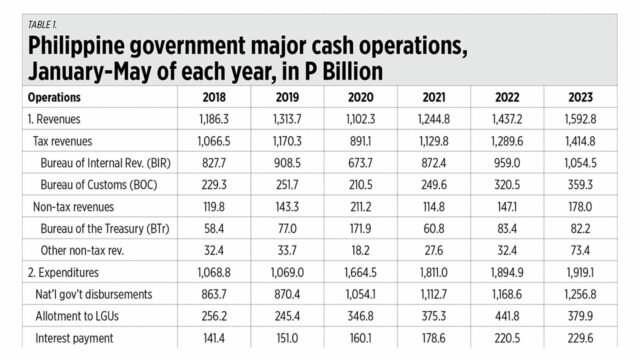
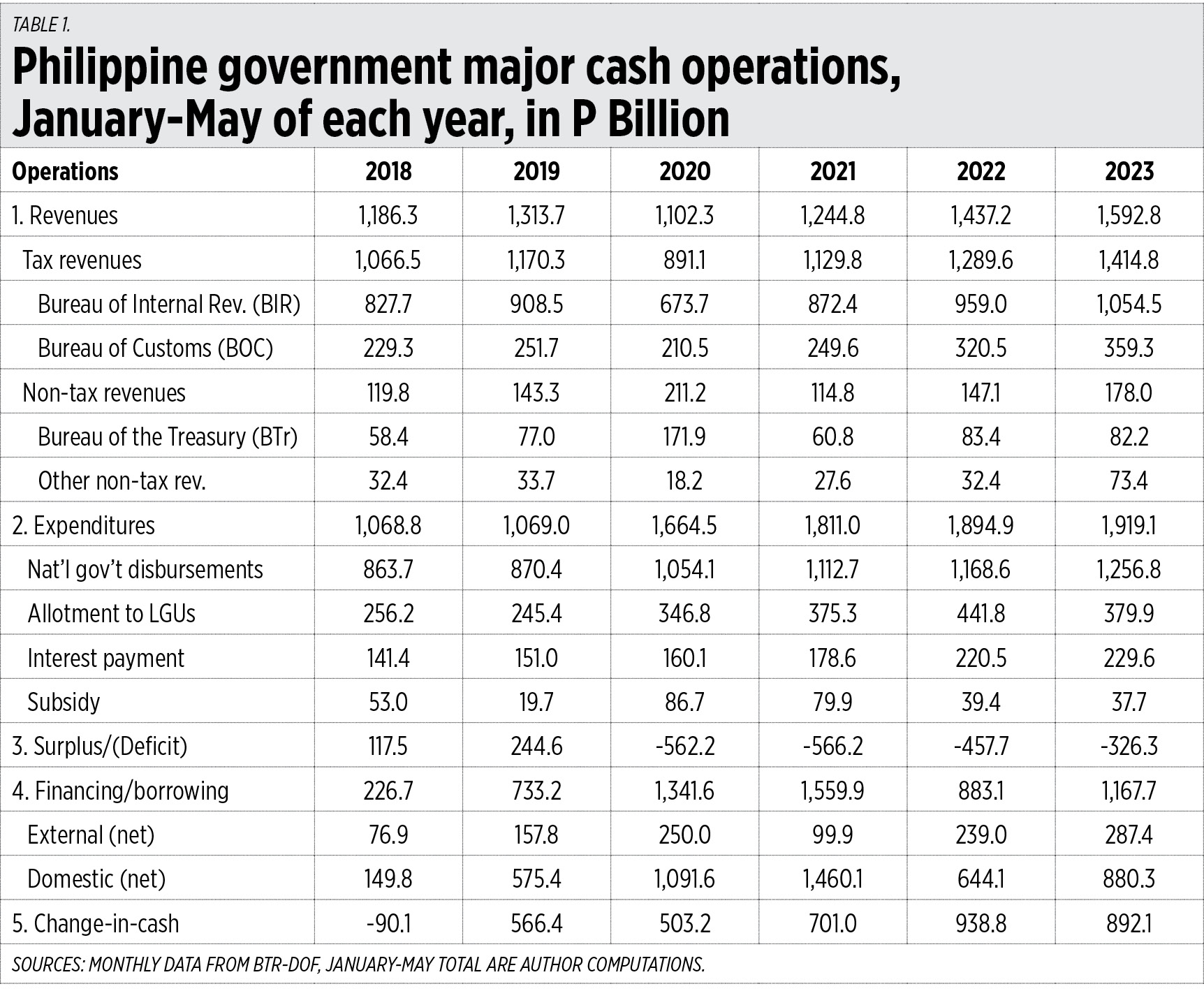
Last week, the Bureau of the Treasury (BTr) released the cash operations report for May 2023. The January-May 2023 data are available, so I will compare the numbers with performance in the same months of 2018 to 2022. The results are generally good.

One, revenues this year have significantly improved, reaching P1.59 trillion from P1.44 trillion last year. This is important for two reasons: there was no tax hike, and lockdown-era tax cuts still remained in place. So, an improvement in economic activities, not a tax hike, expanded the tax base.

Two, expenditures have mildly increased to P1.92 trillion this year from P1.89 trillion last year. While allocations for local government units have declined this year, National Government disbursement remains high as there is spending that continues to remain bloated like the military and uniformed personnel (MUP) pension. This fund must decline significantly if we must control the annual deficit, financing, and borrowing.

Three, the budget deficit has declined to only P326 billion this year from an average of P529 billion/year in the last three years 2020-2022, so this is good news. Financing or borrowing has mellowed to P1.17 trillion this year, higher than 2022 but lower than in 2020 and 2021 (see Table 1).

Interest payment is high, already P230 billion in the first five months of 2023 alone. This is a reflection of the huge increase in public debt during the lockdown years of 2020-2021 and this is not good. We should aim to reduce the annual budget deficit, reduce the need for borrowing, find new revenues like the large privatization of some government assets, in order to retire more public debt while controlling the rise in spending.

DECLINING UNEMPLOYMENT
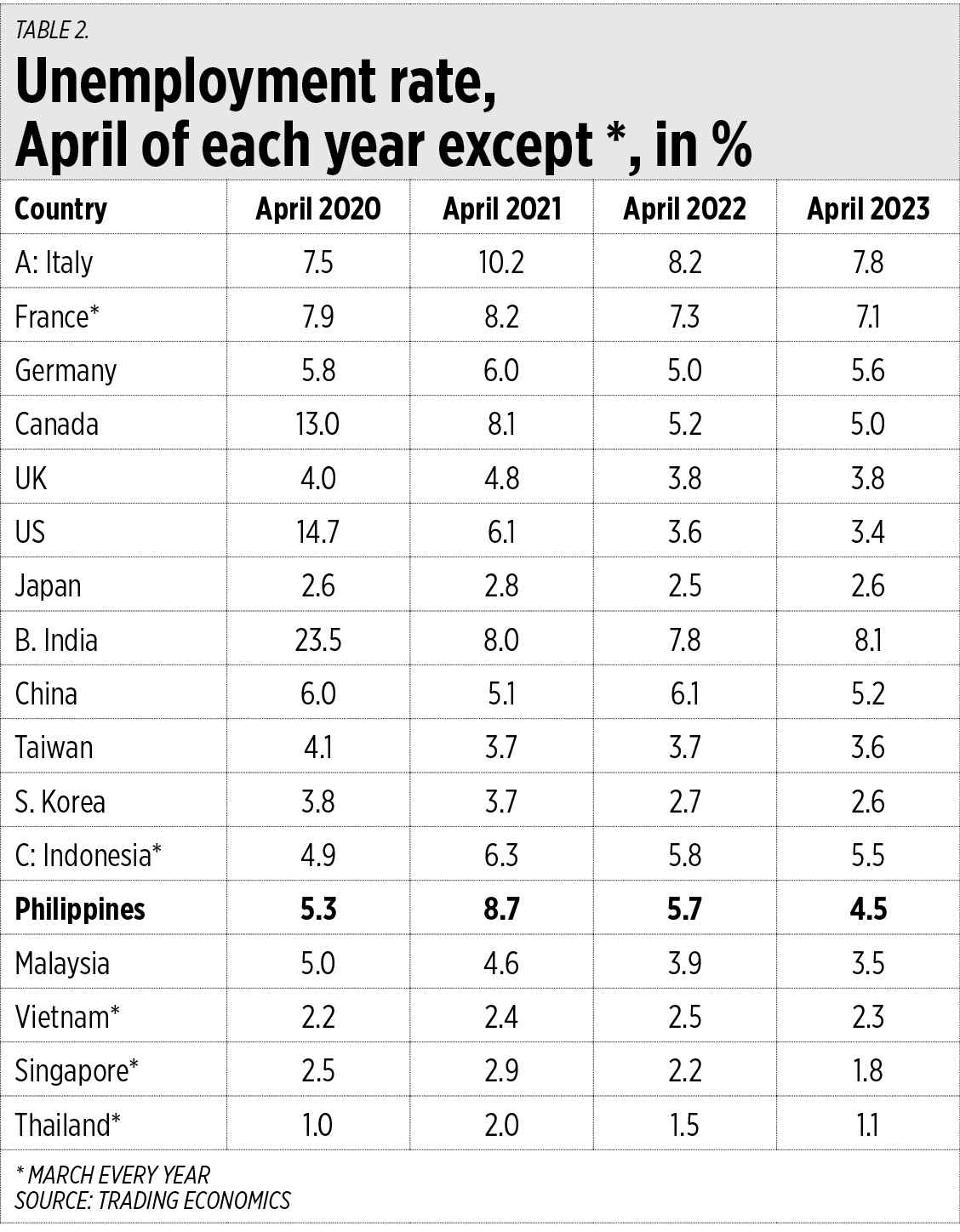
Next is the labor market. In Table 2, I group countries into three: group A are G7 member countries, group B are the big North and South Asian economies, and group C are the ASEAN-6 or the six large economies of the regional bloc.

As of April 2023, four of the G7 countries, plus India and China, and Indonesia in the ASEAN-6 countries had unemployment rates of 5% and above of the labor force. The Philippines’ unemployment rate has significantly declined to only 4.5% which is almost half the 8.7% registered in April 2021, so this is good news.

More Filipinos now have jobs and, hence, have money to spend and buy, which will create more consumer demand and invite more business expansion and innovation.

So far, considering these two indicators — budget deficit and unemployment rate — the Philippines under the Marcos Jr. administration is doing well. These are consistent with the economic team’s high growth target of 6-7% in 2023 and 6.5-8% in 2024-2028. Meaning if both the deficit and unemployment rate continue their downward trends, the high growth targets are achievable, and, better yet, may be surpassed.

We should target high employment, high productivity, and high economic ambition. Go for high revenues and high investments, and a low deficit and low borrowings. Aim for becoming an upper middle-income country — with a per capita income of $4,046 to $12,535 per year — by 2028 or earlier, vs. the current level of $3,623 in 2022.

This is achievable if we have a single-track goal: more growth, expanded production, more economic and business competition. Aim for a larger economic pie, not “well-distributed” shares in a small economic pie.


Bienvenido S. Oplas, Jr. is the president of Bienvenido S. Oplas, Jr. Research Consultancy Services, and Minimal Government Thinkers.

minimalgovernment@gmail.com

Competitive Philippine property landscape

MPTC PHOTO HANDOUT

By Joey Roi Bondoc

Editor’s note: This is the first of a two-part column on the Philippines’ competitive property landscape.

OVER THE YEARS, Colliers has seen the proliferation of more office and residential hubs outside Metro Manila. In our view, this bodes well for the Philippine economy as more economic centers rise. This means that economic development also spreads outside of Metro Manila and indicates that property sector growth is broad-based and not just focused on a single location.

Colliers believes that this pace of progress has been facilitated by an improving infrastructure and overall local government competitiveness, as measured by economic dynamism, innovation, quality of manpower, resiliency, among other factors.

Major property firms are expanding their options as they see a strong revival of the country’s property market post-COVID-19. Undeniably, Metro Manila remains a major investment destination, but developers are setting their sights on other urban areas.

In our view, this decentralization thrust is likely to be supported by the continued implementation of public projects outside Metro Manila. These include airports, bus rapid transits, cargo and passenger railways. Overall, the country’s infrastructure push should guide the expansion plans of developers around the country.

The infrastructure projects implemented by previous administrations have dictated developer strategies. The implementation of key infrastructure projects nationwide has provided access to properties that could be redeveloped into mixed commercial, residential, hotel/leisure and industrial estates. These projects also helped the government bring economic opportunities to areas outside the Philippine capital.

Due to road projects, for instance, business opportunities have spilled over to nearby areas such as Cavite, Laguna, Bulacan, Tarlac, and Pampanga in Luzon.

In the Visayas region, Cebu remains the primary property investment hub, but other locations are starting to catch up with the likes of Iloilo and Bacolod cornering substantial investments from national and homegrown developers.

In Mindanao, Davao remains the most attractive property investment destination.

Overall, Colliers Philippines believes that developers will continue to venture into residential projects in second-tier and third-tier cities all over the country, where demand comes from end-user buyers. The markets may be smaller compared to Metro Manila but more stable in terms of end-user housing demand.

With a thriving property landscape post-pandemic, Colliers also projects the development of offices, malls, hotels, and industrial parks outside of the capital region.

Moving forward, we see local government units competing for more investments and this competitive landscape should result in a more diverse Philippine property market, eventually benefiting investors and end-users.

POST-PANDEMIC ‘CEBOOM’
Cebu remains one of the most attractive and largest residential hubs outside of Metro Manila. The launch of higher-priced condominium units outside of Cebu City such as Mandaue also indicates property firms’ confidence in the purchasing power and rising affluence of Cebuano investors.

Colliers is starting to see the proliferation of upscale to luxury condominium units in major residential hubs outside Metro Manila, especially Metro Cebu. In our view, demand for these projects will partly be sustained by the recovery of the tourism sector which should propel renewed interest in leisure-oriented properties.

Cebu’s improving infrastructure also plays an important role in retaining the locale’s stature as a residential investment destination. The recently-completed Cebu–Cordova Link Expressway (CCLEX) should raise the attractiveness of fringe locations such as Talisay, Liloan and Consolacion for residential developments. Other upcoming infrastructure projects include the Metro Cebu Expressway and Cebu Bus Rapid Transit, both of which are due for completion in 2025.

DAVAO: MINDANAO’S MAJOR PROPERTY HUB
Colliers Philippines believes that the entry of national players in Davao has paved the way for substantial development of integrated communities. Hence, developers should continue with their land banking initiatives and capitalize on the city’s improving infrastructure backbone.

The National Government has lined up vital infrastructure projects in the city which, once completed, should further solidify the city’s attractiveness as a residential investment hub. These include the Davao Coastal Road, Davao City Bypass and the expansion of the Davao Airport.

Residential developers should further test the market and even diversify, especially with the rising viability of upscale and luxury projects amongst investors and end-users. In our view, Davao’s competitiveness and stature as an outsourcing hub in Mindanao, backed by regional economic growth, should retain the city’s attractiveness for more residential projects.

BACOLOD: A PROPERTY SWEET SPOT
Bacolod City is attracting national players and we see this resulting in the development of more township developments and a further expansion of the city’s residential stock. The entry of national developers is also raising the prices of vertical projects, reflecting property firms’ confidence in the purchasing power of Bacolod city’s investors and end-users.

Developers should further assess Bacolod market’s reception towards luxury projects, especially in light of newly launched residential towers by national developers.

In our view, property firms are likely to further test the upscale and luxury segments over the next 12 to 24 months. Colliers believes that residential demand will also be supported by the development of integrated communities in the city. Bacolod should also benefit from the upcoming Panay-Guimaras-Negros Link Bridge. Construction for the project will begin in 2025.

ILOILO RISING
Iloilo’s thriving business landscape is partly buoyed by a continuously expanding outsourcing sector which continues to attract national developers to launch more residential projects in the city.

While residential condominium developments are concentrated in Mandurriao, Iloilo’s main business district, some developers are beginning to explore other districts for upscale and luxury residential developments. We encourage national players to take advantage of the city’s growing investor and end-user market.

Developers should also maximize their projects’ proximity to infrastructure. Major public projects in the city include the Ungka II Flyover which will traverse Pavia, Hibao-an and Buhang. The flyover is expected to reduce travel time from Iloilo City to Iloilo International Airport from 45 minutes to 20 minutes. The flyover is set to be completed in 2025.

Iloilo is one of the most competitive cities in the Philippines backed by skilled workforce and quality infrastructure backbone. Hence, we see Iloilo attracting major local and foreign investments in the near to medium term.

(To be continued next week)


Joey Roi Bondoc is the research director at Colliers Philippines.