Home Blog Page 458

Minimum wages raised in most Philippine regions
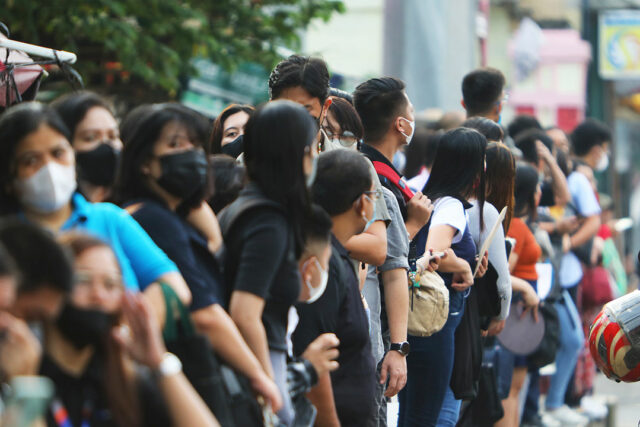
Commuters wait for public transportation along Ortigas Extension in Cainta, Rizal, Sept. 14, 2022. — PHILIPPINE STAR/ WALTER BOLLOZOS

THE PHILIPPINE government has wrapped up most of its 2025 regional minimum wage reviews, leading to a round of pay increases for workers across the country, the Department of Labor and Employment (DoLE) said.

Fourteen regional wage orders covering private sector workers were issued last year by Regional Tripartite Wages and Productivity Boards, the agency said in a statement.

These covered the National Capital Region (NCR), Cordillera Administrative Region (CAR), Ilocos Region, Cagayan Valley, Central Luzon, Calabarzon, Mimaropa, Western Visayas, Central Visayas, Eastern Visayas, Zamboanga Peninsula, Northern Mindanao, Soccsksargen and Caraga. The increases ranged from P20 to P100 daily.

The NCR kept the highest minimum wage level nationwide, with daily rates ranging from P658 to P695. Other regions approved more modest adjustments, reflecting differences in local economic activity, cost of living and productivity conditions.

Separate wage orders were also issued for domestic workers. DoLE said 11 wage orders covering domestic workers were released in the CAR, Ilocos Region, Cagayan Valley, Central Luzon, Mimaropa, Western Visayas, Central Visayas, Eastern Visayas, Northern Mindanao, Soccsksargen and Caraga. These orders granted monthly minimum wage increases ranging from P300 to P2,000.

DoLE estimates that more than 4.5 million minimum wage earners in private establishments directly benefited from the wage adjustments in 2025. About 755,000 domestic workers were also covered by the revised rates.

“Wage orders were issued in consultation with workers and employers to ensure balance between protection and needs, reasonable returns on investments and employment generation,” the agency said.

It added that about 8 million full-time wage and salary workers earning above the minimum wage could also benefit indirectly. These adjustments may trigger wage distortion corrections at the enterprise level.

DoLE defines wage distortion as a situation where a mandated wage increase reduces or eliminates established pay differences among employee groups within the same company.

Separately, DoLE confirmed that the National Wages and Productivity Commission has affirmed the wage orders for Northern Mindanao, which will take effect on Jan. 16. These include a P39 daily minimum wage increase for private sector workers, to be implemented in two tranches, and a P500 monthly increase for domestic workers.

Once fully implemented, minimum daily wages in Northern Mindanao will range from P485 to P500. Monthly pay for domestic workers in the region will rise to P6,500.

Meanwhile, wage boards in the Davao Region and Bicol Region are expected to begin their wage review processes in January and February, respectively.

DoLE said wage-setting decisions continue to rely on consultations with labor and management groups, alongside assessments of regional economic conditions, productivity trends and employment levels.

Beyond wage setting, DoLE said the National Wages and Productivity Commission and wage boards have reached more than 28,000 micro, small and medium enterprises through productivity and gain-sharing programs. A portion of these firms had begun executing productivity-based action plans as of November 2025. — Erika Mae P. Sinaking

Tariffs, China, and the dollar: What Wall Street got wrong in 2025

A WALL STREET subway stop sign is seen in New York. — REUTERS/SHANNON STAPLETON/FILE PHOTO

By Jamie McGeever

ORLANDO, Florida — This was one of the most topsy-turvy years in living memory for financial markets, as US President Donald Trump tore up the economic playbook that has shaped the multilateral, globalized world for decades.

The president’s strategy may have been well telegraphed, but its impact on markets, growth, and policymaking turned out to be very different from what most Wall Street analysts had expected.

The global trade war of 2025 should not have come as a surprise. Trump campaigned on making American manufacturing great again.

“I love tariffs,” Trump said at a rally in Las Vegas two weeks before the election. “I can make anybody do anything through the use of tariffs.”

Trump said he would force countries around the world to pay for “ripping off” the US with “unfair” trade practices — and he did just that on April 2, so-called “Liberation Day.”

Despite months of warning, analysts and investors were still caught flat-footed by the chaotic rollout of a host of sky-high tariffs.

The S&P 500 lost nearly 15% in the three days after Liberation Day, only to recoup most of that in the next few days once Trump delayed some of the more extreme elements of his flagship policy.

Yet even after Trump’s partial rollback, the trade landscape has been transformed. The effective US tariff rate on imports at the end of last year was around 2.5%. It is now nearly 17%, according to The Budget Lab at Yale, the highest since 1935.

What is perhaps most surprising is how little most markets seem to care.

The S&P 500 was expected to end this year at 6,500 points, according to the consensus forecast in Reuters’ 2024 year-end poll. That implied a rise of around 9%. The index is on track to gain twice as much, making a push for 7,000 points.

DOLLAR’S HISTORIC SLUMP
Want to find the biggest forecasting flub of the year? Look no further than the US dollar. The greenback plunged 12% against a basket of major currencies in the first six months of 2025, its worst start to a year since President Richard Nixon took the US off the gold standard and began the era of free-floating exchange rates more than half a century ago.

That wasn’t supposed to happen. Trump’s protectionist tariffs and onshoring were expected to be inflationary and thus liable to keep monetary policy relatively tight. That, in turn, would support foreign inflows into the US and strengthen the dollar, or so the consensus view held.

But the rally never materialized, in large part because many global investors balked at Trump’s controversial policy agenda and trimmed their dollar exposure.

Foreign investors still wanted exposure to the US tech boom and artificial intelligence revolution, so they piled into US equities, but — in a break from the recent past — they hedged the currency risk.

As a result, this year featured a rare phenomenon: a Wall Street boom and a dollar slide.

THE YUAN ALSO RISES
The Chinese yuan — and, in many ways, China itself — was another major forecasting miss.

Analysts’ consensus view early in the year was that Beijing would retaliate against Washington’s tariffs by depreciating the yuan to boost exports, especially given the deflationary pressures bearing down on China’s economy.

But the yuan moved in the opposite direction, at least against the dollar. China’s currency was set to end this year at its strongest level against the greenback in 14 months, a whisker away from the all-important 7.00 yuan per dollar level.

This appreciation hasn’t tanked China’s export market, however. While the country’s shipments to the US have dropped nearly 20% this year, exports to the rest of the world have more than made up for this, pushing China’s 2025 trade surplus above $1 trillion and disproving yet another economic rule of thumb. Rather than focus on boosting domestic demand, China appears as wedded as ever to an export-led growth model.

TRUMP’S SHADOW
Last but not least, there is the Federal Reserve.

A year ago, futures markets were pricing in only one full quarter-point interest rate cut in 2025, but the Fed delivered three, all coming in the last four months of the year.

Cynics might put this dovishness down to the intense political pressure bearing down on Chair Jerome Powell from the White House. Yet, if political interference is to blame, markets didn’t appear overly concerned.

Fed independence is supposedly the cornerstone of the US financial system, but Trump’s actions have elicited barely a peep from investors, barring some ructions in May when Trump indicated that he might fire Powell.

Indeed, US equities, the dollar, and 10-year Treasuries all rose in the second half of the year even as the president’s shadow over the Fed lengthened.

For now, investors seem to be getting used to Trump’s new economic playbook. Will that change next year? Many of the issues that dominated 2025 — worries over trade, an AI bubble, rising public debt, and central bank independence — are still very much in the 2026 mix. It could be another topsy-turvy year.

REUTERS

Note: The opinions expressed here are those of the author, a columnist for Reuters.

A sober look at the New Year

Every new year arrives with noise. Fireworks, countdowns, slogans about fresh starts. As business leaders and managers, we are expected to sound upbeat, to rally people around new goals and bold plans. I understand why. Optimism sells. It motivates. It makes people feel lighter after a long and difficult year. But after decades of working with organizations, both here and abroad, I have learned to be cautious of this ritualized optimism. The new year also has a flip side, and ignoring it can be costly.

I have always found it useful to begin the year not with grand promises but with a quiet inventory. What is broken? What is fragile? What might get worse before it gets better? This may sound pessimistic, but it is actually an act of responsibility. Leaders who only talk about hope risk blinding their teams to real constraints. In business, hope without realism quickly turns into frustration.

Globally, the mood is far from simple. Inflation may be easing in some markets, yet costs remain stubborn. Supply chains are still exposed to conflict, climate shocks, and politics. Technology continues to move fast, especially with AI, but adoption gaps are widening. Some firms are racing ahead, while many are quietly struggling to keep up. This unevenness matters. When leaders declare that the new year will be a breakout year, they often forget that not everyone starts from the same line.

In the Philippines, the contrast is even sharper. On paper, growth numbers look decent. Consumer spending is holding up. Yet talk to business owners, managers, or even government staff, and you hear a different story. Budgets are tight. Hiring is cautious. Projects move slowly. Decisions are delayed because approvals take time, or because people are simply exhausted. I have seen teams enter January already tired, carrying unfinished work from the previous year, expected to act as if everything has magically reset.

This is where realism becomes a leadership skill. A new calendar does not erase old problems. Backlogs do not disappear. Weak systems do not suddenly improve because of a resolution slide in a town hall. When leaders acknowledge this openly, something interesting happens. People relax. They feel seen. The pressure to perform optimism fades, and honest conversations begin.

There is also value in what some might call healthy pessimism. Not the kind that complains endlessly, but the kind that plans for things to go wrong. I often tell executives that pessimists build buffers. They ask what happens if revenues fall short, if a key person leaves, if a policy shifts, if technology fails. Optimists assume smooth sailing. Pessimists design lifeboats. In uncertain times, lifeboats matter more than slogans.

In management, the start of the year is when targets are set. Stretch goals are fashionable. They look good on paper and in board decks. But stretch goals without clear trade-offs create silent damage. Teams cut corners. Managers burn people out. Ethical lines blur. When results fall short, blame travels downward. A more grounded approach asks harder questions. What can we realistically deliver with the people and tools we have? What should we stop doing to protect what truly matters?

Leadership also means managing expectations, not just performance. In the Philippines, we are culturally inclined to say yes, to avoid disappointing others. This tendency becomes stronger at the start of the year, when everyone wants to sound cooperative and positive. Yet leaders who never say no in January often spend the rest of the year explaining delays and failures. Realism early on saves relationships later.

I have also noticed that personal new year habits spill into organizations. Individuals promise to be more productive, healthier, more disciplined. By February, guilt sets in. The same happens in companies. Big transformation programs are launched, only to stall quietly. A leader who accepts that change is slow, uneven, and sometimes boring is better equipped to guide it. Progress measured in small steps may lack drama, but it lasts.

None of this means abandoning hope. It means grounding hope in evidence. It means admitting that some years are about defense, not expansion. Some years are about fixing leaks, not building towers. In my own work, there were years when survival and learning mattered more than growth. Those years were not failures. They were preparation.

As the new year unfolds, I encourage leaders to balance optimism with clear-eyed judgment. Speak about risks as openly as opportunities. Allow teams to express doubt without being labeled negative. Reward honesty over cheerleading. In doing so, you build trust, and trust is a far stronger asset than motivational quotes.

The new year does not owe us success. It offers time. What we do with that time depends on how honestly we see the road ahead. Realism may not sound inspiring, but in the long run, it is what keeps organizations standing when the initial excitement fades.

The views expressed herein are his own and do not necessarily reflect the opinion of his office as well as FINEX.


Reynaldo C. Lugtu, Jr. is the founder and CEO of Hungry Workhorse, a digital, culture, and customer experience transformation consulting firm. He is a fellow at the US-based Institute for Digital Transformation. He teaches strategic management and digital transformation in the MBA Program of De La Salle University.

rey.lugtu@hungryworkhorse.com

NNIC records over 50M passengers in 2025

REUTERS

NEW NAIA Infra Corp. (NNIC) said it handled 52.02 million passengers in 2025, with holiday travel driving overall growth at the Ninoy Aquino International Airport (NAIA).

“Managing higher passenger volumes requires both infrastructure and close coordination,” it said in a statement on Thursday. “The focus has been on improving flow, reducing bottlenecks and ensuring the airport can handle peak demand more effectively.”

December alone saw 4.86 million passengers, with 2.37 million international travelers and 2.5 million domestic passengers. Despite the surge, airport operations remained stable, the company said.

It did not provide comparative year-ago figures.

NNIC credited operational improvements introduced last year for the smooth handling of passengers. These include new biometric immigration gates, upgraded passenger processing systems and enhanced terminal facilities.

Data from the Manila International Airport Authority (MIAA) showed NAIA’s passenger volume for January to September 2025 rose 3.96% to 38.86 million from a year earlier. Domestic traffic grew 3.29% to 20.75 million, while international passengers increased 4.74% to 18.11 million. Over the same period, MIAA recorded 218,086 flights, down 0.6% from 2024. — Ashley Erika O. Jose

Tatiana Schlossberg, granddaughter of JFK, dies of rare form of leukemia

TATIANA SCHLOSSBERG, granddaughter of the 35th US president, John F. Kennedy (JFK), died on Tuesday after revealing in a November essay that she had been diagnosed with a rare form of leukemia. She was 35.

Her passing was announced by her family in a social media post from the John F. Kennedy Presidential Library and Museum.

“Our beautiful Tatiana passed away this morning. She will always be in our hearts,” the family wrote.

Ms. Schlossberg was a climate change and environmental journalist and the second child of JFK’s daughter, former US diplomat Caroline Kennedy, and the designer-artist Edwin Schlossberg.

In a New Yorker essay published in November, Ms. Schlossberg said she had been diagnosed with acute myeloid leukemia with a rare mutation, a cancer of the blood and bone marrow.

At the time, she also criticized her cousin Robert F. Kennedy, Jr., the US health secretary, for being a vaccine skeptic and cutting funding for cancer research. — Reuters

Rejecting worker ideas without creating hatred

There are individuals and teams that continue to create unwanted ideas that border on folly as if they’re testing management sincerity. Exactly how do we manage ideas without making them feel we are too harsh in declining their work? — Quiet Fox. 

First rule of the game? Don’t use unkind words, even if you’ve just received costly to implement or impractical suggestions. It’s difficult, but there’s always a way of deciding on each and every case by following certain guidelines that you’ve formulated when you started promoting, soliciting and receiving ideas.

If not, it’s not too late for you to adjust, change or even create new rules.

In today’s fast-paced business world, many dynamic organizations rely heavily on employee creativity and initiative. Chief executive officers know their managers can’t do it alone. The solution depends much on the active contribution of an army of employee problem solvers.

Linus Pauling (1901-1994), one of the greatest scientists of the 20th century, said: “The best way to have a good idea is to have a lot of ideas.” In other words, quantity precedes quality. That also means tolerating silly ideas under certain limitations.

For people managers, the challenge is delicate: how can you reject ideas without discouraging future contributions or creating resentment among employees?

BALANCING ACT
You have to do it with a mix of empathy, transparency and strategic communication. Rejecting an idea need not be a negative experience. When handled correctly, it can strengthen trust, motivate employees to keep contributing and foster a culture of collaboration. Here are some key strategies to achieve that balancing act:

One, make the process easy for the workers. How easy it is for an employee to submit an idea? Can it be done on a piece of paper or via e-mail with a brief explanation, that could be understood in less than five minutes? How about using a QR code or any internally developed app?

Two, pass the screening process to a triage. This alone insulates top management from harm. Acknowledge receipt within 24 hours. Authorize a three-person small management committee composed of a leader, supervisor and manager for each department. Let them do the cost-benefit analysis as many, ordinary workers aren’t skilled on it.

Three, separate the idea from the employees. Reject the bad idea from the contributor. However, be respectful. Regardless of your industry, be like Toyota that has the ideal, long-term two pillars of “Continuous Improvement” and “Respect for People,” which can’t be separated from one another.

Four, give credit and ownership to the right worker. The sponsor is the worker who’s doing the task every day and is undoubtedly the closest person to the issues. They know how to make things easy for them without sacrificing product quality and quantity. They must be allowed to witness the experimental process, with the help of their leaders, acting as coaches.

Five, implement right away after a successful pilot test. This applies if the idea requires zero, if not minimal investment. If you’re confident, do a company-wide rollout with the condition that it’s for further evaluation. If successful, write the standard operating procedure and circulate it with other stakeholders.

Six, be clear and specific about the rejection. Vague rejections are breeding grounds for confusion and disappointments. By simply saying, “That won’t work” at the outset leaves employees feeling dismissed and undervalued. Instead, explain why the idea cannot be implemented at that time.

Or you may say, “the idea is sound, but at this stage the cost outweighs the benefit.” Also, you may rethink the process to salvage something from an employee’s idea. At times, even weak ideas often contain a usable fragment.

POSITIVE CULTURE
The setting of your feedback can greatly influence how it’s received. For ideas that may be sensitive or disappointing, a private conversation is often the best option. This prevents embarrassment, protects morale and reinforces trust. Public rejections, especially in team meetings, can unintentionally discourage participation and generate resentment.

After rejecting an idea, it’s essential to reinforce a positive culture of idea-sharing. Make it clear that the employee’s contributions are valued and that future suggestions are welcome.

A simple statement like: “Even if this particular idea won’t move forward, I really value your perspective. Please continue bringing ideas to the table.”

Communication is not just about words. Tone, body language and facial expressions play a crucial role in how a message is received. Leaders should maintain a calm, neutral tone and avoid defensive or dismissive gestures. A sincere, approachable demeanor communicates respect and keeps the interaction constructive.

Finally, maintain a record of rejected and submitted ideas for future use. It demonstrates organizational commitment to innovation. Employees can see that their contributions are acknowledged and tracked, rather than discarded.

Lastly, if management only listens to “perfect” ideas, it will never hear the good ones.

Here’s wishing you fewer resolutions and better direction this New Year.


Consult Rey Elbo for free. E-mail elbonomics@gmail.com or DM him on Facebook, LinkedIn, X or via https://reyelbo.com. Anonymity is guaranteed, if requested.

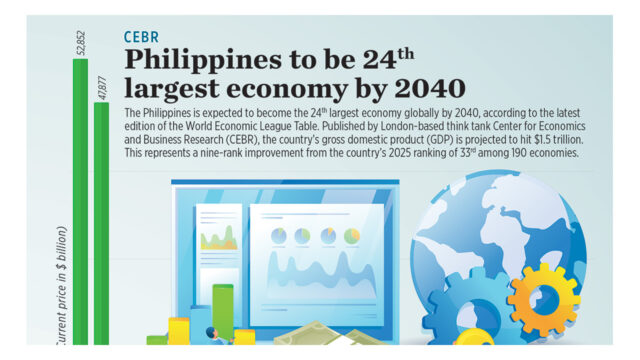
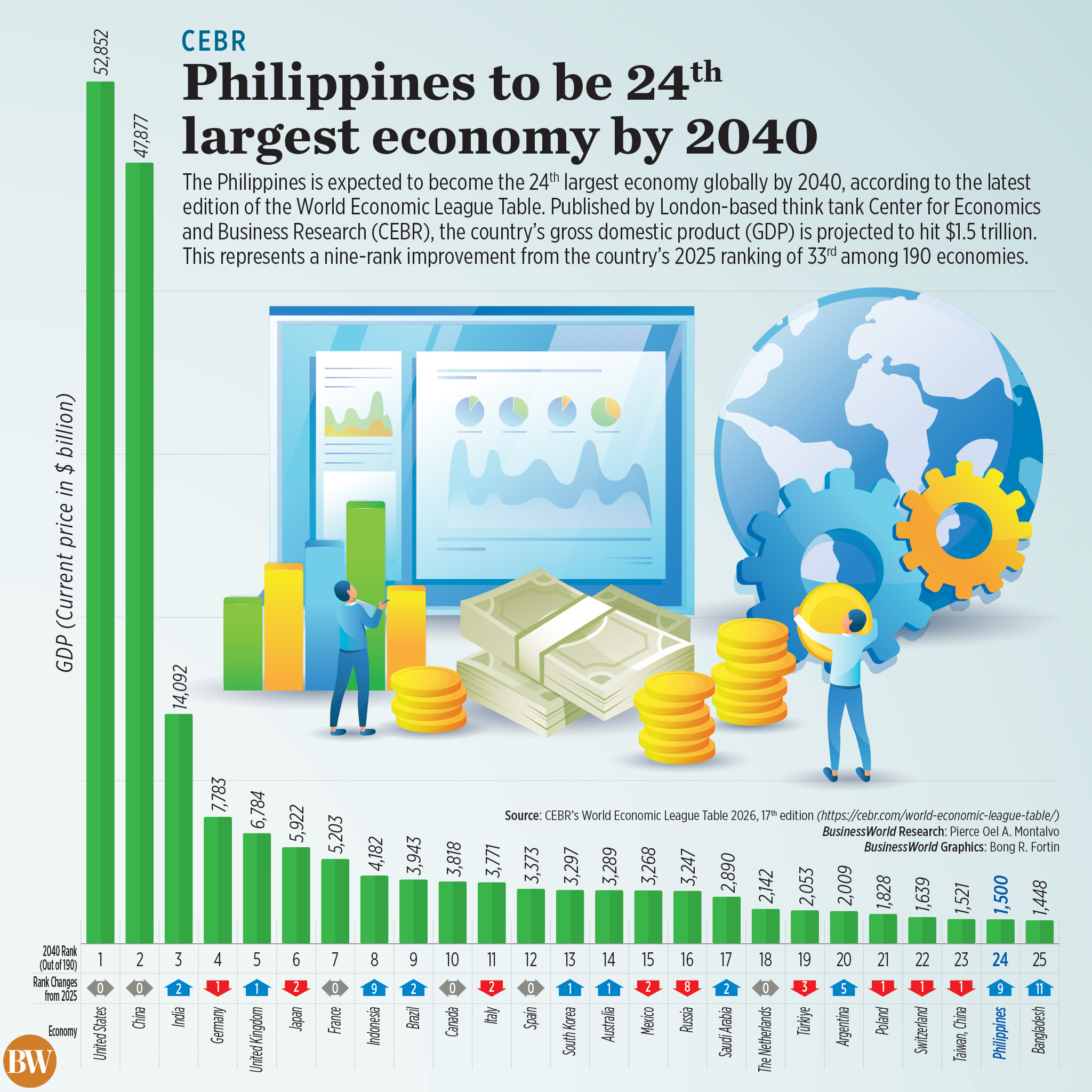
CEBR: Philippines to be 24th largest economy by 2040

The Philippines is expected to become the 24th largest economy globally by 2040, according to the latest edition of the World Economic League Table. Published by London-based think tank Center for Economics and Business Research (CEBR), the country’s gross domestic product (GDP) is projected to hit $1.5 trillion. This represents a nine-rank improvement from the country’s 2025 ranking of 33rd among 190 economies.

PHL market may kick off 2026 on cautious note

BW FILE PHOTO

PHILIPPINE STOCKS may start 2026 moving mostly sideways as trading activity is expected to remain thin due to the holidays and as the market awaits developments on the National Government’s budget for the year.

On Dec. 29, the last trading day for 2025, the bellwether Philippine Stock Exchange index (PSEi) dropped by 0.21% or 12.72 points to end at 6,052.92. Meanwhile, the broader all shares index increased by 0.24% or 8.58 points to 3,473.24.

Year on year, the PSEi was down by 7.29% or 475.87 points from its end-2024 finish of 6,528.79.

Philippine financial markets were closed on Dec. 30, Dec. 31, and Jan. 1 for Rizal Day and the New Year holidays.

As trading resumes on Friday, the market is expected to start the year on a quiet note amid the holiday lull, F. Yap Securities Investment Analyst Marky Carunungan said.

“For the first trading day of 2026, we expect the market to trade cautiously with a slight downside bias given a thin holiday liquidity and lingering uncertainty around the delayed signing of the 2026 budget,” he said.

“While broader fundamentals point to a gradual recovery later in the year, near-term sentiment may still remain fragile until there’s clarity on fiscal execution.”

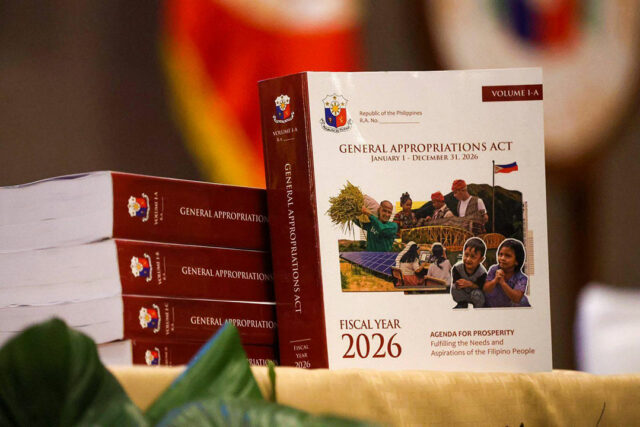
Executive Secretary Ralph G. Recto said on Tuesday that President Ferdinand R. Marcos, Jr. and his team are reviewing the 2026 General Appropriations Act (GAA) and the changes made by lawmakers. Mr. Marcos is expected to sign the GAA on Jan. 5, forcing the country to operate on a reenacted budget in the first few days of 2026.

Rizal Commercial Banking Corp. Chief Economist Michael L. Ricafort said players could take cues from how other stock markets performed over the Philippine bourse’s three-day trading break.

“There is a chance for a start-of-the-year rally, depending on forecasts, especially on reform measures on anti-corruption and further improving governance standards — especially if these priority reform measures are taken seriously,” Mr. Ricafort said.

Meanwhile, for this year, analysts said the PSEi could continue to struggle to find its footing as economic uncertainties linger.

“There’s a chance that the market could rise to around 6,600-6,700 if we see decisive action on governance issues as well as a sustained trend of GDP (gross domestic product) growth above 5%. Conversely, there’s a risk of the index revisiting 5,600 or lower if economic growth stalls or fresh governance concerns emerge,” China Bank Capital Corp. Managing Director Juan Paolo E. Colet said.

“We expect the index to tread sideways between the 6,000 and 6,400 range as a multitude of headwinds, such as the slowdown in manufacturing activities, softer consumer spending, and tightening infrastructure disbursements which could taper economic growth once again,” AP Securities, Inc. Equity Research Analyst Shawn Ray R. Atienza added. — Alexandria Grace C. Magno

China eyes stricter Scarborough Shoal measures, accuses PHL of reef damage

THIS PHOTO taken by the Philippine Coast Guard (PCG) shows one of the two Chinese coast guard vessels shadowed by the BRP Cabra about 26 nautical miles (48.15 kilometers) east of Scarborough Shoal, Nov. 23, 2025. — PCG

By Kenneth Christiane L. Basilio, Reporter

CHINA will impose “strict protection measures” at the disputed Scarborough Shoal to prevent further environmental damage there, according to a Chinese government report, which also accused the Philippines of damaging the maritime feature’s ecosystem.

Chinese authorities will enhance their monitoring of the shoal while carrying out conservation work to strengthen its nature reserve in the feature, based on the report compiled by research groups under Beijing’s Ministry of Natural Resources, a copy of which was obtained by BusinessWorld.

“China will further improve the regular alerting and monitoring mechanism on Huangyan Dao, and consistently carry out surveys, studies, conservation and restoration to maintain and enhance the diversity, stability and sustainability of the coral reef ecosystem,” it said, referring to the shoal by its Chinese name, which the Philippines calls Panatag.

The Philippines and China both claim Scarborough Shoal, which is prized for its rich ecosystem and proximity to key shipping lanes. The dispute over its ownership is part of the wider South China Sea tensions that have strained ties between Beijing, Manila and their allies.

In September, China approved the creation of a 3,500-hectare reserve at the northeast rim of Scarborough Shoal, which it said is intended to preserve the ecological diversity of one of the waterway’s most contested areas. Manila has called the plan a “clear pretext for occupation.”

China has built man-made islands featuring runways, hangars, radar systems and ports on numerous submerged features in the South China Sea to strengthen its naval presence in the resource-rich waters.

The report said “rigorous conservation management” would be introduced at Scarborough Shoal to counter threats to its coral reef ecosystem, including climate change and rising sea temperatures, while partly blaming the Philippines for harmful activities.

“Illegal fishing activities and frequent intrusions by the Philippines have also induced a great stress on the ecosystem,” it said. “Unsustainable illegal fishing activities and frequent intrusions have brought about abandoned materials and pollutant discharge, adversely affecting the health of Huangyan Dao ecosystem.”

China took control of the shoal in 2012 after a standoff with Philippine forces. It has since stationed its coast guard and fishing vessels there, blocking Filipino fishermen despite a 2016 ruling by a United Nations-backed tribunal that declared it a traditional fishing ground.

The Philippine government has rolled out schemes to aid fishermen in the South China Sea, offering incentives, fuel subsidies, food and equipment to encourage their presence in the disputed waters.

The Philippines’ Defense department did not immediately reply to a Viber message seeking comment. BusinessWorld also sought comment from National Security Adviser Eduardo M. Año and Presidential Assistant for Maritime Concerns Andres C. Centino, who did not immediately reply.

SHIFTING BLAME
Manila’s Maritime Council Spokesman Alexander S. Lopez said China’s claim of reef damage at the contested shoal was propaganda, pointing out that previous Chinese maritime activities in the area had harmed the area.

“As part of the 2016 ruling, it was determined that China was the one responsible for the ecological damage of Bajo de Masinloc,” he told BusinessWorld in a Viber message on Monday, referring to another Filipino name for Scarborough Shoal and citing the decision that invalidated Beijing’s sweeping sea claim.

Chinese fishermen’s “illegal harvesting” of giant clams at the feature has caused ecological damage, he said. “They are the ones depleting the giant clams.”

Sherwin E. Ona, an international fellow at Taiwan’s Institute for National Defense and Security Research, said China’s nature reserve plan in Scarborough Shoal and the recent report gives it “legal cover” to occupy the feature.

“This is a ‘lawfare’ approach from China… as the natural marine reserve gives them legal cover for eventual occupation,” he said in a Viber message, adding that the ecological report could provide Beijing with justification to assert authority over Scarborough.

He said Philippine authorities should bolster their presence near the shoal by conducting regular patrols to hinder Beijing from asserting greater control over the feature.

“This should be combined with constant information-sharing and diplomatic efforts to deter China,” said Mr. Ona.

Philippines ‘concerned’ over China’s drills near Taiwan, says they undermine regional stability

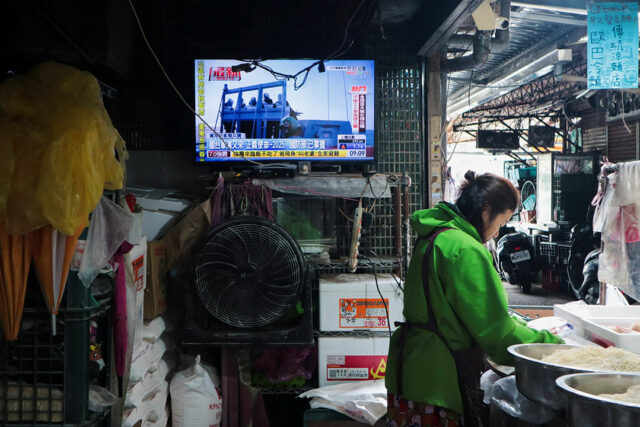
A TV screen in Taipei flashes a news report of China’s “Justice Mission 2025” military drills around Taiwan on Dec. 29, 2025. — REUTERS/TSAI HSIN-HAN

THE Philippine Defense department on Wednesday said it was “deeply concerned” over China’s massive military drills off Taiwan, warning that they undermine regional peace and stability.

In a statement, Defense Secretary Gilberto C. Teodoro, Jr. said China’s coercive activities around Taiwan have implications beyond the region and could affect stability in the Indo-Pacific.

“This heightened scale of coercion has implications that extend beyond cross-strait relations and into the broader Indo-Pacific community,” he said, adding that the military exercises risked “further creating cracks in an already fragile geopolitical environment.”

China fired dozens of rockets toward Taiwan and deployed warships and jets near the island in a show of force simulating an encirclement of the self-ruled island and aimed at deterring foreign intervention in the event of conflict.

The exercise, named “Justice Mission 2025,” was the largest by area so far and the closest yet to Taiwan, which deployed jets and warships to monitor them.

It began just 11 days after the US announced a record $11.1-billion arms package for Taipei that included missile and communications systems; and concluded on Wednesday as China pulled its ships back. Despite this, Taiwan remained on high alert, a Reuters report noted.

Taiwan’s ex-Defense Minister Chiu Kuo-cheng in 2021 said China could be ready to mount a full-scale invasion of the island state by this year, while former US Indo-Pacific Commander John C. Aquilino said indications point to the possibility of a Taiwan invasion by 2027.

Philippine officials have said the country could be involved in any conflict over Taiwan.

In April, Military Chief Romeo S. Brawner, Jr. directed the armed forces to prepare for a possible invasion of the island, while President Ferdinand R. Marcos, Jr. warned in August the Philippines would be dragged “kicking and screaming” into any confrontation, with Taiwan lying less than 200 kilometers from its northernmost islands.

Manila’s National Security Policy 2023-2028 identified a possible Taiwan conflict as a potential flashpoint due to the Philippines’ proximity from the island, which could not only affect Filipinos in Taiwan but also lead to an influx of refugees.

“Basic principles of self-restraint must be observed, and the rule of international law must not be distorted,” Mr. Teodoro said. “The Philippines underscores the importance of upholding international law and regional norms, including the principles of peaceful management of disputes. “

“We reaffirm our support for a free, open, stable, and rules-based Indo-Pacific, where differences are resolved through peaceful means without deception, coercion, or intimidation,” he added. — Kenneth Christiane L. Basilio

Budget reforms fall short in absence of participatory, accountability mechanisms

HANDOUT COURTESY OF OFFICE OF SEN. GATCHALIAN

By Adrian H. Halili, Reporter

THE country’s budget process remained “opaque” even as the government introduced several transparency reforms last year, analysts said, as the recently ratified 2026 national budget awaits President Ferdinand R. Marcos, Jr.’s approval.

“The general condition of the budget process remains opaque. Only a portion was televised. No efforts to enable participation and accountability in any part of the budget process,” Joy G. Aceron, convenor-director of transparency group G-Watch, said in a Facebook Messenger chat.

Lawmakers ratified the P6.793-trillion national budget for 2026 last Dec. 29, with critics noting that government aid and unprogrammed funding remained prone to misuse and politization due to weak accountability mechanisms.

Ederson DT. Tapia, a political science professor at the University of Makati, said that last year’s process showed more transparency, noting an increase in disclosures, stronger public messaging, and repeated invocations of openness.

“Yet transparency is not just about visibility alone. It is also about explainability,” he said in a Messenger chat.

“While procedures became more open, the rationale behind late-stage changes remained difficult for the public to fully grasp,” he added.

The deliberations for the 2026 budget have been marked by the implementation of several transparency measures, as a reaction from public outrage over a corruption scandal involving congressional insertions and opaque budget allocations.

These measures included the uploading of budget documents on online platforms, the livestreaming of bicameral proceedings, and the involvement of civil society in budget deliberations.

“In that sense, we saw improvements in procedural transparency, but deliberative transparency, such as clear articulation of trade-offs and policy priorities, remains incomplete,” Mr. Tapia said.

Ms. Aceron added transparency alone remains meaningless without responsiveness and accountability in budget deliberations.

“Transparency is only a means or tool,” she said, noting that transparency mechanisms serve only as tools if they don’t pave the way for civil society to influence decisions or hold legislators to account.

She added that last year’s budget process offered little room for public accountability, with allocations still prone to patronage and corruption.

“The budget continues to have allocations that perpetuate patronage, like the ayuda (social aid) programs and those prone to corruption, like the unprogrammed allocations,” she said.

Social aid programs like the Medical Assistance to Indigent and Financially Incapacitated Patients remained funded under the 2026 national spending plan, at P51.65 billion.

The program was previously flagged as it required patients to secure guarantee letters from politicians to avail of assistance.

Unprogrammed allocations are now set at P243.4 billion close to the P250-billion funding under the National Expenditure Plan. These standby funds for pre-planned government projects or emergency contingencies have been flagged for potential sources of corruption.

Selective accountability threatens to undercut Philippine anti-graft push

VARIOUS religious and civil society groups joined the second Trillion Peso March along Epifanio de los Santos Avenue (EDSA) in Quezon City, Nov. 30, 2025. — PHILIPPINE STAR/MIGUEL DE GUZMAN

By Chloe Mari A. Hufana, Reporter

PHILIPPINE anti-corruption efforts risk losing their deterrent effect unless investigations begin to reach senior political and business figures, a failure that could further erode public trust and shape behavior within the government in the years ahead, an analyst said.

The public is less unsettled by the absence of arrests than by a pattern in which enforcement actions appear to stop short of individuals with real political or economic weight, political science professor at the University of Makati Ederson DT. Tapia said.

Unless that boundary shifts, accountability will continue to be perceived as conditional, he warned, raising doubts about how far future probes will go.

“People feel that, even if they don’t always articulate it in sophisticated and legal terms. There’s a quiet question that hangs in the air: up to where does accountability actually go?” he said via Facebook Messenger.

The country is probing a multibillion-peso flood control scandal after President Ferdinand R. Marcos, Jr. exposed that high-ranking public officials have been colluding with private contractors to receive kickback money in return.

Only former Public Works officials and government contractors have so far been jailed since the President flagged anomalous flood control projects in August.

As climate risks intensify and infrastructure spending rise, Mr. Tapia said unresolved questions about responsibility could fuel deeper public skepticism.

That perception, if left unaddressed, may gradually alter how citizens and officials engage with institutions. Mr. Tapia said confidence may not collapse abruptly, but its slow erosion is expected, in which anti-corruption campaigns are increasingly viewed as symbolic.

Over time, this risks weakening their ability to deter misconduct as the government rolls out larger and more complex public works programs.

Mr. Tapia said political patronage and elite networks are likely to remain decisive factors, unless reforms disrupt the advantages of delay and distance from accountability.

Those with political and economic capital often do not need to interfere directly, he said, as prolonged investigations and procedural complexity can be enough to diffuse urgency and public pressure.

Looking ahead, Mr. Tapia warned that predictable enforcement outcomes could reshape incentives within the bureaucracy. Lower-level officials may continue to face immediate exposure, while those closer to power remain insulated, reinforcing an uneven risk landscape.

“Once that pattern becomes predictable, it stops deterring behavior,” he said. “It starts shaping it.”

For the government, Mr. Tapia said, the credibility of future anti-corruption drives will hinge on whether accountability visibly extends beyond familiar limits.

Without that shift, he warned, integrity may remain part of official rhetoric, but proximity to power will continue to be seen as the safer long-term strategy.