Home Blog Page 4567

Blasts on Crimea Bridge kill two, threaten supply lines of Russian troops in Ukraine

Army soldier figurines are displayed in front of the Ukrainian and Russian flag colors background in this illustration taken, Feb. 13, 2022. — REUTERS/DADO RUVIC/ILLUSTRATION

KERCH, Crimea — Two people were killed and their daughter was seriously injured on Monday after blasts on the Crimean Bridge, a major supply artery for Russian troops fighting in Ukraine and a prestige project that was personally opened by President Vladimir Putin.

Reuters images from the scene showed no traffic crossing the 19 km (12-mile) road and rail bridge which links Russia to Crimea, which Russia annexed from Ukraine in 2014.

Unverified imagery showed twisted metal barriers, debris and a damaged car on the bridge. Dash cam footage showed drivers braking sharply shortly after the incident. The extent of the damage was not immediately clear.

Russian officials called it an “emergency” situation. Russia’s Grey Zone channel, a Telegram channel affiliated with the Wagner mercenary group, reported there were two strikes on the bridge at 03:04 a.m. (0004 GMT) and 03:20 a.m.

The parents of a girl were killed and their daughter was injured in a passenger car.

“The girl was injured,” Vyacheslav Gladkov, governor of the Belgorod region said in a message on the Telegram messaging app. “The hardest thing is that her parents died, dad and mum.”

“No words can calm the pain of loss here,” he said. The girl was being treated in intensive care.

Sergei Aksyonov, a Russia-installed governor, said the emergency occurred on the 145th pillar of the bridge. He did not provide any further details.

A spokesperson for Ukraine’s southern military command, Natalia Humeniuk, said the incident on the Crimea Bridge could be an act of provocation on Moscow’s side.

“The creation of such provocations, which the occupying authorities of Crimea report immediately very loudly, is a typical way of solving problems by authorities of Crimea and the aggressor country,” Ms. Humeniuk told the national broadcaster Rada.

Russia blamed Ukraine for an attack on the bridge last October. Ukraine admitted only indirectly to the attack months later.

Serhiy Bratchuk, spokesperson for Ukraine’s Odesa military administration, posted a photo on his Telegram account of what seemed to show part of the bridge broken. It was not immediately clear whether that was related to any attack.

After the October attack, Mr. Putin ordered the bridge repaired and even drove a Mercedes across it.

Russia’s transport ministry said there was damage to the road on the bridge closer to the Crimean Peninsula, but there was no damage to the pillars. It did not say what caused the damage.

UKRAINE WAR
George Barros, an analyst at the Washington-based Institute for the Study of War, said if the bridge was seriously damaged it would significantly impact Russian supply lines. “Russia will only have one ground supply line — the coastal highway on the Sea of Azov — to sustain (or evacuate) its tens of thousands of troops in occupied Kherson & Crimea if UKR manages to degrade/destroy the bridge,” Mr. Barros said on Twitter.

It was not immediately clear what the incident on the bridge would mean for the UN-brokered deal that allows the safe Black Sea export of Ukrainian grain. Ukraine and Russia are among the world’s top grain exporters.

The UN deal is due to expire on Monday, with the last ship to travel under the deal leaving the port of Odesa early on Sunday, according to a Reuters witness and MarineTraffic.com.

PUTIN’S SHOWCASE
The bridge, Europe’s longest, was built by a company controlled by Putin ally Arkady Rotenberg. Mr. Putin has long lauded the project, boasting at one point that Russian Tsars and Soviet leaders had dreamed of building it but never did.

The Crimean peninsula has been a cherished vacation destination for Russians, especially after Moscow launched its invasion on Ukraine in 2022 and traveling to the West became much more difficult for Russians.

In recent weeks, traffic jams to the entrance of the bridge went for kilometers on daily basis as Russians went on holidays.

On Monday morning the traffic jam ran for kilometers before police directed vehicles away from the bridge. Social media accounts showed cars lined up on the bridge and its entrance.

The Russian-backed administration of the Crimean peninsula urged residents not to travel via the bridge. — Reuters


Mexico intercepts over 500 migrants in two days

STOCK PHOTO | Image by Jorge Carlos from Pixabay

MEXICO CITY — Mexican authorities on Sunday said they intercepted over 500 migrants in two days in the eastern state of Veracruz as authorities crack down on the transportation of migrants toward the United States in unsafe conditions.

Authorities found 206 migrants abandoned in a tractor-trailer on Saturday in the town of Puente Nacional, Veracruz, a source at the National Migration Institute (INM) said.

The town’s mayor Roberto Montiel wrote on Facebook that “over 180” migrants were found, including women and children, with some of the migrants presenting signs of dehydration.

Earlier on Sunday, the INM reported in a statement that authorities had intercepted 303 migrants in two operations on Friday morning in Veracruz.

In the first, authorities found 107 migrants without regular migration status, including 20 unaccompanied minors, in a tractor trailer after it was pulled over on the highway.

Six people were arrested for alleged roles in transporting the migrants, who hailed from Cuba, El Salvador, Guatemala, Honduras, and Nicaragua, the INM’s statement said.

Also on Friday, authorities found 196 migrants, including 19 unaccompanied minors, packed into an improperly parked tractor-trailer detected on a road close to the city of Fortin de las Flores.

Five of the migrants were adults from Guatemala and another five adults from India, the INM statement said, without providing further details on the other migrants’ nationalities.

The precarious smuggling of migrants en route to the United States has ended in notable tragedies in recent years.

Fifty-five people were killed in December 2021 after a truck carrying an estimated 166 migrants crashed in Mexico’s southern Chiapas state.

In June 2022, 53 migrants died in a sweltering tractor trailer in Texas in the deadliest migrant-trafficking incident on record in the United States. — Reuters

Swatch sues Malaysia for seizure of Pride watches

STOCK PHOTO | Image by Chandlervid85 from Freepik

KUALA LUMPUR — Swiss watchmaker Swatch Group has filed a lawsuit against the Malaysian government for confiscating rainbow-colored watches that celebrate LGBT rights, in an act the company says has damaged its reputation.

Homosexuality is a crime in Muslim-majority Malaysia, and rights groups have warned of growing intolerance in the country towards the lesbian, gay, bisexual, transgender and queer (LGBTQ) community.

In May, Malaysian authorities confiscated watches from Swatch’s ‘Pride collection’ because of the presence of the letters ‘LGBTQ’ on the watches, the home minister said. 

Home ministry officials “illegally” seized 172 watches from 16 outlets, Swatch said in court documents seen by Reuters. The lawsuit, filed on June 24 at the Kuala Lumpur High Court, was first reported on Monday by the Malay Mail, a Malaysian news website.

“Without a doubt, the seized watches did not and are not in any way capable of causing any disruption to public order or morality or any violations of the law,” Swatch said in the lawsuit.

The seizure notices served to Swatch described the watches as having elements of or promoting LGBTQ rights and potentially breaching Malaysian law, the company said.

Most of the seized watches, which have a combined retail value of 64,795 ringgit ($14,250.05), did not contain the ‘LGBTQ’ lettering, Swatch said.

Swatch is seeking damages and the return of the watches, saying its ability to do business in the country has been “greatly jeopardized” following the seizures.

Malaysia’s home ministry did not immediately respond to a request for comment.

The Kuala Lumpur High Court is set to hear the case on July 20.

Malaysia has jailed or caned people for homosexuality. Last year, 18 people were detained at a Halloween party attended by members of the LGBT community.

The seizure and lawsuit come ahead of crucial regional polls that will pit Prime Minister Anwar Ibrahim’s progressive coalition against a mostly conservative ethnic-Malay, Muslim alliance.

In the run up to the elections, Mr. Anwar has again been accused by critics of not doing enough to protect the rights of Muslims in multi-racial, multi-faith Malaysia.

Mr. Anwar was imprisoned for sodomy and corruption for nearly a decade, charges he denied and said were politically motivated.

The premier has repeatedly said this month that his government will uphold principles of Islam, state media reported. He has also said LGBT rights will not be recognized by his administration. — Reuters

Indian tourists flock to Southeast Asia as China’s reopening falters

STOCK PHOTO | Image by L.Filipe C.Sousa from Unsplash

BANGKOK/NEW DELHI — Indian tourists are streaming into Southeast Asia, cementing the world’s most populous country’s position as a key growth market for a travel and tourism sector that is feeling the pinch of China’s slower-than-expected re-opening.

From airlines like IndiGo and Thai Airways to hospitality chains offering thousands of rooms, companies are tapping into India’s burgeoning middle-class and growing spending power, executives and analysts said.

“Southeast Asia is obviously very well positioned for a lot of the growth that is inevitably going to come from India,” aviation analyst Brendan Sobie told an industry conference last month.

The travel and tourism industry is critical for several Southeast Asian economies and contributed about 12% of the region’s gross domestic product before the COVID-19 pandemic. It also employs more than 40 million of the region’s people, according to the Organization for Economic Cooperation and Development.

For a decade or so, the sector was fueled by China but official data from four Southeast Asian countries shows a weak recovery with the number of Chinese visitors in May at least 60% lower than the same month in 2019.

A long-term increase in Indian tourists would lead to a recalibration of airline capacity, hospitality offerings and tourism operators – early signs of which are underway, according to industry members.

India could emerge as the next China “in terms of outbound tourism growth” over the next decade, though connectivity would be constrained by fewer airports there, the Asian Development Bank (ADB) said in a May report.

“India could become the story in the decade after the pandemic for tourism,” it said.

STRONG UPTICK
In Thailand, where tourism is an economic mainstay, the number of Indian tourists – though fewer than Chinese in absolute terms – is only about 14% lower than it was in 2019.

In 2019, Chinese visitors spent about $197 a day in Thailand and Indians spent about $180, with both visiting for about a week, according to Thai government data.

Tanes Petsuwan, deputy governor of the Tourism Authority of Thailand said 1.6 million Indians were expected to visit the kingdom this year.

In May, more Indians than Chinese visited Singapore while that same month nearly 63,000 Indians visited Indonesia compared with just over 64,000 Chinese.

“Indian routes are very strong,” said Chai Eamsiri, chief executive officer of Thai Airways, which is flying 14 flights a week to China – down from about 40 before the pandemic – and 70 a week to India.

Some of a possible doubling of Thai’s narrow-body aircraft fleet over the next decade would be deployed to India, Chai said.

Indian budget carrier IndiGo, which has ordered 500 Airbus narrowbody jets to meet regional demand, said it had seen a “strong uptick” in routes between India and Southeast Asia that it connects with more than 100 flights a week.

“We are introducing flights to Jakarta in August, as well as additional frequencies to Singapore,” said Vinay Malhotra, IndiGo’s head of global sales.

Overall, seat capacity on scheduled flights between China and Southeast Asia was 57% below pre-COVID levels as of June but flights from India to the region had recovered to about 90%, Sobie said.

Indians are helping to sustain a post-pandemic rebound for hospitality chains, including Minor Hotels, which has 45 properties in Southeast Asia with more than 6,000 rooms.

“The Indian market is consistently one of our top source markets,” said CEO Dillip Rajakarier, adding that the hotel chain – part of Bangkok-listed Minor International – had intensified marketing across India.

TIME AND MONEY
In June, Pratyush Tripathy and four friends hopped on a two-and-a-half-hour flight from the Indian city of Kolkata to Bangkok for a five-day holiday, much of it in and around the beach resort of Pattaya.

The trip cost between 40,000 and 60,000 Indian rupees ($484-$726) each, about the same as a flight to Europe, said Tripathy.

“It will save you time and also money,” said the 33-year-old software professional, explaining their decision to visit Southeast Asia, where Indians can usually get visas much more easily than they can for European countries and the United States.

Flight bookings from India to Bangkok jumped by 270% between January to June this year compared with the same period in 2019, according to Indian online travel portal Cleartrip.

Thailand’s central bank expects 29 million visitors this year and 35.5 million in 2024. That’s still fewer than a record of nearly 40 million in 2019, but the Bank of Thailand forecasts that the sector will help drive overall economic growth to 3.6% in 2023 and 3.8% next year, compared with 2.6% in 2022.

To cash in on the surge, Thailand’s tourist industry must understand Indians’ preferences, particularly around food and entertainment, said Somsong Sachaphimukh, vice president of the Tourism Council of Thailand.

“If we don’t adjust quickly, neighboring countries will draw in those visitors,” Somsong said. “Thailand has a lot to offer, so this is a big opportunity.” — Reuters

New Zealand PM says Pacific region less secure due to China’s assertiveness

PHILIPPINE COAST GUARD FILE PHOTO

AUCKLAND — The Pacific region is becoming more contested and less secure as China becomes more assertive, New Zealand Prime Minister Chris Hipkins said on Monday, outlining the country’s need to work with like-minded partners while still engaging with Beijing.

China’s rise and how it seeks to exert that influence is a major driver of the increasing strategic competition, particularly in the Indo-Pacific, Hipkins said in a speech to the China Business Summit in Auckland.

“Our region is becoming more contested, less predictable, and less secure,” he said. “And that poses challenges for small countries like New Zealand that are reliant on the stability and predictability of international rules for our prosperity and security.”

The relationship needed careful management, but China remained a key trading partner, he added.

Mr. Hipkins’ speech at the annual event comes less than a month after he led a successful trade mission to China, New Zealand’s largest trading partner, where he faces some domestic criticism for not being as vocal on human rights and other issues as some had expected.

“In this increasingly complex global environment, our relationship with China will continue to require careful management,” he said.

Wellington has historically taken a more conciliatory approach towards China than Australia or its other Five Eyes security partners, Canada, the United States and the United Kingdom.

“Common interests and concerns do not mean we will always take the same approach. Sometimes there is tactical strength in a diversity of approaches to achieve the same outcomes,” he said.

Wang Xiaolong, China’s ambassador to New Zealand said in a speech that China and New Zealand relations were healthy, stable, and thriving.

“It is no surprise that there are differences between our two countries, given the difference in our respective circumstances. There is no inevitability though, that our countries with differing social systems and levels of development cannot coexist peacefully,” he said in a speech that followed Hipkins’ at the summit. — Reuters

Smart three-peats as the PHL’s Fastest and Best Mobile Network

PLDT’s wireless unit Smart Communications, Inc. (Smart) has once again achieved a remarkable feat as it has earned the Philippines’ Fastest and Best Mobile Network in the Philippines for the third consecutive reporting period of Ookla, an internationally recognized leader in network measurement and connectivity intelligence.

According to Ookla’s latest analysis for Q1-Q2 2023, Smart continued to deliver the fastest mobile speeds and best mobile coverage to customers, clinching the “Best Mobile Network” award, a prestigious distinction for mobile operators around the world.  

Smart initially made history by becoming the first and only mobile operator in the Philippines to receive Ookla’s recognition as the “Best Mobile Network” during Q1-Q2 2022. It then continued its success in Q3-Q4 2022, and most recently in Q1-Q2 2023. 

The best mobile experience for customers  

“It’s our pleasure to congratulate Smart for their exceptional accomplishment of winning the Speedtest Award for Best Mobile Network three times in a row,” said Stephen Bye, President and CEO of Ookla, a division of Ziff Davis. “This remarkable feat showcases Smart’s dedication to enhancing connectivity in the Philippines and ensuring consumers receive the best possible internet experience.” 

“True to our Purpose at PLDT Group, I am proud of how we are able to evolve with our customers’ increasingly digital lifestyles and enable meaningful connections – as attested by our awards from Ookla. As the driving force behind these recognitions, our Fixed, Mobile, and Enterprise customers can rest assured that they can count on us to continuously provide them with the best network possible,” said Alfredo S. Panlilio, President and CEO of PLDT and Smart.   

Ookla’s latest report showed Smart’s superiority in terms of Speed and Coverage Scores.   

Smart emerged as the ‘Fastest Mobile Network’ with a Speed Score of 64.25, while its closest competitor posted a Speed Score of 39.04    

To arrive at this Speed Score, Smart posted a median download speed of 34.08 Mbps and a median upload speed of 7.34 Mbps. On the other hand, its closest competitor posted a median download speed of 22.52Mbps and a median upload speed of 5.38 Mbps.     

Smart also led in the ‘Best Mobile Coverage’ category with a Coverage Score of 786, edging out its closest competitor’s Coverage Score of 769. The Coverage Score captures both the number of locations in which an operator offers service and the quality of service in each location, according to Ookla.     

The ‘Fastest Mobile Network’ award is based on more than 2.4 million user-initiated tests, whereas the Coverage Award is based on over 3.7 million scan counts.   

Consistently superior mobile network    

“Our consistently superior mobile network is the backbone of cutting-edge mobile innovations that empower our customers to live more today. Our customers can rely on us to continuously improve our network and offer an unparalleled mobile experience as they pursue their passions and make the most of the moments that matter to them,” said Francis E. Flores, SVP and Head of Consumer Business Group – Individual at Smart. 

Powered by Smart’s fastest speeds and widest coverage, subscribers can share memorable moments with their loved ones on social media in real time or via crystal-clear video calls. Subscribers can also achieve more in their career or passion – from sending huge files and presentations in an instant, promoting their business online, attending virtual meetings and classes, to streaming their favorite shows and playing high-bandwidth mobile games on the go. 

Underpinning Smart’s mobile network performance are PLDT and Smart’s integrated fixed and wireless networks. As of end-March 2023, PLDT had expanded its total fiber footprint to over 1.1 million kilometers, consisting of over 231,000 kilometers of international fiber and over 874,000 kilometers of domestic fiber. This fiber infrastructure also supports Smart’s 2G, 3G, 4G/LTE, and 5G networks, which cover 97 percent of the country’s population as of end-March 2023. 

To continue enjoying Smart’s fastest speeds and the widest coverage, subscribers are encouraged to register their SIMs at http://www.smart.com.ph/simreg, in line with the newly enacted SIM Registration Law. 

*Based on analysis by Ookla® of Speedtest Intelligence® data for speed and coverage Q1-Q2, Q3-Q4 2022 & Q1-Q2 2023. Ookla trademarks are used under license and reprinted with permission.


Spotlight is BusinessWorld’s sponsored section that allows advertisers to amplify their brand and connect with BusinessWorld’s audience by enabling them to publish their stories directly on the BusinessWorld website. For more information, send an email to online@bworldonline.com.

Join us on Viber at https://bit.ly/3hv6bLA to get more updates and subscribe to BusinessWorld’s titles and get exclusive content through www.bworld-x.com.

[B-SIDE Podcast] Revolutionizing coconut farming in the Philippines

Given their higher yield and early bearing characteristics, coconut hybrids offer Filipino coconut farmers a means to improve production, according to an expert.

In this B-Side episode, Leilani D. Pelegrina, director at the Department of Science and Technology-Philippine Council for Agriculture, Aquatic, and Natural Resources Research and Development (DoST-PCAARRD), discusses the impact of coconut hybridization on coconut farming with BusinessWorld reporter Patricia B. Mirasol.

TAKEAWAYS

Coconut hybrids yield more output with the same level of management.

Coconut hybrids can increase the annual yield of each palm to 150 nuts per year, compared to 45 nuts with traditional coconuts.

Hybrids begin flowering within 3 to 4.5 years, faster than the average 3 to 7 years for traditional coconuts, leading to potential fruit harvesting in 4 to 5 years instead of 3 to 7.

While one farmer claimed to have observed flowering after 18 months, further replication and verification are necessary, according to Ms. Pelegrina.

The potential yield per hectare for traditional coconut varieties is 15,000 nuts per year.

Based on the Philippine Statistics Authority’s farmgate price of P10.47 for a young coconut or buko, farmers cultivating traditional varieties can expect annual sales of around P157,000.

In contrast, a hectare of hybrid coconuts has the potential to yield 22,000 nuts per year, equivalent to approximately P230,340.

Additionally, intercropping practices, such as cultivating cash crops like vegetables, coffee, and cacao, can provide farmers with additional income.

Coconut production in the country increased by 1.6% to 3.26 million metric tons in the first quarter of 2023 compared to the same period in 2022, driven by increased awareness of coconut benefits and growing demand for coconut-based products in major developed countries, as per the Philippine Information Agency.

The coconut hybridization program in CALABARZON (Cavite, Laguna, Batangas, Rizal, and Quezon) will be expanded nationwide.

Funded by the DOST-PCAARRD, the program aimed to enhance the production and sustainability of coconut hybrids in Region IV-A from 2018 to 2022.

The Philippine Coconut Authority (PCA) implemented the project using two hybridization schemes: directed natural pollination and assisted pollination.

Four project sites were involved in the former (Institute of Plant Breeding in Los Baños, Oliveros Farm in Laguna, Stuart’s Farm in Quezon, and Villa Escudero in Laguna), while two project sites were designated for the latter (DFarm in Quezon and Feria’s Farm in Quezon).

Developing coconut hybrids entails combining exceptional parental mother palms (such as the Catigan Green Dwarf and Malayan Red Dwarf) with parental pollen source palms (such as Bago Oshiro Tall, Baybay Tall, Laguna Tall, and Tagnanan Tall). It takes at least 15 years of continuous research to develop coconut hybrid varieties.

“We are scaling this coconut hybridization program nationwide through the coconut farmers and industry trust fund (CFITF),” Ms. Pelegrina said.

Under the Coconut Farmers and Industry Fund Act (Republic Act 11524), farmers can utilize the coconut trust fund to develop the industry.

The fund, initially derived from the coconut levy imposed on farmers in the 1970s, was seeded with capital recovered from the levy.

The DoST received the first tranche of funds from the CFITF in 2022, with 20% of the allocation dedicated to coconut hybridization.

The PCA manages 15% of the funds for operations and activities, while 5% is overseen by the council for research and development, according to Ms. Pelegrina. Budgets from the fund will be received on an annual basis for five years.

The PCA aims to raise its coco levy fund allocation by P11 billion in 2024.

The P75-billion CFITF is facing challenges in hiring personnel and commissioning a study to improve the coconut industry, as the coco levy fund does not cover administrative costs, according to PCA administrator Bernie F. Cruz in a June 26 news briefing.

Filipino farmers can already apply to be accredited as program partners.

The PCA has a process for accrediting private farms, involving prerequisites, Ms. Pelegrina explained. Farmers can visit any PCA office or approach the DOST-PCAARRD, which can then refer them to the PCA.

“The first step should be to write to the PCA and express their intent to be considered as an accredited farmer cooperator,” Ms. Pelegrina said.

She added that at least 5 hectares would be effective for an area to be accredited as a farm, and accreditation includes training sessions on pest management and good agricultural practices.

Stakeholders have emphasized that, in addition to producing coconut hybrids, improving transportation infrastructure and farmers’ access to loans will further promote the coconut industry.

The Philippines is home to 2.5 million coconut farmers, with 69 out of the country’s 82 provinces classified as coconut-producing by the PCA.

Gross borrowings up 36% to P1.26T

BW FILE PHOTO

By Luisa Maria Jacinta C. Jocson, Reporter

THE NATIONAL Government’s (NG) gross borrowings hit P1.26 trillion as of end-May amid an increase in domestic debt, data from the Bureau of the Treasury (BTr) showed.    

In the first five months of the year, gross borrowings climbed by 35.9% from P924.429 billion in the same period a year ago.

Gross domestic debt rose by 41.5% to P912.577 billion in the January-to-May period, from P644.815 billion a year ago. This accounted for almost three-fourths or 72.6% of total gross borrowings in the first five months. 

Broken down, domestic debt was composed of P561.15 billion in fixed-rate Treasury bonds, P283.76 billion in retail Treasury bonds, and P67.66 billion in Treasury bills. 

Meanwhile, external debt grew by 23% to P343.874 billion as of end-May from P279.614 billion a year ago.

Global bonds made up P163.607 billion of the foreign borrowings, followed by program loans (P142.395 billion) and new project loans (P37.872 billion.)

In May alone, gross borrowings reached P146.783 billion versus the net redemption of P258.97 billion in the same month in 2022.

Domestic debt accounted for the bulk or 89.8% of total gross borrowings during the month.

Gross domestic borrowings reached P131.792 billion in May, from a net redemption of P270.769 billion in the same month a year ago.

Broken down, this consisted of P100 billion in fixed-rate Treasury bonds and P31.792 billion in Treasury bills.

Meanwhile, external gross borrowings went up by 27.3% to P14.991 billion from P11.709 billion in the previous year.

This consisted of P9.098 billion in program loans and P5.893 billion in new project loans.

Rizal Commercial Banking Corp. Chief Economist Michael L. Ricafort said that elevated inflation drove up government expenditures, which led to higher borrowings.

Headline inflation eased to 6.1% in May. However, this was still the 14th straight month inflation breached the Bangko Sentral ng Pilipinas’ (BSP) 2-4% target.

It was also still above the revised 5.4% full-year forecast by the central bank.

“Higher interest rates and bigger budget requirements pushed up overall gross borrowings for the year,” ING Bank N.V. Manila Senior Economist Nicholas Antonio T. Mapa said in a Viber message.

From May 2022 to March 2023, the BSP raised rates by 425 basis points, bringing the policy rate to 6.25%.

“Higher debt servicing cost of the National Government, particularly higher interest rates and weaker peso exchange rate since 2022, largely led to higher National Government borrowings,” Mr. Ricafort added.

The National Government has set its borrowing program at P2.207 trillion this year, consisting of P1.654 trillion from domestic sources and P553.5 billion from foreign creditors.

ALTERNATIVE SOURCES
Meanwhile, analysts said the Philippines should start looking into alternative sources of financing instead of relying on government borrowings.

“The fiscal space has narrowed because of the heavy borrowing incurred during the pandemic. At the same time, new spending for universal healthcare, food and nutrition, climate change resiliency, clean energy, etc. will require new sources of funding,” Filomeno S. Sta. Ana III, coordinator of Action for Economic Reforms, said via Facebook Messenger chat.

“The lesson we have learned from previous crises is that we cannot be dependent on borrowing,” he added.

As of end-May, the National Government outstanding debt hit a record P14.1 trillion.

The country’s debt-to-gross domestic product (GDP) ratio stood at 61% as of the end of March, slightly above the 60% threshold considered manageable by multilateral lenders for developing economies.

Mr. Sta. Ana said new taxes could reduce the government’s reliance on borrowings.

“New sources of funding have to be principally generated from domestic sources — that is, taxation. There are good taxes that can be introduced, taxes that will not hurt the economy and the people’s well-being,” he said, citing “sin” taxes and consumption taxes.

Data from a recent report by the United Nations (UN) showed that global public debt hit a record $92 trillion in 2022. Of this, developing countries owed 30% of the total public debt.

The UN also noted that public debt has risen faster in developing countries than developed ones.

“The rise of debt in the developing world has mainly been due to growing development financing needs — exacerbated by the COVID-19 pandemic, the cost-of-living crisis, and climate change — and by limited alternative sources of financing,” it added.

Public debt in developing countries has also increased to 60% of GDP in 2021 from 35% of GDP in 2010.

“Debt restructuring for the Philippines in terms of rescheduling, reduction or cancellation, interest rate cuts, and the like will only take place and be meaningful in magnitude with a more democratic international financial system starting with the International Monetary Fund (IMF) and World Bank. But this is only dealing with one symptom of the problem of underdevelopment and the roots of over-indebtedness will only be resolved with a robust domestic economy,” Sonny A. Africa, executive director of think tank Ibon Foundation, said in a Viber message.

Mr. Africa said when resources are freed up from debt servicing, the funds should go to agricultural modernization, industrialization, and sustainable development.

The UN also said there is a need for more affordable, long-term financing, such as concessional finance. Expanding contingency finance will be crucial “so that countries are not forced into debt as a last resort,” it added.

“Ensuring liquidity through contingency finance for countries facing external shocks is a straightforward measure that’s long overdue. If the International Monetary Fund and World Bank are more democratic and developmental, it will be much easier to pursue debt standstills and workouts,” Mr. Africa said.

“Much more development finance should be given to less developed countries such as the Philippines, including financing for industrial development which is so essential for economic progress,” he added.

In an e-mail, Ateneo de Manila University economics professor Leonardo A. Lanzona in an e-mail said the problem with international finance architecture is its emphasis on macroeconomic fundamentals “which entail fiscal discipline and other forms of restrictions that can limit the country’s choice of policies.”

“Hence, the focus of economic managers has been in creating the illusion of strong fundamentals which may divert the government from investing in long-term projects for social protection and human capital. This system of rewarding countries with good fundamentals can lead to macroeconomic conditions that may not necessarily enhance social welfare,” he added.

Mr. Lanzona also said that this structure forces countries like the Philippines to “concentrate on short-term programs that do not necessarily improve the living conditions of the majority.”

BSP keeps door open to further rate hikes

BLOOMBERG

NEW PHILIPPINE central bank Governor Eli M. Remolona signaled that further monetary policy tightening is still on the table for the Southeast Asian country and said it’s “premature” to talk about cutting the key rate.

The Bangko Sentral ng Pilipinas (BSP) remains on the “tightening side” as it monitors upside risks to inflation, including El Niño and wage hikes, Mr. Remolona said in Canada on Friday in a Bloomberg Television interview, his first since taking over leadership of the central bank.

“For now, we’re contemplating whether to hike or not to hike,” the governor told Bloomberg TV’s Kathleen Hays on Saturday. “We’re not thinking about whether to cut or not to cut.”

The central bank is also watching for any “sharp” movement in the Philippine peso if the US Federal Reserve further tightens monetary policy, Mr. Remolona said. The local currency has strengthened and is among the region’s best performers so far this year.

The Philippine economy remains “very strong,” the central bank chief said, while adding that the BSP would still like to see what impact its most aggressive tightening cycle in two decades — which lifted the key rate to a 16-year high — will have on growth.

A rate cut could be considered if inflation was already “well into” the central bank’s 2%-to-4% target, or if there was a global recession, he said. Headline inflation was at 5.4% in June, still way above the goal despite easing for five straight months.

Headline inflation may hit the target range in the fourth quarter, and may go below 2% early next year, Mr. Remolona said.

The governor also said he wants to further lower banks’ reserve requirement ratio but added that this wouldn’t coincide with any monetary policy tightening.

A former official at the Bank for International Settlements, the 70-year-old governor has repeatedly described the Philippine central bank as “structurally hawkish” and emphasized its inflation-targeting role during his first weeks in office. — Bloomberg

MUP pension reform proposal to be presented to Congress in August

Members of the Philippine Coast Guard are seen at the Port of Manila, May 16, 2022. — PHILIPPINE STAR/KRIZ JOHN ROSALES

THE DEPARTMENT of Finance (DoF) is expected to present the proposed bill seeking to reform the pension system for military and uniformed personnel (MUP) to Congress by August.

Finance Undersecretary Maria Luwalhati C. Dorotan-Tiuseco said the DoF is currently waiting for the completed actuarial studies.

“Then the economic team will meet to draft the proposal. After, it will be presented to the technical working group, where there will be negotiations, and then we will finalize the consensus bill and present it to the President,” she told reporters on the sidelines of a British Chamber of Commerce of the Philippines briefing last week.

Once the bill is finalized, it will be presented to Congress by August.

The 19th Congress resumes its second regular session on July 24.

The proposed unified system of separation, retirement and pension of MUPs is included in the Legislative-Executive Development Advisory Council’s list of priority measures targeted for Congress approval by December.

Finance Secretary Benjamin E. Diokno earlier said President Ferdinand R. Marcos, Jr. supports reforming the MUP pension system, warning that the current setup is not sustainable and may cause a “fiscal collapse.”

The MUP pension program covers members of the Armed Forces of the Philippines, Bureau of Jail Management and Penology, Bureau of Fire Protection, Philippine National Police, Philippine Public Safety College, Coast Guard, and Bureau of Corrections.

Under the current system, MUPs do not contribute to their pension. Instead, the pension benefits are drawn annually from the national budget.

MUPs are also automatically promoted one rank higher upon retirement and can receive their pension after 20 years’ service, with no minimum pensionable age. The monthly pension is also automatically indexed to the salary of active personnel.

Ms. Dorotan-Tiuseco said that the economic team has recently concluded its roadshows to discuss the proposed reform with MUPs.

“We promised MUPs that whatever proposal we will present, it will really be based on data and information culled from the actuarial studies. At the same time, taking into consideration the recommendations and suggestions from MUPs we’ve spoken with,” she said.

“We’re very optimistic that we’ll have a consensus bill because the MUPs have been very gracious and engaging in dialogues with us,” she added.

However, many military personnel raised the issue of transparency when discussing the proposal to require them to contribute to their pensions, Ms. Dorotan-Tiuseco said.

“For example, the MUPs are willing to contribute, but they are asking: where will the funds be placed? Who will manage? They want details. We promised the Secretary of National Defense that we will develop and strengthen a government structure or system,” she added.

“They need to know where the money is going. Transparency, accountability. They want that if it’s not used judiciously, there should be penalties, and that we can provide, definitely. They want to take part in the management of the money,” she added.

Ms. Dorotan-Tiuseco also said that the current version of the proposed reform has incorporated input from military and uniformed personnel during the roadshow.

“We are studying all the proposals. One thing for sure is whatever we will present will be based on numbers and suggestions. At the same time, taking into consideration the objective of the reform, which is to make it sustainable. A sustainable pension system for the MUPs,” she added.

Earlier versions of the MUP reform proposed that personnel in active service would contribute 5% of their monthly pay for the first three years, which will be supplemented by a 16% contribution from the government to reach the 21% total monthly premium for the fund. This scheme would be adjusted until a 9% and 12% ratio is reached in the seventh year.

Meanwhile, new MUPs would pay 9% of their base and longevity pay, with a 12% contribution from the government.

The economic team has also said that the Government Service Insurance System will be tapped to manage the pension fund but noted that there will be no “co-mingling” of funds.

“The MUP’s pension will remain strictly independent from the pension of civilian government workers,” the DoF earlier said.

Representatives from the MUPs will also be included in an oversight committee to manage the pension fund.

Mr. Diokno has said that continuing the current pension system for MUPs is not “fiscally sustainable.”

Data from the DoF showed that accumulating pension liabilities may increase public debt by as much as 25% by 2030. Total unfunded pension liabilities have also reached P9.6 trillion, according to the Bureau of the Treasury.

National Treasurer Rosalia V. de Leon also earlier said that the government would have to spend P214 billion in 2023, P537 billion in 2030, and P1.5 trillion in 2040 to fund the pension requirements of retired personnel. — Luisa Maria Jacinta C. Jocson

Wage hikes seen to force businesses to pass on costs to consumers

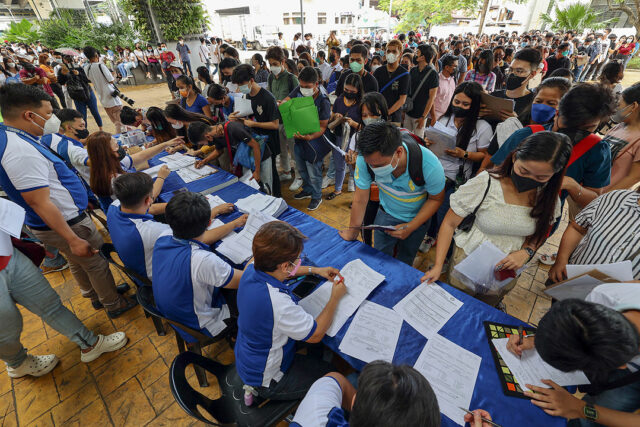
Applicants fill up documents at a job fair in Manila, June 20, 2022. — PHILIPPINE STAR/KRIZ JOHN ROSALES

THE GOVERNMENT should focus more on measures that would reduce the impact of inflation on Filipinos, instead of implementing wage hikes that would likely force many businesses to pass on these costs to consumers, analysts said.

The minimum wage in the National Capital Region (NCR) increased by P40 starting Sunday (July 16), bringing the daily minimum wage to P610 for workers outside the agriculture sector and P573 for workers in the agriculture sector, service retail establishments with 15 or fewer workers, and manufacturing companies with less than 10 workers.

Foundation for Economic Freedom (FEF) President Calixto V. Chikiamco said that while the recent NCR wage order may not be large, it will likely compel small businesses to pass on the additional costs to consumers.   

“The majority of workers, however, are not in the formal sector and won’t enjoy the mandated wage increase. Therefore, they will suffer from the increased prices as a result,” Mr. Chikiamco said in a Viber message.   

“Instead of mandating wage increases, which only benefit a minority, the government should liberalize food importation to reduce food inflation, which will benefit the poor the most,” he added.   

Headline inflation slowed for a fifth straight month in June to 5.4% from 6.1% in May, as food and transport costs eased. However, June marked the 15th straight month of inflation exceeding the Bangko Sentral ng Pilipinas’ 2-4% target band.

Year to date, inflation averaged 7.2%, still higher than the revised 5.4% forecast by the central bank.

While food inflation decelerated to 6.7% in June from 7.5% in May, data showed faster annual price increases were seen in rice, fish, and vegetables.

University of Asia and the Pacific (UA&P) Senior Economist Cid L. Terosa said the minimum wage hike will add about 0.06 to 0.1 percentage point to the average inflation for the next six months.   

“Hence, the National Economic and Development Authority (NEDA) statement that the minimum wage increase is unlikely to drive inflation appears to have weight,” Mr. Terosa said in an e-mail.

Last week, the NEDA said the inflationary impact of the minimum wage increase would be minimal and is unlikely to push inflation above the BSP’s 2-4% target range.   

According to Mr. Chikiamco, the central bank may have already factored in the modest wage increase in its inflation forecast this year.

The Philippine central bank sees inflation returning to the 2-4% target range by October. Full-year inflation is seen to average by 5.4% this year, before further slowing to 2.9% in 2024.

Meanwhile, Hansley A. Juliano, a political economy researcher studying at Nagoya University’s Graduate School of International Development in Japan, said wage hikes are supposed to boost workers’ purchasing power.   

“When the value of money is going down, insisting on not raising wages is essentially reducing the worth of wages, especially those at minimum levels. To insist on not raising their wages is condemning them to below minimum living conditions,” he said in a Messenger chat.

He cited a June 26 blog by International Monetary Fund economists, which noted that rising corporate profits accounted for about half the increase in Europe’s inflation over the last two years as firms raised prices by more than the costs of imported energy. 

“If anything, regulation should and always be directed towards seeing how corporate profits are subsequently reused/reinvested or divested via taxation,” Mr. Juliano said.   

He added that overspending or overinvestment at the executive levels needs to be monitored and assessed, rather than attributing inflation to workers’ demands.

In the Philippines, several labor organizations have filed petitions seeking to increase the daily minimum wage in other regions. The regional wage boards of Central Luzon, Calabarzon, Western Visayas and Central Visayas will likely decide on pending petitions by September.

Under the Labor Code, wage boards must consider demands for higher living wages amid movements in inflation and changes in each region’s cost of living. — Keisha B. Ta-asan

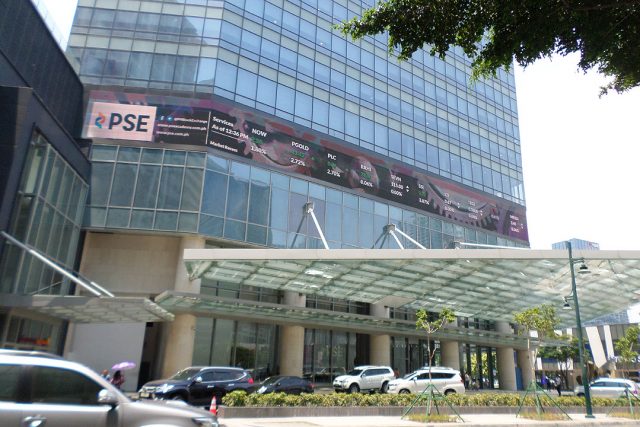
PSE’s Monzon downplays series of market delistings

BW FILE PHOTO

THE PHILIPPINE Stock Exchange’s (PSE) top official sees no cause for concern after a series of firms delisted or signaled plans to pull out from the local bourse.

“Up to June 30, we had three delistings, the other two [were] involuntary — kami ang nag-delist sa kanila (we delisted them) because they were not complying,” PSE President and Chief Executive Officer Ramon S. Monzon told reporters on the sidelines of a Securities and Exchange Commission event last Friday.

“For the second half, I think we have [Metro Pacific Investments Corp.] and Holcim [Philippines, Inc.],” Mr. Monzon said.

He said as of June 30, the PSE had three delistings, which was lower compared with other markets in the region such as Singapore Exchange Ltd., which recorded five delistings.

“All the other exchanges had [delistings as well],” he added.

Earlier this year, Eagle Cement Corp. voluntarily delisted from the PSE after the acquisition of San Miguel Corp. unit San Miguel Equity Investments, Inc. (SMEII) of the company’s 4.4 billion common shares at P22.02 per share, constituting 88.5% of the total issued and outstanding shares of the company.

SMEII conducted a tender offer to acquire the 574.9 million common shares held by shareholders, which represented 11.5% of its total issued and outstanding shares.

In March, the PSE delisted Unioil Resources & Holdings Co., Inc. and PICOP Resources, Inc. due to their continuous non-filing of reportorial requirements and nonpayment of penalties for disclosure violations.

Metro Pacific and Holcim have both signaled intentions to delist from the main board of the PSE after significant shareholders of both companies signaled their intention to take the companies private.

Additionally, 2GO Group, Inc. filed for voluntary delisting from the PSE after SM Investments Corp. conducted a tender offer for up to 378,817,279 common shares or 15.39% of the issued and outstanding common stock of the company at P14.64 apiece.

Meanwhile, Mr. Monzon said that Cosco Capital, Inc. had signaled its intention to conduct an initial public offering (IPO) for an industrial real estate investment trust (REIT) within the year.

“[They] are supposed to be filing their application this month or next month, fina-finalize na lang ‘yung mga listahan ng underwriters (they are just finalizing the list of underwriters),” Mr. Monzon added.

He said the company might list shares worth “anywhere between P15 to 30 billion.” The company has yet to disclose information on the possible listing.

“That’s one big REIT for the second half, we have to get other IPOs,” Mr.  Monzon said.

To date, the local bourse operator has yet to receive new filings from companies intending to go public. — Adrian H. Halili