Home Blog Page 4503

Peso sinks to two-month low on hawkish Fed bets

BW FILE PHOTO

THE PESO weakened to a two-month low against the dollar on Tuesday due to hawkish remarks from a US Federal Reserve official.

The local currency closed at P56.24 versus the dollar on Tuesday, weakening by 22 centavos from Monday’s P56.02 finish, data from the Bankers Association of the Philippines’ website showed.

This was the peso’s weakest close in over two months or since its P56.26-per-dollar close on June 1.

The local unit opened Tuesday’s session weaker at P56.18 per dollar. Its intraday best was at P56.14, while its weakest showing of the day was at P56.38 against the greenback.

Dollars traded rose to $1.15 billion on Tuesday from the $973.75 million seen on Monday.

“The peso weakened anew after Fed official Bowman commented the need for further US policy rate hikes,” a trader said in an e-mail.

Additional interest rate hikes will likely be needed in order to lower inflation to the US Federal Reserve’s 2% target, Fed Governor Michelle Bowman said on Monday, Reuters reported.

Ms. Bowman, in remarks prepared for delivery to a “Fed Listens” event in Atlanta that largely repeated comments she made to a banking group on Saturday, said she backed the latest interest rate increase last month because inflation remains too elevated, and job growth and other indications of activity show the economy has continued expanding at a “moderate pace.”

The Fed raised borrowing costs by 25 basis points (bps) last week, bringing its target interest rate to a range between 5.25% and 5.5%.

The US central bank has hiked rates by a cumulative 525 bps since it began its tightening cycle in March last year.

The Federal Open Market Committee will hold its next policy meeting on Sept. 19-20.

The peso was also dragged down by a stronger dollar, Rizal Commercial Banking Corp. Chief Economist Michael L. Ricafort said in a Viber message.

The dollar index rose by 0.3% to 102.36, edging away from Friday’s one-week low in the wake of a mixed US jobs report which pointed to a cooling, but still resilient labor market.

For Wednesday, the trader said the peso could depreciate further due to market caution ahead of the release of Philippine second quarter gross domestic product data on Thursday.

Both the trader and Mr. Ricafort see the peso moving between P56.10 and P56.30 per dollar on Wednesday. — AMCS with Reuters

DPWH estimates labor demand from infra program to exceed 3M

PHILIPPINE STAR/MIGUEL DE GUZMAN

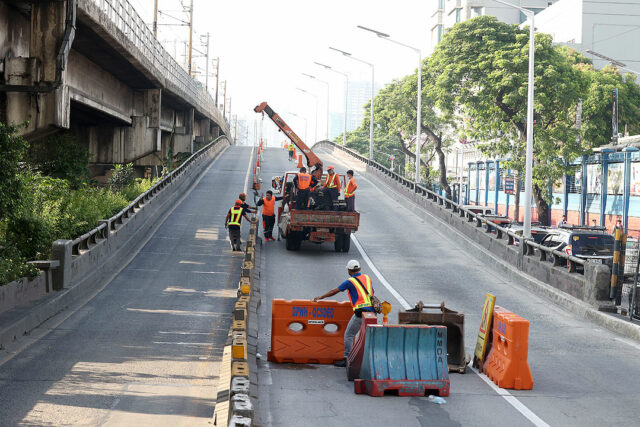
THE Department of Public Works and Highways (DPWH) said on Tuesday that the demand for labor to be generated by the government’s major infrastructure projects will exceed 3 million workers.

“I think the requirement and the threshold for our infrastructure programs is more than three million workers, skilled and unskilled,” Public Works Secretary Manuel M. Bonoan said at a livestreamed Palace briefing.

“And… this is just the start of the big infrastructure development program of the country,” he added.

Also at the briefing, Labor Secretary Bienvenido E. Laguesma said he presented his department’s labor and employment plan to the Cabinet on Tuesday, which called for increased collaboration with other agencies on creating sustainable jobs and ensuring social protections for workers.

“The plan, which we presented earlier to the President, seeks to ensure rights at work, (compliance with) international commitments including human rights, and maximizing sustainable job opportunities,” he said.

Mr. Bonoan said the DPWH welcomes support from the Department of Labor and Employment (DoLE) in staffing the 70,000 ongoing major and minor infrastructure projects this year.

In March, he said the projects, which also include farm-to-market roads with the Department of Agriculture, are valued at about P890 billion this year.

DoLE’s employment plan aims to upgrade worker skills, raise the quality of teachers, and modernize training institutions, Mr. Laguesma told an employer conference last month. It also details a protection program for employees.

President Ferdinand R. Marcos, Jr. in his second address to Congress urged government agencies to continue improving the employability of Filipinos.

Mr. Laguesma said the government will continue with upskilling programs offered via the Technical Education and Skills Development Authority.

He expects around 75,000 jobs in the energy industry resulting from investment commitments from companies in Germany, Singapore, the US and the Netherlands, among other planned power projects.

“We want the private sector to be part of our plan to create more jobs with important government agencies,” he said. “We want them to see the infrastructure they need to complete these projects as well as the manpower requirement.”

The jobless rate eased to 4.3% in May, according to the Philippine Statistics Authority. Job quality improved as the underemployment rate, which measures those employed who are seeking more work or longer hours, decreased to 11.7% from 12.9% a month earlier and 14.5% in May 2022.

Meanwhile, Mr. Bonoan said the government plans to implement more flood control projects in the next two years, which he said will cost about P180 billion. Mr. Marcos ordered the DPWH to resolve flooding, which affected sections of the North Luzon Expressway (NLEX) in Central Luzon.

The DPWH is considering impounding water around the Candaba swamp in Pampanga, among other measures, which include raising the roads to stay above floodwaters.

“That was the instruction we got yesterday so we are now going to look for the funds actually to be able to accomplish raising the (NLEX) bridge to solve the flooding,” he said. — John Victor D. Ordoñez

Applications under review to hike SRP on basic goods

PHILIPPINE STAR/MIGUEL DE GUZMAN

THE Department of Trade and Industry (DTI) said it is reviewing applications to raise the suggested retail prices (SRPs) of basic necessities and prime commodities (BNPCs).

“The price increases that the manufacturers are asking are ranging from 10 centavos to P7 for food products (1% to 5% increase) and P1.50 to P9.75 for non-food products (6% to 10% increase),” Trade Undersecretary Ruth B. Castelo said in a televised briefing on Tuesday.

Ms. Castelo said that 43 shelf keeping units (SKUs) from 13 manufacturers are the subject of pending price increase applications. 

“These products include canned sardines, condensed milk, evaporated milk, powdered milk, coffee, instant noodles, bottled water, canned meat, and toilet soap.”

According to Ms. Castelo, the reasons cited for the proposed price increases include surging prices of raw materials.

Ms. Castelo cited higher prices for specific ingredients such as tamban in sardines, flour in instant noodles, and mechanically deboned meat in canned meat.

“These reasons are being verified by the DTI. We are not just absorbing the information given by the manufacturers,” Ms. Castelo said.

“We have our own mechanism that can verify the higher raw material costs, as well as the increase in packaging materials and transportation costs, and the acquisition cost for the packaging,” she added.

The last SRP bulletin was released on Feb. 8, which permitted SRP increases ranging from 45 centavos to P7 for 76 SKUS, while the prices of 141 SKUs were left unchanged from the previous SRP bulletin issued in August 2022.

Other BNPCs for which prices could rise include 3-in-1 coffee, bread, detergent, candles, and condiments.

Republic Act (RA) No. 7581 as amended by RA 10623 or the Price Act authorizes the DTI and other government agencies to ensure that BNPCs are available to consumers at reasonable prices without denying manufacturers a fair return on their investment. — Revin Mikhael D. Ochave

CREATE law overhaul of incentive system ‘harmed export competitiveness’

REUTERS

THE Corporate Recovery and Tax Incentives for Enterprises (CREATE) law’s incentive-rationalization component harmed exporter competitiveness and warrants a review, the electronics industry association said.

“While CREATE’s reduction of corporate income tax of local companies is good, the incentives rationalization was ill-advised. With the high cost of operations (power, logistics, labor, cooling water, etc.), exporters have been rendered uncompetitive in the global market,” Semiconductor and Electronics Industries in the Philippines Foundation, Inc. (SEIPI) President Danilo C. Lachica said in a Viber message.

Last month, President Ferdinand R. Marcos, Jr. said that he was looking into amending CREATE to address concerns raised by businesses and investors.

Signed in 2021, CREATE reduced tax rates and amended the incentive system to support businesses recovering from the pandemic.

Under CREATE, the corporate income tax rate for micro, small and medium enterprises was lowered to 20% from 35%. Large corporations with taxable income above P5 million also saw rates reduced to 25% from 30%.

The law also grants incentives to registered companies and projects, including income tax holidays, special corporate income tax rates, enhanced deductions, duty exemptions on imports of selected materials, and value-added tax (VAT) zero-rating on local purchases.

However, some incentives like the VAT zero-rating provision have been singled out by export groups.

“Before CREATE, suppliers to exporters were VAT-free. With 12% VAT, local suppliers will not be competitive. Exporters will just import raw materials and kill local suppliers,” Mr. Lachica said.

CREATE requires claimants to VAT exemptions to prove that their local purchases are “directly and exclusively” used in their registered activities in order to enjoy the zero rating.

“I think there were certain provisions in CREATE in the beginning (that) created some confusion, especially those in the Philippine Economic Zone Authority (PEZA) zones. We approached the previous admin, and they were agreeable at the time to sort of have a remedy for that, (but) I think they have to make it clear,” Philippine Chamber of Commerce and Industry President George T. Barcelon said by telephone.

The government has released various circulars and regulations to address such concerns.

In April, the Bureau of Internal Revenue (BIR) allowed local suppliers of goods and services to registered export enterprises to forego BIR approval for VAT zero-rating of items they provide to locators. Instead, their VAT zero-rating may be claimed on the strength of certifications to be issued by investment promotion agencies such as PEZA.

Finance Secretary Benjamin E. Diokno said that the government will continue to review its tax reform measures, including CREATE.

“We continue to review the tax system. As I said, we inherited a superior tax system… That does not mean the tax system is perfect, so we continue to review it,” he told reporters on Friday.

Ateneo de Manila economics professor Leonardo A. Lanzona said that the CREATE law runs “contrary” to the government’s fiscal consolidation objectives.

“The overall goal of CREATE was precisely to attract investors and to accelerate the economic recovery after the pandemic.  The proposed amendment indicates that the current law was unable to accomplish these two goals. If the plan is to reduce VAT, this would already be on top of the income tax reductions incorporated into the law, making the proposed amendment an obvious bonanza to investors,” he said in an e-mail.

“Reducing VAT cannot be possible if the plan is to reduce the overall debt obligations in the face of the decreasing prospects for overall economic growth due to the global economic slowdown,” he added.

At the end of March, the National Government’s debt-to-gross domestic product (GDP) ratio stood at 61%, still above the 60% threshold considered manageable by multilateral lenders for developing economies.

The government is aiming to reduce the debt-to-GDP ratio to less than 60% by 2025, and further to 51.1% by 2028.

Mr. Lanzona said that the government should instead focus on other measures to ramp up investment.

“It is time for the government to do away with simply revising tax measures in order to attract investment. There are other ways of increasing investment that involve structural reforms that will improve the productivity of our domestic resources, including the upskilling of our workers,” he said.

“An investor reading our CREATE law (will conclude that) it doesn’t give them flexibility in availing of local goods and services subject to VAT,” Mr. Barcelon added.

The Finance department has estimated foregone revenue resulting from CREATE at P80.4 billion in 2022, against the P68 billion posted in 2021. This included P59.2 billion arising from the reduction in corporate income tax rates. — Luisa Maria Jacinta C. Jocson

MWSS investigating Maynilad water service interruptions 

BW FILE PHOTO

THE Metropolitan Waterworks and Sewerage System (MWSS) said it is investigating the water service interruptions affecting some customers of Maynilad Water Services, Inc. in the South area due to maintenance at its Putatan treatment plant, which draws water from Laguna de Bay.

“It’s currently being investigated. We have already asked Maynilad to submit their explanation and we are evaluating whether or not their explanations are valid,” Patrick Lester N. Ty, chief regulator at the MWSS Regulatory Office, said on Tuesday in a text message.

The west zone water concessionaires said about 43,000 service connections in the areas of Las Piñas, Bacoor and Imus are expected to experience three months of daily water service interruptions between 5 p.m. and 6 a.m. The interruptions will run between Aug. 8 and Nov. 2, Maynilad said in an advisory. 

The interruptions stem from maintenance at Putatan Water Treatment Plant 2 in Muntinlupa, Jennifer C. Rufo, head of Maynilad corporate communications, said on Tuesday.

“At present, we do not have excess capacity in the Putatan influence area. As a result, when we implement critical repairs or maintenance activities, there are customers whose service levels are affected,” Ms. Rufo said in a Viber message.

Ms. Rufo said Maynilad is currently conducting the replacement of all 14 ultrafiltration (UF) membranes at the facility.

“The UF replacement project is critical to ensure our plant is prepared to handle the expected higher turbidity of Laguna Lake in the coming Amihan season,” she said. 

However, Ms. Rufo said the service interruptions will ultimately depend on the facility’s output.

“I have to stress also, it is possible that the interruptions do not happen as scheduled. Because if the plant can push production, there will be days within the period that customers will have supply. Nevertheless, we want customers to be prepared for the scheduled interruptions as announced,” she said.

The completion of Maynilad’s Poblacion water treatment plant in Muntinlupa, with an expected capacity of 150 million liters per day, will yield adequate water supply to provide the water requirements of its customers, she added. 

“With the completion of the ongoing construction of the 150 MLD Poblacion treatment plant, we will have buffer capacity to ensure uninterrupted service even during maintenance activities,” Ms. Rufo said. 

In January, Maynilad announced that its Poblacion water treatment facility is 53% complete and is expected to produce 50 MLD of additional water by the end of this year.

Maynilad serves the cities of Manila, except portions of San Andres and Sta. Ana. It operates in Quezon City, Makati, Caloocan, Pasay, Parañaque, Las Piñas, Muntinlupa, Valenzuela, Navotas, and Malabon. It also supplies the cities of Cavite, Bacoor, and Imus, and the towns of Kawit, Noveleta, and Rosario, all in Cavite province.

Metro Pacific Investments Corp., which has a majority stake in Maynilad, is one of three Philippine units of Hong Kong-based First Pacific Co. Ltd., the others being Philex Mining Corp. and PLDT Inc.

Hastings Holdings, Inc., a unit of PLDT Beneficial Trust Fund subsidiary MediaQuest Holdings, Inc., has an interest in BusinessWorld through the Philippine Star Group, which it controls. — Ashley Erika O. Jose

Falling interest payments seen benefiting other gov’t programs

Finance Secretary Benjamin E. Diokno holds a press briefing in Malacañang on May 30, 2023. — PHILIPPINE STAR/KRIZ JOHN ROSALES

THE decline in interest payments could lead to more funding for other government programs, the Department of Finance (DoF) said.

“Interest payments have been declining, freeing up fiscal resources which can be reallocated to support the government’s priority programs,” the DoF said in a statement on Tuesday.

The DoF estimates that interest payments accounted for 10.1% of the National Government’s (NG) expenditures between 2016 and 2022, much lower than the 23.3% share between 1986 and 2015.

NG interest payments in the five months to May rose 4.1% year on year to P229.574 billion, according to the Bureau of the Treasury.

Interest on domestic debt declined 11.5% to P152.604 billion, while interest on foreign debt rose 60% to P76.97 billion.

Finance Secretary Benjamin E. Diokno noted that interest payments are equivalent to 11.6% or P670.5 billion of the 2024 budget.

“This allows us to spend more on socioeconomic programs and projects in our priority sectors such as education and infrastructure,” he said.

“When assessing the debt burden component of the budget, it is crucial to solely consider interest payments and net lending,” he added.

A total of 12% or P699.2 billion of the proposed budget has been allocated to address the debt burden.

In the first five months, the NG debt service bill nearly doubled to P819.526 billion. Some 71.99% of the debt service bill consisted of amortization payments.

The DoF said amortization payments are “not included in the expense item since they are not classified as expenditure; hence they are not automatically appropriated.”

“The settlement of debt obligations incurred from expenses was recorded in the past. Therefore, principal amortization only represents the fulfillment of financial responsibilities arising from previously recorded expenses,” Mr. Diokno said.

According to the Budget of Expenditures and Sources of Financing report, the NG’s principal payments next year are projected at P1.24 trillion.

The government is projecting the NG debt-to-gross domestic product (GDP) ratio to decline to 60% by the end of 2024.

At the end of March, outstanding debt as a share of GDP was 61%, still above the 60% threshold considered manageable by multilateral lenders for developing economies.

The NG’s borrowing plan amounts to P2.46 trillion next year. This is 11.5% higher than the P2.207 trillion set for this year. — Luisa Maria Jacinta C. Jocson

Two Japan ODA packages signed for disaster resilience, PCG projects

SCREENGRAB FROM PHILIPPINE COAST GUARD FACEBOOK PAGE

THE Japanese Embassy in Manila has signed two official development assistance (ODA) agreements with the Philippines worth a total of ¥31.1 billion, or around P12 billion.

“The government and people of Japan hope these ODA will expedite the enhancement of the Philippines’ stability and security,” Japanese Ambassador to the Philippines Koshikawa Kazuhiko said in a statement.

The ODA packages cover the third phase of the Post-Disaster Standby Loan (PDSL) worth ¥30 billion and a ¥1.1-billion grant for the Philippine Coast Guard’s (PCG) satellite data communication system.

The embassy said that Mr. Koshikawa and Foreign Affairs Secretary Enrique A. Manalo signed the exchange of notes on the loan facility and grant project on Tuesday.

The post-disaster loan will “support swift recovery in the aftermath of natural and health-related disasters, providing a quick-disbursing budgetary support for the Philippines’ calamity response programs.” 

The loan’s repayment period is 30 years after a grace period of 10 years. It also has a fixed interest rate of 0.01%.

“With Typhoon Egay having attacked the Philippines just last month, it is evident that our countries are frequently exposed to natural disasters such as typhoons, earthquakes, and volcanic eruptions,” Mr. Koshikawa said.

The loan will also help the Philippine government by “easing its funding and budgetary constraints, to execute more swift and flexible initial responses to severe disasters in the coming years,” he added.

The first phase of the post-disaster standby loan was approved in 2013, which supported rehabilitation efforts due to Typhoon Yolanda. In 2020, the second phase of the loan helped finance the Philippine government’s post-pandemic recovery.

Meanwhile, the grant will establish a satellite data communication system for the coast guard.

“Being an archipelago also, Japan understands the importance of vigilance in maritime security. With this procurement, the PCG will be able to ensure smooth communications between its 10 44-meter and two 97-meter vessels and the PCG headquarters inclusive of free communication charges for 10 years,” Mr. Koshikawa said.

“In light of the situation in the South China Sea, this is a very timely cooperation that will enable the decision makers of the Philippine government here in Manila to grasp in real time the situation offshore. Moreover, this will be extremely effective in terms of crisis management and response,” he added.

The embassy said that the project will improve maritime domain awareness and enhance the maritime law enforcement capabilities of the PCG.

“Given our two countries’ similar topographies, I would like to emphasize that Japan will continue to support through various ways the Philippines’ nation-building and resiliency efforts, along with security enhancements, as we both strive to build back better societies,” Mr. Koshikawa added.

In 2021, Japan was the country’s top provider of ODA with loans and grants amounting to $10.36 billion. It accounted for 32% of the Philippines’ ODA portfolio. — Luisa Maria Jacinta C. Jocson

BIR soliciting business groups’ input to improve tax services

PHILIPPINE STAR/KRIZ JOHN ROSALES

THE Bureau of Internal Revenue (BIR) said it is consulting business groups to gain insights on how to streamline tax administration.

“We have signed a memorandum of understanding… We seek to get these organizations’ comments, suggestions, whatever they can contribute, so we can improve our services. One of the things we want to achieve is excellent taxpayer service. We can do this through consultations with the private sector,” BIR Commissioner Romeo D. Lumagui, Jr. told reporters on Tuesday.

The BIR signed a memorandum of agreement with the Philippine Chamber of Commerce and Industry (PCCI); Tax Management Association of the Philippines; Management Association of the Philippines; Financial Executives Institute of the Philippines; Philippine Institute of Certified Public Accountants; Association of Certified Public Accountants in Public Practice; Association of CPAs in Commerce and Industry; Philippine Exporters Confederation, Inc. (Philexport), and the Joint Foreign Chambers of the Philippines.

Deputy Commissioner Maridur V. Rosario said that the private sector’s input will contribute to the “development of effective and well-informed strategies for upgrading our tax system.”

BIR Director Beverly S. Milo said the partnership will integrate the business organizations’ representatives into a working group where their input will also be solicited in the drafting of BIR issuances.

“Initially, the groups will submit their position papers and we will discuss it in future meetings … (For instance), Philexport’s  interest is in value-added tax (VAT) zero-rating. So we’re asking for their position papers to see what improvements they want, what kind of help they need. We will collate those and see what we can do,” Mr. Lumagui added.

“This will increase the chances of attaining our collection target,” he added.

This year, the BIR aims to collect P2.64 trillion, 13% higher than its actual collections of P2.34 trillion in 2022.

PCCI President George T. Barcelon added that a simpler tax structure will support micro-, small- and medium-sized enterprises and help attract foreign direct investment.

“Streamlining… will cascade (the benefits) to people who are interested in establishing businesses here… (so everyone) can enjoy the ease of doing business,” he said. — Luisa Maria Jacinta C. Jocson

Commercial fishing incursions into Visayan Sea municipal waters seen affecting 5,000 fisherfolk

PHILIPPINE STAR/ MICHAEL VARCAS

AT LEAST 5,000 fisherfolk are expected to be displaced if commercial fishing operations are allowed in municipal waters adjoining the Visayan Sea, a fisheries professor said.

Citing the results of a simulation, Wilfredo L. Campos, a professor at the University of the Philippines-Visayas College of Fisheries and Ocean Sciences, said: “Let us assume there would be a 5% increase in commercial catch if they are allowed in the Visayan Sea. In our simulation, about 5,000 municipal fishers will not have anything to catch,” said.

The Visayan Sea is the body of water bounded by Masbate, Panay, Leyte, Cebu, and Negros islands.

Fisherfolk and environmental groups expressed their opposition to the proposed new changes to Republic Act No. 10654 or the Amended Fisheries Code of the Philippines, saying such changes unduly favor commercial operators.

President Ferdinand R. Marcos, Jr., who is also the Secretary of Agriculture, asked Congress for such amendments during his second State of the Nation Address (SONA).

He said that the code needs to be revised to “incorporate and science-based analysis” and determine fishing areas for the protection of fisherfolk and resources.

“Any increase in yield for any sector, commercial or municipal, will result in the decrease in yield of the other,” Mr. Campos said.

According to Oceana, the commercial fishing industry is proposing to remove the restriction on fishing in waters 10.1-15 kilometers offshore to allow “unrestricted access to fish” within municipal waters.

Under the law, commercial fishing vessels are only allowed outside the 15-kilometer limit delineating municipal waters.

In 2022, municipal fisheries accounted for 1.22 million metric tons (MT) of fish or 25.9% of national production.

Aquaculture accounted for 2.35 million MT or 54% of the total while the commercial fisheries segment’s output was 868,408 MT or 20%.

Agriculture Undersecretary Mercedita A. Sombilla said that the Department of Agriculture (DA) and the Bureau of Fisheries and Aquatic Resources (BFAR) have initiated a review of the Fisheries Code as authorized by Section 161 of the law, which provides for “mandatory review… every 5 years.”

“Based on the review, amendments may be made when necessary to address gray areas/operational/implementation issues to ensure that fisheries policies are responsive to changing circumstances,” she said in a Viber message.

She said during a Post-SONA briefing that the proposed amendments will include pre-border controls to ensure the safety of imported fish.

“The initiative for review did not emanate from any stakeholder. It was initiated in compliance with the law. The code was amended in 2015, it is (overdue) for review,” she added.

In 2015, amendments were made to address illegal, unreported, and unregulated fishing (IUUF).

Daniel Ocampo, senior campaign manager for Oceana, said that the mandatory review does not automatically call for immediate amendments to be made.

“Existing mechanisms established under the amended Fisheries Code continue to respond to the impacts of climate change, the status of fish stocks, and the evolving needs of the present times,” he said. — Sheldeen Joy Talavera

China says it fired water cannon based on law

SCREENGRAB FROM CCG.GOV.CN

CHINA’S coast guard on Tuesday released a video of its ship spraying a water cannon at a smaller Philippine boat, saying it had handled the incident according to law.

The Aug. 5 video showed the water barely hitting the makeshift Philippine boat that was trying to deliver food and other supplies to Filipino troops stationed at Second Thomas Shoal in the South China Sea.

The shoal, which the Philippines calls Ayungin, is a submerged reef in the South China Sea where a handful of its troops live on a rusty World War II-era US ship that Manila intentionally grounded in 1999 to assert it claim.

Second Thomas Shoal is about 200 kilometers (124 miles) from the Philippine island of Palawan and more than 1,000 kilometers from China’s nearest major landmass, Hainan Island.

The Chinese Coast Guard in a website posting said the Philippine boats had entered Second Thomas Shoal illegally. It maintained “rational restraint throughout the process,” it added.

China’s Foreign Ministry reiterated its call for the Philippines to remove the outpost from the shoal. China has communicated to the Philippines about the Second Thomas Shoal issue “many times” through diplomatic channels, but its goodwill and sincerity have been “ignored,” it said in a statement.

China is willing to handle maritime issues through talks and consultations, the Foreign Ministry said.

Jonathan Malaya, spokesman of the Philippines’ National Security Council, repeated comments he made on Monday, saying, “the Philippines will never abandon our post in Ayungin Shoal.”

“We urge China not to escalate matters by water cannons or military-grade lasers, which places Philippine lives at risk, but by sincere negotiations and other diplomatic means,” he added.

The Philippines’ Department of Foreign Affairs (DFA) said Second Thomas Shoal is part of the Philippines’ exclusive economic zone.

“The Philippines’ resupply missions and repair of BRP Sierra Madre are part of regular operations in line with domestic and international law and ensures safety and the well-being of our stationed personnel,” Foreign Affairs spokesperson Teresita C. Daza said in a statement.

China on Monday asked the Philippines to remove its grounded warship from the shoal, accusing its neighbor of violating its sovereignty, its own commitments and international law.

The Philippines on Sunday condemned the Chinese action as “excessive and offensive.” It was done “in wanton disregard of the safety of the people on board and in violation of international law,” the Armed Forces of the Philippines said in a statement.

Tensions between the two countries have flared under Philippine President Ferdinand R. Marcos, Jr., who is leading a pivot back to the US, which has been given access to more military bases under their Enhanced Defense Cooperation Agreement.

China claims sovereignty over more than 80% of the South China Sea based on a 1940s map. Aside from China and the Philippines, Vietnam, Taiwan Brunei and Malaysia also claim parts of the major waterway.

A United Nations (UN)-backed tribunal in the Hague favored the Philippines and voided the claim in 2016. China has ignored the ruling, which has received international support.

Mr. Marcos Jr. on Monday said the country continues to assert its sovereignty and territorial rights despite challenges. The Philippines had relayed its complaint against China, he added.

No one was injured in the sea incident, but Philippine officials on Monday said one of its two boats did not complete the resupply mission.

‘NO CHOICE’
After Saturday’s incident, the US State Department on Sunday said China’s “repeated threats to the status quo in the South China Sea (were) directly threatening regional peace and stability” and that Washington stands with its Philippine allies in the face of such “dangerous actions.”

“The United States reaffirms an armed attack on Philippine public vessels, aircraft, and armed forces — including those of its coast guard in the South China Sea — would invoke US mutual defense commitments under Article IV of the 1951 US Philippines Mutual Defense Treaty,” it said in a statement.

The German Embassy in Manila said it was concerned about the use of water cannons by Chinese Coast Guard vessels against a lawful Filipino resupply mission within the Philippine’s own exclusive economic zone.

“We urge all parties to respect the rules-based international maritime order (UNCLOS and Convention on the International Regulations for Preventing Collisions at Sea), with the 2016 arbitral award at its center,” it said in a separate statement. “In light of recent events, Germany stresses that disputes must be resolved peacefully not by force or coercion.”

The Japanese envoy in Manila called the incident “totally unacceptable,” while the Canadian mission said it “unreservedly condemns the dangerous and provocative actions” of the Chinese Coast Guard.

The Philippine Senate last week adopted a resolution urging the Department of Foreign Affairs (DFA) to file a resolution before the UN General Assembly calling on China to stop harassing Philippine vessels and violating Philippine rights at sea.

The resolution also called on DFA to bring to international attention China’s harassment of Filipino fishermen and its refusal to follow the Hague ruling.

In his second address to Congress last month, Mr. Marcos Jr. touted his foreign policy — “a friend to all and enemy of none” — that he said has proven effective.

He said the government would continue to forge more international partnerships “that will lead to a more balanced trade strategy and a healthier economic position.”

Philippine Foreign Affairs spokesperson Teresita C. Daza on Monday said the Philippines had summoned Chinese Ambassador to the Philippines Huang Xilian over the incident. He was also given a note verbale protesting China’s actions.

Mr. Huang told DFA China had no choice but to respond, the Chinese Embassy in Manila said in a statement on Tuesday.

“China has been waiting for feedback from the Philippine side and hopes that both sides will start talks as soon as possible so as to jointly maintain peace and tranquility in the relevant waters,” Mr. Huang said.

DFA on Monday it had been unable to reach its counterpart for several hours during the water cannon incident. — Norman P. Aquino


Congressmen eye bigger budget for defense amid rising tensions with China

By Beatriz Marie D. Cruz, Reporter

PHILIPPINE congressmen on Tuesday sought a higher defense budget for 2024 amid rising tensions with China in the South China Sea.

“We must take proactive measures to enhance our defense capabilities and ensure that we have the necessary resources,” Speaker Ferdinand Martin G. Romualdez said in a statement.

Next year’s proposed budget for the Department of National Defense increased by 14% to P232.2 billion.

The Philippines on Sunday accused China’s coast guard of blocking and shooting water cannons at its vessels, condemning the “excessive and offensive actions.”

Countries including Japan, China, Australia, the United Kingdom and the European Union also called out China on the incident.

Iloilo Rep. Raul C. Tupas, who heads the House National Defense and Security committee, called the incident a “brazen attack.”

“Restraint in dealing with maritime disputes must be observed by the Chinese Coast Guard rather than resorting to means that are unnecessary, uncalled for and may result in escalating tensions,” he said.

Senator Maria Imelda “Imee” R. Marcos sought an explanation from Chinese officials about the incident.

“It is urgent for the [Philippine] Foreign Affairs and Defense departments to demand an explanation from their Chinese counterparts,” Ms. Marcos, who heads the Senate foreign relations committee, said in a statement.

The Philippine Coast Guard vessels were escorting two supply boats charted by the Philippine Navy to deliver food and other supplies to Filipino troops stationed at Second Thomas Shoal, a submerged reef where a handful of its troops live on a rusty World War II-era US ship that was intentionally grounded in 1999.

The Chinese coast guard’s “dangerous maneuvers” prevented a second boat from unloading the supplies and completing the mission for BRP Sierra Madre, the grounded warship, the Philippine military said.

Senate President Juan Miguel “Migz” F. Zubiri on Monday pushed the approval of several bills that seek to boost the country’s external defense, including the proposed Philippine Defense Industry Development Act.

These measures are key to government efforts to build a credible and concrete defense program, he told a hearing.

DEFENSE INDUSTRY
“Amidst growing national concern over our sovereignty, it is very timely that we now consider the merits of revitalizing our self-reliant defense posture program and building a local defense industry that would supply the needs of our Armed Forces,” Mr. Zubiri said.

He added that while the Philippines values its defense cooperation with its foreign allies, it could not afford to rely on them entirely. “Overreliance on our allies leaves us on the back foot — always waiting, and always dependent on what they will supply us with.” 

The Senate chief said it’s a pity the Philippines has to beg other countries for arms and ammunition. “Our brave men and women of the Armed Forces deserve more and deserve better.”

Mr. Zubiri said the Philippines is among the top importers of arms in Southeast Asia, having spent $338 million (P19 billion) on imports in 2021 — next only to Singapore ($361 million) and Myanmar ($394 million).

“Unlike Singapore, however, we have a great deal of resources at our disposal. And unlike Myanmar, we are not operating under military rule. So why is our arms importation nearly as costly as theirs?” he asked.

The lawmaker said a closer comparison would be Indonesia, which in 2021 allotted 3.9% of its spending toward military expenditure, not far from the Philippines’ 3.8% military budget. And yet Indonesia’s arms imports were only $68 million.

Mr. Zubiri said Indonesia has a big arm manufacturing industry, so it imports less.

Indonesia’s defense industry has been growing exponentially, in fact, that the Indonesian government is now expecting to join the world’s 50 top defense companies by next year, he added.

He said they discussed this with President Ferdinand R. Marcos, Jr., who is keen on boosting the country’s defense industry.

Meanwhile, Senator Rafael “Raffy” T. Tulfo asked the government to stop sending high-ranking officials of the Armed Forces of the Philippines (AFP) to China to study and train at its military academy.

During a defense hearing on Monday, the senator said the program, which paid for by China, is a complete insult to Filipinos who continue to be bullied by China.

Mr. Tulfo earlier urged the Armed Forces to remove the cellular tower of a telecommunication company inside the military camp that is largely owned by the Chinese government.

He said some of the Philippine military’s equipment including computer hardware are donated by the Chinese government.

“It’s a major blunder if our Armed Forces continues to patronize things from the Chinese government,” he said in a statement in Filipino.

The lawmaker said he would file a Senate resolution in-aid of legislation to investigate these “alarming practices.” — with Norman P. Aquino

Senate OK’s local governments’ automatic income category

THE SENATE on Monday approved on third and final reading a priority bill that seeks to institutionalize the automatic income classification of local government units.

“This will improve local government units’ (LGUs) fiscal performance and allow our frontline government units to recruit skilled professionals for quality public service delivery,” Finance Secretary Benjamin E. Diokno said in a statement. 

Twenty-two senators voted for Senate Bill 2165, which tags provinces, cities and municipalities into six classes according to their income. Two voted against it.

The Finance secretary must adjust income ranges and undertake income reclassification every three years.

The Finance chief now only has the power to recommend a change in the income brackets of provinces, cities and municipalities.

The Justice department said in a 2012 legal opinion his power “only extends to recommending such appropriate changes or revisions to the proper authority, the Philippine Congress.” This was reaffirmed in a separate legal opinion in 2015.

Bureau of Local Government Finance (BLGF) Executive Director Niño Raymond B. Alvina said the measure is crucial in shaping fiscal decentralization in local governments.

“The updated fiscal indicators will equip the BLGF to improve its oversight functions for provinces, cities and municipalities towards data-driven and performance-informed policy and decision-making at the national and local levels,” he said in a statement.

Senate Minority Leader Aquilino “Koko” D. Pimentel III, one of the senators who voted no to the measure, said there is no need to delegate this power to the Finance secretary.

The House of Representatives approved a similar measure in March.

President Ferdinand R. Marcos, Jr. sought the passage of the bill in his second state of the nation address to Congress last month.

Also on Tuesday, the House ways and means committee endorsed to the plenary a bill that seeks to reward informants on tax and Customs violations.

“This measure seeks to increase tax compliance by establishing a rationalized incentive system for informers of tax violations,” Quirino Rep. Midy N. Cua said in her sponsorship speech on Tuesday.

Under the bill, an informant who gives information that leads to the discovery of tax fraud will get a 10% commission or P10 million, whichever is higher.

If a compromise is reached with the violator, the informant will get either P10 million or 10% of the agreed amount, whichever is lower.

An informant will also get a P10-million reward or 20% of the proceeds from the sale of smuggled and confiscated goods or the collection of additional revenue, whichever is lower.

An informant must apply for the reward before the Internal Revenue and Customs commissioners. The Finance secretary will review rewards worth more than P1 million.

An informant is not entitled to a reward if no additional revenue, surcharge, fee or fine is collected, or if the information is related to an existing case.

Public officials or employees, whether incumbent, retired or separated, as well as their relatives up to the third degree will not be rewarded.

Enacting this into law would “ensure maximum efficiency in the government’s revenue collection efforts,” Ms. Cua said. — Beatriz Marie D. Cruz