Home Blog Page 4487

Livelihood for ex-drug users sought 

THE TECHNICAL Education and Skills Development Authority (TESDA) should have training and livelihood programs solely for former drug dependents who have undergone rehabilitation, Senator Francis Joseph “Chiz” G. Escudero said on Tuesday. 

At a hearing of the Senate committee on higher, technical and vocational education, the lawmaker said he was surprised to learn that TESDA does not have exclusive livelihood and training programs for rehabilitated drug users. 

“If we will institutionalize TESDA’s training and livelihood programs for rehabilitated drug dependents, we might as well design something that will specifically cater to them,” he said during a discussion of Senate Bill 2115 and its counterpart House Bill 7721, which both seek to institutionalize technical-vocational education and training (TVET) and livelihood programs for former drug dependents. 

TESDA representative Joyce Balong told the hearing the agency only prioritizes former drug users in their existing livelihood and training programs. 

Mr. Escudero ordered the consolidation of the two bills and referred these to a technical working group that will specify the exclusive livelihood programs for rehabilitated dependents. — Jan Jiminel Cacdac

Baguio condo breaks ground 

BAGUIO CITY — Homegrown Ray Casa Group of Companies on Friday broke ground for its first luxurious residential condominium project here called the Saleng Spa and Wellness Towers. 

The P500-million project of Casa Infini Properties and Development Corp., the group’s realty arm, is expected to be finished by 2025, Ray Casa Chief Executive Officer Jennylyn Floresca said.     

The company plans to build three commercial buildings and condominiums under Casa Infini Builders & Realty Co. Ltd. and Casa Infini Properties & Development Corp.  

“We are also focusing on land reclassification and developing Airbnb-type vacation villas all over Northern Luzon,” she said.  

Raycasa has been pre-selling its one- and three-bedroom condo units since mid-2022 and expects more than P1 billion in income from these. — Artemio A. Dumlao 

Study on gov’t pay hike could finish in time for 2024 budget

PHILIPPINE STAR/BOY SANTOS

THE Department of Budget and Management (DBM) said it hopes to complete a study to evaluate the need for raising government workers’ pay, in time for its recommendations to be incorporated in the 2024 budget.

Budget Secretary Amenah F. Pangandaman said around P48 million was allocated from the budget of the Governance Commission for Government-Owned or -Controlled Corporations (GCG) for the study, which will cover the compensation structure of National Government agencies and GOCCs.

“This is to ensure that the compensation of all civilian personnel will be competitive with those in the private sector,” she said. “Soon, we will have the result of the study, maybe some time in September or October.”

“If we ever do need an increase, I think we have enough time to adjust (the 2024 budget) in the last quarter of the year, which is when deliberations take place. We hope the study will be advantageous and beneficial to government workers,” she added.

According to Ms. Pangandaman, if another round of salary increases for government employees is deemed necessary, the adjustment will be implemented in tranches, as it was with the previous salary increases dictated by the Salary Standardization Law (SSL).

The SSL was signed by former President Rodrigo R. Duterte in 2019, the fifth such law to date which called for increased salaries of government workers.

The law adjustments kicked in on Jan. 1 of every year until 2023, covering personnel who are “regular, casual, or contractual; appointive or elective; and on full-time or part-time basis.” 

“Apart from the conduct of the study, we, in DBM, are also undertaking a review of the rates of the existing benefits being provided to government employees, in order to assess if there is a need to adjust them in the future,” Ms. Pangandaman said.

She said the 2024 proposed budget will feature at least a minimal increase in uniform and clothing allowances for government workers.

DBM Director Gerald R. Janda of the Organization, Position Classification, and Compensation Bureau said the study also includes possible hikes in travel allowances and other benefits.

“As soon as we complete our study, we will take the matters to our senior officials and our Secretary for policy decisions,” Mr. Janda said.

Separately, the DBM, the GCG, and the Civil Service Commission (CSC) signed a joint circular on the guidelines for implementing Republic Act (RA) No. 11701, which grants night shift differential pay to government employees.

“Today’s signing of the Joint Circular with CSC Chairperson (Karlo Alexei B.) Nograles and GCG Chairperson (Justice Alex L.) Quiroz will ensure that the guidelines on the night differential are widely disseminated and guarantee its uniform policy interpretation and effective and efficient implementation,” Ms. Pangandaman said.

The CSC, in partnership with the DBM, promulgated the implementing rules and regulations of RA 11701, which took effect on Feb. 25, 2023.

Under RA 11701, those with working hours falling between 6 p.m. and 6 a.m. of the following day will be compensated for taking on such hour.

According to the law, the night shift differential pay should be at a rate not over 20% of the basic hourly rate, as authorized by the head of agency. In the case of public health workers, the rate should not be below 10% of the hourly basic rate.

However, the law excludes government employees with regular work day schedules; those who are required to be on call, 24 hours a day, such as the uniformed personnel; and workers under a job order or contract of service.

“The salary increase, and now, the night differential are intended to help cushion the daily challenges of living and raising a family,” Ms. Pangandaman said. — Keisha B. Ta-asan

Bulacan airport ecozone bill hurdles panel, to be compliant with CREATE

SANMIGUEL.COM.PH

A HOUSE joint committee has approved “in principle” a bill seeking to create a special economic zone and freeport comprising various towns in Bulacan in the vicinity of the new airport that is due to rise in the province. 

Albay Rep. Jose Ma. Clemente S. Salceda, who wrote the bill that will be the basis for the consolidated legislation, said that fiscal incentives will be compliant with the Corporate Recovery and Tax Incentives for Enterprises (CREATE) law and other such laws. “No new tax incentives are created, and no power to grant incentives is given to the Ecozone Authority,” he told the joint committee.

The ecozone will encompass the municipality of Bulakan, the Airport Project and Airport City Project, as well as the towns of Meycauayan, Malolos, Paombong, Guiguinto, Balagtas, Bocaue, Marilao, Sta. Maria, and Obando.

The Bulacan ecozone will be subject to audit under the GOCC Governance Act of 2011, according to the bill. State auditors may also appoint a full-time auditor in the ecozone.

The bill tasks the Bulacan ecozone with addressing the province’s flooding problems by undertaking “water supply and storage, sewerage and drainage” projects.

President Ferdinand R. Marcos, Jr. vetoed a previous version of the ecozone bill in July 2022, in one of his first acts in office.

The committee is currently fine-tuning the substitute bill before it is sent on for plenary approval. — Beatriz Marie D. Cruz

SRA says weather does not favor August start to milling season

PHILSTAR FILE PHOTO

THE Sugar Regulatory Administration (SRA) said the recent bout of unfavorable weather weakens planters’ arguments for an August start to milling season, with the wet conditions expected to depress yields from cane.

“We are just getting ready for milling, although the weather is not cooperating. That’s one of the reasons why we’re pushing for a Sept. 1 start,” SRA Acting Administrator Pablo Luis S. Azcona said at a briefing.

“And because August is generally wet in Negros, it is really hard to mill,” he added.

The SRA has held to its position of stating milling on Sept. 1, rejecting calls from planters to start in August.

Mr. Azcona said that milling in rainy weather decreases the purity and sugar content of cane, adding, “Fields are being damaged… (with proper weather), you can ratoon.”

Ratooning is the harvesting of above-ground plants while leaving the roots and shoots intact, setting the stage for the next crop.

He said the SRA originally estimated that 85% of sugar farmers will not have access to water with the onset of El Niño, leading to a forecast decline of 10-15% in cane output.

Meanwhile, Mr. Azcona said 4,000 tons of smuggled sugar that has been seized will be donated to the Department of Agriculture (DA), to be sold at Kadiwa stores at P75 per kilogram.

“Once the (memorandum of agreement) is signed, the stocks will be moved… maybe after repacking,” he said.

In a statement, the DA announced the receipt of the sugar from the Bureau of Customs (BoC) following the signing of a deed of donation.

The smuggled sugar originated in Thailand and was seized in April at the port of Batangas.

“We firmly believe that, through DA, this donation will reach various communities and enable our fellow Filipinos to conveniently access sugar,” BoC Commissioner Bienvenido Y. Rubio said.

As of July 31, the retail price of a kilogram of refined sugar in Metro Manila markets was between P86 and P110, washed sugar between P82 and P90, and brown sugar between P78 and P90, according to DA price monitors. — Sheldeen Joy Talavera

DoE studying Portuguese model for transitioning away from coal power

REUTERS

THE Department of Energy (DoE) said it is studying Portugal’s transition away from coal-fired power plants as part of a broader potential collaboration that could result in Portuguese investment in Philippine renewable energy (RE) projects.

Energy Secretary Raphael P.M. Lotilla said the other areas of possible cooperation are offshore wind, floating solar, hydrogen and ammonia production using renewable energy. 

“Portugal, as an early starter in RE, has similar challenges with the Philippines and is interested in the DoE’s approach in developing and utilizing the country’s RE sources,” the DoE said.

Portuguese Foreign Minister João Gomes Cravinho also conveyed the interest of Energias de Portugal (EDP) and EDP Renewables to invest in Philippine RE projects, the DoE said.

Mr. Lotilla said the Philippines and Portugal will also exchange notes on the import of liquefied natural gas and enhancing transmission systems in aid of preparing for a green energy transition.

Mr. Lotilla said he is interested in how Portugal repurposed its coal-fired power plants and how it incentivized the transition to the use of alternative fuels for co-firing with coal, such as hydrogen and ammonia.

Portugal decommissioned its last coal-fired plants in 2021, keeping it ahead of schedule in its fossil-fuel reduction targets. 

The DoE said Portugal’s example signifies that an exit from coal is possible through carbon pricing, renewable energy investment and comprehensive transition planning.

To date, RE accounts for 22% of the Philippine energy mix. The government is aiming to increase the RE share to 35% by 2030 and 50% by 2040. — Ashley Erika O. Jose

NEDA says procurement snags delaying customs modernization

PHILSTAR FILE PHOTO

CUSTOMS modernization has been delayed by procurement issues, the National Economic and Development Authority (NEDA) said at a hearing in Congress.

Speaking at the joint Congressional Oversight Committee on Official Development Assistance (ODA), Assistant Secretary Jonathan L. Uy of NEDA’s investment planning group said that the Bureau of Customs (BoC) has “started procurement for project supervision and quality assurance consultants, which went through a lengthy process, but there were legal (complications) because of the merger of the highest rated bidder, Spain’s Instituto de la Calidad SA, (Quality Institute or QI) with OCA (Global Consulting and Technical Advisory.)”

OCA Global Investments SLU, a holding company of OCA Global Group, acquired QI on July 1, 2021.

“The merger of those bidding for services for this modernization project (caused the delay),” Mr. Uy said.

The Philippine Customs Modernization Project (PCMP) “aims to streamline operations and processes… by upgrading BoC systems procedures and operational activities,” according to the BoC website.

The PCMP is also expected to help the bureau improve its enforcement with regard to smuggling.

Senate Minority Leader Aquilino D. Pimentel III sought to disqualify the project bidder for “hold(ing) our entire modernization program hostage.”

According to the presentation made by the NEDA, the BoC said that in Resolution No. 2022-1 dated Sept. 16, 2022, its Special Bids and Awards Committee (SBAC) “accepted the change of personality of the lead partner in the joint venture.”

Mr. Uy said negotiations with the consultant were completed in March with the draft contract being finalized.

When asked why negotiations were completed six months after the resolution, Mr. Uy said: “the SBAC appears to have exercised too much prudence in terms of the legal guidance.”

For the PCMP, the Philippines paid a commitment fee of $109,000 or P6 million in 2022, Deputy Treasurer Erwin D. Sta. Ana told legislators. In total, $483,000 or about P26.57 million has been paid for the project, he added.

Commitment fees are a portion of the loan paid by governments for undisbursed portions of their ODA loans. Governments are required to pay a commitment fee whether or not a project is delayed.

Meanwhile, the Support to Parcelization of Lands for Individual Titling (SPLIT), a project of the Department of Agrarian Reform, was also behind schedule.

More than 50 packages were still in their preliminary stages, Mr. Uy said. There was also a low turnout of applicants for Information Technology consultants, which delayed the development of a centralized Certificate of Land Ownership Award (CLOA) Management System.

NEDA said the procurement of goods and consulting services is ongoing.

The SPLIT program is expected to fast-track the subdivision of collective CLOAs.

Out of the 70 NEDA Investment Coordination Committee-approved projects supported by ODA, 40 projects are behind schedule.

Agencies involved in project delays will be invited to the next oversight hearing.

Of the National Government’s $4.21-trillion external debt, ODA accounts for $1.87 trillion worth of outstanding loans, Mr. Sta. Ana told legislators. — Beatriz Marie D. Cruz

PEZA mission to Tokyo, Osaka firms up locator interest in expansions

ICHIJOUSA.COM

THE Philippine Economic Zone Authority (PEZA) said its roadshows to Tokyo and Osaka generated investment feelers from Japanese companies seeking to expand their current Philippine operations.

PEZA Director General Tereso O. Panga said in a statement on Tuesday that the PEZA visited Osaka and Tokyo between July 16 and 22.

The expressions of interest included those from Ichijo Corp. to finalize expansion plans in 2024, along with possible expansion plans for ShinEtsu Corp., OB Kogyo, Ltd., and NEC Networks & System Integration Corp.,” Mr. Panga said.

Mr. Panga said that Ichijo Corp., a builder of energy-efficient, sustainable homes, aims to increase its annual capacity for Philippine-built components to the equivalent of 20,000 units in 2024 from 15,000 previously. In the process it projects the creation of 3,000 to 4,000 additional jobs in addition to the current staffing level of 23,000.

Die and mold company OB Kogyo Ltd. also declared its intent to reinvest $3 million in a Philippine plant over the next three years, also to enhance capacity.

ShinEtsu Corp., produces and researches high-performance rare earth magnets, also expressed interest in a possible expansion to service the global electric vehicle industry.

PEZA said it approved P20.59 billion worth of Japanese investments in the first six months. These were made by Green Energy with Torrefaction Technology, Inc., Asian Transmission Corp., and Pricon Microelectronics, Inc.

The three Japanese investments are expected to lead to the creation of 1,973 direct jobs.

“To date, 881 Japanese companies are registered with PEZA, bringing in P766.550 billion worth of investments in the country, with exports of $5.362 billion and generating up to 340,601 direct jobs for Filipinos,” Mr. Panga said.

The PEZA logged P80.59 billion worth of investment approvals in the first six months, up 258% from a year earlier.

For 2023, the PEZA is targeting 10% growth in investment approvals after logging P140.7 billion in 2022. — Revin Mikhael D. Ochave

BIR tax-to-GDP ratio at 10.8%

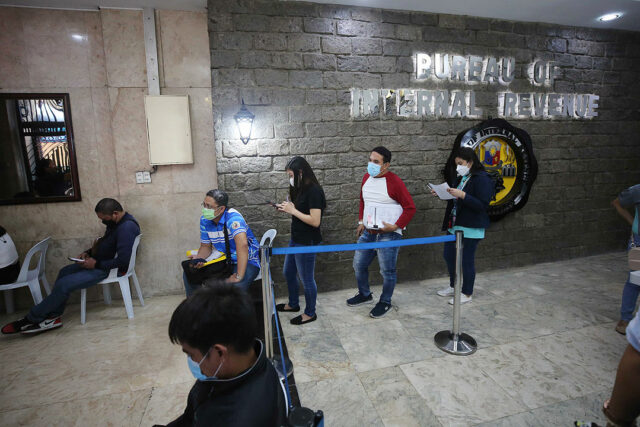
People line up to file their income tax returns at the Bureau of Internal Revenue office in Intramuros, Manila, April 18, 2022. — PHILIPPINE STAR/ RUSSELL A. PALMA

THE Bureau of Internal Revenue (BIR) said tax collections as a share of gross domestic product (GDP) are currently at 10.8%.

The BIR added that it expects its tax-to-GDP ratio to increase to 11.2% next year and to 11.6% by 2025.

The BIR hopes to collect P2.64 trillion in revenue this year, 13% higher than its actual collections of P2.34 trillion in 2022. 

BIR Commissioner Romeo D. Lumagui, Jr. said he expects to meet this year’s revenue goal.

“Because of our performance, we are confident we can attain our collection target. We will continue our job well to make sure we attain this,” he told reporters on Tuesday.

In the first six months, the BIR collected P1.22 trillion, up 7.65% from a year earlier but 2.57% below the bureau’s P1.25-trillion target for the period.

Mr. Lumagui said its performance was affected by the shift to the quarterly filing of value-added tax (VAT) returns.

“That’s why we have to wait for the collection from VAT to come in. Once that comes in, we are certain we will meet our target,” he said, adding that any such distortions created by quarterly filing will eventually be smoothed out.

The BIR collects about 70% of government revenue. — Luisa Maria Jacinta C. Jocson

PSA to start farmer, fisherfolk census in Sept.

TIM MOSSHOLDER-UNSPLASH

THE Philippine Statistics Authority (PSA) on Tuesday said it will begin its latest census of farmers and fisherfolk on Sept. 4.

In a briefing, the PSA said the Census of Agriculture and Fisheries (CAF) will run until Oct. 25.

The census is typically conducted every 10 years, though the upcoming CAF is officially the 2022 edition because of disruptions to the PSA’s data collection workflow.

“The data we gather to this census will empower policy makers, researchers, and stakeholders to make informed decisions that can foster growth, enhanced productivity and ensure the well-being of those who toil tirelessly to put food on our tables,” PSA Deputy National Statistician for Sectoral Statistics Divina Gracia L. Del Prado.

CAF will include an inventory of agricultural and fishery resources, basic information on crops planted, an inventory of livestock and poultry, and a survey of species cultured in aquafarms.

It will also seek to determine the distribution of agricultural land and aquaculture operations.

Expected participants in the 2022 CAF include farm and fishery operators, households, businesses, institutions, government-owned and -controlled corporations, National Government agencies, local government units, and international organizations.

The respondents will be surveyed via computer-assisted personal interviews and self-administered questionnaires.

“The main objective is to get a picture of agri and fishery in the country… we want to show the characteristics of agriculture in the country,” PSA Deputy National Statistician for Censuses and Technical Coordination Minerva Eloisa P. Esquivias said. — Sheldeen Joy Talavera

Urban agri program may seek more funding

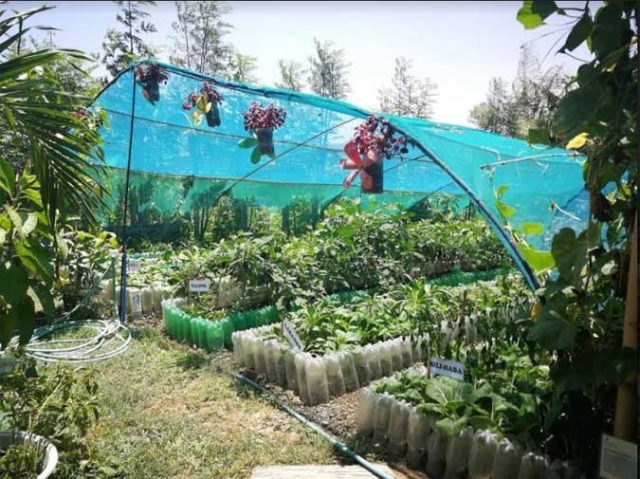
THE Bureau of Plant Industry (BPI) said it may request more funding for its National Urban and Peri-Urban Agriculture Program.

In a briefing on Tuesday, BPI Director Glenn F. Panganiban said the program previously had no specific budget and previously sourced funds from the Department of Agriculture.

“But now isa na siyang ganap na programa at 2023 at ang kanilang budget na around P400 million (It is now a fully-fledged program in 2023 with a budget of around P400 million),” he said.

“Of course, as a national program medyo manipis ang budget na iyon considering ’yong importansya (The funding is not commensurate to its importance) but of course we have to prove ourselves,” he added.

Asked for what he considers an appropriate budget, he said a funding level of about P500 million will be sufficient to cover the entire country.

“Our focus of course is planting materials and other forms of production support. We will also (provide) production equipment and facilities like greenhouses,” he added.

On Tuesday, the BPI and Nestlè Philippines announced the partnership to promote urban agriculture with the goal of promoting food self-sufficiency.

In March, the BPI and Nestlé signed a memorandum of agreement for a three-year collaboration calling for the establishment of farms in urban locations.

Under the agreement, Nestlé’s MAGGI Sarap Sustansya Advocacy will produce and distribute learning materials on vegetable production and affordable plant-based recipes.

It will also provide starter kits containing planting essentials such as seed trays or basic implements, as well as compost and various vegetable seeds produced by the BPI.

The company runs a demonstration farm in Los Baños, Laguna.

“Nestlé Philippines believes in a collaborative approach to building communities, and we are proud to stand alongside the Department of Agriculture in inspiring a farm-to-fork movement among Filipino families and communities,” Nestlé Corporate Affairs Head Joey Uy said. — Sheldeen Joy Talavera

Philippines coach Alen Stajcic to depart after World Cup exit

PHILIPPINES HEAD COACH ALEN STAJCIC — PFF

AUCKLAND — It was a magical run under his watch but the era of coach Alen Stajcic in the red-hot  Filipinas women’s football program has ended.

Just three days separate from the Pinay booters’ sparkling debut in the 2023 FIFA Women’s World Cup (WC), the Australian coach and the Philippine team parted ways.

According to team manager Jeff Cheng, the contract of Mr. Stajcic expired after the football showcase and the venerated mentor had expressed his desire to ply his trade elsewhere.

His assistant, Nahuel Arrarte, is also leaving.

“They will not be renewed as both coaches have asked to explore other options,” Mr. Cheng said in a statement that came as a surprise to football fans.

Mr. Stajcic’s next destination is not disclosed but there had been talks about A-League club Perth Glory eyeing him for the job vacated by Ruben Zadkovich.

“We wish coach Alen and coach Naz the best of luck in their next football adventure, and we will forever be grateful to them for changing the landscape of Philippine football forever,” said Mr. Cheng.

A former mentor for Australia’s national team Matildas, the 49-year-old was largely credited for taking the team from football minnows Philippines into unimaginable heights.

Since taking the reins 20 months ago, Messrs. Stajcic and Arrarte steered the Filipinas to the semifinal of the AFC Women’s Asian Cup, which led to a historic ticket to the World Cup.

This the team followed by a bronze medal in the Southeast Asian Games in Vietnam, the first since 1985, a milestone triumph in the Asean championship before a roaring 8,000 home crowd at Rizal Memorial and attaining new all-time high in FIFA world rankings.

Currently ranked at 46th, Mr. Stajcic’s troops recorded their first goal and first win in a WC game via a 1-0 upset of host New Zealand, reviving widespread interest among basketball loving Pinoys back home and here.

“They have shown us what is possible with proper guidance, dedication and hard work, and their efforts have led to the greatest achievement in Philippine football thus far — a match won against the higher-ranked host nation at a World Cup. They will surely be our beloved heroes for decades to come,” Mr. Cheng  said of Mr. Stajcic and his deputy.

An equally grateful Mr. Stajcic said it was a special and memorable journey with the Philippines.

He counted the World Cup as the highlight of his tenure with the Philippine lady booters.

“The two best experiences of my coaching career thus far were the last two World Cup matches,” he said.

“Beating New Zealand on home soil and scoring our first World Cup goal and getting our first win was the things that dreams are made of. And despite the scoreline, the last match against Norway, where 34,000 patrons attended, with 30000 singing for the Filipinas,  brought shivers down our spine.”

“It showed that Football does belong in the Philippines, and that legacy is something we are all proud of,” he added. — Olmin Leyba