Home Blog Page 4477

LGBTQ fears grow in Malaysia as Islamists shatter reform hopes

DRAHOMÍR POSTEBY-MACH -PIXABAY

 – Artist Carmen Rose used to perform regularly in Malaysia, until a police raid last year put an end to the veteran drag queen’s act and fueled the fears of the LGBTQ community at a time when Islamists are rapidly gaining political clout.

Since the raid, during which several party-goers were arrested, Rose has stopped doing shows, and rarely ventures out in public in costume.

“It’s always a risk going out in drag. If there was a raid, who do we call? Do we bring our boy clothes just in case?” said Rose, who declined to disclose her non-drag identity due to fears of reprisal. “They see us as sexual deviants or sinners.”

Queer Malaysians and rights groups told Reuters that LGBTQ communities face increasing scrutiny and discrimination under Prime Minister Anwar Ibrahim’s government, despite the longtime opposition leader’s reputation as a progressive reformer.

Analysts say Mr. Anwar, who took office after a November general election, is under pressure to bolster his Islamic credentials among the Muslim majority in the face of an increasingly popular ultra-conservative opposition that has steadily gained more political ground since the vote.

Malaysia‘s opposition bloc includes Islamist party PAS, which promotes a strict interpretation of sharia law and opposes LGBTQ rights. The party holds the most number of seats in parliament for the first time ever, and its gains in state elections this month reinforced its political influence.

A PAS lawmaker recently said LGBTQ people should be classified as “mentally ill”. Another PAS leader urged the government to cancel a concert by Coldplay because the band supports queer rights.

“Mr. Anwar doesn’t feel politically stable, so he has to be more Islamic than the other side,” said James Chin, a political analyst at the University of Tasmania in Australia.

Sodomy is a crime in Malaysia, which also has Islamic sharia laws banning same-sex acts and cross-dressing. The multi-ethnic, multi-faith country has a dual-track legal system with Islamic laws for Muslims running alongside civil laws.

While Mr. Anwar has never expressed support for the LGBTQ community, activists say they expected him to show more tolerance as he advocated for an inclusive society during his 25 years in the opposition.

“There was some hope when Mr. Anwar came to power that the reform agenda would seep in to some extent,” said Dhia Rezki Rohaizad, deputy president of JEJAKA, an organization that supports gay, bisexual and queer men.

“It’s disappointing that it has not happened. At the very least, we had hoped that they would just leave us alone, not be actively persecuting us.”


DISCRIMINATION, THREATS

Anwar vowed this year that Malaysia would never recognize LGBTQ rights.

His government has banned books for “promoting the LGBT lifestyle”, detained demonstrators expressing support for queer rights and confiscated Pride-themed watches made by Swiss watchmaker Swatch.

Last month, authorities halted a music festival, after the frontman of British pop band The 1975 kissed a male bandmate onstage and criticized Malaysia‘s anti-LGBTQ laws.

Asked about the government’s position on LGBTQ rights, government spokesperson and communications minister Fahmi Fadzil told Reuters: “Whatever the prime minister has said is the position.”

Some analysts say Mr. Anwar’s uncompromising stance on LGBTQ rights stems from a desire to wipe out doubts about his own sexuality which surfaced after he was jailed for nearly a decade for sodomy. Anwar has repeatedly said the charges were fabricated and politically motivated, but some political opponents still question his Islamic values.

Activists say online harassment and death threats against queer Malaysians are rampant on social media, while undercover police often attend LGBTQ-friendly events. Many groups now ensure there are lawyers at these events in case of a raid.

Thilaga Sulathireh, founder of LGBTQ advocacy group Justice for Sisters, said the government’s rejection of queer Malaysians was tantamount to a human rights violation.

“This has emboldened the conservatives and the right wing, it allows discrimination and violence to take place against LGBT people with impunity,” said Sulathireh, who uses they/them pronouns.

Justice for Sisters is receiving more queries from LGBTQ Malaysians seeking asylum in other countries, they said, adding that the community is also increasingly adopting self-censorship to stay under the radar.

Drag queen Carmen Rose said she cancelled a show this year, fearing another crackdown. She occasionally performs in neighbouring Singapore, and is now considering leaving Malaysia.

“This is not me running away. I’m just tired and I have to also think about myself and my own happiness,” she said. – Reuters

Biden administration to urge Americans get new COVID-19 boosters

REUTERS

 – The Biden administration plans to urge all Americans to get a booster shot for the coronavirus this autumn to counter a new wave of infections, a White House official said on Sunday.

The official said that while the Centers for Disease Control and Prevention are reporting an increase in infections and hospital admissions from the virus, overall levels remain low.

On Thursday, Moderna said initial data showed its updated COVID19 vaccine is effective against the “Eris” and “Fornax” subvariants in humans.

Moderna and other COVID19 vaccine makers Novavax, Pfizer and German partner BioNTech SE have created versions of their shots aimed at the XBB.1.5 subvariant.

Pending approval from health regulators in the United States and Europe, the companies expect the updated shots to be available in the coming weeks for the autumn vaccination season.

“We will be encouraging all Americans to get those boosters in addition to flu shots and RSV shots,” the official said, referring to the Respiratory Syncytial Virus. – Reuters

You don’t have to be an economist to know Australia is in a cost of living crisis. What are the signs and what needs to change?

REUTERS

Disclaimer: This asset – including all text, audio and imagery – is provided by The Conversation. Reuters Connect has not verified or endorsed the material, which is being made available to professional media customers to facilitate the free flow of global news and information.

This article is part of The Conversation’s series examining Australia’s cost of living crisis.

Every day the higher price of seemingly everything is mentioned in the news or in conversations with friends and acquaintances.

The impact is clear as we are required to pay more for most things from our weekly shop and power bills, to filling the car and swimming lessons.

So what is the cost of living and how is it measured?

The “cost of living” refers to the prices people need to pay to meet their needs in their everyday lives.

The most commonly cited measure is the Consumer Price Index compiled by the Australian Bureau of Statistics.

This represents the price of a fixed basket of goods and services. The items in the basket reflect the spending of metropolitan households. Each item is given a weight corresponding to its share in the spending of these households. The CPI does not include the price of land or financial assets such as shares.

The rate of change of prices is known as inflation.

Inflation rose sharply in the 1970s, especially after the oil price shocks. It took a long while to get it down. The Reserve Bank adopted an inflation target of 2-3% in the early 1990s to keep inflation low over the medium term. After a long period of low inflation, it rose sharply again during 2022.

It is now declining.

A similar pattern is seen in comparable economies such as the United States and New Zealand. The supply bottlenecks caused by COVID have eased and economic activity is slowing in response to the increases in interest rates in most economies.

Some prices rise fairly smoothly in line with the overall CPI. Others, such as petrol and fresh food, are much more volatile.

Since 1972 the price of the CPI basket has increased almost 12-fold. But some prices have increased much more.

Cigarettes cost almost 60 times as much (reflecting increased taxes). Labour-intensive hairdressing costs 20 times as much. Prices of other goods have gone up much less, especially after Australia cut tariffs and started importing more from low-cost producers. Over the past decade the prices of clothing and computers have fallen.

People often believe inflation is higher than the CPI reports. Big price rises are more noticeable. You seldom see headlines about prices that have not changed. And when was the last time you heard a discussion about how clothing has been getting cheaper?

House prices are now more than 50 times as high as in 1972, a much larger increase than the CPI. Some of this, however, represents quality changes rather than pure price changes. The average Australian house has roughly doubled in size and may now be the largest in the world.

The CPI reflects the prices faced by an average household. About half of households will have experienced a higher increase in the prices they pay, and half will have seen a lower increase.

Different households consume different goods and services. Retirees tend to spend more on health care and less on childminding. A higher proportion of the spending of lower income households goes on necessities rather than luxuries.

For the “average” household, almost 4% of spending is on tobacco. But of course non-smokers spend nothing while heavy smokers spend much more. So that large rise in cigarette prices affects some people significantly and others not at all.

The ABS publishes some separate living cost indices. The data get much less attention, partly because they are released after the CPI. These differ from the CPI in that they include interest charges. They are also prepared relating to different classes of people.

Over the year to June 2023, the living costs of employees rose by 9.6% but those of self-funded retirees by 6.3% and age pensioners by 6.7%. The main reason for the difference was that interest rates increased and employees are more likely to have a mortgage than are retirees.

These compare to the 6% increase in the CPI over the same period.

The cost of living becomes an increasing problem when incomes, notably wages, fail to keep up with it. Over long periods of time, wages tend to grow faster than prices. The economy becomes more productive over time and the gains flow to both workers and companies.

But over shorter periods, this may not be the case. Last week’s data show wages grew by only 3.6% over the year to the June quarter. This is well below the current inflation rate of 6%. But it is around the growth in prices forecast by the Reserve Bank for the coming year.

As well as an income for workers, wages are a major cost for businesses. So if wages grow too fast, and particularly were they to accelerate, there is a risk of a wage-price spiral.

The 3.6% annual wage increase for the June quarter is slightly less than the 3.7% recorded in the March quarter. The quarterly growth rate has been steady at 0.8% for the past three quarters. If labour productivity grows close to its medium-term average, this size of wage increase should not be a concern.

If business starts to expect raw material and input prices, and prices charged by their competitors, to keep growing strongly, they will be likely to keep increasing their own prices a lot. This risks a price-price spiral.

The Reserve Bank is trying to steer the economy along what it calls a narrow path.

It hopes it has raised interest rates enough to slow the economy and return inflation to its 2-3% target within a reasonable time frame. But it hopes it has not raised them too far, which would push the economy into a recession and lead to a large rise in unemployment.

The bank’s goal is to have the cost of living rising by around 2-3% per year and incomes a bit more than this, so living standards steadily improve for all Australians over time.

Italy to propose ex-minister Franco for ECB board, source says

 – Italy will put forward former economy minister Daniele Franco as its candidate for the executive board of the European Central Bank (ECB), a source close to the matter said on Sunday.

A seat on the six-person board will come free in October when Fabio Panetta is due to step down four years early in order to take up his new job as governor of the Bank of Italy.

Mr. Franco, 70, is one of Italy‘s most experienced economists having served as both deputy governor at the Bank of Italy and state auditor, a key role in the management of public finances.

He was appointed economy minister in 2021 in Mario Draghi’s unity government, helping Italy navigate the COVID-19 crisis and the turbulence caused by Russia’s invasion of Ukraine.

Each of the euro zone’s three biggest economies – Germany, France and Italy – have traditionally had a representative on the ECB board, which oversees euro-area monetary policy, and Rome is anxious to have a chair at the table.

However, there is no rule that the big three should automatically get a seat and other countries could present alternative candidates.

Several sources familiar with the matter had said last month that Piero Cipollone, deputy general director of the Bank of Italy since 2020, was the Italian government’s preferred pick.

However, in a surprise move, Economy Minister Giancarlo Giorgetti decided instead to propose his predecessor, a source close to the matter told Reuters, confirming a report in Il Sole 24 Ore newspaper.

The government had initially put Franco forward as the Italian candidate to lead the European Union’s lending arm, the European Investment Bank (EIB). However newspapers reported at the weekend that he had not been given the job.

Political sources told Reuters last year that Prime Minister Giorgia Meloni had wanted him to remain in government as her economy minister in an effort to reassure financial markets, but he had turned down the offer. – Reuters

How airlines cope with price surge during disasters

KEITH CHAN-UNSPLASH

Canadians vented their frustration against airlines on social media last week after prices of commercial flights out of Yellowknife soared up to 10-fold above normal just as residents were ordered to evacuate due to raging wildfires.

Carriers including Air Canada have pledged to cap prices on Yellowknife flights as most of its roughly 20,000 residents evacuated due to a large approaching blaze. But that can take time, analysts say, since airlines must manually override automated systems that raise fares in the case of higher demand.

Here is a look at how airlines deal with a sudden surge in demand on a particular route.


DISASTERS VERSUS HIGH DEMAND

Airlines set a range of ticket prices based on factors like purchase timing and demand. They then allocate seats to each fare, explained Chris Amenechi, founder of startup SeatCash, which offers subscribers a product that predicts future flight prices.

A demand spike would lead lower-priced fares to sell out and shift to higher priced fares.

“The system doesn’t know it’s a disaster and when it happens, then companies have to make a decision to override the system,” said Mr. Amenechi, a former commercial airline executive.

“In a place like Yellowknife, there are (limited) flights and if all the flights are full you can just imagine how expensive it’s going to be because nobody has an open seat.”

He said in some cases only one first or business class seat may be available.


CAN CARRIERS CAP AGGREGATED FARES?

Air Canada said in a statement that social media examples of flights for C$4,500 ($3,322) from Yellowknife to Calgary were aggregated fares from booking websites. Some of the flights involved several stops operated by other carriers, with some trips lasting as much as 21 hours, compared with a two-hour normal non-stop flight to Calgary.

“We endeavour to get these aggregated fares corrected where possible,” Air Canada said.

Air Canada said it canceled a business class fare of around C$1,000 and made it into a regular fare on one flight out of Yellowknife. They also said they refund passengers who purchase a fare before it is corrected.

Travel site Expedia Group said air partners set flight prices and availability on its site. “Airlines are free to adjust the prices and availability they display.”

Air Canada had a Tuesday flight from Yellowknife to Calgary for as low as C$303 on Saturday. Rival WestJet Airlines had a direct flight of C$122.98 for the route on Monday.

Airlines still have power to lower prices during disasters. Several US carriers offered $19 fares for a 40 minute evacuation flight from Maui to Honolulu to help those fleeing from wildfires this month, where at least 114 died.

“In the Maui case, it’s very clear that US carriers are going out of their way to be good neighbors and evacuate those residents and visitors,” said US aviation analyst Robert Mann. “Those $19 fares were manually capped … at carrier direction.”

Mann suggested US carriers may have learned from a 2015 derailment on an Amtrak train from Washington to New York that drove up airfares due to higher demand, generating accusations of price gouging. – Reuters


Archipelago Labs’ incubation program features first cohort

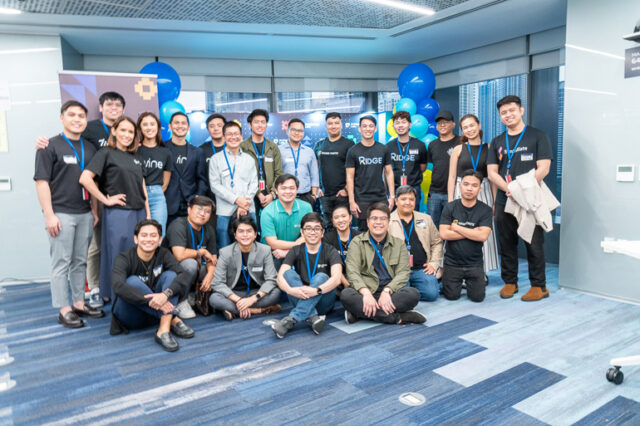
Cohort 1 of the ALAB Incubation Program comprised of startups Twine, Ridge, Synthillate, Gamer Points, and Nexhire

By Chelsey Keith P. Ignacio, Special Features and Content Senior Writer

The first five startups incubated by Archipelago Labs (A-Labs) showcased their technology solutions during the first demo day of its accelerator program.

Among the first cohort of early-stage tech startups under the ALAB Incubation Program are Twine, Ridge, Synthillate, Gamer Points, and Nexhire. The startups were chosen from more than a hundred applicants to undergo the 12-week program, where they got support in improving their business models.

The program with the first cohort culminated with the demo day, which was held at the AWS Office in Bonifacio Global City, Taguig on Aug. 12. The demo day served as an avenue for the startups to show their solutions as well as their planned developments and objectives to investors and key ecosystem players present during the event.

Social app Twine kicked off the ALAB Cohort 1 demo day with its solution of a decentralized social layer powered by artificial intelligence (AI). The startup lets users create their unique digital personality, which will come in the form of a non-fungible token (NFT) to be owned solely by the user.

The app is now live and will validate its ad model this year. The startup has several plans for 2024, among which is partnering with more social networks, including the large ones in the space.

Another startup in the ALAB incubation program was Ridge, which also offers an AI-powered solution for the food and beverage (F&B) industry. The startup provides these businesses with a plug-and-play platform to help them improve their sales by attracting more customers. It also aids them in reducing their inventory losses, such as by preventing spoilages, with the help of machine learning.

Ridge is validating its products this year and plans to go live next year. But the “grander vision” for the startup is to go beyond the F&B industry and expand to other markets such as retail, e-commerce, fintech (financial technology), pharmaceuticals, and hospitality.

In the fintech space, Synthillate is focused on converting intellectual properties (IPs) into financial assets. This is done through its IP valuation algorithm, which determines the value; its IP banking system to accrue value; its IP assetization mechanism to come up with financial contracts and instruments; and its IP asset management.

Aside from the Philippines, the startup is also operating in South Korea, thus commencing its disruptive innovation in developed markets. It has also done exploratory meetings in Thailand and Vietnam, with an aim to become the IP valuation standard in emerging markets.

Meanwhile, gamers are enabled to earn while playing with the solution offered by ad-tech startup Gamer Points, which connects brands with gamers through game ads. Some of the popular games where they could earn from are League of Legends, Valorant, Dota 2, and Fortnite, among others.

Gamer Points is looking to raise funds to reach 500,000 monthly active users; integrate larger brands and advertisers; and extend its reach to India, Southeast Asia, and Latin America.

Helping fellow startups find talents are, meanwhile, the objective of Nexhire, a community-driven talent marketplace that makes use of a bounty and referral system as well as multi-channel distribution.

Nexhire’s go-to-market strategy involves being hyperfocus on the Web3 industry first and then scale moving forward. It also looks to work with specialized or niched communities as well as startup incubators and accelerators to offer its recruitment services. The startup is raising funds to grow its team and launch its beta platform by next year, among other plans.

These five early-stage startups under the ALAB incubation program have a chance to get up to P1 million in startup funding from A-Labs and its investor network as well as an exclusive membership to A-Labs Collective, its network of tech startup entrepreneurs, operators, and investors.

As an accelerator, A-Labs supports early-stage startups centered on the intersection of Web2 and Web3. It is on a mission to work together with these startups through its incubation program, giving them mentorship and expert advisory, open office sessions, and networking opportunities.

Web3 is considered the next, decentralized form of the World Wide Web powered by blockchains, cryptocurrencies, and non-fungible tokens (NFTs); whereas Web2 is the web in its current form, defined by its user-generated content and interactivity.

A-Labs believes there will not be a clear delineation between these two in the future.

“Personally and on behalf of everyone at A-Labs, we think that the Philippines is at an inflection point. Everywhere around the world, VCs (venture capitalists) are talking about how the Philippines is the next big thing in the region… All of these things were being said a few years ago. And what struck me is that perhaps the reason why we’re having a hard time getting to that next stage is that we don’t have a vibrant enough ecosystem,” Philippine Digital Assets Exchange (PDAX) CEO and Founder Nichel Gaba said.

“We don’t have enough opportunities for entrepreneurs to share lessons with one another, key lessons that may spell the difference between success and failure. And I think this is a great opportunity for us to build just that,” he added.

A-Labs is the brainchild of PDAX as well as its early investors and board members Magellan Digital Investment Group and Oak Drive Ventures, Inc.

The ALAB incubation program is now open for applications for the second cohort of startups.

2023 OPPO Inspiration Challenge short-lists 15 finalists for Global Final Demo Event

OPPO recently announced the 15 tech startups short-listed for the Global Final Demo Event of the 2023 OPPO Inspiration Challenge following the successful completion of regional demo events in Boston, Shenzhen, and Bangkok earlier this month. The 15 startups and their innovations will meet in Singapore in October where they will compete for a spot in the global top 5.

The 2023 OPPO Inspiration Challenge received a total of 687 innovative proposals from 66 different countries and regions focusing on the two entry categories of “Inspiration for People” and “Inspiration for the Planet.” Following a thorough evaluation process, the top 15 solutions in each region were selected to take part in three regional demo events in Boston, Shenzhen, and Bangkok.

Hosted by OPPO Research Institute in partnership with the Harvard GSAS Entrepreneur Community, the first regional demo event of 2023 OPPO Inspiration Challenge was held at the Harvard Club of Boston on July 27. During the event, 15 selected startups from Europe, the United States, and Israel pitched their solutions to the judging panel. Following their pitches, entrants also had the opportunity to engage in in-depth technical discussions with Jason Liao, head of OPPO Research Institute, and executives from Harvard Business School and investment institutions.

On July 31, the second regional demo event took place in Shenzhen in partnership with the China University-Enterprise Collaboration Innovation Alliance (CUEC). OPPO Vice-President and President of China Market Bobee Liu and OPPO Health Lab Head Leo Zeng both attended the event, where they were joined by other judges from Qualcomm Ventures, Amazon Web Services, GSMA 5G IN, and Beihang Investment. During the event, attending media and guests also voted for the winners of the “Media Choice” and the “Virtuous Innovation” awards.

The last regional demo event took place in Bangkok last Aug. 7. In partnership with one of the Asia-Pacific region’s most influential universities, Chulalongkorn University, OPPO also invited experts from Amazon Web Services and Deloitte to participate in the judging process.

Based on the four criteria of feasibility, innovation and originality, long-term potential, and social value, the professional judging panels from each of the three regional demo events have now selected their top 5 respective proposals to make up the short list of 15 entrants that will compete in the global final of 2023 OPPO Inspiration Challenge.

To further facilitate the development of the proposals via internal and external collaboration, OPPO will partner with KPMG to hold the Acceleration Camp prior to the Global Final Demo Event. During the camp, senior executives from OPPO will join technology experts, investors, and industry partners to provide assistance to the top 15 global startups.

Following this, the top 5 winning solutions will be selected at the Global Final Demo Event. Each winning startup will be awarded a prize of US$50,000 along with opportunities to help further build their ideas, including productization and commercialization opportunities, strategic partnerships, investment, and exposure at global technology events.

Quezon City government awards P5 million worth of financial grant to StartUp QC finalists

Bamboo Impact Lab, one of the finalists of StartUp QC’s first cohort, receives a financial grant from the Quezon City government.

The Quezon City government awarded financial grants amounting to P1 million to each of the five startup finalists under the first cohort of StartUp QC, the city’s very own startup program.

The finalists include Bamboo Impact Lab, a company that produces high-quality bamboo-derived products; EdukSine Production Corp., an online platform that provides socially relevant, Filipino independent films; and ITOOH Homestyle, the first tech-enabled marketplace for quality-vetted home and office furniture largely crafted by local craftsmen.

Also receiving grants are Indigo Artificial Intelligence Research, Inc., a venture between engineers and professors that provide general-purpose AI capabilities such as multilingual AI engines that can understand local languages, dialects, and its colloquial variants; and Wika which is an accessibility service provider that offers an array of tech-enabled solutions, such as provision of sign language, captions, and audio descriptions for the deaf and visually impaired.

The grants were awarded during StartUp QC’s Demo Day held last Aug. 11, which gave the finalists a stage to pitch their startups.

“Our five pioneering startups have been immersed in various coaching and mentoring sessions meticulously tailored to address their unique requirements. In their journey, we’ve had the privilege of observing firsthand their unwavering determination, commitment, and eagerness to acquire knowledge and evolve,” Juan Manuel J. Gatmaitan, head of the Quezon City Local Economic and Investment Promotions Office, said during the Demo Day.

Launched last October 2022, StartUp QC is an initiative led by the Quezon City government to support existing early-stage startups through various training and mentoring sessions, industry exposure and networking events.

The companies under the cohort have received various business and technical trainings in partnership with the Department of Information and Communications Technology, the Department of Trade and Industry, Quezon City University, Ateneo De Manila University, Miriam College, Thames International, Technological Institute of the Philippines, University of the Philippines, Diliman, and tech innovation hub Launchgarage.

“The city’s support does not end here. In addition to the learning, engagement, and development sessions, we have numerous exciting opportunities planned for our cohort,” Mr. Gatmaitan said. “Each participant will embark on the product development phase of our program. This phase takes their journey to the next level by offering venture acceleration assistance where we will continue to offer the necessary support to each startup and clients eagerly awaiting your presentations.”

Quezon City Mayor Maria Josefina “Joy” G. Belmonte stressed the significance of a city being both innovative and supportive of businesses, stating that local governments should create an inclusive environment that promotes growth and progress for all types of businesses.

“It’s in the interest of all sectors to have a city where anyone would be confident to launch their businesses however novel their idea is. Such endeavors would eventually generate jobs, push the economy to its maximum potential, and help every citizen live the life they aspire to have,” Ms. Belmonte said in a statement.

“The city, together with its partners, are ready to collaborate with these startups and introduce their ideas to the market. Their success will redound to the growth of the community and the city,” she added.

Also present during the Demo Day, Ed Rollan, chief executive officer of Growsari, imparted words of encouragement to the finalists.

“Don’t stop yourselves from thinking big. In every pain point, there’s always a big idea waiting to be unlocked, but always go for the biggest idea that you can think about,” Mr. Rollan shared.

“I’ve also learned in my seven years of doing startups that 90% of the success is actually reliant on our ability to execute, not on our ability to write slides and strategies. So, I encourage all of you to test new things. Learn and just do it; and [when] the learning comes, adjust [and be] agile enough to evolve,” he added.

Ongoing competitions

The Quezon City government is currently accepting applications for the second round of the Startup QC Program until Aug. 30 at 5 p.m. Interested applicants may sign up at https://qceservices.quezoncity.gov.ph/.

Moreover, students in the city are also invited to take part in the Startup QC Student Business Plan Competition.

Launched earlier in July, the program is open to all students of legal age residing in Quezon City, who are enrolled at any school, college, or university in the Philippines.

Applicants are encouraged to submit imaginative business ideas that are focused on high development impact sectors such as agriculture technology (agritech), education technology (edtech), environment technology (greentech or cleantech), health technology (healthtech) and government technology (govtech).

Student applicants who will qualify for this competition will undergo cadetship training sessions on topics such as design thinking, cultivating an entrepreneurial mindset, and creating a pitch deck.

After the cadetship, student finalists will have to pitch their business idea to a panel of judges for a chance to win up to P100,000.

Deadline of applications for this competition is on Sept. 14 at 5 p.m. Interested applicants may sign up also at https://qceservices.quezoncity.gov.ph/.

BoP deficit narrows to $53M in July

By Keisha B. Ta-asan, Reporter

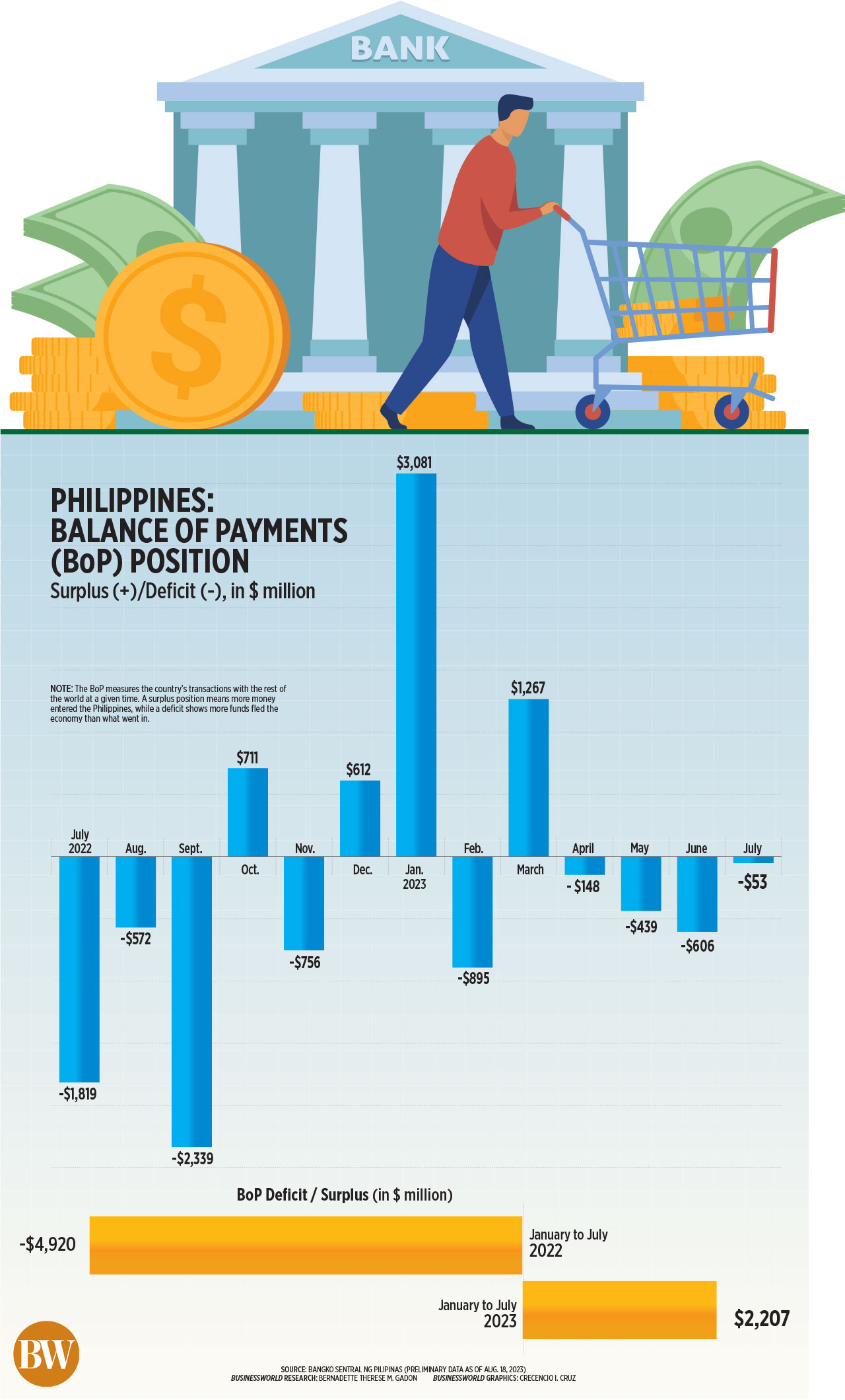
THE OVERALL balance of payments (BoP) deficit sharply narrowed to $53 million in July, as more dollars flowed out of the country to pay for the government’s foreign debt.

The BoP shortfall in July was significantly smaller than the $1.8-billion gap in the same month a year ago and $606 million in June, data released by the Bangko Sentral ng Pilipinas (BSP) late on Friday showed.

This is the narrowest BoP deficit in three months or since the $148-million gap in April.

July also marked the fourth straight month the BoP position was in a deficit.

“The BoP deficit in July 2023 reflected net outflows arising mainly from the National Government’s (NG) payments of its foreign currency debt obligations,” the BSP said in a statement.

The BoP measures the country’s transactions with the rest of the world at a given time. A deficit means more funds fled the economy than what went in, while a surplus shows that more money entered the Philippines.

In the first seven months of the year, the BoP position swung to a surplus of $2.21 billion, from the $4.92-billion deficit in the same period in 2022.

“Based on preliminary data, this development reflected mainly the improvement in the balance of trade and the sustained inflows from personal remittances, net foreign borrowings by the NG, trade in services, and foreign direct investments,” the BSP said. 

Rizal Commercial Banking Corp. Chief Economist Michael L. Ricafort said the smaller BoP deficit in July is likely due to the narrowing of the country’s trade deficit.

The trade deficit for January-June reached $27.96 billion, slightly narrowing from the $29.8-billion deficit posted in the same period last year.

Mr. Ricafort said the narrower BoP deficit was also due to the continued growth in dollar inflows from remittances, business process outsourcing revenues, foreign tourism receipts, profit from Philippine Offshore Gaming Operators (POGO) firms and foreign investments.

The central bank also noted the BoP position reflects the final gross international reserves (GIR) level of $100 billion as of end-July, 0.6% higher than the $99.4 billion as of end-June.

The GIR level reflects a more than adequate liquidity buffer equal to 7.4 months’ worth of imports of goods and payments of services and primary income.

“Specifically, it ensures availability of foreign exchange to meet balance of payments financing needs, such as for payment of imports and debt service, in extreme conditions when there are no export earnings or foreign loans,” the BSP said.

The GIR can also cover up to 5.9 times the country’s short-term external debt based on original maturity and 4.1 times based on residual maturity.

Further growth in dollar inflows and continued narrowing of the country’s trade deficit will support the BoP position of the Philippines moving forward, Mr. Ricafort said.

The planned retail dollar bond offering by the National Government as well as its debut of about $1-billion Islamic bonds this year will boost the dollar reserves, he said.

The government is eyeing to launch a retail dollar bond offering in the third quarter, with an offer size of around $2 billion. The last retail dollar bond sale was in 2021, when the Philippines raised almost $1.6 billion or P80.91 billion.

Earlier in June, the central bank revised its BoP deficit forecast to $1.2 billion or equivalent to -0.3% of gross domestic product (GDP), down from the $1.6-billion (-1.3% of GDP) forecast in March.

The BSP also projected a narrower current account deficit at $15.1 billion (-3.4% of GDP) this year from $17.1 billion (-4% of GDP) previously.

The country’s GIR is expected to hit $100 billion by end-2022 and $102 billion by end-2023.

Economists cut inflation forecasts for 2024, 2025

Rising pump prices may also put pressure on inflation, the central bank said. — PHILIPPINE STAR/MIGUEL DE GUZMAN

PRIVATE SECTOR economists kept their inflation outlook for this year but cut their forecasts for 2024 and 2025, the Bangko Sentral ng Pilipinas (BSP) said.

However, analysts said the threat of El Niño, the impact of trade restrictions on food items, oil production cuts, and hikes on transport fare and wages pose risks to the inflation outlook.

Based on the results of the BSP’s survey of private economists in August, analysts’ average inflation forecast for 2023 was at 5.5%, unchanged from the July survey.

For 2024, the analysts’ mean inflation forecast was trimmed to 3.5%, from 3.6% previously, while the projection for 2025 was also cut to 3.4% from 3.6%.

“Analysts expect inflation to continue easing in the near term owing largely to negative base effects,” the BSP said. “Risks to the inflation outlook, however, remain tilted to the upside due mainly to supply disruptions, particularly the potential adverse impact of El Niño.”

On Thursday, the BSP raised its average inflation forecast for 2023 to 5.6% (from 5.4% previously) and 3.3% (from 2.9%) for 2024, respectively. It also hiked its 2025 inflation forecast to 3.4% from 3.2%.

According to the central bank, analysts cited the higher prices of basic commodity items and services due to weather disturbances and the El Niño phenomenon as a key upside risk to inflation.

The El Niño weather event will likely persist in the Philippines until the second quarter next year, based on the latest advisory from the state weather agency.

This increases the chance of below-normal rainfall conditions, which could lead to dry spells and droughts in some areas of the country and in turn, dampen water resources and agricultural productivity.

“Electricity rates could rise in the fourth quarter of 2023 to second quarter of 2024 owing mainly to the warm and dry weather condition associated with El Niño,” the BSP said.

“A substantial increase in demand for power which could not be supported by power supply reserves could lead to a declaration of yellow or red alerts in the transmission grids, resulting in higher generation charges from the Wholesale Electricity Spot Market (WESM) and independent power producers (IPPs),” it added.

Local distribution utilities may also have to tap more expensive power generation sources as an alternative to hydropower plants, the BSP said.

The impact of trade restrictions on food items as well as oil production cuts by the Organization of the Petroleum Exporting Countries and its allies may also affect inflation in the Philippines.

India’s decision to restrict rice exports of non-basmati and broken white grain has pushed global rice prices higher.

The BSP said second-round effects from higher transport fares and wage hikes may also put pressure on inflation.

Transport groups are requesting for a P2 increase in public transport services nationwide, while a P40 wage hike in the National Capital Region (NCR) took effect on July 16. Pending wage hike petitions for various provinces in the country will likely be decided on by September.

“The main downside risk cited by a few analysts include the lagged effect of the BSP’s successive monetary policy tightening, which is expected to temper inflation,” the central bank said.

The BSP kept benchmark interest rates steady for a third straight meeting last week, but signaled it is prepared to resume tightening if needed amid risks to inflation.

The Monetary Board left its overnight reverse repurchase rate unchanged at a near 16-year high of 6.25%. Interest rates on the overnight deposit and lending facilities were maintained at 5.75% and 6.75%, respectively.

The BSP has raised borrowing costs by 425 basis points (bps) from May 2022 to March 2023 to tame inflation.

The central bank also said most analysts forecast the BSP to extend its policy pause for the rest of the year.

“However, some analysts are looking at one last rate increase by 25 bps in the third quarter and a possible reversal by 25 bps in the fourth quarter,” it said.

For 2024, all analysts expect the BSP to cut the key policy rate by a range of 50 bps to 225 bps. They also anticipate further cuts of 25 bps to 200 bps in 2025.

Meanwhile, all economists expect full-year inflation in 2023 to breach the 2-4% target. For 2024 and 2025, most analysts see inflation decelerating within the target range.

Analysts assigned a narrow 1.7% probability (from 2.8% a month ago) that inflation this year will settle within the target range, while there is a 98.3% chance (from 97.2%) it will exceed 2-4%.

The likelihood of inflation falling within the target band next year increased to 80.5% (from 76.7%), while the probability of inflation settling within 2-4% in 2025 is at 77.5% (from 71.6% previously).

There were 26 respondents in the BSP’s survey of private sector economists, which was conducted from Aug. 5 to Aug. 9. — Keisha B. Ta-asan

Infrastructure spending exceeds target in first half

PHILIPPINE STAR/ MICHAEL VARCAS

THE NATIONAL GOVERNMENT exceeded its target spending for infrastructure by 5% in the first half, data from the Department of Budget and Management (DBM) showed.

According to data from the DBM, infrastructure expenditures reached P507.2 billion in the January-to-June period, surpassing the P483.1-billion infrastructure spending program for the period by 5%.

Infrastructure spending jumped by 7.8% in the first half from P470.5 billion in the same period in 2022.

The National Government disbursed P608.7 billion for actual infrastructure projects in the first six months, 2.6% up from P593.2 billion in 2022.

However, the disbursement for infrastructure projects missed the P618.1-billion target for the period by 1.5%.

The government plans to spend 5.3% of the gross domestic product (GDP) or about P1.29 trillion on infrastructure this year.

“The continued growth in infrastructure spending would remain to be a bright spot in the economy, as it remains high at 5%-6% of GDP, compared with 2% or even less than 2% of GDP 10-20 years ago,” Rizal Commercial Banking Corp. Chief Economist Michael L. Ricafort said in a Viber message.

Infrastructure spending growth also offset the low budget utilization of some government agencies in the second quarter, Mr. Ricafort added.

China Banking Corp. Chief Economist Domini S. Velasquez said higher infrastructure spending may help lift economic growth.

“Given the effect of underspending to Q2 GDP, the government will likely be more focused on spending this year’s entire budget in a timely manner,” she said in a Viber message. Mr. Ricafort expects the rate of infrastructure spending growth to remain in high single digits, and faster than GDP growth in recent years.

Infrastructure activities may also benefit from the El Niño weather pattern in the next few months.

“Drier weather is positive for infrastructure activities,” Ms. Velasquez said.

Infrastructure spending is expected to be maintained at 5-6% of GDP until 2028. — Aaron Michael C. Sy

DBM chief says Q2 GDP growth would have been higher if not for gov’t underspending

PHILIPPINE STAR/WALTER BOLLOZOS

THE PHILIPPINE ECONOMY would have expanded by 5.3% in the second quarter if the government was able to address underspending by key agencies.

The Department of Budget and Management (DBM) Secretary Amenah F. Pangandaman said the government was not able to spend P170 billion in the first semester, which led to a slower-than-expected gross domestic product (GDP) growth in the second quarter. 

“Our study showed that if we only spent at least P65 billion of the P170-billion gap, our GDP would have been 5.3%. So, sayang (what a waste),” Ms. Pangandaman said at an event hosted by the University of the Philippines School of Economics on Saturday.

The Philippine economy grew by 4.3% in the second quarter, the slowest in two years. This was weaker than the 6.4% growth in the first quarter and 7.5% in the same period last year.

For the first half, GDP growth averaged 5.3%, lower than the government’s 6-7% target.

The disappointing second-quarter growth was mainly attributed to weaker consumption and a decline in government spending. Government spending contracted by 7.1% in April to June, a reversal of the 6.2% growth in the first quarter and 10.9% a year ago.

Finance Secretary Benjamin E. Diokno partially attributed the underspending to the over P100 billion in government-issued checks that were not released in the first half.

Ms. Pangandaman earlier said there are P124.1 billion worth of government-issued checks which are currently held by banks. This prevents the funding of social programs that should have been implemented.

According to Mr. Diokno, during his time as a Budget secretary, government units tend to accept projects that are not ready for implementation.

“You have to be very strict. Do not accept projects that have no studies…Do not ask for more than what you can chew. If you will not be able to spend the budget, that is unfair to other departments that can spend the money,” he told reporters on Friday.

In coming up with the proposed 2024 national budget, Ms. Pangandaman said the DBM considered the past spending performance of agencies.

“Even if you want (a budget that is) as high as P100 billion for a certain project, but you won’t be able to spend it, it will be part of our formula,” she said.   

Still, Mr. Diokno said he is optimistic the economy will expand in the second half as easing inflation may boost household consumption and face-to-face schooling lifts economic activity.

He noted that government spending usually catches up in the second half.

Meanwhile, the DBM is pushing for amendments to the procurement laws to speed up government spending.

“I know that the current government procurement process is difficult, so we will reform that, and we will present it to the President next week,” Ms. Pangandaman said.

Ms. Pangandaman earlier said the Government Procurement Policy Board is working on simplifying the law’s implementing rules and regulations to address bottlenecks.

The DBM is also working on building the capacity of local government units (LGUs) amid the implementation of the Supreme Court’s Mandanas-Garcia ruling.

“We have to recognize that the capacity per LGU (is different),” Ms. Pangandaman said. “There are LGUs, especially those who are progressive, who can really create and implement projects that are highly impact and highly technical, but there are some who don’t have enough capacity.”

She said the National Economic and Development Authority (NEDA) will soon release a study that would identify which projects and programs would be better handled by the National Government or LGUs.

“Hopefully we’ll have the study soon so we will be able to identify which projects and programs can be delivered more efficiently by the National Government and what programs can be delivered by our LGUs,” she said.

The government is currently working on devolving national government functions and programs to LGUs to give them the capacity to govern.

Under the Supreme Court’s Mandanas-Garcia ruling, LGUs were granted a larger share of national taxes to support them in the devolution. — Keisha B. Ta-asan with inputs from AMCS