Home Blog Page 4355

Hours after deadly train crash, Greece agonizes over what went wrong

RESCUERS operate at the site of a crash, where two trains collided, near the city of Larissa, Greece, March 1, 2023. — REUTERS

ATHENS — Greek Prime Minister Kyriakos Mitsotakis called it an unspeakable tragedy but questions are being asked whether the fatal collision of passenger and freight trains on Tuesday night could have been prevented.

Nearly 24 hours after the two trains collided in central Greece, killing at least 36 people and injuring dozens, survivors and relatives of victims were still in the dark on who was responsible for Greece’s deadliest train crash in living memory.

Carriages traveling in opposite directions on the same track smashed into one another some 220 miles north of the capital Athens, at speeds some media reports put at up to 160 km (100 miles) an hour, reducing the passenger train into a mangled mass of steel.

There have been widespread media reports electronic signal software was not working, meaning signaling was done manually. Labor unions complain of chronic staff shortages.

OSE, the country’s state-owned operator for rail infrastructure, did not respond to calls requesting comment nor did it issue a statement. The transport minister, who earlier Wednesday burst into tears while visiting the disaster site, tendered his resignation.

Within hours, Greek police had arrested the station master at a provincial train station, accusing him of death through negligence. The 59-year-old denied the charges, attributing the accident to possible technical failure.

Parts of Greece’s rail services were privatized in 2017 under a multi-billion-euro bailout package from the European Union and the International Monetary Fund. Hellenic Train, a unit of Italy’s Ferrovie dello Stato which acquired passenger and freight operations, said it was working with authorities on the investigation.

Labor unions said the collision had highlighted some chronic deficiencies: lack of staff and resources, broken lights and a patchwork of modern and outdated facilities.

“It’s still very early but more than two factors are needed for an accident like this to happen,” said Nikos Tsikalakis, head of the workers union’ at the Greek railway infrastructure operator OSE, in apparent reference to human error and a technical fault.

Mr. Tsikalakis said that about 750 workers were currently employed, down from at least 2,100 people that were initially expected to be employed for the railway system to operate effectively, according to a state-approved game plan.

Another unionist, Yiannis Ditsas, said only part of the signaling system from Athens to Thessaloniki was complete, with the rest handled manually.

“We had reported it, have done for at least the past 25 years,” Ditsas told state TV.

In announcing his resignation, Transport Minister Kostas Karamanlis said he had taken over infrastructure “not fit for the 21st century” when he was appointed in 2019, and then said he would strive to improve it. — Reuters


Lovin’ it! Russians give Big Mac replacement the thumbs up

EN.WIKIPEDIA.ORG

MOSCOW — The signature sauce has changed and the ingredients have been tweaked, but the “Big Hit,” which went on sale in Russia this week, is a tasty alternative to the McDonald’s Big Mac it is replacing, several customers said.

McDonald’s Corp. closed its Russian restaurants soon after Moscow sent tens of thousands of troops into Ukraine last February, eventually selling to a local licensee, Alexander Govor, who unveiled the new brand in June.

That deal imposed restrictions on the color scheme and products that the successor chain Vkusno & tochka, or “Tasty & that’s it,” can use.

Big Macs, McFlurry’s and the Golden Arches were all a no go, as was the McDonald’s-style Big Mac sauce.

“They’ve completely revamped it,” student Mikhail Proskunenkov told Reuters on Wednesday. “They’ve added more greens, changed the sauce. In principle, it’s cool and different, but I still miss the old Big Mac.”

Another customer, Edgar Vardanyan, was lavish in his praise: “I can 100% say that it has got better. I think the ingredients have changed a little, the sauce has become tastier.”

Vkusno & tochka CEO Oleg Paroev said, when announcing the new product in December, that the sauce and layout of ingredients would change.

But his company’s strategy has also been to focus on continuity, with advertising slogans such as “The same double cheeseburger” and the chain’s new logo — a stylized burger with two fries — resembling the letter ‘M’.

Not everyone was sold on the new burger.

“The sauce, which was the Big Mac’s main quality, has become a little more sweet and sour,” said Vladimir, a student.

“And the bun has basically got worse. It has become softer somehow, not so flavourful, and so the Big Hit falls apart more as you eat it.” — Reuters

Night workers, frequent travelers’ sleep patterns linked to breast cancer 

PHILSTAR FILE PHOTO

Filipina scientists have found a link between breast cancer, stress, and disturbed circadian rhythms, as seen in those who work night shifts or travel frequently. 

A gene called Krüppel-like factor 9 (KLF9) is suppressed in breast tumors as compared to normal breast tissue, according to molecular biologist Pia D. Bagamasbad and her student, Weand S. Ybañez, from the University of the Philippines-Diliman’s National Institute of Molecular Biology and Biotechnology.  

KLF9 restricts breast cancer tumorigenesis, or the formation of tumors, their study, which was published on Feb. 23, found.  

According to the study, KLF9 exhibits a cyclical pattern as part of a healthy circadian cycle, or the daily sleep-wake pattern that is set by light and is thus affected by changes in a person’s exposure to light and dark.  

In June 2019, a working group convened by the International Agency for Research on Cancer likewise concluded that night shift work is “probably” carcinogenic—or cancer-causing—to humans. 

“Circadian disruption is an emerging driver of breast cancer, with epidemiological studies linking shift work and chronic jet lag to increased breast cancer risk,” the NIMBB research team said in a March 1 press statement.  

The expression of KLF9 “exhibits a downward trend as breast cancer gets more severe,” Ms. Bagamasbad said in an e-mailed statement. “A solution for night-shift workers to restore the regularity of their circadian rhythm … is to stay in the dark when it is normally daytime outside.”  

“As for the incidence of breast cancer among BPO [business process outsourcing] workers, I do not think such epidemiological studies have been conducted here in the Philippines,” she said.  

Breast cancer is the most common cancer among Filipino women and the third-leading cause of cancer-related deaths in the country.  

The Philippines adds at least 27,000 new cases of breast cancer each year, according to Marvin Jonne Mendoza, head of the section of medical oncology at the National Kidney and Transplant Institute.  

Each breast cancer patient needs P300,000 to P450,000 to complete the required 18 treatment cycles for the disease, he noted. — Patricia B. Mirasol

Cervical cancer poorly understood by most women in region — study

PIXABAY

A study found that only 22% of women in Asia Pacific are knowledgeable about cervical cancer, which is preventable.

Low- and middle-income countries account for 90% of cervical cancer deaths, Allison Rossiter, managing director of Roche Diagnostics Australia, said at a forum on March 1. 

In the Philippines, most women have not been screened for cervical cancer, according to the World Health Organization (WHO). 

By 2030, the WHO hopes to have 90% of Filipino women screened for cervical cancer. 

Societal pressure influences life-changing decisions of women in the region, the Roche study noted. 

“This is entirely preventable, and it’s down to education,” Ms. Rossiter said.

In a patriarchal society, women sometimes have to ask permission from their husbands, said Tofan Widya Utami, an obstetrician-gynecologist of the University of Indonesia.  

“We have to give more effort on improving the education of people, especially the husbands, on the [importance of] health screening,” she added.  

Ms. Rossiter said that many women are still pressured by family and societal expectations, especially “on when they should marry or if they should have a career.”  

“There are conflicting messages about that,” she said.  

Mridu Gupta, chief executive officer of the Cancer Awareness, Prevention and Early Detection Trust, also noted how women deprioritize their health for loved ones.   

“Women are caregivers, and [low] in the list of priorities,” she said at the forum. “If resources are limited, then they prioritize the breadwinner over the caregiver.”  

Each woman has the right to healthcare, Ms. Gupta said.  

“You have the right to it. Make sure you speak up. Keep yourself aware of what’s happening in the world and in your body, and take action.”

BIGGER BUDGET
In a related development, the Cancer Coalition Philippines is asking Congress to increase funds for the cancer control program “so that the Department of Health, as main implementor, can carry out the provisions of the four-year old National Integrated Cancer Control Act (NICCA).”

“The law is good only on paper if it remains unfunded. We are thankful for the budget we now have but we need to increase it based on the data we have,” Carmen Auste, Cancer Coalition vice president, said in a statement.

According to the group, the Health department was “given about P1 billion in previous years to fight cancer but even for breast cancer alone, with 27,000 new cases and 9,000 deaths here annually, that amount needs to be augmented.”

For his part, Teodoro Padilla, executive director of the Pharmaceutical and Healthcare Association of the Philippines, said that funding the law can help improve the whole process of cancer control, including access to medicines.

“Only 13% of new drugs find their way locally although they are already available in other countries. Cancer is something we could live with and not die from. But we need all the tools at the disposal of the patients,” he said.

“Access delayed means treatment denied,” he added. Patricia B. Mirasol

Inflation control to hinge on agri competitiveness, crop insurance, other bills — Diokno

By Beatriz Marie D. Cruz

BILLS on agrarian reform, land use, livestock industry competitiveness, and crop insurance will help the central bank rein in inflation, according to the Secretary of Finance.

“Congress’ main role is to pass new laws or amend existing ones,” Sec. Benjamin E. Diokno told BusinessWorld via Viber Thursday.

Headline inflation may have exceeded 9% in February, the central bank said Tuesday. Inflation was 8.7% in January, the highest level since November 2008.

Mr. Diokno called on Congress to pass the New Agrarian Emancipation Act, which will condone a total P58 billion in unpaid debt of farmer-beneficiaries stemming from agricultural land awarded under the Comprehensive Agrarian Reform Program. 

“This will allow farmers to focus their efforts on increasing the productivity of agrarian reform land,” Mr. Diokno said. 

The bill hurdled the House of Representatives in December, while a counterpart measure in the Senate has been consolidated into a committee report. In his State of the Nation Address, President Ferdinand R. Marcos Jr. called for the need to pass the measure. 

Mr. Diokno also saw the need to amend the Philippine Crop Insurance Corp. (PCIC) Charter by including “suitable disaster risk transfer programs to farmers and fisherfolk for their crop, livestock, and fishery products,” to ensure stable supply of agricultural commodities. 

The chambers must also approve the National Land Use Act to allow which lands will be used for agricultural purposes and ensure that these lands are not converted, Mr. Diokno said. 

Signing it into law will help “classify land according to use: protection (for conservation), production (for agriculture and fisheries), settlements development (for residential purposes), and infrastructure development (for transportation, communication, water resources, social infrastructure),” Mr. Diokno added.

The bill is one of the House’s priority measures for 2023. A similar measure in the Senate is pending at the committee level.

He added that the Livestock Development and Competitiveness Bill will reduce inflation arising from high meat prices. 

The proposed measure “aims to replace the minimum access volume system on corn with a uniform 5% tariff rate to ensure a stable supply of cheap corn for inputs, and earmark corn tariff revenues for corn productivity improvement,” according to Mr. Diokno. 

Both livestock bills are pending in the two chambers’ respective committee levels. 

TARGETS MAINTAINED
“We do not see the need to raise the growth or inflation targets specified in the medium-term expenditure framework,” Mr. Diokno said. Any proposed changes to growth and inflation targets will be discussed in the economic managers’ next briefing at the House of Representatives in April.

Asked about the prospects for further rate hikes, Mr. Diokno noted that the Monetary Board (MB) considers the potential benefits and costs of hiking policy rates.

“The BSP’s future policy actions will be influenced by several factors, including more recent data and prospects for inflation, economic growth, and financial stability,” he said. 

The MB raised its overnight borrowing rate by 50 basis points on Feb. 16, bringing the policy rate to 6%, the highest in nearly 16 years or since May 2007, when the rate was 7.5%. 

The MB will meet on March 23 for its next policy setting. 

At a House briefing Tuesday, Mr. Diokno said that food supply constraints and higher utility rates are the main drivers of inflation. 

In a statement on the economic managers’ meeting with lawmakers, the National Economic and Development Authority noted that short-term measures to improve agricultural productivity are addressing supply chain issues (production and post-harvest facilities, logistics, imports, and anti-smuggling efforts); frequent monitoring and updating of farmgate and retail prices; and using surveys and satellite data to enable timely import decisions. 

The government must also create a centralized database for quick sharing of information; and support vulnerable sectors through subsidies and the Agriculture department’s Kadiwa program, Mr. Diokno said. 

[EXPLAINER] How to protect critical infrastructure from cyber threats

Steven Scheurmann, vice president for Southeast Asia at Palo Alto Networks, talks about the vulnerability of critical infrastructure such as online banking networks, manufacturing operations, and air traffic control systems to cyber threats, and the reasons why they are often targeted.

He also shares insights into how we can protect them as the Philippines transitions into a digital economy.

According to Palo Alto Networks’ 2023 cybersecurity predictions for the Asia-Pacific region, systems undergoing 5G adoption will be vulnerable, from the medical space to manufacturing.

“Have you quantified where you are in cybersecurity, what your exposure is, where you could be compromised? Not every organization has done this,” said Mr. Scheurmann.

Interview and text: Bronte H. Lacsamana
Videography: Joseph Emmanuel L. Garcia
Video editing: Earl R. Lagundino

Budget gap exceeds ceiling in 2022

PHILIPPINE STAR/ RUSSELL PALMA

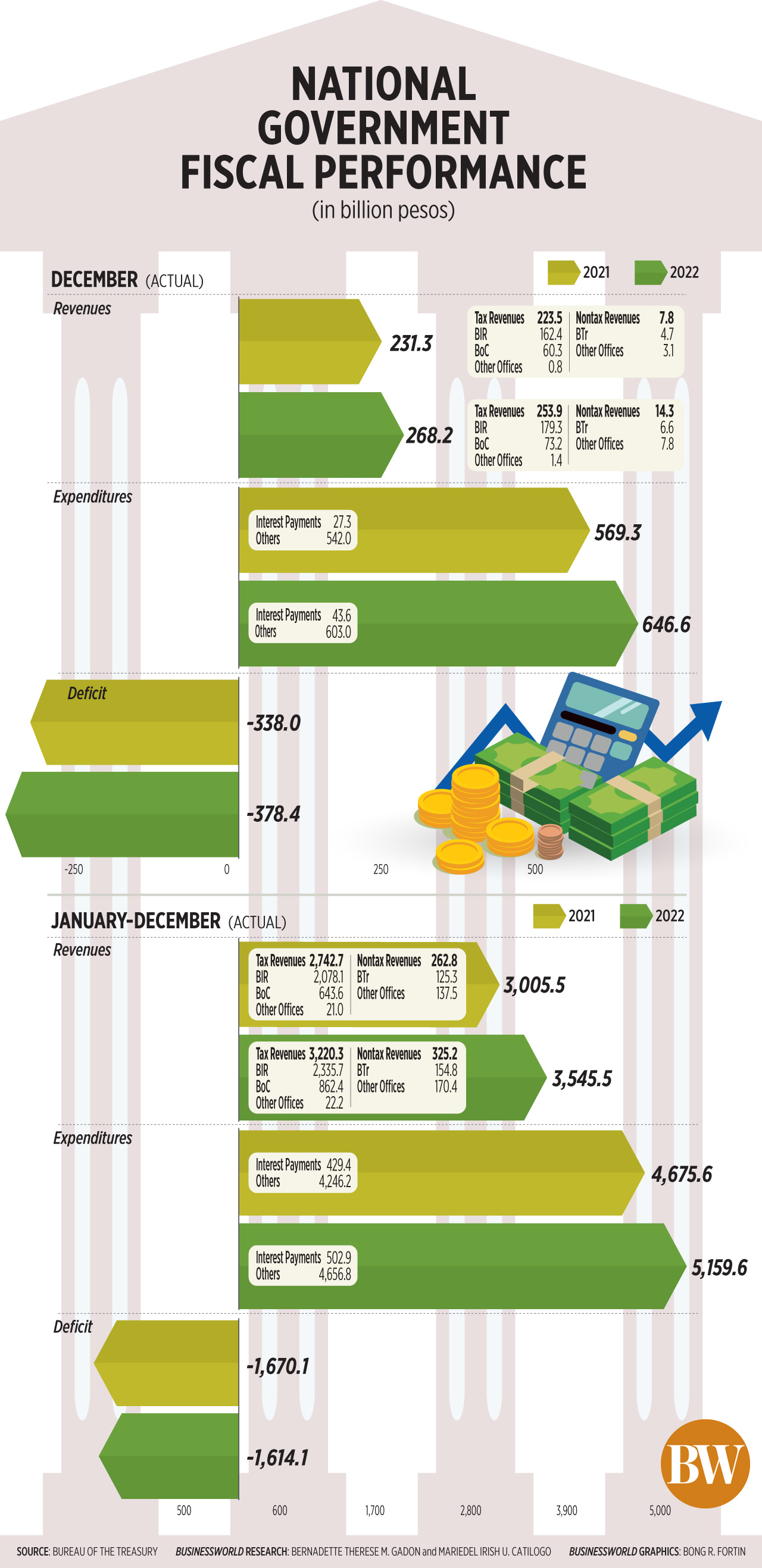
THE NATIONAL Government’s (NG) fiscal gap narrowed year on year to P1.61 trillion in 2022, but exceeded the budget deficit ceiling.

Data from the Bureau of the Treasury (BTr) showed the full-year deficit was lower by 3.35% or P56 billion than the P1.67 trillion shortfall in 2021.

It was also higher than the revised P1.502-trillion target set by the Development Budget Coordination Committee (DBCC) last December.

“The fiscal outturn was driven by revenue growth of 17.97% outpacing the 10.35% expansion in government spending,” the BTr said in a press release on Wednesday.

This brought the fiscal deficit to 7.33% of gross domestic product (GDP), lower than 8.6% in 2021 but higher than the DBCC target of 6.9%.

National Government outstanding debt

In December alone, the budget gap widened to a record P378.4 billion, up 11.94% from the P338 billion in the same month in 2021.

National Government fiscal performance

Revenues in December increased by 15.95% year on year to P268.2 billion.

Tax revenues grew by 13.61% to P253.9 billion during the month, as Bureau of Internal Revenue’s (BIR) collection rose by 10.42% to P179.3 billion and the Bureau of Customs (BoC) revenues reached P73.2 billion, up by 21.4% from a year ago.

On the other hand, nontax revenues from the Treasury went up by 38.31% to P6.6 billion in December.

Meanwhile, government spending jumped by 13.57% to P646.6 billion in December from P569.3 billion in the same month a year ago.

Primary spending — which refers to total expenditures minus interest payments — rose by 11.25% to P603 billion from P542 billion.

FULL YEAR
For the full-year 2022, revenue collection jumped by 17.97% to P3.55 trillion from P3.01 trillion in 2021. It was also slightly higher than its P3.52-trillion program for the year.

Tax revenues, which accounted for 91% of the total revenues, rose by 17.41% to P3.22 trillion from P2.74 trillion a year ago.

Of this, revenues generated by the BIR went up by 12.39% to P2.34 trillion, while collections from the BoC jumped 34.01% to P862.4 billion.

Other tax collecting offices posted P22.2 billion in revenue, an increase of 5.69% from a year earlier.

Nontax revenues from the BTr reached P154.8 million, up by 23.48% from a year ago.

“The BTr’s robust collection was largely driven by higher remittances of dividends on shares of stocks, income from Bond Sinking Fund investments, and interest on NG deposits,” the Treasury added.

Meanwhile, expenditures increased by 10.35% to P5.16 trillion, from the previous year’s P4.68 trillion. This also surpassed the DBCC’s P5.02-trillion program for the full year.

The BTr said that spending was largely attributed to the “faster execution of capital outlay projects amid the lowest COVID-19 (coronavirus disease 2019) alert level classification for most parts of the country; implementation of targeted subsidy programs to mitigate the impact of higher food and fuel prices; and payment of compensation and other benefits for COVID-19 healthcare workers in health facilities.”

Primary spending rose by 9.67% to P4.66 trillion from P4.25 trillion a year ago.

Rizal Commercial Banking Corp. Chief Economist Michael L. Ricafort said in a Viber message that inflation may have contributed to the month-on-month widening of the budget deficit in December.

“The higher inflation could have pushed up nominally the incomes of taxpayers, raised nominal values of assets, and allowed the government to borrow money at higher rates and earn more interest income on its holdings of government bonds. The main result is the increase in government revenues,” Leonardo A. Lanzona, who teaches economics at the Ateneo de Manila University, said in an e-mail.

Mr. Lanzona noted the government needs to look for new sources of revenues, such as new taxes.

“Currently, instead of raising taxes directly, governments allowed inflation to reduce the value of money, which in turn reduced the real value of outstanding debts and generated extra revenues. However, relying on inflation as a revenue source is generally seen as a harmful policy, as it can lead to economic instability, uncertainty, and distortions in the economy,” he added.

Union Bank of the Philippines, Inc. Chief Economist Ruben Carlo O. Asuncion said the narrower full-year NG budget shortfall “is a welcome development even amid rising global and domestic borrowing costs.”

“Higher-than-expected revenue collections due to the economic reopening narrative and higher-than-expected 2022 GDP growth has enabled the trimmed fiscal deficit. Nevertheless, we still sense strong near- to medium-term fiscal pressures due to the higher debt stock this year and the uncertainties on the backdrop of rising monetary policy interest rates (to deal with higher prices),” Mr. Asuncion said. — Luisa Maria Jacinta C. Jocson

Factory activity eases in Feb. amid rising costs

REUTERS

PHILIPPINE FACTORY activity grew at a slower pace in February, as stubbornly high costs and supply chain challenges weighed on the sector, S&P Global said.

The S&P Global Philippines Manufacturing Purchasing Managers’ Index (PMI) reading stood at 52.7 in February, down from 53.5 in January, which “signaled the softest improvement in operating conditions in three months.”

The latest PMI reading matched the 52.7 reading in November 2022, and was the lowest since 52.6 in October 2022.

Manufacturing Purchasing Managers’ Index (PMI) of select ASEAN economies, February 2023“According to the latest PMI data, growth across the Filipino manufacturing sector remained solid midway through the first quarter of 2023, albeit easing slightly from January. Both production levels and factory orders rose at solid rates and were stronger than their respective historical averages,” Maryam Baluch, economist at S&P Global Market Intelligence, said in a statement.

February marked the 13th straight month that the PMI reading was above the 50 mark, which denotes improvement in operating conditions. A reading below 50 signals deterioration.

The headline PMI measures manufacturing conditions through the weighted average of five indices: new orders (30%), output (25%), employment (20%), suppliers’ delivery times (15%) and stocks of purchases (10%).

The Philippines’ PMI reading was the second fastest among six Association of Southeast Asian Nations (ASEAN) member countries, behind Thailand (54.8). It was ahead of Indonesia and Vietnam (both at 51.2) and Myanmar (51.1). Factory output contracted in Malaysia (48.4).

S&P Global said production and new orders in the Philippines expanded in February, but at a slower rate.

“As per anecdotal evidence, greater demand from customers and a growing clientele helped drive the latest upturns,” it added.

Firms increased purchasing activity for a sixth straight month, while pre-production inventories rose for an 18th month in a row.

“Greater production requirements meant that firms also raised their purchasing activity… Similarly, Filipino firms were keen to maintain their stocks in anticipation of greater sales in the months ahead,” S&P Global said.

COST BURDENS
Meanwhile, S&P Global flagged some “areas of concern” for Philippine manufacturers, such as high costs, a drop in employment and “bleak” supply chain conditions.

“Higher prices at suppliers directly fed into cost burdens, causing input price inflation to rise at a rapid and accelerated pace,” Ms. Baluch said.

S&P Global noted the seasonally adjusted employment index slipped for a second month in a row. This also signaled the first drop in workforce numbers since November.

“There were reports of resignations, with several firms also actively laying off staff. That said, the pace of job shedding was marginal overall. Additionally, Filipino manufacturing firms registered a renewed fall in backlogs of work,” it added.

Supply chain problems also continued to weigh on the sector in February.

“Supplier performance worsened further, and to a greater extent, as material scarcity, port congestion and difficult transportation conditions resulted in a further lengthening of average lead times,” Ms. Baluch said.

Despite the challenges, S&P Global said manufacturing firms kept a positive outlook for the year.

While half of the respondents see higher output in the next 12 months, it noted that sentiment was weaker from January “as concerns regarding competition and the rising costs of inputs seeped into expectations.”

“Despite the ongoing supply-side challenges and an uncertain international climate, the Filipino manufacturing sector has remained resilient, benefiting greatly from domestic demand. Firms hope that the buoyancy in the market is maintained as we progress further into the year,” Ms. Baluch said.

ING Bank N.V. Manila Senior Economist Nicholas Antonio T. Mapa said worsening supply problems may have led to persistent cost pressures.

“Higher input costs and supply constraints may have led to the slower expansion, on top of concerns about how sustainable the recent string of expansion will be,” he said in a Viber message.

China Banking Corp. Chief Economist Domini S. Velasquez said logistics issues and higher costs will remain challenges for the sector.

“Moving forward, we expect PMI prints to remain moderately in expansion with China’s added boost. However, cost pressures from higher domestic prices will continue to dampen the outlook for the sector,” she said in a Viber message. — Luisa Maria Jacinta C. Jocson

January credit growth slowest in 9 months

BW FILE PHOTO

BANK LENDING expanded in January at its slowest pace in nine months, reflecting the impact of rising interest rates.

Preliminary data from the Bangko Sentral ng Pilipinas (BSP) released late on Tuesday showed outstanding loans by big banks, net of reverse repurchase (RRP) placements with the BSP, rose by 10.4% to P10.71 trillion in January from P9.70 trillion a year earlier.

January credit growth, which eased from the revised 13.7% in December, was the slowest pace in nine months or since the 10.1% expansion in April 2022.

Month on month, outstanding universal and commercial bank loans, net of RRPs, were broadly unchanged, the BSP said.

“Brisk credit growth and adequate liquidity will continue to sustain the momentum of economic growth,” BSP Governor Felipe M. Medalla said in a statement. 

Lending to residents, net of RRPs, jumped by 10.2% in January, easing from the 13.5% rise in December.

Borrowings for production activities rose by 9.2% year on year, slower than the revised 12.4% growth in December.

This was mainly due to double-digit growth in loans for key sectors such as electricity, gas, steam and air-conditioning supply (12.7%), wholesale and retail trade (10.4 %), manufacturing (10.3%), and information and communication (21.4%).

Lending for real estate activities rose by 3.5% in January, while those for accommodation and food services (-4.8%), and education (-5.8%) declined.

Consumer loans climbed by 20.3% in January, easing from the revised 25.1% growth in the prior month.

Credit card loans (30.7%) and salary-based general purpose consumption loans (67.1%) continued to show double-digit growth, while borrowings for motor vehicles contracted by 4.4%.

Outstanding loans to nonresidents grew by 16.8% in January from 19.9% (revised) a month ago.

“Consumer loans and loans for production activities both grew at slower paces, likely due to high interest rates and inflation,” China Banking Corp. Chief Economist Domini S. Velasquez said in a Viber message. 

“The continued double-digit growth still pointed to robust demand and was likely supported by positive sentiments on the economy’s growth prospects,” she added. 

The benchmark interest rate stood at 5.5% in January, after the BSP raised borrowing costs by a total of 350 basis points (bps) since May 2022. Rising food and utility costs continue to rise, driving inflation to a 14-year high of 8.7% in January.

In February, the Monetary Board increased rates by another 50 bps that brought the policy rate to 6% or the highest in nearly 16 years.

Rizal Commercial Banking Corp. Chief Economist Michael L. Ricafort said credit demand may have been dampened by higher interest rates.

“The slower pace of universal/commercial banking loans, though still decent and among the fastest in nearly three years, may have to do with higher US/global/local interest rates that increased borrowing costs/funding costs that somewhat slowed down demand for loans,” he said. 

Since March 2022, the US Federal Reserve hiked rates by 450 bps to 4.5-4.75%.

“Going forward, these risk factors are still somewhat (be) overshadowed by measures to further reopen the economy, (that could) fundamentally increase demand for loans,” Mr. Ricafort added. 

The economy grew by 7.6% in 2022, surpassing the government’s target of 6.5-7.5% for last year.

However, Ms. Velasquez said loan growth may further soften this year “as the economy is expected to feel the full impact of the BSP’s rate hikes this year.”

“We think if inflation will behave and trend down, we think one more small rate hike should be sufficient to balance monetary tightening and support economic growth,” she added. 

The government is targeting 6-7% economic growth this year.

M3 GROWTH
Meanwhile, domestic liquidity grew by 5.5% in January, slower than the revised 6.7% in December, BSP data showed.

M3 — which is the broadest measure of money supply in an economy — was broadly unchanged on a month-on-month seasonally adjusted basis.

Meanwhile, domestic claims rose by 11.3% in January, easing from the revised 12.7% in December amid sustained bank lending to the private sector.

Net claims on the central government increased by 16.5% in January, easing from 20.8% in December, while claims on the private sector jumped by 10.5%, slightly slower than December’s 10.8%.

Growth in net foreign assets (NFA) declined by 1% in January, an improvement from the 3.5% contraction in December.

“The NFA of banks contracted mainly on account of higher bills payable. Similarly, the BSP’s NFA position fell marginally by 0.2% in January,” the BSP said.

“Looking ahead, the BSP will continue to ensure that overall domestic liquidity conditions remain consistent with the prevailing stance of monetary policy, in line with the BSP’s price and financial stability objectives,” it added. — Keisha B. Ta-asan

Industry group expects electronics exports growth to slow to 5% this year

A worker operates the die attach machine at a semiconductor manufacturing plant in Manila, Dec. 10, 2008. — REUTERS

THE SEMICONDUCTOR and Electronics Industries in the Philippines Foundation, Inc. (SEIPI) set a 5% exports growth target this year, as it expects demand to weaken amid a potential global recession.

The industry missed its 10% growth goal in 2022, as the value of electronics exports jumped by 6.88% year on year to $49.09 billion.

SEIPI President Danilo C. Lachica said in a Viber message that last year’s revenues hit a “record high,” even as it failed to hit the target.

“(We have set) 5% (lower target) for 2023 due to slower global demand. (The growth will be) driven by automotive and industrial electronics products,” Mr. Lachica said, adding the new target was set during a SEIPI board meeting last week.

In January, Mr. Lachica had said SEIPI was eyeing a 9% growth this year.

Meanwhile, SEIPI raised several issues, namely the low foreign direct investments in the electronics industry, high operating costs, and work-from-home (WFH) arrangements, with the officials of the Trade and Finance departments as well as the Philippine Economic Zone Authority (PEZA) and the Bureau of Customs (BoC).

Mr. Lachica previously urged the government to allow exporters and manufacturers to conduct WFH arrangements, particularly for employees not involved in production.   

The proposal came after the government allowed registered information technology and business process management firms to implement 100% WFH and avail of fiscal incentives as long as they transfer their registration to the Board of Investments from the PEZA.   

Mr. Lachica also expressed concern over the BoC’s X-Ray Selectivity System and the implementation of the electronic tracking of containerized cargo system, saying it was unnecessary and entailed more costs for the industry.

SEIPI also raised the issue of the Bureau of Internal Revenue’s imposition of a 12% value-added tax on constructive exporters and production support functions.   

Meanwhile, SEIPI said it is eyeing to locally source more materials used in production such as chemicals, plastics, and packaging materials. This after it successfully localized P321.3 million worth of imported parts and materials in 2022.

“The Parts Localization TWG (technical working group) has tapped more local suppliers and manufacturers to enhance their capacities to supply critical materials for the electronics member companies… The TWG targets to locally source more items this year, focusing on chemicals, plastics, and packaging materials,” it said.

There are plans to expand the parts localization program to the Visayas and Mindanao regions, it added. — R.M.D.Ochave

Megawide, Singapore firm plan $300-M data center

MEGAWIDE Construction Corp. signed a shareholders’ agreement with a Singapore-based group for a $300-million or about P16.5-billion data center project as part of its plan of pivoting toward digital infrastructure.

In a disclosure to the Philippine Stock Exchange, the construction company said it signed on Feb. 28 the agreement with Evolution Data Centres Pte. Ltd. (EDC), Evolution Data Centres Philippines, Inc., and Evolution DC Capital Pte. Ltd.

“Megawide is very excited about this venture because it represents the company’s first investment in the digital infrastructure space,” Megawide’s Chief Business Development Officer Jaime Raphael C. Feliciano said.

“Digitalization has greatly affected enterprises and consumers alike and data centers are at the very core of this new reality,” he added.

The project will involve the long-term development of a 69-megawatt (MW) colocation data center in Cavite. Its first phase will cover a 23-MW deployment spread over five years inside a four-hectare property.

“Rising data consumption and strong governmental support for digital transformation are causing hyper-scalers and cloud service providers to consider the Philippines as they expand their operations,” EDC Chief Executive Officer Darren Webb said.

“We are delighted to be partnering with Megawide to develop this innovative data center in this exciting high-growth region,” he added.

Megawide described EDC as “among the fastest-growing players in large-scale digital infrastructure development, deploying data center capacity, at scale, across multiple high-growth markets in Asia-Pacific.”

According to the disclosure, the transaction is still subject to the approval of the Philippine Competition Commission and all closing conditions. The approval is expected to be within the next 30 to 60 days.

Once cleared, Megawide and EDC are set to enter into subscription agreements for shares in Evolution Data Centres Philippines and a company to be set up to hold land for the data centers. Megawide is expected to own around 49% and 60% of the outstanding capital stock of the two new entities, respectively.

Megawide operates the Mactan-Cebu International Airport and landport Parañaque Integrated Terminal Exchange.

On the stock market on Wednesday, Megawide shares lost 43 centavos or 10.91% to P3.51 each. — Justine Irish D. Tabile

I can’t believe it’s not meat

PLANT-Based Chicken Burger and Plant-Based Pepperoni Pizza —PHOTOS FROM INSTAGRAM.COM/EAT.AMALA

Amala offers a meat analogue for the Pinoy palate

WHILE our morals and stomach can certainly appreciate plant-based “meat,” our tongues and our memories want to taste something familiar. Unfortunately, many of the meat analogues available in the market are made for Western tastes, or else are completely flavorless so that it could become a blank canvas for whatever we cook with them. But coming soon is a meat analogue that targets the Filipino palate.

Archie Rodriguez, who brought California Pizza Kitchen (CPK) to the Philippines, has since given up the restaurant game (according to an interview with BusinessWorld, he has sold his restaurants but still does consultancy work with the group). Mr. Rodriguez is entering the sustainability game with a line of his own “meats” called Amala (which means “pure” in Sanskrit).

“Personally, I’ve always been a healthy eater,” he said during a tasting on Feb. 16. He told us that he had been vegan once, but figured that it was quite unsustainable to live like that back then. “I just wanted the option of eating healthy from time to time.”

The Amala “meats” — made of soy protein, pea protein, or beans — come in many shapes and flavors. They’re set to hit specialty stores in about two months, but they have already been supplying items like “burgers” and “pepperoni” to some restaurants. “All our products can compete with the actual protein (equivalent) itself. In fact, if it doesn’t have equal (amount of) protein (as meat), it has more protein, and less sodium, so it’s healthier,” said Mr. Rodriguez.

BusinessWorld’s more memorable bites with Amala include a “chorizo” taco, with almost the same texture as the real thing (but we’d argue that Amala’s counterpart is tastier), as well as a “lamb” gyro that has the same gaminess as lamb, and a chewier texture. “They’re all vegan,” said Amala co-founder and culinary director Ronald Lopez Davis II. “We had a food scientist to make sure that I don’t lie.”

Mr. Davis continued: “Anyone can eat them. It could be a vegetarian, a flexitarian, or somebody who just wants to eat less meat.”

Amala can also help in addressing issues that are far less savory. Said Mr. Rodriguez, “Think about all the guys, who, for health reasons, have stopped eating tapa or tocino. Suddenly, they can eat tapa or tocino again.”

On his part, Mr. Davis said, “They’re worried about sustainability. They’re looking out for the future of their children. How do you feed 8 billion people? How do you save the earth, so they can stay, and eat more food?”

Mr. Rodriguez is particularly proud of the “beef” tapa and the tocino (dried and cured meat, respectively), which he plans to release as a more localized line to be called Akala (as in, “I thought”). In fact, the brand is now working on securing US Food and Drug Administration approval for its products. “Can you imagine plant-based tapa and tocino outside of the Philippines?”

“For me, it’s really about eating something that’s craveable,” said Mr. Rodriguez. Mr. Davis said, “Mom’s gotta like it, or she’s not gonna serve it.”

Amala can be reached via Instagram at @eat.amala. — Joseph L. Garcia