Home Blog Page 420

Philippines, Australia hold drills in Visayas

Philippine and Australian army troops train together on coastal defense operations in Camp Jamindan, Capiz on Oct. 13.⁩⁩⁩ PHILIPPINE ARMY

By Kenneth Christiane L. Basilio, reporter

The Philippine and Australian armies held defense drills on Monday aimed at bolstering interoperability between the two nations amid shared security concerns over China’s growing assertiveness in the South China Sea.

About 171 Philippine troops and 90 Australian soldiers participated in exercises held in Capiz province in central Visayas. The drills covered coastal defense, missile survivability and mortar and drone operations, according to the Philippine Army.

The drills are part of the broader Exercise Kasangga — Filipino for ally — traditionally held on Luzon island, which faces the South China Sea to the west and the volatile Taiwan Strait to the north.

“Conducting the said exercise outside of the traditional training areas in Luzon sends a clear message about the army’s commitment to strengthen its operations in areas of strategic importance to regional stability,” the Philippine Army said in a statement.

Australia has been one of the Philippines’ closest allies in the eastern hemisphere, and in 2007, the two countries forged a visiting forces agreement allowing their troops to hold joint exercises in each other’s territories. The pact came into force in 2012.

The Philippines has sought to expand its security ties beyond its traditional ally, the US, engaging with other western countries and regional allies as it faces an increasingly assertive China over disputed features in the South China Sea.

Beijing claims almost all of the strategic waterway via a U-shaped, 1940s nine-dash line map that overlaps with the exclusive waters of the Philippines, resulting in clashes at disputed maritime features, as both the countries uphold their claims in the marine-rich water.

IKEA to open ‘Plan and Order’ store in Ayala Malls TriNoma

IKEA is partnering with Ayala Malls to open its first Plan and Order Shop with the aim of bringing its products closer to northern Metro Manila residents.

Spanning 500 square meters, the small-scale store will allow customers to purchase in-store items and will serve as a free collection point for online orders.

It will be located in Ayala Malls TriNoma in Quezon City.

“I am happy that we are now getting closer to many more Filipinos, especially in the north of Manila,” IKEA Philippines Country Retail Manager Ricardo Pinheiro said at an event on Tuesday.

“This partnership between IKEA and Ayala Malls allows us to create spaces that are accessible, convenient, and inspiring,” he added.

The store will also allow customers to plan out the designs of their home for free, with the help of 14 IKEA employees trained in interior design.

“The new Plan and Order Shop at TriNoma reflects our democratic design philosophy and offers a convenient alternative for those who live in the north of Metro Manila,” he said.

“TriNoma’s strategic location aligns with our sustainable philosophy in the most practical sense—it saved our customers gas, time, and effort while still giving access to IKEA’s well-designed, affordable home solutions,” he added.

The store, which is the second store of IKEA in the country, will go live on Oct. 23. – Justine Irish D. Tabile

Apple iPhone Air hands-on: thin yet power-packed

The iPhone Air is an all-new model launched together with the iPhone 17 series — JAYVEE C. FERNANDEZ

With the midnight launch of the 2025 iPhone series coming this week, there’s much anticipation for the base iPhone 17 model and the iPhone 17 Pro/Pro Max. We don’t hear much about the iPhone Air because it seems like its main selling point is the thin form factor. 

 After using it for an entire afternoon, I am making the case that this phone is an executive-class device not just because of its design but also features made specifically for the C-suite. Bold prediction: we will be seeing more of the iPhone Air in the boardroom. Here’s why: 

 Gone with the Gen Z selfie 
 The Gen Z selfie, also known as “0.5” is a trademark of the current generation’s take with group shots. For the older millennials and Gen X executives, the behavior for selfies with colleagues still tends to gravitate towards the front facing camera – a more traditional selfie. The iPhone Air makes use of the 18-megapixel Center Stage camera to automatically zoom in and out of front-camera portrait shots. 

 The Air mindset 
 The iPhone Air will be attractive to those who have embraced the philosophy of the MacBook Air and the iPad Air. You’re getting a thinner and lighter footprint in your C-suite pocket with the same power as the iPhone 17 Pro. The iPhone Air MagSafe Battery accessory is an optional but highly recommended add-on, as it doesn’t add too much weight, yet extends the battery life by 65%.  

If I were to pick the most innovative iPhone product for 2025, it would be the iPhone Air, but not for the reasons you think. 

Pro-level performance without the bulk  
Apple has marketed this phone as the thinnest iPhone ever made, and this is factually correct. They’ve highlighted design and aesthetics as the two pillars of what this phone is all about. After handling the iPhone Air for about half a day, I have come to the conclusion that this is their version of the “AI Phone” without saying it. Before all this I was a little skeptical of the Air, thinking it was more of a marketing gimmick to have another “thin phone” at 5.6mm like most other smartphone brands. The push to only having one camera felt like a step down, just to get everything thinner. But then if that was the case, why did the iPhone Air come with the same A19 Pro chip as the iPhone 17 Pro? That wouldn’t make sense. I also found out that most of the phone’s hardware is located inside the plateau, the upper 20% of the device. Everything else is battery and screen.  

The A19 Pro chip is the quiet powerhouse behind the iPhone Air — the same silicon that drives Apple’s flagship, now packed in a slimmer frame. The 48MP Fusion Camera brings flagship-level versatility into a single lens, using computational processing to pull in more light, sharpen detail, and simulate optical zoom without the bulk. You get clean 1x low-light shots, 2x optical-quality zoom, and a Center Stage front camera that automatically adjusts for portraits or group calls.  

After moderate use, I was surprised with the heat management, with most of the heating concentrated on the plateau. The battery itself does not heat up. Although the iPhone Air does not need a case, I’m seeing the return of the bumper case from way back and a low profile case is probably the best case to highlight the thin form factor. Jayvee C. Fernandez 

How social media is helping boost China’s ‘cool’ image in Vietnam

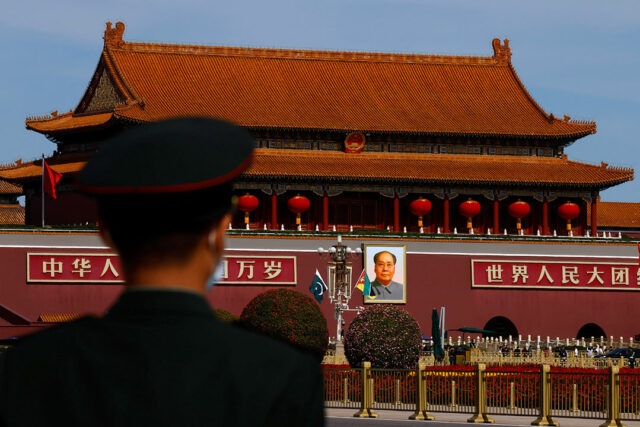
A SOLDIER stands guard at the Great Hall of the People in Beijing, China, Oct. 18, 2023. — REUTERS

HANOI – Dozens of young Vietnamese women lined up for hours last month to catch a glimpse of “cool” troops marching through Hanoi in a huge military parade. But it was not their own soldiers they were looking out for. It was the Chinese contingent.

The scene reflects a shift in attitudes towards China – amid trade tensions with the United States – which has allowed Vietnamese leaders to push forward with sensitive projects, such as high-speed rail links and special economic zones close to China, that may significantly boost bilateral ties.

Only a few years ago, with many Vietnamese wary of a powerful neighbour with which they have fought multiple wars, such projects were seen as too controversial and caused violent protests.

But views are softening, posts on social media, online searches and language learning data show.

Nearly 75% of Vietnamese respondents prefer the United States to China as a partner, but the share favoring China is rising faster than anywhere else in Southeast Asia, bucking the regional trend, according to a poll conducted at the start of the year by the Singapore-based ISEAS-Yusof Ishak Institute.

TIKTOK ROLE

Social media appear to be playing a crucial role in the changing mood in Vietnam – and in particular TikTok, which is popular among the young and last year had 67 million users in Vietnam, the highest number after Facebook META.O, according to the government.

When users of the platform owned by Chinese tech giant ByteDance search for the Vietnamese word for China, they get overwhelmingly positive results, some of them dating back to 2023.

Among popular videos suggested by TikTok are clips of Chinese soldiers performing synchronised dances and video showcasing Chinese cities, with many viewers expressing admiration for China’s rapid development.

TikTok users searching for the Vietnamese name of the South China Sea, a frequent flashpoint between the two Communist countries that have competing claims over the waters, often get clips on tropical storms or tensions between China and the Philippines, which also has claims on parts of the sea, according to tests conducted without user profiles to avoid algorithmic bias.

TikTok’s algorithm is confidential. China has orchestrated online campaigns using fake accounts on platforms including TikTok and Facebook to promote its geopolitical interests in the Philippines.

China’s foreign ministry did not respond to a question about possible online campaigns but said bilateral relations have deepened. Vietnam’s foreign ministry did not reply to a request for comment.

CHINA’S ‘FLAWLESS’ SOLDIERS

In September, crowds gathered in Hanoi to celebrate the 80th anniversary of Vietnam’s declaration of independence from colonial rule.

Tens of thousands lined the streets, many of them to watch Chinese troops march alongside Vietnamese soldiers – an unprecedented sight in the capital of a country that was last invaded by China in the late 1970s and where major streets carry names of anti-Chinese heroes.

“It was worth the wait. So cool. I admire their discipline,” said Le Huyen My, a 22-year-old graduate who travelled from Ho Chi Minh City in the south and camped overnight to secure a spot to watch the Chinese contingent.

One video about the parade reached 3.3 million views on TikTok and drew around 1,400 comments, many praising the Chinese soldiers’ “flawless” marching.

Similar videos on other platforms also drew positive reactions, although Facebook users were more sceptical of both China and the U.S.

“Young Vietnamese online sound less strident about China than before, but that owes more to the state’s increasingly tightening control of nationalism than to fading resentment,” said Nguyen Khac Giang from ISEAS.

Online campaigns against China are still frequent in Vietnam and usually target companies for using Beijing-aligned maps of the South China Sea, but they tend to be short-lived.

That marks a change from 2018 when widespread anti-China protests forced the Vietnamese government to shelve a plan for special economic zones seen as favouring Chinese companies.

Now, Vietnamese state media report frequently on new plans for economic zones at the border with China, stirring no protest.

“Economic interests are prevailing over nationalism,” said Nguyen Hung, a scholar at RMIT University Vietnam, noting the Vietnamese government has promoted a pragmatic approach towards China, especially as trade tensions with Washington escalate.

Chinese companies are now among Vietnam’s top investors, Vietnamese data show, leaders meet frequently and interest in Chinese culture is growing.

China’s President Xi Jinping travelled to Vietnam twice in the past two years and Vietnam’s leader To Lam visited Beijing in his first overseas trip shortly after his appointment as Communist Party chief in 2024.

Online searches in Vietnam for China have surged, focusing on Chinese movies and language, according to Google Trends.

In the first quarter of 2025, Vietnam led global registrations for the HSK Chinese Proficiency Test, China’s official examination for non-native speakers, according to Chinese state media.

But as China has often experienced in centuries of ambivalent relations, Vietnamese pride runs deep.

“The Chinese troops look fascinating, but our soldiers are still the best,” said Nguyen Hue Van, a 21-year-old student who attended the September parade in Hanoi. — Reuters

Boracay, Palawan, Siargao rank among the top islands in Asia

Local and foreign tourists are seen in Puka Beach in Boracay, Aklan, April 6, 2023. — PHILIPPINE STAR/MIGUEL DE GUZMAN

The Department of Tourism (DoT) on Monday said that tourist destinations Boracay, Palawan, and Siargao are part of the top ten islands in Asia in the Condé Nast Traveler’s 2025 Readers’ Choice Awards.

“This recognition by Condé Nast Traveler is a living testament to the beauty, resilience, and stewardship of our island communities,” Tourism Secretary Ma. Esperanza Christina G. Frasco said in a press release.

Ms. Frasco added that the recognition reaffirms the department’s commitment to “preserving natural wonders, advancing sustainable tourism, and ensuring that the prosperity these destinations bring reaches every Filipino.”

The survey by the US-based luxury and lifestyle travel magazine garnered votes from over 700,000 travelers globally.

Boracay ranked fourth in the survey with 90.54 points, followed by Palawan in fifth place with 90.23 points, and Siargao at seventh spot with 85.49 points.

Other world-class destinations included in the list are Phú Quốc in Vietnam, Langkawi in Malaysia, Bali in Indonesia, Andaman Islands in India, and several islands in Thailand, such as Koh Samui, Phuket, and Phi Phi Islands.

In 2024, four islands in the Philippines — Boracay, Palawan, Cebu, and Siargao were recognized by Condé Nast Traveler, making it the only ASEAN country with the most entries.

The DoT noted that the country has also been consistently awarded by the World Travel Awards (WTA) as Asia’s Leading Beach Destination and Asia’s Leading Dive Destination.

“These awards belong to our people, their craft, and the spirit of Love the Philippines that we proudly carry forward,” Ms. Frasco said.

“We invite travelers to help protect these treasures by practicing responsible tourism and supporting local communities. Together, we can ensure that the Philippines’ islands remain vibrant, sustainable, and welcoming for generations to come,” she added.

The Tourism department reported 2,905,363 foreign visitors arrived in the first six months of 2025.

The Bureau of Immigration (BI) also reported that total arrivals in the first half of the year increased by 8%, highlighting 7,840,728 arrivals up from 7,268,465 last year.

The agency added that the US remained the top source of tourists with 753,544 arrivals, followed by South Korea (745,623), Japan (256,776), China (229,915), and Australia (188,082). — Almira Louise S. Martinez

Trump’s tariffs hit home: How US companies and consumers are paying the price

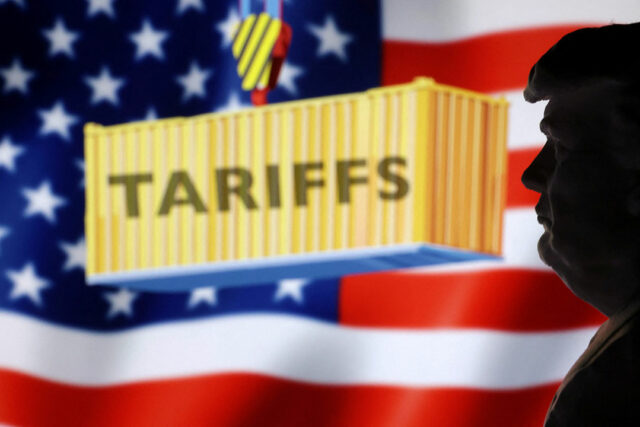
US President Donald J. Trump announced he will impose a 10% baseline tariff on all imports to the United States. — REUTERS

FRANKFURT/WASHINGTON – US companies and consumers are bearing the brunt of the country’s new import tariffs, early indications show, contradicting assertions by President Donald Trump and complicating the Federal Reserve’s fight against inflation.

Trump famously predicted that foreign countries would pay the price of his protectionist policies, wagering that exporters would absorb that cost just to keep a foothold in the world’s largest consumer market.

But academic studies, surveys and comments from businesses show that through the first months of Trump’s new trade regime it is US companies that are footing the bill and passing on some of it to the consumer – with more price hikes likely.

“Most of the cost seems to be borne by US firms,” Harvard University professor Alberto Cavallo said in an interview to discuss his findings. “We have seen a gradual pass-through to consumer prices and there’s a clear upward pressure.”

A White House spokesperson said “Americans may face a transition period from tariffs” but the cost would “ultimately be borne by foreign exporters.” Companies were diversifying supply chains and bringing production to the United States, the spokesperson added.

WHO IS EATING THE TARIFFS?

Cavallo and researchers Paola Llamas and Franco Vazquez have been tracking the price of 359,148 goods, from carpets to coffee, at major online and brick-and-mortar retailers in the United States.

They found that imported goods have become 4% more expensive since Trump started imposing tariffs in early March, while the price of domestic products rose by 2%.

The biggest increases for imports were seen in goods that the United States cannot produce domestically, such as coffee, or that come from highly penalized countries, like Turkey.

These price hikes, while material, have been generally far smaller than the tariff rate on the products in question – implying that sellers were absorbing some of the cost as well.

Yet US import prices, which don’t include tariffs, showed foreign exporters have been raising their prices in dollars and passing on to their US buyers part of the greenback’s depreciation against their currencies.

“This suggests foreign producers are not absorbing much if any of the US tariffs, consistent with prior economic research,” researchers at Yale University’s Budget Lab think-tank said in a blog post.

National indices of export prices paint the same picture. The cost of goods exported by China, Germany, Mexico, Turkey and India have all risen, with Japan the only exception.

FULL IMPACT OF TARIFFS YET TO BE FELT

Adapting to Trump’s tariffs – a still-incomplete set of levies that pushed import taxes from an average of around 2% to an estimated 17% – is still underway. It is seen taking months longer as exporters, importers and consumers jostle over who pays duties worth round $30 billion per month.

“We shouldn’t expect this to be a one-time jump but rather firms are trying to find ways to soften the blow,” and stretch price increases out over time, Cavallo added.

European carmakers have looked – so far – to absorb more of the price impact, but consumer firms including Tide detergent-maker Procter & Gamble, Ray Ban-maker EssilorLuxottica and Swiss watchmaker Swatch have hiked prices.

Around 72% of companies in Europe, the Middle East and Africa tracked by Reuters flagged price hikes since Trump’s trade salvoes started, a Reuters tracker shows. Only 18 companies have warned on profit margins.

Separate Reuters analyses of e-commerce websites Shein and Amazon were already showing robust price increases for Chinese products sold in the United States, ranging from clothing to electronics.

China’s so-called “anti-involution” policy, under which producers are encouraged to scale back competition and even cut capacity in key sectors, could add fuel to the fire by curbing the supply of goods such as solar-power equipment.

That has all set the scene for higher inflation in the United States. The Fed cut its benchmark rate last month on concerns the job market was weakening but policymakers are split over whether or not tariff-driven inflation will likely fade.

The Fed’s newest governor, Stephen Miran, on leave from the Trump administration, argues the tariffs are not inflationary and has brushed off concerns about what he called “relatively small changes in some goods prices.”

A Boston Fed “back of the envelope” calculation projected tariffs would push up core inflation by 75 basis points.

Fed Chair Jerome Powell said tariffs accounted for perhaps 30-40 basis points of the latest core inflation reading of 2.9% but the effect should be “relatively short-lived.”

The Peterson Institute for International Economics estimated that inflation over the next year would be 1 percentage point higher than if tariffs hadn’t been raised but would then fall back.

GLOBAL TRADE SEEN SUFFERING AS TARIFFS BITE

The rest of the world, however, has no reason to celebrate.

As US consumers struggle to keep up with rising prices, demand for exports is likely to slow. An S&P Global survey of purchasing managers at companies all over the world showed new export orders contracting at an increasing pace since June.

European Union exports to the United States fell by 4.4% from the prior year in July, the latest month for which data was available, and in the bloc’s former powerhouse Germany they were down 20.1% in August.

The World Trade Organization, too, slashed its forecast for global merchandise trade volume growth next year to just 0.5%, citing a delayed impact from US tariffs. US shipment data tracked by German think tank the Kiel Institute also showed a clear downtrend.

While that all may partly reflect strong front-loading of orders earlier in the year in anticipation of tariffs, it is also prompting caution about the trade outlook.

Dutch bank ING expected a 17% reduction in EU goods exports to the US over the next two years, costing the bloc 30 basis points of GDP growth.

“The expected impact of US tariffs hasn’t materialized yet,” Ruben Dewitte, an economist at ING, said. “We anticipate these effects will become more visible in the coming months.” — Reuters

World falling far behind deforestation goals with farms and fires driving loss, report says

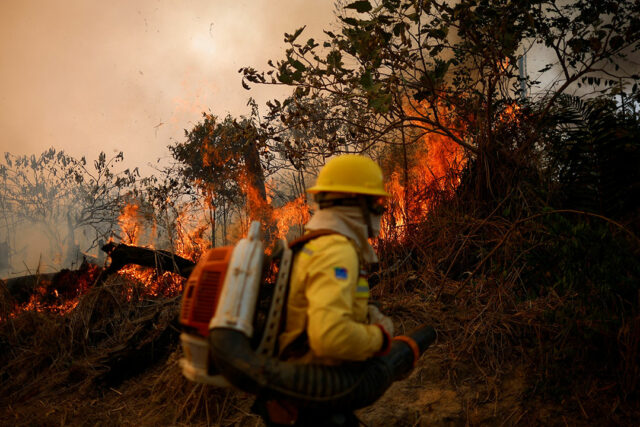
A MEMBER of Brazilian Institute of Environment and Renewable Natural Resources (IBAMA) fire brigade works to extinguish a fire rising in Amazon rainforest in Apui, Amazonas state, Brazil, Aug. 8, 2024. — REUTERS

SANTIAGO – The world is falling far behind a global goal to reverse deforestation by 2030, with losses being largely driven by agricultural expansion and forest fires, according to the 2025 Forest Declaration Assessment.

The report said the world permanently lost 8.1 million hectares (20 million acres) of forest, an area about the size of England, in 2024 alone, putting the planet 63% behind the goal set by over 140 countries in the 2021 Glasgow Leaders’ Declaration on Forests and Land Use.

The Forest Declaration Assessment brings together research organizations, think tanks, non-governmental organizations and advocacy groups, and the report was coordinated by advisory company Climate Focus.

Fires were the leading cause of forest loss, accounting for 6.73 million of those hectares around the world, with the Amazon rainforest hit particularly hard, releasing nearly 800 million metric tons of CO2 from fires in 2024.

“Major fire years used to be outliers, but now they’re the norm. And these fires are largely human-made,” said Erin Matson, lead author of the Forest Declaration Assessment. “They’re linked to land clearing, to climate change-induced drought, and to limited law enforcement.”

Earlier reports also found Amazon fires led to unprecedented forest loss, with Brazil leading tropical forest loss and Bolivia’s forest loss surging by 200% in 2024.

This year’s global forest assessment also found that on average, 86% of annual global deforestation over the last decade was caused by permanent agriculture. It also listed gold and coal mining as growing sources of deforestation.

“Demand for commodities like soy, beef, timber, coal, and metals keeps rising, but the tragedy is we don’t actually need to destroy forests to meet that demand,” Matson said, adding over $400 billion in agricultural subsidies are helping drive deforestation.

“The incentives are completely backwards,” she said, noting international public finance for forest protection and restoration averaged just $5.9 billion a year. The report estimates that $117 billion to $299 billion in financing is needed to reach the 2030 goals.

With the COP30, the United Nations climate change conference, set to start in Brazil in November, Matson points to the country’s proposed Tropical Forest Forever Facility, which aims to raise $125 billion in funding for long-term forest finance as a way to help stem forest loss.

The fund, which would be financed by governments and private investors, could disperse $3.4 billion a year with 20% going to indigenous and local communities.

“Looking toward COP30 in Belem, a successful launch of the Tropical Forest Forever Facility, TFFF, could start to channel long-term reliable finance to keeping forests standing,” Matson said. “So looking at the global picture of deforestation, it is dark, but we may be in the darkness before the dawn.” — Reuters

Trump declares end of Gaza war

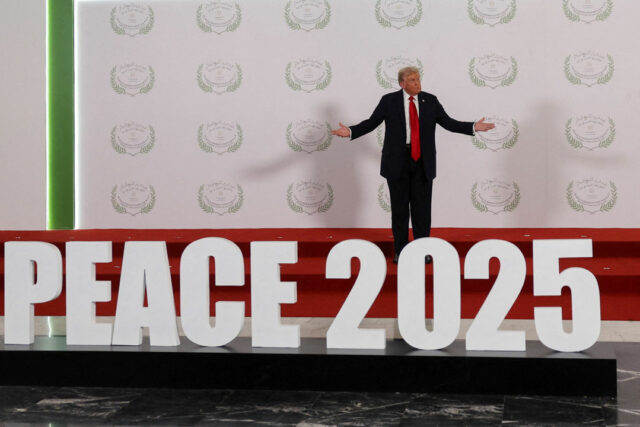
US President Donald Trump gestures as he poses next to a sign before a family photo at a world leaders' summit on ending the Gaza war, amid a US-brokered prisoner-hostage swap and ceasefire deal between Israel and Hamas, in Sharm el-Sheikh, Egypt, Oct. 13, 2025. --REUTERS/Suzanne Plunkett/Pool

CAIRO/JERUSALEM – Hamas freed the last living Israeli hostages from Gaza on Monday under a ceasefire deal and Israel sent home busloads of Palestinian detainees, as US President Donald Trump declared the end of the two-year long war that has upended the broader Middle East.

Hours later, Trump convened Muslim and European leaders in Egypt to discuss the future of the Gaza Strip and the possibility of a wider regional peace, even as Hamas and Israel, both absent from the gathering, are yet to agree on the next steps.

The Israeli military said it had received all 20 hostages confirmed to be alive, after their transfer from Gaza by the Red Cross. The announcement prompted cheering, hugging and weeping among thousands waiting at “Hostage Square” in Tel Aviv.

In Gaza, thousands of relatives, many weeping with joy, gathered at a hospital where buses brought home some of the nearly 2,000 Palestinian prisoners and detainees to be freed by Israel as part of the accord.

“The skies are calm, the guns are silent, the sirens are still and the sun rises on a Holy Land that is finally at peace,” Trump told the Knesset, Israel’s parliament, saying a “long nightmare” for both Israelis and Palestinians was over.

The US, along with Egypt, Qatar and Turkey, mediated what has been described as a first phase agreement between Israel and Hamas for a ceasefire and the release of hostages by Hamas and prisoners and detainees by Israel.

At the Egyptian beach resort of Sharm el-Sheikh later on Monday, Trump and President Abdel Fattah al-Sisi hosted more than 20 world leaders for a summit intended to cement the truce.

At the opening of the summit, Trump signed a document with Egypt, Qatar and Turkey’s leaders welcoming the agreements on Gaza and pledging to “work collectively to implement and sustain this legacy.”

Egypt’s presidency said that discussions included the governance, security and reconstruction of Gaza.

“Now the rebuilding begins,” Trump said at the summit, delivering an expansive speech where he described in grand terms the Gaza agreement he helped broker, saying it could be “the greatest deal of them all.”

Israel and Hamas were not represented at the summit, while the leaders of Saudi Arabia and the United Arab Emirates did not attend.

Trump at one point greeted Palestinian Authority President Mahmoud Abbas, who spoke to the US leader at length. The Palestinian Authority wants to play a significant role in the future administration of Gaza, despite objections from Israel.

FORMIDABLE OBSTACLES REMAIN

The Israeli hostages freed on Monday were the last still alive in captivity from 251 seized in the Hamas-led attacks of October 7, 2023 that killed 1,200 people and triggered the war.

The ceasefire and partial Israeli withdrawal agreed last week halted one of Israel’s biggest offensives of the war, an all-out assault on Gaza City that was killing scores of people per day.

Since then, huge numbers of Palestinians have been able to return to the ruins of homes in the Gaza Strip, swathes of which were reduced to a wasteland by Israeli bombardment that killed 68,000 people, according to Gaza health authorities.

Formidable obstacles remain, even to securing an enduring ceasefire, much less to bringing a wider, more durable peace. Among the immediate issues still to be resolved: recovering the remains of another 26 Israeli hostages believed to have died and two whose fates are unknown.

Hamas says recovering the bodies could take time as not all burial sites are known. Israel’s military said it had escorted four coffins containing the remains of deceased hostages to Israel and that those remains were being identified.

Aid supplies must be rushed into the enclave, where hundreds of thousands of people face famine. U.N. aid chief Tom Fletcher underlined the need to “get shelter and fuel to people who desperately need it and to massively scale up the food and medicine and other supplies going in”.

Beyond that, crucial issues have yet to be resolved, including how to govern and police Gaza, and the ultimate future of Hamas, which still rejects Israel’s demands to disarm.

Hamas gunmen, seeking to assert their presence, launched a security crackdown in Gaza City after Israel’s pullback, killing 32 members of a rival group, a Palestinian security source said.

Tensions have also been rising in the Israeli-occupied West Bank, where Jewish settlements have expanded in land Palestinians envision as part of a future state.

Trump, speaking on his flight to the region, said Hamas had been given a temporary green light for fighters to keep order: “They do want to stop the problems, and they’ve been open about it, and we gave them approval for a period of time.”

The Gaza War has also reshaped the Middle East through spillover conflicts, with Israel imposing punishing damage in a 12-day war against Iran and campaigns against Tehran’s regional allies, including Lebanon’s Hezbollah and Yemen’s Houthis.

Trump, who has presented his plan to end the war in Gaza as the catalyst for a wide regional peace settlement, said more countries would join the Abraham Accords initiative and even floated the idea of a peace deal between arch Middle East enemies Iran and Israel, telling the Knesset he thought Iran wanted one: “Wouldn’t it be nice?”

JOY, RELIEF ON BOTH SIDES

Beaming with relief and joy, two released hostages waved to cheering crowds from vans on the way to an Israeli hospital, one hoisting a large Israeli flag then forming a heart with his hands.

Video footage captured emotional scenes of families receiving phone messages from their loved ones as they were being released, their faces lighting up with disbelief and hope after months of anguish.

“I am so excited. I am full of happiness. It’s hard to imagine how I feel this moment. I didn’t sleep all night,” said Viki Cohen, mother of hostage Nimrod Cohen, as she travelled to Reim, an Israeli military camp where hostages were being transferred.

Palestinians meanwhile rushed to embrace prisoners freed by Israel. Several thousand gathered inside and around Nasser Hospital in Khan Younis in southern Gaza, some waving Palestinian flags, others holding photos of their relatives.

“I am happy for our sons who are being freed, but we are still in pain for all those who have been killed by the occupation, and all the destruction that happened to our Gaza,” a Gaza woman, Um Ahmed, told Reuters in a tearful voice message.

Freed prisoners arrived in buses, some of them posing from the windows, flashing V-for-Victory signs. The appearance of armed and masked Hamas fighters at the scene underscored the difficulty of resolving Israel’s demand that they disarm.

Israel was due to release 1,700 detainees it captured in Gaza, as well as 250 prisoners from its jails convicted or suspected of security offenses, including attacks on Israelis. — Reuters


US backs Philippine ally after China warns over vessel clash

FACEBOOK.COM/USEMBASSYPH/

WASHINGTON/BEIJING – The United States said on Monday it stood by its Philippine ally and emphasized their mutual defense treaty after vessels from China and the Philippines clashed amid heightened tensions in the disputed South China Sea.

Earlier, China’s Foreign Ministry urged Manila not to challenge Beijing’s efforts to “safeguard its territorial sovereignty and maritime rights and interests” after Sunday’s incident in the Spratly Islands, in which the Philippines said China deployed water cannon and rammed a Filipino vessel.

US State Department spokesperson Tommy Pigott condemned China’s “ramming and water cannoning” of a Philippines vessel and said Washington stood with its ally “as they confront China’s dangerous actions which undermine regional stability.”

In a statement, Pigott reaffirmed that Article IV of the 1951 US Philippines Mutual Defense Treaty “extends to armed attacks on Philippine armed forces, public vessels, or aircraft – including those of its Coast Guard – anywhere in the South China Sea.”

China and the Philippines have traded accusations over the confrontation near Sandy Cay, a coral reef within the Spratly Islands.

The two nations have confronted each other repeatedly in recent years in the South China Sea, a strategic trade route that facilitates more than $3 trillion in annual ship-borne commerce, and which China claims most of.

Tensions have heightened recently and Lin Jian, a spokesperson for China’s foreign ministry, told a regular press briefing the Philippines should immediately stop “violations and provocations.”

The State Department said: “China’s sweeping territorial and maritime claims in the South China Sea and its increasingly coercive actions to advance them at the expense of its neighbors continue to undermine regional stability and fly in the face of its prior commitments to resolve disputes peacefully.”

Last year, during the former Biden administration, two senior Republican US senators called for a list of options developed by the Pentagon and State Department to support the Philippines against Beijing in the South China Sea, saying that limiting responses to verbal assurances of the applicability of Article IV undermines the credibility and value of these commitments. — Reuters

House approves P6.793-trillion budget bill on final reading

BW FILE PHOTO

By Kenneth Christiane L. Basilio, Reporter

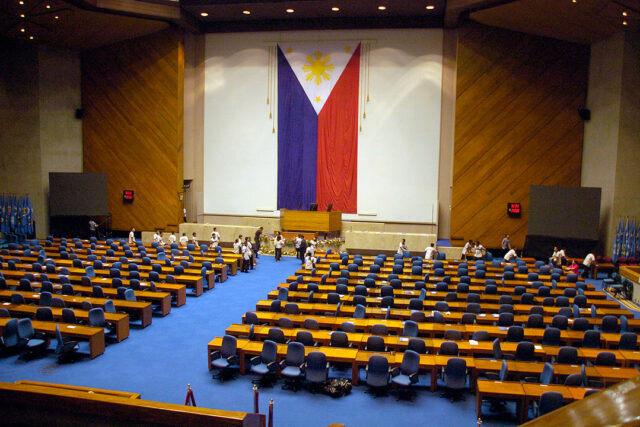
THE HOUSE of Representatives on Monday passed on final reading the proposed P6.793-trillion national budget for 2026, concluding 62 days of deliberations marked by heightened scrutiny over a widening corruption scandal involving flood control projects.

Majority or 287 congressmen approved the revised budget bill that rechanneled the bulk of funding from numerous flood control projects under the Public Works department to priority sectors such as education, in a move aimed at strengthening human capital development.

Twelve congressmen voted against the measure, while two opted to abstain from voting.

“This budget cycle is unprecedented,” Nueva Ecija Rep. Mikaela Angela B. Suansing, who heads the House Appropriations Committee, told the floor. “We needed to navigate through complexities while implementing sweeping reforms in long-standing budget processes and traditions.”

Lawmakers deliberated on House Bill No. 4058 or the 2026 General Appropriations Act against the backdrop of the multibillion-peso flood control controversy, drawing in closer-than-normal scrutiny amid calls to make the budget process more transparent.

The 2026 spending plan, which was 7.4% higher than this year’s national budget, saw a select committee of lawmakers redirecting P201.1 billion or 78.86% of the P255 billion worth of funding originally intended for flood control infrastructure primarily towards education, food and healthcare sectors.

The House sub-committee on Budget Amendments Review last week finalized a P56.6-billion increase in education sector funding under the proposed budget, bringing total allocations to a record P1.28 trillion, Ms. Suansing said.

This includes a hike in allocation for the Education department’s new classroom funding by P35.09 billion. “[This] will translate to around 25,200 new and rehabilitated classrooms,” said Ms. Suansing.

The sub-panel rechanneled about P90.7 billion to the health sector, with the bulk of the funding going to the Philippine Health Insurance Corp. (PhilHealth) subsidy at P60 billion, following last year’s controversy over the government’s pullout of funds from the state health insurer.

It also raised total health allocations by 28.3% to P411.2 billion from the P320.5 billion initially proposed by the Budget department. This includes a P26.73-billion increase for medical assistance to indigent Filipinos.

Lawmakers increased agriculture sector funding by 22.46% to P292.94 billion next year, as they sought to boost food security and improve programs aimed at helping local producers.

Changes include increased funding for the Agriculture department’s farm-to-market road projects by P16.78 billion under the spending plan. Congressmen also raised allocations for financial aid to farmers to P10 billion from the initial P7 billion, which will benefit 1.43 million farmers, Ms. Suansing said.

Lawmakers also included a P10-billion hike for the Labor department’s displaced-worker program, increasing it by 88.2% to P22.14 billion next year.

UNPROGRAMMED FUNDS
At the same time, the lower chamber scrapped P35 billion in unprogrammed appropriations intended for infrastructure programs, leaving only P45 billion out of the P80 billion originally allocated under the budget bill. This is under the bill’s Strengthening Assistance for Government Infrastructure and Social Programs.

“Congress has removed infrastructure from the list of allowable uses for unprogrammed appropriations… a move aimed at preventing potential misuse of these funds,” said Ms. Suansing.

She said foreign-funded infrastructure projects would only be eligible for standby funding, since the government must provide counterpart funding to support them.

“We cannot remove unprogrammed funding under foreign assisted projects because we cannot turn on our agreements at the international level,” she added.

Congressmen also adopted a proposal last week by Deputy Minority Leader and Mamamayang Liberal Rep. Leila M. de Lima to reduce Vice-President Sara Duterte-Carpio’s budget to P733.2 million from the initial P902 million, mirroring a cut made during last year’s deliberations.

“It seems that the rechanneling of the P255 billion only reinforced ‘pork barrel’ politics,” AJ A. Montesa, an advisor at budget watchdog People’s Budget Coalition, said in a Viber message before the spending plan’s approval.

Mr. Montesa said the prioritization of funding for the government’s assistance programs for indigent Filipinos indicates that lawmakers are still intent on perpetuating patronage politics.

“While these programs are branded as ‘assistance’ for people in need, we must also confront the fact that they are largely driven by patronage and clientelism,” Mr. Montesa said.

“Congress should prioritize programs which are rules-based and rights-based, not those which are subject to the discretion of lawmakers and local politicians… these only serve to further entrench poverty and inequality,” he added.

While the reallocations signal a shift towards human capital development and are “commendable in principle,” much depends on whether the funds are spent efficiently and free from corruption, John Paolo R. Rivera, a senior research fellow at the Philippine Institute for Development Studies, said in a Viber message.

IBON Foundation Executive Director Jose Enrique “Sonny” A. Africa said the spending plan fails to provide sufficient funding for critical sectors, warning that it falls short of addressing economic challenges amid slowing growth.

“The budgets for education, health, housing and social protection are hyped as big, but are still very far below what the poor and middle-class need,” Mr. Africa said in a Viber message before the budget bill’s approval. “Agriculture, and especially small Filipino firms, are also left far behind.”

The government is targeting economic growth of 5.5-6.5% this year and 6-7% in 2026.

President Ferdinand R. Marcos, Jr.’s allies in the lower chamber likely moved to boost funding in education, health and agriculture as the government sought to ease discontent over the scandal involving infrastructure spending, said Arjan P. Aguirre, who teaches political science at the Ateneo de Manila University.

“These moves are just meant to ease the tension, meant to please the already disgruntled people,” he said in a Facebook messenger chat.

The budget bill still needs the Senate’s approval before heading to the bicameral conference committee, where conflicting provisions of both House and Senate versions will be reconciled. Once the final budget bill is ratified by Congress, it will be transmitted to Malacañang for signing by the President.

Majority Leader and Ilocos Norte Rep. Ferdinand Alexander “Sandro” A. Marcos III said the lower chamber will act on a proposal seeking to open the bicameral conference committee talks on the proposed budget to the public “as soon as possible.”

“Given the fact that the House has been prioritizing… the passage of the budget, we will make sure that once the… House has more time, we will be able to address the said resolution,” he told the House floor.

Budget watchdogs have urged lawmakers to open the joint congressional committee to public scrutiny, as the traditionally closed-door process has kept people in the dark about last-minute changes to the national budget.

BSP seen to cut policy rate to 4% by 2026

PHILIPPINE STAR/NOEL B. PABALATE

THE Bangko Sentral ng Pilipinas (BSP) will likely deliver three more rate cuts until 2026 to support the economy amid an anticipated slowdown, Fitch Solutions’ unit BMI said.

“(T)he BSP is poised to frontload easing to support the economy,” BMI said in an Oct. 10 note. “As such, we now expect BSP to cut by 25 basis points (bps) at its final meeting in 2025 in December to 4.5% and by another 50 bps in 2026.”

The Monetary Board on Thursday delivered a surprise 25-bp cut, bringing the target reserve repurchase rate to 4.75%, the lowest in over three years.

BSP Governor Eli M. Remolona, Jr. had said weakening business sentiment and investor confidence amid the ongoing flood control corruption scandal led to the Monetary Board’s decision.

BMI said it expects the Philippine economy to grow by 5.4% this year, before slowing to 5.2% in 2026, citing weak business sentiment due to the corruption mess and trade uncertainty.

This is below the government’s 5.5-6.5% gross domestic product (GDP) growth target for this year and the 6-7% goal for 2026.

“Our 5.2% growth forecast for 2026 is well below the government’s target of 6-7%. For one, the US-Philippines trade deal, which leaves 19% tariffs on Philippine goods in exchange for none on American ones, will weigh on the trade balance in 2026,” BMI said.

“For another, business confidence is likely to remain weak amid graft concerns and unpredictable US trade policy.”

BMI said its projection of 50-bp rate cuts in 2026 “may seem a meek response to what will be two consecutive years of growth underperforming the pre-pandemic trend.” This would bring the policy rate to 4% in 2026.

“However, we note that the BSP has already cut interest rates by a total of 175 bps since the current easing cycle began in (August) 2024,” it said. “We therefore expect the BSP to ease at a more measured pace while allowing more time for the easing thus far to feed through.”

Mr. Remolona had also given clear signals that the BSP’s policy easing could continue in December and until next year. 

“Risks to our forecast are skewed towards further rate cuts in 2026. Further unravelling of the corruption scandal across other infrastructure projects beyond flood control projects could dampen business sentiment and widen the output gap,” BMI said.

“With inflation expectations remaining well-anchored, the BSP could prioritize the economy and implement more policy rate cuts in 2026.”

BMI expects inflation to end at 1.6% this year, slightly below the central bank’s 1.7% forecast.

For 2026, BMI sees inflation picking up to 3.5%, faster than the 3.1% projected by the BSP.

Meanwhile, BMI said the central bank has ample reserves to defend the peso, which saw a weak performance after the surprise cut on Thursday.

“The BSP has sufficient reserves to defend the currency,” BMI said.

Gross international reserves jumped to an 11-month high of $108.805 billion at end-September, from $107.1 billion in August. It is also equivalent to 7.3 months’ worth of imports of goods and payments of services and primary income, well above the three-month standard.

“Besides, there probably will not be more selling pressure on the peso due to a 25-bp cut in December,” it added, referring to the Monetary Board’s Dec. 11 meeting.

Last week, Mr. Remolona said they will only defend the local currency if its depreciation becomes inflationary.

The Philippine peso on Monday closed at P58.245 versus the US dollar, slipping by half a centavo from its P58.24 finish on Friday, Bankers Association of the Philippines data showed. — K.K.Chan

Demonetizing large peso notes may harm economy, says BSP

BW FILE PHOTO

DEMONETIZING P1,000 and P500 bills as an anti-money laundering measure may bring more harm than good to the economy, a top Bangko Sentral ng Pilipinas (BSP) official said.

“It’s a tantalizing proposal, but it’s not so simple,” BSP Governor Eli M. Remolona, Jr. told reporters on Monday. “To me, it’s like, you know the saying, you cut off your nose just to spite your face. You’re doing more damage than benefits.”

Mr. Remolona made the statement in response to former Finance Secretary Cesar V. Purisima’s suggestion to demonetize P1,000 and P500 bills to curb corruption, as it would make it more difficult to transport large sums of cash.

Some lawmakers, Public Works officials and private contractors have been embroiled in alleged corruption scandal involving flood control projects. In a Senate hearing last month, two former Public Works district engineers claimed that around P1 billion in cash was packed in suitcases and delivered to a lawmaker.

Parang nabigla lang dun sa sight ng suitcases (I think they were just shocked at the sight of the suitcases). But if you think about it, it’s not going to stop these guys,” Mr. Remolona said.

The BSP chief also said the measure could only cause a small inconvenience for “corrupt contractors” but would burden many people, considering how widely used the large bills are.

“The P1,000 is used a lot. For a small inconvenience for corrupt contractors, you’re going to make life hard for many people,” he said.

Mr. Remolona said the BSP is still reviewing the suggestion and has yet to decide on it.

BSP Assistant Governor Maria Margarita Debuque-Gonzales also said the central bank is working on a paper that would detail the implications of demonetizing high-value peso bills.

Meanwhile, Mr. Remolona said the central bank’s daily cash withdrawal limit has been effective in deterring potential money laundering amid the ongoing corruption issue.

“I think it’s very effective so far. It’s the best we can tell. It’s a very effective measure,” he said. “There are complaints. And we’re listening to those complaints. But for now, I think it’s a good measure.”

Last month, the central bank issued a circular where only a maximum of P500,000 or its equivalent in foreign currency may be withdrawn at once or via multiple transactions within one banking day. It took effect on Oct. 7.

The BSP governor noted that banks welcomed the regulation, as several banks even began implementing it as early as Oct. 4.

“They love it,” he said. “They’ve always been suspicious of some transactions. But they couldn’t refuse… but now they can say, BSP yan eh (That’s BSP’s policy). It makes their life easier.”

Mr. Remolona, who also chairs the Anti-Money Laundering Council (AMLC), also said they plan to tap artificial intelligence (AI) and data scientists to help them sift through the “overwhelming” amount of suspicious transaction reports (STRs) amid the widening graft scandal.

“We are looking for the right AI and the right analysts, data scientists to improve (and) make full use of the STRs. I think we can do more. But we need help from AI,” he said in Filipino.

These STRs, regardless of amount, are filed by covered persons and are used by the AMLC to probe possible illegal financial activities such as money laundering and terrorism financing. — Katherine K. Chan