Home Blog Page 4174

Peso climbs further vs dollar on strong China GDP growth

BW FILE PHOTO

THE PESO appreciated further against the dollar due to easing concerns over a global economic slowdown after a stronger-than-expected Chinese gross domestic product (GDP) report.

The local currency closed at P56.70 versus the dollar on Wednesday, strengthening by 4.6 centavos from Tuesday’s P56.746 finish, data from the Bankers Association of the Philippines’ website showed.

The local unit opened Wednesday’s session at P56.72 per dollar. Its intraday best was at P56.68, while its weakest showing was at P56.775 against the greenback.

Dollars traded went down to $877.55 million on Wednesday from the $1.109 billion on Tuesday.

“The peso appreciated as the stronger-than-expected Chinese economic growth report eased concerns of a near-term global slowdown,” a trader said in an e-mail.

Market sentiment was boosted by stronger-than-expected Chinese economic data on GDP, retail sales, and industrial production, Rizal Commercial Banking Corp. Chief Economist Michael L. Ricafort likewise said in a Viber message.

China’s GDP grew 4.9% year on year in the third quarter, data released by the National Bureau of Statistics showed.

For Thursday, the trader and Mr. Ricafort see the peso moving between P56.60 and P56.80 per dollar. — AMCS

India eases ban on white rice exports, gives PHL top quota

REUTERS

THE INDIAN government said on Wednesday that it eased its ban on exporting non-basmati white rice, and gave the Philippines a quota of 295,000 metric tons (MT), the largest share among selected destination countries.

India also cleared exports of the commodity to Nepal, Cameroon, Cote d’ Ivoire, Guinea, Malaysia, and the Seychelles, India’s director of Foreign Trade said in a statement.

India, the world’s largest exporter of white rice, had suspended exports of non-basmati white rice earlier this year amid concerns over domestic supply, putting upward pressure on international prices. White rice is the variety most commonly traded internationally, while basmati is the preferred domestic Indian variety.

The Philippines typically imports rice from Southeast Asia because regional trade agreements grant ASEAN grain a tariff advantage. The food inflation crisis of early 2023 forced the Philippines to admit non-ASEAN rice on more favorable terms.

Raul Q. Montemayor, national manager of the Federation of Free Farmers, said that the Indian concession does not a guarantee access to Indian rice.

“(Import decisions) depend on the price (and) quality,” Mr. Montemayor said in a Viber message.

“In the past, our importers had not purchased rice from India despite significantly lower prices, most probably due to concerns about quality and reliability of supply,” he added.

Agriculture Senior Undersecretary Domingo F. Panganiban said in a statement in August that the Philippines had appealed to the Indian government to continue allowing rice shipments to the Philippines on humanitarian grounds.

Agriculture Undersecretary Leocadio S. Sebastian told reporters on Monday that Philippine rice imports could drop to 3.1 million MT amid higher global rice prices.

The US Department of Agriculture expects the Philippines to be the world’s top rice importer this year, with shipments of about 3.8 million MT.

Mr. Montemayor said Philippine demand for imported rice is between 2.5 million and 3 million MT, describing any volumes from India as “not that significant, even assuming we import (the entire quota),” he added. — Adrian H. Halili

DTI counting on Gulf investment in Islamic banking, halal industries

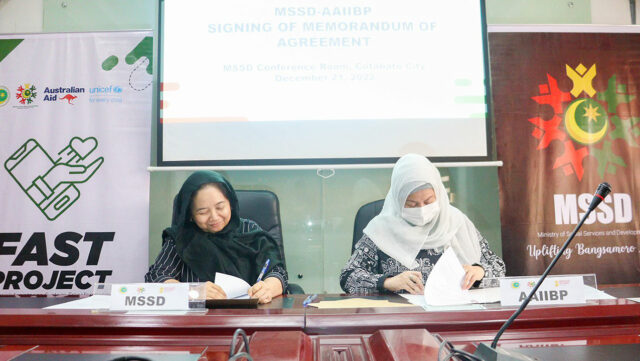
BANGSAMORO Social Services Minister Raissa H. Jajurie and AAIIBP Chief Operating Officer Imelda Tarhata Macarambon sign an agreement on Dec. 21 for the distribution of emergency shelter assistance to typhoon Paeng victims. — MSSD-BARMM

THE GOVERNMENT delegation to the summit with Gulf leaders will pursue investment in the Philippine halal and Islamic banking industries, Department of Trade and Industry (DTI) Secretary Alfredo A. Pascual said.

President Ferdinand R. Marcos, Jr. is visiting Riyadh this week to participate in the summit between Southeast Asian and Gulf leaders.

The Philippine delegation is also sounding out possible Gulf investment in medical tourism, energy, and petrochemicals, Mr. Pascual said in a phone interview, adding that invitations to invest will be extended in roundtable meetings. 

Mr. Marcos flies to Saudi Arabia today (Oct. 19) for the first-ever summit between the Association of Southeast Asian Nations (ASEAN) and the Gulf Cooperation Council (GCC) on Oct. 20, over a decade after the first ministerial meetings between the two organizations in Bahrain in 2009.

Mr. Marcos is expected to hold a bilateral meeting with the Saudi government and businesses, Foreign Affairs Assistant Secretary Daniel R. Espiritu has said.

He noted the Saudi government’s “assistance” in developing the Bangsamoro region in the southern Philippines.

Mr. Marcos’ visit to Saudi Arabia will be his ninth foreign trip this year, and the 15th since he assumed office in June 2022.

He is set to fly to the US in November for the Asia-Pacific Economic Cooperation Economic Leaders’ Meeting, and to the United Arab Emirates in December for the United Nations Climate Change Conference. — Kyle Aristophere T. Atienza

EV industry anticipating upside surprise in vehicle penetration over next 5-10 years

REUTERS

THE electric vehicle (EV) industry is likely to exceed projections in terms of vehicle adoption in the next five to 10 years, the Electric Vehicle Association of the Philippines (EVAP) said.

In an appearance on ANC’s Market Edge program, EVAP President Edmund A. Araga said new EV companies entering the market as well as expansion by current entrants will drive the expansion.

“My projection is that, in five to 10 years, the proliferation in the number of EVs on the road would be (larger) than expected,” Mr. Araga said.

“He expects the EV industry to be at par with those of neighboring countries,” he added.

In the first quarter, Mr. Araga said that the EV industry booked a 15% year-on-year increase in sales to 2,536 units.

Citing a report from the Land Transportation Office Operations Division, he said that the number of EVs registered last year was 15,300.

However, Mr. Araga said adoption remains hindered by mistrust of new technology and the difficulty of shipping units in.

He said the mistrust was reflected in the popularity of hybrid vehicles, which combine battery power with internal combustion engines.

He said motorists consider hybrids an entry point into the market, “to better understand the benefits of using EVs,” he said.

He added that it remains difficult to ship EVs into the country.

“There are a lot of lined up orders… that (dealers) have to address,” he said.

He said that EVAP has asked the Bureau of Customs to streamline the EV shipment process, saying EVs need to enter the country with the same ease as internal combustion engine vehicles. — Justine Irish D. Tabile

Meat imports decline over 9% in nine months to Sept.

REUTERS

MEAT IMPORTS fell 9.37% year on year in the nine months to September, with shipments of beef, pork, buffalo, and turkey all declining, the Bureau of Animal Industry (BAI) reported.

The BAI said imports amounted to 923.16 million kilograms (kg) during the period. In September the total was 105.81 million kg, down from 115.11 million in August and 166.69 million a year earlier.

Imports of beef fell 21.1% to 106.68 million kg for the period. This accounted for 11.56% of meat shipments.

The top beef supplier to the Philippines was Brazil with 40.64 million kg, followed by Australia with 30.88 million and Ireland 11.51 million.

Pork shipments dropped 12.68% from a year earlier to 458.7 million kg.

The top supplier of pork for the period was Spain, with 112.35 million kg, followed by Canada with 85.93 million and Brazil 78.24 million.

The Philippines also imported about 101,759 thousand kg of turkey meat and 2.35 million kg of buffalo meat; shipments decreased by 44.57% and 6.29%, respectively.

Chicken imports rose 18.27% to 324.98 million kg for the nine months. This accounted for 35.21% of meat shipments during the period.

Brazil supplied about 186.13 million kg, followed by the US with 116.98 million and Canada 10.91 million. — Adrian H. Halili

Firms from China’s Jiangsu province see opportunity in Philippine RE, battery industries

REUTERS

THE Department of Trade and Industry (DTI) said companies from eastern China’s Jiangsu province have expressed interest in exploring Philippine investments in renewable energy (RE) and battery technology.

In a statement, the DTI said a business delegation from Jiangsu agreed with prospective local partners to expand bilateral trade, with an eye towards “existing and projected demand and supply capacities.”

Officials from the DTI and Board of Investments (BoI) said other prospective industries that could take in Chinese investment include the automotive, green metals, and electronics segments.

The provincial delegation was headed by officials from Jiangsu’s Trade and Investment Promotion Department, Chamber of Commerce, and Liu Ping, the general manager of Nanjing Donglei Automobile Meter Co., Ltd.

Last month, the BoI secured a commitment from electronics company Shenzhen Grandsun to open two more plants in the Philippines.

This year, the company is expected to complete four audio device production facilities in the Philippines, bringing its total investments in the country to P3 billion.

By the end of this year, Grandsun is expected to employ 1,000 in the Philippines, with a target of 8,000 jobs by 2028.

On the sidelines of the China-ASEAN Expo, the BoI also received a commitment from a state-owned company which has allocated $15 billion in funding for Southeast Asian projects.

The state-owned company claims to be China’s biggest renewable energy operation with a presence in solar, wind, and hydropower energy.

The DTI’s Bureau of Trade and Industrial Policy Research estimates bilateral merchandise trade with China at $39.17 billion in 2022. China was the Philippines’ top trading partner and source of imports.

Meanwhile, approved investments from China hit $26.18 million (P1.43 billion) last year. — Justine Irish D. Tabile

Hotline set up for privacy violation complaints

THE National Privacy Commission (NPC) and the Department of Information and Communications Technology (DICT) said they signed a partnership to launch a privacy complaint hotline.

In a statement on Wednesday, the NPC said the partnership was sealed via a memorandum of agreement (MoA) signed last week.

“The MoA between NPC and DICT is a significant step towards ensuring the digital security and privacy of our fellow Filipinos,” Privacy Commissioner John Henry D. Naga said in a statement.

Information and Communications Technology Secretary Ivan John E. Uy encouraged the public to be proactive in safeguarding their digital well-being.

“Report any privacy concerns or incidents promptly, as your active role is essential to our collective effort to ensure a safer and more secure online environment,” he said.

Under the partnership, the entities will implement a complaints-handling system called Digital Security and Privacy Quick Response Project.

The system is intended to “swiftly” address privacy violations and concerns.

It will be integrated into the eGov application under the Government Digital Transformation Bureau and will be operational on Oct. 25. — Justine Irish D. Tabile

Rice inventory declines in early Aug.; corn stocks rise

PHILSTAR FILE PHOTO

THE national rice inventory fell 0.1% year on year in early August, while corn stocks rose 14.5%, the Philippine Statistics Authority (PSA) said.

In a report, the PSA said the rice inventory was 1.80 million metric tons (MT), featuring declines in rice held by the National Food Authority (NFA) and households.

“Of this month’s total rice stocks, 57.9% were held by the commercial sector, 39.0% by households, and 3.1% by NFA depositories,” the PSA said.

Rice held by commercial warehouses increased 33.6% from a year earlier to 945.1 thousand MT.

NFA rice fell sharply by 62.2% year on year to 50.95 thousand MT, while household rice fell 19.6% to 636.41 thousand MT.

On a month-on-month basis, rice inventory fell 9.5%.

“Month-on-month decreases were noted in rice stocks in NFA depositories (16.3%), in households (16.1%), and in the commercial sector (4%),” it said.

The PSA reported that the corn inventory rose to 806.68 thousand MT in early August from 706.46 thousand MT a year earlier.

“About 92.4% of the corn inventory was held by the commercial sector, while the remaining 7.6% were with households,” it added.

Commercial corn volumes rose 20.4% year on year to 745.28 thousand MT. Corn held by households, on the other hand, dropped 28.1% to 61.4 thousand MT.

On a month-on-month comparison, the national corn inventory declined 2.1%.

“The volume of corn stocks in the commercial sector registered a month-on-month decrement of 2.6%… a monthly increase of 4.8% was noted in the household sector,” the PSA said. — Adrian H. Halili

Administrative procedures readied for sanctioning energy efficiency violators

MOREPOWER.COM.PH

THE Department of Energy (DoE) said it is drafting procedures for administratively sanctioning violators of Republic Act No. 11245, or the Energy Efficiency and Conservation (EEC) Act of 2019.

The DoE said its powers under the draft policy include the authority to initiate proceedings motu proprio, or without the need for a complaint to be raised by from a third party, and to impose fines and other penalties that are updated annually or as the need arises.

The draft circular posted on its website cites the need to “protect and promote the public interest” and to assist the parties in obtaining “just, speedy and inexpensive disposition” of administrative cases under the ECC law and related issuances.

The law authorizes EEC programs and encourages the use of energy efficient and renewable energy technologies.

The law penalizes failure to comply with energy labeling rules; providing inaccurate energy consumption information; selling, leasing, or importing energy-consuming products that do not comply with the minimum energy-saving performance; and refusing to submit to on-site inspections, among others.

“In the exercise thereof, the DoE may commence such hearing or inquiry by an order to show cause, setting forth the grounds for such order,” according to the draft circular.

The DoE said that the show cause order should “clearly state the specific provision of law or regulation violated by the respondent and direct the respondent to submit a written explanation/answer within fifteen (15) calendar days from receipt of the order.”

The DoE said that administrative proceedings will be deemed resolved “upon issuance of an order or decision by the Director of the Legal Services or the authorized representatives of the Secretary in case of the field offices.” — Sheldeen Joy Talavera

ICC probe of Duterte war on drugs pushed after admission of killings

PHILIPPINE STAR/ MIGUEL DE GUZMAN

OPPOSITION congressmen on Wednesday urged the government of President Ferdinand R. Marcos, Jr. to cooperate with the International Criminal Court’s (ICC) investigation of ex-President Rodrigo R. Duterte’s war on drugs after he admitted using secret funds to carry out killings in Davao City when he was the mayor.

In a resolution, the lawmakers urged the state to allow the entry of ICC investigators into the Philippines.

“With former President Rodrigo Duterte’s televised admission of ordering extrajudicial killings and financing them with his confidential and intelligence funds, it is imperative that we allow the ICC to investigate his crimes,” Party-list Rep. France L. Castro, one of the resolution authors, said in a statement.

House Resolution 1393 cited an SMNI TV program where the ex-President “publicly admitted that he used intelligence funds to conduct extrajudicial killings on his constituents in Davao City when he was still its mayor.”

“I had them all killed, that’s why Davao is like that,” Mr. Duterte said in Filipino. “That’s the truth.”

“This admission by Duterte himself serves as strong evidence against him,” Party-list Rep. Arlene D. Brosas said in a separate statement.

The ICC Appeals Chamber on July 18 rejected a Philippine government plea in a 3-2 vote to suspend the probe, saying the ICC-Pre-Trial Chamber had correctly allowed its prosecutor to do its mandate.

The Department of Justice in July said the ICC rejection of its appeal was based on a “flawed interpretation of its own jurisdiction,” adding that it had failed to acknowledge that the Philippines has a functioning legal system.

Mr. Duterte ordered Philippine withdrawal from the ICC in 2018 after ICC Prosecutor Fatou Bensouda announced the opening of a preliminary investigation into deaths linked to police anti-drug operations.

“It does not mean that the international court lost jurisdiction on the case filed before such withdrawal,” according to the House of Representatives resolution.

The chamber was also set to probe vigilante-style killings in Davao City during Mr. Duterte’s vice mayoral and mayoral terms.

The government said at least 6,117 suspected drug dealers were killed in police operations under Mr. Duterte. Human rights groups say as many as 30,000 suspects died.

His successor, President Ferdinand R. Marcos, Jr. said his administration would not cooperate with the ICC’s drug war probe.

“We continue to defend the sovereignty of the Philippines and continue to question the jurisdiction of the ICC in their investigations here in the Philippines,” Mr. Marcos said in July.

At least 342 drug-related killings happened under Mr. Marcos’ first year as president, according to the Dahas project under the University of the Philippines Third World Studies Center.

Asian Parliamentarians for Human Rights this week sounded the alarm over Mr. Duterte’s remarks against Ms. Castro after the House scrapped his daughter Vice-President Sara Duterte-Carpio’s 2024 confidential funds.

The group said it stood in solidarity with Ms. Castro and with all other parliamentarians in the Philippines who have been the target of unwarranted threats and harassment simply for carrying out their mandates.

In an SMNI interview last week, Mr. Duterte said he had told his daughter to say that she would use her proposed intelligence funds to kill Maoists in Congress including Ms. Castro, a party-list lawmaker.

“Your first target in your intelligence fund is France, the communists, whom you want to kill,” he said. “Tell her now.”

The House last week stripped several agencies including the Office of the Vice President and Education department, which Ms. Duterte-Carpio heads, of their confidential funds, transferring P1.23 billion worth of these budgets to security agencies amid worsening tensions with China.

In response, Mr. Duterte described the chamber as the “most rotten institution” in the country. — Beatriz Marie D. Cruz


Budget increase for cybercrime body pushed amid hacking

A screenshot of the webpage of the House of Representatives, which was hacked on Oct. 15, 2023. — PHILSTAR FILE PHOTO

CONGRESS should give the Cybercrime Investigation and Coordinating Center (CICC) P3 billion more amid recurring attacks on government websites, a congressman said on Wednesday.

“We must bolster the CICC with all the necessary cutting-edge technologies to swiftly produce actionable intelligence against all types of threat actors — from thrill seekers and hacktivists to cyber-criminals and cyber-terrorists,” Makati Rep. Luis Jose Angel N. Campos, Jr. said in a statement.

Mr. Campos cited the need to strengthen CICC, whose proposed budget for next year was cut by 7.74% to P320.84 million, by creating a data fusion hub and round-the-clock security operation center to prevent, detect and respond to cyberthreats.

“We must also improve the center’s digital forensics and electronic evidence management systems,” said Mr. Campos, who is vice chairman of the House of Representatives committee on appropriations.

CICC is an inter-agency body responsible for all functions relating to government cybersecurity. It was created by the Cybercrime Prevention Act of 2012 and is attached to the Department of Information and Communications Technology (DICT).

The center also integrates the anti-cybercrime units of DICT, the Justice department, National Bureau of Investigation and Philippine National Police.

Senator Alan Peter S. Cayetano earlier said DICT would need confidential funds to fight cyberattacks such as buying information and rewarding people who give leads on hackers.

Cybersecurity company Kaspersky in March said the Philippines ranked second among countries with the most cyberattacks worldwide in 2022.

Information and Communications Secretary Ivan John E. Uy has said the country only had about 200 certified cyber-security experts last year.

The House of Representatives, Philippine Health Insurance Corp., Department of Science and Technology, Philippine National Police and Philippine Statistics Authority were targeted by hackers in the past month.

Meanwhile, former Election and Audit Commissioner Maria Rowena V. Guanzon and ex-Finance Undersecretary Cielo D. Magno have started an online campaign against the government’s confidential funds.

“There is a growing movement called ‘Wag Kang KuCorrupt… to protest confidential funds and put an end to corruption,” Ms. Guanzon told One News PH. 

The group’s Facebook page had more than 300 followers.

Ms. Guanzon said the Facebook page would be used to teach people how to get and understand data about corruption.

“You have the right to know what the government is doing, especially about how they spend our money,” she said in Filipino. “You have the right to protest when you know the system is being abused.”

She added that while a House of Representatives decision to strip Vice-President Sara Duterte-Carpio of P650 million in confidential and secret funds for next year might have been politically motivated, confidential funds must be scrapped for the right reasons.

Civilian agencies should be barred from getting confidential funds and there should be rules on how these are spent, Ms. Guanzon said. — Beatriz Marie D Cruz and Jomel R. Paguian

80 Filipinos in Gaza want to come home

WIKIMEDIA.ORG

AT LEAST 80 Filipinos in Gaza want to come home amid a worsening war between Israeli forces and Palestinian Islamists, the Philippine Foreign Affairs department said on Wednesday.

“The number of Filipinos asking to get repatriated changes, but it never reaches 100,” Foreign Affairs Undersecretary Jose Eduardo A. de Vega told a livestreamed news briefing in Filipino. “At most, there are 92.”

He said it was unclear whether Egypt would allow Filipinos and other foreigners trapped in Gaza cross its border with Israel so they can go home.

He said Egypt would likely allow foreign nationals to enter the country through the Rafah Border Crossing, but not Palestinians. Some Filipinos might decide to stay in Gaza if their Palestinian spouses can’t cross with them, he added.

“They (Egyptian officials) don’t give assurances,” he said. “They always say be prepared at any notice that suddenly it (Rafah Border Crossing) would be open.”

The Department of Foreign Affairs (DFA) on Monday asked Egypt to allow Filipinos and other foreigners caught in the crossfire to pass through the Rafah Border Crossing to move into Egypt so they could return to their homelands.

There were 131 Filipinos in Gaza, with only about half of them actually Filipino nationals and the rest being children with their Palestinian spouses.

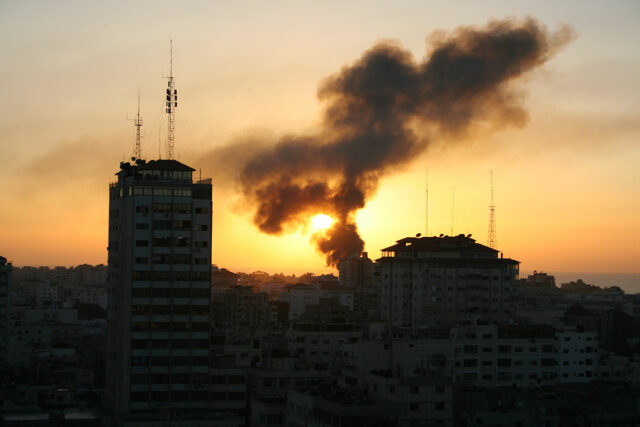
Hamas militants backed by a barrage of rockets stormed from the blockaded Gaza Strip into nearby Israeli towns, killing dozens in a surprise attack on Oct. 7.

A stunned Israel launched airstrikes in Gaza, with its prime minister Benjamin Netanyahu vowing to inflict an “unprecedented price.”

DFA on Sunday placed Gaza under Alert Level 4, forcing Filipinos to evacuate and come home amid the worsening war.

Mr. De Vega said there was no repatriation call for Filipinos in Israel, which was still under Alert Level 2.

Seventeen overseas Filipino workers from Israel were set to arrive in the Philippines late Thursday afternoon, he said.

At least three Filipinos have died in the war, all of them caregivers, while three others remained missing, DFA said at the weekend.

About a third of Filipinos in Israel live in Tel Aviv, according to Overseas Workers Welfare Administration (OWWA) chief Arnell A. Ignacio.

A fifth live in the central district, 12% live in Israel’s third-largest city Haifa and 6.4% are from the northern district.

A tenth of the Filipinos live in the capital Jerusalem, while 5.3% live in the southern district, which is near Gaza.

Mr. Ignacio said 90% of Filipinos in Israel work as caregivers, 8% are permanent residents, 497 are student-interns and 19 are tourists. — John Victor D. Ordoñez