Home Blog Page 4115

Style (10/30/23)


Fenty x Puma Avanti’s 2nd drop on Nov. 3

ON NOV. 3, global singer Rihanna and sports company Puma will launch two new colorways of their Fenty x Puma Avanti sneaker. The shoe is an unconventional mix of two Puma icons blending the high-quality leather design of the King football boot with the outsole of the heritage running shoe, Easy Rider. A fashion take on the football trend and inspired by the materials and colors of vintage sport styles, the second drop of Avanti will be available in dark myrtle and club navy, in men’s, women’s, and children’s sizing. The price point will range from ₱9,600 for adults and ₱5,800 for kids. Both colorways will feature oil treated leather, a tonal leather formstrip with leather piping, gold aglets, and a debossed Fenty number 1 logo on the tongue. The second drop of the Fenty x Puma Avanti will be available to shop from Nov. 3, 10 a.m., exclusively at Puma Glorietta and on PUMA.com.


COS reimagines its iconic Quilted Bag

COS’s signature Quilted Bag – spotted on the arms of several style icons all over the world – consists of an immediately recognizable pillowy, cloud-like texture that adds a sense of tactility to any look. From its original oversized crossbody bag design to its mini and micro versions, the Quilted Bag has become a must-have within fashion circles for its functionality and innovative construction. For its Autumn/Winter 2023 Collection, the London-based fashion brand gives an elevated flair to the iconic piece in luxurious, butter-soft leather. The COS AW23 iteration of the Quilted Bag comes in ew hues like cappuccino, banana-milk yellow, and turquoise in their micro and mini versions. It is also offered in black and cream-white colors. All crafted in 100% leather shell and 100% cotton lining, limited pieces of the Quilted Bag and more contemporary designs from the AW23 Collection are available at the COS Store Manila, SM Aura Premier, or on cos.com.


Flawless Face & Body Clinic marks 22 years with promo

IN HONOR of the 22nd anniversary of the Flawless Face & Body Clinic in December, the clinic is offering both old and new customers 3+1 and 4+1 Medical and Non-medical Service Packages that, after free consultation, promises to holistically cater to each individual need. In these packages, medical and non-medical services are available for clients to further their beauty journey. Clarifying treatments include the Easy Peel, Mesoestetic Peel, FNT Retinol, and Fraxelite, while Brightening treatments include the nutrient-rich Beauty Drip, Vita Detox or Vita Detox with Vitamin C, and FNT Whitening. Customers may opt for lifting in the form of FNT Exosomes or FNT Lifting, or Body Solutions like Shape & Sculpt or Laser Hair Removal. Each remaining month of 2023 will also see exclusive Flash Sales from Flawless, including this month’s offer of 22% off on two sessions of Nano PowerPeel with Mask or Advanced Facial with Rejuvelite, and a free second session with every purchase of Beauty Drip, Vita Detox, or Laser Hair Removal, until Oct. 31. Learn more about the promo via their website, Facebook page, Instagram, and TikTok.

Cebu Pacific says biggest aircraft purchase to be completed by early 2024

CEBU PACIFIC is expecting to complete its biggest aircraft purchase by early 2024, the company’s president said.

“We have just released the RFP (request for procurement) to Airbus and Boeing. We hope the entire process will end by the first quarter of next year,” Alexander G. Lao, president and chief commercial officer of Cebu Pacific told reporters last week.

The budget carrier is planning to order over 100 narrow-body aircraft from Boeing or Airbus worth roughly $12 billion based on the current list of prices, Mr. Lao said.

“We are excited. It is such a big commitment, it will be the largest order in Philippine aviation history,” he added.

Cebu Pacific currently operates a fleet of 73 Airbus and ATR aircraft, which it earlier said will double with its planned order of more aircraft.

It is anticipating 76 aircraft in its fleet this year before expanding to 91 aircraft by 2024.

Earlier, the company’s listed operator Cebu Air, Inc. said it would lower its fleet growth rate for 2024 as engine maker Pratt and Whitney (P&W) inspects A320/321 NEO aircraft engines worldwide following suspected issues.

Cebu Air reported a profit of P2.67 billion in the second quarter after a significant boost in passenger revenues, turning around from the P1.89-billion net loss incurred in the same period last year.

From April to June, the company recorded P22.67 billion in gross revenues, marking a 62.3% increase from last year’s P13.97 billion.

Passenger revenues, totaling P15.84 billion, constituted the majority of Cebu Air’s second-quarter top line, reflecting an 86.3% increase compared with last year’s P8.51 billion.

To date, the low-cost carrier flies to over 30 local destinations and 25 international destinations across Asia, Australia, and the Middle East. — Ashley Erika O. Jose

Friends star Matthew Perry, who struggled with substance abuse, 54

Matthew Perry in a publicity shot for Friends. — IMDB

LOS ANGELES — Actor Matthew Perry, who gained fame in the 1990s as the wise-cracking Chandler Bing in the top-rated US television comedy Friends and chronicled his decades-long battle with substance abuse in a memoir last year, died on Saturday at age 54.

His death was confirmed in a statement posted by NBC, the broadcast network that aired Friends for 10 years, on the social media platform X, formerly known as Twitter.

“We are incredibly saddened by the too soon passing of Matthew Perry,” NBC Entertainment said. “He brought so much joy to hundreds of millions of people around the world with his pitch perfect comedic timing and wry wit. His legacy will live on through countless generations.”

The Los Angeles Times and TMZ.com, both citing unnamed law enforcement sources, reported that the American-Canadian performer was found dead in a hot tub or jacuzzi.

NBC News, citing an unnamed representative of Perry and a law enforcement source, reported the actor was found dead of an apparent drowning at his home in the Pacific Palisades neighborhood of Los Angeles.

Ironically, Perry’s last post on Instagram, on Oct. 23, was a photo of him sitting by a pool or jacuzzi at night, with him writing, “Oh, so warm water swirling around makes you feel good? I’m Mattman.”

Perry was best known for his longtime role as Chandler in the hugely successful Friends, which ran for 10 seasons on the NBC network from 1994 to 2004, co-starring Jennifer Aniston, Courteney Cox, David Schwimmer, Matt LeBlanc, and Lisa Kudrow.

The series made international celebrities out of all six castmates, playing a close-knit group of young adults who shared space in one another’s apartments and met for coffee at the Central Perk, a fictional Manhattan cafe.

One of the major story lines involved a clandestine romance between Chandler and Monica Geller, the character played by Cox, which the four other friends — Rachel, Joey, Phoebe and Ross — each discovered one by one. The two characters eventually marry.

The entire group came back together 17 years after the series finale for a much-ballyhooed reunion special that aired on HBO Max in 2021.

But none ever managed to rekindle quite the level of individual stardom and commercial success they garnered as the ensemble cast of what was for a time the most watched US television program in prime time. Each reportedly earned $1 million per episode at the height of the show’s popularity.

Hidden from the public’s view during much of the original run was Perry’s prolonged struggle with addiction to prescription drugs and alcohol, which he detailed in his 2022 memoir, Friends, Lovers and the Big Terrible Thing.

“Hi, my name is Matthew, although you may know me by another name. My friends call me Matty. And I should be dead,” Perry wrote in the opening of the book.

In a New York Times interview published in October 2022, Perry said he had been clean for 18 months, telling the newspaper: “I’ve probably spent $9 million or something trying to get sober.”

Perry recounted in his book that he had to be driven back to rehab right after shooting the episode of Chandler and Monica’s wedding.

Following Friends, Perry went on to star in three more network television ventures that proved short-lived — Studio 60 on the Sunset Strip, Mr. Sunshine, and Go On.

Through his career, he also logged guest appearances or recurring roles in other hit TV shows, including The West Wing, Ally McBeal, Scrubs, and Beverly Hills, 90210. His motion picture credits included Fools Rush In, The Whole Nine Yards, Almost Heroes, and Three to Tango.

The Massachusetts-born actor grew up in Ottawa after his mother, a Canadian journalist who once served as press secretary to former Prime Minister Pierre Trudeau, divorced Perry’s father and married a Canadian broadcast personality.

Mr. Trudeau’s son and incumbent Canadian Prime Minister Justin Trudeau paid tribute to his boyhood friend, calling Perry’s death “shocking and saddening.”

“I’ll never forget the schoolyard games we used to play, and I know people around the world are never going to forget the joy he brought them,” Mr. Trudeau wrote on X.

As a youngster, Perry became a top-ranked junior tennis player before moving to Los Angeles to pursue acting and improvisational comedy. — Reuters

Belle’s nine-month income up 20% to nearly P2B

LISTED real estate developer and gaming operator Belle Corp. logged a 20% increase in its net income for nine months to September due to the improved operation of its gaming business units. 

In a regulatory filing, Belle said its net income climbed to P1.97 billion for the January-September period from P1.64 billion in the same period a year ago.

“This increase in bottomline figures is mainly attributable to the improved operation of the group’s gaming business units for the period,” Belle said.

Its consolidated revenues as of the third quarter climbed 1% to P4.30 billion from P4.27 billion last year amid gaming revenues’ higher share.

“The increase in revenues was mainly brought about by the improvements in the group’s gaming business units due to a more open economy in 2023 and the lifting of quarantine and capacity restrictions as the coronavirus disease 2019 (COVID-19) situation in the country became more controlled and manageable,” the company said. 

According to Belle, revenues from the share of subsidiary Premium Leisure Corp. (PLC) in the gaming earnings of City of Dreams Manila increased 24% to P1.8 billion.

However, revenues from the lease of the land and buildings of the City of Dreams Manila integrated resort and casino complex fell 4% to P1.5 billion.   

Belle also said that revenues from Pacific Online Systems Corp. increased 40% to P502.4 million from P358.1 million last year.

Pacific Online, which is 50.1%-owned by PLC, leases online betting equipment to the Philippine Charity Sweepstakes Office for lottery operations.

“Belle’s real estate sales and property management activities at its Tagaytay Highlands complex contributed revenues of P500.1 million as of third quarter of 2023, which was P406.4 million lower than its revenues as of the third quarter of 2022 of P906.5 million,” the company said.

Belle is among the portfolio investments of Sy-led holding firm SM Investments Corp., which also has a stake in mining firm Atlas Consolidated Mining and Development Corp., local bakeshop Goldilocks, and Philippine Geothermal Production Co.

On Oct. 27, Belle shares at the local bourse closed unchanged at P1.15 apiece. — Revin Mikhael D. Ochave

Walt Disney Studios postpones release of Snow White, Elio

RACHEL ZEGLER in a scene from Snow White. — IMDB

WALT DISNEY Studios on Friday postponed the release of the live-action remake of the animated classic Snow White and Pixar Animation’s Elio, citing the impact of the ongoing actors’ strike.

The studio moved the release of Snow White, starring Rachel Zegler in the title role, until March 21, 2025, a year later than its original premiere date. The science-fiction animated adventure Elio, which originally was slated to reach theaters in March 2024, has been moved to June 13, 2025.

Hollywood film slates have been scrambled as the result of a work stoppage that began in May, when writers walked off the job. In July, they were joined on the picket lines by members of the SAG-AFTRA performers’ union.

Writers began returning to work earlier this month, after reaching a new three-year contract with the major studios. Actors are still out on strike, effectively stalling much of film and scripted television production.

Other films have also been impacted by the labor unrest.

For instance, Warner Bros delayed the release of its big-budget Dune sequel, initially planned for November, to March 2024 because the stars of the film will not be able to promote the movie by next month.

Earlier this week, Paramount Pictures pushed the release date for the next installment of its Mission: Impossible franchise into 2025.

Disney also said Magazine Dreams, a drama from the company’s Searchlight Pictures starring Jonathan Majors, has been removed from the release calendar. The actor is facing assault charges stemming from an alleged domestic dispute. The film was scheduled to premiere on Dec. 8. — Reuters

SP New Energy’s attributable net loss widens 

SP New Energy Corp. (SPNEC) saw its attributable net loss widen to P32.29 million in the second quarter from P12.31 million in the same quarter last year.

In a stock exchange disclosure, the listed energy company said its revenues from contracts with customers stood at P64.04 million, without disclosing a comparative figure.

It said that as of June 30, 2023, the group recorded a total of P64 million in revenues, which was mainly contributed by Solar Philippines Rooftop Corp. and Solar Philippines Tarlac Corp. from the sale of electricity.

Gross expenses were at P37.39 million during the period while gross profit reached P26.654 million.

As of August, Solar Philippines Power Project Holdings, Inc. (SPPPHI) held 80.5% ownership of SPNEC’s outstanding common shares.

Metro Pacific Investments Corp. in March entered into a share purchase agreement with SPPPHI to “acquire the latter’s rights, title and interests in and to SPEC” with 1.6 billion common shares.

Earlier this month, MGen Renewable Energy, Inc. (MGreen), the renewable energy unit of the Manila Electric Co., said it had signed an investment agreement with SPNEC and SPPPHI to develop a solar and battery energy storage systems project.

Under the agreement, SPNEC will serve as the primary vehicle to develop 3,500 megawatts (MW) of solar panels and 4,000 MW of battery energy storage systems in Luzon.

To enable investment, MGreen will subscribe to 15.7 billion common shares and 19.4 billion redeemable preferred voting shares in SPNEC.

SPNEC will apply to increase its authorized capital stock to allow the investment. The fresh injection of capital by MGreen will fund the construction and expansion of its solar projects. — Sheldeen Joy Talavera

The Maharlika strategic investment fund — the ‘pause,’ the fix

JOSH APPEL-UNSPLASH

Alea iacta est. The die is cast.

Republic Act (RA) 11954 was signed into law on July 18, 2023, establishing the Maharlika Investment Fund (MIF) and creating the Maharlika Investment Corp. (MIC) to manage the fund, following its passage in the House (HB 6608) on Dec. 14, 2022 and in the Senate (SB 2020) on May 31, 2023. The house adopted in full the Senate version of the bill, without going through the usual bicameral conference committee.

The Implementing Rules and Regulations (IRR) was signed by the Treasurer of the Philippines on Aug. 22, 2023, as provided for by Section 54 of the law calling for the promulgation of the IRR within 90 days from enactment, in consultation with the founding government financial institutions (GFIs) Land Bank of the Philippines (LANDBANK) and Development Bank of the Philippines (DBP).

However, “upon the directive of the president” the implementation of the IRR was suspended by a memorandum dated Oct. 12, 2023 from Executive Secretary Lucas Bersamin, “pending further study of the IRR.”

President Ferdinand R. Marcos, Jr. said, “the organization of the Maharlika proceeds apace” and that “we are committed to having it operational before the end of the year.” He insisted that the suspension of the IRR must not be seen as a “judgement of the rightness or wrongness of the Maharlika Fund” but that “we are just finding ways to make it as close to perfect and ideal as possible.”

“HOUSTON, WE HAVE A PROBLEM”
LANDBANK and DBP had to request for “regulatory relief” from the Bangko Sentral ng Pilipinas/Monetary Board (BSP/MB) when they remitted their capital contributions.

TIMING. RA 11954 provided for the capital contributions of LANDBANK’s P50 billion and DBP’s P25 billion to be fully paid (Section 6.1) without specifying a timetable. The IRR, however, required the combined P75-billion contributions to be deposited to the account of the Treasurer of the Philippines for the benefit of the MIC “within five (5) days from the effectivity of the IRR” (Rule III, Section 6).

IMPACT ON CAPITAL RATIOS. At the forum on the Maharlika Fund held by the UPSE Alumni Association on June 21, 2023, this writer was one of the few who pointed out that the contributions from the LANDBANK and DBP to the initial capital of MIC are not in the same category of funds that the GFIs can allocate out of their investible or loanable funds. Instead, they are equity investments that will be deducted from their equity, following Basel 3 rules.

Based on calculations using the audited figures from 2022 annual reports of LANDBANK (pages 49-53) and DBP (page 155) — which show detailed computations of qualifying capital and the risk-weighted assets or RWA:

1. DBP ex-MIF capital ratios will fall below the regulatory minimum of 10% (CET 1 from 11.68% to 7.44% and total CAR from 12.61% to 8.36%). Unless it gets a fresh capital infusion, DBP would even have to shrink its loan book or collect on outstanding loans to meet the regulatory capital ratios.

2. LANDBANK’s ex-MIF capital ratios will drop (CET 1 from 13.9% to 10.2% and total CAR from 14.46% to 10.73%), barely meeting the regulatory minimum and cannot support any expansion in its loan portfolio.

3. Merging the LANDBANK and DBP will not help, as their composite CET 1 ratio will drop from 13.34% to 9.35% (below the 10% minimum) and total CAR from 13.90% to 10.01%.

4. In addition to falling below the minimum capital ratios, the immediate contribution of the LANDBANK’s P50 billion and DBP’s P25 billion may have led to violation (particularly in the case of DBP) of:

1. The very same law RA 1954 — Article III Section 12, and IRR Rule IV Section 12. “The investments from LANDBANK, DBP … shall not exceed 25% of their net worth.”

2. RA 8791 or General Banking Act of 2000, Article 1, Section 24.2. “The equity investment in any one enterprise … shall not exceed 25% of the net worth of the bank.”

ADVERSE IMPACT ON THE ECONOMY, CREDIT RATINGS
Based on a leverage ratio of 6.5 to 8x, the P75 billion taken out from the capital base of LANDBANK and DBP and transferred to the MIC corresponds to siphoning off P500-600 billion of lending from the economy or 4-5% of the total loans of the banking industry. By some estimates, this represents an output loss equivalent to over 2% of GDP.

Fitch Ratings has warned that “… LANDBANK and DBP’s underlying loss absorption buffers are poised to weaken on the back of their contribution to the MIF, irrespective of regulatory forbearance that maybe provided to the banks.”

While not explicitly warning of a credit downgrade of their current BBB rating (which carries an implicit sovereign guarantee) Fitch said their capital contribution to the MIF “may pressure their standalone credit strengths, in the absence of other mitigating factors.”

Fitch also noted that the government stands ready to help the banks should they need it. LANDBANK’s 2021 annual report notes that it received a P27.5-billion capital infusion from the National Government to support its loan expansion and to help absorb the costs of the UCPB merger.

WHERE TO GO FROM HERE?
The immediate solution is to revise the IRR to make the contributions of LANDBANK and DBP staggered over a number of years “until fully paid.” Alternatively, capital calls can be made only once the projects are identified and their viability established. The experience of strategic investment funds elsewhere, especially for infrastructure projects, shows that it takes time for projects to take shape and be funded. It is called “patient capital” for a reason. A disciplined approach to “viability first, funding to follow” will obviate the pressure to deploy the funds to less-than-ideal or wasteful projects.

In the case of DBP, a P5 billion per year contribution (roughly 7% of its unimpaired capital as of end 2022) can be a realistic number over five years that will allow it to meet the requirements of RA 1954, while allowing it to comply with regulatory capital ratios. Instead of having to cut back on lending to industries and MSMEs, it will have the breathing room to expand its loan book, generate income, and build up its internally generated capital to further sustain its lending growth. Similarly, the LANDBANK contribution can be downscaled to P10 billion a year over five years.

Should additional funding for MIC be needed from both GFIs, they can do so without impacting their capital ratios by subscribing to debt instruments that are convertible to equity at a later time. However, this option requires amending the law itself since it provides only for preferred shares that are non-voting, non-participating, and non-convertible (Article II, Section 6.2).

Such a revision in a key provision of the IRR will spare the two GFIs from having to avail of “regulatory relief” from the BSP/MB and avoid a possible credit rating downgrade.

The General Banking Act provides that any equity investment is subject to the “prior approval of the Monetary Board” (RA 8791, Section 24.2, last paragraph). The proposed revision in the IRR will spare the Monetary Board from the unpleasant task of exercising its lawful duty to withhold its approval of the equity investment of DBP for exceeding 25% of its net worth. An alternative scenario to outright disapproval would be for the MB to give its approval for the equity investment but reduced to an amount below 25% of its net worth.


Alexander C. Escucha is president of the Institute for Development and Econometric Analysis, Inc., and chairman of the UP Visayas Foundation, Inc. He is a fellow of the Foundation for Economic Freedom and a past president of the Philippine Economic Society. He is an advocate of best practice in corporate governance with over 40 years’ experience in banking and finance, particularly in strategy, communications, technology and stakeholder/ investor relations.

Azure way to well-being

PHOTO BY KAP MACEDA AGUILA

Bentley turned to science to make this Bentayga Extended Wheelbase variant even more comfortable

WE ALREADY KNOW that we spend an inordinate amount of time on the road, ensconced in our vehicles and suffering through gridlock, potholes, noise, and a wealth of stressors that drain us of our energy — sometimes even before a workday begins.

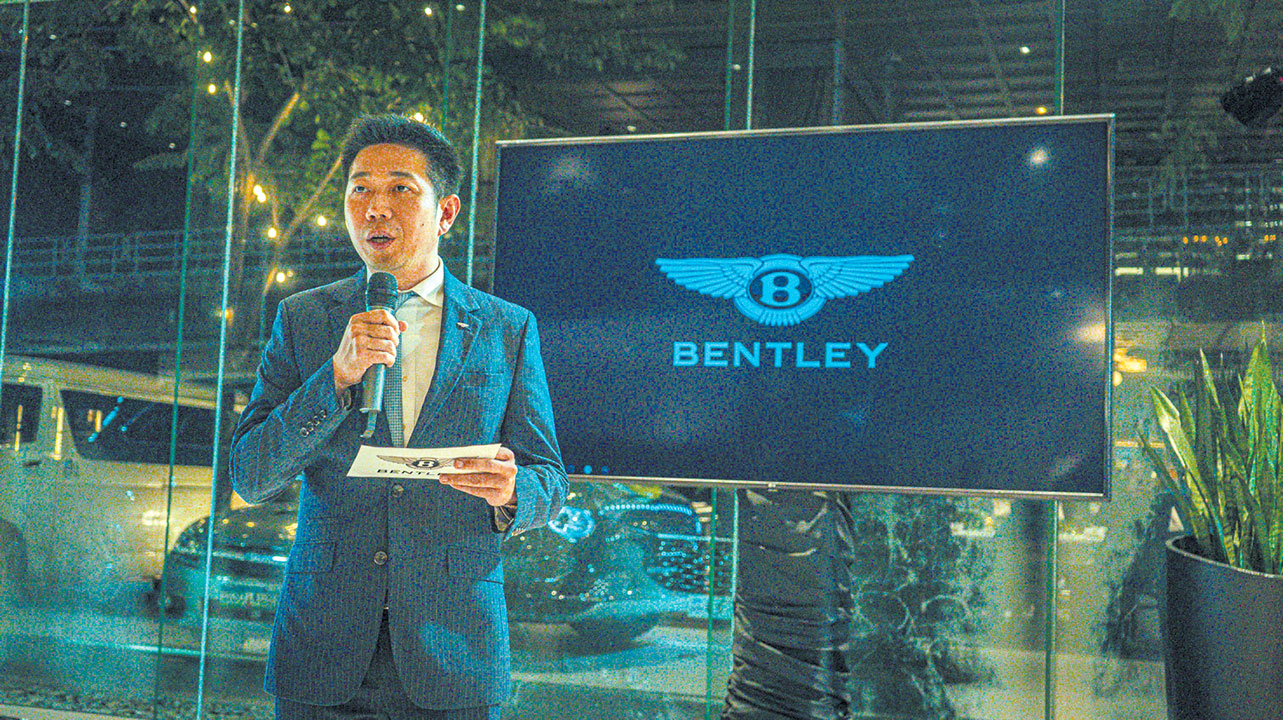
The uber-luxe marque is aware of this, stressed Bentley Manila, and added that the “relaxing and reenergizing environment of the Azure cabin reduces fatigue through multisensory and scientific design, and further helps to enhance the safety of the car.” The company points to studies showing that “tiredness” is a factor in up to 20% of all road crashes.

That’s exactly why a vehicle needs to be comfortable and promote the well-being of its occupants — beyond the bells and whistles of entertainment and tech accoutrements, and the undeniable value of a safety suite.

The Bentley Bentayga SUV, already in a rarified realm of its own and worthy of its storied badge, now comes out with an Azure variant of the EWB (extended wheelbase) prioritizing well-being “that enhances the comfort of its driver and passengers.” Bentley Manila made a further claim that “the Bentayga EWB Azure keeps its driver alert, but comfortable and rested in the cabin.”

The model has been “developed with the help of well-being experts and neuroscientists, (and is equipped with the) Touring Specification option of advanced driver assistance technologies for safer, more relaxing journeys. The stress-free interior ambience is enhanced by reduced levels of noise, vibration, and harshness.”

“It’s an entire derivative strategy that was launched by the brand — in areas that match different customer profiles,” said Bentley Motors Asia Pacific Head of Sales and Network Development Sam Bontoft, in an interview with this writer. There are two general directions: the other is the S, with features that bear the so-called Black Line specification. “That makes it look aggressive,” he maintained, and added that the focus is on driving enjoyment.

What’s the target customer profile of the Azure then?

“It’s a difficult question,” insists the Singapore-based executive, in town for the recent Philippine launch of the Bentayga EWB Azure. “We obviously look at the customers that we have on hand and, of course, we want to appeal to other customers as well — that’s why you get this diversified portfolio of derivatives. With the Azure range, we’re targeting people who are looking for well-being. They want to drive a car that suits their lifestyle. In the EWB, they’re looking for comfort. They want to benchmark features, whether it’s the cabin temperature, seat dynamics or what have you. We don’t target a specific age group or gender. It’s just a vibe that the customer has.”

Is the Bentayga EWB Azure meant for the driver or the chauffeured?

Mr. Bontoft remarked, “It’s interesting. Naturally, you’d think that it’s for the chauffeur-driven because it’s a bit longer with a bit more space at the back. And with the airline seats — you’d want to be in the back, right?

“But look at different markets, for example in the Philippines. I’d assume that the person who buys this car is probably going to be chauffeur-driven, right? But if you go to Australia, we still sell these cars to people who drive — and it’s their family at the back. It’s a mixed bag.”

The Bentayga EWB Azure gets 22-inch, 10-spoke directional wheels, a bright lower bumper grille, unique quilted seats, mood lighting, a heated steering wheel, and even more driver’s assistance aids. As with all Bentley Azure models, the Bentayga EWB receives the Front Seat Specification that includes 22-way adjustable seats for passengers, and heating and ventilation that are keenly tuned to give occupants “optimum temperature for comfort and alertness.”

Insisted Mr. Bontoft, “They’re the most advanced seats in a car thus far.” Further elevating the experience and comfort for passengers, sensors measure the body’s temperature and make micro adjustments in aide of blood flow.”

The Azure range itself introduces a concept to the automotive world,” reported Mr. Bontoft. “It prioritizes the comfort of everybody on board; Azure stands for more than just the specification of the car.”

As for the Bentley Bentayga Azure EWB, he stressed, “What we have is the best rear cabin experience that you can get in a Bentley since the Mulsanne. It’s actually quite impressive. More than 2,500 new parts went into the development of this car, with more than 2,000 hours of testing to achieve the final product.”

Among the new elements are vertical vanes in the front grille, new illumination, power-closing doors that can shut with the press of button from the inside, and all-wheel steering that reduces the turning circle by seven percent, compared to the regular Bentayga.

And since it’s a Bentley, the model lends itself to customization. “Customers have the opportunity to choose from 24 billion different trim combinations, with finer sewing threads creating Bentley’s softest quilt to date,” reported Bentley Manila.

The Bentayga continues to be the top-performing model for the Crewe, England-headquartered luxury automaker, accounting for 40% of sales.

Striking Hollywood actors pass counteroffer ahead of further talks with studios

STOCK PHOTO | Image by Peter Thomas from Pixabay

STRIKING Hollywood actors have made a comprehensive counteroffer to the major studios, the SAG-AFTRA performers’ union said in a post on social media platform X.

Negotiators for the union and the Alliance of Motion Picture and Television Producers, the group representing Walt Disney, Netflix, and other major media companies, meet again on Friday, the actors union said.

Ahead of Friday’s talks, a group of SAG-AFTRA members published an open letter to the union leadership, urging the negotiating committee to continue fighting for improved compensation, royalties, and workplace protections.

“We have not come all this way to cave now,” wrote the group calling itself Members In Solidarity. “We have not gone without work, without pay, and walked picket lines for months just to give up on everything we’ve been fighting for.”

The latest counteroffer submitted by the actors union on Thursday comes after media companies and the union representing striking US actors returned to the bargaining table on Tuesday last week.

Earlier this month, negotiations between Hollywood studios and SAG-AFTRA were suspended as the two sides clashed over streaming revenue, the use of artificial intelligence, and other issues at the core of a three-month work stoppage.

Members of SAG-AFTRA, which represents 160,000 actors and other media professionals, have been on strike since July. The work stoppage has scrambled next year’s film slate and delayed the return of primetime television comedies and dramas. It also has created hardships for crew members, who have been out of work for months. — Reuters

Wellex Industries turns profitable

LISTED Wellex Industries, Inc. reported a turnaround as posted earnings during the July-to-September period, reversing its net loss a year earlier, on the back of higher revenues from leasing its warehouse facilities.

In a stock exchange disclosure, the company said its net income reached P359,641 during in the third quarter, a reversal of the P1.13 million net loss last year.

Wellex said its total revenue for the third quarter rose 38.8% to P6.84 million from P4.87 million previously.

For the nine-month period, the company said it trimmed its net loss to P4.21 million from P7.1 million in the same period last year.

Wellex’s total revenues climbed 19% to P17.58 million compared with P14.81 million a year ago.

According to the company, 28 companies are leasing spaces inside the Plastic City Industrial Corp. in Valenzuela City.

Wellex said that as of the quarter ending Sept. 30, it leased out more areas in its warehouse facilities compared with a year earlier.

Wellex’s website said that the compound houses 44 industrial warehouses across 84 hectares of land. It has facilities such as roads, water, electricity, and security. The company is owned by the Gatchalian family.

As of Oct. 27, shares of Wellex at the local bourse closed unchanged at 25 centavos apiece. — Revin Mikhael D. Ochave

‘Climate-smart’ rice irrigation project planned for Nueva Ecija

THE National Irrigation Administration (NIA) said it is planning to roll out a climate-smart irrigation project in Nueva Ecija, a major rice-producing province in Central Luzon.

Projects can be made climate-smart “by increasing water productivity in national irrigation systems while reducing carbon emissions in irrigated rice cultivation,” the NIA said in a statement.

It added that the “climate smart” project is aimed at promoting broad adoption of alternative wetting and drying technologies in irrigated areas.

The projects will offer financial incentives and capacity-building activities to partner farmers.

The NIA said the initiative will be carried out via a memorandum of understanding (MoU) with Ostrom Climate Solutions, Inc.

It added that the Climate-Smart Rice Project in Upper Pampanga River Integrated Irrigation Systems will be active in the area until 2028.

The project’s goal is to contribute to the achievement of rice security and resiliency, it said.

The company will also manage all project fund releases in accordance with government accounting and auditing rules.

“Ostrom Climate shall provide funds for the implementation of the project, thus incurring no cost to NIA,” it added.

“With the signing of the MoU between NIA and Ostrom Climate, NIA looks forward to the realization of its vision of making the Philippines a climate-smart and climate change-resilient nation,” it said.

Ostrom Climate is a Vancouver-based company providing carbon management solutions. — Adrian H. Halili

No beer in heaven

FREEPIK

“In heaven there is no beer” was one of our favorite ditties during our rough and unrestrained days in high school. The lyrics go:

In heaven there is no beer/That’s why we drink it here/And when we’re all gone from here/Our friends will be drinking all the beer

In heaven there is no wine/So we drink till we feel fine/And when we leave this all behind/Our friends will be drinking all the wine

A half century has passed, and we have matured and have become wiser. Being senior citizens, we have become health-aware. Binge drinking is no longer the norm; moderate drinking is the practice.

Despite the caution in our later years, we simply have reaffirmed our love for beer, wine, and spirits. And we continue to sing “In heaven there is no beer.”

We can likewise intellectualize the worldly significance of liquor. In this regard, I came across a New York Times (NYT) opinion piece titled “How Beer Gave Us Civilization,” written by Jeffrey P. Kahn, a clinical associate professor of psychiatry. The piece, published 10 years ago (March 15, 2013), is a paean to beer.

I wonder whether the author would have written a sober or less celebratory piece if he had known then the evidence that liquor of any type has no safe level of drinking. But I’m getting ahead of my story.

The NYT opinion piece is an advertisement for beer in the disguise of an academic discourse. It nevertheless amuses. Kahn’s ode to beer is anchored on his belief that the drink was the antidote to social constraints. While acknowledging that social constraints “gave structure and strength to our primeval herds,” and hence made “our ancient forebears cooperate, prosper, multiply,” the author recklessly concludes that “these same lifesaving social instincts didn’t readily lend themselves to exploration, artistic expression, romance, inventiveness, and experimentation — the other human drives that make for a vibrant civilization.”

Further: “To free up those, we needed something that would suppress the rigid social codes that kept our clans safe and alive. We needed something that, on occasion, would let us break free from our biological herd imperative….”

And here, Kahn gets more reckless: “We needed beer.”

Whoa! That’s how the psychiatrist, and an academic at that, strays from the scientific method. Worse, says he, this is “how beer gave us civilization.”

Kahn’s thinking is an example of reductionism, of bad logic. A smart-aleck could have engaged Kahn in a mischievous, comical debate. Couldn’t it have been another psychoactive substance like mushrooms, poppy, or cannabis, other than beer, that lent our forebears to “exploration, artistic expression, romance, inventiveness and experimentation?”

Emily Bell, who writes about food and beverages and their connection to culture and politics, will disagree. She has an essay humorously titled: “Early Man Smoked Weed Before Discovering Alcohol. No Wonder It’s Called The Stone Age.” (vinepair.com; updated on Aug. 8, 2016). Bell wrote about a systematic review authored by Tengwen Long et al. titled “Cannabis in Eurasia: origin of human use and Bronze Age trans-continental connections” (published in Vegetarian History and Archaeology on June 27, 2016).

Kahn’s argument crumbles in the face of proof that humankind was already engaged in exploration, artistic expression, romance, inventiveness, and experimentation, before the advent of beer. Prehistoric man, for example, had manifested artistic expression through cave engravings and paintings.

On beer and romance: The story of Adam and Eve is an example of romance to a tee. It was not just about love; it was about sex and nudity, temptation and betrayal, and banishment. But beer was not present when the story of Adam and Eve happened.

Beer itself was the product of such exploration, inventiveness, and experimentation. So, we have to correct Kahn: It is not beer that gave us civilization; it was civilization that gave us beer.

So let’s move away from faulty reasoning, including causal fallacy, as exhibited by Kahn’s NYT opinion. Let’s conform to the scientific method when talking about alcohol.

The latest scientific evidence refutes the hitherto dominant belief that moderate drinking can be good for one’s health. The claim that moderate drinking is good for the health is illustrated by a graph known as the J curve. The graph’s horizontal axis measures drinks per day and the vertical axis measures the relative risk of mortality from all causes.

The lowest point of the J curve, which is somewhere in the middle, represents the moderate drinkers. The J curve shows that the moderate drinkers have the lowest risk of mortality. Said differently, the moderate drinkers (defined as limiting intake to two drinks or less per day for men and one drink or less per day for women) have lower risks of all-cause mortality than those who abstain from drinking (represented by the J’s hook).

The heavier drinkers face much higher risks of mortality. They are represented by the high point in the J curve.

Two studies stand out for disproving the long-held J curve observations.

The first study, authored by Robyn Burton and Nick Sharon, is titled “No level of alcohol consumption improves health,” published in The Lancet, Aug. 23, 2018. Here is a lengthy quote from said journal article:

“The study considers the extent to which moderate levels of consumption are protective for some health conditions. A paucity of estimates from meta analyses identifying appropriate reference categories, adequately accounting for survival bias and other confounders, has meant previous assessments of the harm of alcohol have been potentially inaccurate. However, the emerging literature can account for some of these issues, enabling more reliable estimates of the disease burden attributable to alcohol. By implementing a novel method to establish a counterfactual level of exposure across varied relative risks that does not need to assume zero exposure, the authors present tangible evidence for low-risk drinking recommendations. The level of consumption that minimizes an individual’s risk is 0 g of ethanol per week, largely driven by the fact that the estimated protective effects for ischaemic heart disease and diabetes in women are offset by monotonic associations with cancer.”

The second study is authored by Jinhui Zhao, Tim Stockwell, Tim Naimi, et al. and titled “Association Between Daily Alcohol Intake and Risk of All-Cause Mortality” (published by JAMA Network on March 31, 2023). This study is summarized as follows: The systematic review and meta-analysis consisting of 107 cohort studies and involving more than 4.8 million participants showed that “daily low or moderate alcohol intake was not significantly associated with all-cause mortality risk, while increased rate was evident at higher consumption levels, starting at lower levels for women than men.”

The main problem with the J-curve observations was it could not prove causation. Confounding factors were ignored. For example, the moderate drinkers in the observational studies also had attributes indicating healthy lifestyle and habits which lower their total mortality risks and make them live longer.

Hence, the presence of another variable influences the relationship between moderate drinking and relative risk of all-cause mortality. This phenomenon is called interaction effects. Analysts have to be careful in explaining variables that have interaction effects.

Further, the abstainers chosen for the J-curve observations included those who were former heavy drinkers or those who had chronic health problems. This sample selection of abstainers resulted in a biased outcome.

Now that the evidence points to no safe level of drinking, public policy toward alcohol has to unequivocally discourage consumption.

Society has a consensus that the harm caused by alcohol drinking is not just to individual health, and that it extends to the public sphere. Providing care and treatment to those afflicted with alcohol-related diseases is a cost to public health. The productivity losses arising from alcohol-related diseases likewise affect the whole economy.

Drunkenness results in accidents or collisions that harm others. And excessive drinking foments violence, especially against women and children.

The examples above constitute what economists call the negative externalities of alcohol drinking. A tax on negative externalities is thus appropriate to discourage consumption and to compensate for the harm to others that such individual consumption causes.

In the Philippines, alcohol taxes are moderate, and one reason behind that is the view that light drinking is acceptable. This has to change, now that the evidence refutes moderate drinking and establishes that no safe level of alcohol drinking exists.

This does not translate into prohibition. Taxation remains the most effective policy to deter consumption of harmful goods. But it is high time we had much heavier alcohol taxation.

Probably, my generation will continue to drink alcohol despite taxing it heavily. Anyhow, we are that generation that will soon be knocking on heaven’s door. And in heaven there is no beer.

But let there be no doubt that any ounce of alcohol is unsafe for everyone.


Filomeno S. Sta. Ana III coordinates the Action for Economic Reforms.

www.aer.ph