Home Blog Page 402

Robinsons Land pushes for 30% RE use in all developments by 2030
JGSUMMIT.COM.PH

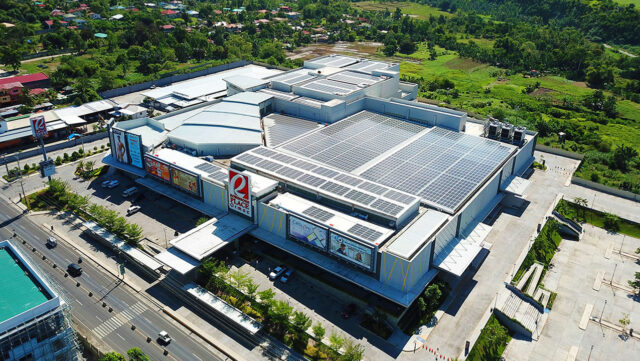
ROBINSONS LAND CORP. (RLC) aims to increase the share of renewable energy (RE) in its total power consumption to as much as 30% by 2030 as part of a broader push to integrate sustainability measures across its developments.

“In the next five years, as we’re building more townships, not only are we investing in it, but we’re making sure that we’re very compliant with regulatory requirements in terms of disclosing our carbon emissions, our energy intensity, water intensity, and waste management,” RLC Chief Strategist and Lead for Sustainability Ramon Daniel S. Rivero said on the sidelines of the BusinessWorld Insights forum last Friday.

At present, renewables account for 10% to 15% of RLC’s total power consumption.

RLC has spent approximately P3 billion on sustainability initiatives to date, covering solar panel installations, green building design and certification, and energy-efficient equipment and technologies, Mr. Rivero said.

“We will continue to invest and earmark 20% to 30% of total sustainability spend on further initiatives in the next five years,” he added.

Mr. Rivero said the company’s office buildings have obtained green building certifications such as Leadership in Energy and Environmental Design and Excellence in Design for Greater Efficiency. Its malls have also invested in solar energy to expand its share in the power mix.

The company is also looking to divert nonbiodegradable waste generated in its properties to recyclers and other waste processing facilities, Mr. Rivero said.

“We’re now looking into potential tools that can compost them (food waste) faster within hours, and then the output would be fertilizer-based compost waste which we can use to plant and use as carbon credits,” he noted.

RLC will also continue integrating wastewater treatment and materials recovery facilities into the design of its new and existing developments, Mr. Rivero added.

Earlier this year, RLC said it plans to build 2,000 electric vehicle charging units across its developments nationwide within the next five years as part of its push for electric mobility options.

The company reported a 7% increase in second-quarter attributable net income to P3.4 billion, while revenues for the period rose by 16% to P12 billion.

RLC shares on Monday were up by 2.33% or 34 centavos to close at P14.94 per share. — Beatriz Marie D. Cruz


Robbie Williams Istanbul concert canceled over safety concerns, singer says

COMMONS.WIKIMEDIA.ORG

ANKARA — British singer Robbie Williams said city authorities called off his upcoming Istanbul concert “in the interests of public safety” after Turkish NGOs and social media users campaigned for the event to be canceled and protested against his appearance.

The Oct. 7 concert was scheduled to take place on the second anniversary of the Hamas attack on southern Israeli communities that led to Israel’s military offensive in Gaza.

For days, Turkish social media accounts and pro-Gaza NGOs had been calling for the event to be scrapped, accusing Mr. Williams of being “Zionist.”

The 51-year-old singer has faced renewed scrutiny in predominantly Muslim Turkey over his family’s Jewish heritage and his 2015 performance in Israel, which drew criticism from pro-Palestinian groups.

Bubilet, the ticketing company, said it had canceled the concert at the request of the Istanbul Governor’s Office. The governor’s office was not immediately available for comment.

Mr. Williams wrote on Instagram late on Saturday that the safety of his fans “comes first,” adding he was deeply sorry for the cancellation, which he said was “beyond our control.” — Reuters

Return on investment in the New Generation

STOCK PHOTO | Image from Freepik

Last June, faculty members from the Department of Management and Organization at Ramon V. del Rosario College of Business conducted a workshop to review and refine the syllabus for the course on Strategic Management. Before we began, the Department Chair, Dr. Kit Bonnet, posed an important question: “Why do you still pursue teaching?” While some may view this as a simple question and respond that teaching is their source of income, my response was different. I shared with the group that I find joy in seeing a return on investment from my efforts.

Many of us understand that return on investment (RoI) is a ratio that measures the profitability of an investment by comparing the gain or loss to its cost. It helps assess the potential return on investments in stocks or business ventures. Many business owners focus solely on their profits after investing in a business. This perspective is common among capitalists who invest their resources to generate profit.

The RoI I mentioned in relation to my journey in teaching holds a deeper meaning. It’s the joy of receiving messages from students celebrating their success stories after graduation. A powerful talk from teacher Sabrina Ongkiko at TEDx sparked my perspective on RoI. Despite earning her pre-med degree from one of the Philippines’ top universities, she dedicated herself to public education. Faced with her parents’ doubts about her decision and the question of their return on investment, she passionately shared her experience as a public-school teacher. She highlighted a former student who once dreamed of attending a prestigious university and ultimately thrived there as a scholar. Ms. Ongkiko conveyed to her father that this achievement is her true RoI. She takes immense pride in her student, who is now competing at the highest level, embodying the profound impact of teaching.

Being in the academe carries immense responsibilities. Educators possess the power to inspire, influence, and transform students, significantly impacting their futures and careers. While teaching may not always be seen as the most glamorous profession, it is undoubtedly one of the noblest. The foundation an educator builds in the minds and spirits of students will shape their destinies as they emerge as leaders in their respective fields.

Guided by the vision and mission of the Department of Management and Organization at Ramon V. del Rosario College of Business, DLSU, we strive to infuse faith in management education, empowering our students to become competent, humanistic, nationalistic, and socially responsible business leaders who will act as transformative change agents in society.

As we addressed the Department Chair’s question, I shared some of my RoIs from my time at DLSU. One student reached out to share his success story: while applying for a marketing assistant position, he was tasked with developing a strategy to boost business. He utilized strategies and tools acquired in our Strategic Management class to present his ideas to the interviewer. Much to his surprise, he did not just get the job, but he was even offered a much higher position as Marketing Executive, responsible for leading the execution of his strategies. This is just one of the many RoIs I have experienced since I began teaching at DLSU in 2023. My fellow teachers have started sharing their own successes, recounting the triumphs of their students, and it’s truly inspiring to hear how educators’ dedication and guidance yield profound returns on investment through their students’ journeys to success.

When someone asks if I’m getting tired from juggling my responsibilities — teaching and full-time work as the Head of Group Accounts Management under Corporate Solutions at Manulife Philippines — I acknowledge that it can be exhausting. However, every time I hear about my students applying what they’ve learned and succeeding in their endeavors, it makes all the tiring preparations, evaluations, and countless final paper checks worthwhile. I realize I am not just teaching; I am investing in the next generation of business leaders, and the rewards of that investment are just beginning to unfold. They are indeed my returns on investment.


Bryan N. Bernabe is a professional lecturer who teaches management courses at De La Salle University, RVR-College of Business. He is also the head of Group Accounts Management under Corporate Solutions & Alternative Distribution in Manulife.

PHINMA leverages education, hospitality, and construction units for Saludad

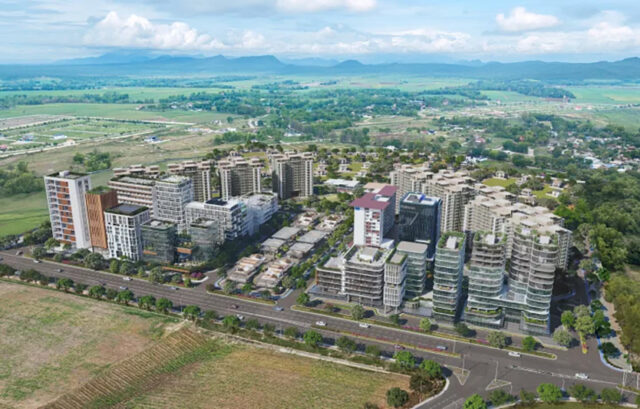
Saludad is a 21-hectare master-planned mixed-use community in Bacolod City. — PHINMAPROPERTIES.COM

LISTED conglomerate PHINMA Corp. is leveraging its education, construction, and hospitality units for the development of its real estate arm’s first township outside Metro Manila.

“With PHINMA Education, PHINMA Construction Materials, and PHINMA Hospitality contributing their expertise, Saludad is envisioned not merely as a residential address, but as a holistic community where families can learn, work, grow, and thrive,” the company said in an e-mailed statement on Monday.

The conglomerate’s real estate arm, PHINMA Property Holdings Corp. (PHINMA Properties), launched the P12-billion Saludad township last year.

The 21-hectare development is a master-planned ecosystem featuring residential areas, commercial hubs, educational institutions, hospitality components, and retail spaces.

In April, PHINMA Properties broke ground on Maayo Terraces, an 11-tower mid-rise residential condominium project within the Saludad township.

Also located within the township are Likha Estates, which offer lot-only developments; PHINMA Hospitality’s TRYP by Wyndham Hotel; and Southwestern University PHINMA.

Saludad will also feature open green spaces, walkable streets, and commercial hubs.

“Instead of following a Manila or international template, the township was co-created with JEPP Real Estate Co., a Bacolod-based firm rooted in the heritage of the city’s prominent families, and masterplanned by award-winning architect Royal Pineda,” PHINMA Properties President and Chief Executive Officer Raphael B. Felix said.

“This collaboration grounds Saludad in Bacolod’s culture and identity while elevating it through world-class design and innovation.”

Mr. Felix cited the strong residential demand in Bacolod’s property market, particularly in the affordable segment.

“Unlike Metro Manila, where condominium oversupply challenges developers, Bacolod’s real estate market remains balanced and resilient, with strong take-up particularly in the affordable and mid-income segments,” he said.

He added that the city’s growing population, rising middle class, and quality of life will boost opportunities in sectors such as education and hospitality.

“Bacolod has always been a city with untapped potential,” Mr. Felix said.

The Negros Island Region recorded 5.9% economic growth in 2024, outpacing the national average of 5.7%, according to the Philippine Statistics Authority.

PHINMA Properties has over 21 residential communities in Metro Manila and has expanded to Cebu and Davao.

“Saludad is our way of affirming our belief in Bacolod and our commitment for the long term,” Mr. Felix said.

At the local bourse on Monday, PHINMA Corp. shares slipped by 0.47% or eight centavos to close at P16.90 apiece. — Beatriz Marie D. Cruz

CLI seeks SEC approval for third tranche of P15-B debt securities program

THE WAVE TOWERS — CEBU LANDMASTERS, INC.

CEBU LANDMASTERS, INC. (CLI) has filed a registration statement with the Securities and Exchange Commission (SEC) for a follow-on offering of up to P5 billion in sustainability-linked bonds, representing the third and final tranche of the company’s P15-billion debt securities program.

In a disclosure on Monday, CLI said the bonds will be issued in Philippine pesos and structured into three series with different maturity dates: Series F due 2029, Series G due 2032, and Series H due 2035.

The base offer is set at P3 billion, with an oversubscription option of P2 billion.

Net proceeds from the offering will be used to refinance CLI’s project development, pay off maturing obligations in 2025, and support general corporate expenses, among other purposes.

CLI’s sustainability-linked bonds received a PRS Aa plus credit rating with a stable outlook from the Philippine Rating Services Corp. (PhilRatings).

The PRS Aa rating signifies high quality with very low credit risk and reflects CLI’s strong capacity to meet its financial commitments.

In March, CLI raised P5 billion from its first sustainability-linked bond issuance to fund the construction of 16,000 affordable housing units in the Visayas and Mindanao by March 2029.

The company has a portfolio of 130 projects across 17 cities, covering offices, residential developments, mixed-use projects, resorts, hotels, co-living and co-working spaces, and townships.

At the local bourse on Monday, CLI shares closed flat at P2.34 apiece. — Alexandria Grace C. Magno

IC allows Intra Strata to resume business

INSURANCE.GOV.PH

THE INSURANCE COMMISSION (IC) has allowed nonlife insurer Intra Strata Assurance Corp. (ISAC) to resume its normal operations as it has been released from conservatorship following its failure to submit regulatory requirements.

“Notice is hereby given that the Insurance Commission has lifted the suspension of the Certificate of Authority issued against Intra Strata Assurance Corp. and has released the company from conservatorship effective Oct. 3, 2025,” the regulator said in a document posted on its website on Oct. 3.

On Sept. 12, the company was placed under conservatorship and told to cease and desist from transacting new business after it was unable to submit its audited financial statements for 2024.

ISAC earlier said it was already working to address the issue to ensure stricter regulatory compliance moving forward.

Latest IC data showed Intra Strata’s premiums earned stood at P198.313 million in 2024, while its net income was at P165.43 million. — AMCS

Manila’s Appeal to Workers Dips, Remains the Second-Lowest Among Its Peers in the Region

Manila fell two places to 115th out of 150 cities in the 2025 Global 150 Cities Index  by human resources consulting firm Associates for International Research, Inc. (AIRINC). Among select cities in the East and Southeast Asian region, Manila remained the second lowest, only ahead of Jakarta. The Philippine capital placed 101st in financial rank and 116th in lifestyle rank. The index ranks cities based on available financial and lifestyle benefits and considers how appealing each city is to live in based on local salary levels, tax rates, living costs, and living conditions.

Manila’s Appeal to Workers Dips, Remains the Second-Lowest Among Its Peers in the Region

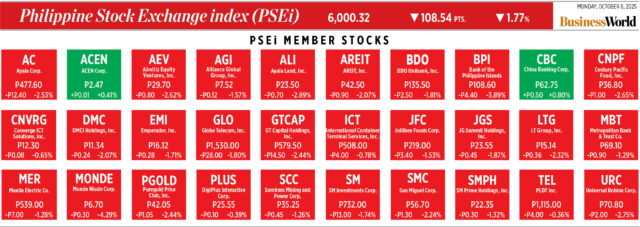
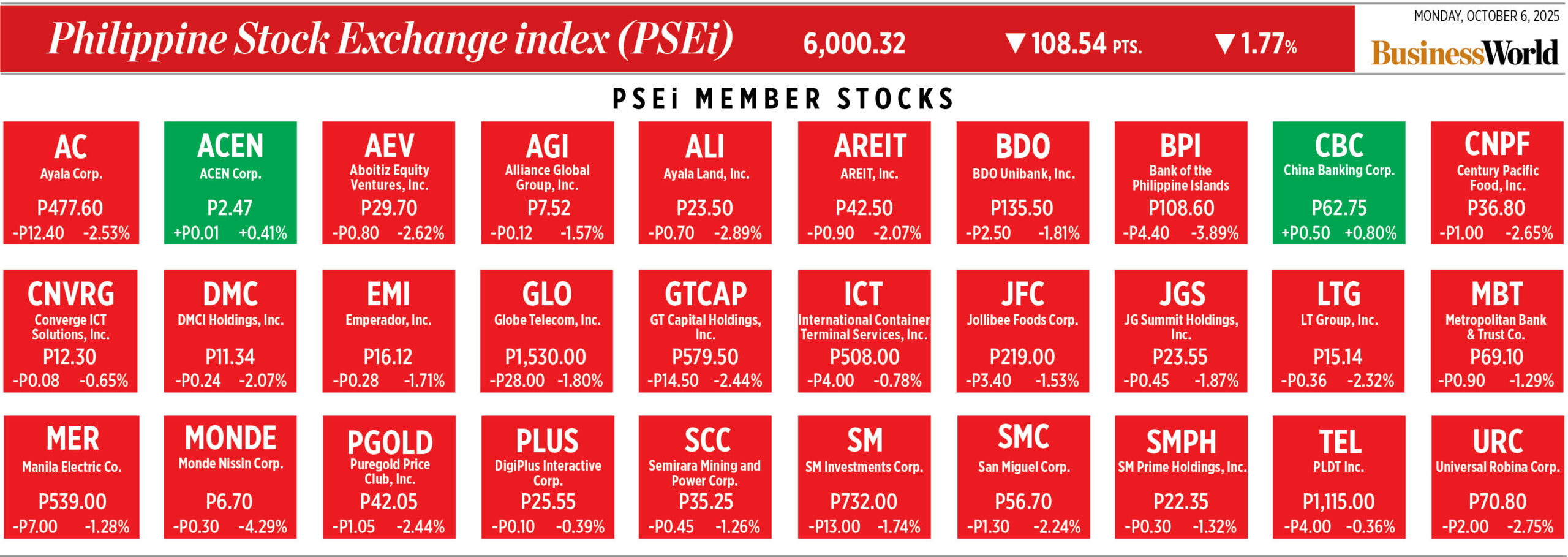
How PSEi member stocks performed — October 6, 2025

Here’s a quick glance at how PSEi stocks fared on Monday, October 6, 2025.


Shares slide as market turns cautious before CPI

BW FILE PHOTO

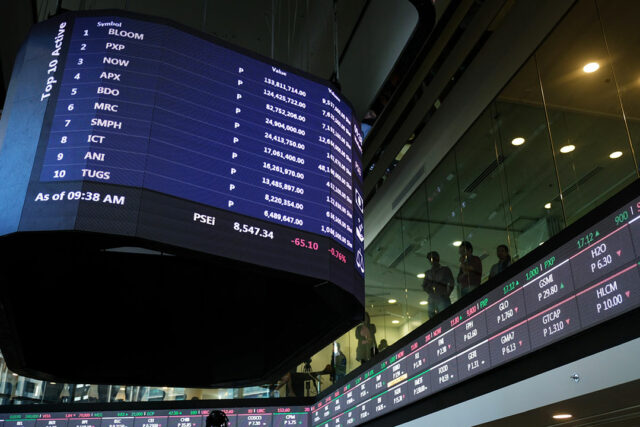
PHILIPPINE STOCKS slid anew on Monday, snapping a three-day climb as investors pocketed their profits and took a cautious stance before the release of the September consumer price index (CPI).

The benchmark Philippine Stock Exchange index (PSEi) sank by 1.77% or 108.54 points to close at 6,000.32, while the broader all shares index dropped by 1.13% or 41.90 points to 3,643.95.

“The PSEi declined after three consecutive days of gains last week as profit taking influenced today’s trading session. Investors remain cautious ahead of the inflation rate release tomorrow, which could influence the BSP’s (Bangko Sentral ng Pilipinas) next policy move,” Regina Capital Development Corp. Head of Sales Luis A. Limlingan said in a Viber message.

The Philippine Statistics Authority will release September inflation data on Tuesday (Oct. 7), while the BSP’s policy-setting Monetary Board will hold its review on Thursday (Oct. 9).

A BusinessWorld poll of 12 analysts yielded a median estimate of 1.9% for September inflation, within the BSP’s 1.5-2.3% forecast for the month.

If realized, the CPI would have accelerated from 1.5% in August but steadied from the 1.9% clip in September 2024. This would also be the fastest print in six months or since the 2.1% in February.

Meanwhile, the market is divided on the BSP’s next move, with 10 of 16 analysts in a separate BusinessWorld poll expecting the central bank to pause this week due to emerging inflation risks following three consecutive cuts that brought its policy rate to 5%.

The remaining six said the BSP is likely to deliver a fourth straight 25-basis-point (bp) reduction to support the economy amid weaker growth prospects.

The central bank has lowered rates by a cumulative 150 bps since it began its rate-cut cycle in August 2024. BSP Governor Eli M. Remolona, Jr. has left the door open to one last cut this year that could end this easing cycle.

“The market slumped anew back to 6,000 levels in a broad-based decline that saw all but two index stocks ending in the red, as risk-off sentiment continues to prevail,” AP Securities, Inc. said in a market note.

The majority of sectoral indices ended in the red on Monday. Holding firms declined by 2.02% or 100.57 points to 4,868.22; financials fell by 1.97% or 41.15 points to 2,042.04; industrials went down by 1.63% or 147.82 points to 8,868.57; property sank by 1.42% or 32.72 points to 2,261.87; and services dropped by 0.78% or 17.78 points to 2,252.48.

Meanwhile, mining and oil rose by 2.61% or 346.07 points to 13,605.29.

Decliners overwhelmed advancers, 139 to 64, while 58 names closed unchanged.

Value turnover surged to P12.12 billion on Monday with 2.07 billion shares traded from the P4.57 billion with 798.67 million stocks that changed hands on Friday.

Net foreign selling increased to P341 million on Monday from P80.56 million on Friday. — A.G.C. Magno

Motorcycle sales up 11.8% in first 8 months

Around 200 motorcycle riders pass Roxas Boulevard in Manila, Sept. 17, 2023. — PHILIPPINE STAR/EDD GUMBAN

MOTORCYCLE SALES hit 1.23 million units in the first eight months, up 11.8% from a year earlier, the Motorcycle Development Program Participants Association, Inc. (MDPPA) said in a statement.

The MDPPA, an association of major motorcycle brands like Honda, Kawasaki, Suzuki and Yamaha, and TVS, said August sales amounted to 133,689 units, up 18.4% year on year.

The association described Philippine demand as “sustained” due to their products’ affordability and practicality in the face of increasingly congested roads.

The MDPPA’s forecast for full-year sales growth, issued earlier in the year, was 5%.

The leading product segments in August were automatic motorcycles with sales of 106,382 units, up 24.8%; mopeds (21,805 units, up 3%).

Sales of motorcycles purchased for business amounted to 26,399 units in August 2025, up 14.4%.

“Despite declines in some segments, the industry as a whole remains in a healthy position, and we are confident that the broad appeal of motorcycles will continue to drive demand moving forward,” according to Alexander A. Cumpas, MDPPA president. “This positive growth trajectory is a testament to the enduring relevance and growing importance of motorcycles in the everyday lives of Filipinos, underscoring a resilient and evolving industry.”

MDPPA’s advocacies include road safety and environmental protection.

Rice import suspension, tariff hike called harmful to PHL’s poorest 30%

PHILSTAR FILE PHOTO

THE Foundation for Economic Freedom (FEF) said the proposals put forward by the Department of Agriculture (DA) to address weak prices of palay (unmilled rice) reflect short-term thinking that erode competitiveness and harm the poorest third of the population.

In a position paper, the FEF, whose membership consists of former government technocrats, said measures like  freezing rice imports, raising import tariffs from the current 15%, and price caps are potentially inflationary and at any rate have failed to raise palay farmgate prices since the import freeze took effect at the start of September.

The 60-day rice import freeze is currently under study for a possible extension to the end of the year. It had been imposed to provide relief to farmers, who had been receiving lowball offers for their grain by traders.

Meanwhile, tariffs are being considered for restoration to 35%.

The FEF called for the immediate lifting of the import freeze and maintaining rice tariffs at 15%. It supports investment in research, irrigation, infrastructure, and extension service to increase farmer productivity.

It also called for the government’s rice reserves to be managed by the Department of Social Welfare and Development (DSWD), to make emergency distribution more efficient.

It said the private sector should take the lead in stabilizing prices, leaving the DA with the main responsibility of distributing cash assistance to the 2.2 million rice farmers, which will require a robust farmers’ registry to minimize fake claims. — Andre Christopher H. Alampay

Shift to 10% VAT could signal more borrowing, taxes Metrobank says

DOF.GOV.PH

THE GOVERNMENT could raise borrowing and other taxes to offset billions in foregone revenue should it decide to reduce value-added tax (VAT) to 10% from the current 12%, Metropolitan Bank & Trust Co. (Metrobank) said.

“One thing is clear: reducing the VAT rate would result in a substantial loss of government revenue,” Metrobank said in a commentary attributed to Marian Monette Q. Florendo, a research and business analytics officer, and James Nathan Ang of the bank’s research and market strategy departments.

Any resulting hike in borrowing or taxes could outweigh the expected benefits of lowering VAT.

Last month, Batangas Rep. Leandro Antonio L. Leviste filed House Bill (HB) No. 4302 seeking to reduce VAT to 10% from 12% to make the country’s tax system more “progressive.”

According to the measure, however, the government may opt to return the VAT rate to 12% for a year if the projected deficit is expected to surpass the programmed deficit.

The Department of Finance, which has said that it does not support new taxes, warned that HB No. 4302, if signed into law, could lead to foregone revenue averaging P330 billion annually, which is equivalent to 1% of gross domestic product (GDP).

The Bureau of Internal Revenue posted VAT collections of P467.04 billion by the end of July, below its P473.41-billion target but 9.17% higher than its year-earlier total.

VAT is imposed on the sale, barter, exchange or lease of goods or property and services and on imported goods.

Metrobank’s Ms. Florendo and Mr. Ang cited three potential scenarios in the event of a VAT reduction, including “the government (offsetting) the revenue loss through increased borrowing.”

At the end of June, the debt-to-GDP ratio was 63.1%, the highest since 2005 and a ratio that Metrobank said “provides limited space for further debt accumulation.”

The Metrobank analysts also noted that the measure could prompt the National Government to increase its levies on other goods and services.

“The second is that the government will seek alternative sources of revenue to offset the losses,” they said. “This could involve raising taxes on specific goods or services, which may, in turn, lead to higher prices on these items, potentially undermining the intended relief from the VAT reduction.”

They added that it could boost household consumption if businesses lower their prices to reflect the reduced VAT.

Household final consumption grew 5.5% in the second quarter, outpacing the 4.8% from a year earlier.

“With more disposable income, consumers might spend more on goods and services, which in turn could expand the overall tax base. While this may not fully cover the shortfall, it could soften the revenue impact by boosting economic activity,” Ms. Florendo and Mr. Ang said.

“The challenge, however, is that the scale of this effect would depend heavily on consumer response and whether businesses pass on the tax savings to their customers,” they added.

Metrobank said the government’s analysis of the potential impact of a VAT adjustment and other tax measures must be data-driven to show potential benefits to economic competitiveness while demonstrating fiscal prudence. — Katherine K. Chan