Home Blog Page 401

Alba Viento Power plans P34-B wind farm in Zambales

FREEPIK

RENEWABLE ENERGY developer Alba Viento Power Corp. is proposing to build a 300-megawatt (MW) wind farm in Zambales with an estimated cost of $600 million (P34 billion).

In a filing with the Department of Environment and Natural Resources, the company said the project will cover 4,698 hectares across Botolan and Cabangan municipalities.

Construction is targeted to begin in the first quarter of 2027, with commercial operations expected by the first quarter of 2029.

“The proposed wind power plant will help augment the demand for reliable and affordable power supply,” Alba Viento said. “The project will not only supply electricity to Filipino households and businesses but will also contribute to national development.”

The company said it plans to use higher-capacity wind turbine generators to maximize output while minimizing land disturbance within the contract area. The facility is expected to connect to the Botolan substation of the National Grid Corp. of the Philippines.

Alba Viento said the project aligns with the Philippines’ renewable energy transition and supports the country’s clean energy goals.

Alba Viento Power is a special purpose vehicle wholly owned by Alba Renewables Philippines Corp., which in 2024 secured a 25-year wind energy service contract from the Department of Energy to develop and utilize wind energy in Zambales.

Alba Renewables aims to become the leading independent power producer in Southeast Asia within the next five years. While focusing on the Philippines, it is expanding into Thailand and plans to enter a third regional market within 24 months. The company is targeting a multi-gigawatt portfolio of operational, under-construction, and advanced-stage development assets. — Sheldeen Joy Talavera

Entertainment News (10/21/25)


K-drama hits come alive in PPO concert

THE magic of Korean drama is set to return to the concert stage as the Cultural Center of the Philippines, the Korean Cultural Center in the Philippines, and the National Commission for Culture and the Arts present OST Symphony II: K-Drama in Concert. It will take place on Oct. 25 at the Samsung Hall, SM Aura, Taguig City, with two shows at 2 and 6:30 p.m. It will star the Philippine Philharmonic Orchestra (PPO) led by Herminigildo Ranera. The setlist will include the music of KPop Demon Hunters, Crash Landing on You, and When Life Gives You Tangerines. There will also be guest performers: Korean singer-songwriter Hong Isaac, rising artist YEGNY, and Filipino performers Kyline Alcantara and Angel Guardian. The concert is free and open to the public, with tickets available at smtickets.com.


GMA, FILSCAP renew alliance to protect music rights

GMA NETWORK and the Filipino Society of Composers, Authors, and Publishers, Inc. (FILSCAP) have renewed their partnership in protecting and upholding the rights of artists behind original musical works. The contract signing was held last week in Quezon City, with the goal to help artists be aware of and be active in upholding the rights of their musical compositions.


Dusit Thani will have a tree lighting celebration

DUSIT THANI is having its tree lighting celebration in time for the holiday season. It will take place on Nov. 6 starting at 6 p.m. The ceremony will feature a performance by Christian Bautista. The event will be at the hotel lobby of the Dusit Thani Manila at the Ayala Center, Makati City.


Pink glitter edition of Maya Visa card released

THIS November, K-pop girl group BLACKPINK is holding its DEADLINE World Tour in Manila. In line with this, payment platform Maya is offering VIP tickets, exclusive perks, and concert seats which fans can avail themselves of using the pink glitter edition of the Maya Visa card. From Oct. 1 to Nov. 11, daily spend using the card can earn participants raffle entries for the giveaways. A minimum spend of P500 in a single transaction qualifies for one daily entry.


ENHYPEN’s first VR concert to visit Manila

K-POP boy group ENHYPEN’s first-ever VR concert, IMMERSION, will tour many countries, including the Philippines. It will be shown in Manila exclusively at the Gateway Cineplex in Cubao, Quezon City from Nov. 20 to Dec. 6. Tickets will be available starting Nov. 8 at 12 p.m. via gatewayImmersive.com.ph. The concert is presented by Wilbros Live.


McDonald’s Stripes Run set for December

THE 2025 McDonald’s Stripes Run marks the 14th year of the event. This year’s race kit includes a shirt, race bib, race socks, tote bag, and goodies from partner brands. Aside from the race kit, everyone will get freebies at the finish line. It will take place on Dec. 7 at the SM Mall of Asia Concert Grounds in Pasay City. Proceeds from the run will go to the programs of Ronald McDonald House Charities of the Philippines, a non-profit organization that supports Filipino children by providing better access to education and healthcare. To register, visit https://bit.ly/McDonaldsStripesRun2025.


The Fray, December Avenue to perform at Araneta

AMERICAN band The Fray and Filipino band December Avenue will be sharing the spotlight at the Smart Araneta Coliseum in Quezon City on Dec. 12.  Fans can expect a setlist of both international and local favorites from both bands, performed live at the venue. Tickets are available via Ticketnet at https://www.ticketnet.com.ph/event-detail/the-fray.


Tame Impala releases 5th album

SINGER-SONGWRITER Tame Impala (real name: Kevin Parker) has released his fifth full-length album, Deadbeat, via Columbia Records. The album opener, “My Old Ways,” has also dropped its music video, directed by Kristofski and featuring cinéma vérité footage the director took throughout the process of Mr. Parker making the record in various locations around the world. The album is inspired by Australian bush doof culture and particularly the local scene centered around Margaret River in Western Australia in the 1990s. It is out now on all digital music streaming platforms.


Bryan Adams to tour in Manila

GRAMMY-WINNING singer-songwriter Bryan Adams has announced the Asia leg of his newest tour, Roll With The Punches. The Manila concert will be held at the SM Mall of Asia Arena on Jan. 31, 2026, presented by Wilbros Live. Tickets are now available via SMTickets.com and SM Tickets outlets nationwide.

A new populist tool

Students attend online classes in Baseco, Tondo, Manila. — PHILIPPINE STAR/EDD GUMBAN

By Jam Magdaleno and Cesar Ilao III

LAST WEEK, Laguna Governor Marisol “Sol” Aragones announced a blanket suspension of in-person classes at all levels, shifting all schools — public and private alike — to online learning. The reason? The “possible” occurrence of a strong earthquake within two weeks, following the tremors that recently hit Cebu and Mindanao.

To many parents, the announcement sounded reassuring: better safe than sorry. To students, it meant almost a month of flexible learning, reminiscent of the pandemic experience. To politicians, it was a masterstroke of populist signaling: quick, visible action that pleases an anxious public.

The rush to suspend in-person classes reveals how, in post-pandemic Philippines, class suspensions have become the new populist tool. What used to be a last-resort response to typhoons and calamities is now wielded as a political reflex, an easy way to appease fearful constituents while avoiding deeper, structural questions.

But what do we mean when we say “populist?” We use the term in its broadest sense: politicians appealing to public sentiment as the highest virtue, while overriding other bases for policy decisions, such as science and data. Populism thrives on a binary framing that leaves little room for nuance.

One familiar refrain captures it well: “Ang klase na mawawala ay maaaring mahabol, ngunit ang buhay ay iisa (One can catch up a missed class, but you only have one life).” Such rhetoric turns complex policy trade-offs into moral absolutes.

The suspension was premised on the “precautionary” need to conduct structural checks on school buildings. Yet this raises a fundamental question: Why only now? Earthquakes in the Philippines are not new; they are regular features of our geography. The National Building Code of the Philippines (Republic Act No. 6541) already mandates that all public and private buildings be properly maintained to ensure structural safety and integrity. If safety inspections were a true priority, shouldn’t they have been scheduled routinely, not triggered by social media panic? In other words, the decision is reactive, not proactive.

Instead of institutionalizing safety through preparedness and infrastructure investment, officials resort to what communication scholars describe as symbolic action — temporary closures, online classes, and “monitoring” announcements — that perform concern and signal action but deliver little in the long term. To borrow from French thinker Guy Debord, we are witnessing a spectacle of safety.

Two days after Laguna’s announcement, the Department of Education (DepEd) issued “a reminder” that class suspensions should be “exercised with balance and prudence,” signaling that the measure may have gone too far.

The most troubling assumption behind such decisions is that learning can be replicated online without compromising its quality. The pandemic normalized a reliance on digital platforms among schools and local officials: an approach often mistaken for a genuine, science-backed education policy.

What began as a temporary emergency response in 2020 has since become a perverse incentive. one that allows decision-makers to suspend in-person learning at the slightest “hint” of danger, even after seismologists have disproved rumors that recent the earthquakes were related to one another.

Let’s look at the facts: For millions of students, “online learning” means poor connectivity, unaffordable devices, and parents forced into the role of teachers. For younger pupils, it means lost social interaction, the foundation of real learning. The abrupt shift also presumes that teachers and professors can instantly rework lesson plans, laboratory activities, and fieldwork schedules without disruption.

To assume that schools can switch back to online mode overnight, with no preparation, is to ignore the very crisis policymakers claim to address.

Every day of lost classroom instruction further widens the gap in reading, math, and science — areas in which Filipino students already perform among the world’s weakest. In the 2022 PISA assessment, the Philippines scored 355 points in mathematics (versus the OECD average of 472) and 347 points in reading (versus 476). The science result was approximately 373 points (against an OECD average of 485). Because each 20-point shortfall is roughly equivalent to one year of schooling, this implies that Filipino 15-year-olds could be as much as five to six years behind their international peers.

Education officials and local executives appear to have forgotten that physical classes remain the irreplaceable venue of instruction. Every canceled class, every day of lost interaction, compounds the learning crisis the country already faces.

Beyond education, these suspensions reverberate through the local economy. The small karinderya (food stall) beside the school, the jeepney and tricycle drivers who ferry students, and the sari-sari (sundry) stores that sell snacks all lose income when classrooms are empty.

According to a 2021 study by the Asian Development Bank (ADB), a full year of school closures could cost the Philippine economy up to P1.15 trillion in lost output as parents withdraw from work and productivity declines. Meanwhile, the Philippine Statistics Authority (PSA) reported in 2023 that Laguna’s economy surpassed P1.03 trillion in gross provincial output, making it the first province in the country to cross the trillion-peso mark. Given this scale, even short-term disruptions in in-person learning can ripple through local communities with significant economic consequences.

While future studies have yet to quantify how much small enterprises lose during prolonged suspensions, the scale of Laguna’s economy and its dependence on service and transport livelihoods make such disruptions far from trivial.

The move also sets a worrying precedent. If one province can cancel in-person learning for almost a month on the basis of a possible earthquake, what will stop other local executives from doing the same?

Laguna’s case is a symptom of a larger national problem: the ease with which we suspend learning, and with it, progress itself. When short-term political optics replace long-term investment in schools and safety, we tell an entire generation of students and parents that disruption is normal and that education is negotiable.

Populism always exacts a price beyond the next election — it is society that ultimately pays. In this case, the cost is a weaker education system, deeper learning losses, and an economy made ever more fragile by political performance.


Jam Magdaleno is a political and economic researcher, writer, and communication strategist. He is the Head of Information and Communications of the Foundation for Economic Freedom (FEF), a Philippine-based think tank. Cesar Ilao III is a lecturer at the University of the Philippines and a researcher and communications specialist for the FEF. He was formerly a researcher at Monash University, Australia.


Philippines: balance of payments (BoP) position

THE PHILIPPINES’ balance of payments (BoP) surplus sharply narrowed year on year in September, the central bank reported on Monday. Read the full story.

Philippines: balance of payments (BoP) position

UnionBank OKs resignation of 3 senior officers

BW FILE PHOTO

UNION BANK of the Philippines (UnionBank) on Monday said it has accepted the resignation of three assistant vice-presidents from its consumer banking group, marking a series of management changes in the Aboitiz-led lender’s retail operations.

In a disclosure to the Philippine Stock Exchange, the bank said the departures include ATM Services Manager and Assistant Vice-President Maria Louisa S. Doce, Consumer Banking Product Development head and Assistant Vice-President Anna Margarita A. Gapac and Government and Debit Cards Channel head and Assistant Vice-President Ma. Nerliza A. Centeno.

Ms. Doce’s resignation will take effect on Oct. 23. Ms. Gapac, who also resigned due to personal reasons, will step down on Oct. 25, while Ms. Centeno opted for early retirement effective Oct. 22, the lender said.

UnionBank had not yet announced their replacements.

The management changes come as the bank continues to navigate tighter margins and higher provisioning expenses. Its net income fell 40.5% year on year to P1.82 billion in the second quarter due to lower loan interest earnings and increased credit provisions.

In the first half, its consolidated profit stood at P3.25 billion, down 38.9% from a year earlier.

UnionBank has been focusing on digital banking and technology-driven services after its acquisition of Citigroup, Inc.’s local consumer banking business in 2022. The lender is also among the first in the country to operate a digital bank under its UnionDigital unit.

UnionBank shares closed at P29 each, down 0.34% or 10 centavos from the previous trading day. — Aaron Michael C. Sy

How PSEi member stocks performed — October 20, 2025

Here’s a quick glance at how PSEi stocks fared on Monday, October 20, 2025.


Palace says gov’t intensifying steps vs corruption after biz groups’ call

PHILIPPINE STAR/EDD GUMBAN

THE MARCOS administration on Monday said it is intensifying efforts against corruption following calls of major Philippine business groups for a swift and decisive action, amid what they described as “historic, massive and unprecedented” scandal involving public works projects.

“So much has been done and many more are still being investigated,” Palace Press Officer Clarissa A. Castro told a news briefing in Filipino, citing initiatives such as the creation of the “Sumbong sa Pangulo” platform and the Independent Commission for Infrastructure (ICI).

“The President and the administration share the sentiment of businessmen, which is why investigations continue, and actions are being expedited to hold those involved accountable.”

In a joint resolution, major Philippine business organizations over the weekend urged Philippine President Ferdinand R. Marcos, Jr. to take swift and decisive actions against corruption, warning that the controversy has damaged investor confidence and posed serious threat to the country’s economy, governance, and international standing.

They noted that while businesses regularly pay taxes and regulatory fees, they expect the government to act transparently and uphold accountability in return.

The coalition, comprising the Makati Business Club, the Philippine Chamber of Commerce and Industry, and the Employers’ Confederation of the Philippines, among others, also called on the President to empower the ICI with greater authority to thoroughly investigate and prosecute those involved in the alleged anomalies.

They cautioned that continued inaction could weaken the Philippines’ competitiveness and deter foreign investment.

They added that restoring integrity in government operations is essential to rebuilding public trust and promoting sustainable economic growth.

Ms. Castro said Malacañang agrees that the ICI could use “more teeth,” but maintained that it is already performing well under existing authority.

“When the ICI calls witnesses — even senators and members of Congress — they cooperate and respond. The investigation is proceeding smoothly,” she said.

Asked whether the President is open to granting the ICI expanded powers through legislation, as proposed by Caloocan Rep. Edgar R. Erice, Ms. Castro said the President “will not close the door” on the idea but sees no immediate need.

“If there’s room for improvement, the President is always open. But right now, the ICI’s work speaks for itself,” she said.

INFRA COST-CUTTING PLAN
Meanwhile, the Department of Public Works and Highways (DPWH) on Monday said that it will soon release its recommendations to lower the project cost for local infrastructure projects, as the agency faces mounting scrutiny over corruption.

“Very soon, we will be coming up not just with an across the board (recommendation), but a per-region adjustment to the cost of materials throughout the projects,” Public Works Secretary Vincencio B. Dizon said during the agency’s budget hearing.

The recommendations are part of the agency’s revamp amid the scandal that involved contractors and Public Works officials who allegedly siphoned off funds meant for flood control projects.

“In the next few weeks, we will be announcing a recommendation already and this must be applied immediately, not just moving forward, but must be applied immediately, especially, for those projects that are still ongoing procurement,” he added.

In the same hearing, Senator Lorna Regina “Loren” B. Legarda proposed to cut all DPWH infrastructure projects by about 25% to 30%, noting overpricing on project costs as a “temporary corrective measure.”

Senator Paolo Benigno “Bam” Aquino IV said that an across-the-board budget cut may be warranted if the DPWH fails to address overpricing.

“If there’s overpricing, we won’t be able to sign off in good conscience knowing that the design and cost of materials are overpriced,” Mr. Aquino said.

The Public Works chief said that some infrastructure projects of the agency have been found to be overpriced by up to 30% of the original costs.

“Because many of them are higher than the real cost of materials all over the country,” he added.

Mr. Dizon said that any saving generated from the cost-cutting measures could be utilized by the government for “more important or equally important services.”

Earlier, the DPWH’s 2026 budget was slashed to P625.78 billion, 28.9% lower than the original proposal of P881.31 billion, after Mr. Marcos ordered a “sweeping review” due to the corruption scandal. — Chloe Mari A. Hufana and Adrian H. Halili

House open to cutting standby fund but caution needed, lawmaker says

PHILIPPINE STAR /KJ ROSALES

THE House of Representatives is open to cutting unprogrammed appropriations, a lawmaker said on Monday, but warned that some projects still require standby funding despite calls for proposed reductions.

In a media briefing, Nueva Ecija Rep. Mikaela Angela B. Suansing said she is “very open” to discussions on reducing allocations for unprogrammed appropriations, adding that the House is not firmly opposed to revisiting standby funding once the budget bill enters bicameral conference deliberations.

But she emphasized the need to preserve standby allocations for foreign-assisted projects and the military’s modernization program, saying that abrupt cuts to their spending could jeopardize the programs that rely on flexible funds.

“I’m very open to discussing with the Senate how we can potentially rationalize the contents of unprogrammed appropriations,” said Ms. Suansing, who heads the House Appropriations Committee. “But as you can see, there are other programs that really need to be retained.”

“The House is not closed to the possibility that the entire P243-billion [unprogrammed] allocation may not be retained.”

Senate President Vicente “Tito” C. Sotto III said in early October that the chamber would push to remove all unprogrammed funds from the proposed P6.793-trillion national budget for 2026, adding that he had discussed the proposal with Senator Sherwin T. Gatchalian, who heads the Senate Finance Committee.

The House last week approved its version of the 2026 budget on final reading, reallocating around P255 billion originally earmarked for flood control projects. Congressmen also trimmed the Office of the Vice-President’s budget to P733 million and revised P35 billion in standby funds.

The spending bill must still pass second and third readings in the Senate and undergo deliberations in a joint congressional committee, where further revisions may be introduced, before it can be transmitted to the Presidential Palace for signing.

“Rather than zeroing out the particular items under unprogrammed appropriations, one option is to explore reducing them,” she said.

She said some P133 billion needs to be retained for foreign assisted projects. The funding could not be placed under assured funding due to strict requirements in securing guaranteed allocations.

“Because during the budget preparation stage, the requirements needed for these projects to be included in programmed appropriations were not met,” she said.

There must be a “perfected contract” between the Philippines and foreign institutions for the project, and it must be approved by the socioeconomic planning board first before being included in the budget bill.

She added a portion of the P50-billion funding should also be retained for military modernization.

“Our armed forces really need additional support for equipment.”

Ms. Suansing said the House adopted most of the unprogrammed appropriations because they are “necessary funds” for next year, noting that their implementation depends on the availability of additional government revenues.

Congressmen slashed unprogrammed appropriations to P243 billion from the initially proposed P249 billion under the National Expenditure Program.

Also on Monday, Ms. Suansing said the House ensured the proposed 2026 budget would be free of “pork barrel,” which previously allowed lawmakers to fund projects within their districts that fell outside the national infrastructure program. — Kenneth Christiane L. Basilio

Groups ask Ombudsman to probe impeachment raps vs VP Duterte

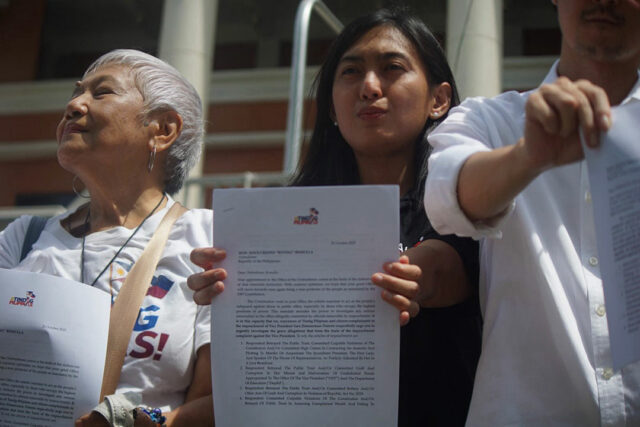
A CITIZEN coalition filed a letter urging the Office of the Ombudsman to investigate allegations raised in the impeachment complaints against Vice-President Sara Duterte-Carpio, Oct. 20, 2025. — AKBAYAN PR

A CITIZEN coalition on Monday filed a letter before the Office of the Ombudsman urging an investigation into allegations raised in the impeachment complaints against Vice-President Sara Duterte-Carpio over her alleged misuse of confidential and intelligence funds (CIF) and grave abuse of power.

“We are calling on the Ombudsman to take the cases against Vice-President Sara Duterte seriously, to investigate the articles of impeachment,” said Francis Joseph “Kiko” Aquino Dee, co-convenor of the Tindig Pilipinas, in an interview with reporters.

Tindig Pilipinas, along with Magdalo and Mamamayang Liberal, was among the groups that filed the first impeachment complaint against Ms. Duterte in 2024.

In their letter, the groups asked the Ombudsman to initiate a motu proprio investigation and, if warranted, file appropriate cases against the Vice-President.

In a separate statement, Akbayan called Ms. Duterte’s earlier justification that she used the confidential funds to “investigate corruption” within her agency an “absurd alibi” meant to divert public attention from her alleged misuse of public money.

The Office of the Vice-President (OVP) did not immediately respond to a Viber message seeking comment.

The complaints accused Ms. Duterte of committing a betrayal of public trust, culpable violation of the Constitution, graft and corruption, and other high crimes. These include her alleged public admission of plotting assassinations against the President, the First Lady, and the former House Speaker, as well as her alleged misuse of confidential funds under both the OVP and the Department of Education.

Tindig Pilipinas said Ms. Duterte’s “disturbing public admission” reflected the “violence and impunity” that marked her father’s anti-drug campaign.

The coalition also demanded full transparency on the use of confidential funds, comparing the issue to other alleged corruption cases such as ghost flood control projects.

The groups said the Ombudsman must demonstrate that its anti-corruption mandate “applies equally to all officials” and that “no one, not even the Vice-President, should be beyond the reach of the law.”

In July, the Supreme Court struck down the House’s impeachment complaint against Ms. Duterte, ruling that it had violated the one-year bar rule and her right to due process. The high court clarified that she was not absolved of the charges, and that a new complaint could only be filed starting February next year.

Critics have pointed to Ms. Duterte as among those positioning for the 2028 presidential elections, given that President Ferdinand Marcos Jr. is limited to a single term.

Ombudsman Jesus Crispin “Boying” C. Remulla said in a press briefing on Monday that his office would not set aside the articles of impeachment filed against Ms. Duterte and that these could serve as a reference in their fact-finding efforts to assess the allegations against her.

“It will serve as a good guide,” Mr. Remulla said. — Erika Mae P. Sinaking

Tariff panel to send proposal in Nov.

REUTERS

THE Cabinet-level Tariff and Related Matters Committee met last week to deliberate on the government’s extended deferment of rice imports and the proposed farmgate price for palay, with its recommendations expected to be submitted to the Economic Development Council (EDC) by the first week of November, the Palace said on Monday.

“They will submit their recommendations to the EDC, and we’ll have to wait and see what their final recommendation will be,” Palace Press Officer Clarissa A. Castro told a Palace briefing in Filipino.

The Marcos administration earlier suspended rice importation to stabilize domestic supply and temper retail prices amid concerns from both farmers and consumers.

The government is also weighing adjustments to farmgate prices to ensure fair returns for producers while managing inflation risks.

The Department of Economy, Planning, and Development is currently evaluating a proposal to open a one-month rice import window in January, followed by a reimplementation of an import freeze from February through April next year.

The plan comes amid pressure to balance farmer protection — with palay farm-gate prices falling year on year — and consumer supply stability in a sector liberalized under the Rice Tariffication Law. — Chloe Mari A. Hufana

DPWH vows to fill up 2,000 posts

DEPARTMENT of Public Works and Highways (DPWH) Secretary Vivencio “Vince” B. Dizon speaks during a press briefing with the Malacañang Press Corps on Sept. 1. — PHILIPPINE STAR/RYAN BALDEMOR

THE Department of Public Works and Highways (DPWH) said it is now filling up about 2,000 vacant positions with some positions to be filled through promotions of employees.

“We need to promote deserving, honest and hardworking people here in DPWH which include JO (job order),” Secretary Vivencio B. Dizon said in a statement on Monday.

The agency will prioritize employees of DPWH including those under job order or contractual basis, Mr. Dizon said, adding that this is in line with the government’s push to give opportunities to promote those job order employees.

Further, Mr. Dizon said reforms will also seek to eliminate salary delays.

Meanwhile, Mr. Dizon on Monday announced the appointment of Lara Marisse Esquibil as officer-in-charge for operations for Convergence Projects and Technical Services. — Ashley Erika O. Jose

6,000 suppliers flagged due to lack of ownership report

BW FILE PHOTO

THE Department of Budget and Management (DBM) said about 6,000 government suppliers with a platinum status risk suspension over non-submission of their beneficial ownership reports to the Philippine Government Electronic Procurement System (PhilGEPS).

In a statement on Monday, the DBM said out of the 12,769 PhilGEPS platinum registered corporations this year, only 6,766 have submitted their beneficial ownership documents.

“The disclosure of beneficial ownership is a powerful feature of the new law because it ensures that conflicts of interest in public procurement are avoided. We are closing the doors on corruption and collusion in bidding for government projects,” Budget Secretary Amenah F. Pangandaman said.

Under the new government procurement law, “old tricks of name-changing, head-swapping and dummy company owners will no longer work,” she said in mixed English and Filipino.

Procurement Service-DBM (PS-DBM) Executive Director Genmaries S. Entredicho-Caong said non-submission of this document automatically suspends their platinum registration, which is the only eligibility document required from bidders.

The DBM said the Government Procurement Policy Board, through PS-DBM PhilGEPS, with partners such as the World Bank and Open Ownership, is establishing a public online beneficial ownership registry of bidders and an analytical tool prototype to help procuring entities identify red flags and prevent irregularities.

Ms. Entredicho-Caong also noted that based on a 2023 Technical Support Office (TSO) report, it found that 65.8% of bidders have common owners, based on a random sampling of 180 procuring entities.

Meanwhile, the DBM found out that 71.6% of bidders were related to government officials.

PS-DBM earlier canceled PhilGEPS membership of multiple firms linked to the Discaya family, including the St. Gerrard Construction, Gen. Contractor & Dev’t Corp., Alpha & Omega Gen. Contractor & Dev’t Corp. and St. Timothy Construction Corp. — Aubrey Rose A. Inosante