Home Blog Page 3906

The disagreement between two climate scientists that will decide our future

CDD20 —UNSPLASH

GETTING to net zero emissions by mid-century is conventionally understood as humanity’s best hope for keeping Earth’s surface temperature (already 1.2°C above its pre-industrial level) from increasing well beyond 1.5°C — potentially reaching a point at which it could cause widespread societal breakdown.

At least one prominent climate scientist, however, disagrees.

James Hansen of Columbia University in the US published a paper with colleagues in November which claims temperatures are set to rise further and faster than the predictions of the Intergovernmental Panel on Climate Change (IPCC). In his view, the 1.5°C target is dead.

He also claims net zero is no longer sufficient to prevent warming of more than 2°C. To regain some control over Earth’s rising temperature, Hansen supports accelerating the retirement of fossil fuels, greater cooperation between major polluters that accommodates the needs of the developing world and, controversially, intervening in Earth’s “radiation balance” (the difference between incoming and outgoing light and heat) to cool the planet’s surface.

ABOUT US
There would probably be wide support for the first two prescriptions. But Hansen’s support for what amounts to the deliberate reduction of sunlight reaching Earth’s surface has brought into the open an idea that makes many uncomfortable.

Michael Mann from the University of Pennsylvania in the US and another titan of climate science, spoke for many when he dismissed solar radiation management as “potentially very dangerous” and a “desperate action” motivated by the “fallacy … that large-scale warming will be substantially greater than current-generation models project.”

Their positions are irreconcilable. So who is right — Hansen or Mann?

EARTH’S RADIATION BALANCE
First, an explanation.

There are only two ways to reduce global warming. One is to increase the amount of heat radiated from Earth’s surface that escapes to space. The other is to increase the amount of sunlight reflected back to space before it lands on something — whether a particle in the atmosphere or something on Earth’s surface — and is converted to heat.

There are many ways to do both. Anything that reduces the amount of greenhouse gas in the atmosphere will let more heat escape to space (replacing fossil fuels with renewables, eating less meat and tilling the soil less for example). Anything that makes the planet brighter will reflect more sunlight to space (such as refreezing the Arctic, making clouds whiter or putting more reflective particles in the atmosphere).

But the key difference between the two, in terms of their impact on global warming, is their response time. That is, the time it takes for a change in the factors that allow more heat to escape or sunlight to be reflected to appear as a change in Earth’s surface temperature.

Intervening to speed up the loss of heat from Earth’s surface cools the planet slowly, over decades and longer. Intervening to increase the sunlight Earth reflects back to space cools the planet more or less immediately.

The essence of the dispute between Mann and Hansen is whether reducing greenhouse gases, by a combination of reducing new emissions and permanently removing past emissions from the atmosphere, is now enough on its own to prevent warming from reaching levels that threaten economic and social stability.

Mann says it is. Hansen says that, while doing these things remains essential, it is no longer sufficient and we must also make Earth more reflective.

WHEN WILL WARMING END?
Mann aligns with IPCC orthodoxy when he says that emissions reaching net zero will result, within a decade or two, in Earth’s surface temperature stabilizing at the level it has then reached.

In effect, there is no significant warming in the pipeline from past emissions. All future warming will be due to future emissions. This is the basis for the global policy imperative to get to net zero.

In his new paper, Hansen argues that if the atmospheric concentration of greenhouse gases remains close to its current level, the surface temperature will stabilize after several hundred years between 8°C and 10°C above the pre-industrial level.

Of this, at least 2°C will emerge by mid-century, and probably a further 3°C a century from now. A temperature increase of this magnitude would be catastrophic for life on Earth. Hansen adds that to avoid such an outcome, brightening Earth is now necessary to halt the warming in the pipeline from past emissions.

But at the same time, we must also largely eliminate emissions if we are to stop recreating this problem in the future.

STILL GETTING HOTTER…
We are scientists who study the feasibility and effectiveness of alternative responses to climate change, addressing both the engineering and political realities of enabling change at the scale and speed necessary.

We find Mann’s rebuttal of Hansen’s claims unconvincing. Crucially, Mann does not engage directly with Hansen’s analysis of new data covering the last 65 million years.

Hansen explains how the models used by IPCC scientists to assess future climate scenarios have significantly underestimated the warming effect of increased greenhouse gas emissions, the cooling effect of aerosols, and how long the climate takes to respond to these changes.

Besides greenhouse gases, humanity also emits aerosols. These are tiny particles comprising a wide range of chemicals. Some, such as the sulphur dioxide emitted when coal and oil are burned, offset the warming from greenhouse gases by reflecting sunlight back to space.

Others, such as soot, have the opposite effect and add to warming. The cooling aerosols dominate by a large margin.

Hansen projects that in coming months, lower levels of aerosol pollution from shipping will cause warming of as much as 0.5°C more than IPCC models have predicted. This will take global warming close to 2°C as early as next year, although it is likely then to fall slightly as the present El Niño wanes.

Underpinning Hansen’s argument is his conviction that the climate is more sensitive to greenhouse gases than previously reported. The IPCC estimates that doubling atmospheric CO₂ raises Earth’s temperature by 3°C. Hansen calculates it to be 4.8°C.

This, and the much longer climate response time that Hansen calculates from the historical record, would have a significant impact on climate model projections.

TIME FOR REFLECTION
The differences between Mann and Hansen are significant for the global response to climate change.

Mann says that allowing emissions to reach net zero by mid-century is sufficient, while Hansen maintains that on its own it would be disastrous and that steps must now be taken in addition to brighten the planet.

Brightening Earth could also reverse the reductions in reflectivity already caused by climate change. Data indicates that from 1998 to 2017, Earth dimmed by about 0.5 watts per square meter, largely due to the loss of ice.

Given what’s at stake, we hope Mann and Hansen resolve these differences quickly to help the public and policymakers understand what it will take to minimize the likelihood of imminent massive and widespread ecosystem destruction and its disastrous effects on humanity.

While 1.5°C may be dead, there may still be time to prevent cascading system failures. But not if we continue to squabble over the nature and extent of the risks.


Robert Chris is an honorary associate, Geography, at The Open University. Hugh Hunt is a professor of Engineering Dynamics and Vibration at the University of Cambridge. The Open University provides funding as a founding partner of The Conversation UK. University of Cambridge provides funding as a member of The Conversation UK.


Improving children’s eating behavior

Maggi pushes for early nutrition education in public schools

THE BRAND Maggi — known for condiments, seasonings, and soups — is promoting growth and wellness to the youth by teaching schoolkids the value of eating vegetables.

In an e-mailed press release, Rosalyn Simba, Business Executive Officer of Nestlé Philippines’ Food and Dairy Culinary Business Unit (Maggi being a brand under Nestlé) explained their plans for the advocacy.

In 2023, through the help of the Department of Education (DepEd), the brand imparted nutrition concepts through the ongoing Sarap Sustansya Inter-School Cooking Competition. Since then, Maggi has opened the event to public schools that have implemented the DepEd’s Gulayan sa Paaralan program. Maggi aims to emphasize the importance of vegetable-based dishes and teach healthy cooking as an essential life skill through the competition.

The project requires each participating school to field a team comprised of a student, teacher, and parent who will cook a balanced meal for a family of four with a budget of P400.

“The cooking competition is a way for us to teach these positive skills in a fun and engaging manner,” said Ms. Simba. To truly support nutrition education, children must “enjoy the benefits of a vegetable-rich diet that brings out the flavor and goodness of vegetables in everyday dishes,” she added.

This is why Maggi continues to offer recipe ideas on its website, as well as other cooking tips in its Sarap Sustansiya Kusinaskwela modules.

Ms. Simba pointed out that the need for continued education is evident in the Philippines since there is a persistence of stunting and malnourishment in many Filipino schoolchildren between the ages of five and 10 years old.

According to a 2017 report by the Department of Science and Technology’s Food and Nutrition Research Institute and Nestlé Philippines, mean scores on knowledge, attitudes, and behavior towards nutrition improved after approximately 60 hours of nutrition lessons among Grade 2 and 3 students

A similar trend was also observed among the children’s mothers and caregivers after they attended nine sessions on nutritious foods, good eating habits, and balanced diets.

“Teaching schoolchildren at an early age about the importance of a balanced diet promotes the formation of healthy eating habits and lifelong behaviors that improve their nutritional status and overall wellness,” said Ms. Simba.

“Motivating young students to establish good eating practices can lay the foundation for a healthy Filipino population in the future.”

For recipes, visit
https://www.youtube.com/@maggiphilippines9761Brontë H. Lacsamana

PetroEnergy unit develops site for Bohol solar farm

STOCK PHOTO | Image by Pixabay from Pexels

PETROGREEN Energy Corp., the renewable energy arm of PetroEnergy Resources Corp., said on Wednesday said it had completed site development works for its 27-megawatt of direct current in Bohol.

“All the major site development works, prior to the installation of the solar panels and major electrical facilities, have been completed by our contractor, Media Construction and Development Corp.,” PetroGreen’s site engineer Frederick B. Pizana said in a statement.

Once operational, the P1.2-billion Dagohoy solar power project will supply power to Bohol, which has been dependent on imported power supply from Leyte and Cebu.

PetroGreen is a joint venture between PetroEnergy and Kyuden International Corp., the overseas investment arm of Kyushu Electric Power Co.

The company’s major contractors — Global Electric for the solar farm construction and Philcantech Enterprises for the electrical and grid connection — will prepare for the start of the power plant construction by the second week of January next year, according to PetroGreen Vice-President for Commercial Operations Maria Victoria M. Olivar.

“Barring any unforeseen circumstances, this progress should allow [PetroGreen] to meet our commitment to the [Department of Energy] and to our off-taker SN Aboitiz Power,” Ms. Olivar said.

Dagohoy Mayor Hermie C. Relampagos said the town is “blessed to be the site of the first large solar farm in Bohol.”

Earlier this month, PetroGreen said it had gained support from the municipal government of Bugallon in Pangasinan for its 25-megawatt solar power project.

The solar project, which is expected to generate 41,000 megawatt-hours of power, is set to deliver power in the area by the fourth quarter of next year.

For the third quarter, PetroEnergy reported an attributable net income of P167.95 million, up 51.3% from P111.03 million recorded last year.

Gross revenues increased by 47.6% to P959.51 million from P649.92 million previously. — Sheldeen Joy Talavera

How AI will change the way developers work

TRUSTPAIR.COM

By Laurent Doguin

1. Investments in WebAssembly will continue to grow.

While getting less attention next to the popular and trending large language models (LLMs), WebAssembly (WASM) is one to look out for. WASM is still evolving and has experienced recent advancements with companies continuing to invest in the future of this technology alongside the Bytecode Alliance.

WASM is making its way into databases, cloud platforms, edge devices, various SaaS technologies and more. Today, there are new technologies being developed to increase WASM interoperability, to create even more value around it. That said, as WASM continues to mature and more companies invest in this technology, we will see a usage increase both in and out of the browser, especially as new runtimes and compilers are developed.

2. Developers will brush up on their Python skills to keep up with LLMs.

While it was fairly easy to skip the Kubernetes hype and other infrastructure-related trends, AI and the focus on LLMs will be nearly impossible for developers to ignore.

For example, improving developer productivity is critical to the success of any technology organization. Each developer has different tasks, different stacks to work with and requires different things from various LLMs. As a result, developers will need to start fine-tuning LLMs to their specific needs, and Python is the default programming language to achieve that.

3. Generating code with artificial intelligence (AI) will be easily accessible through low-code/no-code.

Everybody’s talking about generative AI and LLMs and for good reason. However, there are still many unanswered questions about regulation, privacy, security, intellectual property and more.

Developers’ natural response to these challenges often mirror a curious and entrepreneurship-like approach, with many developers taking the “I’m going to build my own thing to solve this problem” route. But as developers’ interests grow around a particular area, the general level of knowledge rises, tooling improves, and abstractions move up so that it becomes easier to tackle a particular problem.

If we look at the most optimal way to fine-tune models, it’s often well-suited to a chain of tasks, and this can be easily represented graphically with low-/no-code tooling. As such, we can expect low-/no-code and generative AI to work hand-in-hand in facilitating everyone’s productivity.

4. Federated learning will be a key player in the future of AI, especially in a privacy-challenged world.

While it’s true that we might be done with the traditional learning set when it comes to AI, there are still many untapped sources of data. Anything we do on our devices syncs to a server to either train LLMs or fine-tune LLMs to a specific usage.

That’s where federated learning comes in. With the recent popularity of generative AI, there has been more buzz around adopting a decentralized approach to training AI models, also known as federated learning.

By having the ability to secure training models and support privacy-sensitive applications, federated learning will be a critical player in unlocking the future of AI, while addressing crucial concerns around data privacy and security.


Laurent Doguin is the director of developer relations and strategy at Couchbase, the cloud database platform company. Previously, he was a developer advocate at Couchbase where he focused on helping Java developers. Prior to Couchbase, Laurent held developer roles at Clever Cloud and Nuxeo.

WalterMart, 2GO team up for e-commerce delivery service

STOCK VECTOR | Image by pch.vector on Freepik

LOGISTICS provider 2GO Group, Inc. partnered with WalterMart Supermarket to provide delivery service in areas across Metro Manila for the latter’s e-commerce business.

In a statement on Wednesday, 2GO said the delivery service for WalterMart Supermarket’s e-commerce business would operate in Caloocan, Malabon, Valenzuela, Quezon City, San Juan, Pasig, Makati, Taguig, Pasay, Las Piñas, Bicutan, Parañaque, Muntinlupa, as well as areas in Manila such as Binondo, Tondo, San Andres, and Santa Ana.

“Through 2GO, our objective is to bring daily essentials from stores directly to customers while ensuring standards of product quality,” 2GO Retail Business Unit Head Dennis Yaw said.

2GO said the delivery service aims to provide customers with “the freshest and highest quality goods, delivered directly to their homes.”

“We have had a long-standing partnership with 2GO, and we trust in their commitment to ensuring our customers receive the best service,” WalterMart Assistant Vice-President for Business Development Victor Paul Intal said.

“With 2GO’s delivery services, we aim to maintain the high quality of goods delivered to our consumers’ doorsteps, aligning with WalterMart’s standards,” he added.

According to 2GO, the partnership would operationalize WalterMart’s grocery delivery service, which offers same-day delivery.

“This service aims to elevate the overall shopping experience for customers through user-friendly apps and online platforms, offering a convenient alternative to in-store visits, especially during the upcoming holiday season,” 2GO said.

“Furthermore, it extends its reach to customers residing abroad who wish to shop for their families in Metro Manila,” it added.

2GO, part of Sy-led SM Investments Corp., offers multimodal transportation, warehousing and inventory management, special containers, project logistics, and e-commerce logistics, including last-mile deliveries, and express courier deliveries. The company also provides sea travel and various peripheral logistics such as freight forwarding, import and export processing, and customs brokerage.

Formed in 1992, WalterMart Supermarket has 46 stores located in different areas such as Metro Manila, Laguna, Batangas, Cavite, Quezon, Bulacan, Tarlac, Pampanga, and Bataan. — Revin Mikhael D. Ochave

Top 10 trends in the economics of war and global peace

“And so this is Christmas, For weak and for strong/The rich and the poor ones, The road is so long/And so happy Christmas, For black and for white/For yellow and red ones, Let’s stop all the fight.”

— John Lennon, “Happy Christmas (war is over),” 1971.

There’s so many different worlds, So many different suns/And we have just one world, But we live in different ones/Now the sun’s gone to hell and, The moon’s riding high/Let me bid you farewell, Every man has to die/But it’s written in the starlight, And every line in your palm/We’re fools to make war, On our brothers in arms.”

— Mark Knopfler/Dire Straits, “Brothers in Arms,” 1985.


ADVANCED Merry Christmas, dear readers. Those words above from two of my many rock idols occasionally hum in my head when I read and hear about the ongoing brutal wars in Europe and the Middle East, and there are hints of the wars ending soon. And I hope it will be by the first quarter of 2024.

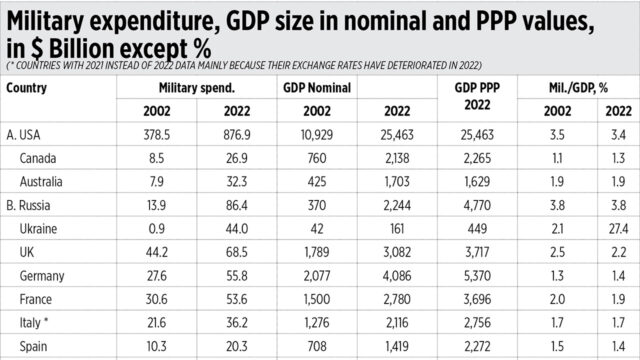
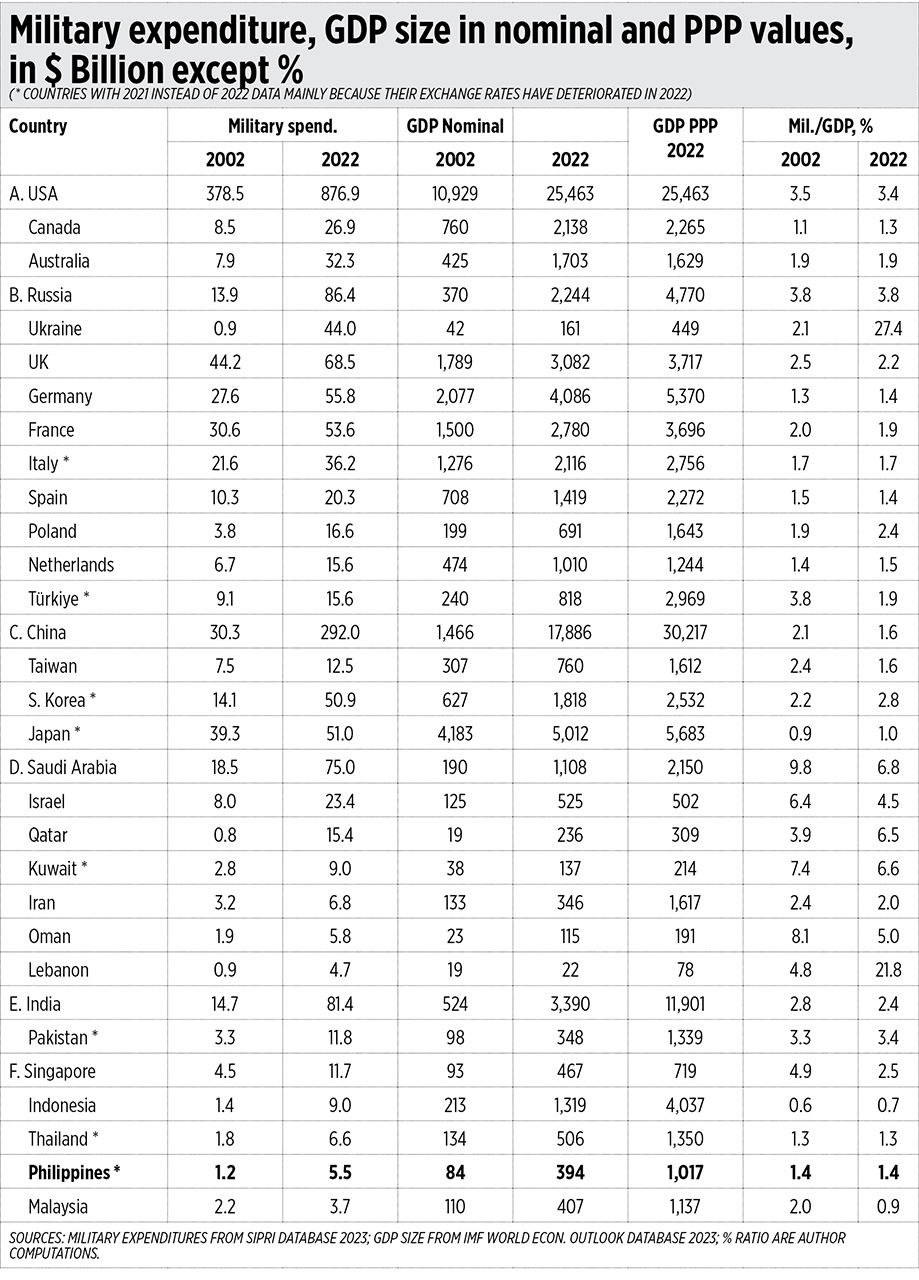
For this column I constructed a table showing how much countries spend on armaments and other military spending, and I compared the spending data with their GDP size. The source of data on military expenditure is the Stockholm International Peace Research Institute (SIPRI).

I grouped the countries into six. In Group A are the US, Canada, and Australia which can join any war in the Atlantic and Pacific sides, with Australia more focused on the Pacific. In Group B are countries involved in the Russia-Ukraine war. In Group C are those involved in the potential conflicts between China and Taiwan and North and South Korea. Those in Group D are involved directly or indirectly in the Israel-Gaza/Hamas war. In Group E are India and Pakistan which have a big territorial conflict over Kashmir. And in Group F are the ASEAN-5, which are not directly involved in any of the above-mentioned conflicts. Other countries which are involved in any of those regional conflicts but whose military spending is below $4 billion were not included in the table for the purpose of brevity.

Here are 10 trends in the economics of war, and our path to global peace.

One, the economics of war is that for some countries, “war is business” and hence, more actual wars or war preparations mean more business. This applies largely to countries like the US (think of its companies like Lockheed, Raytheon, Boeing, Northrop, General Dynamics…), the UK (BAE), and China (Norinco, AVIC…).

Two, these major arms exporting countries are often also those with high oil-gas demands yet have limited oil-gas production and reserves. Hence, a lot of past and current wars are in the Middle East (the US invasion of Iraq, a big portion of Syria), plus Russia which has huge oil-gas-coal reserves. The presence of a non-Muslim Israel in the Middle East neighboring Palestine is, of course, a big factor for the endless instability in the region.

Three, the US has the largest military expenditure in the whole world at $877 billion in 2022, three times larger than China’s $292 billion, and 10.2 times larger than Russia’s $86 billion. The US’ military spending/GDP ratio remains flat at 3.5% for the two decades from 2002 to 2022.

Four, Europe’s top five largest countries outside Russia (the UK, Germany, France, Italy, Spain) alone have combined military expenditures of $231.7 billion in 2022, which is 2.7 times larger than Russia’s. Ukraine military spending jumped from $1 billion in 2002 to $44 billion in 2022, much of its money and armaments sent by the US and NATO countries.

Five, Russia is not China. The Russian economy is “small” compared to China’s, its GDP nominal size of $2.2 trillion in 2022 is only 1/8th of China’s $17.9 trillion. And Russia’s military spending is only a third of China’s. If the US plus other big NATO countries cannot defeat Russia in their proxy war via Ukraine, there is big question mark over if the US and NATO can defeat China over the Taiwan issue.

Six, countries with the largest military spending/GDP ratio are not in NATO but in the Middle East. Saudi Arabia, Qatar, Kuwait, and possibly the United Arab Emirates (there is no data for 2021 or 2022) have 6-7% of GDP. But Iran, considering western media’s exaggeration that it has huge military spending, actually has a small ratio of only 2%. In contrast, poor Lebanon, with a GDP of only $22 billion in 2022 (smaller than Cambodia’s $29 billion and slightly larger than Brunei’s $17 billion) has military spending of 22% of GDP. Really weird and wasteful.

Seven, India, with its territorial conflict with Pakistan over Kashmir, also has a territorial conflict with China and hence is ramping up its defense spending. But its military/GDP ratio remains modest at 2.4%.

Eight, ASEAN countries with generally fast GDP growth continue to have modest military spending compared to many countries and regions in the world and this is good. Only Singapore has a military/GDP ratio of larger than 1.5% (see the table).

Nine, the so-called “rules based international order” (RBIR) is double talk. Invasion is wrong and anti-RBIR if the invader is Russia (invading Ukraine) or China (possibly invading Taiwan). But invasion is justified and consistent with RBIR if the invader is the US and other western NATO countries (see Vietnam, Afghanistan, Iraq, Syria, etc.). Invasion is invasion and we should condemn it whether the invader is Russia or America or China. We should focus on non-interference, stop these endless wars, stop regime-change via external aggression.

Ten, countries and humanity should focus on global peace and prosperity, diplomacy and wealth creation, not heavy armaments procurement and military destruction. We should devote our manpower to commerce, tourism, and investment and not on training so many soldiers and gun-toting warriors. Let John Lennon and Mark Knopfler’s words prevail in international politics and economics.

Hoping for peace and prosperity, hoping for an end to the Ukraine war and the Middle East war by early 2024. And hoping for no war whatsoever over Taiwan, over disputed atolls in the South China Sea or West Philippine Sea.


Bienvenido S. Oplas, Jr. is the president of Bienvenido S. Oplas, Jr. Research Consultancy Services, and Minimal Government Thinkers. He is an international fellow of the Tholos Foundation.

minimalgovernment@gmail.com

Actor Andre Braugher, star of Brooklyn Nine-Nine, 61

ANDRE BRAUGHER starred in the police satire Brooklyn Nine-Nine for eight seasons. —IMDB.COM

TWO-TIME Emmy-winning actor Andre Braugher, star of the television comedy Brooklyn Nine-Nine and the 1990s police drama Homicide: Life on the Street, died on Monday after a brief illness, his publicist said on Tuesday. He was 61.

Mr. Braugher starred alongside Andy Samberg in the police satire Brooklyn Nine-Nine for eight seasons from 2013 through 2021 in the role of Captain Ray Holt, for which he received four Emmy nominations and two Critics Choice awards for best supporting actor in a comedy series.

He had previously established himself as a dramatic actor playing Detective Frank Pembleton in Homicide from 1992 to 1998, a breakout role for which he won his first Emmy in 1998, for lead actor in a drama series.

Mr. Braugher also won an Emmy for lead actor in a miniseries in 2006 for the role of Nick Atwater in Thief.

In all, he had 11 Emmy nominations, according to the Television Academy’s website, and 67 acting credits, according to IMDB.com.

Mr. Braugher was also a regular on stage at the New York Shakespeare Festival, winning an off-Broadway Obie Award in 1997 for the title role in Henry V. He also played in Measure for Measure, Twelfth Night, and As You Like It.

His most recent film role was as New York Times Editor Dean Baquet in She Said, a dramatization of the newspaper’s Pulitzer Prize-winning work on the sexual abuse and harassment of leading figures in show business and the media.

Born and raised in Chicago, Mr. Braugher earned a B.A. from Stanford University and an M.F.A. from Juilliard, according a biography provided by publicist Jennifer Allen.

He is survived by his wife, actress Ami Brabson; sons Michael, Isaiah, and John Wesley; brother Charles Jennings and his mother, Sally Braugher. — Reuters

Age matters 

KRAKENIMAGES —UNSPLASH

“AGE cannot wither nor custom stale her infinite variety.” But that’s Shakespeare’s Cleopatra. Many others fall into a different category as far as aging goes. Age withers the ordinary person. In Cleopatra’s case the asp shortened her life anyway. She died at 39 years old.

Even when employers do not specify age limits for top jobs, including those to head big organizations, they have in mind a person south of 50 years old. The adjectives of “dynamic,” “energetic,” and “innovative” when putting together a profile of a recruitment target naturally attach to a youthful individual, not someone who gets a senior citizen discount at the restaurant.

Business safeguards the lowering of the age median in its organization by setting a mandatory retirement age, and even hurrying up the exits with early retirement. This ensures that after the retiree blows out six candles (each representing a decade) on his cake, he is on the way out. (You will be covered by our healthcare program for five more years.)

A “youth culture” is obligatory in entertainment and sports where someone in his mid-30s is nearing his expiration date. Sure, movies still feature cameo appearances by aging stars who may still rock but need to sit down after three minutes. They are especially in demand in sequels of a franchise series, playing their old roles decades back.

The culture of youth has extended to the political arena. Spokespersons don’t even have laugh lines, and candidates for local government positions look like the third generation of a dynasty, which they happen to be.

The fascination with young people taking the reins of government and business lies in the oft-quoted phrase that you can’t teach old dogs new tricks. Just mention the word “digital” and the topic quickly changes to vinyl records — they have a warmer sound.

This bias against age (sometimes called “ageism”) is pernicious as it seems enough to dismiss somebody who comes out for a TV interview simply by describing him as old without needing to refute the points he is making. (Of course, that was during your time, Sir.)

Still, it must be said that our culture respects age. How many times are we extended unsolicited help to climb stairs or negotiate a slippery floor? (Please take my hand.) What about the ever-ready offer to take a photo — Sir, you want me to take your photo with your very fetching caregiver?

But is an old person automatically ignored?

Certain positions are unaffected by age. A partial list of these will suffice. Trillionaires can have hair growing out of their ears and still be accorded a measure of respect punctuated by genuflections. There are Warren Buffet for one and his deputy successor, Charles Munger, even a bit older, both in their 90s (age, not the decade) but still taken seriously. The latter, who died recently at 99 years old, famously counseled against cryptocurrency — “it’s rat poison squared.”

Oldsters exempt from the age prejudice tend to hire or associate with others not in their age bracket, (Many of their classmates have died anyway.) When the management team looks like a class reunion for the golden jubilarians, it can send the wrong signal to the investors. Old leaders surround themselves with much younger associates, so that they can be construed to possess the faint intention of having a succession plan, even if they do not — success needs no succession.

Age has become a political issue in the presidential race in the most powerful country in the world. The top two contenders are only three years apart and crossing their 80s, not exactly holding hands. There are even now calls for setting an age limit for elected positions. The physical demands of a job, in the corporate or political setting, require some level of stamina, and the ability to stay awake at meetings.

Ageism fuels the demand for cosmetic alterations like removal of eye bags. (Ma’am, you need to check those in at the counter.) The effort to look younger, or at least not too old, is a constant struggle. Still, an increasing number of seniors just stop dyeing their hair and declare — okay, so I’m old… sue me.

Does age consign the elderly to a passive role? Carlos P. Romulo was supposed to have said that “Age does not matter, as long as the matter doesn’t age.” He was, of course, referring to the brain.


TONY SAMSON is chairman and CEO of TOUCH xda
ar.samson@yahoo.com

Rural lender launches digital banking platform OwnBank

OWN BANK, The Rural Bank of Cavite City, Inc., has launched an online banking platform called OwnBank, offering an 8% savings interest rate per annum to new depositors.

Users may avail of the 8% savings rate by applying for a seven-day time deposit account.

After seven days, users may transfer their funds to a regular OwnBank Time Deposit account that has a 7.5% savings rate and adjustable terms up to one year. They may also instead transfer the funds to Own It, an account with a daily-credited interest rate of up to 6%.

The OwnBank app also offers free fund transfers to other OwnBank users and to all major banks and e-wallets.

The rural bank was founded in 1956 and went through a digital transformation in 2021 with the help of Streetcorner Group, an association that includes Akulaku, a financial technology platform, and nonlife insurer Metropolitan Insurance Co, Inc., it said.

Users can also buy load and data plans for all mobile networks and game credits, as well as pay bills, via the platform. Remittances will soon be available on the app, OwnBank said, as well as online shopping, Quick Response or QR code payments, card payments, and bank direct debit payments.

A Christmas-inspired cosmopolitan cocktail for the holidays

A MAINSTAY served in bars the world over, the Cosmopolitan has cemented itself as a classic cocktail. It became even more popular in the 1990s due to the long-running HBO show Sex and the City.

For the holidays, a twist on the classic Cosmo comes in the form of Chrisma-politan by Gioseppe Racelis. This mix of vodka, cranberry juice, and the premium orange Cointreau, served with a dash of vanilla and a hint of spice is an interesting addition to any holiday gathering.

Mr. Racelis — equipped with over 13 years of experience in the industry, a Level 2 Certification in Wine & Spirit Education Trust (WSET), and is the former Assistant Food and Beverage Manager of Discovery Suites Manila — recommends topping it with a decadent creamy layer of sweetened foam.

To complete this Yuletide treat, “Garnish it with red peppercorns for a pop of color and flavor,” the De La Salle-College of Saint Benilde educator advises.

Chrisma-politan by Gioseppe Racelis

Ingredients:
45 ml Vanilla vodka
45 ml Cranberry juice
30 ml Cointreau
Sweetened milk foam
Red peppercorn

Procedure:
1. In a shaker, pour in the vanilla vodka, Cointreau, and cranberry juice. Shake vigorously with ice.
2. Strain and pour in a rock glass with ice.
3. Top with sweetened milk foam.
4. Garnish with red peppercorn on top.

Philippines still classified ‘high’ risk in humanitarian crises and disasters

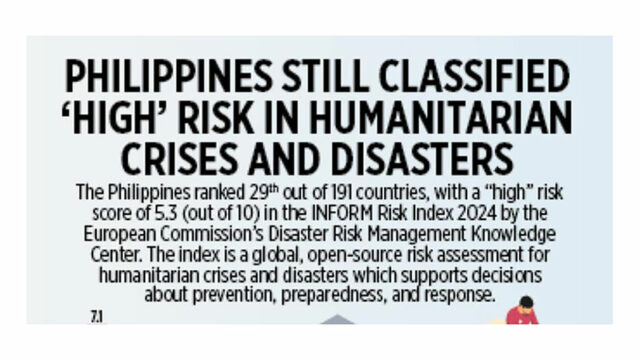
The Philippines ranked 29th out of 191 countries, with a “high” risk score of 5.3 (out of 10) in the INFORM Risk Index 2024 by the European Commission’s Disaster Risk Management Knowledge Center.  The index is a global, open-source risk assessment for humanitarian crises and disaster which supports decisions about prevention, preparedness, and preponse.


How PSEi member stocks performed — December 13, 2023

Here’s a quick glance at how PSEi stocks fared on TuesdayDecember 13, 2023.