Home Blog Page 3726

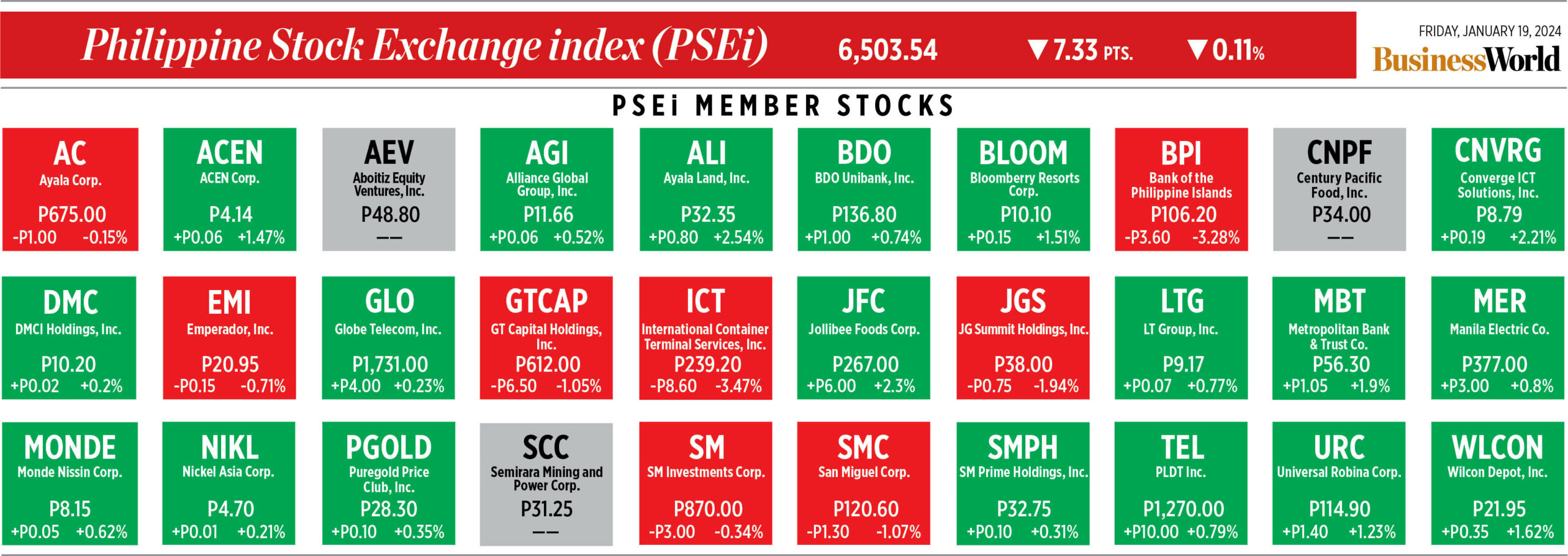
How PSEi member stocks performed — January 19, 2024

Here’s a quick glance at how PSEi stocks fared on Friday, January 19, 2024.


Peso to move sideways ahead of US GDP data

BW FILE PHOTO

THE PESO may move sideways against the dollar this week ahead of the release of US gross domestic product (GDP) and personal consumption expenditures (PCE) data.

The local currency closed at P55.97 versus the dollar on Friday, weakening by 13 centavos from Thursday’s P55.84 finish, data from the Bankers Association of the Philippines’ website showed.

Week on week, the peso declined by 5.9 centavos from its P55.911 close against the greenback on Jan. 12.

The peso opened Friday’s session at P55.85 against the dollar. Its intraday best was at P55.77, while its weakest showing was at P56.02 versus the greenback.

Dollars exchanged went down to $1.39 billion on Friday from $1.43 billion on Thursday.

The peso depreciated on Friday as the dollar gained due to cautious statements from US Federal Reserve officials, Rizal Commercial Banking Corp. Chief Economist Michael L. Ricafort said in a Viber message.

San Francisco Federal Reserve Bank President Mary Daly on Friday said she believes the US economy and monetary policy are in a “good place,” and the risks have grown more balanced while work remains to bring down inflation, Reuters reported.

The words calibration, patience and gradualism suggested Ms. Daly believes Fed rate cuts will arrive but are not imminent.

Earlier on Friday, Ms. Daly said it would be “premature” to think interest-rate cuts were around the corner.

Ms. Daly is likely the last Fed policy maker to speak publicly before the Fed’s Jan 30-31 policy meeting, due to an agreed-upon quiet period running up to each meeting.

Comments from other policy makers last week and stronger-than-expected economic data have prompted traders to temper bets on a first Fed rate cut in March, pricing in a May start to rate cuts instead.

Markets took particular note of Fed Governor Christopher Waller, who said inflation is within “striking distance” of the Fed’s goal but that the central bank should move carefully and methodically.

The US central bank raised borrowing costs by a cumulative 525 basis points (bps) to 5.25-5.5% from March 2022 to July 2023.

The peso was dragged down by global crude oil prices reaching three-week highs recently amid tensions in the Red Sea, Mr. Ricafort added.

For this week, the peso may move sideways before the release of US GDP and PCE data, Security Bank Corp. Chief Economist Robert Dan J. Roces said in a Viber message. He expects the peso to move between P55.80 and P56.20 per dollar this week.

Meanwhile, Mr. Ricafort sees the local unit ranging from P55.85 to P56.05 versus the greenback. — AMCS with Reuters

PSEi to move sideways before US GDP, PCE data

PHILIPPINE STAR/KRIZ JOHN ROSALES

THE MAIN INDEX may move sideways this week as the market is expected to take cues from the release of key US and Philippine economic data.

The benchmark Philippine Stock Exchange index (PSEi) went down by 7.33 points or 0.11% on Friday to end at 6,503.54, declining for the fourth consecutive day. while the broader all shares index rose by 0.57 point or 0.01% to finish at 3,451.78.

Week on week, the PSEi fell by 139.64 points or 2.1% from its 6,643.18 close on Jan. 12.

“Profit-taking characterized [last] week’s sessions, amid increasing concerns of escalating geopolitical tensions,” online brokerage firm 2TradeAsia.com said in a market report.

“The PSEi declined for the fourth consecutive day after global crude oil prices hovered among three-week highs recently amid increased tensions in the Red Sea area that could lead to higher shipping costs and some shipping delays in the Asia-Europe shipping route due to longer route around Africa, instead of the short cut through Suez Canal via the Red Sea,” Rizal Commercial Banking Corp. Chief Economist Michael L. Ricafort likewise said.

Missile attacks in Syria, Lebanon, Iraq, and Yemen on Saturday threw into sharp focus the increasing risk of the war in Gaza triggering a wider regional conflict pitting Iran and its allies against Israel and the United States, Reuters reported.

Iran said five of its Revolutionary Guards were killed in a missile strike on a house in Damascus which it blamed on Israel, and security sources in Lebanon said an Israeli strike there killed a member of Iran-backed Hezbollah.

Later on Saturday, missiles and rockets launched by Iran-backed militants in Iraq, where such groups have targeted US forces, hit al-Asad air base, the US Central Command said.

The United States also said it had targeted a missile the Iran-backed Houthi group in Yemen was aiming into the Red Sea, which it called a threat to shipping.

For this week, AB Capital Securities, Inc. Vice-President Jovis L. Vistan said in a Viber message that the market will remain in a “corrective mode,” with the PSEi expected to test its 6,500 support ahead of the release of US personal consumption expenditures (PCE) price index data on Friday.

“This week, markets will be taking their cues from the latest US GDP (gross domestic product) and home sales data. The Philippines will also be releasing fourth quarter growth figures,” Regina Capital Development Corp. Head of Sales Luis A. Limlingan said in a Viber message.

Fourth quarter and full-year 2023 US and Philippine GDP and data will be released on Thursday.

2TradeAsia.com put the PSEi’s support at 6,400 and resistance at 6,700. 

“The market failed to revisit the 6,700 level, and is currently retesting 6,500,” it said.

Meanwhile, Mr. Ricafort placed the PSEi’s immediate major support at 6,215-6,310 and its next resistance at the 6,600 level. — RMDO with Reuters

BCDA open to selling NAIA T3 site amid lease renewal talks

Passengers queue at the Ninoy Aquino International Airport (NAIA) Terminal 3 in Pasay City, Oct. 29, 2022. — PHILIPPINE STAR/MIGUEL DE GUZMAN

THE Bases Conversion and Development Authority (BCDA) said that it is currently in talks with the Manila International Airport Authority (MIAA) for future lease or sale agreements for an airport terminal sitting on BCDA land.

“One of the big revenue potentials of BCDA is the renewal of the lease for the land where Terminal 3 is located. That is BCDA’s land, the entire 60 hectares,” BCDA President and Chief Executive Officer Joshua M. Bingcang said in a briefing last week.

According to Mr. Bingcang, BCDA’s 25-year lease agreement with the MIAA expired last year. The lease covers the property where the Ninoy Aquino International Airport Terminal 3 (NAIA T3) was built.

“The arrangement that we have, which ended last year, is a 25-year lease. They were up to date with their payments … and we have ongoing negotiations,” he added.

“We have two options, one is for them to buy it and we are open to that because it is cash now, but we are also okay with a long-term lease,” Mr. Bingcang said.

“We have had acquisition talks before because anyway we do not have other uses for it,” he added.

The zonal value of the 60-hectare property is P50 billion which would be lower than the market value if a sale is executed, according to Mr. Bingcang.

However, he said that if the MIAA decides to go with a long-term lease agreement the BCDA will be proposing higher lease rates.

“The price in 1997 is different from the price in 2024. Before, it was P200 million a year. Basically, we are projecting at least P600 million a year for (that) property,” he added.

Mr. Bingcang was due to meet Eric Jose Castro Ines, the general manager of the MIAA, last week.

Asked to comment, the MIAA said that it will “provide updates once the higher authorities have finalized their discussions,” noting that the discussions took place at a “closed-door meeting.” — Justine Irish D. Tabile

FAO: Better market access for farmers key to boosting agri

REUTERS

By Adrian H. Halili, Reporter

THE PHILIPPINES needs to focus on improving market access for farmers to support its agriculture industry, an official with the United Nations Food and Agriculture Organization (FAO) said last week.

“The main challenge in the Philippines is access to markets. It is very complicated,” FAO Country Representative for the Philippines Lionel Henri Valentin Dabbadie told BusinessWorld.

He said that farmers are having difficulty selling their produce due to the country’s archipelagic nature, leaving producers mainly dependent on their local markets or on traders who consolidate their harvests.

“Most of the time, those traders are also small traders, and they also don’t have a lot of money,” he added.

Last week, the Department of Agriculture (DA) said it will invest in constructing a network of cold storage facilities to minimize post-harvest losses and allow commodities to be stored to maintain their quality during periods of oversupply.

The facilities would allow farmers to generate revenue from their harvests, even if it requires waiting until market conditions improve.

“When you see the product arriving in the market, the quality is not very good. So, you can definitely improve the quality of the product; to improve it, you need to have (more) investment” Mr. Dabbadie said.

Agriculture Secretary Francisco Tiu Laurel, Jr. said the DA is budgeting P1 billion for the construction of four cold storage facilities on Luzon.

Mr. Laurel added that another P5 billion is needed in the next three years to construct other such facilities elsewhere.

“It is definitely something that should have been done a long time ago, and (this plan) is going in the right direction,” Mr. Dabbadie added.

In a Palace briefing, Mr. Laurel said that there had been no major investments in postharvest facilities in the last 40 years, with those that were built being too small to make an impact on post-harvest losses.

The government has also invested in the building of more farm to market roads, with around 67,328.92 kilometers built last year.

“There is a real need for investment in Philippine agriculture, particularly from the point of view of facilitating access to markets and improving the quality of the markets,” he said.

He added that the FAO is considering supporting the government with projects to improve the agriculture value chain.

LRT-2 West Extension funding expected this year, Transport dep’t says

PHILSTAR FILE PHOTO

THE Department of Transportation (DoTr) is aiming to obtain funding for the Light Rail Transit Line 2 (LRT-2) West Extension project this year.

“For the west extension, we’re still working (to secure funding)… our target is within this year,” Transportation Secretary Jaime J. Bautista told reporters last week.

Last year, the Light Rail Transit Authority (LRTA) through the DoTr requested the issuance of multi-year obligational authority (MYOA). Once issued, the authority will signify the government’s commitment to fund the project. 

The MYOA is issued by the Department of Budget and Management to government agencies undertaking multi-year projects.

Last year, the LRTA noted the delay in the MYOA’s issuance, which should have been released in 2022.

Construction of the rail line is expected to begin next year, Mr. Bautista said.

The proposed LRT West Extension covers three kilometers from Recto Avenue station to Pier 4. This project will have three stations: Tutuban, Divisoria and Pier 4.

The LRT-2 West Extension project will cost an estimated P10.12 billion. The project also includes the procurement of additional light rail vehicles to meet growing passenger demand. — Ashley Erika O. Jose

Foreign debt service bill up sharply at end of October

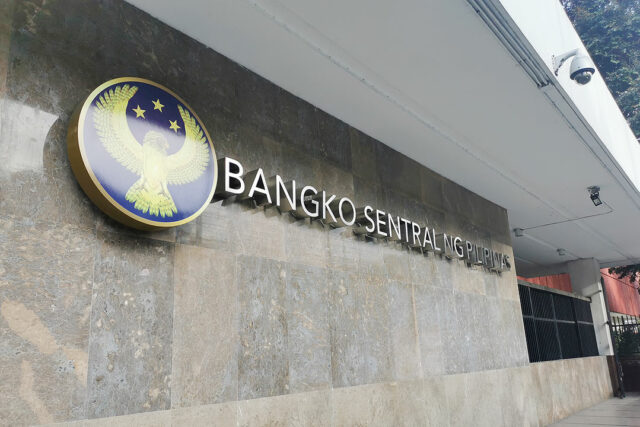
Bangko Sentral ng Pilipinas main office in Manila. — BW FILE PHOTO

THE debt service bill for foreign obligations rose 132.8% in the 10 months to October, the Bangko Sentral ng Pilipinas (BSP) reported.

Citing preliminary data, the BSP said the debt service bill on external borrowing was $11.938 billion during the period.

At the end of October, debt service was equivalent to 3.5% of gross domestic product (GDP), against 1.6% a year earlier.

Debt service is the amount a country needs in order to remain up to date on foreign debt payments. It includes both principal and interest payments.

The BSP said principal payments rose 113.9% to $6.258 billion in the 10 months.

Interest payments stood at $5.68 billion, up 157.8%.

The principal component was mostly fixed medium- to long-term credit, while interest payments consisted mainly of fixed and revolving short-term credit from banks and nonbanks.

Rizal Commercial Banking Corp. Chief Economist Michael L. Ricafort said that the growth in debt service was due to high interest rates and elevated inflation.

“Furthermore, increased foreign borrowing, both from commercial and multilateral and government sources amid the need to diversify borrowings also fundamentally increased the foreign debt service bill,” Mr. Ricafort added.

The BSP estimates outstanding external debt to have risen 10.1% to $118.833 billion at the end of September.

External debt refers to all types of borrowings by Philippine residents from nonresidents, following the residency criterion for international statistics.

The external debt ratio, or the external debt as a percentage of GDP, was equivalent to 28.1% of GDP.

Separately, the Department of Finance announced that the Bureau of the Treasury (BTr) will be launching a retail Treasury bond (RTB) offer within the first quarter.

“The RTBs encourage ordinary Filipinos to start investing in safe and stable sources of passive income, while promoting financial inclusion,” it said in a statement last week.

“To further this agenda, the BTr is looking to engage more digital finance platforms, allowing the BTr to reach a wider investor base,” it added.

The department said that the BTr is also eyeing global bond offerings for its external financing program this year to diversify its funding sources.

“The BTr is exploring a potential curtain-raiser offering in the first semester of the year,” it added.

Former Finance Secretary Benjamin E. Diokno said that the government is planning to raise around $5 billion from the issuance of foreign bonds this year.

The government’s borrowing program is set at P2.46 trillion this year, of which P606.85 billion will come from external sources.

In 2023, the government raised $3 billion from dollar bonds in January; $1.26 billion from a retail dollar bond offering in October; and $1 billion from its inaugural Sukuk bond issue, which was settled in December.

The government borrows from domestic and external sources to help fund a budget deficit capped at 5.1% of GDP this year. — Luisa Maria Jacinta C. Jocson

Gov’t intervenes in sugar market with P5 billion scheme to purchase direct from farmers to support farmgate price

PHILIPPINE STAR/MIGUEL DE GUZMAN

THE GOVERNMENT has allocated P5 billion to purchase sugar directly from farmers in order to prop up farmgate prices, an industry group said on Sunday.

“President Ferdinand R. Marcos, Jr. approved the initial budget of P5 billion for the government to directly purchase sugar from farmers at a premium price,” Manuel R. Lamata, president of the United Sugar Producers Federation of the Philippines (UNIFED), said in a statement.

Industry groups have called for government intervention to narrow the gap between sugar farmgate and retail prices. UNIFED said that this gap has been in place since the start of the milling season in September.

“To my fellow sugar planters, do not sell yet your sugar at these low prices. Wait a little more because our President has stepped in to help the sugar farmers,” Mr. Lamata said.

He said earlier that trading prices for raw sugar have declined to P2,300-P2,500 per 50-kilogram bag, which is below the production cost for producers.

Separately, the Sugar Regulatory Administration (SRA) said that it had recently met with sugar industry representatives to draft procedures for direct purchasing.

Last year, the SRA said trading prices for sugar will remain stable at P3,000 per 50 kilo bag.

“We also discussed steps to be taken to further enhance productivity and profitability, ensure stability of sugar supply for consumers and industrial users, and retail prices, keeping in mind that the sugar farmer is also a retail consumer,” SRA Administrator Pablo Luis S. Azcona said.

The regulator has projected a possible 10-15% decline in raw sugar production due to El Niño. Official estimates place production at 1.85 million MT for the crop year.

El Niño is projected to persist until May this year and bring drought and dry spells to 63 provinces, according to PAGASA (Philippine Atmospheric, Geophysical and Astronomical Services Administration), the government weather service.

Mr. Azcona has said that the SRA was planning to impose a suggested retail price scheme for sugar.

The retail price of refined sugar in Metro Manila markets was between P74 and P100 per kilo, while brown sugar fetched P60-90 per kilo, according to Department of Agriculture price monitors. — Adrian H. Halili

2023 business registrations post 5% growth

A vendor sits in a stall selling products in sachet packaging at a public market in Manila, Philippines, Aug. 1, 2019. — REUTERS

THE Department of Trade and Industry (DTI) said 984,332 business names were registered last year, up 5%, attributing the rise to its digitalization efforts.

The DTI in a statement said that 88% or 864,200 of the registrations were new, while 12% or 120,132 were renewals.

“The majority of the applicants processed and completed their applications online based on the payment collections received,” the DTI said.

According to data from the Department’s Business Name Registration Division (BNRD), small retail businesses, known in the Philippines as sari-sari stores, remained the top business activity among registrants with 172,905.

In second place are other restaurants and mobile food services activities, which accounted for 78,174 business registrations.

In third place are real estate businesses buying, selling, renting, leasing, and operating apartment buildings, non-residential structures, and dwellings, which had 41,165 registrations.

The BNRD said that it is working with regional and provincial offices to encourage early renewal of business names.

“Meanwhile, barangay-level registrations constituted 60% of the total business names registered with 588,118, while 221,620 applications were with the city or municipality,” the DTI said.

Last year, the DTI moved the registration process 100% online, while integrating the systems of the BNRS (Business Name Registration System) and local governments.

Since August, “walk-in applicants at Negosyo Centers have been directed to use either their devices or designated computer units at the DTI offices to independently file and process business name registration applications through the BNRS website,” it said. — Justine Irish D. Tabile

European chamber calls for PHL free trade deal to go on fast track

European Chamber of Commerce of the Philippines Logo
ECCP.COM

By Justine Irish D. Tabile, Reporter

THE European Chamber of Commerce of the Philippines (ECCP) said free trade agreement (FTA) negotiations between the European Union (EU) and the Philippines should be fast-tracked to maximize its development impact.

“We recognize that the timely conclusion of the EU-Philippines FTA will result in significant socio-economic development, as well as bring relations to new heights, especially in areas such as trade and investment, employment, economic diversification, innovation, and sustainability,” ECCP President Paulo Duarte told BusinessWorld via e-mail.

At a recent briefing, the Department of Trade and Industry (DTI) Undersecretary Alan B. Gepty said the DTI is hoping to finalize a decision on whether negotiations for the FTA will resume in the first quarter.

“The ECCP commends the Philippine government’s dedication to advancing discussions on the EU-PH FTA … As such, the ECCP emphasizes the urgency of fast-tracking the negotiations,” Mr. Duarte said.

“The ECCP trusts that the EU and Philippine governments will be able to progress towards the resumption of the negotiations based on its shared values and interests,” he added.

Mr. Gepty told reporters last week that both the EU and the Philippines had submitted their reports to their principals.

“Hopefully, within the first quarter of this year, we will have the two-way decision. We have reported to our principals and the EU has also done the same,” he added.

The EU and the Philippines began exploratory talks for an FTA as early as 2013 with the first round of negotiations taking place in May 2016.

However, talks have been stalled since 2017 over issues related to intellectual property rights and data exclusivity, among others.

Mr. Gepty said that the Philippines will have to take into account the EU trade agenda seen in the EU’s FTAs with other countries.

“The EU is very particular on the sustainable development agenda. They are very particular on the environment, climate change, among others,” he said.

Mr. Duarte said that the ECCP envisions the EU-Philippines FTA to be on par with agreements forged with Singapore and Vietnam.

Meanwhile, Mr. Gepty said that the Philippines is also considering participation in the Comprehensive and Progressive Agreement for Trans-Pacific Partnership (CPTPP).

“Actually, we already manifested to join, even before, when it was still the Trans-Pacific Partnership (TPP) Agreement,” he said.

“One big reason why we wanted to join TPP, among others, is that the US at the time was still part of TPP and the US is a major trading and investment partner of the country,” he added.

“But of course, many things happened, the US withdrew. But still our interest remains because we believe that the CPTPP parties are valuable partners also of the Philippines,” he said.

He said that there is a need to study the legal implications of the country’s participation in the CPTPP as well as the value-added market access.

“But the participation of the UK bolsters our interest to join the CPTPP. We already have FTAs with most of our major trading partners like Australia, New Zealand, Singapore, Japan and South Korea,” he said.

“The value added here, in terms of market access, is Canada, Mexico, Peru and Chile, and the UK is our major trading partner, so that will provide additional market access if we join,” he added.

Chip industry bats for CREATE amendment reinstating 5% GIT

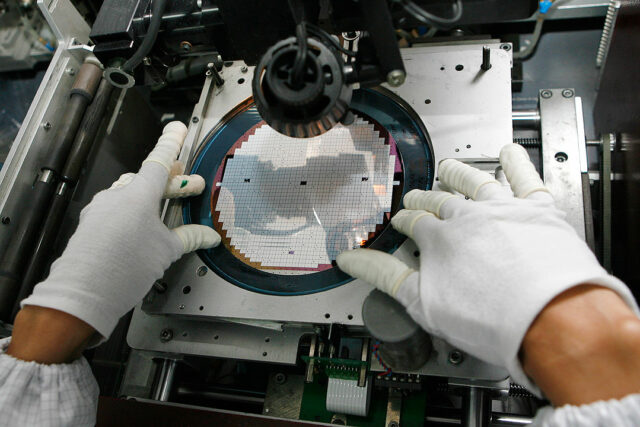
A worker operates the die attach machine at a semiconductor manufacturing plant in Manila, Dec. 10, 2008. — REUTERS

By Beatriz Marie D. Cruz, Reporter

LEGISLATORS must reinstate the 5% gross income tax (GIT) incentive in amendments to the Corporate Recovery and Tax Incentives for Enterprises (CREATE) Act, the chip industry said, noting that the option to pay tax on the basis of gross income will make the Philippines more competitive.

“We would still hope to see the reinstatement of the 5% GIT, at least until Philippine operating costs are comparable with Vietnam, Malaysia & other ASEAN (Association of Southeast Asian Nations) competitors for foreign direct investments,” Semiconductor and Electronics Industries in the Philippines Foundation, Inc. (SEIPI) President Dan Lachica said in a Viber message.

“The 5% GIT was part of the original agreement when foreign investors set up their factories in the Philippines,” Mr. Lachica added.

The House committee on ways and means approved the CREATE MORE bill in November 2023. A copy of the committee report was sent to reporters on Thursday.

House Bill (HB) No. 9794 or the CREATE MORE (CREATE to Maximize Opportunities for Reinvigorating the Economy) bill seeks to amend Republic Act No. 11534 or the CREATE law.

Under the proposed CREATE MORE, domestic and export companies, including those inside ecozones and freeports, will be entitled to duty exemptions, VAT exemption on imports, and the VAT zero-rating of local purchases.

Companies outside ecozones and freeports will also enjoy VAT zero-rating on local purchases as well as duty exemption on imports of capital equipment, raw materials, spare parts, or accessories, according to a copy of the committee report.

The proposed law also seeks to establish a 20% corporate income tax (CIT) rate on domestic and foreign corporations under the enhanced deduction income tax regime.

The current version of the bill gives offers more incentives to the export industry sector, according to the Confederation of Wearable Exporters of the Philippines (CONWEP).

“It did cover as much ground,” CONWEP Executive Director Maritess Jocson-Agoncillo said via telephone. “You can see the effort that it’s including even the industries producing smaller quantities for the export market.”

“HB 9754 defined a better differentiation delineating critical parameters between registered domestic enterprises from the registered export enterprises,” she added.

“The draft bill conscientiously integrated existing laws, such as the Export Development Act of 1994 (RA 7844), the GoNegosyo Act (RA 10644), the Creative Industries Act (RA 11904), and provisions to include marketing efforts of export companies in the enhanced deduction scheme,” Ms. Jocson-Agoncillo said. “Clearly, these provisions indicate the government’s intention to bolster the export industry sector.”

Ms. Jocson-Agoncillo said the provision on VAT on goods and services favors the cross-border doctrine of taxation for export groups.

“It clarifies the VAT application on goods and services directly attributable to export enterprises. It’s now aligned with the cross-border doctrine of taxation. We should not be imposed a duty tax of 12% for goods that we produce for the global market and would not be consumed domestically,” she said.

However, Ms. Jocson-Agoncillo said legislators should define how to classify “risk claims” for those who apply for VAT refunds.

The bill only states that VAT refund claims will be classified into low-, medium-, or high-risk.

“This is a provision that needs to be calibrated — the detailed parameters of what constitutes low, medium, high, and the implementation as well,” she said.

Filomeno S. Sta. Ana III, coordinator of Action for Economic Reforms, said foregone revenue from a “more generous” tax incentive system under the CREATE MORE bill could “trigger a fiscal crisis.”

“Ultimately, this threat of a fiscal crisis is what will block the new flow of investments and thus impede growth and employment,” Mr. Sta. Ana said via Viber.

“The major reasons why investment performance is mediocre are the lack of a coherent economic strategy, the drift in economic policy-making, the contradicting or see-sawing policies,” Mr. Sta. Ana said.

Foundation for Economic Freedom President Calixto V. Chikiamco said reducing taxes could deprive the government of resources to carry out its mandates.

“Lowering the CIT to 20% would lead to large fiscal losses, which government can’t afford at this time,” Mr. Chikiamco said in a Viber chat.

The ways and means panel is set to tackle the CREATE MORE bill on Tuesday before it is sent to the plenary for debates.