Home Blog Page 367

CARS crosses the finish line

Doing right is its own reward

NEWS OF the restoration of funding for the Comprehensive Automotive Resurgence Strategy (CARS) Program was welcomed by the auto industry and the business sector at large with a resounding cheer. This swift action by the government reflects its resolve to sustain efforts in shoring up foreign investor confidence and strengthening the business environment in the country. It is a clear signal that the government is steadfast in its commitments to investors and that it honors a transparent rules-based approach toward progress and development.

In his announcement of the finalization of the funding solution for CARS, Finance Secretary Frederick Go stressed that this is in response to the private sector’s concerns on “the ease of doing business, the cost of doing business and the predictability of doing business” in the Philippines. He assured that “car manufacturers enrolled in the program that the government will fulfill its commitment to investors.”

Business leaders hailed the resolution of the funding issue. In a report by BusinessWorld, Philippine Chamber of Commerce and Industry (PCCI) President Ferdinand A. Ferrer was quoted as saying that the return of funding for CARS “is a clear indication that the government will support critical industries and prior commitments.”

In the same article, Federation of Philippine Industries Chairperson Elizabeth H. Lee was also quoted as saying that, “Only by sustaining industrial programs with credibility can the Philippines position itself as a trusted destination for long-term manufacturing investments.”

This year, the Philippines will chair the Association of Southeast Asian Nations (ASEAN). This is an excellent platform to elevate the standing of the country as a partner of choice for investors. Accordingly, a clear show of consistency in policy direction, implementation and governance is an unequivocal validation that the Philippines is open for business and a dependable investment destination.

Indeed, I believe that the government clearly demonstrated its responsiveness and ability to act quickly and with determination in addressing a clear pain point of the business sector. The returned funding of CARS is particularly important because it impacts the government’s goal of revitalizing the industry under the Philippine Development Plan (2023 to 2028).

The automotive industry — especially insofar as local vehicle production is concerned — is an essential pillar of the manufacturing sector. It is a significant contributor in transforming the production sector by generating more quality jobs and competitive products. Senator Loren Legarda, in a proposed Senate Bill back in 2022, cited the observation of the National Economic and Development Authority (NEDA) Former Director-General Cielito Habito that the manufacture of motor vehicle parts “has strong backward linkages with local industries, indicating strong multiplier effects for the local economy.” Director Habito referred to a study — albeit dating back to 2010 — that “every P100 worth of production in industry leads to a rise in total economic output by P367.” Apart from its spillover effects to other industries, it provides for technology transfer to local firms, thus increasing the overall potential of the domestic economy.

The strategic value of the automotive industry is significant, to be sure. In 2017 — the peak of auto sales prior to COVID — it was noted by then Executive Secretary Salvador Medialdea that the output value of the industry reached P300 billion or 4% of the country’s gross domestic product (GDP). At the same time, the Chamber of Automotive Manufacturers of the Philippines, Inc. (CAMPI) reported that combined investments of auto industry players had reached P120 billion while the Technical Education and Skills Development Authority (TESDA) cited in a report that every P100 billion in investments would translate to 169,000 jobs. Further, a more recent report by the International Trade Council in December 2024 projected that automotive exports from the Philippines would reach US$1.28 billion in 2025.

Given that domestic motor vehicle sales are estimated to have reached over 490,000 in 2025, the scale of economic contributions by the auto industry must be even more compelling. In an economy that is driven by local consumption (up to 70%), increasing local production capacity is a strategically important pillar of sustainable development for the country. This will allow us to improve our balance of trade, minimize our vulnerability to imported inflation, mitigate supply chain disruptions and fluctuations in logistics costs, increase local value add, and create more jobs.

Motor vehicles are even more important in light of the rising mobility needs of the country. The ASEAN Statistics Report for 2024 showed that the number of registered motor vehicles (including four- and two-wheelers) per 1,000 people in the Philippines as of 2023 stood at 128. This compares with 1,097 in Malaysia, 682 in Thailand and in 473 Indonesia. Vietnam — with data only from 2020 — was reported at 42. Given the archipelagic nature of the Philippines, the need for transport vehicles cannot be ignored — for farm-to-market use, retail, commerce, commuting, private use, and special purposes such as ambulances, police vehicles, and other civic needs. “Mobility security” should, therefore, be a priority concern of the government.

However, in the return of funding for CARS, it was also mentioned that funding for RACE (Revitalizing the Automotive Industry for Competitiveness Enhancement) was not included. I am confident that this is not because of any lack of appreciation for the strategic importance of the proposed program by the Board of Investments (BoI). I believe that the government is just taking a more deliberate approach to assuring that — once approved and announced — there will be no further hitches to realizing the program goals and benefits.

We will move forward as a nation, taking one measured step at a time. After all, haste does make waste.


Apple Pay free to launch any time in the Philippines, says BSP

STOCK PHOTO | Image by Jonas Leupe from Unsplash

APPLE PAY may enter the Philippine market at any time as the Bangko Sentral ng Pilipinas (BSP) has already ruled that it is not an operator of payment system (OPS), an official said. 

“We abide by the determination that it’s not an OPS,” BSP Deputy Governor Mamerto E. Tangonan told reporters on the sidelines of the central bank’s annual reception for the banking community on Friday. “So, Google Pay has launched. So, it’s up to them (Apple Pay) when they will launch.”

The BSP said in mid-2025 that both Google Pay and Apple Pay are technology service providers and not OPS and do not need to register with the regulator as they do not hold funds but instead process payment credentials, and there is also no contract between them and merchants.

In November, Google Pay entered the Philippines through the launch of Google Wallet, which allows users to link debit or credit cards to the e-wallet.

Earlier reports have said that Apple Pay could be available by the third quarter. However, Mr. Tangonan said they have not been informed regarding the timing.

Asked if the central bank is in talks with Apple Pay, he said: “After we said, ‘Ah, okay, we don’t deem it an OPS,’ that’s it.”

The BSP defines an OPS as an entity that provides clearing or settlement services in a payment system, or defines, prescribes, designs, controls or maintains the operational framework for the system.

Its functions include the maintenance, operation, or provision of platforms or systems that enable payments or fund transfers.

As of Jan. 16, 312 OPS are licensed to operate in the country, based on BSP data. — Katherine K. Chan

Opera star Renée Fleming withdraws from Kennedy Center May performances

AMAZON.COM

WASHINGTON — Grammy Award-winning opera star Renée Fleming has withdrawn from performances in May at the Kennedy Center, with her withdrawal coming during a wave of cancellations at the Washington institution since its takeover by President Donald J. Trump.

A message on the Kennedy Center’s website said Ms. Fleming, who had been scheduled to appear with the National Symphony Orchestra (NSO) in May, had to withdraw “due to a scheduling conflict.”

“Renée Fleming regrets that, due to a scheduling conflict, she must withdraw from her May 2026 concerts with the NSO,” the message on the institution’s website said. “A new soloist and repertoire will be announced at a later date, and the remainder of the program remains unchanged.”

Last year, Ms. Fleming left her role as artistic adviser-at-large at the center, citing the departures of the institution’s previous leadership.

Mr. Trump named himself chairman of the Kennedy Center and filled its board with his allies last year. In December the institution’s board voted to rename it the Donald J. Trump and the John F. Kennedy Memorial Center for the Performing Arts, or Trump Kennedy Center for short.

Since then, many groups and artists have withdrawn from the center, citing the Republican leader’s takeover. Democrats, noting that the center’s name was established by Congress, have said Mr. Trump’s rebranding has no force of law. John F. Kennedy’s family denounced the renaming move as undermining the slain president’s legacy. — Reuters

D&L unit launches 100% abaca pellets for commercial use

Abaca pellets — D&L POLYMER & COLOURS, INC.

LISTED D&L Industries, Inc.’s subsidiary D&L Polymer & Colours, Inc. (DLPC) said its abaca pellet has reached the commercial stage and is now being introduced to potential customers across Asia for testing.

On Friday last week, DLPC President and Chief Executive Officer Lester Lao introduced the 100% abaca pellets, which allow upstream plastic compounders to blend the product directly into their formulations, rather than relying solely on DLPC-processed composites.

“This milestone marks a new chapter in our natural fiber journey. What began as an idea decades ago has now evolved into a commercially viable material that can help industries meet their sustainability goals, and we believe this is just the beginning of what natural fibers can achieve for the future of plastics,” Mr. Lao said.

“As we move toward broader commercialization, the 100% abaca pellet represents a transformative step toward a more sustainable, fiber-integrated plastics ecosystem,” he added.

The pellet builds on DLPC’s work since last year, when the company first blended abaca into plastics.

“Pelletization is the tipping point that finally makes natural fibers easy to use at scale. With a ready-to-compound 100% abaca pellet, manufacturers can incorporate sustainability into their products without changing their processes, opening an entirely new market where abaca can be handled just like any conventional polymer ingredient,” Mr. Lao said.

In January last year, DLPC said it was already in discussions with potential partners interested in using the technology to make their plastic products more sustainable.

While abaca fiber is currently the base material, the technology has also been tested with other locally available fibers, including pineapple, spider-lily (bakong), and vetiver.

Natural fiber composites enhance the mechanical and chemical performance of traditional plastics while improving sustainability. These lightweight materials are strong enough to float in water and are suitable for applications ranging from consumer goods to industrial uses, such as construction and automotive parts.

DLPC said it is working with manufacturers across consumer goods, packaging, construction, and automotive sectors to explore applications for the new abaca pellet.

The company noted that pelletized forms simplify production, speeding up the adoption of natural fibers in mainstream manufacturing and supporting global goals to reduce plastic use and environmental harm.

“From a broader sustainability perspective, the implications are considerable. Natural fiber composites produced using these pellets can replace a meaningful portion of virgin polymers — with current formulations allowing dosing of up to 40% and the potential to go higher as technology advances — reducing dependence on fossil-based plastics while delivering improvements in strength, durability, and weight efficiency,” DLPC said.

The company said it is also increasing market education efforts and joint development programs to help partners transition to natural fiber-enhanced materials. — Alexandria Grace C. Magno

Canadian beef exports to China will resume following Carney’s visit

REUTERS

WINNIPEG, Manitoba — Canadian beef will be exported to China following the relaxation of an import ban that had been in place since 2021, the agriculture minister said, though analysts cautioned it will likely be in small amounts.

The reopening of what could be a vital market for Canadian beef follows the visit of Canadian Prime Minister Mark Carney, who reached an agreement with China’s leadership to lower tariffs and do more business on a number of agricultural commodities, including canola.

“We know that there’s a large company that’s shipping its first load of beef to China next week,” said Canadian Agriculture Minister Heath MacDonald. Earlier on social media he said “China has lifted market access for Canadian beef.”

China’s customs agency did not immediately respond to a request for comment.

The move is not expected to have an immediate major impact on Canadian beef exports or prices because North America has a shortage of domestic beef and prices are historically high.

Sylvain Charlebois, a food market expert known as The Food Professor, said: “China reopening or expanding access for Canadian beef won’t move food prices in Canada in any meaningful way.

“The volumes involved are relatively small, and Canada simply doesn’t have the scale to divert large amounts of beef away from the domestic market without disrupting other exports first.”

However, China is an important market for certain cuts of beef, so the reopening is important for Canadian farmers and beef exporters.

Beef market analyst Jerry Klassen said: “It’s very important for Canadian beef farmers to have access to as many markets as possible. The Chinese market is very important because it has potential for significant growth.”

Mr. Klassen and the Canadian Cattle Association said the details on the reopening were not yet available, so the full implications would only be understood once they were. However the association celebrated the resumption of trade.

China was Canada’s fourth largest beef market in 2021, before being suspended in December of that year.

China can be a vital export market for Canada when North America has a beef surplus and domestic prices are low. — Reuters

Stronger action needed to address gaps in liver cancer care

STOCK PHOTO | Image by Pch.Vector from Freepik

Liver cancer remains one of the most serious yet preventable public health threats in the Philippines. It is now the fourth most common cancer in the country, with 12,544 new cases recorded in 2022, and the third leading cause of cancer-related deaths, claiming 11,653 Filipino lives in the same year. These numbers reflect not just a medical challenge, but a systemic failure to prevent, detect, and treat a disease that is often diagnosed too late.

Chronic hepatitis B infection, the leading cause of liver cancer in the Philippines, continues to affect nearly 5% of the population. Other major risk factors include liver cirrhosis, often the result of untreated viral hepatitis, alcohol-associated liver disease, non-alcoholic fatty liver disease linked to obesity and diabetes, metabolic syndrome, and chronic hepatitis C infection. Many of these risk factors are preventable or manageable through timely vaccination, screening, and sustained access to care.

Yet for many Filipino families, a liver cancer diagnosis arrives as a financial and emotional catastrophe. When a loved one becomes seriously ill, households often face lost income, long-term caregiving responsibilities, and crippling out-of-pocket expenses. In the Philippines, household payments account for about 45% of total healthcare spending — one of the highest rates in Southeast Asia. This reality turns illness into poverty and places unbearable strain on families already struggling to make ends meet.

As the country marks Liver Cancer and Viral Hepatitis Awareness and Prevention Month, civil society organizations are calling for stronger and more coordinated government action to reduce preventable deaths from liver cancer. These groups emphasize the urgent need to scale up prevention, improve early detection, and expand access to modern, life-extending treatments.

The Yellow Warriors Society of the Philippines (YWSP), a national organization of hepatitis B patients and advocates, has underscored that current health programs still fall short of capturing the true social and economic impact of liver cancer on Filipino households. UHC Watch, a civil society group monitoring the implementation of the Universal Health Care (UHC) Law, has echoed this concern and urged PhilHealth to expand benefit packages to cover the full continuum of liver cancer care — from screening and diagnosis to treatment and palliative services.

There are positive developments. In his 2025 State of the Nation Address, President Ferdinand Marcos, Jr. reaffirmed the government’s commitment to strengthening UHC, including PhilHealth’s Yaman ng Kalusugan Program (YAKAP), which supports screening for six priority cancers, including liver cancer. He also directed the Department of Health (DoH) to improve access to the Cancer Assistance Fund (CAF) by publishing a complete list of hospitals offering support for outpatient and inpatient services, diagnostics, and medicines for priority cancers.

These initiatives are welcome, but they must be matched with policies that ensure sustainability, equity, and real-world impact. One critical tool in achieving this is Health Technology Assessment (HTA). HTA helps determine which health interventions — including screening tools, diagnostics, and advanced cancer therapies — are clinically effective, cost-effective, and suitable for public funding under the UHC Law. When used well, HTA can reduce out-of-pocket costs and ensure that limited public resources deliver the greatest benefit to patients.

YWSP has issued a timely appeal for the DoH to adopt a broader, societal perspective in HTA decision-making. As YWSP president Hilario Pajac aptly noted, “Policy decisions should reflect the real value of patients returning to productive life and caregivers remaining employed. The full human and social impact of liver cancer must be considered if we want policies that truly save lives.”

This call is supported by global evidence. A 2025 report by the London-based Office of Health Economics highlights that adopting a societal perspective in HTA can foster innovation and better address both clinical and societal needs, an approach particularly relevant to the Asia-Pacific region, where populations are aging and chronic diseases are rising. The report stresses that evaluating health interventions solely through a narrow healthcare lens risks undervaluing treatments that restore productivity, reduce caregiver burden, and prevent long-term economic losses.

Despite these benefits, the report notes that most Asia-Pacific countries still apply societal perspectives only in limited or supplementary analyses, citing barriers such as methodological constraints, capacity gaps, data limitations, and tight HTA timelines. To address these challenges, it recommends stronger policy support, capacity-building through training and international collaboration, better patient and caregiver engagement, and more consistent integration of societal value elements into HTA processes.

Meanwhile, innovation in liver cancer treatment continues to advance. Targeted therapies now disrupt specific pathways that allow cancer cells to grow and spread, while immunotherapies harness the body’s immune system to recognize and destroy cancer cells. These therapies offer hope particularly for patients diagnosed at later stages, but only if they are made accessible through inclusive and evidence-informed health policies.

Closing the gaps in liver cancer care will require a holistic and intersectoral response. Government, civil society, clinicians, and the private sector must work together to strengthen prevention, expand early detection, and ensure equitable access to effective treatments. For Filipino patients and their families, timely action is not just a policy choice. It is a matter of survival, dignity, and hope.


Teodoro B. Padilla is the executive director of Pharmaceutical and Healthcare Association of the Philippines, which represents the biopharmaceutical medicines and vaccines industry in the country. Its members are at the forefront of developing, investing and delivering innovative medicines, vaccines, and diagnostics for Filipinos to live healthier and more productive lives.

Debt yields mixed amid global volatility

YIELDS on government securities (GS) ended mixed last week amid global market volatility and as players await key Philippine economic data for clues on the Bangko Sentral ng Pilipinas’ (BSP) policy direction.

GS yields, which move opposite to prices, inched up by an average of 0.42 basis point (bp) week on week at the secondary market, based on the PHP Bloomberg Valuation Service Reference Rates as of Jan. 23 published on the Philippine Dealing System’s website.

At the short end, rates of Treasury bills (T-bills) went down, with yields on the 91-, 182-, and 364-day tenors dropping by 3.11 bps (to 4.7664%), 4.52 bps (4.8359%), and 5.16 bps (4.8912%), respectively.

Meanwhile, all tenors at the belly fetched higher yields. The two-, three-, four-, five-, and seven-year Treasury bonds (T-bonds) climbed by 0.33 bp (to 5.2987%), 2.65 bps (5.4974%), 3 bps (5.6489%), 3.22 bps (5.7656%), and 4.45 bps (5.9368%), respectively.

The long end of the curve also went up, with yields on the 10-, 20-, and 25-year notes rising by 1.52 bps (to 6.0635%), 1.21 bps (6.4996%), and 1.04 bps (6.4956%), respectively.

GS volume traded increased to P102.98 billion on Friday from P71.97 billion a week prior.

Bond yields were mostly mixed as global markets were volatile due to trade war concerns amid US Donald J. Trump’s tariff threats, the first bond trader said.

At the short end, rates went down on strong demand for shorter tenors amid strong market liquidity and lingering global uncertainties, but longer-dated bonds fetched higher yields amid market jitters, the trader said, adding that the peso’s weakness and its potential impact on the BSP’s easing path also added to concerns.

“Recently, short-term yields have stayed low as we anticipate that the BSP will continue its easing cycle to support a softening economy. There is limited room for yields to compress much further because the BSP has signaled that its easing cycle is nearing an end. While a cut is expected, any further downward movement in yields is being checked by rising inflation forecasts for 2026,” the second bond trader said.

“Despite the massive oversubscription in recent auctions, the downside for T-bill yields is becoming increasingly restricted. The overwhelming demand shows that investors are locking in the current rates before they drop further. A weak peso, which recently hit record lows of P59.46, and global geopolitical tensions are making it difficult for yields to stay at these floor levels. If the peso continues to slide, the BSP may be forced to pause rate cuts to protect the currency, which would cause short-term yields to bottom out or even bounce back slightly.”

Markets hit a rocky patch last week due to the fallout from Mr. Trump’s aggressive stance to acquire Greenland, which threatened a new trade war with Europe, Reuters reported.

Markets initially reeled, with stocks, bond prices and the US dollar all swooning, an unusual occurrence. But major equity indexes rebounded later in the week after Mr. Trump backed off tariff threats, suggesting a deal was in sight for Greenland.

Meanwhile, on Friday, BSP Governor Eli M. Remolona, Jr. said that another cut remains uncertain, adding that price stability is their primary concern.

He said that while they will consider the latest gross domestic product (GDP) data when the Monetary Board meets to review their policy stance on Feb. 19, weaker-than-expected growth wouldn’t automatically warrant further easing.

The BSP on Dec. 11 delivered a fifth straight 25-bp reduction in benchmark interest rates, bringing the policy rate to an over three-year low of 4.5%. It has lowered borrowing costs by a total of 200 bps since its rate cut cycle began in August 2024.

Mr. Remolona earlier said they could deliver one last cut to help support domestic demand and spur economic recovery.

Governance concerns due to a corruption scandal involving state infrastructure projects have dragged public and private investments, causing Philippine GDP growth to slump to a four-year low of 4% in the third quarter of 2025.

For this week, the first trader said the market will monitor the fourth-quarter and full-year Philippine GDP data to be released on Thursday (Jan. 29), BSP policy signals, and global geopolitical developments.

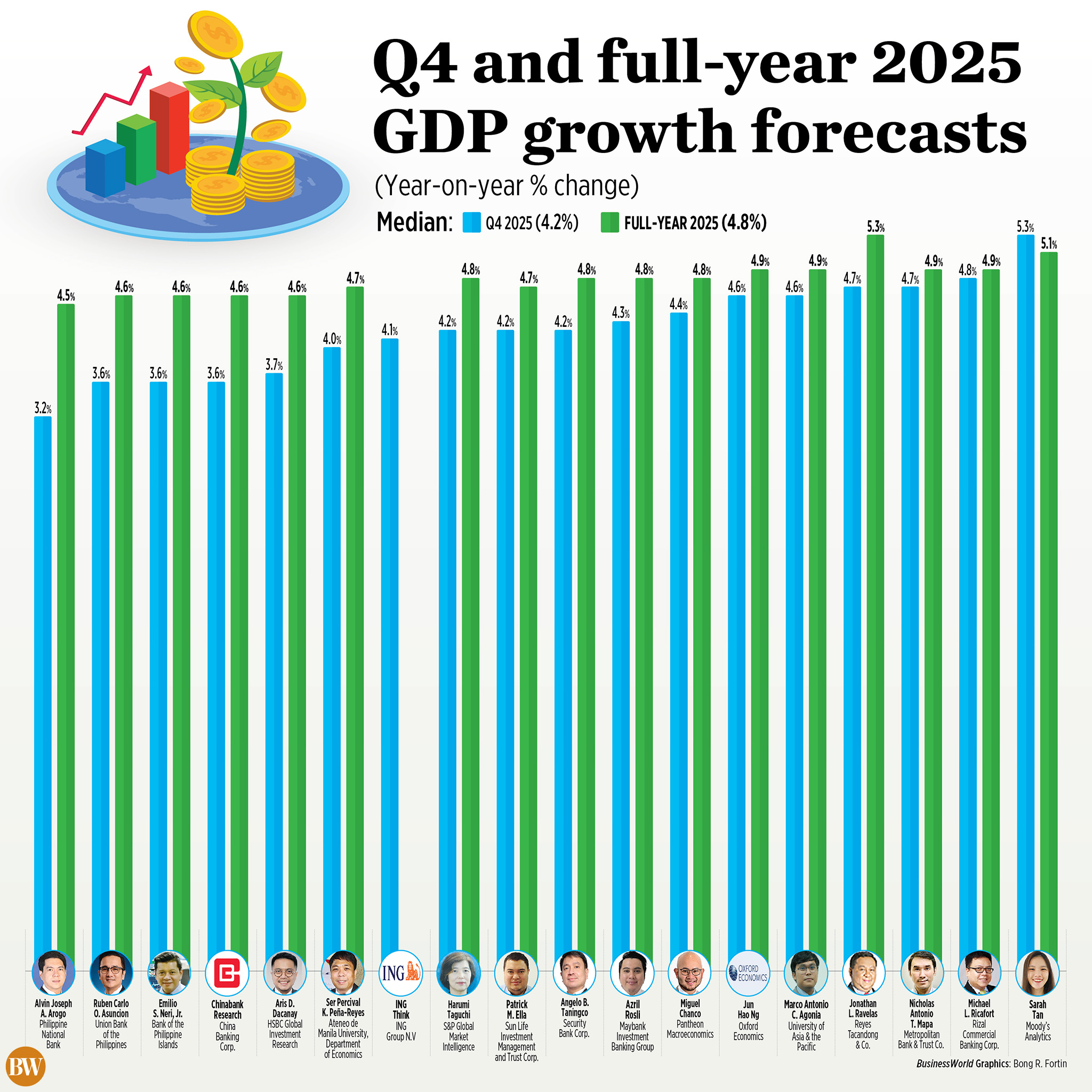
The Philippine economy likely expanded by 4.2% in the fourth quarter, based on a BusinessWorld poll of 18 economists and analysts. This would be faster than the 4% growth in the third quarter, but slower than 5.3% expansion in the same period in 2024.

This would put full-year growth at 4.8%, below the government’s 5.5%-6.5% target. This would also be slower than the 5.7% expansion in 2024 and the weakest since the 9.5% contraction posted in 2020.

“Market players are now observing the trend that will dictate the direction of the yield curve in the coming weeks. The performance of the Philippine peso, which might breach the P59.50 level, could signal a shift in monetary policy. Also, the market is watching the US Treasury yields and Federal Reserve signals, which often set the ceiling for local interest rates,” the second trader added.

Investors widely expect the Fed to hold rates steady when it gives its monetary policy decision on Wednesday at the end of its two-day meeting, Reuters reported. Fed funds futures are pricing in at least one more such cut this year, according to LSEG data. — P.O.A. Montalvo with Reuters

Hongqi AWD EVs prove ‘efficient’ in DoE test

Hongqi EH7 — PHOTO FROM HONGQI PHILIPPINES

HONGQI PHILIPPINES participated in last year’s Department of Energy (DoE) Eco-Run — represented by Flagship versions of its high-power, dual-motor all-wheel-drive (AWD) electric vehicles Hongqi EHS7, the Hongqi EH7, and Hongqi EHS9.

The test activity covered a 154.5-kilometer route from Tarlac through Pangasinan to La Union via the Tarlac-Pangasinan-La Union Expressway (TPLEX). “Intended to generate credible, real-world energy-efficiency data, the run included a wide mix of internal combustion vehicles, plug-in hybrids, and battery electric vehicles, with most BEVs running single-motor drivetrains and only a few participating with dual-motor AWD systems, all under actual highway driving conditions,” said Hongqi Philippines in a release.

The vehicles were said to have been driven in a manner to “reflect typical highway behavior.” Participants accelerated to overtake slower traffic at 100kph, then returned to a cruising speed of 80kph. At the conclusion, “all three vehicles still delivered exceptional energy-efficiency results, reflecting Hongqi’s balanced approach to performance and efficiency,” continued the statement.

The standardized unit for testing by the DoE is a “Liter of Gasoline Equivalent” or Lge, allowing comparisons with different powertrains. According to the DoE, this unit of energy content is defined as being equal to the chemical energy contained in one liter of standardized gasoline liquid fuel, allowing for a fair measurement of new energy vehicle efficiency against traditional internal combustion engines.

The EHS7 returned a consumption figure of 48.79km/Lge, the EH7 attained 51.16km/Lge, and the EHS9 scored 40.57km/Lge.

Hongqi Philippines said that the results “are particularly noteworthy given the vehicles’ performance specifications. Both the EHS7 Flagship AWD midsize SUV and EH7 Flagship AWD midsize sedan produce 610hp (455 kW) and 756Nm of torque, while the larger EHS9 Flagship AWD full-size SUV delivers 544hp (405 kW) and 750Nm of torque. These figures highlight Hongqi’s ability to balance powerful dual-motor AWD performance with efficient energy consumption.”

“The DoE Eco Run results reaffirm Hongqi’s commitment to delivering electric vehicles that combine exceptional performance with real-world efficiency,” said Hongqi Philippines President Rashid Delgado. “Hongqi’s BEVs demonstrate that high performance and efficiency can go hand in hand. From our dual-motor AWD models to single-motor RWD vehicles, each achieves strong power and notable energy efficiency, reflecting our commitment to engineering excellence and a refined driving experience across the entire lineup.”

For more information, visit any of the Hongqi Philippines showrooms in Bonifacio Global City, Alabang, Manila Bay, and Quezon City. The official website is www.hongqi.ph; social media accounts are (hongqi.philippines) on Facebook and (@hongqi_ph) on Instagram (@hongqi_ph).

Spanish prosecutors drop abuse case against Julio Iglesias

MADRID — Prosecutors at Spain’s High Court have shelved a preliminary investigation into singer Julio Iglesias, saying on Friday that the court lacked jurisdiction as the alleged crimes were abroad and the accusers did not reside in the country.

Rights group Women’s Link Worldwide had filed the complaint on Jan. 5 on behalf of two women said to have worked in Mr. Iglesias’ Caribbean residences over a 10-month period in 2021, based on an investigation by US broadcaster Univision and Spanish outlet elDiario.es.

The accusations included human trafficking for forced labor and servitude, sexual assault and violations of workers’ rights. Mr. Iglesias described them as “completely false” in various social media posts.

Attempts by Reuters to contact representatives of Mr. Iglesias, 82, have gone unanswered. His record label Sony has declined to comment on the case.

The prosecutor’s office said in a filing seen by Reuters that the High Court was unable to try Mr. Iglesias as the alleged crimes were in the Dominican Republic and the Bahamas, adding that prosecution could still be sought in those two countries.

In addition, the alleged victims were not Spanish and did not reside in Spain, it said, citing Supreme Court jurisprudence that limited the legal principle of universal jurisdiction. — Reuters

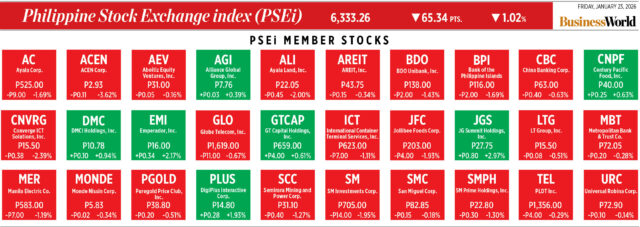
How PSEi member stocks performed — January 23, 2026

Here’s a quick glance at how PSEi stocks fared on Friday, January 23, 2026.


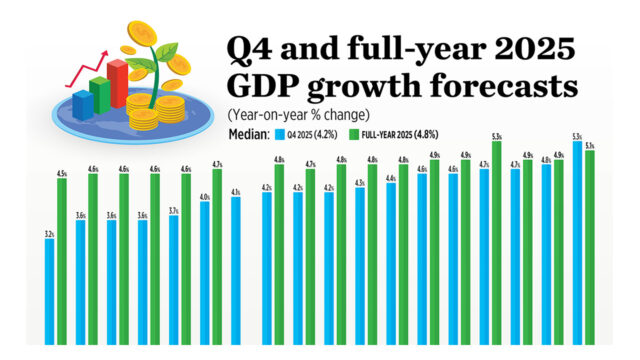
Q4 and full-year 2025 GDP growth forecasts

THE PHILIPPINE ECONOMY likely expanded at a slower pace in the fourth quarter of 2025, bringing full-year growth below the government’s target amid a corruption scandal, analysts said. Read the full story.


Stocks to move sideways as mart eyes GDP data

BW FILE PHOTO

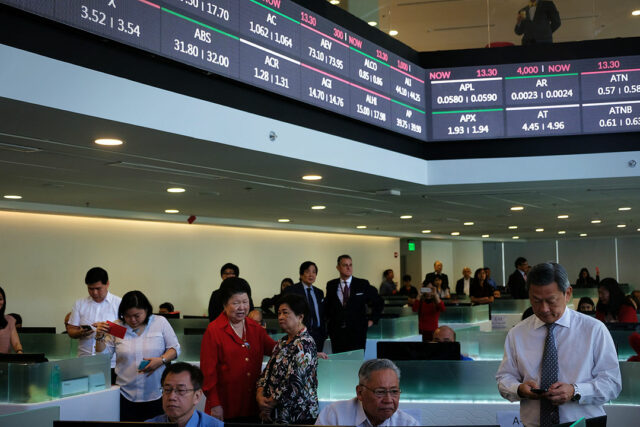
PHILIPPINE STOCKS may move sideways this week as investors wait for the release of fourth-quarter and full-year 2025 gross domestic product (GDP) data.

On Friday, the Philippine Stock Exchange index (PSEi) fell by 1.02% or 65.34 points to end at 6,333.26, while the broader all shares index went down by 0.54% or 19.69 points to close at 3,599.31.

Week on week, the PSEi dropped by 131.41 points from its Jan. 16 finish of 6,464.67.

“The local bourse retreated, weighed in part by renewed geopolitical tensions between the US and European Union,” 2TradeAsia.com said in a market note.

“The local market snapped its four-week rally last week as offshore trade and geopolitical concerns weighed on investor sentiment. In the decline, the bourse gave up its position above the 6,400 level,” Japhet Louis O. Tantiangco, research manager at Philstocks Financial, Inc., said via Viber.

Markets hit a rocky patch last week due to the fallout from US President Donald J. Trump’s aggressive stance to acquire Greenland, which threatened a new trade war with Europe, Reuters reported. But major equity indexes rebounded later in the week after Mr. Trump backed off tariff threats, suggesting a deal was in sight for Greenland.

For this week, Mr. Tantiangco said the main trading driver will be the latest Philippine GDP data.

“Focus is expected to be on the Philippines’ fourth-quarter and full-year 2025 gross domestic product data as this would give clues on the local economy’s state and direction. A significant improvement from the third quarter’s 4% growth may spark positive sentiment, but a print slower may cause the market to decline further,” he said.

A BusinessWorld poll of 18 economists and analysts yielded a median estimate of 4.2% for fourth-quarter growth. If realized, this would put the full-year average at 4.8%, below the government’s 5.5%-6.5% target.

“Chart-wise, the local market is still considered to be on an uptrend. Its 50-day and 200-day exponential moving averages are about to form a golden cross, which is a bullish signal,” Mr. Tantiangco said.

“However, we’re also starting to see signs that the market’s momentum is waning… Its moving average convergence/divergence line has already crossed below the signal line, signaling bearish movements in the short run.”

He put the PSEi’s trading range for this week at 6,150 to 6,400.

For its part, 2TradeAsia.com placed the PSEi’s immediate support at 6,300 and resistance at 6,500.

“Domestic assets are navigating the second-degree effects of this global volatility, particularly through the lens of US dollar-Philippine peso fluctuations and redirected capital flows. As capital seeks alternatives, the Philippines stands as a potential beneficiary of ‘hot money’ flows within the region, though broad-based gains are likely to be capped by local inflationary concerns and geopolitical tensions.” — A.G.C. Magno