
Philippines moves up in Human Development Index

THE PHILIPPINES jumped five spots in the latest Human Development Index, but remained one of the laggards in Southeast Asia, the United Nations Development Program (UNDP) said. Read the full story.

THE PHILIPPINES jumped five spots in the latest Human Development Index, but remained one of the laggards in Southeast Asia, the United Nations Development Program (UNDP) said. Read the full story.

BOCA CHICA, Texas – SpaceX’s Starship rocket, designed to eventually send astronauts to the moon and beyond, completed nearly an entire test flight on its third try on Thursday, making it much farther than before with a cruise through low orbit before being destroyed during a return to Earth, the company said.
During a live webcast of the flight, SpaceX commentators said mission control lost communications with the spacecraft during its atmospheric re-entry. The vehicle was nearing a planned splashdown in the Indian Ocean about an hour after launch.
A few minutes later, SpaceX confirmed that the spacecraft had been lost, presumably either burning up or coming apart during re-entry or crashing into the sea.
Still, completion of most of the intended hour-plus test flight trajectory of Starship marked a major milestone in the development of a spacecraft crucial to Elon Musk’s satellite launch business and NASA’s moon program.
NASA chief Bill Nelson congratulated SpaceX on what he called “a successful test flight” in a statement posted on the social media platform X.
The two-stage spacecraft, consisting of the Starship cruise vessel mounted atop its towering Super Heavy rocket booster, blasted off from the Elon Musk-owned company’s Starbase launch site near Boca Chica Village on the south Texas Gulf Coast.
During its flight, Starship reached peak altitudes of 145 miles (234 km), the company said.
SpaceX engineers had hoped to improve on the Starship’s two past performances, which both ended in explosions minutes after launch. However, the company had acknowledged in advance a high probability that its latest flight might similarly end with the spacecraft’s destruction before the planned mission profile was finished.
SpaceX’s engineering culture, considered more risk-tolerant than many of the aerospace industry’s more established players, is built on a flight-testing strategy that pushes spacecraft to the point of failure, then fine-tunes improvements through frequent repetition.
Despite the outcome of Thursday’s test, all indications are that Starship remains a considerable distance from becoming fully operational.
Mr. Musk, SpaceX’s billionaire founder and CEO, has said the rocket should fly hundreds of uncrewed missions before carrying its first humans. Several other ambitious milestones overseen by NASA need to be met before the craft can execute a moon landing with American astronauts.
Still, Mr. Musk is counting on Starship to fulfill his goal of producing a large, multipurpose next-generation spacecraft capable of sending people and cargo to the moon later this decade, and ultimately flying to Mars.
Closer to home, Mr. Musk also sees Starship as eventually replacing the SpaceX Falcon 9 rocket as the workhorse in the company’s commercial launch business. It already lofts most of the world’s satellites and other payloads to low-Earth orbit. – Reuters

LONDON – An Australian computer scientist who claims he invented bitcoin is not “Satoshi Nakamoto”, the pseudonymous inventor of the cryptocurrency, a judge at London’s High Court ruled on Thursday.
Craig Wright has long claimed to have been the author of a 2008 white paper, the foundational text of bitcoin, published under the pseudonym.
The Crypto Open Patent Alliance (COPA) took Wright to court to stop him suing bitcoin developers, asking for a ruling that Wright was not Satoshi.
Judge James Mellor said on Thursday that Wright was not Satoshi and that he would give his full reasons for his decision at a later date.
COPA – whose members include Twitter founder Jack Dorsey’s payments firm Block – previously said it had brought the lawsuit to preserve the open-source nature of bitcoin.
After Mellor announced his decision on Thursday, Dorsey posted a quote from the judge and a single letter: “W”.
COPA accused Wright of repeatedly forging documents to substantiate his claim, including during the trial itself, which Wright denied when he gave evidence.
Its lawyer, Jonathan Hough, said at the start of the trial in February that Wright’s claim was “a brazen lie, an elaborate false narrative supported by forgery on an industrial scale”.
Hough said that “there are elements of Dr Wright’s conduct that stray into farce”, citing his alleged use of ChatGPT to produce forgeries.
But he added: “Dr Wright’s conduct is also deadly serious. On the basis of his dishonest claim to be Satoshi, he has pursued claims he puts at hundreds of billions of dollars, including against numerous private individuals.”
Wright’s lawyers, however, argued in court filings that he had produced “clear evidence demonstrating his authorship of the white paper and creation of bitcoin”. – Reuters

A US government weather forecaster projects El Nino conditions will likely end by spring this year but saw a 62% chance that a weather pattern characterized by unusually cold temperatures in the Pacific Ocean, La Nina, will develop during June-August.
There is an 83% chance that a transition from El Nino to ENSO-neutral is likely to occur by April-June 2024, followed by a shift to La Nina, National Weather Service’s Climate Prediction Center (CPC) said in a monthly forecast on Thursday.
“Even though forecasts made through the spring season tend to be less reliable, there is a historical tendency for La Nina to follow strong El Nino events,” the CPC said.
The ongoing El Nino weather pattern will continue to fuel above-average temperatures across the globe, the World Meteorological Organization (WMO) said last week.
El Nino peaked in December and would go down as one of the five strongest in history, it said.
Last year’s El Nino, which followed three La Nina years, saw hot and dry weather in Asia and heavier rains in parts of the Americas that boosted farm output prospects in Argentina and the southern US Plains.
India, the world’s biggest rice supplier, restricted exports of the staple following a poor monsoon, while wheat output in No.2 exporter Australia took a hit. Palm oil plantations and rice farms in Southeast Asia received less than normal rains.
The high probability of a strong La Nina arriving this year has put grains farmers on alert in Argentina, where the climate phenomenon usually brings dry weather with lower rainfall.
“With the El Nino phenomenon expected to end this year, 2025 might not have such a rosy beginning, while it will likely also increase the rains which feed the Panama canal and potentially ease congestion,” shipbroker Allied said in a note. – Reuters

HOUSTON/MIAMI – The highest bid received in a US auction of shares that will decide the fate of Venezuela-owned oil refiner Citgo Petroleum was $7.3 billion, enough to cover only a third of court-approved claims, two people familiar with the matter said.
A federal court in Delaware is auctioning the shares of a parent of Venezuela’s foreign crown jewel, Houston-based Citgo, that it found liable for the South American country’s debt defaults and expropriations. Creditors have flocked to Delaware to press claims totaling $21.3 billion in a case first brought nearly seven years ago by miner Crystallex.
Results from the first bidding round in January, however, show a sales process that is unlikely to provide a satisfactory outcome for creditors or Citgo’s current owners. Offers received thus far in a case that broke new legal ground in sovereign immunity would leave many claims unpaid, analysts and sources warned.
The court may have to revamp the sales process, or consider an alternative being drafted by Venezuela, which would offer creditors a larger payout with proceeds spread over several years, while retaining some of Venezuela’s stake in the company, the people said.
Judge Leonard Stark, who is overseeing the case, has declined to consider Venezuela’s payment proposals, the people said. It is unclear if he would reconsider with the highest offer in the initial bidding round covering only 14 of the 26 claims that he has accepted from 18 creditors.
The weak initial bids were below the $13 billion to $14 billion value specialists appointed by the court had estimated for the shares. That shortfall is prompting Citgo’s parent companies and boards to reprise an offer presented earlier this year: a $10 billion payment funded over time from Citgo profits, equity and borrowings.
EXTRA INNINGS
The auction has drawn interest from oil giant ConocoPhillips COP.N and units of conglomerate Koch Industries, both putting their claims against Venezuela via credit bids for the assets.
Other offers came from energy companies and private investors wanting to acquire the PDV Holding shares to gain control of the seventh-largest US oil refiner by volume, the people said.
Spokespeople for Conoco, Citgo and boards supervising the refiner declined to comment. Koch Industries and attorneys for the court official overseeing the auction did not reply to requests for comment.
PDV Holding’s only asset is Citgo, which owns three US refineries, oil storage terminals and pipelines, and controls a retail distribution network.
Citgo has been highly profitable, earning $4.8 billion in profits in the last two years.
The 12 non-binding offers received in January, however, reflect concerns over the future value of refiners with intense carbon footprints and Citgo’s troubled ties with Venezuela’s state oil firm PDVSA, which remains under socialist President Nicolas Maduro’s grip, the people said.
A lawyer representing Citgo had called the first bidding round “disappointing.”
The court is expected soon to set a second, binding round, but prospects of an offer higher than the non-binding $7.3 billion are slim, the people added.
Court officials involved in the case “will need to sit down with Venezuela and get together something that will make sense,” said a person close to the auction process.
Venezuela’s $10 billion proposal would provide creditors with a combination of cash, securities and shares in Citgo over a three-year period. It would ultimately allow Venezuela to retain about half ownership.
“We have only been doing damage control so far. We want to move the ball forward, the game has not finished,” one of the people familiar with Venezuela’s proposal said.
POLITICAL MISSILES
Venezuelan entities overseeing Citgo want to tie the payment plan to stronger US protection for the refiner from creditors as Maduro’s government refuses to reverse a ban on opposition candidate Maria Corina Machado from running for president, closing what Western countries saw as a path towards democracy in Venezuela.
The idea includes pulling the Venezuela-related claims out of the court case and into the US Foreign Claims Settlement Commission (FCSC), a quasi-judicial independent agency within the Justice Department, for better addressing all of Venezuela’s creditors.
Plan advocates are expected to discuss the proposal with US officials, possibly including Secretary of State Antony Blinken ahead of the April 18 expiry of a US license that relaxed sanctions on Venezuela’s energy sector.
Unifying Venezuela’s fractious opposition around a proposal, however, has been cumbersome and convincing Washington could be even more challenging, the sources acknowledged. Some politicians and members of Citgo’s supervising boards believe that having Ms. Machado in agreement would give the company a better chance of winning US support.
“Citgo will be even more valuable in the future,” Ms. Machado told reporters late Wednesday after a rally in central Carabobo state. “Hence, an organized restructuring process of all debts and accounts will benefit creditors more than the current auction.”
The plan also would require the US Treasury Department, which last year green-lit the auction, to agree to the offer, and the Delaware court could be forced to halt or freeze a sales process it fought hard to advance.
Spokespeople for Gerardo Blyde, who represents opposition parties negotiating with the Maduro administration, did not provide comment. The US State and Treasury departments did not immediately provide comment.
“We need a bullet-proof effort this time,” one of the people behind the ideas said referring to getting top opposition politicians well connected to Washington to lead the initiative. – Reuters

We all experience loss and grief. Imagine, though, that you don’t need to say goodbye to your loved ones. That you can recreate them virtually so you can have conversations and find out how they’re feeling.
For Kim Kardashian’s fortieth birthday, her then husband, Kanye West, gifted her with a hologram of her dead father, Robert Kardashian. Reportedly, Kim Kardashian reacted with disbelief and joy to the virtual appearance of her father at her birthday party. Being able to see a long-dead, much missed loved one, moving and talking again might offer comfort to those left behind.

After all, resurrecting a deceased loved one might seem miraculous – and possibly more than a little creepy – but what’s the impact on our health? Are AI ghosts a help or hindrance to the grieving process?
As a psychotherapist researching how AI technology can be used to enhance therapeutic interventions, I’m intrigued by the advent of ghostbots. But I’m also more than a little concerned about the potential effects of this technology on the mental health of those using it, especially those who are grieving. Resurrecting dead people as avatars has the potential to cause more harm than good, perpetuating even more confusion, stress, depression, paranoia and, in some cases, psychosis.
Recent developments in artificial intelligence (AI) have led to the creation of ChatGPT and other chatbots that can allow users to have sophisticated human like conversations.
Using deep fake technology, AI software can create an interactive virtual representation of a deceased person by using their digital content such as photographs, emails, and videos.
Some of these creations were just themes in science fiction fantasy only a few years ago but now they are a scientific reality.
Digital ghosts could be a comfort to the bereaved by helping them to reconnect with lost loved ones. They could provide an opportunity for the user to say some things or ask questions they never got a chance to when the now deceased person was alive.
But the ghostbots’ uncanny resemblance to a lost loved one may not be as positive as it sounds. Research suggests that deathbots should be used only as a temporary aid to mourning to avoid potentially harmful emotional dependence on the technology.
AI ghosts could be harmful for people’s mental health by interfering with the grief process.
Grief takes time and there are many different stages that can take place over many years. When newly bereaved, those experiencing grief might think of their deceased loved one frequently. They might freshly recall old memories and it is quite common for a grieving person to dream more intensely about their lost loved one.
The psychoanalyst Sigmund Freud was concerned with how human beings respond to the experience of loss. He pointed out potential added difficulties for those grieving if there’s negativity surrounding a death.
For example, if a person had ambivalent feelings towards someone and they died, the person could be left with a sense of guilt. Or if a person died in horrific circumstances such as a murder, a grieving person might find it more difficult to accept it this.
Freud referred to this as “melancholia”, but it can also be referred to as “complicated grief”. In some extreme cases, a person may experience apparitions and hallucinate that they see the dead person and begin to believe they are alive. AI ghostbots could further traumatize someone experiencing complicated grief and may exacerbate associated problems such as hallucinations.
There are also risks that these ghost-bots could say harmful things or give bad advice to someone in mourning. Similar generative software such as ChatGPT chatbots are already widely criticized for giving misinformation to users.
Imagine if the AI technology went rogue and started to make inappropriate remarks to the user – a situation experienced by journalist Kevin Roose in 2023 when a Bing chatbot tried to get him to leave his wife. It would be very hurtful if a deceased father was conjured up as an AI ghost by a son or daughter to hear comments that they weren’t loved or liked or weren’t their father’s favorite.
Or, in a more extreme scenario, if the ghostbot suggested the user join them in death or they should kill or harm someone. This may sound like a plot from a horror film but it’s not so far fetched. In 2023, the UK’s Labor party outlined a law to prevent the training of AI to incite violence.
This was a response to the attempted assassination of the Queen earlier in the year by a man who was encouraged by his chatbot girlfriend, with whom he had an “emotional and sexual” relationship.
The creators of ChatGPT currently acknowledge that the software makes errors and is still not fully reliable because it fabricates information. Who knows how a person’s texts, emails or videos will be interpreted and what content will be generated by this AI technology?
In any event, it appears that no matter how far this technology advances, there will be a need for considerable oversight and human supervision.
This latest tech says a lot about our digital culture of infinite possibilities with no limits.
Data can be stored on the cloud indefinitely and everything is retrievable and nothing truly deleted or destroyed. Forgetting is an important element of healthy grief but in order to forget, people will need to find new and meaningful ways of remembering the deceased person.
Anniversaries play a key role in helping those who are mourning to not only remember lost loved ones, but they are also opportunities to represent the loss in new ways. Rituals and symbols can mark the end of something that can allow humans to properly remember in order to properly forget. – Reuters

PRESIDENT Ferdinand R. Marcos, Jr. promised a US delegation that the government will cut red tape and corruption to make investing in the Philippines more attractive, US Secretary of Commerce Gina Raimondo said on Thursday.
“President Marcos was clear with us and has been in his actions, that he is very forward-leaning towards the US,” she told a virtual briefing, after her two-day visit in Manila with a 22-member US Presidential Trade and Investment Mission this week.
“All these things (cutting red tape, anti-corruption measures) are steps in the right direction which will make the Philippines an even more attractive place to do business for American companies.”
The US mission indicated plans to invest over a billion dollars in the Philippines, Ms. Raimondo said on Monday.
Visa and United Parcel Service, Inc. committed to upskill Filipino workers from micro, small and medium enterprises and support their digitalization efforts, the US Department of Commerce said on Wednesday.
Microsoft Corp. also expressed its commitment to work with the Bangko Sentral ng Pilipinas, and the Departments of Budget and Management and Trade and Industry (DTI) to train jobseekers and students in artificial intelligence.
Google will also roll out a career certificate program in 50 virtual campuses at the DTI 1,300 local business centers in 16 regions.
More than 30 million workers are expected to benefit from the digital upskilling investment pledges, Ms. Raimondo said at the briefing.
Private equity firm KKR & Co. has also pledged to continue investing about $400 million to develop about 2,000 telecommunications towers in the Philippines.
Calixto V. Chikiamco, Foundation for Economic Freedom president, said in a Viber message that Mr. Marcos should appoint an official that will act as a “ringleader or bastonero” to impose discipline on local governments and government agencies that impose unwarranted bureaucratic delays on investors.
“Government should institute express lanes for big-ticket investment projects, which further reduces the number of days in the processing of permits and licenses at all levels of government,” Terry L. Ridon, a public investment analyst and convenor of think tank InfraWatch PH said in a Facebook Messenger chat.
The President should also implement a whistleblower program to bring to the surface corruption in major projects.
US companies are keen on investing in the Philippines’ semiconductor industry and to double the number of packaging, testing and assembly facilities, Ms. Raimondo told a business forum in Makati on Tuesday. The Philippines has 13 of these facilities in total.
The Philippines is one of seven countries that the US is working with to diversify its semiconductor supply chain, as required by the CHIPS and Science Act.
Under the law, the US will provide $52.7 billion in subsidies to boost chip manufacturing and to persuade chipmakers in China to move to the US or other friendly countries.
Last month after his visit to Manila, US State Department Undersecretary for Economic Growth, Energy, Environment Jose W. Fernandez said high energy costs are keeping semiconductor companies and miners from investing in the Philippines.
“These are some of America’s biggest and most successful companies and they are deeply committed to making these investments,” Ms. Raimondo said on Thursday.
“He (Mr. Marcos) is very committed to making the necessary changes in the regulatory structure, cutting tape, being against corruption, being a transparent government.” — John Victor D. Ordoñez

THE Department of Trade and Industry (DTI) said on Thursday that Lufthansa AG’s maintenance unit Lufthansa Technik Philippines is hoping to tap the Maharlika Investment Corp. (MIC) to help fund its proposed P8-billion facility in Clark.
In a statement, the DTI said discussions on the project took place on the sidelines of President Ferdinand R. Marcos, Jr.’s visit to Germany on March 12.
“Lufthansa is considering a partnership with MIC for this project, with initial discussions already underway with Maharlika Fund’s President and Chief Executive Officer Rafael Consing, Jr.,” the DTI said.
The facility is expected to employ at least 400 workers.
“The expansion plan of Lufthansa will provide high-quality and better-paying jobs to Filipinos while strengthening the aerospace maintenance, repair, and overhaul capabilities of the country,” the DTI said.
Lufthansa Technik currently operates a 23-hectare maintenance center at the Ninoy Aquino International Airport.
The leased Clark site is estimated at about two hectares and has a two-year completion timeline.
According to the DTI, potential Lufthansa Technik maintenance customers at the new facility include British Airways, Korean Air, Lufthansa, Emirates, and Qantas.
The company also shared plans for a Phase 2 expansion and is considering Clark, Bulacan or Sangley Point.
Lufthansa AG is currently studying mounting direct flights to the Philippines, Trade Secretary Alfredo E. Pascual said, which will open opportunities for tourism but also for other business services of Lufthansa that the Philippines can support.”
To date, Lufthansa employs 2,800 mechanics, engineers and support personnel and operates eight hangar bays and workshops in the Philippines. — Justine Irish D. Tabile

THE Department of Transportation (DoTr) said it will soon offer feasibility-study contracts for the proposed Samar-Leyte and Panay railway projects.
“The study is under procurement. A typical high-quality feasibility study will take two years,” Leonel Cray P. de Velez, assistant secretary for planning and project development, said in a Viber message on Thursday.
The DoTr website indicates plans to bid out the feasibility studies for the projects this quarter.
The studies, each valued at P78.60 million, will include the pre-feasibility and development studies as well as the preliminary detailed engineering design of the infrastructure projects, the DoTr said.
Last year, the DoTr said it obtained about P600 million in funding for four feasibility studies on four railway projects — the Panay railway, the Philippine National Railway North Long Haul line, the North Mindanao Railway, and the San Mateo Railway.
The Panay rail system project includes the construction of a passenger and freight railway, logistics facilities, maintenance depots, and transit-oriented developments.
Also in 2023, the DoTr created a task force for the proposed Eastern Visayas Metro Railway System which will link Samar and Leyte islands.
Last month, the DoTr was undertaking a study to evaluate the viability of the Mindanao Railway Project Phase 3. — Ashley Erika O. Jose

THAI construction materials company Shera PCL Ltd. said it hopes to start operations in the Philippines by the fourth quarter to grab a share of the country’s growing construction industry.
On the sidelines of the Philippine World Building and Construction Expo, Thunnop Jumpasri, Shera’s country head for the Philippines, said such an investment will be the company’s first outside Thailand.
“The construction industry of the Philippines I think registered the highest growth among ASEAN countries and we have seen a lot of potential of the products here in the Philippines,” Mr. Jumpasri said.
“I think the outlook and the projection for Philippine gross domestic product this year is around 6-7% and normally the construction industry grows (at the same rate as) the economy,” he said.
The company’s first plant outside of Thailand will be located in Teco Industrial Park in Mabalacat, Pampanga and is registered with the Board of Investments.
“We plan to finish the construction of the factory within this year. The total investment is around P2 billion for the whole factory,” he added.
Initially, the factory is planned for output of 100,000 tons of fiber cement board, expandable later to 200,000 tons.
Once operational, the plant is expected to take on 120-150 employees, more than 90% of which will be local hires.
“We intend to recruit Filipinos for more than 90% of our workforce because we see that they have the capability and skill that are suited for our operations. And this will not only be for our facilities team; even our commercial team is composed of Filipinos,” Mr. Jumpasri said.
Shera has been present in the Philippines for over 15 years. The Philippines is its biggest market outside Thailand, followed by Vietnam and Indonesia.
Last year, the company booked P1.5 billion in sales in the Philippines, with expectations of sales growth of 10-15% this year. — Justine Irish D. Tabile

THE Department of Trade and Industry (DTI) said it is studying a Department of Health proposal to ban disposable vapor products (vapes).
“I think the issue with disposable vapes is that the device includes the actual refill product in one system, meaning it is not divisible into the actual vape device and the consumable,” DTI Consumer Protection Group Head Amanda F. Nograles said in a briefing.
She said because the devices do not break down into separate components, the consumable part of the disposable device cannot be tested.
“It’s harmful because how will you test the possible effects of pods? How will you test if it is really safe for consumption?” Ms. Nograles said.
Under Republic Act No. 11900 or the Vaporized Nicotine and Non-Nicotine Products Regulation Act, the DTI, in consultation with the Food and Drug Administration, sets the technical standards for safety and quality of vape products.
“Our rule is to subject the products to mandatory product certification and registration starting June. That is why we are preparing the testing facilities for the devices and the consumables (vape pods),” Ms. Nograles said.
In the absence of testing, the DTI currently accommodates “the manufacturer’s submission of testing results from accredited labs.”
Last month, the DTI said additional funding will be needed to upgrade capacity at DTI’s vape certification facilities.
According to the DTI, its facilities are not currently capable of processing HTP consumables, e-liquids for vapor products, and nicotine pouches.
Asked how much more funding is needed Ms. Nograles said: “We requested… less than P170 million.” — Justine Irish D. Tabile
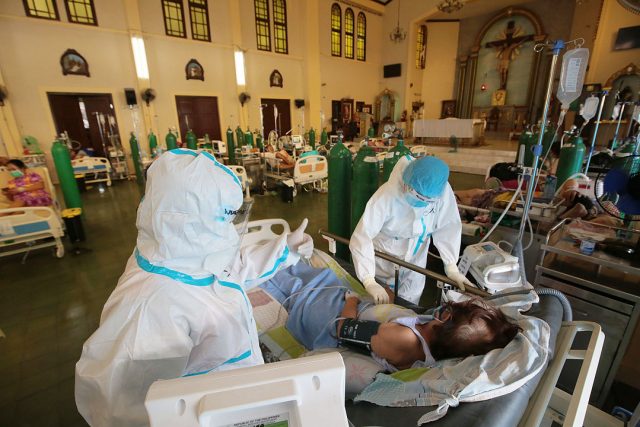
HOSPITALS dedicated to treating infectious diseases are not cost-efficient, according to a doctor participating in a webinar organized by the Asian Development Bank (ADB).
Hyuncheol Bryant Kim, an associate professor at the Hong Kong University of Science and Technology, said establishing hospitals designed for use in pandemics may see low utilization rates.
“If it is dedicated only for the infectious diseases, it will basically be empty,” he said at the ADB webinar, “What Has COVID-19 Taught Us About Asia’s Health Emergency Preparedness and Response?”
In 2022, the House of Representatives approved on third and final reading a measure seeking to establish the Philippine Center for Disease Prevention and Control. A counterpart bill in the Senate is awaiting second reading.
“We do not have to focus too much on infectious diseases. But rather than we have to focus on our general muscles to fight against any type of enemies in the future,” Mr. Kim said.
When the coronavirus disease 2019 (COVID-19) pandemic broke out, governments implemented lockdowns to curb the spread of the virus.
The Philippines, which had one of the longest and strictest lockdowns in the world, posted negative growth, with students enduring a learning crisis as schools shut down.
The Philippines had over 4 million confirmed COVID-19 cases, resulting in more than 66,000 deaths. — Beatriz Marie D. Cruz
