Home Blog Page 3295

Megawide obtains ‘PRS Aa’ rating for planned P5-B bond issuance

MEGAWIDE Construction Corp. said it has obtained a “PRS Aa” issue credit rating with a stable outlook from the Philippine Rating Services Corp. (PhilRatings) for its planned P5-billion bond issuance.

The “PRS Aa” rating indicates obligations of high quality and low credit risk, with the obligor demonstrating very strong capacity to meet its financial commitments, the company said in a statement on Monday.

The company’s proposed bond issuance consists of a P4-billion base offer with an oversubscription offer of up to P1 billion.

Megawide will use the proceeds from the base offer to refinance the company’s existing debt obligations and for general corporate purposes. The oversubscription allotment will be reserved for business development opportunities.

The company said that a stable outlook indicates that the assigned rating is likely to be maintained or to remain unchanged in the next 12 months.

PhilRatings also kept the “PRS Aa” rating on Megawide’s P4-billion outstanding rated bonds.

The ratings considered Megawide’s experience in the construction industry along with vertically integrated operations that complement the government’s infrastructure projects; and the company’s expansion projects in recent years.

In 2023, Megawide recorded a P269-million consolidated net income, a reversal of the P1.87-billion consolidated net loss in 2022, led by the growth of its construction business. The company’s consolidated revenue increased by 26% to P18.6 billion.

Megawide is a listed construction company engaged in various infrastructure projects such as the Malolos-Clark Railway and the Metro Manila Subway.

The company is also involved in property development through its subsidiary PH1 World Developers, Inc.

On Monday, Megawide shares were unchanged at P3 apiece. — Revin Mikhael D. Ochave

Fall Guy deepens box-office malaise with another soft debut

THE FALL Guy had so much going for it — Ryan Gosling and Emily Blunt, two of Hollywood’s hottest stars, no real competition, and a multimillion-dollar promotional campaign.

Yet the $125-million production from Comcast Corp.’s Universal Pictures brought in just $28.5 million in its domestic box-office debut this weekend — the latest evidence that film fans are refusing to return to their pre-pandemic, moviegoing ways.

Despite a few must-see pictures in recent years, such as 2023’s Barbie and Oppenheimer, or 2022’s Avatar: The Way of Water, ticket sales have stubbornly remained a third below pre-pandemic levels, imperiling the crucial summer box office season that begins the first weekend in May.

It’s possible no film tops $1 billion this summer, which would be the first year that’s happened in almost two decades, excluding 2020, when cinemas were closed to comply with pandemic-related restrictions.

“This summer’s box office appears likely to suffer both from a smaller overall film slate and a relative lack of top-tier franchise pictures,” Doug Creutz, an analyst at Cowen, said in a research note. Sales are running down 22% year over year, “and we expect summer box office to perform at that level or worse.”

In an earlier time, a film with the cast and caliber of The Fall Guy would almost certainly have done better. The picture earned critical praise, bringing together elements of an action movie and romantic comedy. Mr. Gosling, co-star of Barbie, and Ms. Blunt, recently in Oppenheimer, made numerous promotional appearances, including one together on NBC’s Saturday Night Live that went viral on TikTok and Instagram.

The biggest challenge for studios and theaters today may be getting film fans off their couches to see original fare from directors who aren’t marquee names. Streaming soared in popularity during the pandemic and taught consumers to expect a steady diet of new movies and TV shows to watch at home — for less than a weekend trip to the cinema.

The standard streaming plan at Netflix, Inc., which recently said its worldwide subscriber base hit 270 million, costs $15.50 a month, about what a single movie ticket costs in many markets.

To distinguish the theater experience from what consumers see at home, theater owners are increasingly introducing larger-screen formats such as those sold by Imax Corp., which were a significant driver of ticket sales to Dune: Part Two and Oppenheimer. The latter title has grossed close to $1 billion globally.

Movies don’t typically need to reach $1 billion in ticket sales to be considered a success. Many earn multiples of their production costs and turn a profit without ever nearing that mark.

But the dearth of big hit pictures is a reminder that the industry remains in a hole. In 2019, studios produced nine films that grossed over $1 billion, a record year in which Walt Disney Co. alone supplied seven. In 2018, there were five.

Last year, Hollywood delivered two films that topped $1 billion. If the industry fails to produce a billion-dollar film this year, it will be the first time — excluding pandemic years — since 2008. Of this year’s summer releases, only Inside Out 2 and Deadpool & Wolverine are expected to produce the domestic box office achieved by Oppenheimer in 2023, according to Mr. Creutz’s estimates.

One reason is overall output — which has been hurt by sweeping budget cuts in Hollywood and lingering effects of strikes that shut down movie and TV production for months last year. Some films scheduled for release this year will come out in 2025 instead.

Adam Aron, chief executive officer of AMC Entertainment Holdings, Inc., the world’s largest cinema chain, said in April that major studios are producing an average of 64 films a year, compared with about 84 prior to the health crisis.

As a result, box-office sales in the US and Canada are expected to fall to $8 billion in 2024, down from $9 billion last year.

That’s hurting theater operators: Shares of AMC are down 46% this year. Marcus Corp., a cinema and hotel group, is down 18%. Metropolitan Theaters, a 100-year-old business, filed for bankruptcy in February.

Still, studios rely on more than just the box office for profit, including sales of consumer products tied to the films and online movie rentals. They also use movies to attract subscribers to streaming services and can license their pictures to competitors.

And some films in 2024 have performed strongly, including Dune: Part Two, which delivered more than $700 million in ticket sales, as well as Godzilla x Kong: The New Empire and Kung Fu Panda 4, which each grossed over $500 million. None of those would have made the top 10 in 2019 in terms of worldwide receipts, however.

Some theaters chains are coping better than others. Last week, Cinemark Holdings, Inc. reported sharply higher first-quarter profit, along with sales that nearly matched year ago levels. Its shares are up 26% this year.

Sean Gamble, the company’s president and chief financial officer, predicts a solid recovery in 2025, when films including Captain America, Mission: Impossible, Jurassic Park and another Avatar are due for release, as well as a Michael Jackson biopic and a Superman reboot.

“Next year’s lineup is already coming together in a big way with a wide array of spectacle films,” he said on a call with investors. — Bloomberg


Investor group buys majority stake in PHL nonlife insurer

A GROUP led by Southeast Asian financial services investor Triple P Capital has completed its acquisition of an 85% stake in nonlife insurance company MAA General Assurance Phils. Inc. (MAAGAP).

The group of investors includes the International Finance Corp. (IFC), the German development finance institution DEG or Deutsche Investitions- und Entwicklungsgesellschaft MBH, Belgian Investment Company for Developing Countries SA (BIO), and OP Finnfund Global Impact Fund I KY, Triple P Capital said in a statement on Monday.

IFC said in its own statement that it is investing up to $10 million.

MAAGAP was previously wholly owned by Malaysian investment holding company MAA Group Bhd. The sale of the 85% stake, reported to be valued at $49.3 million, was announced in November 2023 also included an option to buy out MAA Group’s remaining 15% share.

“Following the acquisition, the investor group will work together with MAAGAP to strengthen its presence in the country by focusing more on the underpenetrated segments — micro, small, and medium enterprises and retail — by offering targeted personal accident, motor, health, and fire and property insurance products,” IFC said.

“A robust insurance market is critical to strengthening the Philippines’ resilience. With climate change triggering more natural disasters that pose an increasing threat, insurance protection is key to providing a safety net and stability, especially for the most vulnerable. Access to affordable insurance services allow small businesses and the poorest to bounce back financially and rebuild their lives after an unexpected loss, fostering resilient and inclusive growth,” IFC Country Manager for the Philippines Jean-Marc Arbogast added.

The investors will also collaborate with MAAGAP’s management to implement global best practices in corporate governance, environmental and social responsibility, risk management, and compliance, Triple P Capital said.

The consortium will support the company’s digitalization and inclusive product development efforts, it added.

“MAAGAP’s prudent management, strong reputation, and solid distribution position create a powerful combination,” said David Steel, founding partner at Triple P Capital. “We are thrilled to collaborate with MAAGAP’s exceptional leadership team, whom we have known and respected for many years. Together, we aim to provide quality insurance products, extend coverage to more Filipinos and Filipino businesses, and build resilience against accidents, climate change, and other disasters.”

“This collaboration presents a unique opportunity for us to learn from the investors their international best practices in governance, environmental and social responsibility, risk management, and more. Together, we aim to elevate our standards, expand our reach, and contribute to the resilience of the Filipino community. This alliance reflects our shared commitment to growth, innovation, and delivering top-notch services to our clients and stakeholders,” MAAGAP President and Chief Executive Officer Martin L. Dela Rosa said.

DEG Senior Investment Manager Pritesh Modi added that the acquisition will help address the insurance protection gap in the Philippines, and boost job creation and economic growth.

Insurance penetration, or premium volume as a share of gross domestic product or the contribution of the sector to the economy, went down to 1.6% in 2023 from 1.73% in 2022, data from the Insurance Commission showed.

“MAAGAP with its microinsurance business line is well positioned to advance our mission to increase resilience also among the vulnerable people,” Finnfund Investment Manager Ulla-Maija Rantapuska added.

BIO Senior Investment Officer Olivier Toussaint said MAAGAP’s market positioning and vision are in line with BIO’s goal of supporting small businesses.

“We are thrilled to partner with MAAGAP’s management team and our co-investors in accompanying the company’s next growth phase while strengthening its approach to ESG (environmental, social, and governance) and impact,” he added.

Romulo Mabanta Buenaventura Sayoc & de los Angeles provided legal counsel for the transaction, PwC provided financial and tax due diligence, and Milliman provided actuarial support to Triple P Philippines.

Meanwhile, SyCip Salazar Hernandez & Gatmaitan, and Deol & Gill provided legal counsel to MAA International. — A.M.C. Sy

How to age well in Asia and the Pacific

FREEPIK

THE Asia and the Pacific region is aging rapidly. Older people, those aged 60 and above, accounted for 13.5% of the region’s population in 2022. That figure is expected to nearly double to 25.2% by 2050.

Such unprecedented population aging is happening at lower incomes than when advanced economies faced such demographic change. The sheer speed and scale of aging, coupled with the heightened vulnerability of older persons, underscores the urgent need for the region to promote the well-being of older people.

Four interconnected dimensions are important for old-age well-being, namely health, productive work, economic security, and social engagement. Health is central since it can keep older people productive, economically secure, and socially engaged. The four dimensions are closely linked. Some are inherently mutually reinforcing such as health and social engagement while others can create unintended consequences such as the work disincentives of generous pension benefits.

Economic and social progress in the region has sharply reduced poverty, tangibly improved quality of life, and significantly extended longevity. Yet the well-being of current and future cohorts of older people is at risk from multiple threats. For instance, 57% had at least one diagnosed noncommunicable disease, 31% had elevated depressive symptoms, 40% had no pension, either contributory or social, and 16% felt lonely most of the time.

As such, older people in Asia and the Pacific face vulnerabilities across all four key dimensions of old-age well-being. Furthermore, a yawning inequality separates older people in health, productive work, economic security, and social engagement.

More specifically, well-being in old age is impeded by pervasive informal employment and stark gender inequality. Very few informal workers in the region enjoy protection from disabling illness or injury. Informal workers enjoy little or no paid leave, disability allowance, or pension, or other option to prepare financially for old age. Many have little choice but to work as long as their health permits.

Women can expect to live longer than men but are more prone to disease and therefore insecurity in old age. Gender inequality has narrowed in some areas but persists institutionally, such as in pension systems that tie benefits to contribution periods without allowing for the greater family demands that cultural norms place on women. Time spent on housework and family care constrains women’s economic opportunities and leaves them vulnerable in old age.

Old-age well-being is thus a work in progress in the region. A key policy agenda across the region is to ensure the well-being of older people by helping them to age well. Well-being in old age can be enhanced by individuals’ lifetime investment in their own health, education, skills, financial preparedness for retirement, and family and social ties. Policies for aging well should therefore actively promote healthy lifestyles, lifelong learning to update skills and learn new ones, and long-term financial planning for retirement.

Promoting well-being in old age has fiscal costs, but countermeasures can help contain them. In particular, public and private investment in human capital — beginning in the cradle with preventative and curative healthcare, followed by lifelong education — can generate over time bigger silver dividends as healthy and educated older people become more productive. The silver dividend or additional productivity that could be gained from untapped work capacity among older persons is substantial and could equal up to 1.5% of gross domestic product for some economies in the region.

Governments must do more to empower people to plan and prepare for old age. They can disseminate information and raise awareness to help workers of all ages set realistic expectations about future retirement needs, taking into account that future policies may change the retirement age and pension terms. They can also support initiatives that help firms and workers themselves develop career plans and retirement paths in anticipation of longer working lives.

A lifelong, life-cycle, population-wide approach is needed to meet the aging challenge. Evidence presented in this report lends strong support to a three-pronged approach to aging well: A lifelong approach encourages continuous investment in human capital throughout people’s lives. A life-cycle approach provides adequate intervention in accordance with age-specific needs. And population-wide outreach targets people of all ages.

Comprehensive aging policies can ensure a healthy and productive older population with autonomy and ability to offer a large silver dividend, the economic and social contributions made by older people.

Future generations of older people in Asia and the Pacific will live healthier and longer lives and be more educated. To leverage their full potential to the benefit of their own well-being and the broader society, it is time for governments to take action to improve all four dimensions of well-being in old age.

If they do, people of all ages can aspire to live well and age well.

This piece is based on research undertaken for the Asian Development Policy Report 2024: Aging Well in Asia, which was released at ADB’s 57th Annual Meeting in Tbilisi, Georgia. The views expressed are those of the authors and do not necessarily reflect the views of the Asian Development Bank, its management, its Board of Directors, or its members.


Aiko Kikkawa is senior economist at ADB’s Economic Analysis and Operational Support Division, Economic Research and Development Impact Department, while Donghyun Park is economic advisor for Strategic Knowledge Initiatives at ADB’s Office of the Chief Economist and Director General, Economic Research and Development Impact Department.

MerryMart records 28.9% drop in net income

MERRYMART Consumer Corp. announced on Monday a 28.9% drop in its 2023 net income to P408.2 million from P574 million the previous year, mainly due to increased operating expenses.

“The decrease is mainly due to the lower gross profit and higher expenses during the year given the temporary scale up stage of the wholesale business with higher per transaction value but tighter margins and additional expenses in the distribution centers, logistics network and systems upgrade,” MerryMart said in a regulatory filing on Monday.

The company’s revenues rose by 17.9% to P6.3 billion from P5.35 billion in 2022, driven by higher revenue from additional stores, the growth of existing stores, and the wholesale business.

MerryMart saw a 23.1% increase in operating expenses to P1.14 billion due to new operational stores and increase in distribution centers, logistics and systems upgrade expenses.

Gross profit dropped by 19.2% to P818.1 million.

Total assets of the company as of end-December increased by 50.3% to P12.31 billion in value.

“The wholesale business is currently on scale-up stage. The wholesale e-commerce business has significantly grown with tighter margins but with higher transaction value. MerryMart continues to invest in parts of its business that is important in its preparation as it expects to significantly grow its market share with improvements in distribution centers, logistics and systems upgrade,” the company said.

MerryMart Chairman Edgar “Injap” J. Sia II said the company’s “strong foundation” allows it to face challenges and sustain growth.

“With a strong foundation in place, MerryMart will be better equipped to weather challenges and scale operations efficiently in the future. We are making strategic decisions that prioritizes long-term sustainability above all, laying the groundwork for the future success and growth of MerryMart to delight the customers today as well the next decades,” he said.

In July, the company targets to open its largest standalone full-sized supermarket at Ayala Land’s Cresendo Estate in Tarlac province. The supermarket sits on 4,032 square meters of land and features roof solar panels, LED lighting fixtures, as well as bicycle slots and electric car charging provisions.

The upcoming branch will carry the full line of grocery, pharmacy, personal care and other basic essential products.

On Monday, MerryMart shares fell by 1.2% or one centavo to 82 centavos per share. — Revin Mikhael D. Ochave

French bakers make world’s longest baguette, beating Italy

PARIS — French bakers cooked the world’s longest baguette on Sunday at 140.53 meters (461 ft), reclaiming a record for one of the nation’s best-known emblems taken by Italy for five years.

The baguette, about 235 times longer than the traditional one, was made in Suresnes in the suburbs of Paris during an event for the French confederation of bakers and pastry chefs.

The previous longest baguette of 132.62 meters was baked in the Italian city of Como in June 2019.

To better that, the French bakers began kneading and shaping the dough at 3 a.m. before putting it in a specially built slow-moving oven on wheels.

“Everything has been validated, we are all very happy to have beaten this record and that it was done in France,” Anthony Arrigault, one of the bakers, said after the baguette was approved by the Guinness World Records judge.

Part of the baguette, which had to be at least 5 cm thick throughout, was cut and shared with the public.

The rest was to be given to homeless people.

The traditional French baguette must be about 60 cm long, be made from wheat flour, water, salt, and yeast only, and weigh about 250 grams, according to the official regulation. — Reuters

Chinabank posts P5.9-B net income for Q1, boosted by core business

BW FILE PHOTO

CHINA BANKING Corp. (Chinabank) posted an 18% increase in its net profit to P5.9 billion in the first quarter amid “robust” core business growth, it said on Monday.

The bank’s first-quarter performance translated to a return on equity and return on assets of 15.5% and 1.6%, respectively, it said in a disclosure to the stock exchange.

Its financial statement was unavailable as of press time.

“We are focused on sustaining our growth trajectory. Our good first-quarter results provide the momentum to achieving our ambitious goals and targets,” Chinabank President and Chief Executive Officer Romeo D. Uyan, Jr. said in a statement.

“From compelling product innovations to reimagined customer-facing solutions, to the adoption of a new bank logo, exciting things are happening in Chinabank,” he added.

The listed lender’s net interest income grew by 18% to P15 billion last quarter amid higher asset yields and loan volume.

Chinabank’s net interest margin improved by 22 basis points to 4.4%, it said.

Meanwhile, operating expenses grew by 6% year on year to P7.2 billion in the first quarter.

It also set aside “reduced” provisions of P302 million in the quarter “as economic conditions continued to improve,” Chinabank said.

This resulted in a cost-to-income ratio of 48%.

The bank’s loans grew by 11% to P805 billion at end-March, driven by strong demand from both businesses and consumers, it said.

Still, its nonperforming loan (NPL) ratio stood at just 1.8%, while NPL coverage was at 143%.

“On the funding side, total deposits expanded by 13% to P1.2 trillion,” Chinabank said.

The bank’s assets grew by 11% to P1.5 trillion at end-March.

Total capital likewise rose by 11% to P154 billion in the period.

The bank’s common equity Tier 1 ratio stood at 15.3%, while its total capital adequacy ratio was at 16.2%.

Chinabank said its book value per share improved by 11% to P57.35.

“With our strong balance sheet and capital position, we can sufficiently fund our growth plans in the years ahead,” Chinabank Chief Finance Officer Patrick D. Cheng said.

The bank has 648 branches and 1,071 automated teller machines (ATMs) to date, including the 168 branches and 203 ATMs of Chinabank Savings.

Chinabank announced during its 2024 annual stockholders’ meeting that cash dividends rose by 16% to an all-time high of P5.9 billion from the previous year.

This represented 27% of its 2023 net income of P22 billion. The bank’s stockholders on record as of May 3 will receive P1.20 per share regular cash dividend and an additional P1 per share special cash dividend on May 16.

Chinabank’s shares rose by 40 centavos or 1.06% to end at P38.20 apiece on Monday. — Aaron Michael C. Sy

Philippine retail industry: Innovate or evaporate

MALL OPERATORS are aggressively renovating and upgrading their leasable retail spaces to attract more consumers. Philippine and foreign brands continue to occupy mall space with some retailers even making a comeback to the Manila retail landscape by locating both in stand-alone malls and transit-oriented shopping centers. Pockets of renovation and total mall redevelopment are visible all over Metro Manila as landlords and retailers aim to sustain footfall and consumer spending despite dissipating impacts of revenge spending.

LOCK IN SPACES IN CBDS WITH BRISK ACTIVITIES
Makati central business district (CBD), Fort Bonifacio, and Ortigas Center continue to record office and residential vacancies lower than the Metro Manila average. We also see returning expatriates choosing residential units situated in these business hubs. Colliers believes that retailers should continue looking for available retail spaces in these locations especially with our expected influx of more outsourcing and traditional office tenants either transferring to or expanding in these business districts. Previously, Colliers highlighted the need for retailers to start locking in physical space in these CBDs especially with our projected rise in lease rates for the remainder of the year.

STRATEGICALLY LOCATE IN TRANSIT-ORIENTED RETAIL SPACES
In 2023, Colliers has observed that some local and foreign brands transferred from stand-alone malls in Metro Manila to transit-oriented retail spaces like One Ayala. The latter’s retail component has an occupancy of about 60%. As of March 2024, One Ayala features a myriad of retailers from personal accessory, fast fashion, and food and beverage segments. In our view, One Ayala’s retail component greatly benefits from the presence of its 89,000 square meter (957,600 square feet) office space, with outsourcing employees as among the shops’ immediate market. Colliers believes that more foreign and Filipino retail tenants are likely to gravitate towards transit-oriented retail spaces for the remainder of 2024.

These formats will also become more popular moving forward especially with the planned completion of major public projects in Metro Manila and other major cities outside the capital region from 2027 to 2029 including airports, railways, bus rapid transit systems, and the Metro Manila subway.  We see the proliferation of retail shops in these public projects especially with the government’s commitment to ‘Build, Better, More’ and spend the ideal 5% to 6% of the country’s gross domestic product (GDP) on infrastructure.

MAXIMIZE HIGH-DENSITY SPACES TO SUSTAIN FOOTFALL AND SPENDING
Colliers believes that developers operating regional and super-regional malls with expansive activity centers should promote more innovative use of high-density retail spaces. Previously, Colliers highlighted selected Metro Manila malls that are already offering flexible workspaces and vacant spaces as venues for gatherings and occasions such as Robinsons Malls. Ayala Malls, aside from actively mounting events in its activity centers, has also started offering pickle ball games in selected branches. Mall operators should drum up interest in their activity centers by organizing trade fairs, exhibits, mini concerts, and other public events. Mall operators should explore which events are likely to raise consumer traffic and encourage mallgoers to stay longer and spend more. There’s no doubt that there has been a heightened propensity for consumers to visit physical malls particularly given the new foreign retailers that have set up shop in the country. The challenge for mall operators and retailers now is how to sustain consumer footfall and entice more Filipinos to spend amid elevated interest rates and as inflation rises again after easing in January.

FLEXIBLE WORKSPACE IN MALLS AND/OR NEAR TRANSIT-ORIENTED DEVELOPMENTS
From 2024 to 2026, about 60% of the new retail supply that will likely be completed in Metro Manila are regional to super-regional malls with gross leasable area (GLA) of 50,000 sq.m. and above (538,000 sq.ft. and above). Colliers encourages flexible workspace operators to consider occupying space especially in transit-oriented mall developments especially now that footfall is reverting to pre-covid levels. Co-working space operators may also partner with retail establishments such as gyms, restaurants and cinemas to add value to their services.

Malls are very good locations for flexible workspaces as they serve as one-stop shop for employees. Customers have easy access to restaurants, cinemas, and supermarkets. Retail centers also have strong transport links and access to parking. A Colliers USA survey found that “Coworking spaces have the potential to drive foot traffic, and by default, revenue spend, to mall area shops and restaurants. More than two-thirds of people say that a coworking space located in a mall would encourage them to visit shops more often.”

AGGRESSIVE RENOVATION OF MALLS TO CATER TO EVOLVING CONSUMER PREFERENCES
Ayala Land is setting aside P13 billion ($230 million) to renovate Glorietta, Greenbelt 2, Trinoma in Makati CBD and Quezon City, and Ayala Center in Cebu. Across Metro Manila, some developers are also implementing pockets of renovation within their malls. Among the shopping centers currently undergoing pockets of renovation include Shangri-la Plaza, SM City East Ortigas, and Robinsons Manila. This aside from the 162,300 sq.m. (1.7 million sq.ft.) of new leasable retail space due to be completed every year from 2024 to 2026. We expect these malls to integrate more activity centers as well as immersive or experiential spaces to take advantage of the revival of high-density retail. We also expect these new malls to feature a mix of local and new foreign brands, with the retailers offering more refreshed and ‘instagrammable’  spaces to capture mallgoers’ attention.

SIZABLE NEW SUPPLY
From Q4 2023 to Q1 2024, Colliers recorded the completion of 281,000 sq.m. (3.0 million sq.ft.) of new retail space following the completion of One Ayala in Makati CBD, GH Mall in San Juan and Gateway Mall 2 in Quezon City. In 2024, we estimate the delivery of 338,900 sq.m. (3.6 million sq.ft.) of leasable space. Among the malls due to be completed starting Q2 2024 are: Bridgetowne Opus Mall, Solaire North Retail, SM City Deparo and SM Mall of Asia Expansion. From 2024 to 2026, we expect the annual completion of 162,300 sq.m. (1.7 million sq.ft.) of new retail space with the Bay Area accounting for half of the new leasable mall space.

VACANCY TO INCH UP IN 2024
In Q1 2024, retail vacancy across Metro Manila rose to 15.5% from 14.4% in Q3 2023 due to the opening of new malls. Despite the latest addition to Metro Manila’s stock, vacancy only marginally increased due mainly to retailers’ absorption of new space or expansion across the capital region. Among the retailers that opened shop from Q4 2023 to Q1 2023 in Metro Manila include MN+LA and Springfield in One Ayala, HeyDay and Seattle’s Best in Glorietta, Lego Certified Store PH, United Colors of Benetton and Bacarrat in Shangri-la Plaza, HOKA, Bandai Gashapon Global and Chris Sports in GH Mall and Wolfgang Steakhouse and Planet Sports in Gateway Mall 2.

To arrest further rise in vacancy and to sustain healthy levels of consumer traffic, developers have taken a more aggressive approach in renovating their leasable retail spaces. For instance, Ayala Land has announced plans to redevelop Greenbelt 1 & 2, Glorietta, Trinoma and Ayala Center Cebu. SM has also renovated SM Aura, SM Southmall (foodcourt), SM City East Ortigas and is redeveloping SM City Marikina. Shangri-la Plaza is also undergoing renovation to bring in more local and foreign retailers and welcome more shoppers. In 2024, we project vacancy to reach 17% with the completion of about 338,900 sq.m. (3.6 million sq.ft.) of new supply.

Even with the completion of substantial leasable retail space, Colliers is optimistic of greater absorption over the next 12 month. The Philippines continues to attract a lot of foreign retailers that intend to maximize the rising disposable incomes of Filipino consumers. With rosy economic outlook, sustained inflow of remittances from Filipinos working abroad, and the country reaping the benefits of having a demographic sweetspot (large fraction of population working with few dependents), we see the retail sector sustaining its growth trajectory in the years to come.

For the Metro Manila retail sector, innovation is the name of the game. Mall developers and retailers need to work together in challenging the status quo. We see aggressive transformation of retail spaces as operators scramble to attract new foreign retailers and sustain footfall. These efforts, along with fierce competition amongst stakeholders, should eventually benefit Filipino consumers. Expect more refreshed leasable spaces in malls across the country, particularly as retail players attract the young employees that have rising purchasing power. It’s the same consumer base that loves to ‘add to cart’ as well as purchase items in-store. Retailers are also likely to be more strategic especially with transit-oriented retail becoming the norm. Exciting times ahead for Philippine retail.


Joey Roi Bondoc is the research director for Colliers Philippines.

Six myths about thin power reserves

There have been plenty of power deficit incidents recently in the Philippines, with reports on yellow and red alerts starting from April 18 up to May 2. I counted at least 10 stories on this in BusinessWorld alone, including “Visayas under red alert; yellow raised over Luzon” (April 18), “Coal plant moratorium to stay — DoE” (April 26), “Yellow alert raised over Luzon grid” (May 2), and “ERC to suspend WESM trading when Luzon and Visayas are under red alert” (May 2).

Many analyses have been presented explaining why those yellow-red alerts happened. While many assessments are rational, I find others faulty, to say the least. Here are some myths related to the yellow-red alerts:

1. Renewables were not pushed hard enough to replace old, ageing coal and oil plants, leading to the thin power supply.

2. No new power plants went online during the Duterte administration (2016-2022), again leading to the thin power supply.

3. There was a moratorium on the construction of new coal plants from 2020 onwards, ibid.

4. The problem is not in transmission, only in generation.

5. The price control on electricity protects the consumers (bear with me, there is a connection to thin power supplies).

6. El Niño is getting stronger than La Niña, leading to a rising demand for power.

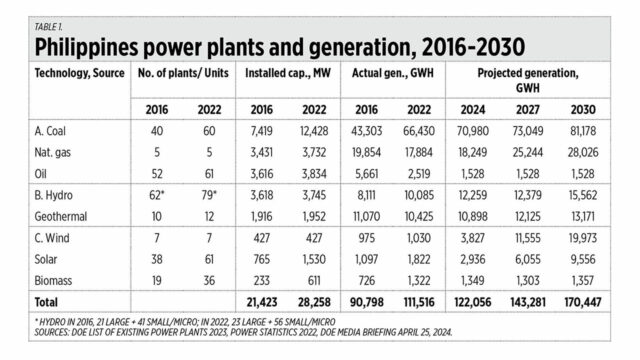
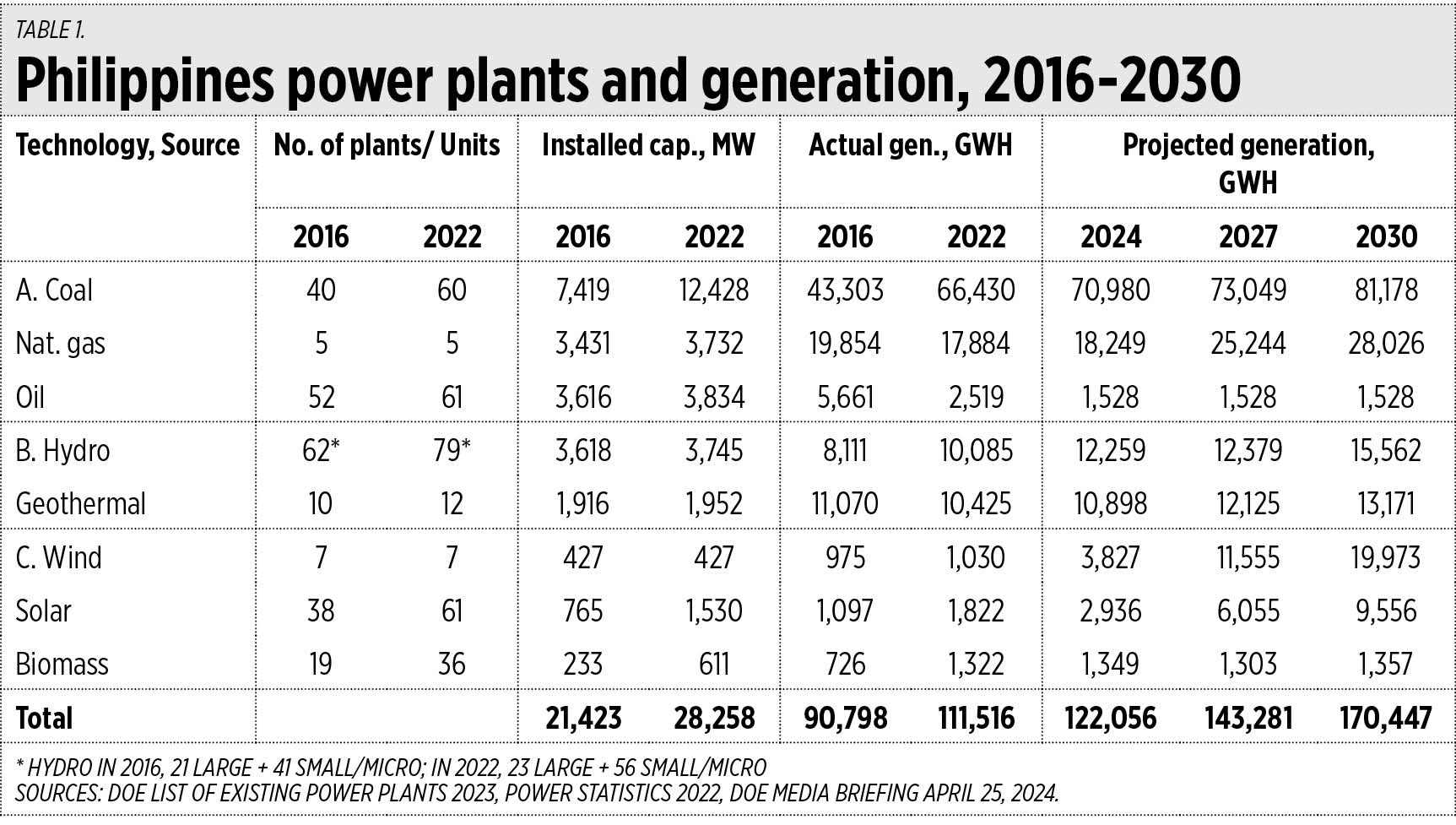
Points one to two are belied by the numbers in Table 1.


One, the number of solar and biomass plants increased during the past administration, from 38 and 19 respectively in 2016, to 61 and 36 in 2022. Over the same period, solar generation doubled while biomass almost tripled. For wind power, the projected generation this year is almost four times the level of 2022, while solar output this year will be nearly double that in 2022.

Two, between 2016 and 2022, 20 new coal plants were added to the grids (see Table 1). In the Luzon grid, the biggest coal power plant addition was GN Power Dinginin with 1,450 megawatts (MW). It became operational in 2021 and 2022. In the Visayas grid, the biggest addition was the coal-powered Therma Visayas, Inc. (TVI) with 338 MW which became operational in 2019. And in the Mindanao grid, the biggest addition was the coal-powered GN Power Kauswagan with 604 MW which became operational in 2019-2020.

Then we come to the third myth, that there was a moratorium on the construction of coal-powered plants. In the Department of Energy (DoE) website, I came across the “Advisory on the Moratorium of Endorsements for Greenfield Coal-fired Power Projects…” dated Dec. 22, 2020. It said that coal plants are still ALLOWED to be constructed: “… any coal-fired power project in any of the following parameters will not be affected: (a) Committed power projects, (b) Existing power plant complexes which already have firm expansion plans, (c) Indicative power projects with substantial accomplishment… with signed and notarized acquisition of land or Lease Agreement… With approved permits or Resolutions from LGUs…”

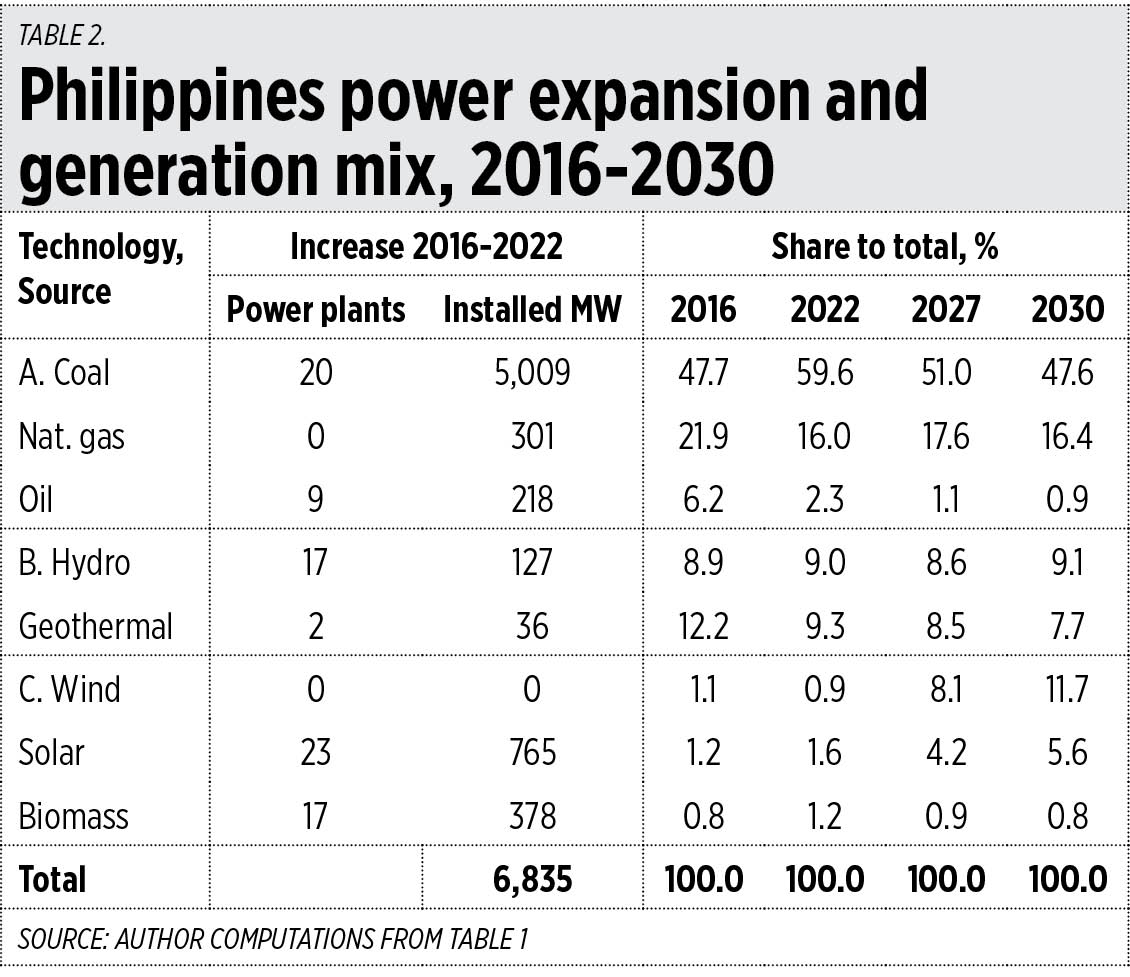
The DoE’s projections see the continued annual increase in coal generation until 2030 and beyond, but the projected share of coal to the total will decline from 60% in 2022 to 47.6% in 2030 while the share of wind plus solar will increase from 2.5% in 2022 to 17.3% in 2030 (see Table 2).

We then come to the fourth myth, that the problem is not in transmission, only in generation. But when it comes to the grid code requirements for ancillary services, the system operator, the National Grid Corp. of the Philippines (NGCP), has been non-compliant. The NGCP’s franchise was given in 2008 and the firm contracting of reserve requirements was made only after about a decade — but at an insufficient amount. See these stories in relation to this point: “Energy dep’t to require more firm contracts for reserve power” (BusinessWorld, Dec. 25, 2019) and “DoE Pushes NGCP to Contract Sufficient Power Reserves for Energy Reliability” (DoE website, April 24, 2021).

Energy Regulatory Commission Chairperson Monalisa Dimalanta has said that they “penalized the NGCP in November 2022 for not complying with DoE directives on the reserves contracting.

“They paid the penalty and launched the Competitive Selection Process (CSP). They did not get enough offers though so the total contracted capacity is still not at required levels, but the operation of the reserves market allowed NGCP to source that capacity from the market.”

Let us discuss the fifth point: The price control on electricity protects the consumers. I consider the price control via the primary and secondary price cap at the Wholesale Electricity Spot Market (WESM) as anti-consumer. The short-term benefit of a forced lower price is easily negated by an insufficient power supply while demand keeps rising, which leads to even higher price spikes in the medium- to long-term. Also contributing to the situation are the unacted upon supply contracts between generation companies (gencos) and distribution utilities/electric cooperatives, which involve years of waiting for regulatory approvals. Gencos will hesitate to expand their supply capacity if they are in danger of losing money, and the public then suffers via frequent threats of blackout. Keeping prices low therefore leads to yellow and red alerts.

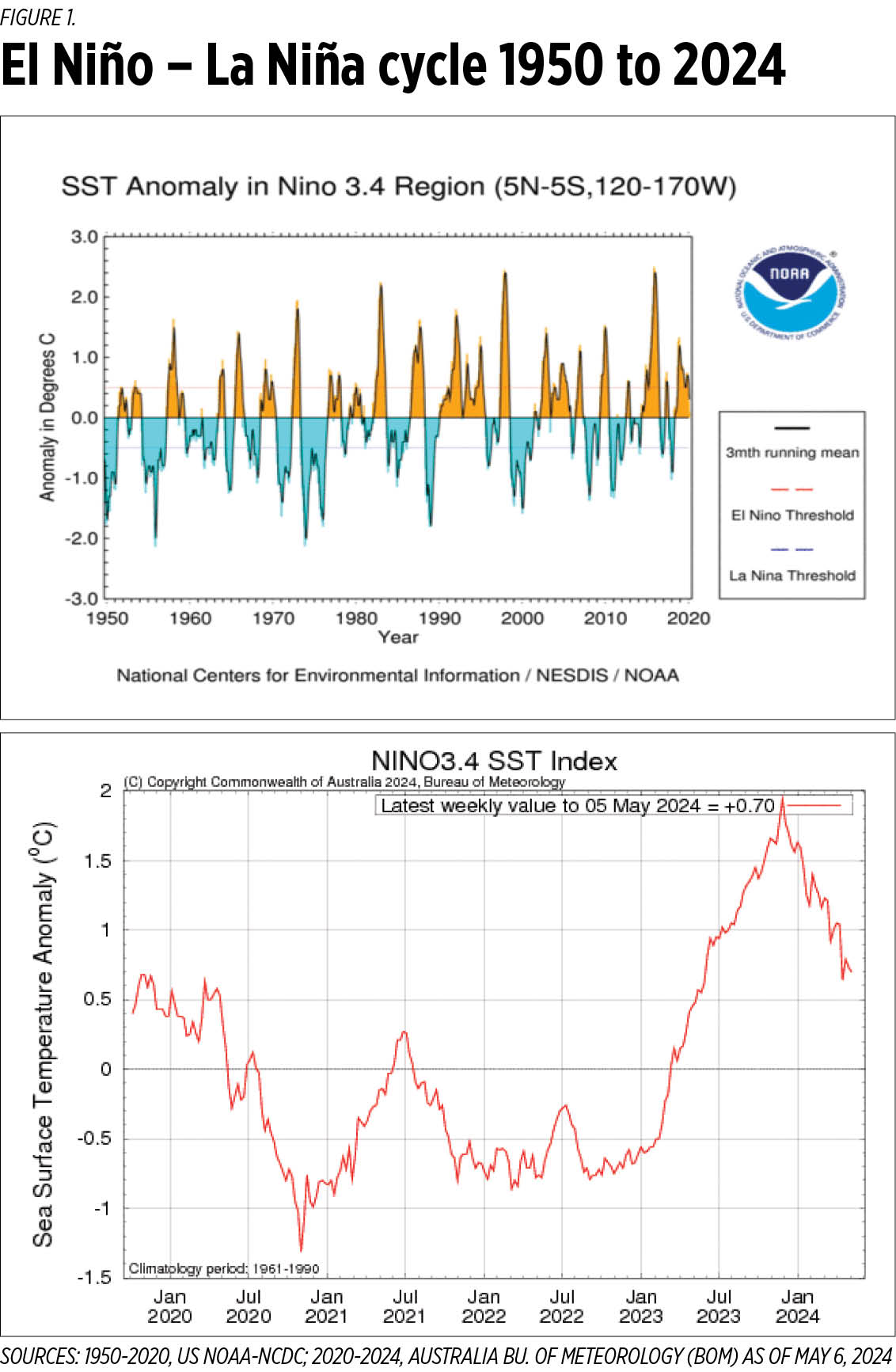
Finally, we come to the sixth point: that El Niño is getting stronger than La Niña, leading to a rising demand for power. The El Niño-La Niña cycle is natural and has been regularly occurring since planet Earth was born some 4.6 billion years ago, so the current El Niño had been predicted to happen after the triple-dip La Niña of 2020-2023, and it is 100% certain that La Niña will happen again — it is projected to appear around July-August this year. Then we prepare for colder temperatures, more rains and floods. This is shown by actual data over the past seven decades (see Figure 1). Demand will rise because of El Niño’s heat (leading to yellow and red alerts because demand is stronger than the supply of electricity), but not because El Niño is getting stronger than La Niña (during which time demand should fall).

To remedy the continuing thin power reserves and frequent yellow-red alerts, the NGCP as system operator be monitored for strict compliance with grid code reserve requirements; price controls at WESM should be removed, and the approval of market-determined power supply contracts should be hastened; we should also hasten the integration of nuclear power in the power system; and, we should ultimately ditch climate alarmism and embrace energy realism, recognizing that the warming-cooling cycle is natural.


Bienvenido S. Oplas, Jr. is the president of Bienvenido S. Oplas, Jr. Research Consultancy Services, and Minimal Government Thinkers. He is an international fellow of the Tholos Foundation.

minimalgovernment@gmail.com

Maynilad says it uses satellite, AI for leak detection 

MAYNILAD Water Services, Inc. said it has tapped satellite-based infrastructure intelligence company Asterra to use satellite imagery and artificial intelligence (AI) to detect underground pipe leaks.

Detecting underground pipe leaks will help the company to reduce network losses and recover more water supply for distribution, the west zone concessionaire said in a statement on Monday.

“By leveraging on this cutting-edge technology, Maynilad can locate underground pipe leaks in a more efficient way, as it reduces the time and effort needed for our field personnel to pin-point leak sources that often involves digging test pits on the streets,” Maynilad President and Chief Executive Officer Ramoncito S. Fernandez said.

The water company said it has tapped Asterra’s patented algorithms that were originally developed to detect water on other planets.

The use of the technology involves applying algorithmic analysis to track the spectral “signature” of potable water underground over a land area of approximately 3,000 square kilometers captured in a satellite image, it said.

The leakage information that the AI algorithms pick up are captured in a geographic information system report that specifies street locations, enabling Maynilad to fast-track the process of detecting and repairing underground leaks.

The company said it is examining 1,000 kilometers of its primary lines across its service area and “actively looking” for possible leaks during its year-long pilot use of Asterra’s technology.

Maynilad serves the cities of Manila, except San Andres and Sta. Ana. It also operates in Quezon City, Makati, Caloocan, Pasay, Parañaque, Las Piñas, Muntinlupa, Valenzuela, Navotas, and Malabon. It also supplies the cities of Cavite, Bacoor, and Imus, and the towns of Kawit, Noveleta, and Rosario, all in Cavite province.

Metro Pacific Investments Corp., which has a majority stake in Maynilad, is one of three Philippine units of Hong Kong-based First Pacific Co. Ltd., the others being Philex Mining Corp. and PLDT Inc.

Hastings Holdings, Inc., a unit of PLDT Beneficial Trust Fund subsidiary MediaQuest Holdings, Inc., has an interest in BusinessWorld through the Philippine Star Group, which it controls. — Sheldeen Joy Talavera

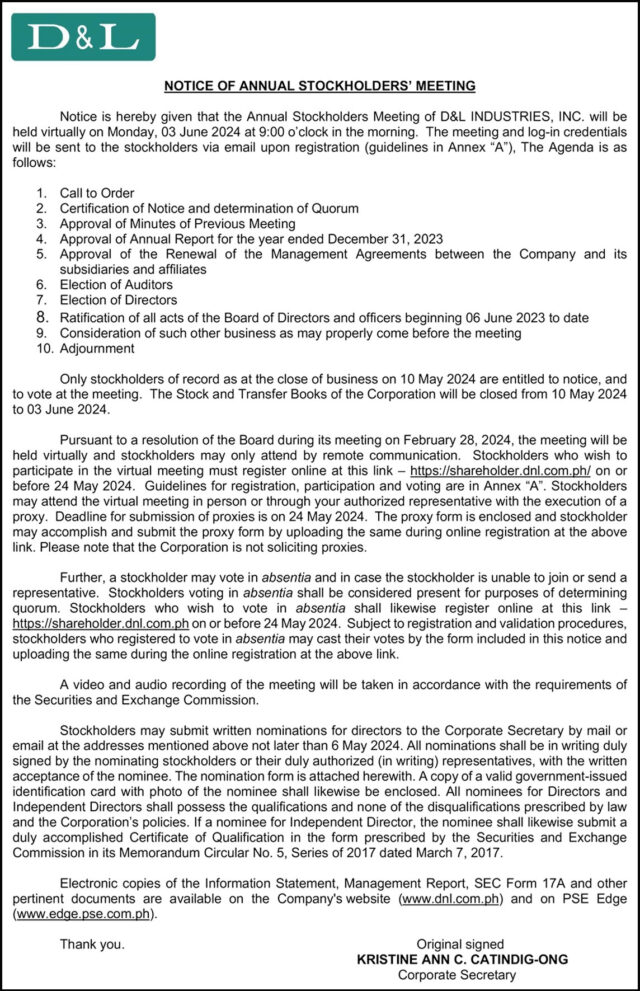
D&L Industries, Inc. to conduct 2024 Annual Stockholders’ Meeting virtually on June 3


Spotlight is BusinessWorld’s sponsored section that allows advertisers to amplify their brand and connect with BusinessWorld’s audience by publishing their stories on the BusinessWorld Web site. For more information, send an email to online@bworldonline.com.

Join us on Viber at https://bit.ly/3hv6bLA to get more updates and subscribe to BusinessWorld’s titles and get exclusive content through www.bworld-x.com.

Eurovision 2024 begins in Malmo with contestants’ walk on ‘Turquoise Carpet’

—EUROVISION.TV

MALMO, Sweden — Eurovision 2024 began in the Swedish city of Malmo on Sunday when 37 contenders walked the “Turquoise Carpet” amid heightened security and calls for boycotts due to Israel’s participation.

The 68th version of the song contest, which is always billed as non-political, is taking place against the backdrop of the devastating Israeli military campaign in Gaza, triggered by Hamas’ Oct. 7 attack on Israel last year.

Much focus is expected to be on Israeli contestant Eden Golan, when she performs her song “Hurricane” in the second semifinal on Thursday, with bookmakers placing the entry among the top 10 to win the competition.

The Israeli delegation did not attend the carpet on Sunday due to Holocaust Memorial Day in Israel, said Swedish broadcaster SVT, which co-organizes the contest with the European Broadcasting Union (EBU).

Israel agreed to modify the lyrics of its original song “October Rain,” which the EBU said made reference to the Oct. 7 Hamas onslaught.

The contest comprises three live shows, with half a dozen countries having a shot at the title this year, according to fans and bookmakers.

Sweden’s Loreen won the 2023 competition in Liverpool, northern England, with her song “Tattoo,” granting the Nordic country an automatic entry into next Saturday’s grand final.

The “Big Five” of the EBU — the UK, France, Germany, Spain, and Italy — are also automatically given a spot in the final, while the other contenders will compete in semi-finals for the remaining places.

It will be the seventh time Sweden is hosting the song contest after last doing so in 2016, and the third time Malmo will stage the competition.

Sweden’s participants for this year, twins Marcus & Martinus, were drawn in March to open the final with their dance pop song “Unforgettable.” — Reuters

ADVERTISEMENT
ADVERTISEMENT