Home Blog Page 3025

Style (06/24/24)


Avon releases Pride Collection

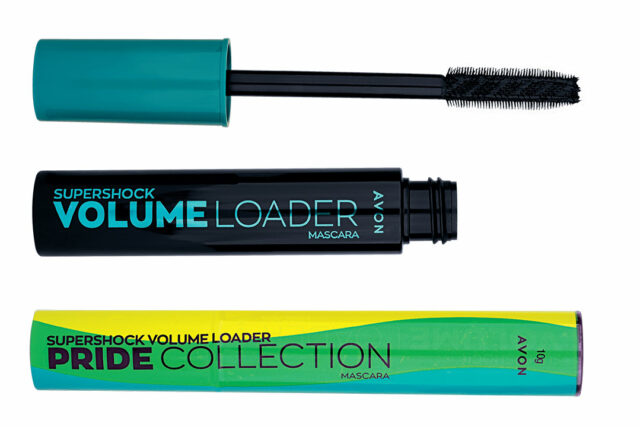
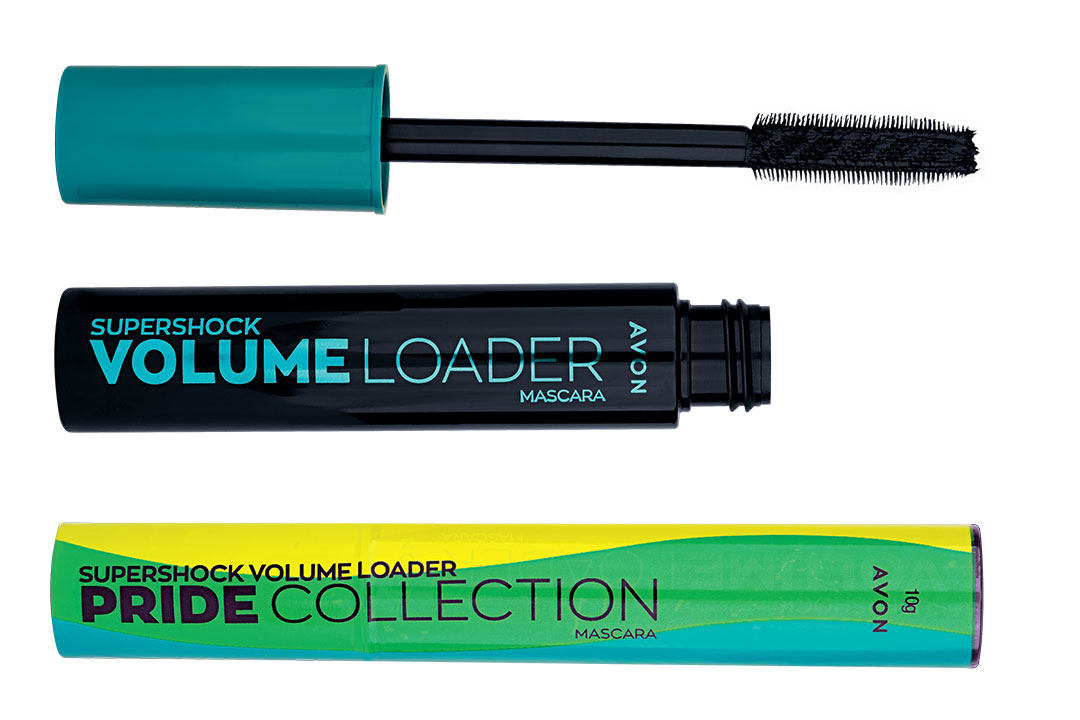
FOR PRIDE Month, Avon has released a limited-edition Pride Collection that features the Supershock Volume Loader Mascara, and an expanded lineup of the Glimmerstick Eyeliner in four new shades. The Supershock Volume Loader Mascara is enriched with vitamin E for healthier-looking lashes. Its helix brush ensures flawless application, delivering a water-resistant, smudge-proof, flake-proof, and clump-free formula from root to tip, with an intense black color, packaged in vibrant limited-edition Pride packaging. Meanwhile, Avon’s Glimmerstick Eyeliner Pride Collection is infused with nourishing rosehip oil and vitamin E. Available in four limited-edition shades — Azure Blue, Daring Citrine, Emerald Glow, and Cosmic Obsession. They are designed to achieve a bold and playful look that will last all day. To further show support to the LGBTQIA+ community, Avon sponsors products for LGBTQIA+ organizations such as Home for the Golden Gays, Bahaghari, PANTAY, and LoveYourself, providing useful body care, apparel, make-up, fragrance, and skincare items for its members to appreciate. Each Supershock Volume Loader Mascara purchase will come with a P10 donation to Avon’s partner support groups. The Pride Collection can be found at www.avonshop.ph, through Avon Representatives, Lazada, Shopee, and TikTok Shop.


Gap collaborates with Dôen

GAP has collaborated with California clothing label Dôen for a collection of women’s apparel and accessories. It features Dôen’s feminine take on Gap’s iconic styles. “Gap partners with brands that champion originality and use fashion as a powerful form of self-expression,” said Mark Breitbard, President and CEO of Gap, in a statement. Said Katherine Kleveland, Co-Founder and CCO of Dôen in the same company statement: “As with all our Dôen designs, the collaboration pieces were designed to be loved, worn in, and passed down — and we’re beyond excited to partner with Gap to be able to offer this to an engaged global community.” In the Philippines, Gap is exclusively distributed by Specialty Lifestyle Concepts, Inc. (formerly Casual Clothing Retailers, Inc.), a member of SSI Group, Inc. Gap is available at Ayala Malls Manila Bay, Glorietta 4, Shangri-La Plaza, SM Mall of Asia, Trinoma, Alabang Town Center, SM Megamall, and Abreeza Davao.


Ikea wants you to sleep

IN ITS new campaign, “Wake up! It’s time to sleep,” Ikea features three different Ikea customers falling asleep at their showroom. The campaign aims to call on Filipinos give more attention to having better sleep, and encourages Filipino customers to experience Ikea sleep solutions themselves before they purchase them at the IKEA Pasay City showroom. According to Ikea Life at Home Report 2023, 44% of Filipinos consider sleeping the main driver of nurturing at home. Ikea’s sleep offerings include the soft Åfjäll foam mattress (starts at P3,990) and the firm Valevåg Pocket spring mattress (starts at P7,990). There’s also a wide selection of ergonomic pillows like the ergonomic Mjölkklocka pillow (P1,990) which has memory foam for full comfort whether the user is a side or a back sleeper. Light also comes into play with the dimmable Tärnaby table lamp (P990) and the Trådfri remote control kit (P1,290). The sleep solutions are available at Ikea Pasay City and online at IKEA.ph.

Philippines lands at 168th out of 180 in Yale’s environmental sustainability ranking

The Philippines placed 168th out of 180 countries in the 2024 edition of the biennial Environmental Performance Index (EPI) by the Yale Center for Environmental Law & Policy. Countries are ranked based on their progress toward mitigating climate change, improving environmental health, protecting ecosystem vitality, and reaching established environmental policy targets. The country got an overall EPI score of 32 out of 100, the fifth-lowest in the region and below the Asia-Pacific median EPI score of 41.8.

Philippines lands at 168<sup>th</sup> out of 180 in yale’s environmental sustainability ranking

PSEi member stocks performed — June 21, 2024

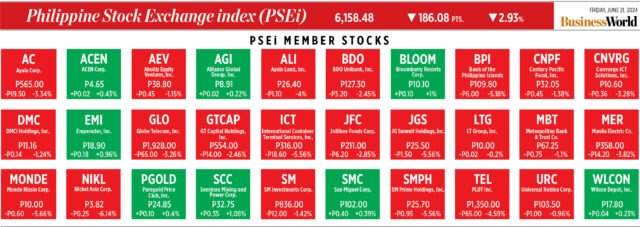
Here’s a quick glance at how PSEi stocks fared on Friday, June 21, 2024.


Bargain hunting likely before BSP policy review

BW FILE PHOTO

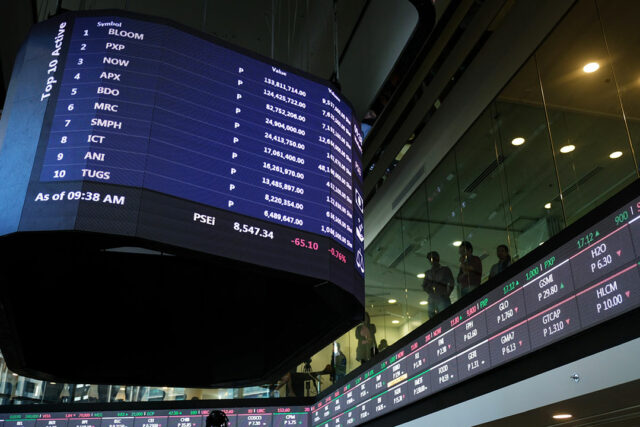
BARGAIN HUNTING may prop up Philippine shares this week after the index ended at a seven-month low on Friday, and as the market awaits the Bangko Sentral ng Pilipinas’ (BSP) policy meeting.

On Friday, the bellwether Philippine Stock Exchange index (PSEi) closed lower for an eighth consecutive session, going down by 2.93% or 186.08 points to end at 6,158.48. The broader all shares index also retreated by 1.89% or 65.11 points to 3,375.20.

The PSEi’s finish was its worst for the year thus far and was the lowest in over seven months or since its 6,110.88 close on Nov. 14, 2023.

Week on week, the index dropped by 3.5% or 225.22 points from its 6,383.70 finish on June 14.

“Market-on-close selling drove the local bellwether back towards the 6,100 level ahead of the Bangko Sentral ng Pilipinas’ (BSP) Monetary Board meeting [this] week,” online brokerage 2TradeAsia.com said in a note.

“The local market is seen to be exhibiting a bearish bias, running an eight-day losing streak,” Philstocks Financial, Inc. Senior Research Analyst Japhet Louis O. Tantiangco said in a Viber message.

For this week, the main driver for Philippine stocks would the BSP’s policy review on Thursday, June 27, Mr. Tantiangco said.

“With its recent downturn, the market has been driven to more attractive levels. Thus, we may see some episodes of bargain hunting in this week’s trading. However, we do not expect the market to stage a strong rally yet until investors hear positive narratives on the timing of the Bangko Sentral ng Pilipinas’ policy easing,” he said.

“Investors will be watching out for cues on the BSP’s monetary policy outlook. Hints of rate cuts soon may cause a turnaround in the market’s current direction. If there would be none, however, the market may continue with its bearish bias,” Mr. Tantiangco added.

Investors will also monitor the peso’s movement against the dollar, he said.

The local unit weakened to a near 20-month low on Friday, ending at P58.80 per dollar, inching down by two centavos from its P58.78 finish on Thursday, Bankers Association of the Philippines data showed. This was the peso’s worst finish since its P58.87-a-dollar close on Oct. 24, 2022.

Mr. Tantiangco put the PSEi’s immediate support at 6,150 and resistance at 6,400.

For his part, Rizal Commercial Banking Corp. Chief Economist Michael L. Ricafort put the PSEi’s next important support at 6,000 and major resistance at  6,350-6,390.

He said the BSP is expected to match the US Federal Reserve’s latest rate pause at their meeting this week “to maintain healthy interest rate differentials and to help stabilize the peso exchange rate, import prices, and overall inflation.”

Another lead for the market is the possible release of the latest Philippine budget balance data this week, Mr. Ricafort added.

2TradeAsia.com placed the PSEi’s immediate support at 6,000, primary resistance at 6,300, and secondary resistance at 6,500. — R.M.D. Ochave

Peso may stay weak vs strong dollar

PHILIPPINE STAR/ MIGUEL DE GUZMAN

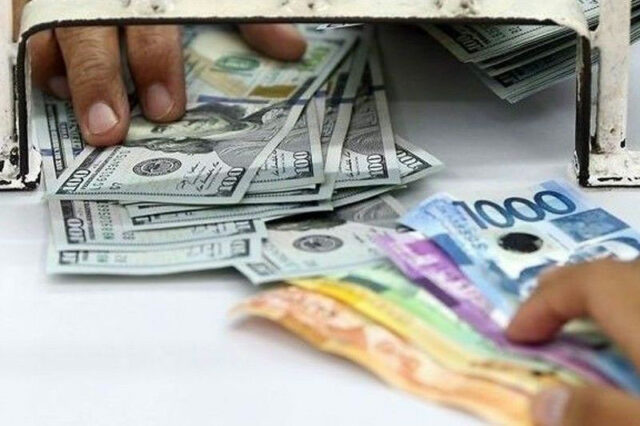
THE PESO is likely to stay at the P58 level this week as the dollar will continue to be supported by the US Federal Reserve’s “higher for longer” policy stance, analysts said.

The local unit weakened to a near 20-month low on Friday, ending at P58.80 per dollar, inching down by two centavos from its P58.78 finish on Thursday, Bankers Association of the Philippines data showed.

This was the peso’s worst finish since its P58.87-a-dollar close on Oct. 24, 2022.

Week on week, the peso declined by 15 centavos from its P58.65 finish on June 14.

“Asian currencies showed mixed performance against the US dollar, with focus shifting to Friday’s US June purchasing managers’ index manufacturing data,” Security Bank Corp. Chief Economist Robert Dan J. Roces said in a Viber message.

The Fed’s hawkish stance continued to support the dollar on Friday, leading to a weaker peso, Rizal Commercial Banking Corp. Chief Economist Michael L. Ricafort added in a Viber message.

The dollar rose against other major currencies on Friday, hitting a fresh eight-week high against the yen as data showed a strong US economy and as the Federal Reserve’s patient approach to interest-rate cuts contrasts it with more dovish peers, Reuters reported.

The dollar index, which measures the currency against six others, was last up 0.2% at 105.82. It had spiked 0.41% overnight, erasing declines for the week, following a second successive rate cut at the Swiss National Bank and hints from the Bank of England of a reduction in August.

For this week, Mr. Roces said the peso’s weakness may persist amid a strong dollar.

“Overall, major central bank rate cuts ahead of the Federal Reserve’s decision are keeping the dollar well-supported and may continue on to [this] week,” he said.

“An offsetting positive factor for the peso is the increased possibility of Fed rate cuts recently, interestingly and ironically, as the latest fed fund futures priced in nearly two Fed rate cuts for 2024,” Mr. Ricafort added.

He expects the peso to move between P58.50 and P58.80 per dollar this week. — AMCS with Reuters

BoI seeing increased investor interest in agriculture projects

REUTERS

THE Board of Investments (BoI) said it is seeing increased investor interest in agriculture, after investment promotion agencies (IPAs) were empowered to approve projects with higher investment thresholds.

In a statement over the weekend, the BoI said the higher thresholds at IPA level approved by the Fiscal Incentives Review Board (FIRB) helped stimulate interest in farming projects.

On Feb. 2, the FIRB, through Resolution No. 003-24, increased the threshold to P15 billion and below from the previous P1 billion and below.

Since then, the BoI has approved six agriculture projects valued at P13.38 billion.

Agriculture attracted the most investment with P6.05 billion, while the transportation and storage industry drew P3.95 billion, the BoI said.

The approved investments include the registration of a new producer of processed chicken, a dairy farm, and a cold-storage facility.

“Recent approvals with investments ranging from P1 billion to P15 billion highlight the benefits of increased investment thresholds for the agriculture sector,” Trade Secretary and BoI Chairman Alfredo E. Pascual said.

“These projects, upon completion, will drive the adoption of new technologies and strengthen food security. This is crucial to meet the rising food demand and sustain resilient agricultural systems despite climate change and other challenges,” he added.

Since the Corporate Recovery and Tax Incentives for Enterprises law was implemented in 2021, the FIRB has approved 28 projects valued between P1 billion and P15 billion, valued at a combined P126.61 billion.

Meanwhile, the FIRB approved 15 projects involving over P15 billion in investment, amounting to P835.89 billion.

“This increased project cost threshold for IPA approval affirms the government’s push to streamline business processes and manage incentives prudently,” Mr. Pascual said. — Justine Irish D. Tabile

Wage hike not expected to hurt foreign investor interest in PHL

PHILIPPINE STAR/BOY SANTOS

A WAGE hike is not expected to reduce the appeal of the Philippines to foreign investors, the British Chamber of Commerce of the Philippines (BCCP) said.

BCCP Executive Director and Trustee Christopher James Nelson said by phone that wage hikes will not necessarily mean the loss of foreign investors, contrary to the fears of other employers.

“It’s not the only factor… investors will also look at (other factors). There’s no single factor that will lead investors to say, ‘Okay, wages have gone up, that means I go somewhere else.’ It is a combination of factors,” he added.

The Philippine mechanism for raising minimum wages is via rulings issued by regional wage boards, which cannot hear wage hike appeals until the anniversary of the last ruling.

Mr. Nelson said the peso’s prolonged weakness and agriculture-related legislation would be the developments British investors are focused on.

He added that the Philippines remains attractive to foreign investors due to the recent executive orders of President Ferdinand R. Marcos, Jr., specifically the one cutting tariffs on imported rice.

“It’s those actions could have a greater impact (on foreign investors) because what drove inflation, particularly, is the cost of rice and meat products and foodstuffs,” he said.

He said regional boards should decide on wage hikes instead of Congress legislating higher wages.

“We were happy to see that they’ve gone back to the wage boards. That was how, in the Philippines, it has been previously done. That’s important as opposed to having a mandated increase from Congress,” he added.

An economist and some employers last week said a wage increase would drive away foreign investors, and turn to neighbors Vietnam and Cambodia.

Labor groups have said a skilled workforce is also an important factor for attracting foreign investors, though they need to be paid fairly.

The wage board for Metro Mania concluded a public hearing on wage hikes on Thursday, discussing petitions ranging from P100 to P750 from various labor groups. It is currently reviewing the proposals.

It is set to release its decision on or before July 20, the anniversary of the last wage order in the National Capital Region (NCR).

The daily minimum wage in the NCR is P610 for non-agriculture workers and P573 for agricultural workers, retailers with 15 workers or less, and manufacturing firms regularly employing fewer than 10 workers. — Chloe Mari A. Hufana

TIEZA sees changes to CREATE encouraging tourism investment

PHILSTAR FILE PHOTO

THE TOURISM INDUSTRY is expected to attract increased investments once the amendments to the Corporate Recovery and Tax Incentives for Enterprises (CREATE) Act are passed, an industry regulator said.

On the sidelines of the Philippine Tourism and Hotel Investment Summit on Friday, Tourism Infrastructure and Enterprise Zone Authority (TIEZA) Chief Operating Officer Mark T. Lapid said investors “will benefit because that will level the playing field. Meaning, what you can get in the Philippine Economic Zone Authority (PEZA), you can also get in the Board of Investments (BoI) and in TIEZA,” Mr. Lapid said in a mix of English and Filipino.

“But the only thing that you cannot get from the other investment promotion agencies and you can get from us is the infrastructure support,” he said. “So yes, this will make the sector more attractive to investors.”

In March, the House of Representatives approved on final reading the CREATE to Maximize Opportunities for Reinvigorating the Economy (CREATE MORE) bill, which seeks to cut the corporate income tax to 20% from 25% The bill has been passed on to the Senate.

During the summit, the Philippine Hotel Owners Association, Inc. (PHOA) and Leechiu Property Consultants released the Philippine Hotel Investment Outlook Survey, which in part laid down government support recommendations that it hopes will attract more investment.

In particular, PHOA and Leechiu called for additional tax incentives and the extension of  current incentives to help offset setbacks during the pandemic and help proponents recover at least half of their construction and land acquisition costs.

Francis Nathaniel C. Gotianun, chairman of the organizing committee of the summit, said: “We are  trying to get a reinvestment allowance … since hotels require a lot of capital investment on an ongoing basis, we were hoping that we could get a 50% rebate on our renovation costs because we continuously renovate hotels,” Mr. Gotianun told BusinessWorld.

Another recommendation in the report is increased incentives for sustainability initiatives, which PHOA and Leechiu said will help “inspire both hospitality establishments and the public to integrate environmental stewardship into their operations.”

According to Mr. Gotianun, the government can help the industry by providing funding access for sustainability initiatives.

“It can be in the form of a subsidy or reimbursement for investment in sustainability. It would be good if there was some sort of financing facility, rebate, or tax break as a result of the investment,” he said.

“The idea is that if we can get some tax shielding as a result of that investment, it will encourage people to invest again. Obviously, the more government support we can get, the more we’d be happy to invest,” he added.

Meanwhile, Mr. Lapid said TIEZA is offering 10 assets for joint ventures or for public-private partnerships.

“These are open for investment, so the private sector can come in or form a joint venture, and then from our part, we would be responsible for the property and the land cost,” he said.

The projects include the development of a critical tourism infrastructure project in Boracay Island, the rehabilitation and redevelopment of the Balicasag Island Dive Resort, the development of an integrated tourism complex in Ilocos Norte, and the development of an integrated drive complex in Moalboal in Cebu Province. — Justine Irish D. Tabile

ERC reviewing allowable power plant outage levels

THE Energy Regulatory Commission (ERC) said it is reviewing the reliability index that typically sets the allowable outages for energy facilities, to improve monitoring and set appropriate penalties.

“We are reviewing the reliability indices based on the petition filed by PIPPA (Philippine Independent Power Producers Association, Inc.) to make sure the indices are real measures of operational performance,” ERC Chairperson Monalisa C. Dimalanta said via Viber.

“We can then improve our monitoring tools and impose appropriate penalties,” she added.

The reliability index in force since 2020 allows the ERC to set the maximum days of planned and unplanned outages per year, varying by generating plant technology.

The ERC reviews non-compliance of power generators and issues notice with an order to comply and to explain. It will then impose fines and penalties to those that refuse or fail to comply.

The ERC reported that five power generation companies exceeded the unplanned outage allowance as of April 30, a period when the power grids declared red and yellow alerts.

Ms. Dimalanta said the ERC hopes to complete the review within the month.

At a forum last week, Ms. Dimalanta said many distribution utilities (DUs), primarily electric cooperatives, had nearly 100% exposure to the Wholesale Electricity Spot Market (WESM) over the last two months during the heatwave and subsequent red alerts.

“Almost all of their supply came from the WESM. They do not have bilateral contracts where  the price is locked in, where the supply is assured,” she said.

Ms. Dimalanta said that the ERC monitored about 30 DUs with 25% to 100% WESM exposure and verified whether they have power supply agreements (PSAs) for approval and whether they have asked for provisional authority.

“Hopefully, for the next few months, we will be able to clean up that list,” she said.

WESM is where energy companies can buy power when their long-term contracted power supply is insufficient for customer needs, but they pay a premium for spot power.

Meanwhile, Ms. Dimalanta said the ERC expects more consumers to choose their own suppliers as the threshold for the Retail Competition and Open Access (RCOA) falls.

“As we lower the threshold for RCOA over the next 4-5 years, we see more consumers migrating from being captive by their DUs (distribution utilities) to being contestable customers choosing their own suppliers,” she said via Viber.

Under the Electric Power Industry Reform Act of 2001, qualified contestable customers, or end-users consuming at least 500 kilowatts a month, may choose their own power suppliers under the RCOA scheme.

End-users are given the opportunity to participate — on a voluntary basis — in the Competitive Retail Electricity Market, allowing them to choose from an array of power suppliers that offer cheaper electricity.

Captive customers are those served by DUs in areas which they are based.

During the forum, Ms. Dimalanta said the ERC projects that the conduct of the competitive selection process (CSP) “will not be as dominant in the space as we see them now” in the next few years.

She said that more consumers will migrate to the contestable market and “there will be less of the captive consumers that DUs will need to contract for.”

“In that near future, there will be fewer customers served by DUs under PSAs. So there will be less relevance for CSPs because customers will be contracting directly for their own supply,” Ms. Dimalanta said.

The government requires DUs to select the cheapest electricity through a CSP. — Sheldeen Joy Talavera

Fishport landed volume up 55% in May at 66,587.86 MT

PHILIPPINE STAR/ MICHAEL VARCAS

THE catch landed at regional fishports rose 55.5% by volume in May, according to the Philippine Fisheries Development Authority (PFDA).

In a report, the PFDA said the landed catch was 66,587.86 metric tons (MT) during the period, up from 42,814.9 MT a year earlier.

Month on month, fish deliveries rose 10.5% from April levels.

The PFDA said the increased fish catch came despite the “lingering effects of El Niño and the onset of the rainy season which may have affected fish and fishing activities.”

The General Santos Fishport Complex reported deliveries of 34,747.19 MT, more than double the 15,788 MT booked a year earlier.

Deliveries at the Navotas fishport increased 18.7% to 23,312.20 MT during the month.

The Iloilo fishport reported volume of 3,172.54 MT, followed by Bulan fishport in Sorsogon with 2,310.55 MT and the Lucena Fish Port Complex with 1,817.06 MT.

The catch landed at the Zamboanga fishport was 898.94 MT, while that in Davao was at 222.389 MT.

It added that fish landed at Sual, Pangasinan was 78.7 MT during the month. — Adrian H. Halili

Chinese e-vehicle firm invited to establish operations in PHL

PHILIPPINE STAR/EDD GUMBAN

THE Philippine Consulate in Chongqing, China and the Philippine Trade and Investment Center (PTIC) said they have invited Chongqing E-Cars Technology Co., Ltd. to set up an assembly plant and expand its operations in the Philippines.

Citing the market for electric tricycles, Chongqing Consul General Ivan Frank M. Olea and PTIC Commercial Consul Glenn G. Peñaranda met with Chongqing E-Cars Vice-President Alex Wang on June 21 to discuss plans for expanding e-trike deployments in the Philippines.

At the meeting, Mr. Wang said lithium-powered e-trikes can run for 140-170 kilometers on a single charge and are more sustainable than traditional gasoline-fueled tricycles.

In April, the Pakil, Laguna municipal government launched 12 three-wheelers made by Chongqing E-Cars, making Pakil the first local government unit to partner with the Chinese manufacturer in green transportation.

Mr. Peñaranda said the PTIC would be willing to assist the company in setting up a manufacturing or assembly plant in the country.

“Mr. Olea added that the Consulate General and Chongqing E-Cars can strengthen cooperation in terms of promoting people-to-people and business-to-business exchanges between the Philippines and China,” the consulate said. — John Victor D. Ordoñez

Instilling integrity into the corporate DNA

IN BRIEF: 

• Nearly half (49%) of global respondents believe that compliance with their organization’s standards of integrity has improved over the past two years, marking a 7% increase from 2022.

• Unethical mindset is more dominant in the upper echelons of organizations, with 67% of board members admitting they would consider unethical actions for their own benefit compared to only 25% of employees.

• Recent research indicates that corporate fraud shaves approximately 1.6% off a company’s equity value each year. In monetary terms, that equates to a staggering $830 billion.

The current climate of persistent macroeconomic, geopolitical, and market volatility, coupled with stringent regulatory scrutiny, continue to put the moral compass of organizations to the test. These global conditions underscore the critical importance of the values businesses uphold, particularly trust and integrity.

Trust serves as a significant competitive advantage, particularly when market unpredictability challenges business resilience. Without trust from employees, customers, suppliers, and investors, an organization’s future viability is jeopardized.

At the same time, companies rooted in integrity ensure long-term sustainability by adhering to ethical practices, which reinforce their brand and operational stability. A lack of integrity erodes trust, leading to significant operational and strategic challenges.

The interplay between these two raises a critical question: “How can trust endure without integrity?” This query forms the crux of the EY Global Integrity Report 2024, which surveyed over 5,400 respondents across 53 countries and territories.

On the upside, 49% of global respondents believe that compliance with their organization’s standards of integrity has improved over the past two years, marking a 7% increase from the EY Global Integrity Report 2022.

However, 38% of global respondents acknowledge a willingness to engage in unethical behavior to advance their career or remuneration. This pervasive mindset creates substantial risks that could lead to various adverse impacts within an organization.

The cost of low corporate integrity is high. Specifically, corporate violations in the US and the UK incurred penalties totaling $1 trillion, as a result of half a million infractions between 2010 and 2023. 

This article explores actionable insights from the EY Global Integrity Report 2024 and identifies human-centered approaches that leaders can use to build an integrity-first culture within their organizations.

THE CURRENT STATE OF INTEGRITY
Despite improved perceptions of organizational standards of integrity, companies continue to grapple with significant incidents and violations. The EY report highlights that 20% of companies acknowledge experiencing major integrity breaches, such as fraud, data privacy or security incidents, or regulatory compliance violations, within the past two years.

Notably, among those reporting significant integrity incidents, over two-thirds indicate the involvement of third parties.

An analysis of over 500,000 corporate violations from 2010 to 2023 reveals that certain financial and employment violations, including accounting deficiencies, AML deficiencies, tax violations, labor standards, workplace safety, and consumer privacy issues, have become 2 to 10 times more frequent since 2010.

Conversely, there has been a notable decline in violations related to employee compensation, public safety, banking, and environmental issues. However, progress remains limited in addressing anti-competitive behavior, discrimination, and whistleblower retaliation.

EMPLOYEES’ APPROACH TOWARD INTEGRITY
Although a majority of employees (58%) take a principled approach to integrity, there remains a substantial proportion (42%) who may compromise these standards under certain conditions.

In this dichotomy, the report shows that potentially compromised employees have a more negative view of their organization’s compliance environment. They are nearly three times more likely to say that unethical conduct is ignored within their teams, and more than five times more likely to say that unethical conduct is ignored within their organization’s supply or distribution chain.

LEADERS’ INTEGRITY DILEMMA
An unethical mindset towards career or pay is predominant in the upper echelons of organizations, with 67% of board members admitting they would consider unethical actions for their own benefit compared to only 25% of employees.

Moreover, 47% of board members and 40% of senior management have observed actions within the past two years that could damage their organization’s reputation if made public, yet no internal response was taken. This lack of action highlights a critical gap in ethical oversight and accountability.

WHAT BREEDS MISCONDUCT
The survey identifies several root causes of integrity incidents globally, including failure of financial processes and controls (27%), lack of internal resources to manage compliance and integrity activities (27%), employees not understanding policy and requirements (26%), and lack of appropriate tone from senior leadership (25%).

Equally significant, 45% of global respondents who reported integrity incidents attribute them to poor leadership tone or management pressure. This issue is compounded by the apparent reluctance among leaders to address misconduct.

Such factors contribute to an environment conducive to misconduct, emphasizing the need for robust controls, resources, and leadership commitment to foster a culture of integrity.

HIGH COST OF LOW INTEGRITY
Misconduct is an unpleasant reality, surfacing even within the most ethical organizations. Corporate infractions come at a high cost — not just in resources spent on internal investigations and remediation but also in fines and penalties paid to government regulators.

For instance, recent research indicates that corporate fraud shaves approximately 1.6% off a company’s equity value each year. In monetary terms, that equates to $830 billion in 2021 alone.

But the costs extend beyond the financial. A top-down, all talk, no walk mentality erodes trust both within the organization and in the public eye, placing the company’s reputation and financial health in jeopardy.

BUILDING AN INTEGRITY-FIRST CULTURE
Embracing the following integrity-first approaches — which put the right programs in place to drive behavior to create a strong culture and a strong belief in their commitment to integrity — can help organizations keep pace with evolving regulations and increasing societal expectations:

Lead from the top. Integrity can’t be built or sustained with all talk and no action. Organizations need to focus on preventing and addressing misconduct by starting from the top. Moreover, leaders need to listen and practice what they preach to instill integrity further down the line. Words alone won’t inspire integrity; leadership action is a must.

Design and implement a structure to execute strategy. To prevent unethical actions from the top down, organizations must implement robust governance structures within their integrity programs and strategies. Breaking down silos is also crucial to encourage a “speak up” culture against any misconduct.

Strengthen a culture of integrity across the organization. Organizations must recognize that integrity is a collaborative endeavor, not merely a stand-alone function. Embedding compliance directly into operations—from new business development to vendor payments—transforms corporate policies into actionable workflows.

Boost awareness, training and communication. The report indicates that fewer than 47% of management teams frequently communicate to their employees the importance of behaving with integrity. Making the rationale behind policies crystal clear fosters a resilient organization capable of thriving in both good and bad times.

Create a virtuous circle of integrity. In times of rapid change and difficult market conditions, maintaining, let alone enhancing, corporate integrity can seem daunting. But it is precisely in these challenging times that integrity must not only be preserved but also prioritized.

This article is for general information only and is not a substitute for professional advice where the facts and circumstances warrant. The views and opinion expressed above are those of the author and do not necessarily represent the views of SGV & Co.


Roderick M. Vega is the Forensic and Integrity Services Leader of SGV & Co.