Home Blog Page 3021

Election distress

PHILIPPINE STAR/EDD GUMBAN

Comelec Chair George Garcia, the former campaign manager of President Ferdinand Marcos, Jr., has gone on television to explain the features of the Korean-brand of vote-counting machines. However, I did not quite understand from his explanation if we are buying or leasing them. The Smartmatic brand machines which we used in past elections were purchased outright, and we had to deal with problems due to storage in warehouses of the delicate IT equipment which we do not have the capability to maintain. I wonder how much of our taxpayer money had to be spent on maintenance of these voting machines stored for years in warehouses (including the cost of electricity and air conditioning, and security plus repairs). I hope this time we have learned our lessons and just lease them so the Korean suppliers are responsible for maintenance.

Mr. Garcia proudly disclosed that this time, the counting machine would print a “receipt” detailing the candidates voted for, to give to each voter. If these receipts are not destroyed within the precinct before the voter leaves, this will guarantee candidates who buy votes the certainty that they are getting their money’s worth!

As the mid-term election nears, I worry more and more about the composition of our Senate. With no less than three Dutertes running*, and another Tulfo rumored to be interested, it is becoming a truly family business. Today, 25% of the Senate is composed of senators who are relatives, namely two Villars (mother and son), two Cayetanos (siblings), and two sons of Erap. If our voters are still inclined to vote for family names they already know, then we will possibly have three more Dutertes (father and two sons), and one more Tulfo sibling. That makes up almost half of the next Senate! These will represent our over 100 million Filipinos in the making of national policy.

As long as our educators continue to focus on depositing more and more information in students’ brains, rather than sharpening their critical thinking skills, we will continue to have voters who do not look at the qualifications of candidates who want to be our leaders. It will take a radical change in our “teaching” methods. Instead of the “banking” (deposit and withdraw knowledge) approach, we will have to focus on “learning” methodologies, in which the emphasis is on sharpening skills: the students’ ability to think independently. This also calls for lessening the burdens on our teachers so that they can prepare properly for their real work.

I have taught in high school, college, and graduate school. In high school, I prepared each day to give quizzes in order to have numbers as the basis for giving grades. In order to make it easy to check tests and record grades, I had to make most of the questions answerable in multiple choice or True and False. This does not help sharpen critical thinking in the learners. I really believe the grading system at the graduate school where I taught which gives only three options (Pass, Fail, Distinction) encourages more discussion among the learners and learning facilitators (“teachers”). This can help sharpen critical thinking, especially since our poor students have to communicate in Tagalog (the National Language), English (still a foreign language in most communities), plus their own mother tongue. No wonder we rate so poorly in international learning competitions.

Lately, Alice Guo, the suspended mayor of Bamban, Tarlac, has been confirmed to be a foreigner and therefore not qualified to be in her position. According to an ongoing Senate investigation, Guo was born in China from Chinese parents, and somehow obtained a Filipino birth certificate, a Filipino passport, and Comelec endorsement as a candidate and as elected Mayor.

It is very alarming that in some of the POGO quarters in Bamban, Chinese military uniforms were discovered! If I remember correctly, Sun Tzu, in his Art of War, states that the great general is the one who can take over a territory without resorting to warfare. I also recall somewhere Sun Tzu justifying the use of falsehoods as part of a winning “war” strategy. I hope our security officials have read Sun Tzu to better understand what China is doing, and know better how to deal with it.

Meanwhile, I continue to think that we really should consider changes in our election laws. Perhaps we should not have direct elections for national offices. Local government executives (elected mayors and governors) can vote for the President, and locally elected representatives to legislatures can select a Prime Minister from among their peers. The power sharing can be determined in a new Constitution. The Prime Minister leads the legislative/policy making body; and the President leads the execution of such policies all the way to the community levels. This way, we have better chances of ensuring that national leaders are chosen by peers who know better what kind of people should be their (and our) leaders. Perhaps political party memberships will then make more sense.

Ah, but so much for wishful thinking. The current Senate members, especially those who have been in jail, or belong there, would never agree to the idea of abolishing their cushy jobs. They are able to brag publicly about their privates, and still be addressed as “Honorables.”

*This according to Vice-President Sara Duterte, though her father, former president Rodrigo Duterte, has denied this according to the Philippine Star yesterday. “Duterte said people should not believe everything his daughter says, as sometimes she has the tendency to make jokes,” said the front-page story. — Ed.


Teresa S. Abesamis is a former professor at the Asian Institute of Management and fellow of the Development Academy of the Philippines.

tsabesamis0114@yahoo.com

Next phase of Villar City dev’t set to begin — chairman

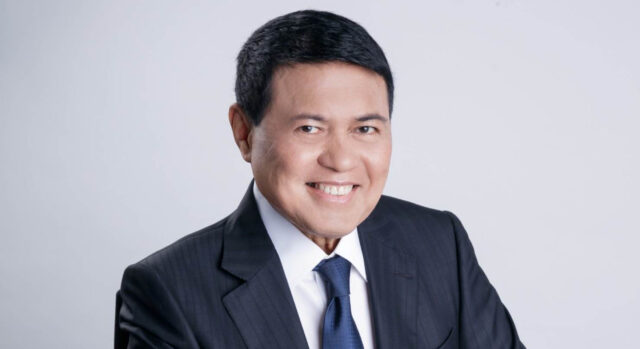
MANUEL B. VILLAR, JR.

THE Villar group on Tuesday said it is launching the next phase of development for its 3,500-hectare Villar City integrated development to meet future demand.

The next phase of development covers the institutional and recreational needs of the future communities in Villar City, the Villar Group said in an e-mailed statement.

“One year after we launched Villar City, we are now firming up plans for two golf courses, a church, an events arena, a prestigious university, an integrated entertainment complex with a casino, a partnership with a renowned hospital, and more road networks to cut travel time across Cavite and Metro Manila, among other features,” Villar Group Chairman Manuel B. Villar, Jr. said.

“These components will be spread throughout Villar City to cater to the evolving needs not only of today’s market but also those of the next generation of homeowners,” he added.

The Villar Group said that close to 900 hectares out of the 3,500 hectares in Villar City have been activated or developed by its property arm, Vista Land & Lifescapes, Inc. The developed areas consist of neighborhoods, shopping complexes, and offices.

“We’ve only just begun our work. This will take many years—even decades—to complete. But we’re already laying the groundwork, filling up this beautiful blank canvas to create the new center of gravity of Metro Manila,” Mr. Villar said.

Launched in August 2023, Villar City is an emerging megalopolis that links 15 towns and cities across Metro Manila and Cavite. It is planned to be an integrated development that will converge economic, lifestyle, cultural, and leisure activities.

Villar City will feature modern districts including a central business district, a tech valley, university town, and a premier lifestyle hub with leisure and recreational facilities. It will feature 10 million trees, 100 cafes, and pocket parks.

To improve accessibility to Villar City, the Villar Group opened the 10-kilometer, 10-lane Villar Avenue last year that connects Las Piñas, Bacoor, and the university district of Dasmariñas City in Cavite.

Villar-led power and infrastructure conglomerate Prime Asset Ventures, Inc. also previously completed the P3.8-billion acquisition of the four-kilometer Muntinlupa-Cavite Expressway.

 Last year, the Villar Group also unveiled the 119-hectare Forresta ultra-premium residential project in Alabang. It is being developed by Vista Land’s Brittany brand. The property offers lot sizes from 857 square meters to 1,461 square meters.

The group also opened the Brittany Hotel Villar City in March, catering to the upscale boutique hotel segment. — Revin Mikhael D. Ochave

Filipino firms find cybersecurity measures daunting

THOMAS-PIXABAY

PHILIPPINE businesses are reluctant to adopt advanced cybersecurity because they find it “complex and daunting,” according to Yondu, Inc.

This reluctance is why 99% of Filipino companies could not defend themselves from cyberattacks, the Globe Telecom, Inc. unit said in a statement.

Businesses should overcome this hesitation and be more proactive, said Dennis S. Sanchez, Yondu’s chief information security officer.

“Stay informed about the latest threats,” he said. “Understand what hackers are doing and apply those methods to your own defenses. Instead of just waiting for attacks, you should test your own systems and use up-to-date techniques.”

Cisco’s Cybersecurity Readiness Index for 2024 found that only 1% of organizations in the Philippines could ward off modern cybersecurity risks, compared with 3% globally.

Intelligence sharing between the private and public sectors can help improve everyone’s cybersecurity acumen, Information and Communications Technology Assistant Secretary Renato A. Paraiso told a BusinessWorld Insights event on June 25.

“That should be the focus of collaboration — voluntary information sharing [by] providing a safe space for everyone to improve their cybersecurity capacity through the experience of everyone else,” he said. “If we mandate it, it becomes regulatory. It’s counterproductive.”

Organizations can contribute to a safe cyberspace by following the law, said Aubin Arn R. Nieva, director of data security and compliance office at the National Privacy Commission (NPC).

“In case of a breach, you have 72 hours to report it to the NPC, and then you have the obligation to notify data subjects that their data have been breached,” he said. “If corporations do not comply with that, are they not ruining the policies that are there to govern for good measure?”

Know the importance of how to respond to a breach, Alexis Bernardino, field chief information security officer and head of enterprise consulting practices at PLDT Enterprise, said.

“In the event of a successful cyberbreach, it is not only the operational disruption that is catastrophic but also the reputational damage,” he told the June 25 event. “You cannot put a monetary value on that.” — Patricia B. Mirasol

Marubeni PHL shifts focus to RE as coal contracts near end

SHIGERU SHIMODA

By Aubrey Rose A. Inosante

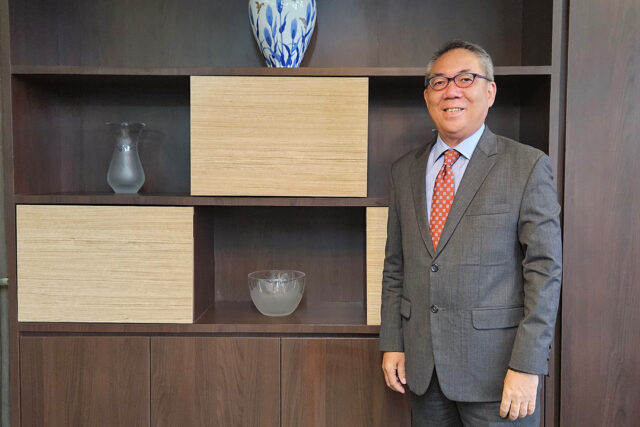
AS the 25-year contracts for the coal-fired power plants of Japanese firm Marubeni Philippines near their end, Shigeru Shimoda, the company’s president and chief executive officer, leads a transition towards renewable energy (RE).

The objective is to reduce coal reliance by 2025, aligning Marubeni with global sustainability goals, he said in an interview with BusinessWorld.

“Currently, our power generation is in Pagbilao (Quezon) and Sual (Pangasinan), both of which are large coal-fired power plants, but the build-operate-transfer (BOT) contracts (will expire soon),” he said.

The BOT contracts for the Sual and Pagbilao plants will expire in 2024 and 2025, respectively.

A BOT contract refers to a financing model commonly used for large-scale projects, typically infrastructure projects developed through public-private partnerships.

TeaM Energy Corp., a joint venture between Japanese companies Marubeni Corp. and JERA, functions as an independent power producer that owns and operates the 1,218-megawatt (MW) Sual Power Station in Pangasinan and the 735-MW Pagbilao Power Station in Quezon. In collaboration with Aboitiz Power Corp., it also operates the 420-MW coal-fired Pagbilao Unit 3.

“We need alternatives. It’s not straightforward, but we are exploring floating solar and offshore wind projects alongside other players,” he said, adding that San Miguel Corp. and Aboitiz Power Corp. will take over Sual and Pagbilao.

Mr. Shimoda said that the company is keen on maximizing the San Roque Multi-Purpose Dam and Hydroelectric Plant in Pangasinan but is still in discussions with the Department of Environment and Natural Resources.

Marubeni, which began operations in the Philippines in 1909, is also exploring opportunities in solar farms, but it is hindered by foreign restrictions in terms of land ownership.

Nevertheless, the company is determined to identify a suitable location and establish partnerships with reliable local entities, Mr. Shimoda said.

“Mr. President says solar is fine, however, we always have to take into account the land competition among the farmers as you try to develop. Let’s say developing gigawatts of solar, it could take thousands of hectares,” he said.

“Looking at the whole Marubeni, the power division developed a huge size of the solar power generation in the Middle East. Marubeni, as one of the leading Japanese companies, we have to do [these] to tackle global warming,” he said.

Mr. Shimoda also noted Marubeni’s interest in the operation and maintenance of the North-South Commuter Railway, which spans 147 kilometers and is currently being developed as a commuter rail system in Luzon.

Besides renewable energy initiatives, he highlighted the company’s healthcare involvement through a joint venture with LSI Medience Corp. and Metro Pacific Hospitals.

“Last year, we invested in In Vitro Fertility (IVF) services in Quezon City,” he said, noting that Marubeni and Towako Repro Bio Cell, Inc. operate through a joint venture company Conceive IVF Manila, Inc.

PATH TO LEADING MARUBENI PHL
Mr. Shimoda began his journey with Marubeni in 1988, opting for a different path from his father who held a position at Mitsubishi Corp.

He initially ventured into wood chip plantation development and progressed to the role of president director at P.T. Musi Hutan Persada, overseeing a tree plantation in Indonesia.

Reflecting on his assignment as president and CEO of Marubeni Philippines, he acknowledged his prior experience with Southeast Asian countries despite never having visited the Philippines before.

As the pandemic disrupted normal business operations, Mr. Shimoda assumed his role in the Philippines in April 2020, navigating virtual interactions from his condo.

Recognizing the challenge of establishing his presence remotely, he said he endeavored to introduce himself through digital platforms to Filipino business counterparts already familiar with Marubeni.

He said his integration into the local business community began gradually through invitations from Mr. Edgardo Puyat Reyes, whom he met at the Manila Golf Club.

Mr. Reyes, who recently passed away, repeatedly invited Mr. Shimoda for golf sessions, providing opportunities to engage with other club members and gain insights into Filipino customs, history, and business practices.

“We talked, and he introduced me to other members. I learned a lot about the customs, history, and business background of the Philippines from Mr. Ed Reyes. I appreciate what he did for me,” he said.

Mr. Shimoda, alongside his role at Marubeni, serves as vice-president of The Japanese Chamber of Commerce and Industry of the Philippines Inc. (JCCIPI), having previously held the position of president until last March.

He views his involvement in JCCIPI as crucial for enhancing Philippine-Japan economic relations and representing around 680 members.

In discussing the competitive landscape, Mr. Shimoda underscored the Philippines’ need to attract foreign investment more aggressively, highlighting the country’s advantages such as its youthful workforce and growing mid-income population.

He stressed the importance of creating jobs and enhancing incentives to compete effectively with countries like Vietnam, Indonesia, Malaysia, and Thailand, which have robust manufacturing ecosystems and established supply chains.

“That’s what I keep telling to the government. I think in this country, the only thing to concentrate on is to create a job, then we need foreign investors as more labor force will be available due to young workforce,” he said.

FinTech Alliance seeks to become a self-regulatory organization

FINTECH ALLIANCE.PH wants to become a self-regulatory organization (SRO) in two to three years, officials said on Tuesday.

“We haven’t actually applied, but we are already practicing it. It’s just that it’s quite tedious to actually complete the application… We are actually prepared to formally have that SRO status, though I think we have two more years, almost three more years to do that. But I think we can already apply for that,” FinTech Alliance.PH Trustee Imelda C. Tiongson said in a media briefing on Tuesday.

The group will apply for an SRO license with the Securities and Exchange Commission (SEC), she said.

Under the Securities Regulation Code, an SRO is an organization or association that is allowed to make and enforce its own rules among members. Both the Philippine Stock Exchange and Philippine Dealing Exchange Corp. are licensed as SROs.

Ms. Tiongson said FinTech Alliance.PH is very strict in regulating its own members, going as far as kicking out those who pose risks to the industry.

“We actually expelled two members — these are online lending companies — for gross violations of the Data Privacy Act,” Fintech Alliance.PH Chairman and Rizal Commercial Banking Corp. Executive Vice-President and Chief Innovation and Inclusion Officer Angelito “Lito” M. Villanueva said at the same briefing.

Having an SRO license will let the group help regulators, he added.

“Even SEC Chairman Emilio B. Aquino has been saying that the SEC cannot really police everybody because given the fact that these companies are digital in nature, and most of them are not even registered with the SEC,” he said.

“One of those pain points that we have identified is the proliferation of digital lending companies, and of course, the overexposure and over-leveraged Filipinos having multiple loans from multiple online lending companies,” Mr. Villanueva added.

Credit Information Corp. (CIC) President and Chief Executive Officer Ben A. Baltazar said being an SRO would allow Fintech Alliance.PH to monitor and regulate these online lending firms.

“It’s very important for us to engage with these kinds of entities because a significant chunk of our covered entities are online lending platforms. In fact, they account for a huge surge in loans issued for the past couple of years. So, it’s very important for us to have this policy alignment,” he said.

“One of our internal checks is to see, other than being duly registered with the SEC, if they are affiliated with Fintech Alliance. It goes a long way. And if I might say that, your members that are lenders actually overall have better levels of compliance with the CIC,” he added.

Mr. Villanueva said that while the country has already surpassed the government’s target to have 269 fintech companies by 2028 since last year, not all these firms are members of the group. — AMCS

Eddie Murphy’s ‘every man’ hero returns in Beverly Hills Cop sequel

LOS ANGELES — After more than a decade of superheroes saving the world on the movie screen, Eddie Murphy is bringing back the character he describes as “every man.”

Mr. Murphy returns as Axel Foley in Beverly Hills Cop: Axel F, a new installment in the action-comedy franchise that debuted 40 years ago in 1984. The movie lands on Netflix on Wednesday.

“For 10-15 years, everything was CG (computer-generated), big visual effects and superheroes and people saving the day wearing capes and tight suits,” Mr. Murphy said in an interview. “I knew eventually it would have to get back to this,” he added. “It used to be stuff was character-driven and story-driven and that’s going to always work.”

In the new film, the wise-cracking Foley is working as a detective in Detroit when he learns his estranged daughter is in danger in Beverly Hills. He returns to the city to reconnect with her and help solve a case.

Foley “is not Superman,” Mr. Murphy said. “He’s every man, every guy who doesn’t play by the rules. He’s the kind of guy you want to have a beer with.”

The movie — the fourth in the franchise and the first since 1994 — aims to capture the look and feel of the original without modern special effects. The action takes place through real-life stunts such as a harrowing helicopter chase across Los Angeles.

“What was more difficult was all the physical stuff,” Mr. Murphy said. “I’m in my 60s now and I did the first one (at) 21 years old, so you can imagine the differences.”

Previous stars Judge Reinhold and John Ashton reprise their roles in the film. Newcomers include Kevin Bacon and Joseph Gordon-Levitt.

Mr. Bacon said he liked the old-school stunts in the new movie, saying he believed it was hard to impress today’s audiences with computer-generated effects.

“If you put a truck driving and it knocks the door off a cop car, and you see Joe in the middle saying ‘there’s no seatbelt,’ that’s like, to me, that’s a wow,” Mr. Bacon said.

“That’s much more satisfying, I think, for people now because I think we’re just kind of numb to all the other stuff.”

Mr. Murphy said there had been attempts over the years to resurrect the franchise but none of the scripts had the “emotional hook” of the storyline between Foley and his now-adult daughter.

“The movie is really about this father reconciling with his daughter,” Mr. Murphy said. “Once we added that to it, everything just fell into place. That’s the glue that holds the whole movie together.” — Reuters

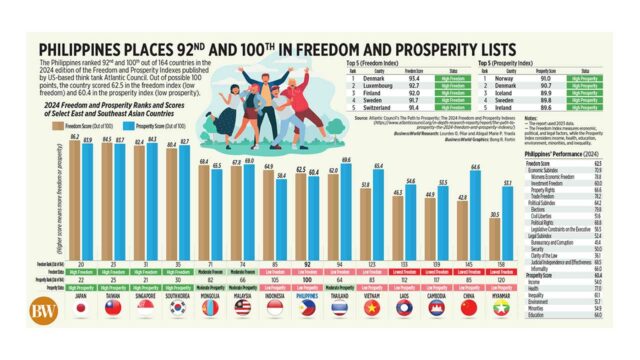
Philippines places 92nd and 100th in freedom and prosperity lists

The Philippines ranked 92nd and 100th out of 164 countries in the 2024 edition of the Freedom and Prosperity Indexes published by US-based think tank Atlantic Council. Out of possible 100 points, the country scored 62.5 in the freedom index (low freedom) and 60.4 in the prosperity index (low prosperity).

Philippines places 92<sup>nd</sup> and 100</sup>th</sup> in freedom and prosperity lists

Engaging individual independent contractors in the Philippines

RIO LECATOMPESSY-UNSPLASH

Contracting out of services is recognized and allowed under Articles 106-109 of the Philippine Labor Code. These provisions are implemented by Department of Labor and Employment (DoLE) Department Order No. 147-17 (DO 174) which defines “contracting” or “subcontracting” as an “arrangement whereby a principal agrees to farm out with a contractor the performance or completion of a specific job or work within a definite or predetermined period, regardless of whether such job or work is to be performed or completed within or outside the premises of the principal.”

There are requirements under DO 174 like registration and substantial capitalization. However, pursuant to DoLE Circular No. 01, series of 2017, DO 174 does not apply to, among others, contracting out of a job or work to a professional or individual with unique skills and talents who himself/herself performs the job or work for the principal, or the so-called individual independent contractors. Thus, arguably the individual contractors engaged by domestic and foreign corporations (the latter being remote engagement) need not comply with the requirements under DO 174, specifically the registration and capitalization requirements.

However, the tests to determine the existence (or absence) of employer-employee relationship as laid down in case law and in DO 174 as well, still apply, to wit: a.) the four-fold test; b.) the independent contractor test; and c.) the economic dependency test.

FOUR-FOLD TEST
Our Supreme Court has held in several cases that in determining the existence of employer-employee relationship, the following elements are generally considered: a.) the selection and engagement of the employee; b.) the payment of wages; c.) the power of dismissal; and, d.) the power to control the means and methods by which the work is accomplished by the employee, and not just the results. The last element, the so-called “control test,” is the most important element.

INDEPENDENT CONTRACTOR TEST
This test is usually used in contracting out or outsourcing arrangements under DO 174, under which it is provided that, a contracting arrangement is legitimate if the following circumstances concur:

a.) The contractor or subcontractor is engaged in a distinct and independent business and undertakes to perform the job or work on its own responsibility, according to its own manner and method;

b.) The contractor or subcontractor has substantial capital to carry out the job farmed out by the principal on his account, manner, and method, investment in the form of tools, equipment, machinery and supervision;

c.) In performing the work farmed out, the contractor or subcontractor is free from the control and/or direction of the principal in all matters connected with the performance of the work, except as to the result thereto; and,

d.) The Service Agreement ensures compliance with all the rights and benefits for all the employees of the contractor or subcontractor under the labor laws.

The Supreme Court, however, has also applied this test in cases involving consultants or individual independent contractors, especially (a) and (c).

ECONOMIC DEPENDENCY TEST
This is also known as the economic reality test. This basically refers to the individual being economically dependent on the company for his/her continued employment in the latter’s line of business. This test has been used also for individual independent contractors.

Our Supreme Court has held in several cases that the specific selection and hiring of an individual, because of his unique skills, talent, expertise (and even celebrity status in certain cases) not possessed by ordinary employees, is a circumstance indicative, but not conclusive, of an independent contractual relationship. It even ruled that the “riders” of an e-commerce company are not independent contractors, as the work being performed by them, i.e., picking up and delivering goods from warehouse to buyers, does not require special skill, talent, expertise, or unique ability or competency. In this regard, the principal, whether a domestic or foreign corporation, must be able to prove that the work being performed by the individual contractors requires special skills, talent, expertise, or unique ability not possessed by its ordinary and regular employees. If the functions are usually necessary and desirable to the usual business of the principal and as such these can be performed by ordinary employees, this is a circumstance indicative (although not conclusive) of an employment relationship.

With respect to the payment of wages, the huge amount of compensation (e.g., around P450,000–P500,000 a month in at least two cases) has been considered as a badge of an independent contracting arrangement. Conversely, if the compensation is low, it may be considered as a circumstance indicative (although not conclusive) of an employment relationship.

The power of control refers to the authority of the employer to control the employee not only with regard to the results of the work to be done but also as to the means and methods by which the work is to be accomplished. If the control pertains only to the desired results and not to the manner and means by which the employee performs his work to achieve the desired results, this is not the control contemplated under the four-fold test and the one exercising such control is not considered as the employer. In one case, the fact that the company has the power to approve or reject the work output is not tantamount to control as to the means and manner of doing the work. According to the Court, “it is but logical that one who commissions another to do a piece of work should have the right to accept or reject the product.” In a contracting arrangement, the acts, reminders or instructions from the principal which merely serve as guidelines to attain the desired result, do not indicate that the principal is the employer of the assigned workers.

If the application of the foregoing tests points to the principal as the employer of the individual independent contractors, it is liable to pay them the benefits under applicable laws, which may include back wages and benefits at least covering the prescriptive period of three years for money claims. Theoretically, there could also be administrative and criminal sanctions for not registering them with the Social Security System, Philippine Health Insurance Corp., and Home Development Mutual Fund, aside from paying the remittances in arrears, but it can be argued that the company acted in good faith and that this obligation arises only if there is a definite declaration that it is the employer.

Moreover, by engaging employees (and not independent contractors), the foreign company may be considered as doing business in the Philippines without the requisite license from the Securities and Exchange Commission (SEC), which means that it can be sued but it cannot sue here in the country, and there could also be tax liabilities. If the foreign company is not keen on getting a license or establishing an entity in the Philippines, their next best recourse is to fix the independent contractor agreement and implement the same in conformity with our local labor laws.

This article is for informational and educational purposes only. It is not offered and does not constitute legal advice or legal opinion.


Neptali B. Salvanera is a partner of the Labor and Employment Department (LED) of the Angara Abello Concepcion Regala & Cruz Law Offices or ACCRALAW.

(632) 8830-8000

nbsalvanera@accralaw.com

China AI startups head to business-friendly Singapore in bid for global growth

FRANZ BACHINGER-PIXABAY

WHEN Wu Cunsong and Chen Binghui founded their artificial intelligence (AI) startup two years ago in Hangzhou, China, they quickly ran into obstacles, including dearth of venture capital. This March, they did what scores of other Chinese AI firms have done and moved their company, Tabcut, 2,500 miles southwest to Singapore.

The business-friendly country offers Wu and Chen better access to global investors and customers at a time when elevated geopolitical tensions keep many US and international firms away from China. Equally crucial for an AI startup, they can buy Nvidia Corp.’s latest chips and other cutting-edge technologies in the politically neutral island nation, something that would have been impossible in China because of US export controls.

“We wanted to go to a place abundant with capital for financing, rather than a place where the availability of funds is rapidly diminishing,” Wu said in an interview.

Singapore is emerging as a favorite destination for Chinese AI startups seeking to go global. While the city-state — with an ethnic Chinese majority — has long attracted companies from China, AI entrepreneurs in particular are accelerating the shift because trade sanctions imposed by the US on their homeland block their access to the newest technologies.

A base in Singapore is also a way for companies to distance themselves from their Chinese origins, a move often called “Singapore-washing.” That’s an attempt to reduce scrutiny from customers and regulators in countries that are China’s political opponents, such as the US.

The strategy doesn’t always work: Beijing-based ByteDance Ltd. moved the headquarters for its TikTok business to Singapore, but the popular video service was still hit by a new US law requiring the sale or ban of its American operations over security concerns. Chinese fashion giant Shein, which also moved its base to Singapore, has faced intense criticism in the US and is now aiming to go public in London instead of New York.

But for AI startups, more is at stake than just perception. AI companies amass large amounts of data and rely on cutting-edge chips to train their systems, and if access is restricted the quality of their product will suffer. The US has blocked sales of the most sophisticated chips and other technologies to China, to prevent them from being used for military and other purposes. OpenAI, the American generative-AI leader, is curbing China’s access to its software tools.

China has also taken a strict approach to AI-generated content, trying to ensure it complies with the ruling Communist Party’s policies and propaganda. The country made one of the world’s first major moves to regulate the nascent technology last July, asking companies to register their algorithms with the government before they roll out consumer-facing services.

That means that AI developers “won’t be able to engage in free explorations if they are in China,” said a founder of consulting firm Linkloud, who asked to be identified only by his first name Adam because of the sensitivity of the subject. He estimated that 70% to 80% of Chinese software and AI startups target customers globally, with many now choosing to skip China altogether. Linkloud is building a community for Chinese AI entrepreneurs exploring global markets.

Singapore’s AI regulations are less stringent and it’s known for the ease of setting up a company. The country, with its unique location in Southeast Asia and a vibrant network of multinational companies, can be a bridge for entrepreneurs and companies to the region and to the world, said Chan Ih-Ming, executive vice-president of the Singapore Economic Development Board.

“Many businesses and startups, including Chinese ones, choose Singapore as their hub for Southeast Asia and see Singapore as a springboard to global markets,” he said. The city-state was home to more than 1,100 AI startups at the end of 2023, he said. While Singapore doesn’t disclose data by country, evidence of China-based AI companies setting up shop is mounting.

Jianfeng Lu is a pioneer of the trend, having moved to Singapore from the eastern Chinese city of Nanjing to establish his AI startup Wiz Holdings Pte. in 2019. With backing from Tiger Global, GGV Capital and Hillhouse Capital, he built its speech recognition AI engine from the ground up, and sold customer-service bots to clients in Latin America, Southeast Asia and northern Africa. He didn’t sell in China, a move his fellow founders term prescient.

He is now a sought-after mentor for his Chinese peers who want his advice on how to set up a business and settle in Singapore. An online chat group Mr. Lu runs for Chinese entrepreneurs wishing to relocate to the city-state has 425 members. (Not all are AI founders.)

“If you want to be a global startup, better begin as a global startup,” the 52-year-old entrepreneur said. “There’s complete predictability about how systems work here.”

Meanwhile, fundraising in China has become more difficult because of its slowing economy and rising tensions with the US, which is prompting global VC firms to reduce their exposure to the country.

Wu and Chen’s Tabcut had a frustrating and arduous experience finding backers in China, with local VC firms demanding financial and operating details for months before making a call, Wu said. Tabcut ended up going with Singapore-based Kamet Capital instead, raising $5.6 million from the firm late last year. The startup moved its global headquarters to the country in March, while launching a beta version of its AI video generating tool for global users.

Climind, a startup that builds large language models and productivity AI tools for professionals in the environmental, social and governance field, is preparing to move in the coming weeks from Hong Kong to Singapore, where its co-founder and chief technology officer Qian Yiming is already based. The company founded last year has a small team of 10.

Besides the cultural and linguistic affinity, Singapore is attractive because its government offers help, including financial backing and technical support, Mr. Qian said over a video call. His company is among those that’s received funding from the state, and startup incubators also abound in the country, he said.

“Access to global markets is easy, the environment is good and politics is stable,” Mr. Qian said.

Last week, Singapore was named the second-best AI hub globally by researcher Linkee.ai. The country had the second-highest number of available AI jobs among the listed cities and an average salary of $158,000 for AI specialists, surpassed only by Zurich, where they earn $182,000.

To be sure, some Chinese AI companies have scored early successes in their domestic market and remained there. China itself is pushing for AI, robotics and other deep tech startups to stay domiciled within the country and, eventually, list in the local stock markets. Beijing supports the most promising of them by backing them with capital, and providing low-interest loans and tax breaks.

But such companies will struggle to expand globally because their services are typically tailored for the Chinese audience and regulatory environment, said Yiu-Ting Tsoi, founding partner of the Hong Kong-headquartered HB Ventures, which invests in Chinese as well as regional tech and AI startups. The more successful an AI startup is in China, the more challenging it is for it to go global, said Tsoi, a former JPMorgan banker.

It’s a reversal from a decade ago when China’s technology giants like Alibaba Group Holding Ltd. and Didi Global Inc. aggressively expanded outside the country, amassing customers for their consumer-friendly apps. Now the escalating geopolitical tension means that young Chinese AI companies are increasingly having to choose whether to try to grow in China, under Chinese rules, or abroad — a combination of both is impossible.

“More regulations are coming out and navigating all of that becomes complicated,” said Karen Wang, 28, Climind’s chief executive officer. “From branding, PR, regulations and compliance angles, Singapore makes sense.” — Bloomberg News

PSEi member stocks performed — July 2, 2024

Here’s a quick glance at how PSEi stocks fared on Tuesday, July 2, 2024.


SOGIE Equality Bill passing will improve the workplace for all – advocate

photo by Edg Adrian A. Eva

The passing of the Sexual Orientation and Gender Identity Expression (SOGIE) Equality bill will empower diversity, equity, and inclusion (DEI) in the workplace, a gender equality advocate said. 

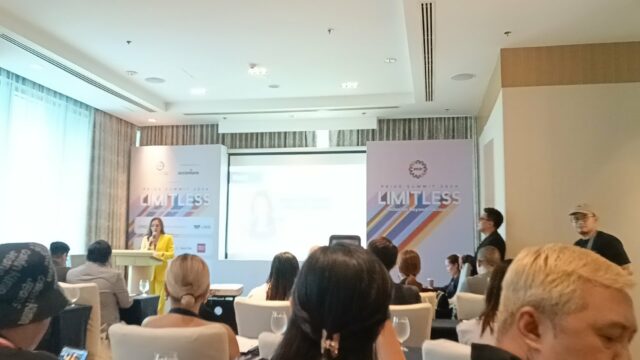
“It will help catapult DEI in the workplace because the law (SOGIE Equality Bill) will prevent… discrimination,” Janlee Dungca, managing director of Castro PR, and a transwoman, said in an interview at the Pride Summit press conference held on June 27.  

The SOGIE Equality bill will offer protection against discrimination and violence in the workplace to all Filipinos, not just LGBTQIA+ individuals, Ms. Dungca said, as everyone has sexual orientation, gender identity, gender expression, and sex characteristics (SOGIESC).

“If a…woman gets discriminated against in the workplace or anywhere because she is a woman, the SOGIE Equality Law will also protect that person. If there is a man who gets discriminated for being a man, the law will also protect him,” Ms. Dungca furthered.  

The diversity in DEI suggests that companies hire different types of employees from various backgrounds, particularly regarding SOGIESC, she said.   

However, she explained that diversity is not enough; there should be equity and inclusivity in the workplace.  

“Equity means that you’re (going to) give more opportunities or more leverage for the marginalized people (LGBTQIA+) so that they can be on the same standing as the non-LGBT people. Inclusion… means you are helping this diverse set of people to achieve their limitless potential by having benefits that included,” Ms. Dungca said. 

Her advocacy for DEI in the workplace began after she experienced discrimination in a job application for a student-formator role at a religious academic institution in 2011. 

“My friend who worked in the HR Department of the said institution told me that a huge consideration as to why I didn’t get the job was because I’m trans,” she explained.  

A global study by the University of California School of Law’s Williams Institute in 2021 found that around 29.8% of LGBTQIA+ employees reported not being hired for a job because of their SOGIESC. 

The respondents reported SOGIESC-based unfair treatment during the job hiring process, including explicitly discouraging LGBTQIA+ applicants from applying for a job position.    

“Because I was judged, not because of my capabilities, but because of me being trans…looking back, I wish I did better… but also that really pushes me to advocate for gender equality, for diversity, equity, and inclusion in the workplace,” Ms. Dungca said. – Edg Adrian A. Eva

Stocks decline further on continued profit taking

The lobby of the Philippine Stock Exchange in Taguig City, Sept. 30, 2020. — REUTERS

STOCKS continued to decline on Tuesday as investors pocketed their gains from last week’s rally and following weak Philippine manufacturing activity data.

The Philippine Stock Exchange index (PSEi) dropped by 0.62% or 39.81 points to end at 6,358.96 on Tuesday, while the broader all shares index fell by 0.48% or 16.80 points to close at 3,462.67.

“The local bourse extended its decline amid continuous profit-taking, while many investors were cautious, waiting for the June inflation rate,” Philstocks Financial, Inc. Research Analyst Claire T. Alviar said in a Viber message.

“The slight decline in S&P Global Philippines Manufacturing Purchasing Managers’ Index (PMI), which signified a growth slowdown, weighed on sentiment,” she added.

The S&P Global Philippines Manufacturing PMI, which measures the country’s monthly factory performance, stood at 51.3 in June, slightly lower than the 51.9 reading in May.

June was the 10th consecutive month that PMI was above the 50 mark, which signals an improvement in operating conditions from the previous month. A reading below 50 indicates the opposite.

Meanwhile, the Philippine Statistics Authority will release June consumer price index (CPI) data on Friday, July 5.

A BusinessWorld poll of 14 analysts conducted last week yielded a median estimate of 3.9% for the June CPI, within the central bank’s 3.4-4.2% forecast for the month.

If realized, June inflation would match the 3.9% recorded in May. It will also be slower than the 5.4% print in the same month a year ago.

“Philippine shares were sold down, with investors keeping to cash as US Federal Reserve Chair Jerome H. Powell will speak later today before a policy panel at the European Central Bank Forum. Investors will closely monitor what he might say at the forum,” Regina Capital Development Corp. Head of Sales Luis A. Limlingan said in a Viber message on Tuesday.

Sectoral indices ended mixed. Financials dropped by 1.42% or 27.45 points to 1,899.46; holding firms went down by 1.08% or 59.92 points to 5,461.51; and property declined by 0.32% or 8.12 points to 2,504.93.

Meanwhile, mining and oil gained by 1.53% or 129.46 points to 8,590.55; services climbed by 0.33% or 6.70 points to 1,993.56; and industrials rose by 0.02% or 2.24 points to 8,983.20.

“Among the index members, Century Pacific Food, Inc. achieved the top spot, increasing by 2.72% following its additional special cash dividends declaration due to strong first-quarter results. On the other hand, Converge ICT Solutions, Inc. had the biggest loss, dropping by 4.35%,” Ms. Alviar said.

Value turnover rose to P3.94 billion on Tuesday with 422.91 million shares changing hands from the P3.34 billion with 417.96 million stocks traded on Monday.

Market breadth was negative as decliners outnumbered advancers, 110 to 65, while 48 names ended unchanged.

Net foreign selling stood at P310.09 million on Tuesday, a reversal of the P88.92 million in net buying on Monday. — RMDO

ADVERTISEMENT
ADVERTISEMENT