Home Blog Page 2986

Uber-backed e-bike startup Lime plans fleet expansion

LIME, the operator of a shared electric bike and scooter network backed by Uber Technologies, Inc., is planning to invest more than $55 million this year to expand its global fleet.

The San Francisco-based company will add more than 30,000 net-new bikes across North America, Europe and Australia while also replacing aging ones, Chief Executive Officer Wayne Ting said in an interview.

It’s also looking to return to Greece and Mexico — markets that it had exited during the pandemic, he said, and is exploring new business lines such as advertising deals and a new vehicle type for its shared fleet. The company separately reported a 32% increase in gross bookings in 2023 from a year earlier, totaling a record $616 million. Its adjusted earnings before interest, taxes, depreciation and amortization gained more than 500%, surpassing $90 million.

Lime, which has a fleet of about 200,000 bikes and scooters, is expanding even as its rivals in the US have struggled to stay afloat.

Many are looking to offload operations now that the era of low interest rates and easily accessible venture-capital funding is over. Stronger regulations of two-wheelers and shifting commuting trends have also been headwinds for the industry.

Late last year, scooter company Bird Global, Inc. went bankrupt. Another peer, Superpedestrian, is shutting US operations and weighing the sale of its European business, according to TechCrunch. Lyft Inc., which bought Citi Bike in 2018, was looking for a strategic partner, or to sell its bike-share business.

Meanwhile, Lime is “at that inflection point where we can scale up the business without having to make a ton more R&D investment,” Mr. Ting said. “Our software is already made, our hardware is already developed. We’re not increasing the fixed costs, so profitability grows at a much faster pace. And I think we’re going to continue see that play out for a couple of years.”

Uber threw Lime a lifeline in 2020 when it was struggling through pandemic-induced lockdowns. Uber, which held a roughly 29% stake as of late last year, led a $170-million investment round for Lime back then, selling its Jump bike-sharing business operations to Lime as part of the deal. Lime was valued at about $510 million at the time, people familiar with the terms said, asking not to be identified because the terms were private.

Today, about 60% of Lime’s business comes from outside of the US, in cities where the infrastructure is less car-centric and more bike-friendly. The company’s major bike markets include Sydney, Rome, Seattle, London, Milan and Paris — the latter of which banned e-scooters but expanded an e-bike fleet cap by 5,000 ahead of the summer Olympics this year.

IPO PLANS
Lime is more broadly positioning itself for an initial public offering. It first floated IPO plans in 2021 before US public equity markets dried up. Late last year, it hired Ann Gugino, former chief financial officer of the US pizza chain Papa John’s International, Inc., as CFO to build the necessary internal controls before going public.

“We’re doing everything we can to ensure that we are ready internally, and then we’re just going to wait to see when is the right macro environment to consider an IPO,” Ting said. “Much of this is outside of our control.” — Bloomberg News


Digital entertainment firm eyes int’l expansion

LISTED digital entertainment company DigiPlus Interactive Corp. is considering international expansion to support its growth, with a focus on markets with large Filipino populations, its president said.

“Maybe we’ll operate in another country that has a big Filipino population,” DigiPlus President Andy Tsui said during a media roundtable last week.

“That may be another good potential market for us in the future,” he added.

DigiPlus offers digital entertainment platforms such as BingoPlus and ArenaPlus, with approximately 20 million registered users and a target of ten million new registrations this year.

DigiPlus plans to enter provincial markets and increase brand visibility through physical locations.

For 2024, DigiPlus aims to expand its presence in the gaming market by leveraging new technology to improve user experiences.

It is considering adding non-gaming elements such as movies and a sports live streaming channel to the company’s digital platforms to expand its offerings.

DigiPlus recently unveiled its new corporate identity under a partnership with brand specialist Landor. — Revin Mikhael D. Ochave

Arts & Culture (04/10/24)


PPO concert at Bukidnon

THE PHILIPPINE Philharmonic Orchestra (PPO), under the baton of Maestro Herminigildo Ranera, will be having their next outreach concert in Bukidnon for the inauguration of the Bukidnon Center for Culture and the Arts. They will be bringing their music to the New Bukidnon Sports and Cultural Complex Museum, on April 12, at 3 p.m. and 7 p.m. There will be solo performances on the clarinet by Ariel Sta. Ana and on the bassoon by Fenvee Andra. Featured artists Lara Manigue and Gian Magdangal will also enchant the audience with their music performances.


Patricia Evangelista talk and book signing

FOR her book Some People Need Killing, journalist Patricia Evangelista has garnered much acclaim. On April 13, she will be holding a talk and a book signing for fans who have followed her work, hailed a “journalistic masterpiece” by The New Yorker. It will take place on the 2nd Floor of McKinley Parking Building (above Unimart), Club Filipino Avenue, Greenhills Shopping Center, San Juan City. Registration starts at 4 p.m. and the program starts at 5 p.m. For reservations, message 0947-426-1432.


De La Salle College of Antipolo students exhibit at ARTablado

SENIOR high school students from the Arts and Design track of De La Salle College of Antipolo are having their works displayed at ARTablado in Robinsons Antipolo until April 13. The show, called “Kaleidscope 2: Mirrored Realities,” allows young artists to bring their work to a wider audience. The title not only symbolizes the kaleidoscopic range of artistic expressions and perspectives showcased in the exhibit, but will also forward the legacy of last year’s students.


Peru-Philippines friendship drawing contest

THE “Peru-Philippines Friendship Drawing Contest” is welcoming children from all backgrounds and nationalities to showcase their artistic talents and imagination. It is open to participants between the ages of six to 11, divided into two categories: Category 1 (six to eight years old) and Category 2 (nine to 11 years old). Participants are encouraged to unleash their creativity using any medium, to express their interpretation of the deep-rooted friendship shared between Peru and the Philippines. For further information, reach out to the Honorary Consulate General of Peru in Manila at peruvianconsulate@yahoo.com.

Yellen junks 200 years of economics to block China clean tech

US TREASURY SECRETARY JANET YELLEN — IMF AND CHRISTIAN LUE-UNSPLASH

IMAGINE if a Chinese company announced plans to build the biggest electric-vehicle battery factory the world had ever seen.

Up to $5 billion would be spent on a single plant to manufacture more power packs every 12 months than the world produced last year. The sprawling facility might cover 1.5 square miles (4 square kilometers), employ an army of 6,500 people, and drive costs down 30%, devastating any competitors that failed to keep pace. The company in question, furthermore, had racked up more than $1 billion of losses over the past seven years, and would post another $5 billion over the coming seven.

Does that sound like the definition of predatory overcapacity, hollowing out the world’s manufacturing sector in the service of aggressive Chinese mercantilism? If so, it’s worth considering that the facility we’re talking about is how Elon Musk pitched Tesla, Inc.’s Gigafactory One, a half-hour drive east of Reno, Nevada, when he first announced it 10 years ago.

That should be a consideration for Treasury Secretary Janet Yellen, who is visiting China to persuade the government and companies that their investments in clean technology are excessive and damaging.

“Government support is currently leading to production capacity that significantly exceeds China’s domestic demand, as well as what the global market can bear,” Yellen said in a speech to the American Chamber of Commerce in Guangzhou. That excess is building in “solar, EVs, and lithium-ion batteries,” she said last month at a US solar plant.

Step back for a moment, and the suggested policy change is remarkable. One of the most distinguished living economists is rejecting what’s been one of the most fundamental principles of economics for more than 200 years: comparative advantage. If a country can manufacture goods at lower costs than you can, you shouldn’t raise tariff barriers. Instead, you should import the goods, and send back something in return where your industry is more efficient.

Yellen herself appears to recognize the disconnect. “People like me grew up with the view: If people send you cheap goods, you should send a thank-you note. That’s what standard economics basically says,” she was quoted as saying in an interview with the Wall Street Journal last week. “I would never ever again say, ‘Send a thank-you note.’”

There are several particularly remarkable aspects of this shift. For one thing, clean technology such as solar panels, EVs and lithium-ion batteries still comprises a rather small share of China’s exports, roughly 5.7% last year. China earned less export revenue from EVs in 2023 than from suitcases and backpacks, from furniture (excluding chairs), from wheeled toys and scooters, and from table lights and light fixtures. No clean-technology product comes close to its biggest export sectors, mobile phones and computers.

Another notable factor is that imbalances in the US-China economic relationship now are as minimal as they have been in a generation. The bilateral trade deficit in 2023 came to $279 billion, the lowest since 2010. Relative to the size of the US economy, the figure is the lowest it’s been since 2002, just months after China joined the World Trade Organization.

There’s also a disconnect between the levels of clean technology deemed necessary by Washington when talking about climate change, and the levels considered excessive when confronting China. Just four months ago, the two agreed to triple renewable energy capacity globally by 2030, a target that went on to form the core of the COP28 United Nations climate agreement in December.

It’s hard to argue the world is oversupplied when you remember that a major manufacturing facility typically takes at least three or four years to get off the ground from planning to full operation, and that many announced plants never even get built. Only in EVs and to some extent solar panels — where rapid technology switches are likely to lead to many production lines getting shuttered in the years ahead — are proposed capacities running ahead of what the world needs if we’re to transition to a net-zero economy.

In lithium-ion batteries, we are still below target. In wind power — the clean-technology segment where exports are most difficult because of the huge size of turbines, and as a result a decent proxy for where the world might be if it weren’t for the investment plans of ambitious Chinese companies — we are drastically deficient.

If China’s clean-tech investments have become a perceived problem for the US and European Union over the past year, it’s as much to do with the way that the political establishment and major domestic companies in those markets have quietly soured on the energy transition over the same period.

When investors see strong emerging demand for a commodity and think they have a competitive position in producing it, they do what Tesla did at Gigafactory One (and Henry Ford did at the famed Highland Park and River Rouge complexes): They build on a scale that shocks the rest of the world, convinced that their cheaper costs will induce more demand and allow them to capture market share.

It’s the same dynamic that’s allowed Nvidia Corp. to add nearly $2 trillion to its market capitalization since the start of 2023, despite the fact that at this stage no one is really making money from the artificial intelligence its chips can facilitate.

If Chinese firms are showing more animal spirits in doing just this, it’s not because of unfair state support. As we’ve shown, clean-technology firms there are no more dependent on soft money than rivals elsewhere in the world.

Of more than 50 disputes filed against China at the WTO, just one — dormant since 2011 — has been over clean technology. The advantage of jawboning and unilateral tariffs like those being considered by the US and EU is that they don’t need to hold up to the rigor of trade law. In the absence of a functioning WTO, it’s a neat way of painting anti-climate protectionism as green industrial policy.

China has no shortage of issues around the energy transition and state subsidies. In attacking its clean-technology exports, however, the world is cracking down on one part of the economy where the private sector is dominant, and where the prospects for reducing global emissions are good.

In acting as the standard-bearer for this policy, Yellen is rejecting fundamental principles of economics to justify a policy of restricting public access to affordable and clean technology. It’s a protectionist disaster in the making — for both the US, and the planet.

BLOOMBERG OPINION

HSBC takes $1-B hit from sale of Argentina business

REUTERS

LONDON — HSBC is selling its business in Argentina and booking a $1-billion loss on the deal, the bank said on Tuesday, as it continues to shrink its once globe-spanning empire to focus on Asia.

HSBC is selling the business, which covers banking, asset management and insurance, to Argentina’s fifth largest bank Grupo Financiero Galicia for $550 million, the British bank said.

HSBC CEO Noel Quinn has sought to simplify the sprawling lender to improve performance by exiting several markets in which it has under-performed, including France and Canada.

The sale also fits with the bank’s Asia pivot strategy as it shifts capital, especially to India and China.

HSBC’s shares were flat in early trading in London, while its Hong Kong-listed shares gained 1.1%.

“Argentina has been a problematic market for HSBC in recent years given hyperinflation in the region and a sharp currency devaluation, which has resulted in significant earnings volatility for the business,” said Gary Greenwood, analyst at Shore Capital.

“Exiting Argentina also represents a further step in management’s strategy to simplify the Group and concentrate resources on areas of the business where greater shareholder value can be created,” he said.

As well as booking a loss in the first quarter, HSBC said the deal would lead it to recognize $4.9 billion in historical currency translation reserve losses when the sale closes.

The losses grew by $1.8 billion last year as a result of the devaluation of the Argentinian peso, the bank said.

HSBC said those losses had already been recognized in its capital levels and would have no impact on its core capital or asset value levels.

“This transaction is another important step in the execution of our strategy and enables us to focus our resources on higher value opportunities across our international network,” Mr. Quinn said in a statement.

“HSBC Argentina is largely a domestically focused business, with limited connectivity to the rest of our international network,” he said.

The Argentina business, given its size, creates substantial earnings volatility for the group when its results are translated into US dollars, according to HSBC.

HSBC has faced shareholder scrutiny in recent years over its geographic spread and overall strategy.

The bank defeated a resolution last year from Hong Kong-based shareholders, and backed by major Chinese investor Ping An, to potentially spin-off its Asia unit to try to fully realize the value of its most lucrative business.

The bank said it remained committed to the United States, where it exited retail banking in 2021, and to Mexico, a question mark for the bank ever since it paid $2 billion in 2012 to US regulators over lax money laundering controls. — Reuters

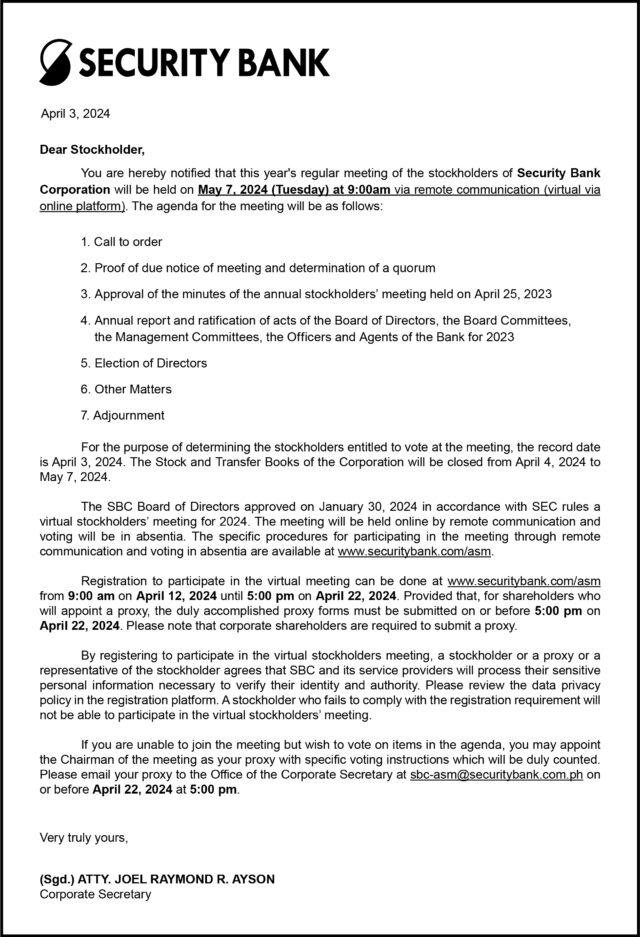
Security Bank to hold stockholders’ meeting via remote communication on May 7


Spotlight is BusinessWorld’s sponsored section that allows advertisers to amplify their brand and connect with BusinessWorld’s audience by publishing their stories on the BusinessWorld Web site. For more information, send an email to online@bworldonline.com.

Join us on Viber at https://bit.ly/3hv6bLA to get more updates and subscribe to BusinessWorld’s titles and get exclusive content through www.bworld-x.com.

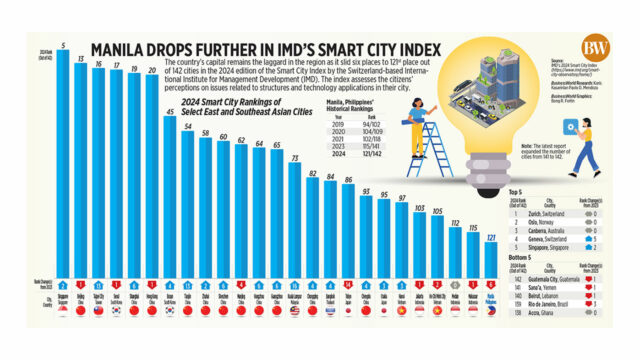
Manila drops further in IMD’s Smart City Index

The country’s capital remains the laggard in the region as it slid six places to 121st place out of 142 cities in the 2024 edition of the Smart City Index by the Switzerland-based International Institute for Management Development (IMD). The index assesses the citizens’ perceptions on issues related to structures and technology applications in their city.


Manila drops further in IMDs Smart City Index

Asian shares rise before US CPI data, ECB meet

SINGAPORE — Industrial metals prices extended their gains on Tuesday with expectations of a worldwide manufacturing rebound, while Asian shares crept up a little more cautiously ahead of this week’s US consumer price index (CPI) data and a crucial European Central Bank (ECB) meeting.

MSCI’s broadest index of Asia-Pacific shares outside Japan rose 0.6%. Japan’s Nikkei rose 0.8%. S&P 500 futures and FTSE futures were flat while European futures were down 0.18%.

In Shanghai, the most-traded May copper futures rose more than 1% to a record high, while zinc and tin made multi-month peaks and aluminium traded just below Monday’s two-year top.

Even iron ore, battered by China’s property downturn, steadied above $100 a ton in Singapore.

“It’s pretty much a China bet,” said Vishnu Varathan, head of economics at Mizuho Bank in Singapore.

“It’s coincided with a global manufacturing bottoming, and I think that plays well into China’s industrial recovery. That aspect of it is a broader-based story for metals.”

Last week, data showed US manufacturing growing for the first time in one-and-a-half years. China’s manufacturing activity expanded for the first time in six months in March.

Among Asian bourses, Taiwan stocks touched a record high, led by a more than 4% jump in shares of TSMC after the world’s largest contract chipmaker won a $6.6-billion subsidy for an Arizona production plant.

Chinese stocks were more circumspect, with mainland indexes marginally lower and Hong Kong’s Hang Seng up 0.7%, though proxies outside China from European stock markets to the Antipodean currencies have been standout gainers.

China’s yuan, down about 1.8% this year, has found a floor around 7.3 to the dollar.

Since the beginning of March, the EuroSTOXX index has risen 2.3% and Germany’s DAX is up 3.2%. The Nasdaq has been flat and the Nikkei has lost 1%.

CPI AND ECB AHEAD
The main focus this week is on US inflation data due on Wednesday and the ECB meeting on Thursday.

Ahead of Wednesday figures that are expected to show a slight tick higher in annualized US headline inflation, the shift in the rates outlook has driven up yields and pumped up US dollar long bets to levels starting to look stretched.

Meanwhile, the euro traded firmly in Asia at $1.0860 ahead of a Thursday policy meeting where investors expect the European Central Bank to flag a cut in June, but might see some risk that they strike a hawkish tone instead.

The yen, meanwhile, continues to face heavy pressure as investors see any lags in global rate cuts as leaving the gap wide with Japan’s near-zero interest rates.

At 151.87 per dollar, the yen is a whisker from last month’s 34-year low of 151.975. Against the euro, the yen is at its weakest for three weeks at 164.96. — Reuters

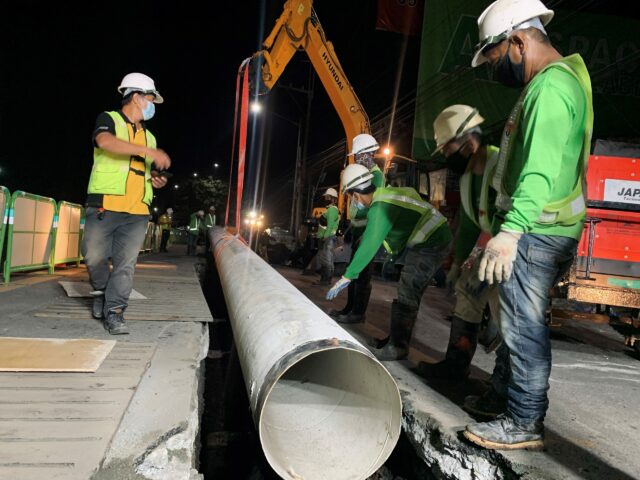
ARTA targets water project approvals for streamlining

MAYNILADWATER.COM

THE ANTI-RED TAPE Authority (ARTA) said it plans to streamline the permit approval process for water and wastewater pipe laying works as well as leak repairs.

In a statement on Tuesday, ARTA said it is currently consulting the water industry and government agencies.

The third meeting, which was conducted on April 3, was also attended by Israel’s Ambassador to the Philippines Ilan Fluss who expressed his support for ARTA’s plans.

“What we bring to the table is our experience, our approach, and our regulations and legislation. We share it in the Philippine context,” Mr. Fluss said.

“At the end of the day, it is an internal Philippine process that we are happy to contribute to with our best practices,” he added.

ARTA said that Israel uses sustainable water technologies to overcome water scarcity.

“We aspire to achieve several key outcomes, particularly in mirroring Israel’s sustainable water industry practices and ensuring that the permitting process does not unduly burden stakeholders and citizens alike,” ARTA Deputy Director General for Operations Gerald Divinagracia said. 

“The Israeli Embassy’s contributions will guide us in formulating strategies to enhance efficiency and minimize bureaucratic obstacles,” he added.

During the meeting, Tahel Brandes, Israeli Water and Sewage Authority Senior Deputy Legal Adviser, presented Israel’s Water Law, the Water Council, and the regulatory reforms that are helping implement a sustainable water system.

The Development Academy of the Philippines, which also attended the meeting, was tasked with updating its review of the water utility industry, while ARTA is set to conduct a business process mapping workshop for the National Water Resources Board. — Justine Irish D. Tabile

Farm subsidy reform seen potentially raising agri production by 17%

PHILSTAR FILE PHOTO

REPURPOSING agricultural subsidies to infrastructure could help countries like the Philippines boost agricultural output and exports while ensuring food security, participants said at a forum organized by the Asian Development Bank (ADB).

“This repurposing benefits not just those countries, but the entire ADB region, increasing agricultural output by 17%, reducing hunger by 51 million people, or 30% in 2025,” Mark Rosegrant, research fellow emeritus at the International Food Policy Research Institute, told the ADB Food Security Forum.

Countries urged to repurpose their agricultural subsidies were the Philippines, China, India, Kazakhstan, Indonesia, Thailand, Bangladesh, and Vietnam.

“Investments in broad-based rural infrastructure cuts post-harvest losses by about 50% in the region,” Mr. Rosegrant said.

The resulting lower food prices could reduce the hungry by 16 million people in 2035, he added.

Tetsushi Sonobe, ADB Institute dean, said that agricultural subsidies should be minimized, and are better allocated to research, infrastructure and irrigation to insure long-term gains for the sector. 

Mr. Rosegrant also cited the need to invest in irrigation and water use efficiency.

“When you have the same trajectory of investment in irrigation together with investment in water use efficiency, you can actually reduce water use by about 7.5% while maintaining the growth in irrigated areas,” he told the forum.

Countries should also invest in agricultural research and design as well as reducing greenhouse gas emissions, he said.

“By 2050, we would have reduced the initial emissions in Asia Pacific by a third here, and that’s because of landscape productivity growth, together with generation adoption of technologies such as conservation tillage, precision agriculture, and improved management of rice and livestock among others.”

Xianbin Yao, Senior Advisor of the ADB’s Food, Nature and Rural Development Sector Office, said investment in all segments of the agricultural food chain, especially for rice, is crucial.

“There is still a challenge to increase the productivity for the rice yield in countries where there is high demand… that can resist the heat the water and flood and then at the same time to manage it minimize post-harvest loss,” he said on the sidelines of the forum. 

“One has to carry out a very thorough assessment to decide where to allocate the resources,” Mr. Yao said. — Beatriz Marie D. Cruz

Philippines urged to seek exploration partners from US, India to deter harassment from China

BW FILE PHOTO

By John Victor D. Ordoñez, Reporter

THE PHILIPPINES should seek out South China Sea energy exploration partners from regional or global powers like India or the US, according to maritime analysts. 

“Working with large companies from important countries who might be harder for China to harass is one tactic that’s been used before,” Raymond M. Powell, a fellow at Stanford University’s Gordian Knot Center for National Security Innovation, told BusinessWorld in a message on X, formerly Twitter. 

“Previously, US company ExxonMobil had an oil contract off Vietnam’s coast, and its size and US ties made it also harder to bully,” he added.

The Philippines is under pressure to find other  sources of indigenous energy as its Malampaya gas field, which supplies a fifth of the country’s power requirements, nears depletion. PXP Energy Corp.’s exploration work at Reed Bank, another potential source of gas in disputed waters, remains suspended due to tensions with China.

Last month, the US and India promised to boost maritime security ties with the Philippines with China continuing to aggressively assert its territorial claims.

China has said, any plan for resource exploitation in the South China Sea should not involve countries outside the region.

Philippine Ambassador to the US Jose Manuel D. Romualdez has said Manila is “working closely with our allies, not only the US but also Japan and Australia” to exploit the resources available to it in the South China Sea.

The main venue for China-Philippines confrontation remains the BRP Sierra Madre outpost at Second Thomas Shoal. The Chinese Coast Guard routinely attempts to obstruct Philippine resupply missions to the grounded ship.

The Malampaya gas field is the country’s only indigenous commercial source of natural gas. It is expected to run out of easily recoverable gas using current techniques by 2027.

President Ferdinand R. Marcos, Jr. extended Malampaya Service Contract 38 to February 2039, allowing operators to exploit the field beyond the initial Feb. 22, 2024 expiration date.

Lucio B. Pitlo III, a research fellow at the Asia-Pacific Pathways to Progress Foundation, said many prominent multinational oil companies are still reluctant to do gas work in the South China Sea due to the political and security risk. 

“However, there may be opportunities for collaboration in less fraught areas, like tapping renewable energy (RE) through floating solar or offshore wind farms and wave energy,” he said via Messenger chat.

He also noted that ”Chinese capital, technology, and experience in this field can benefit the Philippines.”

On the other hand, Infrawatch PH convenor and public investment analyst Terry L. Ridon said the government must ensure it does not conduct exploration activities in areas of the sea with  overlapping claims.

“For areas with overlapping claims, it is unwise to undertake exploration as it will only raise tensions in disputed waters,” he said via Messenger chat.

The government aims to increase the share of RE in the power generation mix to 35% by 2030 and to 50% by 2040. Renewables currently account for 22% of the Philippine energy mix.

In January last year, the Philippine Supreme Court voided a 2005 government deal with China and Vietnam for joint gas and oil exploration.

It said the agreement violated the constitution for allowing foreigners to explore for natural resources in 142,886 square kilometers of Philippine territory without full supervision from the Philippine government.

Mr. Pitlo said the ruling may complicate Manila’s oil partnerships in the South China Sea.

Legislators have been pushing for measures seeking to ease the process of importing liquefied natural gas (LNG) amid the dwindling reserves of the Malampaya field.

Senator and chairman of the Ways and Means Committee Sherwin T. Gatchalian said last year that LNG will set the stage for the transition to RE.

China claims more than 80% of the South China Sea, which is believed to contain substantial oil and gas deposits and through which billions of dollars in trade passes each year.

A United Nations-backed arbitration court in July 2016 voided China’s claims, which were based on a 1940s map.

China has ignored the ruling, which has failed to stop its island-building activities in areas also claimed by the Philippines, Vietnam, Brunei, Malaysia, and Taiwan.

“Since the Philippines has the sovereign rights to explore and exploit natural resources including gas exploration in its exclusive economic zone (in the South China Sea), Manila has the prerogative to collaborate with foreign actors,” Chester B. Cabalza, founding president of Manila-based International Development and Security Cooperation, said via Messenger chat.

PhilRice seeks increased seed budget from RCEF

PHILSTAR FILE PHOTO

By Adrian H. Halili, Reporter

THE PHILIPPINE Rice Research Institute (PhilRice) said it is seeking more funding from the Rice Competitiveness Enhancement Fund (RCEF) for seed to be distributed to farmers.

“We are also proposing to increase the seed volume so that more farmers can be served. We hope there will also be an increase (in funding),” PhilRice Director for RCEF Program Management Office Flordeliza H. Bordey, told BusinessWorld.

The RCEF is intended to modernize the rice industry and is funded by import tariffs generated as a result of Republic Act 11203, or the Rice Tariffication Law.

A Senator has proposed another six year extension to RCEF with an increased budget of P20 billion a year.

“We welcome that development, because we are (an) implementer of the program… what we have done through the program has really helped our farmers,” Ms. Bordey said.

The fund supports the supply of machinery, seed, and fertilizer, among others, to farmers. The rice tariffs support RCEF with P10 billion annually. The tariff allocations are set to expire in June.

The law, which took effect in 2019, allowed private traders to bring in rice shipments without restriction. At the time, they had to pay a 35% tariff on Southeast Asian grain.

PhilRice handles the distribution of certified inbred seed to farmers.

She added that the agency’s seed distribution will be little changed this year with RCEF funding of P3 billion.

She added that the Department of Agriculture’s National Rice Program has also allotted P700 million for seed distribution.

PhilRice’s inbred seed yielded an average of 4.36 metric tons (MT) per hectare last year, against 3.63 MT per hectare in 2022.

RCEF has set an aspirational target of five MT per hectare by 2025.