Home Blog Page 292

Cluster of mystery deaths in western Bulgarian mountains confounds police

MAX KLEINEN-UNSPLASH

SOFIA — Six people were found dead in the mountains of western Bulgaria over the past week, in a case marked by conflicting accounts and strange circumstances that led a prosecutor to liken the two triple deaths to the 1990s mystery series “Twin Peaks”.

“This is a case without comparison in our country,” Zahari Vaskov, the director of the national police general directorate, told a press conference on Monday.

Prosecutors suspect the deaths may have been murder-suicides or suicides, a lack of clarity that has fuelled speculation and conspiracy theories among Bulgarians.

On Sunday, the police discovered the bodies of three people, including a 15-year-old boy, in a camper van in the Okolchitsa Peak area. Investigators believe they were connected to a triple killing that took place a week earlier by a mountain hut near Petrohan, which was later burned down.

The hut was used as the base of a non-governmental organization devoted to nature protection, though some accounts have also described its members as “forest rangers” who for years patrolled the area near the Serbian border and assisted border police.

Five of the dead were members of the National Agency for Control of Protected Areas NGO and had lived at the hut, police said. The boy was the son of a friend.

No member of the group could be reached for comment.

Police released CCTV footage from outside the hut recorded on February 1, the day of the killings, showing all six deceased bidding each other farewell. The three who remained at the hut were later filmed setting it on fire.

Police said the NGO members were involved in Tibetan Buddhism, adding that Buddhist books and banners were found inside the hut. Police also cited a relative of one member who spoke of “exceptional psychological instability” within the group.

Four shell casings, two handguns, and a rifle were found near the bodies, police said, and forensic experts determined that shots were fired from close range.

Police later tracked down the other trio, only to find them dead in the camper van. Two of the dead had head injuries, while the autopsy of the third was still ongoing.

“We can conclude, for both investigations, that one of the main versions that we are working on is murder-suicide and suicide,” said Natalia Nikolova, the deputy prosecutor at the Appeal Prosecutor’s Office in the capital Sofia. — Reuters

DigiPlus deepens investments in customer care across BingoPlus, ArenaPlus, and GameZone

DigiPlus Interactive Corp. (DigiPlus), the pioneer and leading digital entertainment provider behind BingoPlus, ArenaPlus, and GameZone, continues to strengthen its investments and capabilities in customer care, reinforcing its commitment to providing reliable, player-first support across its platforms.

The company reports that its 24/7 customer service operations are now backed by a 450-strong workforce, reflecting sustained investment in high-caliber talent, intensive training, and rigorous service standards. These investments underpin DigiPlus’ efforts to build a scalable customer support organization that champions service quality and upholds Responsible Gaming for players.

“As a leader in digital entertainment, we recognize our responsibility to build and sustain a customer-first service culture,” said Carlos Feliciano, Customer Service director at DigiPlus. “By designing a scalable, future-ready framework and streamlining processes for simplicity and speed, we aim to make support effortless and intuitive — and elevate the overall customer experience for BingoPlus, ArenaPlus, and GameZone players.”

A more robust training framework to build a high-caliber, human-centered team

Great service starts with a strong training foundation. In 2025 alone, the DigiPlus customer service team collectively logged over 87,000 training hours. DigiPlus has since expanded its customer care training programs to ensure teams are equipped to thrive in fast-paced and complex business operations. Recognizing the need for more immersive learning beyond traditional classroom instruction, the company enhanced its training framework to better prepare customer service teams for real-world scenarios.

The updated approach blends foundational learning with guided, hands-on experience, allowing frontliners to apply skills early while receiving structured coaching from senior team members over an extended, progressive training period. This ensures that BingoPlus, ArenaPlus, and GameZone customer-facing teams are confident, capable, and ready to deliver consistent, high-quality service.

Alongside capability-building, DigiPlus emphasizes human-centered service. Customer care teams are trained to prioritize meaningful conversations over scripted responses, respect players’ time, and resolve concerns more effectively by viewing each interaction as part of a broader customer journey.

Readiness to provide Responsible Gaming support for players

Responsible Gaming remains a key pillar of DigiPlus’ customer care strategy. Customer service teams also undergo a dedicated Responsible Gaming training module that equips them to recognize potential indicators of gaming-related concerns among customers and respond with professionalism, empathy, and appropriate support.

As part of this approach, customer care teams are trained to guide players through available Responsible Gaming tools and safeguards on the platforms, such as options to manage gaming duration or schedule, set limits on deposits or spending, or request self-exclusion or temporary account deactivation. These Responsible Gaming tools are designed and pioneered by DigiPlus to help protect players and encourage more mindful and balanced gameplay.

Where customers require additional well-being support, customer frontliners may also direct players to further resources, including the EmbracePLUS mental health helplines (Smart: 0908-235-2351, Globe: 0956-392-1924; open daily from 12:00 p.m. to 8:00 p.m.), which provide Psychological First Aid, and other independent support organizations.

Scaling customer engagement efficiencies in 2026

Looking ahead to 2026, DigiPlus aims to further strengthen customer service operations by driving greater efficiency through innovation. The company plans to continue enhancing processes and responsibly leveraging technology to streamline workflows, improve response times, and enable smarter, more personalized customer support — laying the groundwork for a scalable and future-ready service experience.


Spotlight is BusinessWorld’s sponsored section that allows advertisers to amplify their brand and connect with BusinessWorld’s audience by publishing their stories on the BusinessWorld Web site. For more information, send an email to online@bworldonline.com.

Join us on Viber at https://bit.ly/3hv6bLA to get more updates and subscribe to BusinessWorld’s titles and get exclusive content through www.bworld-x.com.

ILO study says TNVS drivers earn way above minimum wage

Transport network vehicle services (TNVS) riders and drivers receive above the mandated minimum wage in the Philippines, according to a recent study commissioned by the International Labor Organization (ILO).

In the “2025 Platform Work Survey: Philippines” presented during the Department of Labor and Employment’s (DoLE) 2026 National Tripartite Conference, it also noted that digital platforms are a major source of livelihood in the country because of the flexible working arrangements they offer.

According to the survey that covered 12 out of 17 regions in the country, the average net earnings of a TNVS rider or driver per week reach P6,704.00, net of costs, as opposed to the average minimum wage of approximately P498 to P695 per day or P4,865 weekly set by the government.

The survey was conducted from June to December 2025 and interviewed 400 respondents from nine platforms providing food delivery, logistics and parcel delivery, and ride-hailing services. It has a margin of error of 5%.

The ILO commissioned a comprehensive survey on platform work, including delivery and TNVS riders and drivers, to analyze the working conditions of workers in the platform economy, document labor practices, assess the impact of digital platforms on employment, and inform enterprise formalization and social protection strategies.

Based on the ILO study, nearly 90% of the riders and drivers indicated that they have access to social protection provided by the platform, including health insurance, insurance for workplace injury, and pension plan or retirement benefit.

Among the top reasons the TNVS riders considered for choosing this industry are flexibility, which allows them to select their schedules and attend to family and personal matters, and decent earnings, which they deemed better than other available jobs.

According to riders and drivers, there are platform initiatives to improve their working conditions, such as increasing earnings and incentives, enhancing training and safety, and improving operational support and communication channels.

The study also noted that ride-hailing app platforms are specifically focusing on facilitating mandatory government benefits — Social Security System (SSS), PhilHealth and Pag-IBIG — to their drivers.


Spotlight is BusinessWorld’s sponsored section that allows advertisers to amplify their brand and connect with BusinessWorld’s audience by publishing their stories on the BusinessWorld Web site. For more information, send an email to online@bworldonline.com.

Join us on Viber at https://bit.ly/3hv6bLA to get more updates and subscribe to BusinessWorld’s titles and get exclusive content through www.bworld-x.com.

Australia urges calm after violent clashes in Sydney during Israeli President’s visit

AUSTRALIAN Prime Minister Anthony Albanese — REUTERS

SYDNEY — Australian leaders on Tuesday urged calm and called on protests to remain peaceful after clashes between police and demonstrators opposing Israeli President Isaac Herzog’s visit to Australia erupted in Sydney.

Police said 27 people were arrested, including 10 for allegedly assaulting officers, after violence broke out on Monday evening when police moved in to clear thousands of protesters who had gathered near Sydney’s town hall.

Protesters including an opposition lawmaker said on Tuesday they had been assaulted by officers.

Prime Minister Anthony Albanese said he was “devastated” by the violence and urged protesters to express their views peacefully.

“Australians want two things. They don’t want conflict brought here. They want killing to stop, whether it’s Israelis or Palestinians, but they do not want conflict brought here,” Mr. Albanese told radio station Triple M.

“The causes are not advanced by these sorts of scenes – they are undermined.”

There were no reports of serious injuries, New South Wales state police said in a statement.

POLICE GRANTED SPECIAL POWERS
Thousands gathered in central Sydney on Monday to protest against Mr. Herzog’s visit to Australia, which comes after a mass shooting at a Jewish religious event at Bondi Beach in December that killed 15 people.

Police had been authorized to use rarely invoked powers during the protest, including directing crowds to move, restricting their entry to certain areas and searching vehicles. A legal challenge to those restrictions was dismissed by a Sydney court on Monday. Mr. Herzog was not present at the protest site.

Television footage showed some protesters trying to push through blockades as officers forced them back. Some were seen lying on the ground while police tried to restrain them.

Police used tear gas and pepper spray to disperse the crowd.

New South Wales state Premier Chris Minns defended police actions, saying officers were required to make rapid decisions in tense and volatile situations, and urged calm.

“I understand there’s criticisms of New South Wales Police, I just want to make it clear they were caught in an impossible situation,” he told a press conference.

In a statement, the Palestine Action Group Sydney said protesters were unable to leave the event because they were surrounded by police on all sides.

“The police began charging the crowd with horses, indiscriminately pepper spraying the crowd, punching and arresting people,” the group said.

Abigail Boyd, an opposition Green lawmaker in the state parliament, said she had been punched by officers while attempting to vacate the site.

“I have a very sore arm and shoulder where they punched me. I’m really in shock,” she told a press conference.

New South Wales Police Commissioner Mal Lanyon said police actions were justified and that they showed restraint.

“Police did what they needed to do, which was to hold the line and then form and move the protesters back with a view to dispersing them,” he said.

“Having an angry and violent mob marching on police is not a situation that I want our officers in.”

Josh Lees, the head of Palestine Action Group Sydney, said supporters of the group would rally outside police headquarters in the city on Tuesday evening in response to Monday’s clashes. — Reuters

Weight-loss drug tirzepatide advised only for adults with diabetes and obesity according to Zuellig Pharma

STOCK PHOTO | Image by ennrick from Pixabay

Tirzepatide, a recently popular weight-loss drug, is advised for individuals with certain cases of type 2 diabetes and obesity, according to Zuellig Pharma, a pharmaceutical company.

The drug, fondly known as “Tirz,” recently gained popularity due to its dual-action mechanism, which can help regulate both blood sugar and body weight.

In an email interview, Zuellig Pharma said that tirzepatide (brand name: Mounjaro), for instance, targets both GIP and GLP-1—hormones that help regulate blood sugar after meals—to support blood sugar control and weight management.

“By targeting both GIP and GLP-1, the drug works on the brain and metabolism at the same time,” said David Cummings, a professor at the University of Washington.

“This doesn’t just lower blood sugar; it resets the body’s weight set-point, offering clinical results that were previously difficult to achieve through traditional means,” Mr. Cummings added during a forum led by Zuellig Pharma on Jan. 27.

The brand Mounjaro KwikPen, exclusively and authorized for distribution by Zuellig Pharma, is the only tirzepatide brand approved in the country by the Food and Drug Administration as of this writing.

Meanwhile, Dr. Gyneth Lourdes Bibera, Zuellig Pharma’s medical director, said that tirzepatide is advised for adults whose type 2 diabetes is not sufficiently controlled with diet and exercise.

It is also recommended for adults with obesity (BMI ≥ 30) or overweight (BMI 27–29.9) who have at least one weight-related health condition, such as hypertension, cardiovascular disease, or dyslipidemia, among others.

Tirzepatide can be prescribed alone when metformin is considered inappropriate due to intolerance or contraindications, or in combination with other diabetes medications for better blood sugar control.

“It is also indicated as an adjunct to a reduced-calorie diet and increased physical activity for weight management, including weight loss and weight maintenance,” Ms. Bibera added, noting that this applies to adults meeting the criteria above.

The World Health Organization (WHO) supports the use of GLP-1 therapies, including tirzepatide, for adults with obesity and type 2 diabetes as part of a comprehensive treatment plan.

WHO also noted that these medications should be used alongside lifestyle changes such as diet and exercise, while emphasizing the need for monitoring, long-term safety evaluation, and equitable access.

The Mounjaro KwikPen is available at leading drugstores nationwide, but only with a doctor’s prescription. — Edg Adrian A. Eva

Electric vertical takeoff aircraft completes first public test flight in Munich

ERC SYSTEM

MUNICH — Munich startup ERC System has conducted a test flight of what it says is one of Europe’s largest electric vertical takeoff aircraft (eVTOL), a 2.7-ton prototype designed for heavy-lift missions such as transferring patients to emergency hospitals.

The eVTOL named Romeo, with a 16-meter wingspan and the dimensions of a helicopter, completed its first public demonstration on Friday at the Erding military airfield near Munich.

“We’ve proven we can get 2.7 tons into the air, and therefore later the payload we need,” chief commercial officer and co-founder Maximilian Oligschlaeger told Reuters during the test.

The prototype can be flown by a pilot or unmanned. It includes space for six seats but flew empty for safety reasons on the test flight. ERC aims to bring the aircraft to market in 2031, targeting payloads of about 500 kilograms (1,102 lb).

Despite financial turbulence in the broader eVTOL sector, ERC says it is well-funded. The company is a subsidiary of German tech company and Bundeswehr service provider IABG, which Oligschlaeger said has invested a significant double-digit-million-euro sum.

Rescue flight operator DRF Luftrettung, a future customer, is supporting development and expects the aircraft to cut costs and travel times in hospital-to-hospital patient transfers.

ERC declined to comment on what the aircraft would cost once it is on the market.— Reuters

US appeals court lets Trump continue ending deportation protections

A “Make America Great Again” hat is seen on display on the trading floor at The New York Stock Exchange. — REUTERS

A US APPEALS court in California on Monday temporarily lifted a federal judge’s order that had blocked the Trump administration from ending deportation protections for nearly 89,000 migrants from Honduras, Nepal, and Nicaragua.

The 9th US Court of Appeals said the government could likely prove there were “legitimate” reasons to end Temporary Protected Status for immigrants from those countries and paused a California federal judge’s ruling against the administration for the duration of the appeal.

“TPS was never designed to be permanent, yet previous administrations have used it as a de facto amnesty program for decades,” US Homeland Security Secretary Kristi Noem said on X in response to the decision. “Given the improved situation in each of these countries, we are wisely concluding what was intended to be a temporary designation.”

Attorneys and spokespeople for the National TPS Alliance, which represents the migrants, did not immediately respond to requests for comment on the ruling.

TPS provides deportation relief and work permits to people already in the US if their home countries experience a natural disaster, armed conflict or other extraordinary event. Mr. Trump has sought to end most TPS enrollment as part of a broader effort to restrict immigration.

US District Judge Trina Thompson in San Francisco blocked Ms. Noem in December from ending TPS for migrants from Honduras, Nepal, and Nicaragua, finding the administration failed to adequately consider conditions in the three countries that would prevent them from returning. Ms. Thompson also said the terminations may have been motivated by racial animus, citing statements from Ms. Noem and Republican President Donald Trump portraying immigrants as criminals and a drain on US society.

A unanimous three-judge 9th Circuit panel said on Monday, however, that the terminations may not have been eligible for court review. The panel also said the government could likely show that Ms. Noem appropriately considered conditions in the countries before ending the migrants’ TPS.

The three judges were appointed by Mr. Trump, Republican President George W. Bush and Democratic President Bill Clinton. — Reuters

French central bank chief Villeroy to leave early, Macron to pick successor

STOCK PHOTO | Image by Rodrigo Pignatta from Pixabay

PARIS — Bank of France Governor Francois Villeroy de Galhau will stand down in June, more than a year before the end of his term, allowing President Emmanuel Macron to name his replacement before a 2027 presidential election that the far-right could win.

Mr. Villeroy, 66, has been a consistent voice for lower interest rates in the European Central Bank’s governing council, although analysts expect his successor to adopt a similar stance.

Mr. Villeroy announced his departure in a letter to the central bank’s staff, saying he was leaving to lead a Catholic foundation supporting vulnerable youth and families. He had been due to stand down in October 2027.

A source familiar with the matter said the timing of his departure was deliberate, aimed at ensuring continuity at the central bank and heading off any market jitters that could arise if a successor had to be chosen under a far‑right presidency.

Polls show either euroskeptic far-right leader Marine Le Pen or her protege Jordan Bardella could win the next presidential election in spring 2027.

“I made this important decision naturally and independently,” Mr. Villeroy told central bank staff. “The time between now and the beginning of June is sufficient to organize my succession in peace.”

And he told Les Echos that nobody had told him to do anything. “If I had been asked, I would have refused. It’s a strictly personal decision.”

Mr. Macron’s office did not immediately reply to a request for comment.

Mr. Villeroy’s successor would have a six-year term, renewable once, and must be approved by the finance commissions of the National Assembly and Senate.

Their term of office may be terminated early only if they become incapable of performing their duties or are guilty of serious misconduct, according to French law.

Lawmaker Jean-Philippe Tanguy from the far-right Rassemblement National told Reuters the move was aimed at putting in place anti-RN allies in case there is a change of power and said it was “another step towards illiberalism under Macron’s regime.”

ECB LOSES POLICY DOVE
With Mr. Villeroy’s departure, the ECB will lose one of its most outspoken policy doves. Mr. Villeroy has been consistently warning for months about the downside risks to inflation, most recently due to the euro’s strength.

“The victory over inflation has been won, and even though international uncertainties remain high, of course, monetary policy is in a good position with the ECB,” he told staff.

French Finance Minister Roland Lescure said Mr. Villeroy’s actions “have always been guided by rigor, independence and concern for the public interest.”

Governors of the Bank of France usually have previously spent time at the Treasury, which deals with many of the most sensitive issues within the French Finance Ministry.

Two sources said that its current director Bertrand Dumont or past head Emmanuel Moulin would be good candidates, as well as Bank of France deputy governor Agnes Benassy-Quere or former ECB policymaker Benoit Coeure, both of whom have had positions in the Treasury.

Former OECD Chief Economist Laurence Boone, currently at Spanish bank Santander, is also seen as a possible candidate to replace Mr. Villeroy, both sources said.

While Mr. Coeure tended to support an accommodative monetary policy when he was at the ECB, little is known about where the other possible contenders stand.

However, French policymakers tend to lean dovish, a stance that could prove useful as France grapples with a growing public debt burden. — Reuters

Moody’s keeps stable outlook for Philippine banks

Buildings in Manila are seen under cloudy skies. — PHILIPPINE STAR/RYAN BALDEMOR

THE PHILIPPINE BANKING system remains stable as its steady profitability, funding and liquidity, as well as strong capital position can help temper potential asset quality risks from the rise in retail loans and the economic fallout from an ongoing corruption probe, Moody’s Ratings said. 

“We maintain a stable outlook for the Philippines’ (Baa2 stable) banking system, underpinned by a stable operating environment and adequate loan-loss buffers,” Moody’s Ratings said in a report on Monday. 

A stable outlook means the debt watcher’s assessment of rated local lenders will likely be unchanged over the next 12 to 18 months.

Moody’s currently rates eight commercial banks in the country, namely, BDO Unibank, Inc., Metropolitan Bank and Trust Co., Bank of the Philippine Islands, China Banking Corp., Rizal Commercial Banking Corp., Philippine National Bank, Union Bank of the Philippines, and Security Bank Corp.

These lenders hold about 66% of the sector’s total assets as of end-September 2025.

Of the eight, only Security Bank has a negative outlook from Moody’s.

The debt watcher noted that weak investor sentiment arising from the flood control scandal poses risks to the industry, particularly in potential payment delays in the construction sector. 

This, alongside higher credit costs, could taint the industry’s asset quality, Moody’s said.

Late last year, several lawmakers, Public Works officials and private contractors were embroiled in corruption allegations tied to anomalous flood control projects across the country.

“Unsecured products accounted for most of the growth in retail loans, so credit costs will likely increase as this portfolio seasons,” Moody’s said.

“At the same time, the ongoing probe is likely to delay payments to the construction sector and related industries, which will affect the repayment capacity of borrowers in these areas.”

However, Moody’s said the anticipated economic recovery and further easing by the Bangko Sentral ng Pilipinas (BSP) may offer some relief for Philippine banks. 

For 2026, Moody’s sees the country’s gross domestic product (GDP) growing by 5.5% on the back of strong household consumption, sustained remittance inflows from overseas Filipinos, improving public investments and ongoing reforms.

If realized, this year’s GDP growth would pick up from the five-year low of 4.4% in 2025 and would settle at the midpoint of the government’s 5%-6% target for the year.

The BSP has so far lowered borrowing costs by a total of 200 basis points (bps) since August 2024, bringing the key policy rate to 4.5%.

In 2025 alone, it delivered five straight 25-bp cuts, with the last two prompted by dim consumer and business sentiment due to the flood control fallout.

BSP Governor Eli M. Remolona, Jr. has left the door open for another cut at their Feb. 19 meeting if the fourth-quarter growth slowdown proves to be demand-driven.

“Nonetheless, a more accommodative monetary policy stance will help support private consumption and ease the debt servicing costs of some borrowers,” Moody’s said.

Moody’s likewise expects Philippine banks to maintain strong capitalization as internal capital generation matches capital consumption.

However, it sees lending growth slowing to between 8% and 9% over the next 12 to 18 months.

Bank lending has posted double-digit expansion for nearly two years, since May 2024, based on BSP data.

Meanwhile, Moody’s said the industry could continue to rake in profits as wider net interest margins due to rising higher-yielding retail loans offset the impact of higher provisions and lower interest rates. 

Local banks’ funding and liquidity are also likely to hold up this year, the debt watcher noted.

“Banks maintain healthy loan-to-deposit ratios, indicating sufficient liquidity to support credit demand,” Moody’s said. “While the rise in long-tenor project financing introduces funding risks from maturity transformation, Philippine banks have consistently maintained steady net stable funding ratios, a trend we expect will continue.”

“Strong liquidity positions, primarily in cash and government securities, will also remain stable and help address short-term funding gaps,” it added. — Katherine K. Chan

Meralco rates likely to rise in February

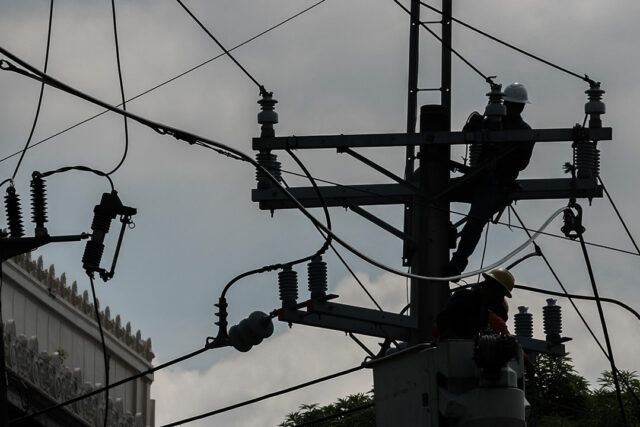
Linemen conduct maintenance work along Magallanes Drive in Manila. — PHILIPPINE STAR/NOEL B. PABALATE

ELECTRICITY RATES in Metro Manila and nearby provinces are likely to go up this month, as initial indications from Manila Electric Co. (Meralco) point to increases across several cost components.

In a statement on Monday, Meralco Spokesperson Joe R. Zaldarriaga said that although the company has yet to receive the final billings from its suppliers, there is an upward pressure on several pass-through charges.

He said the increase in the power prices in the Wholesale Electricity Spot Market (WESM) likely have contributed to the higher generation charge.

Tight supply margins in Luzon drove the average WESM price 9% higher month on month to P3.25 per kilowatt-hour (kWh). Power supply fell by 8.3% to 13,228 megawatts (MW), while demand slipped by 8% to 8,574 MW.

Meanwhile, power procured from Meralco’s suppliers is expected to have increased due to the peso depreciation, which affected their costs that are mostly dollar denominated.

The peso closed at P58.86 per dollar on Jan. 30, weakening by seven centavos from its P58.79 finish on Dec. 29.

“There is also a possible increase in transmission charge due to higher market prices for regulating and contingency reserves,” Mr. Zaldarriaga said.

Meanwhile, he said that an additional P0.08 per kWh will be charged to consumers following the approval of the Energy Regulatory Commission (ERC) of a new rate for universal charge for missionary electrification (UCME).

The ERC approved an increase in the rate for UCME to P0.2763 per kWh from P0.1993 per kWh previously.

UCME is a charge collected from on-grid electricity end-users used to subsidize the more expensive cost of providing power in off-grid areas.

“As these are still initial, the overall rate movement could still change,” the Meralco official said.

Last month, the power distributor decreased electricity rates by P0.1637 per kWh month on month to P12.9508 per kWh, driven by lower transmission charge.

The ERC earlier approved the cost recovery sought by four power generators amounting to P31 billion in fuel cost recovery. As a result, Meralco will collect an additional P0.2816 per kWh starting March.

Meralco is the country’s largest private electric distribution utility, serving over 8.1 million customers in Metro Manila and surrounding provinces, including Bulacan, Cavite, Rizal, and parts of Laguna, Batangas, Pampanga, and Quezon.

Meralco’s controlling shareholder, Beacon Electric Asset Holdings, Inc., is partly owned by PLDT Inc. Hastings Holdings, Inc., a unit of PLDT Beneficial Trust Fund subsidiary MediaQuest Holdings, Inc., has an interest in BusinessWorld through the Philippine Star Group, which it controls. — Sheldeen Joy Talavera

Informal work fills the gap as Philippine economic growth slows

A vendor serves various street food along Carriedo Street in Manila. — PHILIPPINE STAR/RYAN BALDEMOR

By Erika Mae P. Sinaking

FRENY C. DONGOYA sells pares — Filipino comfort food made of braised beef in a sweet-savory soy sauce served with garlic fried rice — for P120 ($2) a plate in Pasay City near the Philippine capital.

On most days, her customers are call center agents and motorcycle riders grabbing quick meals between shifts. She hasn’t raised prices despite higher food costs.

“If I increase prices, they stop coming,” she told BusinessWorld in Filipino. “Then I earn nothing.”

Ms. Dongoya works long hours, but she’s not counted in official job statistics. Like millions of Filipinos, she operates in the informal economy — without permits, tax registration or social protection.

Her situation captures the tension in the Philippine economy as it enters 2026.

Growth slowed sharply last year. Full-year expansion in 2025 eased to 4.4%, the weakest in 14 years excluding the pandemic. Infrastructure spending stalled and global trade softened. Yet officials continue to project confidence about reaching upper middle-income status.

On the ground, the picture looks uneven.

Outside business districts such as Bonifacio Global City and Ortigas, much of the workforce depends on low-paid, unstable jobs. Informal workers sell food, run small stores or take on casual labor. They cushion daily life for formal workers — but see little benefit from economic growth.

About 42% of the workforce or 20.6 million Filipinos remain in informal employment, according to estimates by IBON Foundation.

Christopher James R. Cabuay, an associate professor of economics at De La Salle University in Manila, said this helps explain why growth feels disconnected from household income.

“The current growth model is not structured to favor those in the informal sector,” he told BusinessWorld via teleconference.

“Most of the jobs we produce are in sectors like wholesale and retail trade or accommodation and food services. These employ many workers, but value-added per worker is small, so wages grow slowly,” he added.

Productivity gains are limited, and many workers stay near subsistence levels even during expansion years.

High-value sectors tell a different story. Business process outsourcing, finance and information technology earn in foreign currency and benefit from global demand. These industries helped stabilize growth during external shocks.

But their gains don’t spread evenly.

Analysts describe this as a two-track economy. One track is globally linked and relatively stable. The other is local, informal, and exposed to inflation and weak demand.

Warfredo Alejandro II works in the first track. The 27-year-old is a credit card specialist in the business process outsourcing sector. He has a steady paycheck and benefits. But he depends on the informal economy to manage daily costs.

He notes that affordable meals from vendors like Ms. Dongoya are the only way many employees can stretch their take-home pay.

“Street vendors make life affordable,” he said. “Without them, many employees would struggle to stretch their salaries.”

‘HIDDEN SAFETY NET’
Mom-and-pop stores and food stalls cluster around office towers for a reason. They sell cheap meals and essentials. For workers on entry-level wages, that matters.

Alellie B. Sobreviñas, an associate professor of economics at La Salle, said informal vendors act as an economic buffer for urban workers.

“They are a hidden safety net” especially for workers with long or irregular hours, she said in an e-mailed reply to questions.

When authorities clear sidewalks or relocate vendors without alternatives, costs rise quickly. Workers pay more for food. Commute times increase. Disposable income shrinks.

“That is an effective pay cut,” Ms. Sobreviñas said.

This does not mean informality is desirable, she said. Informal workers lack protection, access to credit and legal security. But removing them without replacing the services they provide creates pressures.

Formalization is often presented as the solution. In practice, it is costly.

For a small food vendor, registering a business requires multiple permits, fees and tax compliance. Costs can reach tens of thousands of pesos. For operators earning thin margins, that’s out of reach.

Ms. Dongoya pays her helpers P400 to P500 a day — below Metro Manila’s P695 minimum wage, which only applies to formal jobs.

Mr. Cabuay said this creates another gap. Wage policies help those already inside the system. They do little for those outside it.

“The difference between what an informal worker earns and what they could earn in the formal jobs available to them is often not that large,” he said.

Many formal openings are also low skill: cleaners, service crew and laborers. They offer stability but limited wage gains. For some workers, informality still pays more.

This weak incentive slows formalization and keeps productivity low.

Economists warn that this structure limits long-term growth. Without stronger manufacturing and higher-value domestic industries, job quality will remain constrained.

Mr. Cabuay and his colleagues have raised concerns about government targets of 6% to 8% growth. Without upgrading jobs, growth will not translate into higher incomes for most workers.

Other barriers remain. Small firms struggle to access credit. Regulations are complex and public investment has been uneven.

The result is an economy that grows without lifting the base.

In business districts, consumption looks strong. Malls are busy and offices are full. But many households remain one shock away from hardship.

For informal workers, inflation hits first and hardest. Food and fuel costs rise, earnings don’t adjust quickly and savings are limited, yet their role remains essential.

Without informal vendors, entry-level formal workers would face higher living costs. Without informal transport, commutes would be longer. Without small retailers, neighborhoods would lose access to cheap goods.

The challenge is not choosing between formal and informal work. It is closing the gap between them.

That means lowering the cost of formalization, improving access to credit, and creating jobs that pay more because they produce more.

Until then, growth will continue to feel abstract for millions.

Ms. Dongoya doesn’t talk about gross domestic product targets. She watches foot traffic and rice prices.

“If customers disappear, I disappear,” she said.

For now, they keep coming. That says as much about the Philippine economy as any official forecast.


Renewable energy contracts for sale fuel Philippines crackdown

STOCK PHOTO | Image from Pixabay

MANY PROSPECTIVE INVESTORS who won contracts for renewable energy projects in the Philippines had no plans of building them. They were only waiting to sell those rights to someone else for the right price.

That led the Department of Energy to terminate agreements for nearly 18 gigawatts of solar, wind and other clean-power projects, according to Energy Secretary Sharon S. Garin.

It’s a costly speed bump for the nation that’s ahead of its Southeast Asian neighbors in its push for green energy projects with full foreign ownership and tax incentives. Manila aims to boost the share of renewables in its energy mix to more than a third by the end of the decade from about a quarter now.

“There are companies that are just getting contracts and they’re waiting to sell it to somebody else,” Ms. Garin said in an interview. “It’s like bonds or stocks, they’re just waiting for the time when the price rises.”

Excluding the canceled contracts, the country still has more than 130 gigawatts of renewable energy projects in the pipeline, far more than any other nation in Southeast Asia, according to data compiled by Global Energy Monitor.

Ms. Garin said that puts the government on track to meet its target of increasing the share of clean power in the country’s energy mix to 35% by 2030 and eventually to 50% after a decade. The contribution of renewables is ahead of natural gas that’s at around 10%, but coal dominates the mix at about 60%.

“Because there are more credible investors that are willing” to get contracts and fill the gap caused by the cancellations, she said. The agency will hold an investment forum on Friday to announce new auctions for the contracts. “This year alone, we’ll probably have about eight auctions compared to only one or two every year previously,” the former lawmaker said.

The Philippines will lead the region’s deployment of battery energy storage systems with 2.6 gigawatts expected to be added this year, according to BloombergNEF, as more clean-power projects are built. Nearly all of the new storage capacity additions will come from the first phase of Manila Electric Co.’s Terra Solar project that has a total capacity of 3.5 gigawatts, it said.

Bulk of the solar power contracts terminated by the government belonged to Solar Philippines, with 33 out of its 42 contracts canceled, Ms. Garin said, after the company failed to deliver on its commitments and in updating the agency on the status of the projects despite repeated calls to do so.

Congressman Leandro Leviste, who founded the company, referred Bloomberg News to a previous video post on his Facebook account when sought for comment. In that video, he denied delivering only a fraction of the contracts and that he didn’t sell any franchise. Last month, he stepped down as board member of the firm behind the Terra Solar project.

“We will protect the credible and reliable investors, but we will discipline those who are not delivering,” Ms. Garin said. “We’re past the infancy stage. Now, different sets of rules have to be established.”

Apart from green energy, the nation of 113 million people is also seeking to prolong the life of its main Malampaya gas field.

President Ferdinand R. Marcos, Jr. last month announced that a Philippine contractor discovered a new gas source near Malampaya, which is estimated to contain around 98 billion cubic feet of gas and would help extend the life of its depleting gas field.

Ms. Garin said the new energy source will be connected to the power system by end of the year and that two other areas near the field have also shown potential. But the country will need to continue importing liquefied natural gas to meet its growing energy needs. “The more renewables you have, the more gas you need,” she said. — Bloomberg