Home Blog Page 281

Ancestral domain titles: The missing link in the carbon market

STOCK PHOTO | Image from FREEPIK

By Erwin L. Tiamson

As typhoons grow stronger and floods become deadlier, the Philippines faces a stark reality: climate change is no longer a distant threat, but a present crisis. Yet amid the devastation lies an untapped solution — carbon projects rooted in ancestral domains.

There is a real opportunity for the Philippines’ indigenous communities, one that can turn decades of unrewarded stewardship into sustainable local income, jobs, and investment. As carbon finance matures, forest restoration is no longer only a public good: when structured correctly, it can become a durable revenue stream for Indigenous Peoples (IPs) who hold Certificates of Ancestral Domain Title (CADTs) and who, by law, are recognized as the rightful stewards of their ancestral lands — covering over 6 million hectares with more titles still under processing.

The key is institutional design. Treating carbon benefits as an accessory to ownership, much like the fruits of the land belonging to the owner-farmer, can lead to several positive outcomes. This enables indigenous communities to gain clearer entitlement to revenues. At the same time, project bankability improves because investors see stable titles and predictable revenue streams, then denuded land finally attracts long-term capital for reforestation and environmental recovery.

Philippine law already contains the building blocks for this shift in which the Indigenous Peoples Rights’ Act (IPRA, Republic Act No. 8371) awards ancestral domains to indigenous communities as private but communal property — recognizing that ownership arises from their long-standing ecological stewardship, including the reforestation of denuded land. Under this framework, the carbon benefits generated from such restoration rightly belong to them as fruits of ancestral domain ownership.

This principle also finds support in property economics, particularly in Harold Demsetz’s theory where ownership evolves to internalize the gains and responsibilities of productive activity. Assigning rights to those who manage and restore the resource ensures that the benefits of stewardship flow to those who bear its costs. At the same time, the Department of Environment and Natural Resources (DENR) has begun operationalizing carbon accounting, verification, and certification systems (CAVCS), which explicitly include projects in ancestral domains and on private lands — providing a practical platform for ownership-based models.

Another market development makes the moment even more promising. The Philippines recently amended the Investors’ Lease Act (RA No. 12252, 2025) to extend the maximum permissible lease period for foreign investors on private lands not to exceed 99 years, a reform intended to increase long-term private investment certainty. While the amendment principally targets industrial and commercial investment, it also includes ecological conservation projects. The intention is to signal a shift in the investment climate: long-tenure property arrangements are now easier to structure, which can help match long-term restoration returns with long-term capital. This distinction is critical. Ancestral domains under IPRA are classified as private but communal property. As such, they are not subject to the constitutional restrictions on foreign equity or land ownership. This legal status creates room for compliant, long-term partnerships that bring in both local and foreign capital while fully respecting indigenous ownership and control.

Why does ownership matter for carbon financing and for IPs?

First, ownership clarifies entitlement. Lenders and carbon buyers prefer projects with well-defined legal rights to the asset generating revenue. If carbon credits are legally accessory to CADTs, indigenous communities can use projected carbon revenues to access readiness finance, technical assistance, or even structured pay-for-performance contracts that pay upfront for reforestation work.

Second, ownership aligns incentives: when communities own the credits, they have their own equity in the outcome, which strengthens accountability and ensures that reforestation efforts endure.

Third, ownership unlocks local benefits: generating wage jobs in plantation and nursery work, supporting community forestry enterprises, and enabling downstream value-chain activities such as seedling nurseries, eco-tourism, and wood-friendly agroforestry to be realized. These activities not only create sustainable livelihoods within the community but also build a foundation for inclusive local economies rooted in environmental stewardship.

Fourth, ownership helps reduce poverty and counters rural insurgency: Beyond economics, this model also contributes to social stability. Ownership-based projects turn ancestral lands into productive assets, helping reduce rural poverty and foster stability in upland areas long affected by marginalization and insurgency.

To convert opportunity into reality, several institutional steps are needed. They are practical, achievable, and policy-friendly:

  1. Affirm carbon rights as an accessory to CADTs. A clear administrative clarification that carbon benefits arising from restoration within titled ancestral domains belong to the CADT holder will remove ambiguity for buyers and financiers.
  2. Make indigenous communities the default project proponents. IPs should have the legal presumption of project proponent status for carbon activities in their domain, with the option to partner with technical developers — not to be supplanted by them.
  3. Standardize agreements and FPIC to reflect ownership. Agreements must disclose valuation, revenue flows, and service fees; FPIC must confirm who retains carbon rights and under what terms.
  4. Integrate CADTs into carbon registries and Measurement, Reporting, and Verification (MRV). Registries and MRV protocols should recognize indigenous titleholders as registrants or named beneficiaries, so credits are legally and operationally tied to the community.
  5. Shift the Government’s role to capacity and finance facilitation. The government should only provide measurement, legal, and financial readiness support.
  6. Leverage long-term financing instruments. Align project periods and investment horizons with restoration timelines, a shift now more feasible under the recent reform of the Investors’ Lease Act (RA 12252).

Over time, carbon rights anchored on ancestral domain ownership can also be securitized and traded, much like other environmental assets. This would enable a wider range of local and foreign investors to participate in sustainable restoration while channeling capital directly to indigenous-led projects.

When these elements come together, carbon projects in ancestral domains become more than conservation drives: they become inclusive, investment-grade community enterprises that restore forests, create jobs, and provide predictable income for historically marginalized groups. For policymakers, donors, and private investors, the message is clear: prioritize property-aligned design. Doing so transforms carbon finance from a short-term program into a durable pathway for IPs’ prosperity.

Crucially, these efforts also advance the country’s climate adaptation goals. Restoring forest cover, as emphasized by the UP Resilience Institute, is one of the most effective and sustainable flood control measures — acting as a natural first line of defense that is far more resilient than dikes or purely structural interventions. Restoring cover has become more urgent in light of the deleterious effects of climate change on the Philippines, including the destructive floods and typhoons we are experiencing these days.

The goal is to realign incentives so that developers, buyers, and financiers work with indigenous owners on terms grounded in law and fairness, creating stronger projects, lower risk for investors, and lasting gains for the communities that have protected these lands for generations.

The Philippines can show how an ownership-anchored carbon strategy turns stewardship into prosperity. The policy changes are straightforward; the market signals are present; the social benefits are real. What remains is political will, clear rules, and practical capacity-building — small inputs that yield significant outcomes for climate, communities, and a more inclusive green economy.


Atty. Erwin L. Tiamson leads the Indigenous Peoples Property Rights Project of the Foundation for Economic Freedom. He teaches Property and Land Laws at the UP Geodetic Engineering Department and Arellano Law School and is a policy consultant specializing in land rights, environmental law, and institutional design.

Sun Life Philippines is still top life insurer in premium terms

SUN LIFE of Canada (Philippines), Inc. (Sun Life Philippines) kept its place as the top life insurer in the country in terms of premium income in the first nine months of 2025.

The insurer booked a premium income of P44.73 billion in the period as it improved its services and expanded its offerings, it said in a statement on Thursday.

It attributed its performance to its client-centric approach, the commitment of its advisors, and the dedication of its employees.

“At Sun Life, our commitment goes beyond providing financial solutions. As we celebrate our 130th anniversary, we strive to be the Filipinos’ Partner for Life in their journey towards brighter futures. We will continue to innovate and deliver services that empower them to achieve their goals and dreams,” Sun Life Philippines Chief Executive Officer and Country Head Benedict C. Sison said.

The company said it will work to maintain its top spot in the industry to meet the changing needs of its clients while ensuring sustainable growth and positive community impact.

“Sun Life Philippines continues to expand its product offerings and enhance its services to meet the evolving needs of Filipino families in an increasingly dynamic financial landscape.”

The life insurance sector booked a premium income of P299.45 billion in the first nine months of 2025, up by 13.77% from the same period a year prior, the Insurance Commission said. — A.M.C. Sy

Cautious consumption seen weakening seasonal hiring

https://www.philstar.com

By Chloe Mari A. Hufana, Reporter

SLOW AND UNEVEN government aid after recent typhoons could dampen fourth-quarter growth as households curb holiday spending following the hit to their incomes and job opportunities, analysts said.

Federation of Free Workers President Jose G. Matula said delayed assistance and fewer seasonal job openings could dampen holiday consumption, a key driver of gross domestic product (GDP).

“When there are fewer seasonal hires, wallets get thin,” he said via Viber, adding that families might postpone purchases and trim nonessential spending.

The Philippines posted modest economic growth in the third quarter, weighed down by the impact of natural disasters.

Third-quarter growth slowed to 4% year on year, from 5.5% a quarter earlier and 5.2% a year earlier.

The slowdown was largely driven by faltering infrastructure spending, as a high-profile corruption probe into government construction projects — particularly flood-control works — delayed billing and disbursements.

Private consumption, which accounts for more than 70% of GDP, slowed to 4.1% in the third quarter from 5.3% in Q2, dragged down by declining consumer confidence.

The labor market in September was also negatively impacted by natural disasters, as reflected in the most recent jobs report .

The Philippine Statistics Authority reported a 3.8% jobless rate for the month, weakening from 3.7% a year earlier.

September typically marks the start of the holiday season in the Philippines, when businesses ramp up hiring to meet rising demand in the run-up to December.

Mr. Matula called on the government to fast-track emergency job programs, and front-load public works so that “people regain (working) hours now, not after the holidays.”

“Relief work programs like Tulong Panghanapbuhay sa Ating Disadvantaged/Displaced Workers (TUPAD) and cash-for-work reach some displaced workers, but the support is inadequate and too slow,” he noted.

He said payouts from emergency employment schemes remain inconsistent, and most temporary jobs last only a few days — insufficient to replace lost income.

“Relief work should pay at least the regional minimum, be released on time, and automatically start after calamities,” he said.

He urged the government to link short-term cleanup work to long-term reconstruction jobs “with safety gear, proper hours, and union participation,” adding that success should be measured “by paid hours and decent jobs, not photo-ops.”

Labor Secretary Bienvenido E. Laguesma acknowledged that natural calamities have disrupted labor market conditions.

“Natural disasters act as (an) economic shock or disruptor that affects business spending, even leading to downsizing or, at times, closure, lower consumer confidence and demand, and even restrict(ing) availability and mobility of work-ers,” he said via Viber.

He said these factors are expected to weigh on near-term labor performance, but maintained that the overall outlook remains steady.

“We continue to see stable employment trends based on the last two months of the Labor Force Survey, which are well above our target of a 94–95% employment rate,” he added.

He has expressed hope that hiring will pick up in the runup to December.

The holidays might not bring its usual boost to the labor market this year, as weaker exports and recent natural disasters curb seasonal job creation, according to University of the Philippines School of Labor and Industrial Rela-tions Assistant Professor Benjamin B. Velasco.

He said holiday hiring in retail, services, and manufacturing is expected to soften, curbed by sluggish demand for garments and electronics — two of the country’s key export earners.

“Seasonal jobs are not as robust this year,” he said via Messenger, adding that external headwinds and domestic disruptions have made employers more cautious in expanding their workforce.

John Paolo R. Rivera, a senior research fellow at the Philippine Institute for Development Studies, noted the critical role of household consumption.

“The holidays usually bring the biggest boost to retail, food, travel, and services. A strong rebound in spending can help offset weaker government disbursements or exports,” he said via Viber.

Mr. Rivera added that income losses and job disruptions from the typhoons could suppress growth if consumers hold back.

“Private consumption is very sensitive to income and confidence, especially among lower- and middle-income households who drive the bulk of holiday demand. When families prioritize essentials or rebuild after disasters, dis-cretionary purchases drop, which could temper retail and services growth even into early 2026.”

Economist Reinielle Matt M. Erece of Oikonomia Advisory and Research, Inc. noted that consumption remains the economy’s strongest pillar, accounting for the largest share of GDP and serving as the country’s main buffer against external shocks.

“This quarter, we may expect consumption to be the primary driver of growth. Especially as the holiday season takes effect, when households typically receive higher incomes and demonstrate higher propensity to spend,” he said via Viber.

“However, recent calamities may drive spending down as households focus more on preparations and recovery rather than consumption. In addition, weaker government spending may also dampen job absorption in govern-ment and even in the construction sector.”

Mr. Erece added that consumption growth may slow “more than desired” this quarter but said recovery could be possible next year if reforms move ahead.

“We may see proactive measures in 2026, not just in economic reforms but also politically as well. If we improve institutions sooner, recovery is definitely possible in 2026,” he added.

The public works scandal has rippled across key sectors of the economy, including the stock market and the peso. Investor confidence has taken a hit, with shares in construction and infrastructure-related firms sliding as deep-rooted vulnerabilities in government oversight were exposed.

The peso, meanwhile, has struggled against the dollar, reflecting broader concerns about fiscal policy and the potential slowdown in public investment.

Mr. Velasco urged policymakers to seize this moment as a wake-up call to adopt a more progressive industrial policy that strengthens domestic linkages in agriculture and manufacturing.

“We need an industrial strategy anchored not just on export markets, but also on local demand and national goals such as food security, green jobs, and sustainable growth,” he said.

Mr. Rivera noted that preventing a broader economic slowdown will depend on prompt government aid, stable prices, and a quicker recovery in disaster-hit areas to sustain household spending and support overall economic growth.

Now You See Me movie sent new cast members to magic school

LOS ANGELES — For Ariana Greenblatt, learning magic tricks at The Magic Castle clubhouse in Los Angeles was the best part of starring in the third installment of the American heist film, Now You See Me: Now You Don’t.

“Before opening hours, we would spend a couple hours in there and just learn as much as we possibly could in the time given, and it was so much fun,” the former Disney Channel star said of the month the actors spent at the home of the Academy of Magical Arts learning illusions seen in the film.

“It’s so weird. I feel like we have newfound skills, which is my favorite part of this job,” said Ms. Greenblatt, who received several film award nominations for her role in Barbie.

The new movie, directed by Ruben Fleischer, features returning actors Jesse Eisenberg, Woody Harrelson, Dave Franco, Isla Fisher, and Morgan Freeman, along with newcomers Justice Smith, Dominic Sessa, Rosamund Pike, and Ms. Greenblatt.

The film is now showing in the Philippines with an MTRCB Rating of PG.

The film, distributed by Lionsgate and opening in US theaters on Friday, continues the story of “The Four Horsemen” as they reunite to recruit three skilled illusionists for a high-stakes robbery of the world’s largest “queen dia-mond” from a crime syndicate.

“We learned so much… a lot of card tricks,” said Mr. Sessa, whose debut in The Holdovers earned him the Critics’ Choice Movie Award for Best Young Performer. “Ariana did a lot of pickpocketing (in her role), and she was con-stantly trying to use me as her prop to practice on.”

For franchise veteran Mr. Franco, the magic tricks he learned over years of working on the films paid off.

“We’re playing the greatest magicians in the world. So, as an audience, when you’re watching us, you want to believe that we’re actually doing some of these tricks,” he said.

“Our director, Ruben, encouraged us to learn as much as we could to make it look as real as possible,” he added, noting that his card-throwing skills have become especially advanced.

It was important to Mr. Fleischer and the cast that the illusions looked convincing.

“The director really wanted to make sure that the magic was real, that it wasn’t just computer-generated effects, which meant for us as actors, practicing every day, the tiniest little hand moves,” fellow franchise veteran Mr. Ei-senberg said. — Reuters

Managing difficult employees

My long-time worker has turned difficult, absenting himself on critical days, missing out on a routine task that must be delivered every Monday. Due to his frequent absences, I’m forced to do it alone, or with the help of others who must work overtime. I feel he’s trying to sabotage our work. What’s the cure? — Fat Cat.

Some people vanish when the heat is on. You see them all week — laughing, chatting, sipping coffee — until crunch time arrives, and suddenly, they’re “on emergency leave,” “not feeling well,” or “unreachable due to poor signal.” Congratulations! You’ve just met the master of strategic absenteeism.

I was in the same boat before. Three decades back, our department was tasked to produce a print copy of an eight-page bi-weekly newsletter that needed to hit everyone’s desks every first and third Monday of the month. That means all hands on deck on Thursdays and Fridays — editing, proofreading, getting approval, and rushing files to the printer on Saturday.

My assistant, who knows the production cycle better than anyone, used to disappear just when I needed him most. Coincidence? That’s unlikely.

So how do you manage a worker who’s absent not by accident, but by habit and design?

I talked to him about it several times, but he came off convinced I could do it without him. Several weeks after that, he resigned, to my relief. He was eventually replaced by an outsider. Problem solved.

SEVEN-STEP APPROACH

Looking back, if he didn’t resign, I would have resorted to the following measures, with an eye towards demonstrating empathy, holding people accountable, while showing just the right dose of managerial spine:

One, diagnose before you prescribe. Before resorting to any disciplinary action, start with curiosity instead of confrontation. People don’t usually sabotage themselves without reason — though some do it with surprising dedication.

Have a serious, private talk with the employee. Keep it conversational, not confrontational: “I’ve noticed you’re often away on critical days, which are our key production days. What’s going on?” The answer, even if it’s silence, will tell you a lot.

Two, clarify expectations in writing. Make expectations explicit. Ambiguity is the best friend of the underperformer. Say something like: “Since our task must be ready by the first and third Monday, your presence on the last two working days prior is critical.

“Let me know if you have other ideas.” Putting everything in writing eliminates many alibis. It also draws a professional boundary: this isn’t about your feelings — it’s about performance.

Three, document, but don’t dramatize. If the absences continue, document every instance. Record the date, the reason (if any), and the operational impact. This creates a factual trail that protects you from claims of bias. Managers sometimes lose battles not because they’re wrong, but because they failed to keep records.

And they failed to act accordingly. In other words, don’t rely on memory. Memory fades ­— documentation doesn’t.

Four, reassign responsibility strategically. The best way to handle a saboteur is to take away his leverage. Reassign his critical tasks to others, even temporarily, including outsourcing the work outside of the organization. This achieves two things:

It ensures work continuity. Also, it sends a clear message that no one is indispensable.

Five, consult Human Resources (HR). Allow HR to enter the picture. But don’t march in waving frustration. Bring data: attendance logs, written reminders, e-mail summary of your discussions. HR professionals appreciate managers who have done their homework.

Frame the issue as a performance management issue, not a personality conflict. You’re not attacking the person — you’re addressing a behavior that disrupts workflow.

Six, reinforce the culture of dependability. Don’t let one person’s inconsistency and indispensability poison the team’s morale. Praise the reliable ones publicly. Give credit to people who did a lot even if the job is not part of their job description.

Positive reinforcement creates peer pressure — the healthy kind. When dependable employees see that their reliability is noticed, it strengthens the culture.

Seven, be prepared to let go. If all else fails, it may be time to part ways. Repeated absenteeism during critical days is not just a scheduling issue — it’s a trust issue. You can train skills, but you can’t train integrity.

As Peter Drucker warned, “The worst thing you can do for a person who is wrong for the job is to keep him.” Letting go isn’t punishment; it’s protection — for the team, the schedule, and your sanity.

LEADERSHIP TEST

When someone habitually disappears during the busiest days, they’re not just absent physically — they’re absent in spirit. The manager’s role is to convert that absentee into a “non-entity” without him knowing it. Eventually, he will get the message.

In business, deadlines don’t wait for anyone — especially for someone who treats work like a part-time hobby. A manager’s job isn’t just to produce results — it’s to ensure that people show up, literally and figuratively, to make those results happen.

So, when your assistant conveniently hides behind those emergency leaves, remind yourself: this isn’t just a personnel issue. It’s a leadership test.


Consult your workplace issues for free. E-mail REY ELBO at elbonomics@gmail.com or DM him on Facebook, LinkedIn, X or via https://reyelbo.com. Anonymity is guaranteed.

At COP11, the Philippines must promote health and stop carrying the tobacco industry’s agenda

STOCK PHOTO | Image from FREEPIK

By Ulysses Dorotheo

As countries gather in Geneva for the 11th session of the Conference of Parties (COP11) to the World Health Organization (WHO) Framework Convention on Tobacco Control (FCTC) on Nov. 17 to 22, this question looms large: Will the Philippines stand firm to protect public health or will it protect the tobacco industry? If history is any indication, there are grave concerns that tobacco industry influence may again overshadow the nation’s public health commitments.

In 2005, the Philippines ratified the WHO FCTC, committing to protect public health policies from the commercial and vested interests of the tobacco industry, as mandated under FCTC Article 5.3. This means government decisions on tobacco control must be made without industry influence, regardless of the industry’s repeated claims about supposed “economic benefits,” because reality tells another story.

While tobacco excise taxes earn the government about P150 billion annually, this pales against the enormous costs of nicotine addiction and tobacco-caused diseases, disabilities, and deaths. In addition to the P263-billion annual economic burden from tobacco use, more than 112,000 Filipinos are killed every year by tobacco-caused diseases, a staggering and preventable toll. Despite these human and socioeconomic costs, the country implements policies that fail to protect people and allow the tobacco industry to flourish.

This vulnerability is reflected in the Philippines receiving five Dirty Ashtray Awards at previous COPs, an international symbol of shame that calls out governments that speak as if they represented tobacco industry interests. This year, with the country’s rank in the 2025 Global Tobacco Industry Interference Index deteriorating to 68th out of 100 countries, we are again at high risk for international disrepute and perhaps more Dirty Ashtrays. In the 2025 FCTC Scorecard, the Philippines also recorded one of the steepest declines in ASEAN for failing to safeguard government policies from tobacco industry interference.

This regression reflects persistent, well-funded tobacco industry efforts to weaken regulations and create a new generation of nicotine users. While adult cigarette smoking prevalence declined from 28.3% in 2009 to 18.5% in 2021, e-cigarette use among Filipino youth is rising at alarming rates. In this context, the tobacco industry is attempting to rebrand itself as a partner in “harm reduction” and pretending to care about Filipinos, when this is just a deliberate business strategy to ensure its profits by keeping people addicted.

In public health practice, genuine harm reduction helps smokers quit nicotine for good. The tobacco industry, however, has distorted this principle to market e-cigarettes, heated tobacco products, and nicotine pouches as “safer alternatives,” while continuing to aggressively market and profit from conventional cigarettes. The goal of the industry is not to eliminate nicotine addiction but to sustain and expand it, especially among the youth.

Big Tobacco’s dual strategy is clear; while publicly claiming to drive a “smoke-free future,” it is increasing cigarette sales globally and in the Philippines. Meanwhile, these new nicotine products are designed to look cool and are marketed with flavors to appeal to younger customers. The result is not genuine harm reduction, but harm creation.

The industry’s fake harm reduction narrative is being amplified through groups that present themselves as supposedly independent “consumer advocates,” “health champions,” or “scientific experts,” but they simply echo the industry’s misleading messages. They focus on unproven “reduced harm,” while dismissing substantial evidence of health risks and aggressive youth targeting. As Singapore’s Minister of Home Affairs recently highlighted, these groups “are essentially paid mouthpieces for the tobacco industry,” peddling “snake oil” to mislead governments and citizens with overstated claims of safety. The Minister also noted that such arguments do not reflect mainstream public health evidence and can even normalize risky behavior among the youth.

The passage of the Philippines’ Vape Law, which lowered the minimum age of access to nicotine products from 21 years to 18 and shifted regulatory authority away from the health sector, led to a rise in youth vaping and widespread marketing on social media platforms. Instead of reducing smoking, this law opened new pathways to nicotine addiction for younger generations and allowed these fake harm reduction narratives to thrive. These outcomes are not coincidental. They are preventable consequences of policymaking that is shaped by industry influence rather than genuine public health principles.

With more than 110 million Filipino lives on the line, the promise that “Sa Bagong Pilipinas, Bawat Buhay ay Mahalaga” (“Every Life Matters in the New Philippines”) must translate into clearly pro-health policy positions at COP11. If every life truly matters, the entire Philippine government (trade, agriculture, labor, finance, social welfare, justice, local government, foreign affairs, and health) must uphold Article 5.3 by ensuring that the government delegation’s positions on tobacco control are free from industry influence, including groups that indirectly represent industry interests. This also means that the government must reject the industry’s misuse of the term “harm reduction” and ensure that regulations are enforced and strengthened to eliminate youth access by prohibiting tobacco marketing and banning all flavored tobacco and nicotine products.

COP11 is a critical opportunity for the Philippine government to pivot toward genuine public health leadership. Genuine adherence to its WHO FCTC commitments requires rejecting industry narratives, ensuring that tobacco and nicotine use are addressed through evidence-based interventions free from tobacco industry interference.

The Philippine government can either continue down the path influenced by the industry, or it can take this opportunity to put our people first. The question is whether political will exists to make it happen.


Dr. Ulysses Dorotheo is a Filipino neuro-ophthalmologist and public health physician and the executive director of the Southeast Asia Tobacco Control Alliance (SEATCA).

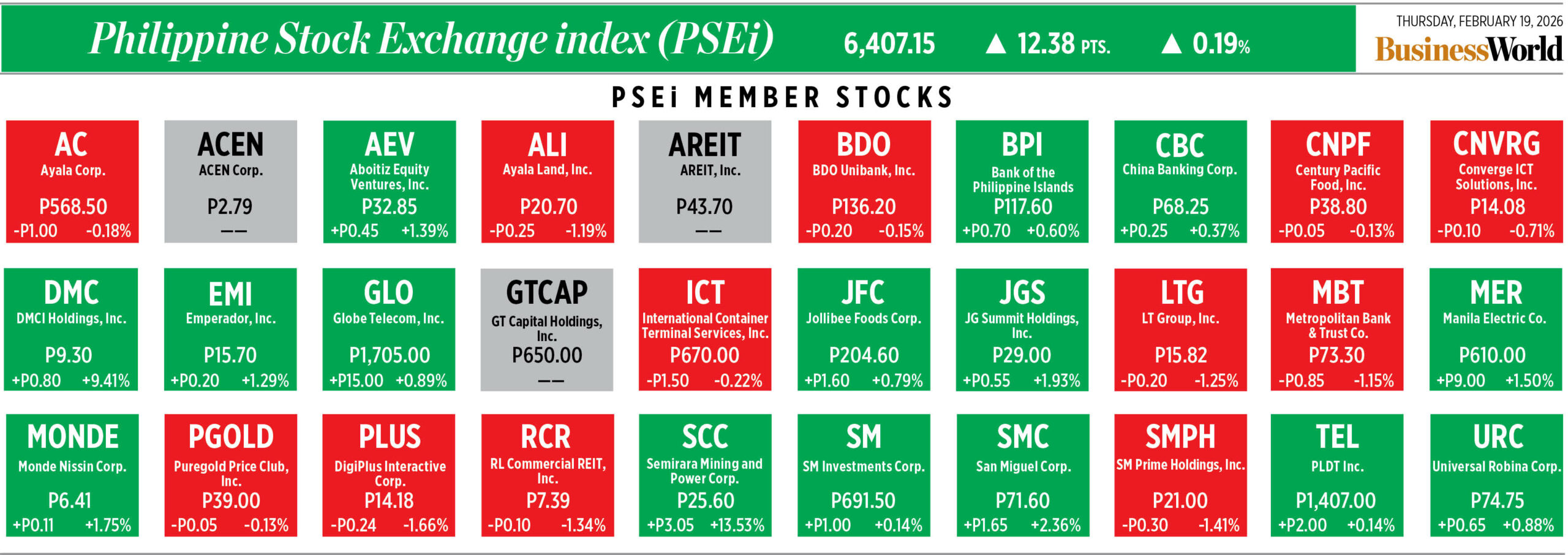
How PSEi member stocks performed — November 13, 2025

Here’s a quick glance at how PSEi stocks fared on Thursday, November 13, 2025.


Recipe for disaster

The decision by the Mavericks to relieve Nico Harrison of his duties as general manager marks a turning point for all and sundry. When he orchestrated the departure of erstwhile franchise cornerstone Luka Doncic, he promised immediate and sustained contention for them. Instead, they have suffered from an identity crisis. His firing opens a new chapter, perhaps not with the certainty of triumph, but with the palpable relief that comes with the admission that they made a monumental mistake.

The Mavericks are just nine months removed from pulling the trigger on one of the most stunning and controversial deals in the history of the National Basketball Association. The imperative for Harrison was clear: renovate the roster, pivot from a Doncic-centric offence to an Anthony Davis-anchored defense, and open a fresh championship window. Needless to say, they grossly underestimated how deep the structural and emotional currents ran. The trade dismantled the bedrock identity of the blue and white and exposed their intrinsic frailties.

In the aftermath, the results have been brutal. The Mavericks barely made the play-in tournament after the trade deadline, and then failed to survive it. This season, they have been a woeful 3-8 so far, ranking among the worst in the league in offensive efficiency, three-point shooting, and assists. Throughout the slide, Davis has been mostly injured; add Kyrie Irving’s continued sidelining to this familiar sight, and the recipe for disaster is complete.

In the locker room and in the stands, the mood stayed sour. Fans kept up with the “Fire Nico” chants, and ownership, led by governor Patrick Dumont, finally owned up to the legacy-altering misstep by letting go of Harrison. The veritable acknowledgment of the blunder brings with it no small measure of embarrassment. At the same time, it heralds hope and triggers a foundational rebuild; reports have noted that the Mavericks will pursue a senior basketball operations hire and shift attention to the future by focusing on top overall pick Cooper Flagg and other draft assets.

To be sure, the road ahead remains rife with obstacles. The Mavericks are constrained by earlier player swaps that will cost them draft picks between 2027 and 2030. And even as they will still carry Davis’ contract and injury history, they look to rebuild the trust of an alienated fan base. Once more, they’re seizing an opportunity to change direction. This time, however, they’re doing so on the strength of reflection and not bravado. Whether they ultimately succeed in their pivoting, only time will tell.


Anthony L. Cuaycong has been writing Courtside since BusinessWorld introduced a Sports section in 1994. He is a consultant on strategic planning, operations and human resources management, corporate communications, and business development.

Misery index climbs to 2-month high in September

The Philippine’s adjusted misery index climbed to a two-month high of 16.2% in September from 15.7% in August. While this may have reflected an improvement in the jobless rate, it also showed underemployment rate, the share of workers seeking more jobs, worsening. The index, which now incorporates adjusted underemployment rate* alongside inflation and unemployment rates, offers a broader measure of economic discomfort. Originally developed by economist Arthur Okun, the misery index serves as a proxy for economic destress. A lower reading typically signals better economic health, though structural issues may persist beneath the surface.

My father’s legacy of integrity, family, and faith

Nov. 1 is not only All Saints’ Day — it’s also a day of joyful remembrance. It marks the birthday of Benjamin “Amen” M. Gozon, our beloved Tatay — a man whose life of honesty, humility, and devotion continues to guide our family.

This year, we celebrated by visiting the Manila Cemetery ahead of the crowd and gathering for lunch on Nov. 2. Granddaughter Annette Gozon Valdez used AI to bring old photos to life in our family chat — sparking laughter, tears, and nostalgia. Inspired, Ate Kay gathered more vintage pictures, and her son Menardo “Butch” Jimenez turned them into a moving video of memories that reminded us what a rare man our Tatay truly was.

Tatay, a lawyer, served as Director of Mines for 14 years, Secretary of Agriculture and Natural Resources under President Diosdado Macapagal, and Governor of the Land Authority, the forerunner of the Department of Agrarian Reform. He became the first non-engineer Director of Mines — a testament to his diligence. “Every task assigned to me, I studied well” he would say. His dedication and fairness earned him respect.

During his term as Director of Mines, I recall a major corruption case — the Harry Stonehill scandal dominated the headlines. Yet Tatay slept soundly. His principle was simple: “The softest pillow is a clear conscience.” He lived by that, keeping his reputation spotless throughout his government career. Today when we see integrity compromised, his life reminds us that success is measured not by wealth or titles.

When President Diosdado Macapagal appointed him to the Cabinet, Tatay himself was surprised as the President didn’t even know him personally. It was his staff’s testimony about his honesty and diligence that opened the door. A testament that when we do right or wrong, it will eventually get known. When he was Governor of the Land Authority, one of his first acts was to expropriate my mother’s (Carolina “Arling”  Lapus  Gozon ) inherited rice lands in Nueva Ecija — proof that official duty came before family.

Beyond public service, Tatay was a devoted husband and father. My mother “Arling” was a hardworking businesswoman and family disciplinarian. When her temper showed, Tatay would gently remind us: “Your mother works very hard for all of you and thinks of nothing else but her children.” He modeled respect and understanding in marriage — a quiet strength that grounded our home. Four of us children — Benjamin Gozon, Jr., Carolina “Kay Gozon Jimenez,” Felipe “Henry Gozon,” and myself — believed and truly felt we were the favorite. Family matters counselor Bishop Jonel Milan said: “Your father was a natural “psychologist. He treated each child uniquely, knowing what mattered most to each one.”

From his travels, he gave me the Nancy Drew book series, my favorite in the elementary school.  Ate Kay, the eldest daughter, was made to feel special and responsible. Kuya Ben carried the pride of being his namesake and firstborn, and Henry, the youngest son, had his own tender place in Tatay’s heart.

He taught by encouragement. When I struggled in math, he simply said: “Kaya mo ’yan. Wala akong anak na bumabagsak.” So, I studied harder — and passed. When granddaughter Laurie (now Jimenez Westfall),as a toddler would throw tantrums and bump her head in the wall. Tatay called her “Baet” (“good girl”). And… she actually became one.

Tatay’s wisdom lives on in his simple, powerful reminders: Always do the best in everything you do. Aim high, and if you achieve 50% of what you want in life, consider yourself blessed. Spend wisely and with gratitude. Huwag ubos-ubos biyaya. He practiced financial discipline. Every Christmas he took his grandchildren for shopping. If they chose beyond the budget, he gently squeezed their hand — the cue to look for something else. He taught to live within your means, contentment, and stewardship without a single lecture. He lived his faith quietly and deeply. He read the Bible several times. He treated everyone with respect and warmth.

His 14 grandchildren, his treasures, are now  grown and ALL well accomplished. From Ben Jr.: Belinda Madrid, Mylene Gana, Benjie and Nicky; from Kay Jimenez: Butch, Joel, Laurie, and Carmen Ong; from Felipe “Henry”: Annette, Philip, Maritess Viterbo; and from me: Edmin, Ted and Tricia Valderrama.

We remember Tatay as a model of integrity, service, and faith. His life is a blessing, an inspiration we remember with love and fondness on All Saints’ Day, his birthday.


The views expressed herein are her own and do not necessarily reflect the opinion of her office as well as FINEX.


Flor G. Tarriela is the youngest of the children of Benjamin M. Gozon. She is a finance and banking professional. She founded Flor’s Garden in Antipolo.

Gov’t warned investments will dry up if corruption not acted on

PRESIDENTIAL COMMUNICATIONS OFFICE

By Justine Irish D. Tabile, Reporter

The corruption scandal engulfing the infrastructure industry is expected to deter investments if the government does not prosecute those involved and follow up with reforms.

Danish Ambassador to the Philippines Franz-Michael Skjold Mellbin sees the corruption issue as an opportunity for the Philippines to move forward.

“Of course, everybody is waiting to see actual action on this,” he told reporters on the sidelines of the Nordic Ambassadors’ Forum 2025 on Thursday.

“I think that will send a very important signal: what is the government actually going to do to prosecute and process cases against those who are going to be indicted and who are under suspicion for having stolen and misused public funds,” he added.

He said that the government should not stop at prosecutions but also look at how it can improve existing processes to attract more investment.

“We do have some specific ideas on how to stem the tide in several areas. One of them would be to digitize more, but not just on the front end. It has to be digitization on the back end of government services,” he said.

“As long as you’re pushing paper around, that does open, unfortunately, the opportunity for individuals to mess with the process or to elicit certain favors. This is one way you can improve,” he added.

He also cited the need for the government to make regulations clearer and more objective.

“I think that there are quite a lot of opportunities, and I’m very happy that the business community now also is stepping forward trying to help the government with specific suggestions,” he said.

“One of those suggestions is to have more centralized tax assessment (for a) higher degree of professionalism and transparency in tax assessments,” he added.

Nordic Chamber of Commerce of the Philippines President Bo Lundqvist said corruption does not instill confidence among Nordic investors.

“If there is any takeaway… it is how important these matters — honesty, trust, and transparency — are to us Nordics,” he told BusinessWorld.

“From a business perspective, if you plan to make a serious (long-term) investment… you want to make sure you as a country (has) at least those ideals and those values that you bring with you,” he added.

He described as a positive development the initiation of the inquiry by the President, adding that the Congress has been diligent in its investigation, raising confidence that prosecutions will  eventually succeed.

“That’s the first thing to do. Enforce, right? You cannot change the world in one day. Everyone understands that. You cannot change traditions and all that,” he added.

“If you start (demanding) accountability, where people actually get punished for wrongdoing, well, then that hopefully changes the attitude, and we can slowly get to a more transparent and honest type of government,” he added.

He said the government needs to put budgets, transactions, spending, and progress reports online.

“The transparency needs to go all the way to what was actually spent and what was actually done … I think a chain of checkpoints (is required),” he added.

Postponed La Salle-Ateneo match serves as UAAP 88 Final Four finale

UAAP

The postponed duel of De La Salle University and Ateneo de Manila University will now serve as the finale to an anticipated photo finish race with Final Four seats at stake in the UAAP Season 88 men’s basketball.

The UAAP on Thursday announced the new date of the much-awaited match between the archrivals set on Nov. 26 at the Smart Araneta Coliseum after its suspension on Nov. 9 due to super typhoon Uwan.

But aside from the long-time animosity in the Blue-Green basketball war, major Final Four complications could also be up for grabs for a fitting finale in the main game at 4:30 p.m.

Ateneo escaped La Salle in the first round, 81-74, holding on despite nearly losing an enormous 33-point lead, for then a 4-0 start before losing four of its last five games.

La Salle, with a late push after a 2-3 start, sits at third with a 6-4 slate while Ateneo is not far behind at fifth place with a 5-5 record, making it a make-or-break game if they remain within striking distance of each other by next week.

University of Santo Tomas is barely ahead of Ateneo at 6-5 for the coveted fourth place as National University (10-2) and titleholder University of the Philippines (8-3) pace the race for an inside track to the Top 2 laced by twice-to-beat incentives.

Still in contention behind are Adamson University (5-6) and Far Eastern University (FEU) (4-7) with the University of the East being the only eliminated squad so far.

And that also makes the other suspended game equally interesting, starring Santo Tomas and FEU at 1:30 p.m.

Other postponed matches that will retain scheduled game times are Ateneo-La Salle Zobel (U16) at 7:30 a.m., Santo Tomas-FEU Diliman (U16) at 9:30 a.m., Santo Tomas-FEU (women) at 11:30 a.m. and Ateneo-La Salle (women) at 7 p.m.

All tickets dated Nov. 9 will be honored by the UAAP and the Smart Araneta Coliseum for the new schedule while refunds are also available.

“Tickets purchased for the postponed Nov. 9 games will be honored on the new game date, and will remain valid for entry to the corresponding games indicated on the ticket. For those who wish to request a refund, please refer to the details,” said the UAAP. — John Bryan Ulanday