Home Blog Page 2668

Edtech firm Instructure looking to set up PHL office by next year

PEXELS-PATRICK VOGT

By Aubrey Rose A. Inosante, Reporter

EDUCATION TECHNOLOGY (edtech) firm Instructure Holdings, Inc., the developer of the learning management system Canvas, aims to open a physical office in the Philippines next year amid a growing user base.

“We are continuing to invest in people and we’re looking at opening up an office here,” Harrison Kelly, Managing Director for the Asia-Pacific (APAC) region at Instructure told BusinessWorld on the sidelines of an event on Sept. 6.

“It’s going to enable us to bring tightly integrated teams together as we continue to grow out, which will provide a better experience, not only operationally for Instructure, but also to our end customers.”

Mr. Kelly said establishing an office in the Philippines is of “immediate importance” for the company and could happen within the next 12 months or sooner.

The company’s APAC headquarters is located in Sydney, Australia, while its main office is in Salt Lake City, Utah.

Instructure’s flagship product, student application Canvas, is being used in six out of the top 10 rated universities in the Philippines such as the University of the Philippines, Ateneo de Manila University, De La Salle University, and University of Santo Tomas.

“In the Philippines, we first set foot here in 2017. We’ve seen a market uplift over that time; COVID was an obvious accelerant,” he said.

He added that the adoption has differed per area, they mainly saw increased use of Canvas in Central Manila and other major cities in the Philippines.

“With a couple of the new things that we’ve got on the horizon, we know we can break down those barriers to access and provide that equity of learning for all,” Mr. Kelly said.

The company is investing in artificial intelligence (AI), he said. Instructure recently unveiled its new AI-powered tools, including automated discussion summaries, content translation, and a Smart Search API feature in Canvas, among others.

“We know [AI] is here to stay. We know it’s a disruptor. It’s going to be intangibly linked with people’s future, whether that’s in a school or institutional setting or whether that’s in the workforce,” Mr. Kelly said.

“But certainly, with our focus on lifelong learning, student success, and AI, that’s going to underwrite how we think about our near-term future and mid-term future,” he added.

Private equity firm KKR & Co. will take Instructure private for $4.8 billion, Reuters reported in July.

Earlier this year, Instructure completed the acquisition of academic credential management platform Parchment for $835 million. — with Reuters

Governance in one-person corporations

UPKLYAK-FREEPIK

The Revised Corporation Code of 2019 provided for the formation of One Person Corporations or OPCs, which makes it easier for entrepreneurs to limit their personal liability when running a business. India, in 2013, already allowed OPCs. Singapore also allows sole proprietorships with limited liability. The US, I believe, has something like the Singapore model.

Why bother to put up an OPC rather than a sole proprietorship? Well, an OPC can have a single incorporator, instead of the usual five, and a single stockholder — which can be a person, a trust, or an estate. More important, the single stockholder enjoys limited liability — his or her personal assets are protected, and he or she is liable only up to the capital investment in the company.

In single or sole proprietorships, when the business goes bust, unpaid creditors and suppliers can go after the assets of the business, the personal assets of the owner, and possibly even the assets of the owner’s spouse. With OPCs, however, creditors and suppliers can go after only the assets of the business and not that of the owner.

OPCs also do not have minimum capital requirements, making them easier to set up. Decision-making is also centralized, since the owner, director, and president are all the same. No Board of Directors required. However, the sole stockholder is required to name an alternate nominee in the Articles of Incorporation, in case of his or her death or incapacity.

Offhand, the structure of an OPC does not appear to promote good corporate governance. After all, it does not seem to provide for a system of check and balance, with the stockholder, director, and president rolled into one. Much like in any sole proprietorship, the top guy can do whatever he wants, until he gets flagged down.

In considering corporate governance best practices for OPCs that lack boards of directors, board committees like audit, risk, and corporate governance cannot be formed. OPCs do not appoint independent directors either. Although they still need to appoint external auditors, are subject to audits, and must comply with reporting and regulatory requirements.

In this line, in the absence of a formal board of directors, OPCs can establish a Board of Advisors that can provide strategic advice and oversight. These advisors can also be a sounding board for major decisions, especially if they are subject-matter experts, former executives, or industry leaders who bring valuable perspectives.

The thing though, it will entail some expense on the part of the OPC to maintain such a board. Advisors will not agree to come on board for nothing. And, quality comes with a price. But the OPC can make the most of the board in adding not only credibility to the OPC but also expertise. In fact, highly competent advisors can vastly improve management’s decision-making.

In a way, having such a board can also make it easier for an OPC to seek private investments or secure a credit line. It can even count when securing a bank loan. The same board can also take on functions like Audit, Risk, and Governance, especially as the business grows. Advisors can also assist in establishing internal policies on ethical behavior, compliance, and social responsibility.

As far as practicable, such external advisors should have no vested interest in the company. They need to be able to offer objective views on financial and strategic matters, if only to ensure transparency and accountability. Admittedly, an owner can easily dismiss advisors who do not agree with him. But in turn the owner loses access to diverse expertise and views.

Maintaining an independent Board of Advisors provides the primary benefit of enhancing an OPC’s public image as being transparent, accountable, and well-governed. To some extent, this can help build market. The younger generation seems to give more premium to patronizing businesses that maintain a positive image as a responsible steward.

At the same time, regular consultation with a Board of Advisors provides the OPC owner a structured approach to governance, even via informal mechanisms, and helps the OPC owner make more informed decisions for the business. An entrepreneur can be one-track minded, and can greatly benefit from outside expertise and diverse viewpoints.

And, as mentioned earlier, should the OPC seek to grow or attract investors, the presence of a governance structure — starting with a Board of Advisors — can help boost confidence in the company’s sustainability and ethical practices. Having an internal governance structure can also make it easier to comply with future legal requirements as the business grows or as regulations evolve. In a way, it can be seen as form of future-proofing.

Obviously, adopting clear accounting practices and having external audits are minimum requirements for enhanced transparency. The OPC must also build a reputation of ensuring compliance with all laws and regulations.  But engaging external experts, like a Board of Advisors, for periodic reviews of financials and strategic advice can help ensure better governance.

Obviously, it will not be easy for an OPC, especially one with limited resources as a start-up, to adopt corporate governance best practices like those observed in bigger corporations. Moreover, it is not a legal requirement for OPCs. Not yet, anyway. But adopting even just a few practices at the onset can still offer substantial benefits.

A Board of Advisors must be structured in a way that it can provide strategic oversight, credibility, and help the business owner make informed decisions. Beyond public perception, having external advisors and implementing internal governance frameworks can help promote sustainability, reduces risks, and ensures transparency and accountability.


Marvin Tort is a former managing editor of BusinessWorld, and a former chairman of the Philippine Press Council

matort@yahoo.com

The US will have a big presence in this year’s International Bazaar

YERBA MATE contains 90% more antioxidants than green tea, and can boost cardiovascular health, lower cholesterol levels, and minimize cancer risks. Perfect for caffeine enthusiasts through its unique characteristics, this herbal tea is highly caffeinated and usually compared to that of coffee rather than tea. — PHOTO COURTESY OF THE OFFICE OF PUBLIC DIPLOMACY

THE ANNUAL International Bazaar — organized by the International Bazaar Foundation (IBF), the Spouses of the Heads of Missions (SHOM), as well as the Diplomatic and Consular Missions in the Philippines — will be back in town on Nov. 3 at the World Trade Center in Pasay City.

There will be 174 booths from about 40 participating countries. “This is the only event where you can find all the products of these countries in one event. A lot of these products, you don’t see outside at the stores,” IBF Press Relations Officer Veronica Jimenez told BusinessWorld during a press conference on Sept. 11 at the World Trade Center.

The US will be joining this year, and it is going big with 16 booths. Nora Salazar, executive director of the IBF told BusinessWorld, “They would like to promote the importance of the products from the US that are agriculturally related.”

Their pavilion would be under the theme “Galing USA” (a play on the Filipino homonym “galing” which can mean either a place of origin or a praise of skill). Among the products that will be available at the booths are red meat, poultry, cheeses, dried fruits and nuts, peas and lentils, fresh fruits, soy-based products, candies and confectionery, wheat-based products, wines, and local craft beers brewed with US ingredients.

The exhibitors of the Galing USA Pavilion include Alternatives Food Corp., Candy Corner, Dane Commodities, ELIAS Wicked Ales and Spirits, Fly Ace, Frutesca, Global Strategic Partners Distribution, Inc., Hightower, Inc., Hotdog On Sticks/Nathan’s Famous, LL & Lance Multi-Products, Inc., La Petite Fromagerie, MIDA Food, Miracle Soybean Food International, Panaderia Antonio Food Corp., The Plaza Catering, and The Wine Club.

The Galing USA Pavilion is supported by the US Department of Agriculture Foreign Agricultural Service in collaboration with the California Milk Advisory Board, Potatoes USA, US Dry Bean Council, US Highbush Blueberry Council, US Meat Export Federation, USA Dry Pea & Lentil Council, and the USA Poultry and Egg Export Council.

FRoM CHOCOLATES TO YERBA MATE
Other countries are also offering a wide variety of food stuff. The Belgian embassy’s booth will offer chocolates, there will be paprika and Hungarian sausage from the Hungarian embassy, wines from the Australian embassy, and yerba mate from the Argentine embassy.

Aside from food products — garri mix, made from granulated cassava, and Chin Chin, a deep-fried snack, among others — the Consulate of the Republic of Ghana will also be showing off framed Lego figures which are works by one of their consular officers.

The home court won’t be lagging behind either: the Philippine pavilion will have 50 booths, offering the “Philippines’ Best,” including clothing, homeware, decor, jewelry, and food.

This year’s theme for the bazaar is “Shop Global, Help Local.”

“Beyond the delightful shopping and cultural experiences, ‘Shop Global, Help Local’ is about making a difference,” said Pamela Manalo, chair of the IBF (a post traditionally held by the spouse of the Secretary of the Department of Foreign Affairs, at present Enrique Manalo, the son of diplomat Rosario Manalo, the first woman to pass the Philippine Foreign Service Officers’ Examinations). “The funds raised through this event will support programs that will empower abused women, abandoned children, the homeless, and other marginalized communities — offering them not just a handout, but also hope.”

In a release, the organizers said, “All proceeds from this annual Bazaar will go to the various IBF and SHOM charity projects and programs that aim to uplift marginalized communities and extend educational opportunities to indigent scholars. The IBF supports its 52 active scholars, as well as livelihood projects for distressed communities and victims of calamities, provides financial and in-kind assistance to civic organizations, medical institutions, and NGOs in providing care to persons with disabilities, the elderly, the homeless, abused women and abandoned children, and other deserving groups.”

The bazaar is also a way to foster good relationships within the international community. Take note of the list of participating countries: Argentina, Australia, Bangladesh, Belgium, Brunei Darussalam, China, Colombia, the Czech Republic, France, Hungary, India, Indonesia, Iran, Ireland, Israel, Japan, Korea, Lao PDR, Malaysia, Malta, Mexico, the Netherlands, New Zealand, Pakistan, Palestine, Singapore, Spain, Sri Lanka, Thailand, Turkiye, the US, the UK, Vietnam, Angola, Georgia, Ghana, Jamaica, Peru, Syria, and Tanzania.

Ms. Jimenez said, “Everybody’s interested in the products of the other countries. I think it’s a form of fellowship for the different countries. Especially now that we’re living in such challenging times. But these countries, in this particular event, get together despite what’s happening outside.

“It kind of strengthens our relationship with each other. Because of that, this has been a very successful event every year. We forget about whatever quarrels we have outside, and just be kind and nice to each other.”

Entrance fee to the bazaar is P150. The International Bazaar will be on a Sunday, Nov. 3, from 9 a.m. to 7 p.m., at Halls B and C of the World Trade Center in Pasay City. — Joseph L. Garcia

More PHL executives now support cybersecurity, says Google Cloud expert

MORE senior executives in Philippine companies are now supporting cybersecurity and recognizing its business impact compared to five years ago, according to a cybersecurity expert from Google Cloud.

“Five years ago, there wasn’t a lot of support at the senior business levels, the C-suite levels, the board levels for cybersecurity, I think that’s changed now in the Philippines,” Steve Ledzian, chief technology officer for Asia-Pacific and Japan at Mandiant, now part of Google Cloud Security, told reporters on Wednesday.

Senior executives now understand that “cyber impact means business impact” and have taken an interest in resourcing it better, he said on the sidelines of the 8th Association of Southeast Asian Nations Chief Information Officer Forum.

However, he said, there is still room for these leaders to get a clearer picture of how cyber incidents happen and how they might impact business.

“[Firms can] take a red team exercise where you hire a friendly hacking firm to come in, not just if they can break in, but if they can get your crown jewels and come right up to the line of what would otherwise be a business impact,” Mr. Ledzian said.

He said companies such as Mandiant can deliver these red team exercises. The “red team” uses nondestructive methods to accomplish a set of jointly agreed upon mission objectives, between the customer and red team provider, simulating an attack.

Mr. Ledzian also recommended conducting a compromise assessment.

He said that a compromise assessment helps determine if there is an undetected attacker in the network, noting that digital attacks are often invisible and can go unnoticed for many months.

“We need to provide shared information. What happens in one country may happen in another,” Cybercrime Investigation and Coordinating Center Executive Director Alexander K. Ramos said at the forum.

Kitti Kosavisutte, chairman at TB-CERT, the Thailand banking sector computer emergency response team, said this information can be used to protect organizations but highlighted that security incident information is sensitive to organizations.

“When we share information, it may impact the reputation of others. We need to create a mechanism that allows members to share information without impacting other organizations,” he said. — Aubrey Rose A. Inosante

Term deposit yields mixed before Fed decisioneditor

BW FILE PHOTO

YIELDS on the central bank’s term deposit facility (TDF) ended mixed on Wednesday as investors awaited the US Federal Reserve’s policy decision overnight.

The term deposits of the Bangko Sentral ng Pilipinas (BSP) fetched bids amounting to P213.935 billion on Wednesday, above the P200 billion on the auction block but lower than the P218.169 billion in tenders for the same offer volume a week ago.

Broken down, tenders for the one-week papers reached P134.256 billion, above the P120 billion auctioned off by the central bank and the P132.746 billion in bids for the P100-billion offering seen the previous week.

Banks asked for yields ranging from 6.2495% to 6.315%, narrower than the 6.23% to 6.3155% band seen a week ago. This caused the average rate of the one-week deposits to decline by 1.5 basis points (bps) to 6.2878% from 6.3028% a week earlier.

Meanwhile, bids for the 14-day term deposits amounted to P79.679 billion, lower than the P80-billion offering and the P85.423 billion in tenders for the P100 billion worth of papers placed on the auction block a week ago.

Accepted rates for the tenor were from 6.298% to 6.445%, slimmer than the 6.25% to 6.455% margin seen a week ago. With this, the average rate for the two-week deposits inched up by 0.51 bp to 6.3827% from 6.3776% logged in the prior auction.

The BSP has not auctioned off 28-day term deposits for nearly four years to give way to its weekly offerings of securities with the same tenor.

The term deposits and the 28-day bills are used by the BSP to mop up excess liquidity in the financial system and to better guide market rates.

TDF yields were mixed before the Fed’s policy announcement at the end of its Sept. 17-18 review, with the market divided about the size of the US central bank’s first rate cut in over four years, Rizal Commercial Banking Corp. Chief Economist Michael L. Ricafort said in a Viber message.

The Federal Reserve on Wednesday almost certainly will lower interest rates for the first time in more than four years as the US central bank starts to reverse the restrictive conditions it imposed to beat back inflation, but whether policy makers opt for a half-percentage-point cut or smaller move remains up in the air, Reuters reported.

Their choice on how they want to kick off a new easing cycle — less than two months before what is expected to be a close US presidential election — likely hinges more on what signal they want to send as they pivot from the highest interest rates in a quarter of a century than about expectations for near-term macroeconomic impact, even as their worries about the job market grow. 

A half-percentage-point cut — now given more than a 60% probability in rate futures markets — would signal a commitment to sustaining the current economic expansion and the job growth that goes along with it, something Fed Chair Jerome H. Powell has said is the top priority now that inflation is approaching the central bank’s 2% target.

A quarter-percentage-point reduction in borrowing costs would be more consistent with how the Fed has begun prior easing cycles outside of any brewing crisis. It would align with the cautious approach policy makers said they were taking towards rate cuts, and track economic data that has shown the economy slowing but not, seemingly, about to crack.

The Fed’s rate decision and new policy statement were scheduled to be released at 2 p.m. EDT (1800 GMT) along with updated economic projections that will show how much lower policy makers anticipate rates will fall over this year and in 2025. Officials will also update their outlooks for inflation, unemployment and economic growth.

The Fed’s benchmark policy rate has been held in the current 5.25%-5.5% range for 14 months. That is longer than three of the last-six Fed “hold” periods but is short of the 15 months that rates sat unchanged before the 2007-2009 financial crisis and even further shy of the 18-month pause during the “Great Moderation” of the late 1990s.

While the rate decision itself is critical, how Mr. Powell describes that choice and the outlook for borrowing costs during his post-meeting press conference may be more so. He is due to begin his remarks half an hour after the release of the policy statement and projections.

Inflation by the Fed’s most watched measure is now about a half a percentage point away from the central bank’s target, and expected to come down gradually through the rest of 2024 and next year.

The economy by almost all measures has fared better than expected through it all, with the Fed now expected to shift gears and offer its first clues on Wednesday about how fast and how far it plans to pivot. — Luisa Maria Jacinta C. Jocson with Reuters

Senate approves new DBP charter on second reading

BW FILE PHOTO

THE SENATE on Wednesday approved on second reading a bill that seeks to replace the current charter of the Development Bank of the Philippines (DBP) to raise its authorized capital stock to P300 billion and allow it to conduct an initial public offering (IPO).

Under Senate Bill No. 2804 or “The New Development Bank of the Philippines Act,” which will repeal Executive Order No. 81 issued in 1986 or DBP’s current charter, the state-run bank’s capital will be hiked to P300 billion from P35 billion — part of which can be raised via an IPO — to help finance its priority sectors.

“As a government financial institution, and a partner in national development, the bank shall support the programs of the government that propel economic growth and increase productivity such as the development of infrastructure, expansion of businesses especially micro, small and medium enterprises (MSMEs), and high-impact programs in education, healthcare, housing, other social services and those that support the protection of the environment,” it said.

“The bank shall serve as a national development policy bank to support and implement government policies on the direction of financial flows to priority areas, enhance competition in financial markets and promote financial sector development leading to capital allocation improvements thereby contributing to macroeconomic stability,” it added.

The measure said that the National Government will own 70% of the DBP’s capital stock at all times, with P32 billion or 10.67% being fully subscribed to and paid for by the state.

The President can also further raise the capitalization of the bank upon the recommendation of the Finance secretary, and may allocate part of all of DBP’s unrestricted retained earnings to fund the increase.

Under the bill, DBP’s board of directors will be made up of the Finance secretary as ex-officio chairperson, the National Economic and Development Authority secretary as an ex-officio member, five regular directors and two independent directors who will be appointed by the President.

The DBP will also be allowed to engage in financial leasing in connection with government projects.

“It is a win for every Filipino to have the DBP’s charter be aligned with the modern challenges and demands of the constantly changing economic and social landscape in the country,” Senator Mark A. Villar, one of the bill’s authors and its sponsor, said in a statement.

“This is the very mandate of the DBP — to provide development financing for Filipinos.” — J.V.D. Ordoñez

Instagram rolls out teen accounts with enhanced controls amid concerns

SOLEN FEYISSA/UNSPLASH

META Platforms is rolling out enhanced privacy and parental controls for Instagram accounts of users under 18 in a significant overhaul aimed at addressing growing concerns around the negative effects of social media.

Meta will port all designated Instagram accounts automatically to “Teen Accounts,” which will be private accounts by default, the company said on Tuesday.

Users of such accounts can only be messaged and tagged by accounts they follow or are already connected to, while sensitive content settings will be dialed to the most restrictive available.

Users under 16 can change the default settings only with a parent’s permission. Parents will also get a suite of settings to monitor who their children are engaging with and limit their use of the app.

Several studies have linked social media use to higher levels of depression, anxiety and learning disabilities, particularly in young users.

Meta, ByteDance’s TikTok and Google’s YouTube already face hundreds of lawsuits filed on behalf of children and school districts about the addictive nature of social media. Last year, 33 US states including California and New York sued the company for misleading the public about the dangers of its platforms.

Top platforms, including Facebook, Instagram, and TikTok, allow users who are 13 years of age and above to sign up.

Meta’s move comes three years after it abandoned development on a version of the Instagram app meant for teenagers, after lawmakers and advocacy groups urged the company to drop it, citing safety concerns.

In July, the US Senate advanced two online safety bills — The Kids Online Safety Act and The Children and Teens’ Online Privacy Protection Act — that would force social media companies to take responsibility for how their platforms affect children and teens.

As part of the update, the under-18 Instagram users will be notified to close the app after 60 minutes each day. The accounts will also come with a default sleep mode that will silence notifications overnight.

Meta said it will place the identified users into teen accounts within 60 days in the US, UK, Canada, and Australia, and in the European Union later this year. Teens around the world will start to get teen accounts in January. — Reuters

The Atimonan coal project, energy transition, and the ERC

One of the important recent developments in the Philippines power sector was the renewed plan by Meralco PowerGen. Corp. (MGen) to proceed with the Atimonan coal power project in Quezon province.

Here are some reports in BusinessWorld that show the evolution in the plans of the Atimonan project through the years: “Atimonan folk to critics of power plant project: Don’t block progress” (July 21, 2017), “Cusi defends CEPNS given to Atimonan coal power plant” (Oct. 4, 2018), “Meralco willing to undergo competitive selection process to allow Atimonan construction to start” (May 29, 2019), “Groups want MGen coal plant project’s ECC declared expired” (Oct. 19, 2020), “From coal to gas, MGen readies Atimonan plant’s conversion” (Aug. 2, 2023), “Meralco seeks to proceed with Atimonan power project” (Sept. 10, 2024).

This move towards coal by MGen is good and brilliant. Coal power is among the important work horses of the industrialized countries in the west and the new economic dragons in East Asia that helped in their fast economic growth and improved well-being of their people.

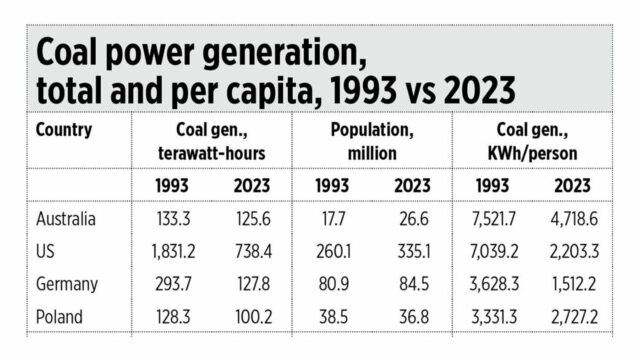
Developed countries like Australia, the US, the UK, Germany, Australia, Canada, and Japan have higher coal power generation per capita than three decades ago. The Philippines’ coal generation per capita remains small until today (see the table).

THE ENERGY TRANSITION
The constant pressure — if not bullying — by various groups who say that the Philippines should retire its coal plants early and shut them down is based on the fanatical belief that decarbonization and degrowth is good for our people. This is wrong.

The endless push for “energy transition” is misplaced. Coal, gas, and nuclear remain the most reliable, safe, and competitively priced energy sources that developing countries like the Philippines need.

At the Asia Power Forum in Singapore on Sept. 12, Aboitiz Power Corp. Chief Corporate Services Officer Carlos Aboitiz made a good presentation entitled “The energy transition: A perspective from Emerging Asia.”

According to the press statement they issued, Mr. Aboitiz said that “Energy is produced only if it is consumed… At the end of the energy value chain are individuals and the institutions that produce the hallmarks of modern society… Often, we hear pronouncements that renewables are cheaper than their fossil fuel counterparts… Unfortunately, the math doesn’t add up. Today’s math is based on incomplete accounting, using the levelized cost of electricity or LCOE as opposed to accounting for the intermittency and lack of resource[s] in solar and wind during different times of the day and year.”

He is correct. The LCOE is computed only when an energy source like solar or wind is running. When it is not running like when the sun is not shining and the wind is not blowing, a backup source (usually a gas or oil plant) must run and its cost must be included in the computation and the total cost per kWh in a day goes up.

THE TEMPEST AT THE ERC
Another important development in the energy sector was the order handed down on Sept. 5 by the Ombudsman to suspend Energy Regulatory Commission (ERC) Chairperson Monalisa Dimalanta for six months.

Among the recent reports in BusinessWorld about this development were: “Business groups urge quick resolution after suspension of ERC’s Dimalanta” (Sept. 9), “ERC chair exploring options after six-month suspension” (Sept. 9), “Dimalanta case resolution seen as critical to making progress on power projects” (Sept. 15).

Among the big business and professional organizations in the Philippines that issued statements of concern about the Ombudsman’s ruling were: the Philippine Chamber of Commerce and Industry, the Philippine Exporters Confederation, and the Employers Confederation of the Philippines. These groups issued a joint statement saying, “This decision along with other recent decisions by the Judiciary puts at risk the trust, independence and authority of the ERC… We advocate for a swift and transparent resolution of the suspension to restore the integrity of the ERC and its Commission.”

Said the Management Association of the Philippines: “The country needs a fully functional ERC, led by a competent and dedicated Chair like Chair Dimalanta who has demonstrated not only integrity and dedication, but also innovativeness and courage to make bold and prompt decisions.”

Said the Makati Business Club: “We believe that the six-month suspension order issued by the Ombudsman not only affects investor perception but also affects the certainty of the Philippine business environment given the critical role of power in business and investments.”

Said the Philippine Independent Power Producers Association, Inc.: “We generators hope that this matter will be resolved soonest since the suspension of our ERC chairperson affects the whole industry… The industry cannot afford a commission without its chair. We hope that all stakeholders unite in its support to the ERC chair.”

Said the Retail Electricity Suppliers Association of the Philippines: “The retail electricity suppliers are already facing complex issues on energy security, it is even more crucial that the Commission remains stable and effective to ensure continuous access to sustainable and reliable power solutions.”

The petitioner, the National Association of Electricity Consumers for Reforms, Inc. (NASECORE), gravely misrepresented what constitutes consumer interest.

NASECORE does not represent me as an electricity consumer myself. My concern as a consumer is having more choices. Whether I should consume 1,000 kilowatt-hours (kWh) or 600 kWh or 250 kWh per month depending on my needs and household budget, I want an electricity supply that is available when I need it, with no blackouts. I do not want my choices to be limited to using either candles or a diesel genset because of blackouts and an insufficient power supply.

Political drama in the energy sector is not among my concerns, so as I see it, NASECORE and its leadership are just pursuing their own personal and political agendas.

The Ombudsman should have had the wisdom to not be easily swayed by the arguments of this so-called consumer organization. But it failed to use that wisdom.


Bienvenido S. Oplas, Jr. is the president of Bienvenido S. Oplas, Jr. Research Consultancy Services, and Minimal Government Thinkers. He is an international fellow of the Tholos Foundation.

minimalgovernment@gmail.com

A tasting analysis of the 2021 vintage Grand Cru Medoc

MAX-TUTAK-UNSPLASH

WHEN VinExpo Asia returned to Hong Kong after a six-year hiatus — the last time it was held was pre-pandemic, in 2018 — the excitement was not exactly like before. The reason was that just the previous year, in 2023, VinExpo Asia was held in Singapore, so instead of a bi-annual event, it had become an annual event, so the excitement, in a sense, had been halved — at least for us in Asia that do not want to travel to VinExpo Bordeaux or VinExpo Paris.

But I must hand it to the Union des Grand Crus in Bordeaux (UGCB), which boasts of 132 members, most of which are Grand Cru Classe chateaux from Medoc, Pessac-Leognan, St.-Emilion, and Pomerol, for adding glitter to the event with their vintage tasting program that is now integral to every VinExpo.

For this year, the UGCB featured the relatively mysterious 2021 vintage. If I remember correctly, there were around 75 chateaux that participated in the 2021 vintage tasting program in this year’s VinExpo. Too many for any wine afficionado to taste in a single day, so I decided to focus on Medoc, and those participating Grand Cru chateaux from this main Bordeaux sub-region.

As expected, no first growths (Latour, Lafite, Haut-Brion, Margaux, and Mouton-Rothschild) were present, but a good number of second growths were present, with many of the 61 classified Grand Cru wines from the historic 1855 Medoc Classification represented.

THE 2021 VINTAGE
Without getting too technical (like how an oenologist and vigneron would explain it), I will keep this simple.

Most of the chateau representatives at VinExpo agreed that 2021 was a colder than usual year, even given the situation of global warming. That said, the weather favored the early ripening grape varietals like merlot and cabernet franc, over the other two Medoc staples, cabernet sauvignon and petit verdot. The 2021 vintage therefore offers wines that are lower in alcohol content, have friendlier tannins, and are higher in acidity. This was good in fact for white Bordeaux.

On the red Bordeaux side, I felt this was more like Bordeaux from the 1990s and earlier, with less alcohol and more drinkable at a younger age, though they have proven to be age-worthy.

From personal experience, my tastings of at least 30 Medoc wines, while still uneven in quality, texture, and even acidity level — obviously from the difference in individual “terroirs,” the wines in general were all approachable and noticeably lower in alcohol, averaging 13-13.5%. While 13% and 13.5% seem like a miniscule difference from previous vintages’ 14% and 14.5%, the actual tasting manifested the perceivably lighter alcohol.

Below are my eight favorite Grand Cru Medoc wines, in alphabetical order, together with my customary tasting notes:

1. Chateau Brane-Cantenac 2021, 2nd growth, Margaux

• Made with 74% Cabernet Sauvignon, 22% Merlot, and little Cabernet Franc, Petit Verdot and a rare sighting of Carmenere

• Tasting Notes: “lovely aromatics, ripe berry flavors, some earthy notes, vanilla, medium-bodied, with delicious plummy aftertaste; a relatively soft Cabernet-based wine that is straight forward and easy to appreciate.”

2. Chateau Cantenac Brown 2021, 3rd growth, Margaux

• Made with 73% Cabernet Sauvignon and 27% Merlot

• Tasting Notes: “fragrant, sultry, herbaceous, medium-bodied, toasted oak, and a nice finish; this one is sexy and drinkable now but should age gracefully as well.”

3. Chateau Croizet-Bages 2021, 5th growth, Pauillac

• Made with 66% Cabernet Sauvignon, 33% Merlot, and 1% Petit Verdot

• Tasting Notes: “Black cherry, violets, satiny, very friendly tannins, and with complex roasted almond finish; this is my first encounter with this Chateau and I am super satisfied with what I tasted.”

4. Chateau La Lagune 2021, 3rd growth, Haut Medoc

• Made with 70% Cabernet Sauvignon, 20% Merlot, and 10% Petit Verdot

• Tasting Notes: “more complex nose, herbaceous notes, star anise, plums, sweet oak, peppercorn, and a long flavorful berry finish; one of the Grand Cru wines under the radar, and still with excellent prices.”

5. Chateau Lagrange 2021, 3rd growth, St.-Julien

• Made with 84% Cabernet Sauvignon, 14% Merlot, and 2% Petit Verdot

• Tasting Notes: “eucalyptus, black currant, licorice, medium bodied with racy acids, nicely structured but already drinkable, spicy with cinnamon at the end; this has a very high Cabernet Sauvignon percentage, even higher than the 80% Lagrange had for their amazing 2019 vintage, so this one will age well while still be appreciated in its youth.”

6. Chateau Lynch-Bages 2021, 5th growth, Pauillac

• Made with 67% Cabernet Sauvignon, 25% Merlot, 5% Petit Verdot, and 3% Cabernet Franc

• Tasting Notes: “opulent, surreal nose with licorice, ripe blackberry, silky tannins, viscous and fuller bodied compared to fellow 2021 wines, with long bold fruits in delectable finish; this was easily one of my favorites at the VinExpo tastings.”

7. Chateau Pichon Comtesse de Lalande 2021, 2nd growth, Pauillac

• Made with 88% Cabernet Sauvignon, 10% Cabernet Franc, and 2% Merlot

• Tasting Notes: “sultry, floral notes, plummy, eucalyptus, medium-bodied, long, lingering raisin-like finish; to be honest, I am more a fan of the other Pichon, the Pichon Baron than the Pichon Comtesse, but for this vintage I have to admit the Comtesse de Lalande was better, at least from my tasting point of view.”

8. Chateau Rauzan-Gassies 2021, 2nd growth, Margaux

• Made with 78% Cabernet Sauvignon and 22% Merlot

• Tasting Notes: “sophisticated nose with lavender and petals, silky, grainy tannins, plummy, with mocha flavors and jam-like lingering finish; another rare time where I prefer this over the more popular Rauzan-Segla.”

The good thing about the 2021 vintage is the chateaux owners know that this vintage cannot command the exorbitant prices that the more recent top vintages commanded, like those of 2015, 2016, and 2018. So, I think these wines will be better value-for-money Grand Cru wines that should hit our country’s shelves soon.

The colder vintage made for softer Cabernet Sauvignons that to me are super underrated because I love the Cabs not for the strong tannins but for their inherent flavors. There are a lot of great finds from this vintage, and if you get hold of any of the eight wines I recommended, please do buy them. You can enjoy them now and they will still keep for another 10 years — but it is not a vintage to save for your granddaughter’s wedding.

For those who have written to me and inquired about my wine seminars, I am happy to announce that come Sept. 27, Friday, post-dinner at 8 p.m., I will be holding a wine tasting seminar at the Kyodo Lounge in Robinsons Magnolia, QC. For those interested, please visit this link to register:  https://thewinetrainingcamp.wordpress.com/workshop09272024


Sherwin A. Lao is the first Filipino wine writer member of both the Bordeaux based Federation Internationale des Journalists et Ecrivains du Vin et des Spiritueux (FIJEV) and the UK-based Circle of Wine Writers (CWW). For comments, inquiries, wine event coverage, wine consultancy, and other wine related concerns, e-mail the author at wineprotege@gmail.com, or check his wine training website https://thewinetrainingcamp.wordpress.com/services/.


SFC+ links overseas Filipinos to local brands

FILIPINO grocerant Seafood City has partnered with top local brands to launch one-stop digital marketplace application SFC+ to cater to the needs of overseas Filipinos.

“We created this app with the goal of reaching and serving Filipinos globally as well as meet their evolving lifestyle demands,” SFC+, Inc. President and Chief Executive Officer (CEO) Elewin Rebaya told reporters on Wednesday.

“It should be available selectively today, but it will be launched officially on Oct. 15,” BayaniPay CEO Winston L. Damarillo said separately.

The digital marketplace app will be available for iOS, Android, and web users in the Philippines and the US, Mr. Rebaya said, adding that users can connect with its partner brands like SM Group, ABS-CBN, flag carrier Philippine Airlines, global payment solutions BayaniPay, BDO Unibank, Inc., and local telecommunications carriers like Smart Communications, Inc. and Globe Telecom, Inc.

Mr. Rebaya said SFC+ plans to add more brands to its platform to serve more users globally.

“SFC+ is a digital hub for Filipinos in North America that gives them exclusive access to US and top Philippine brands, discounts, rewards, and a host of exciting benefits every time they transact using the app,” Mr. Rebaya said.

Through this one-stop app, overseas Filipino users will be able to purchase local products.

SFC+ will also feature zero-fee remittance, bill payment, and embedded banking services by BayaniPay with East West Bank USA and BDO Unibank.

“Frictionless investments in multiple verticals like real estate, which allows users to conveniently purchase properties in the Philippines from abroad, and health care will soon be available on the app,” it said in a media release.

Mr. Rebaya said SFC+ is hoping to capture its current one million in-store foot traffic and 400,000 active customer base. — Ashley Erika O. Jose

Snap advances bet on augmented reality devices with upgraded version of its Spectacles glasses

TRUSTPAIR.COM

SNAP announced an upgraded version of its Spectacles augmented reality (AR) glasses on Tuesday, doubling down on its bet that wearable devices to enhance the view of the real world will be one of the next frontiers in tech.

Snap, long known for its ephemeral messaging app Snapchat and animated filters, has been an early leader in augmented reality, which can overlay digital effects onto photos or videos of real-life surroundings through a camera or lens.

The first edition of Spectacles launched in 2016, but the effort has not increased revenue for Snap, whose business relies on selling digital advertising.

Larger rivals are also racing to advance AR. Meta is expected to unveil its first AR glasses during its Connect developer conference next week.

The fifth generation of Spectacles is powered by a new operating system called Snap OS. The user interface responds to the wearer’s hands and voice and the operating system better understands the user’s surroundings to render AR effects, said Snap CEO Evan Spiegel during the company’s annual partner summit.

The glasses have a larger field of vision than previous generations and automatically tints in sunlight.

Spectacles will not be sold to consumers initially and instead will be available for $99 per month to developers who create AR features.

That is a key step toward building adoption among everyday users, Mr. Spiegel said in an interview ahead of the summit.

“There has to be really compelling experiences,” he said. “By working really closely with developers and just continuously improving our platform, I think we’re going to get to a place where there are a lot of compelling lenses for people to try with Spectacles.”

The new operating system will also enable developers to make better AR experiences between two or more Spectacles wearers, Snap said. For example, two users in the same room could play chess on a virtual board that is rendered in the players’ surroundings.

A SIMPLIFIED SNAPCHAT
Snap also announced a redesign of the Snapchat app, reducing its previous five separate sections to three. The company previously simplified how users can interact with ads on Snapchat to improve results for advertisers.

Still, Snap shares are down 40% this year as the company struggled against larger digital-ad platforms with more users.

In a letter to staff this month, Mr. Spiegel said Snap has reversed two years of declining revenue and would continue to compete for ad dollars by going after smaller advertisers.

But he laid out the case for continuing to pursue AR, citing it as a nascent field where Snap can create user demand.

“Unlike in digital advertising, where we were a late entrant in a market with established, scaled players, we are a leader in the market for this new type of glasses,” he said. Reuters

DBP sees net earnings decline in first half

BW FILE PHOTO

DEVELOPMENT BANK of the Philippines (DBP) saw its net income decline by 14.26% year on year to P3.79 billion in the first half as it booked lower foreign exchange gains and set aside more loan loss provisions.

This was down from the P4.42-billion net profit it booked in the same period last year, its unaudited financial statement showed.

DBP’s net interest income grew by 9.61% to P12.42 billion at end-June from P11.33 billion a year ago.

Broken down, interest earnings went up by 4.8% year on year to P23.84 billion from P22.75 billion, driven mainly by higher income from loans and receivables amid an elevated rate environment.

The bank’s interest expense was steady at P11.42 billion.

Meanwhile, other income fell by 21.59% year on year to P4.14 billion from P5.28 billion as DBP’s foreign exchange gains went down by 17.89% to P2.72 billion at end-June.

On the other hand, other expenses decreased by 12.99% to P7.44 billion from P8.55 billion.

The bank’s impairment provisions rose by 69.47% to P4.71 billion at end-June from P2.78 billion in the same period a year ago.

DBP’s net loans and receivables inched down by 2.6% to P471.38 billion at end-June from P483.97 billion a year prior.

On the funding side, deposits declined by 2% to P744.4 billion from P759.97 billion.

The bank’s total assets inched up by 0.87% to P974.43 billion as of June from P966.07 billion.

Its capital funds stood at P88.54 billion, up by 5.86% from P83.64 billion a year ago. — A.M.C. Sy