Home Blog Page 262

Berlin Film Festival: Yellow Letters sends warning about democracy, says director

BERLIN — Berlin Film Festival marriage drama Yellow Letters should serve as a cautionary tale for Western audiences who believe democratic backsliding is a distant concern, not a danger that could emerge at home, said Turkish‑German director Ilker Catak.

The film, which is competing against 21 others for the festival’s top prize, focuses on what happens to a marriage under extraordinary political pressure, Mr. Catak told Reuters.

In it, Ozgu Namal and Tansu Bicer star as a married actor and playwright who lose their jobs and have to leave behind their comfortable lives after the husband is targeted by the Turkish state for posting critical content online.

“We always thought in the West that we’re immune to that kind of political repression. And now we’re realizing we’re not,” Mr. Catak said, adding it was important to protect democracy.

“You can lose your job too, if you are stating the wrong political statements.”

REFLECTION FROM AUDIENCE
Those themes found a real-life parallel in Turkey last spring with the arrest of Istanbul Mayor Ekrem Imamoglu, President Tayyip Erdogan’s biggest political rival.

The arrest prompted the largest anti-government protests in a decade and led to mass detentions. The crackdown on the key opposition party has undermined the democratic credentials of European Union candidate and North Atlantic Treaty Organization member Turkey.

Mr. Catak hoped the film would prompt reflection: “I would wish that people watch my film and they think about their own state, their own country.”

To drive home the parallels, viewers are asked to imagine that the German cities where the film was shot, Berlin and Hamburg, are Ankara and Istanbul in Turkey.

“If we had shot it in Turkey only, it would have been easy to say, ‘OK, that’s a Turkish problem,’” explained Mr. Catak.

Yellow Letters is Mr. Catak’s second Berlin entry after 2023’s The Teachers’ Lounge, which was selected as Germany’s entry for the Oscar’s best international feature film award.

The festival runs until Feb. 22, with the top Golden Bear prize awarded at the closing ceremony on Feb. 21. — Reuters

Globe partners with AC Logistics for nationwide logistics

ACLOGISTICS.COM.PH

AYALA-LED Globe Telecom, Inc. has partnered with AC Logistics Holdings Corp. to streamline its nationwide logistics and operations, designating the latter as its preferred warehousing provider.

Under the agreement, AC Logistics will manage, store, and dispatch Globe’s trade materials, including subscriber identity modules (SIMs), devices, and other retail collaterals, to channels and partners.

“This partnership strengthens a critical part of our operation, ensuring that Globe products reach our customers and partners with consistency and speed… With AC Logistics, we gain a trusted partner who supports our mission to deliver reliable service where it matters most,” said Globe Chief Financial Officer and Chief Risk Officer Juan Carlo C. Puno.

The Muntinlupa-Cavite Expressway (MCX) warehouse will serve as a strategic hub for Globe, supporting deliveries to Metro Manila and Calabarzon and other key routes.

AC Logistics’ MCX Warehouse is designed for high-volume, high-accuracy operations, handling inbound receiving, storage, inventory management, and outbound distribution for Globe’s trade operations.

“At the MCX Warehouse, our teams are committed to ensuring 100% inventory accuracy, efficient order processing, and excellent customer service across every segment of the supply chain,” said AC Logistics Contract Logistics and National Distribution Product Head Irma Diaz-Guevara.

In a separate release, Globe said it has partnered with data streaming company Confluent to establish a new standard for digital innovation in the Philippines.

Under the partnership, Globe, through its corporate arm Globe Business, will provide services to enterprises, allowing them to modernize internal processes using artificial intelligence.

At the local bourse on Monday, shares in Globe fell by P22, or 1.29%, to close at P1,680 apiece. — Ashley Erika O. Jose

On ASEAN energy, Terra Solar, and PEPIF 2026

Sustaining our high growth has become elusive for the Philippines recently. Our average GDP growth of 6.3% a year in 2022 to 2024 slowed down to 4.4% in 2025, largely due to soured investments and lower construction activities as results of the ongoing infrastructure corruption scandal.

While the governance and political aspects of the corruption issue are being addressed, the energy infrastructure aspect must also be addressed because when many big investments start coming in, they should not be met by blackouts (as I like to refer to then, Earth Hours) necessitating that they buy big and expensive gensets.

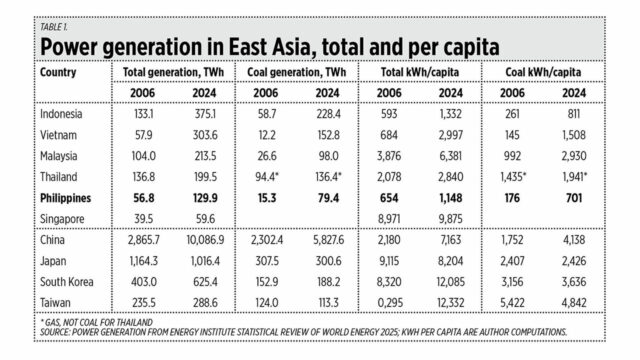
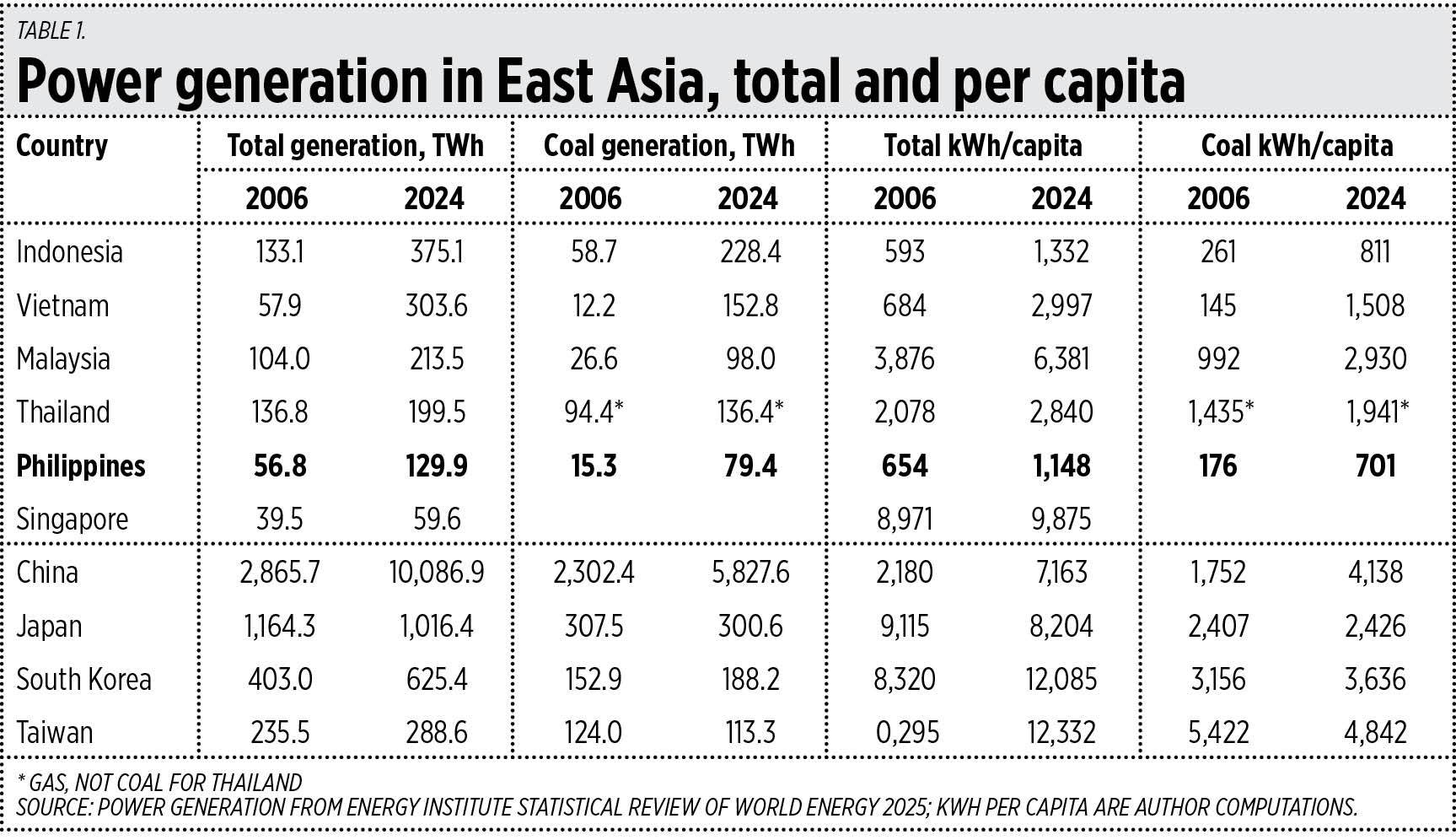
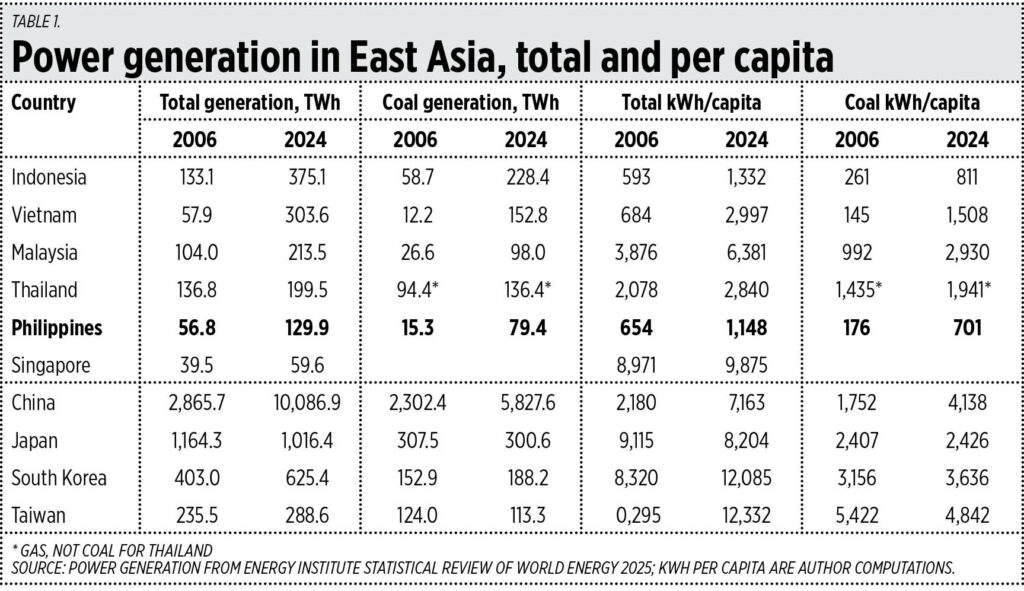
I computed the power generation per capita of the ASEAN-6 countries and our four industrialized East Asian neighbors in 2006 or 20 years ago, and 2024, which had the latest comparative data available. In 2024, the Philippines had the lowest generation of only 1,148 kilowatt-hours (kWh) per capita. Thailand had twice that number, Vietnam nearly triple, Malaysia nearly six times, Singapore nearly nine times, and South Korea and Taiwan had 10 to 11 times the power generation of the Philippines.

The main driver of the high levels of power generation of our neighbors is their high coal use. In 2024, our coal generation was only 701 kWh per capita. Vietnam had twice that number, Malaysia four times, China six times, and Taiwan nearly seven times that of the Philippines (see Table 1).
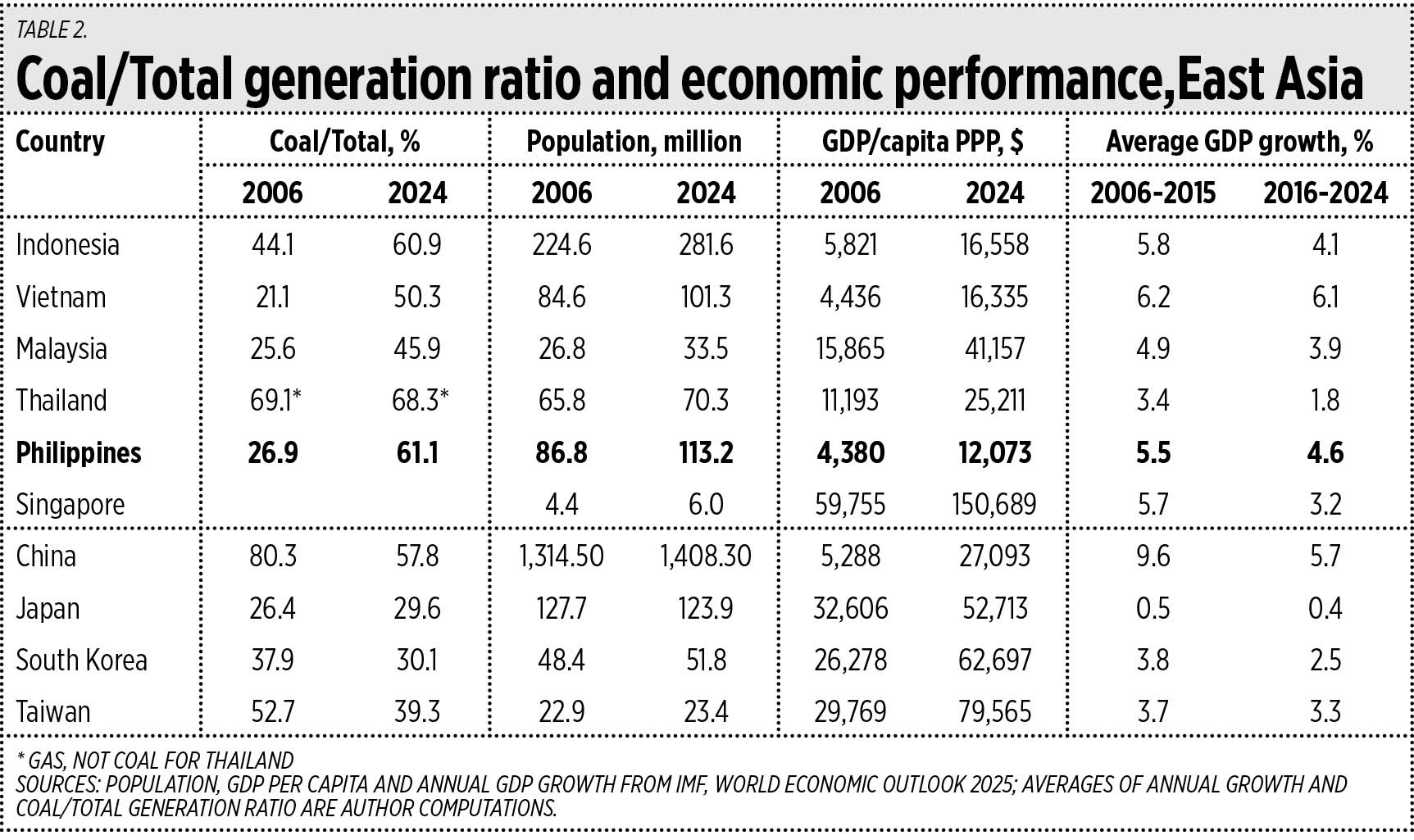
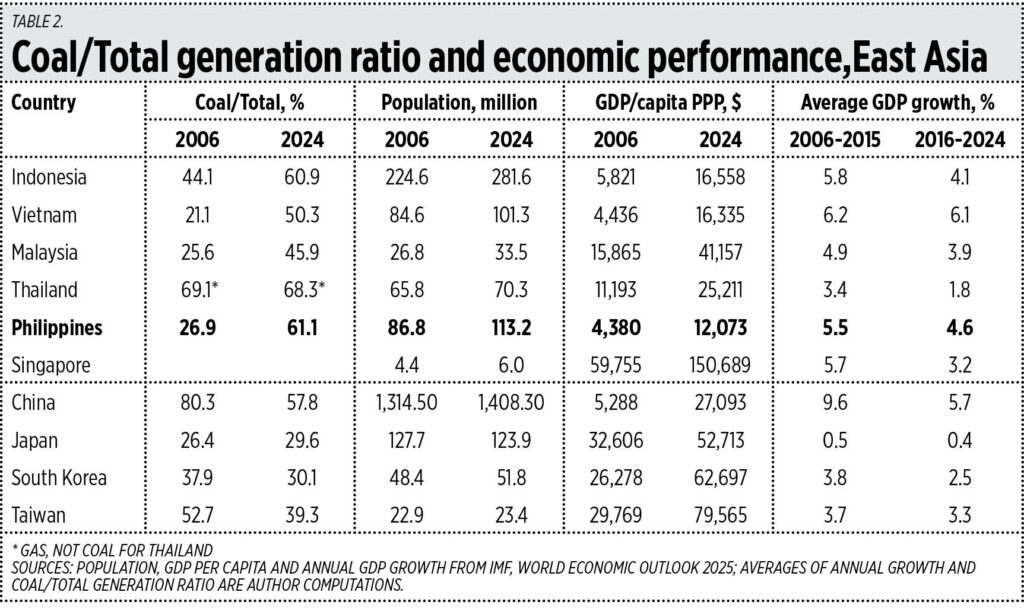
I also computed the Coal/Total generation or (C/T) ratio of these countries, then their average GDP growth over the past two decades. In 2024, Indonesia, Malaysia, the Philippines, and Vietnam had C/T ratios of 46% to 61%. Thailand and Singapore are LNG users and their Gas/Total generation ratio was 68% and about 98%, respectively.

Japan, South Korea, and Taiwan had lower C/T ratios of only 30% to 39% in 2024 while China had 58%.

One notable thing is that five countries with high C/T ratios of 46% and above also had a high average GDP growth of 3.9% to 6.1% from 2016 to 2024. Meanwhile, countries with C/T ratios of 39% and below, or which were more of LNG users, had lower average growth of 0.4% to 3.3%. These were Thailand, Singapore, Japan, South Korea, and Taiwan (see Table 2).
MTERRA SOLAR ENERGIZATION
Last week, on Feb. 12, Meralco PowerGen Corp. (MGEN), through its affiliate Terra Solar Philippines, Inc. (MTerra Solar), inaugurated The First Spark: MTerra Solar Phase 1 Initial Grid Synchronization and Energization in Gapan, Nueva Ecija. Phase 1 is huge — 1,288 megawatts-direct current (MWdc) of installed solar photovoltaic (PV) capacity as of end-January 2026, with 622 battery energy storage system (BESS) units already installed.

Energy Secretary Sharon S. Garin noted that developments of this scale are “essential to supporting the Philippines’ long-term energy security… This power plant alone — once completed — will be producing power for 10% of Luzon.”

MGEN President and CEO Emmanuel V. Rubio emphasized that “MTerra Solar proves the Philippines can build big — and build fast. Today’s energization is not the finish line; it is the start of a bigger journey that will expand our capacity, broaden our impact, and demonstrate that the Philippines can lead in delivering renewable energy at scale.”

National Grid Corp. of the Philippines (NGCP) Head of Transmission Planning Redi Allan Remoroza emphasized that “As the system operator and transmission network provider, NGCP recognizes today’s energization as a key infrastructure readiness milestone.”

PEPIF 2026
The Philippine Electric Power Industry Forum (PEPIF) 2026, organized by the Independent Electricity Market Operator of the Philippines (IEMOP), will be held on March 12 at the John Hay Convention Center in Baguio City. Key speakers include the provincial Governor of Benguet, the Energy Secretary and Undersecretaries, the ERC Chairperson, the ADB lead for energy, and major corporate players including the Philippine Independent Power Producers Association and the SN Aboitiz Power Group.

A big panel discussion in the afternoon is focused on the theme, “The Energy Trilemma in the Philippines: Pathways to Security, Sustainability and Equity.” The six panel speakers will be Energy Undersecretaries Mylene Capongcol and Mario Marasigan, Energy Regulatory Commission Director Sharon Montaner, PIPPA Chairman Roman Miguel de Jesus, Ateneo Economics Professor Fernando Aldaba, and the NGCP’s Redi Allan Remoroza.

I will be the moderator of this panel of high-caliber speakers. My task is to steer the discussion to focus on the theme and not deviate from it, and bring out the best insights from the speakers so I will speak less and let the panelists speak more, setting aside my hat as an opinion writer.

The IEMOP has sent invitations to all key energy players in the country. This looks like another exciting, stimulating activity for the Philippines’ energy sector.


Bienvenido S. Oplas, Jr. is the president of Bienvenido S. Oplas, Jr. Research Consultancy Services, and Minimal Government Thinkers. He is an internationa fellow of the Tholos Foundation.

minimalgovernment@gmail.com

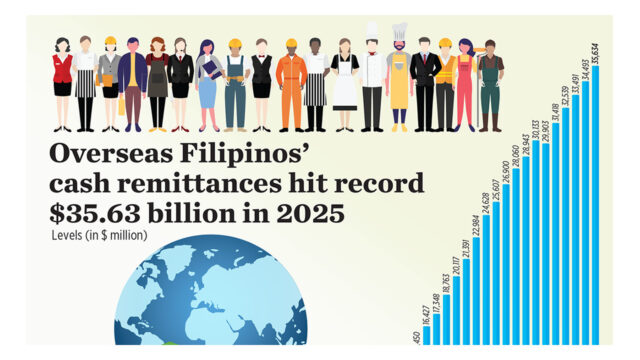
Overseas Filipinos’ cash remittances hit record $35.63 billion in 2025

MONEY SENT HOME by Filipinos abroad jumped to a record high of $35.634 billion in 2025, with the weak peso boosting gains from dollar conversion, the Bangko Sentral ng Pilipinas (BSP) reported on Monday. Read the full story.

PDIC indefinitely extends loan incentive program for closed banks’ borrowers

THE PHILIPPINE Deposit Insurance Corp. (PDIC) has indefinitely extended its Closed Bank Loan Incentive Program (CLIP) and simplified the initiative’s mechanics to make it more accessible to borrowers seeking relief.

The program, which is now called CLIP 4.0, borrowers of closed banks with total outstanding principal balances of up to P10 million may qualify for several incentives if they settle their payments in full and via cash. These incentives will be available to all closed banks regardless of the date of closure and will be determined solely by loan type and status.

PDIC said this ensures “greater transparency, consistency, and ease of implementation.”

For loans secured by real estate mortgage (REM), the interest rate on unbooked interest has now been standardized at 3% per year from variable rates of 3% to 5% previously that depended on bank closure date, age and status of the loan.

“This change offers borrowers more predictable and affordable settlement terms.”

The 50% discount on outstanding principal and booked interest, penalties and other charges for borrowers with clean loans or loans secured by chattel mortgage or pledge will also be retained. All borrowers, regardless of loan type, will also continue to get full waivers on unbooked penalties and other applicable charges.

“With the latest enhancements, the PDIC hopes to expand the program’s reach and encourage more availments,” the state deposit insurer said.

“By simplifying the rules and further enhancing the incentives and indefinitely extending the program, the PDIC reinforces its commitment to providing meaningful financial relief, enabling borrowers of closed banks to resolve their obligations more efficiently and move forward with renewed financial stability.”

CLIP was launched in 2021 to help borrowers settle their loan obligations in closed banks, letting them preserve their credit standing and avoid the foreclosure of their mortgaged assets.

PDIC, as receiver of closed banks, collects loan payments from borrowers of these lenders, which are used to help fund creditors’ claims. “By sustaining this incentive program, the corporation ensures faster and more efficient loan collections and optimized recovery for creditors.” — A.M.C. Sy

Berlin Film Festival: Bella Ramsey unexpectedly enjoyed making coming-of-age cancer comedy

BELLA RAMSEY and Neil Patrick Harris in a scene from Sunny Dancer.

BERLIN — Making Sunny Dancer, a film about a summer camp for teenagers with cancer, turned out to be nothing like Bella Ramsey expected, and in the best possible way, the Game of Thrones star told Reuters ahead of its Berlin Film Festival premiere on Friday.

“When the e-mail first came through about it, I was like, ‘I don’t think I’m going to like this,’” said the 22-year-old. “And it just was perfect, it just was completely not what I thought it was going to be, in the best way.”

Ramsey plays Ivy, a 17-year-old cancer survivor who wants nothing to do with the camp her parents have signed her up for.

But the teens she meets there are far from the fragile group she imagined — they sneak alcohol, fight, flirt, and generally cause trouble — and Ivy quickly sheds her reservations.

Sunny Dancer, which also stars Neil Patrick Harris, Ruby Stokes, and James Norton, opened the festival’s Generation 14plus sidebar for young adult cinema.

NO HOSPITAL CLICHES
“There are no hospital scenes in this. No, not a single one,” said Ramsey, who also starred in The Last of Us.

After doing the necessary sensitivity work early on, writer‑director George Jaques “freed” the cast to focus on fun, recalled the actor.

For his second feature, Mr. Jaques knew he wanted to make a cancer film, but as more of a comedy or coming-of-age film.

He drew on his experiences watching his mother fight cancer when he was a teen, and later working with a British charity for teenage cancer patients.

“You realize how naughty they are and how fun they are and how they get chemo done in Ed Hardy jeans and Jordans,” said Mr. Jaques.

He added that he wanted to break the stereotype that they’re only “poor sickly kids that lie on hospital beds.”

“They’re full of life,” he said. “And they’re so much more interesting than their diagnosis.” — Reuters

US prefab housing firm Hive Modular eyes hotel, housing projects in PHL

Hive Modular Founder and Chief Executive Officer John Avrett — BEATRIZ MARIE D. CRUZ

HIVE MODULAR, an American startup producing sustainable prefabricated homes, is in talks with local residential and hospitality developers to roll out modular units nationwide, citing growing demand for sustainable construction.

“We have a pipeline of residential projects, but most are focused on hospitality,” Hive Modular Founder and Chief Executive Officer John Avrett said during a media tour of the company’s facility in Silang, Cavite, on Feb. 11.

“For hospitality developers, time is money. If they can get a hotel online by 10, 12 or 14 months faster, then they can easily rent those rooms out and get revenue,” he said on the sidelines of the event.

Part of its pipeline includes hospitality projects in La Union and Batangas, he added.

Construction of modular housing units takes about three months, with the overall project lifecycle averaging four to six months, Mr. Avrett said.

He noted that about 90% of construction work for its modular homes is completed at its 2,300-square-meter (sq.m.) facility in Cavite, which helps reduce on-site construction costs.

“We’re faster because we’re doing the construction work, and at the same time we’re doing the site preparation and foundation,” Mr. Avrett said.

The company said modular housing also incorporates sustainable practices, noting that traditional construction accounts for about 40% of global greenhouse gas emissions.

Pricing for its CasitaM units, which measure 60 sq.m. with 45 sq.m. of interior space, starts at P5 million. The units include one bedroom, one bathroom, a lounge and living area, and a deck.

Meanwhile, its 60-sq.m. CasitaX units are priced at P7.5 million and include one bedroom, one bathroom, a kitchen, and a deck.

The company is also optimistic about investing in the Philippines as a manufacturing base, Mr. Avrett said, citing the country’s young and skilled workforce as well as the growth of its shipbuilding and aerospace industries. — Beatriz Marie D. Cruz

To win over Asia, Canada needs more than nice speeches

STOCK PHOTO | Image by Andre Furtado from Unsplash

By Daniel Moss

CANADA is on a public-relations roll. Prime Minister Mark Carney wowed Davos elites by declaring a “rupture” with the American-led financial and industrial system that has prevailed for decades. That’s a message that resonates in Asia, where economies grew rapidly by supplying an abundance of goods to American consumers, only to be confronted with tariffs that were scarcely conceivable a few years ago.   

Ottawa is stepping up its courtship of the region. The campaign was readily apparent in Singapore last week with a conference devoted to stronger ties with Southeast Asia. This effort isn’t for the fainthearted, nor should businesses expect instant results just because of the premier’s aphorisms. Nor should it be under any illusion that the region is a substitute for America, destination for almost three-quarters of Canada’s exports and with whom its capital markets are intimately bound.

The air was thick with references to fragmentation and the demise of the rules-based order. Singapore, home to one of the world’s busiest ports, can relate. While the country was handed a relatively small US tariff of 10%, it feels spurned. In his budget speech on Thursday, Prime Minister Lawrence Wong described a “more dangerous” world.

There are sound reasons for Carney’s push. He wants to double non-US shipments in a decade, a tall order without seeking fresh opportunities. Economic growth in the Association of Southeast Asian Nations was a better-than-anticipated 4.5% last year, according to the Asian Development Bank, and projected to be about the same in 2026. Trade with the US is robust, despite levies imposed by President Donald Trump.

It’s also a region looking for partners. None have abandoned defense ties with America, but are chastened by Trump’s territorial ambitions — and his musings that Canada itself should be swallowed. Southeast Asia is also wary of China’s military build-up and the risk of a miscalculation in the South China Sea. Ottawa can pitch itself as US-lite: Accents that sound similar, a legal system that seems straightforward and a Group of Seven economy. (Making inroads might also mean Canada pulls punches; I heard little direct criticism of Beijing in sessions I attended.)

Conditions can vary greatly; and businesses looking to invest here should be aware that there’s more than one Southeast Asia. There are prosperous countries like Singapore with first-class infrastructure and a highly educated, outward looking workforce. Vietnam has one of the most impressive rates of growth in the world. Then there are the places that aren’t doing so well: Thailand’s economy languishes and seems unable to escape deflation, while Indonesian markets have been pummeled, and economists are skeptical of economic data. Some speakers praised the region’s young populations. That depends on what you mean. Rates of fertility in Singapore, Thailand, and Malaysia are low and unlikely to climb much. Indonesia, Vietnam, and the Philippines are headed in the same direction.

And for Canadian firms with goods and services to sell, finding the right local partner is important. As is understanding that ally and the nature of their friends and rivals. This was a point well made at one session devoted to infrastructure. A large slice of business is dominated by family conglomerates that dabble in everything from agriculture to telecommunications and banking. These clans enjoy warm ties with lawmakers and regulators. State investment companies, which ultimately answer to elected leaders, are also enthusiastic investors. This is fine, as long as things go well. But what happens when economies or joint ventures take a turn for the worse?

Also beware cultural and political landmines. A question from the floor startled me: Should Canadians try to engineer or encourage social change while they invest? Absolutely not. Western executives should steer clear of promoting views on gender, identity, and even freedom of the press, they were told. What sells in Montreal or Toronto won’t always go down well in Jakarta or Manila.     

No economic or political order is set in stone. Just because the US under Trump has turned from protector to insurgent doesn’t mean everyone else is a reliable bet. I remember when Vancouver was awarded the honor of hosting an early meeting of Asia-Pacific leaders in 1997. Prior to that year, the story was all about bountiful growth. By the time I arrived to report on the summit, Thailand and Indonesia had been forced to secure emergency loans from the International Monetary Fund and South Korea was finalizing terms of its rescue.

As much as Carney’s soundbites were applauded, closer ties can sometimes come down to more basic requirements. Speaker after speaker at the Singapore gathering bemoaned how long it took to travel to the city state, and the convoluted passage they had to take to get here. Adding a few more direct flights would be a great — and very practical — enhancement.

Canada’s interest in Asia has come a long way since Justin Trudeau, the former premier, took a selfie in a Singapore park in 2018. Trudeau squatted in front of a plaque dedicated to a distant relative from the colonial era. By all means, come to Southeast Asia, she might have said. But keep your eyes open. The region is complex, and today’s corporations should pay heed.

BLOOMBERG OPINION

How PSEi member stocks performed — February 16, 2026

Here’s a quick glance at how PSEi stocks fared on Monday, February 16, 2026.


Philippines to cooperate with ICC if warrants are issued vs Duterte allies

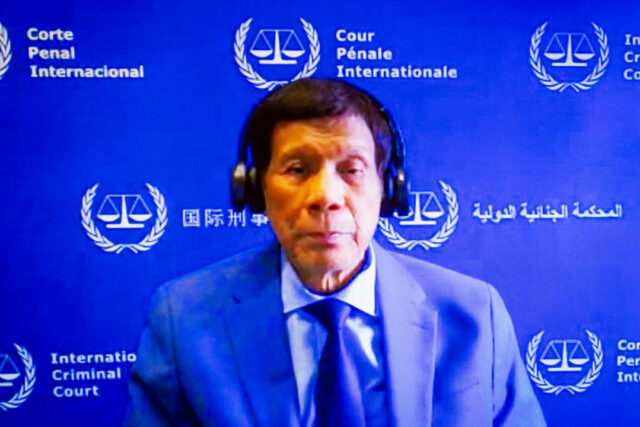
FORMER PRESIDENT RODRIGO R. DUTERTE — INTERNATIONAL CRIMINAL COURT / COUR PÉNALE INTERNATIONALE

By Chloe Mari A. Hufana, Reporter

THE Philippines will cooperate with the International Criminal Court (ICC) if it issues arrest warrants against people linked to former President Rodrigo R. Duterte over his anti-drug campaign, Malacañang said on Monday, signaling Manila’s willingness to help despite its withdrawal from the tribunal.

“If it goes through the process, that’s what this government wants,” Palace Press Officer Clarissa A. Castro told a news briefing in Filipino. “Everything this government does goes through the process.”

The Philippines withdrew from the ICC in 2018, with the exit taking effect in 2019. However, Ms. Castro said authorities might still cooperate in serving arrest warrants through the International Criminal Police Organization, similar to the mechanism used when Mr. Duterte was arrested in 2025.

Over the weekend, the ICC identified several high-profile figures as co-perpetrators in the drug war, including Senators Ronald “Bato” M. dela Rosa and Christopher Lawrence “Bong” T. Go. Mr. Duterte is detained in The Hague, where he faces charges of crimes against humanity.

Also named in court documents were former Justice Secretary Vitaliano N. Aguirre II; former Philippine National Police chiefs Vicente D. Danao, Jr., Camilo P. Cascolan and Oscar D. Albayalde; ex-National Bureau of Investigation chief Dante A. Gierran; and former Philippine Drug Enforcement Agency head Isidro S. Lapeña.

The ICC has yet to issue arrest warrants against them.

Mr. Aguirre and Mr. Go have denied the allegations. Mr. Dela Rosa has not attended Senate sessions since Nov. 11, 2025, when reports first surfaced about a possible warrant.

His lawyer, Israelito P. Torreon, earlier said the ICC’s disclosure was procedural and did not constitute a finding of guilt.

Ms. Castro urged those named not to evade authorities if they maintain their innocence.

“If you are hiding, what does that mean?” she asked. “There is no need to hide if you know you are not at fault.”

Mr. Duterte’s confirmation of charges hearings are scheduled for Feb. 23, 24, 26 and 27.

According to a less redacted version of the charge sheet from the ICC Office of the Prosecutor, Mr. Duterte and his associates shared a “common plan or agreement to neutralize alleged criminals” through violent means, including murder.

Prosecutors said Mr. Duterte bears criminal responsibility for three counts of crimes against humanity involving at least 76 deaths.

These include 19 killings during his tenure as mayor of Davao City, 14 murders of alleged high-value targets, and 43 deaths of lower-level drug suspects nationwide from 2016 to 2018.

Legal and foreign policy analysts said the Marcos administration’s stance reflects a broader effort to demonstrate adherence to international law.

Josue Raphael J. Cortez, a diplomacy lecturer at De La Salle-College of St. Benilde, said the government’s position indicates an intent to collaborate with the ICC and reinforces its rule-of-law credentials.

He noted that the crimes occurred before the Philippines’ withdrawal from the Rome Statute took effect, providing the legal basis for the tribunal’s jurisdiction.

“The very fact that the crimes transpired in the years prior to such withdrawal serves as the benchmark from which our National Government is dealing with the matter,” he said, rejecting claims that cooperation is purely political.

Francis M. Esteban, a faculty member at Far Eastern University’s Department of International Studies, said the move strengthens the Philippines’ image as a rule-based actor in the international system despite pressures facing multilateral institutions.

He said the administration appears to be reaffirming its view that international norms and institutions must be respected, even amid geopolitical tensions.

Mr. Cortez added that cooperation with the ICC also aligns with Manila’s broader diplomatic objectives, including its bid for a nonpermanent seat at the United Nations Security Council and efforts to maintain credibility among foreign partners.

Marcos promises affordable homes at 4PH turnover

PHILSTAR FILE PHOTO

PRESIDENT Ferdinand R. Marcos, Jr. on Monday pledged to deliver more affordable houses as he led the turnover of units under the Expanded Pambansang Pabahay Para sa Pilipino (4PH) program in Taytay, Rizal.

“We have come a long way, but we are still working hard to reach our target number of houses in the coming years,” he said in Filipino during the ceremony, which also marked the seventh anniversary of the Department of Human Settlements and Urban Development (DHSUD).

Since Mr. Marcos took office in 2022, the government has built more than 423,000 housing units under the program, according to official data.

The DHSUD is targeting 1.133 million housing units by 2028, with about 90,000 units planned for completion this year.

Mr. Marcos said the government is not only speeding up construction but also making it easier for families to finance their homes.

He cited lower interest rates offered by the Home Development Mutual Fund, also known as Pag-IBIG.

Pag-IBIG is offering a 3% interest rate for the first five years of loans under the Expanded 4PH Program to help keep monthly payments affordable for qualified members.

“With the help of subsidies from the government, more families now have the opportunity to own their own [house],” Mr. Marcos said.

He added that the administration would continue expanding housing production, including through modern construction methods.

The President visited a Megawide Construction Corp. precast plant, saying such facilities would help speed up building and increase output.

“We will do everything we can to not only build this plant that you see today but also to expand and multiply it to speed up construction and increase the number of homes we can provide,” he added.

During the event, Mr. Marcos awarded lot certificates and financial assistance to beneficiaries under the Enhanced Community Mortgage Program. He also handed certificates of entitlement to beneficiaries of longstanding presidential proclamations, granting them security of tenure on land they have occupied for decades.

The President said the government would continue working with private developers to accelerate construction, streamline procedures and widen the program’s reach.

“As long as there are Filipinos dreaming of their own home, the government will continue to act to support this dream,” he said.

The DHSUD, created under Republic Act No. 11201 in 2019, oversees housing and urban development policies nationwide. — Chloe Mari A. Hufana

House to fast-track Marcos priority bills, says majority leader

PHILIPPINE STAR/MICHAEL VARCAS

THE House of Representatives is accelerating action on President Ferdinand R. Marcos, Jr.’s priority measures, with several bills now nearing plenary deliberation, the chamber’s majority leader said on Monday.

House Majority Leader and Ilocos Norte Rep. Ferdinand Alexander “Sandro” A. Marcos III said eight measures under the Legislative-Executive Development Advisory Council (LEDAC) priority list are set for discussion at the House floor.

“These committee-level approvals show that the House is doing the hard work earlier under the leadership of Speaker Dy — building consensus, refining policy and making sure the measures we bring to the floor are ready,” he said in a statement.

He was referring to Speaker Faustino “Bojie” G. Dy III, who was elected to lead the chamber in September following leadership turmoil linked to the multibillion-peso flood control controversy.

Mr. Marcos said the House had approved 12 priority bills as of February, including amendments to the bank secrecy law and a measure extending the estate tax amnesty period.

LEDAC recently added four more measures to the administration’s legislative agenda, including proposals to abolish the travel tax and to address the spread of disinformation.

Several other priority bills have cleared their respective mother committees and are awaiting action from the House Appropriations Committee on funding provisions.

These include proposals to establish an independent anti-graft body for public works projects, pass a national land use act, and enact a magna carta for small businesses.

Measures seeking to create a presidential scholarship program, reset elections in the Bangsamoro autonomous region, amend the government’s cash-assistance program for poor Filipinos, expand scholarship support and strengthen the Bureau of Immigration are also pending appropriations clearance.

“Our focus remains on bills that directly affect education, health, food security and social protection — areas where legislation translates into real impact for Filipino families,” the presidential son said.

He added that the chamber aims to ensure measures are thoroughly reviewed before reaching the floor.

“The goal is to pass sound, well-vetted laws that people can actually feel in their daily lives, whether in the classroom, at the health center, or at the dinner table,” he said. “That’s progress, and we intend to sustain it.” — Kenneth Christiane L. Basilio