Home Blog Page 257

US business delegation expected to arrive in July

BRYAN ANGELO--UNSPLASH

THE PHILIPPINES is set to welcome a 30-member business delegation from the US in July, the Philippine Trade and Investment Center (PTIC) in New York said.

“The list of participants for the mission will be released once finalized and confirmed to travel to the Philippines,” the PTIC said on Tuesday. 

“A target of 30 investors or businesses will be carefully selected for the mission,” it added.

The delegation will be brought to Manila, the Luzon Economic Corridor (Manila-Clark-Subic), and Palawan for high-level briefings, business-to-business meetings, site visits, and engagements with government and private-sector partners.

On Feb. 11, the New York PTIC launched an event to drum up the 2026 US Business Mission to the Philippines.

Organized in partnership with the Philippine Consulate General in New York and the Philippine American Chamber of Commerce, it provided “an in-depth look at the Philippine economy and the opportunities available through the mission.”

The event featured the Philippine Economic Outlook Briefing and the US Business Mission launch.

Ronilo Balbieran, a professor at the University of Asia and the Pacific, delivered the briefing on Philippine macroeconomic fundamentals.

“Now is the best time for American businesses to invest in the Philippines. Valuations are still attractive, growth prospects are strong, and local investor confidence is high,” he said.

Meanwhile, SGV & Co. Senior Director Marian Kris B. Santos briefed on  macroeconomic trends, policy reforms, regulatory environment, and emerging industries. — Justine Irish D. Tabile

6-8% VAT seen workable if exemptions eliminated

Illustration photo shows various medicine pills in their original packaging in Brussels, Belgium, Aug. 9, 2019. — REUTERS/YVES HERMAN/ILLUSTRATION

THE PHILIPPINES could lower the value‑added tax (VAT) rate to 6-8% if exemptions are removed, which poses a dilemma for the government, which must ensure the categories losing their exemptions can still afford basic needs, analysts said.

Raymond Abrea, chairman and chief executive officer of the Asian Consulting Group, said the exemptions could be removed for everything except agricultural products in the interest of lowering the 12% VAT rate, the highest in Southeast Asia.

“I agree. Reduce it even to 6%. Reduce the rate from 12% down to 8% but remove the exemptions,” he told the Pandesal Forum at the Kamuning Bakery Cafe in Quezon City on Tuesday.

His position was similar to a World Bank recommendation to maintain exemptions for raw agricultural products and medicine.

The Philippines charges 12% VAT on the sale, lease, barter, and import of goods and services. It accounts for around 22% of the Bureau of Internal Revenue’s (BIR) collections.

Philippine collection efficiency is just 35-40%, Mr. Abrea said in his presentation.

“The ASEAN average is 57% collection efficiency. In the Philippines, where there are a lot of smugglers and crooks, it’s 35-40%,” he said.

In comparison, Thailand posts a collection efficiency of 71-79% on its 7% VAT, the lowest rate in the region.

Mr. Abrea also noted that the VAT exemptions of persons with disabilities and senior citizens are also abused, and disproportionately benefit the rich.

Former Budget Undersecretary Cielo D. Magno said removing exemptions to lower the VAT rate must be paired with broader reforms to ensure basic needs remain accessible.

“It’s all connected. If we say no more VAT exemption for medicine, it’s related to the reform that we should have proper health insurance,” she said.

Ms. Magno added that legislators must take a comprehensive view of reform, and not just treat the matter as a tax administration fix.

She also said that raising taxes alone will not resolve fiscal challenges.

“We Filipinos feel overtaxed and underserved,” Ms. Magno said.

Both Ms. Magno and Mr. Abrea supported consolidating the Bureau of Customs (BoC) and BIR into a National Revenue Authority, an independent entity with the power to pursue corrupt politicians.

“We deserve a better tax authority (that is) efficient, proper, honest, and independent politically,” she said.

The government hopes to collect P4.82 trillion in revenue in 2026, with P3.431 trillion expected from the BIR and P1.003 trillion from the BoC.

Ms. Magno added that while a proposed wealth tax is conceptually sound, enforcement would be challenging.

“The rich have the ability to hide their wealth and most of that wealth is not in the Philippines… That’s why it’s so important for… international cooperation to trace where the wealth is,” she said. — Aubrey Rose A. Inosante

DPWH backs award to China group of P3-B Bataan-Cavite bridge deal

BW FILE PHOTO

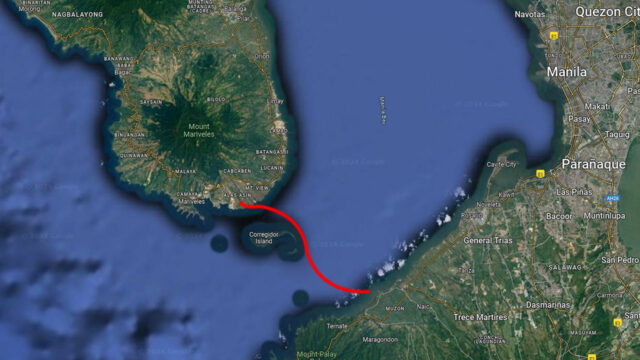
THE Department of Public Works and Highways (DPWH) recommended the award of the P3.07-billion contract package 2 of the Bataan-Cavite Interlink bridge project to a consortium led by China Wu Yi Co. Ltd.

In a resolution dated Nov. 13, 2025, the DPWH’s bids and awards committee (BAC) said the consortium of China Wu Yi, Jinan Urban Construction Group Co., Ltd. and CM Pancho Construction, Inc. were the highest-rated bidder in terms of the combined score for their technical package and price.

As such, the DPWH recommended the approval of the notice of award to the group, according to a resolution signed by Senior Undersecretary Emil K. Sadain. 

The Bataan-Cavite Interlink Bridge project consists of six phases, with bidding for Phase 1 still under review following the submission of eight proposals to the agency. The first phase of the project has also attracted bids from foreign companies, mainly Chinese construction firms.

Contract package 2 or the Cavite land approach covers 1.3 kilometers of road, while contract package 3 involves the north and central marine viaducts.

According to the DPWH’s BAC resolution, bids were received from Beijing Urban Construction Group Co., Ltd.; China Road and Bridge Corp.; the consortium of China Wu Yi, Jinan Urban, C.M. Pancho; the joint venture of Hunan Road & Bridge Construction Group Co., Ltd. and China Civil Engineering Construction Corp.

D.M. Consunji, Inc. also submitted a proposal.

The 32.15-kilometer interlink bridge across the mouth of Manila Bay is expected to boost regional economic integration and development.

In 2023, the Asian Development Bank (ADB), which is co-financing the project, approved a $2.11-billion loan. The government is responsible for the remaining $664.23 million.

According to the ADB, the civil works for the Bataan-Cavite Interlink bridge will be broken up into six contract packages.

The others are contract package 4 which covers the south marine viaducts; and contract packages 5 and 6, which involve the bridge’s navigational channel cable and high-level approach spans. — Ashley Erika O. Jose

Dedicated DA office to oversee coffee industry

PIXABAY

AGRICULTURE Secretary Francisco P. Tiu Laurel, Jr. ordered the creation of a dedicated Coffee Industry Development Office (CIDO) to centralize oversight of the crop, the Department of Agriculture (DA) said.

Department Order No. 06 puts CIDO under the Office of the Undersecretary for Special Concerns and Official Development Assistance (ODA), now headed by Undersecretary Jerome V. Oliveros.

The DA draws the power to create the office from Executive Order No. 292, or the Administrative Code of 1987. It empowers the DA to support domestic and export-oriented agriculture.

Mr. Laurel said coffee has long been treated as a minor crop and now demands full attention.

The DA said coffee consumption is booming while domestic production has lagged. Mr. Laurel noted that coffee farmers are ageing while access to inputs is limited and equipment outdated.

The DA said the creation of CIDO as a standalone office “signals a shift from side-line management to a focused, strategic approach.”

All coffee development funds, including those under the High Value Crops Development Program and the Office of the Secretary, will now be controlled by CIDO, the DA said.

Mr. Laurel said “We cannot keep talking about the promise of Philippine coffee while farmers grow older, yields stagnate and imports rise,” he said.

“By creating CIDO under focused leadership, we are putting strategy, funding and execution in one accountable office. This is about restoring competitiveness and making sure Filipino coffee farmers finally capture the value of a market that is already growing around them,” he said.

PHL free trade talks with Europe must consider worker interests, NGO says

REUTERS

TRADE Justice Pilipinas said the government needs to address workers’ rights before continuing negotiations for a free trade agreement (FTA) with the European Union (EU).

In a statement on Monday, the group called for a halt to FTA negotiations “until there is concrete, verifiable progress on workers’ rights, forced labor enforcement, and a real industrial strategy that creates decent jobs.”

The statement was issued after a consultation on the EU-Philippines FTA organized by the International Trade Committee of the European Parliament.

During the consultation, labor group Sentro ng mga Nagkakaisa at Progresibong Manggagawa (SENTRO) said trade liberalization has long failed Filipino workers.

“Each new deal benefits a narrow elite, while wages stagnate and inequality deepens. Without structural reforms, this FTA will simply lock in an unjust economic model,” SENTRO Secretary General Josua Mata said.

He noted how the order meant to guarantee minimum wages for commercial fishermen who supply export markets “exists mostly on paper.”

“As such, commercial fishers have yet to receive minimum wage, and many report zero net income after voyages due to debt and exploitative sharing systems,” he said.

“These conditions amount to labor bordering on forced work — in supply chains linked directly to exports. Trade must follow reform — not replace it,” he added.

Meanwhile, Joseph Purugganan of Focus on the Global South raised concerns about whether the agreement is a partnership of equals, noting how the US reciprocal tariffs embody how powerful economies weaponize trade instruments for their own economic and political benefit.

“Trade Justice Pilipinas views the EU-Philippines FTA through this lens of weaponized interdependence,” he said, adding that “the burden of proving otherwise rests with the EU.” — Justine Irish D. Tabile

DENR issues new rules to expedite titling process for residential land

PHILSTAR.COM/DOMINIQUE NICOLE FLORES

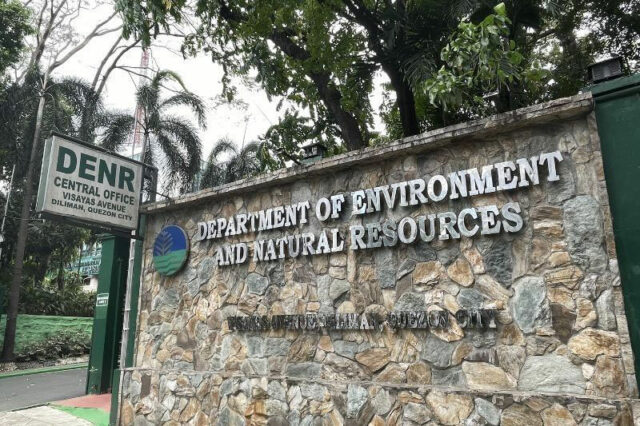
THE Department of Environment and Natural Resources (DENR) said it issued new regulations to accelerate the process of residential land titling.

The changes involve simplified procedures, revised eligibility rules, and an electronic application and tracking process, it said.

DENR Administrative Order No. 2025-35 authorizes the overhaul of the residential free patent system to address barriers that have prevented households from obtaining land titles.

The order clarifies who qualifies as an actual occupant and allows heirs, spouses, returning residents, and those whose possession was interrupted for valid reasons, such as work, marriage, or disasters, to apply for titles.

The new rules establish a 120-day processing period for applications and enable electronic filing and monitoring through the Land Administration and Management System. Applicants may also defer submission of Land Registration Authority certification for up to 90 days.

The standardized application fee remains P150, while cadastral survey charges are waived, reducing the cost to applicants, according to the DENR.

The DENR said untitled land has contributed to delays in infrastructure projects, complications in inheritance, and vulnerability to property disputes.

“We are fixing a system that has left too many families in uncertainty for too long,” Environment Secretary Raphael P.M. Lotilla said in a statement. “Our duty is to ensure that land governance is not only efficient but truly responsive to the realities ordinary Filipinos face.”

The DENR expects the updated rules to improve security of tenure, provide legal recognition for residential landowners, and reduce administrative backlogs. — Vonn Andrei E. Villamiel

Manila, Washington to expand missile deployments following strategic talks

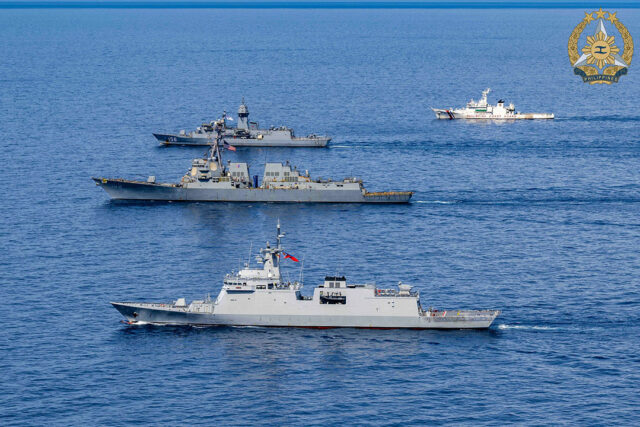
BRP Diego Silang, USS Dewey, HMAS Towoomba and BRP Teresa Magbanua at this year’s first multilateral maritime cooperative activity in the South China Sea. — EDWARD BUNGUBUNG/ARMED FORCES OF THE PHILIPPINES

THE US and the Philippines have agreed to step up the deployment of advanced US missile and unmanned systems during a “strategic dialogue” held in Manila on Feb. 16.

In a statement, the US Embassy said both sides agreed to “continue and work to increase deployments of US cutting-edge missile and unmanned systems to the Philippines.”

Last year, Washington deployed Navy-Marine Expeditionary Ship Interdiction System missile platforms to the Philippines during annual joint military exercises. The systems have since remained in an undisclosed location in the country.

The allies also committed to expanding multilateral defense cooperation through maritime activities, bilateral and multilateral exercises and enhanced security coordination.

Both governments said they would further strengthen joint readiness, improve interoperability and enhance exercise execution, including in contingencies such as civilian-led disaster response.

The US also pledged to help modernize the Philippines’ civilian and military cyber defense capabilities to better detect and disrupt cyberthreats.

Discussions included improving Manila’s ability to monitor and respond to maritime challenges, including illegal, unreported and unregulated fishing.

“They committed to maintaining a vigilant posture in the Indo-Pacific to prevent conflict and to develop strong measures, alongside deterrence, to keep sea lanes open and not subject to arbitrary control by one country,” the embassy said.

Both sides reaffirmed that collective defense remains critical to deterring aggression in the South China Sea. The Philippines and the US have been treaty allies since the 1951 Mutual Defense Treaty, which obligates both sides to defend one another in the event of an armed attack.

Defense ties have strengthened under President Ferdinand R. Marcos, Jr., whose administration has taken a firmer stance against Beijing’s activities in Philippine-claimed waters.

Beyond maritime security, the dialogue also covered cooperation against transnational crime, cybercrime, online scam operations and illicit drug trafficking. The two countries pledged to deepen law enforcement coordination and combat transnational repression.

Energy security was also on the agenda. Both sides agreed to expand cooperation on energy supply, resilience and critical infrastructure to support economic and defense priorities.

The US committed to support the Philippines’ plans to develop nuclear energy capabilities, including organizing a trade mission to connect Manila with leading US nuclear technology firms. Washington will also provide $1.5 million to fund a simulated nuclear reactor control room for training.

“Recognizing the importance of energy security to national security, both sides endorsed growing and deepening cooperation on energy supply, resilience and critical infrastructure,” the embassy said.

Meanwhile, the Philippines held its first multilateral naval drill of the year in the South China Sea with the US and Australia, as the three allies moved to strengthen interoperability amid rising tensions with China in the disputed waterway.

In a statement on Tuesday, the Armed Forces of the Philippines said the exercises were aimed at “enhancing operational cohesion” among participating forces through maneuvering drills and logistics coordination designed to improve maritime domain awareness in contested waters.

The two-day activity, held from Feb. 15 to 16 in the West Philippine Sea — Manila’s term for parts of the South China Sea within its exclusive economic zone — involved naval and air assets from the three countries.

The Philippines deployed FA-50 fighter jets, the missile frigate BRP Miguel Malvar and the Philippine Coast Guard’s multirole response vessel BRP Teresa Magbanua. The US sent the guided missile cruiser USS Dewey, while Australia deployed the frigate HMAS Toowoomba.

“The two-day exercise, spanning the waters of the West Philippine Sea, reinforces the continuity of multilateral cooperation and reflects the participating nations’ sustained commitment to strengthening maritime security in the region,” the Philippine military said, adding that the drills captured key operational insights.

Described as multilateral maritime cooperative activities, the exercises were the first for 2026 and underscored what the Armed Forces called a “shared, multinational resolve to strengthen interoperability and uphold freedom of navigation and overflight under international law.”

The drills took place against the backdrop of escalating tensions between Manila and Beijing, including recent diplomatic exchanges and confrontations at sea involving disputed features near vital shipping lanes.

China claims almost the entire South China Sea under its U-shaped nine-dash line, which overlaps with the exclusive economic zones of the Philippines and other Southeast Asian states.

Manila has repeatedly rejected Beijing’s sweeping claims, citing a 2016 arbitral ruling by the Permanent Court of Arbitration in The Hague that voided China’s expansive assertions under international law.

Beijing has refused to recognize the ruling and continues to maintain a large presence of coast guard and maritime militia vessels in disputed areas, resulting in repeated standoffs with Philippine forces. — Adrian H. Halili and Kenneth Christiane L. Basilio


DFA condemns Chinese Embassy’s job-loss threat

DEPARTMENT OF FOREIGN AFFAIRS FACEBOOK PAGE

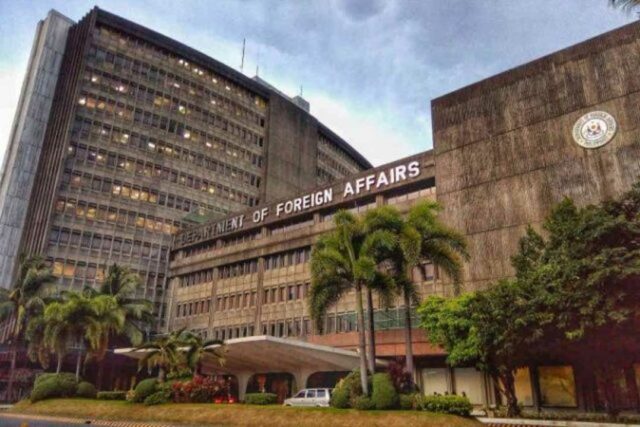
THE Department of Foreign Affairs (DFA) on Monday condemned remarks by the Chinese Embassy in Manila suggesting that Filipino job losses could result from an escalating diplomatic spat, warning that such statements risk further straining bilateral ties.

“We take strong exception to the embassy’s tone, which appears to imply that such cooperation could be withheld as a form of leverage or retaliation,” the DFA said in a statement issued late on Monday.

The rebuke marks the latest development in a war of words between officials from Beijing and Manila, after the Chinese Embassy released several statements criticizing Philippine officials for their vocal stance on the South China Sea dispute.

Some of the embassy’s statements directly named individual officials, prompting Philippine authorities to say the messaging crossed diplomatic norms.

“The DFA values cooperation with all states across economic, cultural, and other domains, as it delivers clear benefits to the Philippines and its people,” the agency said.

It added that the embassy’s remarks could be perceived as coercive and undermine constructive bilateral dialogue.

“The DFA once again urges the Chinese Embassy to adopt a responsible and measured tone in public exchanges,” it said.

Last week, Chinese Embassy spokesman Ji Lingpeng warned that proposals by Philippine lawmakers to declare certain Chinese diplomats persona non grata could affect diplomatic relations and “cost millions of jobs.”

The Philippine Senate earlier adopted Senate Resolution No. 256 condemning the Chinese Embassy for what it described as aggressive statements against Philippine officials and uniformed personnel over their position on the South China Sea.

The DFA said it remains committed to using diplomatic channels to stabilize and advance ties between Manila and Beijing despite recent tensions.

The South China Sea remains one of the region’s most volatile flashpoints. China has expanded its presence in the disputed waters despite a 2016 ruling by a United Nations-backed arbitral tribunal that voided its sweeping claims.

The dispute involves overlapping claims by the Philippines, Vietnam, Malaysia, Brunei, Indonesia and Taiwan. — Adrian H. Halili

PHL labor groups dispute ILO findings on riders’ earnings

PHILIPPINE STAR/EDD GUMBAN

By Erika Mae P. Sinaking

LABOR GROUPS are pushing back against preliminary findings of an International Labour Organization (ILO) study on the Philippine platform economy that suggested that riders and drivers earn significantly more than the national minimum wage.

The draft study titled “2025 Platform Work Survey: Philippines,” a copy of which was obtained by BusinessWorld, found that logistics and ride-hailing workers earn a mean net weekly income of P6,704, while some online freelancers and virtual assistants earn as much as P26,387 a week.

The findings, presented at the 2026 National Tripartite Conference on Jan. 29, showed that 73% of riders choose platform work for its flexibility and ability to set their own schedules, while 48% think the pay is better than other available jobs.

But labor representatives said the figures are overstated and fail to reflect the actual costs of working in the gig economy.

In response, ILO Philippines said the findings were “preliminary and strictly draft,” shared only for technical validation and dialogue.

“These findings are not final, not endorsed, and not intended to be cited as definitive conclusions,” the ILO said in a Viber message, adding that the validation process lets stakeholders question assumptions and clarify context to ensure the final report reflects Philippine realities.

Federation of Free Workers Vice-President for Research, Advocacy and Partnerships Julius H. Cainglet described the release as premature.

“The comparison is even malicious,” he told BusinessWorld via teleconference on Tuesday. “They compared the minimum wage to the weekly earnings supposedly made by platform economy workers — it’s almost like comparing apples to oranges,” he added.

He argued that the minimum wage is based on an eight-hour workday, while the reported weekly earnings may include excessive overtime and workers managing multiple platform accounts.

Geoffrey P. Labudahon, national coordinator of RIDERS-SENTRO, said the study appears to cite gross rather than net income.

“The earnings look large because they are gross. They do not account for maintenance, fuel and phone data needed to stay online,” he said by telephone.

After deducting fuel costs of about P350 daily, mobile data and long-term maintenance such as tires and belts, a rider’s take-home pay may fall below the P695 daily minimum wage in Metro Manila, he pointed out.

Labor groups also questioned the study’s portrayal of flexibility. Mr. Labudahon said platform policies have shifted toward stricter scheduling in recent years, with assigned shifts and “auto-accept” features that penalize riders who decline orders.

On social protection, while the study found that 90% of workers have access to some benefits, labor leaders said most riders pay their own Social Security System and PhilHealth contributions as self-employed people.

“We haven’t met a single person who has a retirement plan or health insurance from the platform companies,” Mr. Labudahon said.

He urged the ILO to engage more systematically with riders’ unions and revisit the study’s methodology, particularly its treatment of expenses and unpaid labor time.

The ILO said it remains committed to neutrality, technical rigor and social dialogue as it finalizes the report.

Special holidays in 6 LGUs declared for March

PHILIPPINE STAR/MIGUEL DE GUZMAN

PRESIDENT Ferdinand R. Marcos, Jr. has approved special nonworking days in six local government units (LGUs) in March, Malacañang said on Tuesday.

March 20 is a holiday in San Fernando, La Union, for its founding anniversary. March 10 is observed in Tanauan City, Batangas, marking its 25th cityhood anniversary, and also in Norala, South Cotabato, for its local founding celebration.

March 13 is a holiday in Bauko, Mountain Province for the Begnas di Bauko Festival, a thanksgiving event honoring ancestors and the community’s harvest traditions.

Masbate province will observe March 18 for its 125th founding anniversary. Aguilar, Pangasinan celebrates March 16 for the Ansakket Festival, highlighting rice-based delicacies and harvest customs.

Meanwhile, Palace Press Officer Clarissa A. Castro clarified that the start of Ramadan on Feb. 18 is not a holiday; only the end of Ramadan, Eid al-Fitr, is a regular holiday in the Philippines.

Special nonworking days typically suspend classes and government work in the affected areas, while private businesses have discretion over operations. These holidays aim to recognize local history, culture and community traditions.

Critics, however, warn that the growing number of special holidays could affect productivity and increase business costs by reducing the number of working days.

Policymakers face a trade-off between honoring local customs and sustaining economic momentum. — Chloe Mari A. Hufana

Stronger PHL-Italy ties pushed

DEPARTMENT OF FOREIGN AFFAIRS FACEBOOK PAGE

MANILA and Rome should prioritize improving their maritime ties following the renewal of their bilateral defense cooperation agreement, analysts said.

Both countries must prioritize strategies on information-sharing, humanitarian response, and the cultivation of naval capabilities, Josue Raphael J. Cortez, a diplomacy instructor at the De La Salle-College of St. Benilde’s School of Diplomacy and Governance, said.

“With Italy being the more advanced country in this partnership, it undoubtedly has more resources and capabilities which the Philippines may adapt and procure in the near future,” he said in a Facebook Messenger chat.

The Philippines last week signed a new bilateral defense agreement with Italy, which includes procurement, defense co-production, and logistics and technology collaboration.

“The signing of the renewed agreement between the Philippines and Italy on cooperation in the field of defense is a concrete step towards strengthening bilateral defense relations and advancing practical cooperation,” Foreign Affairs Secretary Maria Theresa P. Lazaro said in a statement posted on X (formerly Twitter).

She added that both countries reflected a shared commitment to long-term development of defense capabilities and greater interoperability.

According to Mr. Cortez, the agreement will significantly support the Philippines in achieving a self-reliant defense posture.

“Italians are known for being innately connected with both defense and its maritime heritage, there is a great possibility that they will be able to impart to us some of the strategies they would usually employ in addressing maritime-related security challenges,” he said.

Chester B. Cabalza, founding president of Manila-based think tank International Development and Security Cooperation, said that Italy’s pivot towards Southeast Asia may be a strategic move to avoid the ongoing rivalry between China and the United States.

“Italy has strategic hubs in the Philippines, Indonesia, and Malaysia as Rome’s primary regional anchors,” he said in a Facebook chat.

He added that Rome may offer its leading multi-role fighters to Manila, with a potential delivery in the succeeding years.

“There were discussions on new generation offshore patrol vessels and specialized shipbuilding for territorial defense,” he added.

Manila has been increasingly active in forging defense agreement with foreign countries to push back against China’s coercive behavior in the South China Sea. The vital waterway handles an estimated $3 trillion in annual trade and is considered a flashpoint for regional conflict.

Beijing continues to assert sovereignty over nearly the entire South China Sea, defying a 2016 ruling by the Permanent Court of Arbitration in The Hague that invalidated its sweeping claims. — Adrian H. Halili

More Korean investments sought

THE PHILIPPINES is eyeing to enhance ease of doing business and attract more investment from South Korea amid Manila’s push to position itself as a more competitive destination for foreign capital.

Executive Secretary Ralph G. Recto and Seoul’s Ambassador to Manila Lee Sang-Hwa met on Monday to discuss ways to deepen economic ties between the two nations, a statement from Mr. Recto’s office on Tuesday said.

The talks focused on improving the local business climate and drawing more Korean investment, with Mr. Recto assuring the envoy that the government is working to address investor concerns and streamline doing business in the country.

The discussions also centered on expanding bilateral economic cooperation and strengthening commercial links.

South Korea also signaled support for the Philippines’ hosting of key Association of Southeast Asian Nations (ASEAN) meetings this year, reflecting Seoul’s broader effort to deepen engagement with Southeast Asia under expanding ASEAN-Korea cooperation frameworks.   

The two sides reaffirmed their commitment to stronger diplomatic relations ahead of the 77th anniversary of formal ties between Manila and Seoul in March, a partnership that has increasingly expanded beyond trade to include infrastructure, tourism and regional collaboration.   

The talks come as President Ferdinand R. Marcos, Jr.’s administration seeks to leverage its 2026 ASEAN chairmanship to attract investment and highlight economic priorities across the region, with senior officials emphasizing preparations aimed at boosting jobs and business activity. — Chloe Mari A. Hufana