Home Blog Page 24

Euro zone government bonds steady

Fifty-euro notes are seen in this file photo. — REUTERS

LONDON — Euro zone government bonds held steady on Tuesday as traders watched to see whether peace talks between the US and Iran would take place, and awaited the Senate confirmation hearing for Kevin Warsh, US President Donald J. Trump’s pick to lead the US Federal Reserve.

Bond markets in March and early April swung sharply in response to headlines related to the war in the Middle East, as investors feared sustained high energy prices would force central banks to tighten policy to prevent a broader surge in prices.

But there were few new developments to react to on Tuesday. The US expressed confidence that peace talks with Iran would go ahead in Pakistan and a senior Iranian official said Tehran was considering joining, but significant hurdles and uncertainty remained as the end of a ceasefire approached.

Germany’s 10-year yield, the benchmark for the euro zone, dropped a bit less than 1 basis point (bp) to 2.97%, while its interest rate-sensitive two-year yield was flat at 2.45%.

Markets continue to price a very small chance of a European Central Bank rate hike later this month, though they see a 25-bp rate increase as more likely than not by June, and are close to fully pricing two such moves by yearend.

Other euro zone bonds were largely moving in line with the benchmark. Italy’s 10-year yield was steady at 3.71%.

Aside from war headlines, investors were expected to watch Mr. Warsh before US lawmakers.

Mr. Trump has openly vented his frustration at Fed Chairman Jerome H. Powell for not lowering rates more.

Analysts at ING said Mr. Warsh would have to “tread a fine line between making the case for lower borrowing costs, which helped him get the nomination from the President, and preserving the Fed’s inflation-fighting credentials.” — Reuters

Arthaland says Liv North sales near 50% since launch

ARTHALAND.COM

LISTED developer Arthaland Corp. said its Liv North project in Quezon City has achieved nearly 50% sales since it was launched in late August to early September last year.

Arthaland Executive Vice-President and Chief Sustainability Officer Oliver L. Chan said during a media briefing on Tuesday that the 46-story Liv North, the first tower of the company’s P14.1-billion two-tower development along Katipunan Avenue, has reached almost half of its total sales.

The company expects total sales of about P9 billion for Liv North.

Arthaland has begun construction of the mixed-use residential project, which will have two towers. The first phase, Liv North, will offer 748 units ranging from studio to two-bedroom configurations, targeting students, professionals and investors.

“Liv is a community shaped by the same foresight families embrace when building for future generations. By uniting purposeful design, accountability, and opportunity, Liv reflects Arthaland’s enduring vision of building sustainable legacies,” Arthaland Vice-Chairman and President Jaime C. González said.

The development will feature amenities such as a gym, a multipurpose court, swimming pools, study areas, garden spaces and a retail podium. It will also incorporate sustainability features aimed at improving efficiency, comfort and indoor environmental quality.

The company said low-emitting and non-toxic construction materials will be used to support healthier indoor air quality for residents.

Arthaland said the project is targeting LEED, WELL, EDGE and BERDE certifications.

“Liv is our vision for how future communities should be built — connected, sustainable, and designed to elevate your everyday. Through Liv we are creating lasting value not only for residents but for the entire neighborhood,” Mr. Chan said.

Mr. Chan said buyers are a mix of end-users and investors, with demand largely coming from end-users. Most purchases are for personal or family use, while a smaller portion comes from investors, including those planning ahead for children who will study in nearby universities such as Ateneo de Manila University.

Liv is located along Katipunan Avenue, with access also from Esteban Abada Street. The development will include a pedestrian footbridge connecting the podium area to a nearby university.

The bridge will be funded and maintained by Arthaland and is expected to improve pedestrian safety, provide easier access between the campus and surrounding establishments, and help ease traffic along Katipunan Avenue.

“For the bridge, we are still in the process of designing it properly. We have the perspectives and engineering plans, but we have not finished it yet, so we still do not have the exact cost for the bridge at this point,” Mr. Chan said.

“Everything will be funded through our capital. I think because we are building the bridge for the benefit of the development and the community, not just Ateneo,” he added.

Liv North is scheduled for completion by the third quarter of 2031.

Shares in Arthaland Corp. were unchanged at P0.425 apiece on Tuesday. — Alexandria Grace C. Magno

MSMEs told to plan ahead as fuel costs rise

PHILIPPINE STAR/MIGUEL DE GUZMAN

By Edg Adrian A. Eva, Reporter

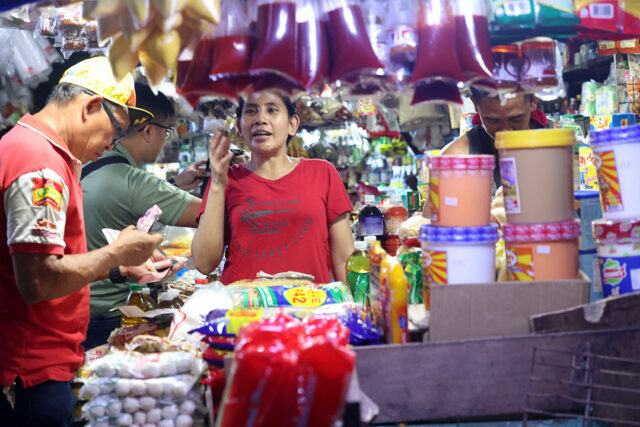
PHILIPPINE MICRO, small and medium enterprises (MSME) should plan ahead as margins get squeezed by mounting operating expenses from rising fuel costs driven by the Middle East war, according to Metropolitan Bank & Trust Co. (Metrobank).

MSMEs, which make up the bulk of businesses in the country, are particularly vulnerable to higher fuel and transport costs that can quickly spill over into production, logistics, and pricing.

“Take stock of what’s important for your business, have a plan and then go out there and act,” Metrobank Chief Marketing Officer Digs A. Dimagiba told BusinessWorld on the sidelines of an event last week.

“Get the help that you need, whether internally within your business or externally from partners, to really go out there and take action, because the last thing you want to do is stay still, feel helpless or be trapped,” he added.

The warning comes as businesses brace for prolonged volatility in global energy markets. The Philippine Chamber of Commerce and Industry earlier said MSMEs would be among the hardest hit if elevated fuel prices persist beyond two to three months.

Higher transport and production costs have already started feeding into inflation, which rose to 4.1% in March from 2.4% in February, according to the Philippine Statistics Authority.

Mr. Dimagiba said reacting to shocks is expected, but businesses that plan ahead are better positioned to manage risks and identify opportunities.

Metrobank refers to this approach as “financial mindfulness,” which emphasizes maintaining control and making deliberate decisions even during uncertain periods.

The bank also used the event to launch its Moneygurado documentary series, which aims to help Filipinos become more intentional in managing their finances through real-life stories across four episodes.

Mr. Dimagiba said crises typically prompt businesses to seek additional financing, either to sustain operations or pivot to more opportunities.

Metrobank offers the SME Puhunan Loan, which provides funding for working capital requirements such as inventory and receivables, as well as for capital expenditures like equipment purchases and expansion.

The loan program features flexible terms to match borrowers’ cash flow and repayment capacity, allowing businesses to better navigate fluctuating economic conditions.

Mr. Dimagiba said the bank remains ready to support MSMEs as they navigate the uncertain environment.

“If you need help navigating this crisis, Metrobank is ready to assist,” he said. “We will share our knowledge and expertise, and if you require our products and services, we will provide them to the best of our ability.”

France’s Macron sympathizes with authors who quit Bolloré-owned publisher

FRENCH President Emmanuel Macron arrives to the South Portico of the White House for a meeting with President Donald J. Trump on Aug. 18, 2025. — FLICKR/OFFICIAL WHITE HOUSE PHOTO/DANIEL TOROK

PARIS — President Emmanuel Macron on Friday defended editorial diversity after more than 100 authors quit the venerable French publishing house Grasset last week in protest at the growing influence of its top investor, conservative billionaire Vincent Bolloré.

Mr. Bolloré’s outlets have shifted sharply to the right in recent years, focusing on crime and immigration and giving frequent airtime for politicians from Marine Le Pen’s far-right National Rally party.

In an open letter, dozens of Grasset authors — including Dany Laferriere and Dominique Bona — said they refused to be “hostages in an ideological war that seeks to impose authoritarianism everywhere in culture and the media.”

“We don’t want our ideas, our work, to be his property,” the authors added.

Speaking to reporters at the Paris Book Festival, Mr. Macron said, “I think it is very important to express and uphold (editorial) diversity, respect for authors, the history of these publishing houses and their identities.”

The authors’ protest was prompted by the exit of the publisher’s chief executive, Olivier Nora, who left the publishing house on Tuesday last week without an explanation.

French media reported Mr. Nora was pushed out by the publishing group’s owner, the Louis Hachette Group, after a dispute about whether and when to publish a book by French-Algerian writer Boualem Sansal about his detention in Algeria.

Mr. Bolloré is the biggest shareholder in Louis Hachette, with a 31% stake, through which he also controls media outlets such as the Journal du Dimanche and CNews. He is also the main shareholder of media conglomerate Vivendi.

Louis Hachette and Mr. Bolloré did not respond to a request for comment. Previously, Mr. Bolloré has said critics have wrongly portrayed him as an enemy in a cultural battle over media and power, and has described himself as a “scapegoat.”

Founded in 1907, Grasset, the publisher of Marcel Proust and Irene Nemirovsky, became part of the Hachette group in 1954. Under Mr. Nora’s tenure as president, which began in 2000, it published works by authors including Nobel laureate Han Kang and Isabel Allende. — Reuters

Suspension of excise tax on specific petroleum products

PHILIPPINE STAR/MIGUEL DE GUZMAN

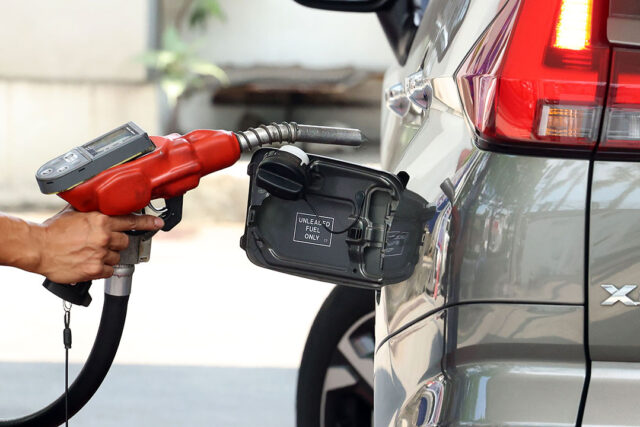
Excise taxes are levied on goods manufactured or produced locally for domestic sales or consumption, imported things, and services performed within the Philippines. These taxes, imposed in addition to the value-added tax, serve to generate revenue, and to discourage the consumption of harmful goods. They are imposed either as a “specific tax” based on a physical unit of measurement, or as an “ad valorem tax” based on the selling price or specified value.

The rate of excise tax on petroleum products has evolved since the 1990s. In the ’90s, the excise tax for unleaded premium gasoline stood at P4.35 per liter. By 2018, our Congress, through Republic Act No. 10963 (the Tax Reform for Acceleration and Inclusion, or TRAIN, Law), increased the excise tax on petroleum products in three tranches from Jan. 1, 2018, to 2020. As a result, the tax on unleaded premium gasoline rose incrementally from P7 to P10.

However, under the TRAIN Law, Congress recognized the risks of rising oil prices. They added that “[f]or the period covering 2018 to 2020, the scheduled increase in the excise tax on fuel shall be suspended when the average Dubai crude oil price based on Mean of Platts Singapore (MOPS) for three months prior to the scheduled increase of the month reaches or exceeds $80 per barrel.”

This safeguard is particularly relevant today as the conflict between the United States, Israel, and Iran continues to unravel. The volatility of the global energy market affects us with the increase of the Dubai crude oil price. In response, the Government has initiated measures to address the fuel price hikes. On March 24, President Ferdinand R. Marcos, Jr. officially declared a State of National Energy Emergency through the issuance of Executive Order (EO) No. 110. Congress, in turn, enacted Republic Act (RA) No. 12316.

REPUBLIC ACT NO. 12316
RA No. 12316 amends the Tax Code by adopting the same parameters found in TRAIN Law where Congress directs the suspension of an increase when the average Dubai crude oil prices, based on MOPS, reach $80 per barrel. However, this time, Congress has: 1.) granted the President the power to exercise this authority upon the recommendation of the Development Budget Coordination Committee, in coordination with the Secretary of Energy; 2.) expanded the power to allow not only the suspension, but also the reduction of taxes; and, 3.) allowed for the power to be exercised if the price reaches or exceeds the threshold for one month immediately preceding the issuance of the order, instead of the three months under the TRAIN Law.

The suspension or reduction may be applied to specific petroleum products, and implemented either as a full suspension or partial reduction as may be warranted by prevailing conditions. In this regard, Congress has provided the President with flexibility to respond swiftly to crises as conditions change. Congress added that any suspension or reduction shall be effective for a period not exceeding three months and that the aggregate period of suspension shall not exceed one calendar year. This specific power of the President can only be exercised until Dec. 31, 2028.

EXECUTIVE ORDER NO. 114
On April 16, acting upon the recommendation of Development Budget Coordination Committee, the President signed EO No. 114 (EO 114). This order mandates a temporary three-month suspension of excise taxes on specific petroleum products, namely liquefied petroleum gas (LPG) and kerosene. However, this relief specifically targets household consumption. EO 114 excludes LPG used as raw materials for petrochemical products or motive power, as well as kerosene used as aviation fuel. This ensures that tax relief primarily benefits vulnerable households.

REVENUE REGULATION NO. 003-2026
To operationalize the relief, the Department of Finance, upon the recommendation of the Commissioner of Internal Revenue, issued Revenue Regulations No. 003-2026 (RR 003-2026) on April 17. The regulation outlines how the suspension of excise taxes will be administered and monitored across the entire supply chain.

The suspension strictly applies to petroleum products removed from the place of production or customs custody after the effectivity of EO 114. This means that existing inventory, for which excise taxes have already been paid but remain unsold, is not covered by the suspension. This effectively precludes any manufacturer or exporter from claiming exemptions on excise taxes already paid for existing stock and avoids the administrative burden for the Bureau of Internal Revenue (BIR) that would otherwise come with processing refund claims.

To ensure that manufacturers of domestically produced LPG and kerosene, as well as importers, adhere to the restrictions, the BIR has established rigorous documentation requirements. Taxpayers must ensure full compliance with these reportorial requirements. Otherwise, they shall be subject to penalties under the Tax Code.

SUBMISSION OF RETURNS AND REPORTS
Manufacturers of domestically produced LPG and kerosene must ensure that their tax returns with the BIR indicate a “zero” tax rate with remarks “EO No. 114, SERIES OF 2026.” In addition, all official register books (ORBs) must be meticulously updated to reflect the removal of LPG and kerosene products. For importers of LPG and kerosene products, they must continue to submit their tax returns to the Bureau of Customs (BoC) and secure the Authority to Release Imported Goods (ATRIG) with remarks “EO NO. 114, SERIES OF 2026.”

STOCK INVENTORY
Under the EO, the Department of Finance, through the BIR and BoC, is directed to conduct an inventory of existing stocks of LPG and kerosene as of the effectivity of EO 114. Consequently, RR 003-2026 requires concerned manufacturers, importers, and lessees of storage depots to submit duly notarized inventories of all covered petroleum products as of April 16. These must be submitted to the relevant offices, either the Excise LT Field Operations Division or to the concerned Excise Tax Area, within 10 days after the effectivity of EO 114. This notarized document, denominated as Certificate of Stock Inventory, serves as the baseline for the BIR officers during the tax suspension period, allowing them to verify exactly when the tax-exempt removals should begin.

ISSUANCE OF WITHDRAWAL CERTIFICATES
RR 003-2026 also mandates that all withdrawal certificates issued for every removal of covered petroleum products covered by the suspension must be prominently stamped with the phrase “STOCKS COVERED BY EO NO. 114, SERIES OF 2026.” This ensures that throughout the supply chain, there is clear trail identifying the exempt petroleum products.

The implementation of EO 114 through RR 003-2026 reflects a pragmatic approach to addressing the crisis. By excluding existing stock from the suspension, the BIR has prioritized the stability of tax administration. This framework ensures that the implementation remains free from the administrative chaos typically associated with tax refunds.

Under RR 003-2026, the excise tax suspension is contingent upon complete and intact record-keeping. It is also stated that the excise tax on fuel products will revert automatically to the rates provided in the Tax Code without need for further legislative or executive action, upon occurrence of any of the following conditions, whichever comes first: a.) one week after the one month average Dubai crude oil price based on MOPS falls below $80 per barrel as duly certified by the Department of Energy; or, b.) after three months. Thus, for manufacturers and importers, meticulous compliance is necessary to ensure that these temporary measures do not lead to future tax complications. n

The views and opinions expressed in this article are those of the author. This article is for general information and educational purposes, and not offered as, and does not constitute, legal advice or legal opinion.


Atty. Princess Rexille V. Liboon is a senior associate of the Tax department of the Angara Abello Concepcion Regala Cruz Law Offices.

8830-8000

pvliboon@accralaw.com

How miserable is the Philippines compared to its neighbors in 2025?

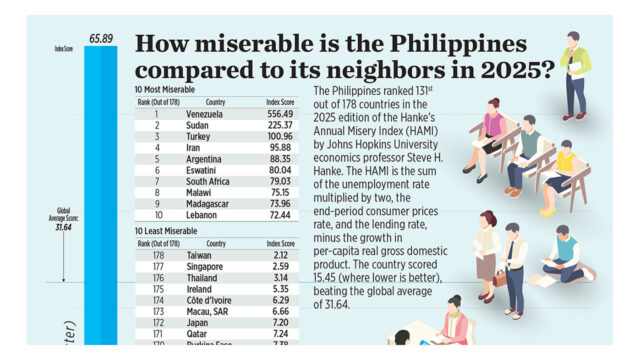
The Philippines ranked 131st out of 178 countries in the 2025 edition of the Hanke’s Annual Misery Index (HAMI) by Johns Hopkins University economics professor Steve H. Hanke. The HAMI is the sum of the unemployment rate multiplied by two, the end-period consumer prices rate, and the lending rate, minus the growth in per-capita real gross domestic product. The country scored 15.45 (where lower is better), beating the global average of 31.64.

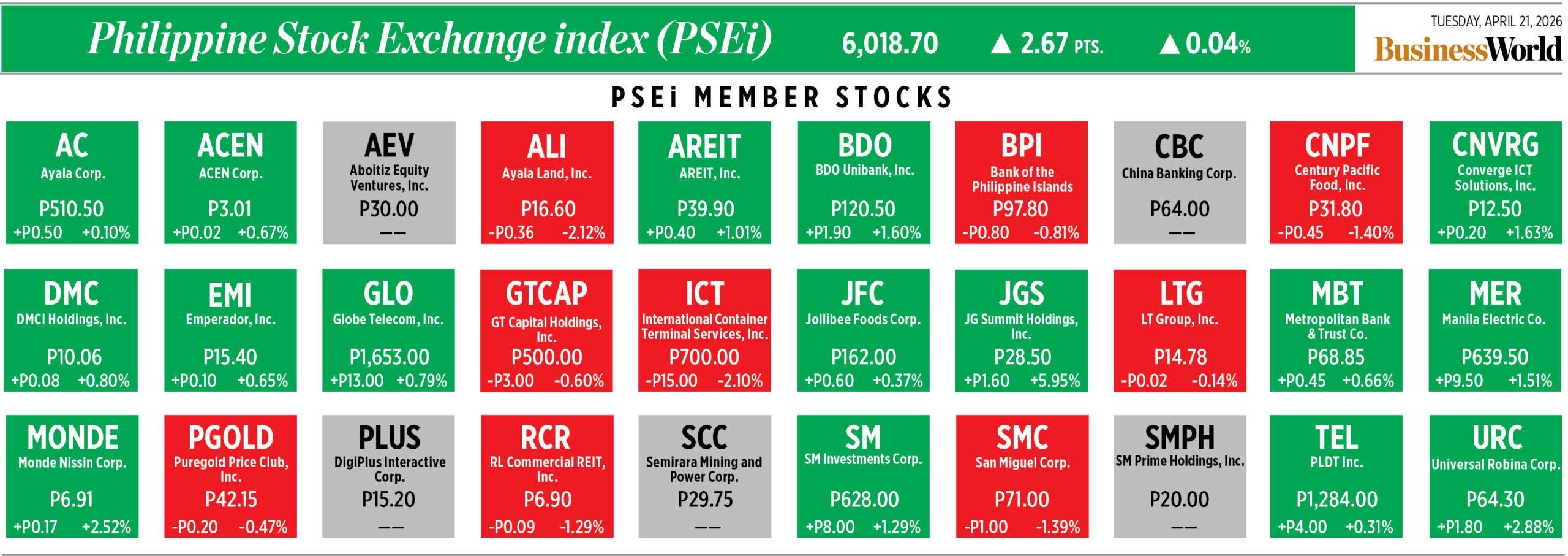
How PSEi member stocks performed — April 21, 2026

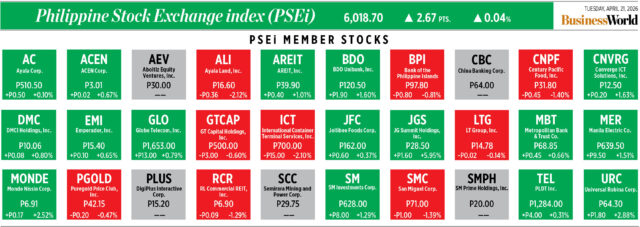
Here’s a quick glance at how PSEi stocks fared on Tuesday, April 21, 2026.


PHL stocks edge up ahead of BSP policy meeting

REUTERS

By Alexandria Grace C. Magno, Reporter

PHILIPPINE STOCKS inched higher on Tuesday, with investors largely staying on the sidelines ahead of the Bangko Sentral ng Pilipinas’ (BSP) policy meeting and amid lingering uncertainty over the US-Israel war on Iran.

The benchmark Philippine Stock Exchange Index gained 0.04% or 2.67 points to close at 6,018.7, while the broader all-share index added 0.15% or 5.09 points to finish at 3,387.53.

Market sentiment remained cautious, with investors closely monitoring developments surrounding the Middle East war, particularly the fragile cease-fire between the US and Iran.

Hopes that both sides could still reach a deal before the truce expires helped keep the market in positive territory, though gains were limited by risk aversion.

“Sentiment was stable as the market looked for updates on the unclear status of peace talks, which continued to limit risk appetite,” Luis A. Limlingan, head of sales at Regina Capital Development Corp., said in a Viber message.

He added that investors are maintaining a wait-and-see stance ahead of the central bank’s policy decision.

Philstocks Financial, Inc. Research Manager Japhet Louis O. Tantiangco noted that while optimism over possible diplomatic progress supported equities, cautious positioning persisted due to lingering risks from the war.

Focus is also squarely on the BSP’s April 23 policy review, where analysts are divided but leaning toward a rate hike as inflation risks build.

BSP Governor Eli M. Remolona, Jr. earlier said the central bank has room to raise interest rates to temper price pressures stemming from elevated oil prices linked to the Middle East crisis.

A BusinessWorld poll showed that 11 of 19 analysts expect the Monetary Board to raise the benchmark rate by 25 basis points to 4.5%, potentially marking the BSP’s first tightening move since October 2023.

The central bank has said it is closely watching core inflation and the impact of rising prices on lower-income households.

Sectoral performance was mixed, with four of six indexes closing higher. Holding firms led the gains, climbing 1.04% to 4,677.37, followed by industrials, which rose 0.89% to 8,894.59. Mining and oil added 0.63% to 18,164.97, while financials edged up 0.37% to 1,906.16.

On the other hand, services declined 1.35% to 2,743.44, while property dropped 0.46% to 1,990.8.

Among individual stocks, JG Summit Holdings, Inc. posted the biggest gain, rising 5.95% to P28.50. Ayala Land, Inc. was the top decliner, falling 2.12% to P16.60.

Market breadth was positive, with 106 winners outpacing 90 losers, while 76 stocks were unchanged. However, trading activity slowed, with value turnover dropping to P6.91 billion from P7.17 billion in the previous session.

Foreign investors remained net sellers, though outflows eased to P311.95 million from P446.83 million a day earlier, reflecting continued caution among offshore funds.

Japan’s military export easing may hasten PHL’s modernization push

THE PHILIPPINE frigate BRP Jose Rizal, US destroyer USS John Finn and Japanese landing ship JS Osumi. — ARMED FORCES OF THE PHILIPPINES

By Pexcel John Bacon

JAPAN’S DECISION to ease its defense export restrictions could accelerate Philippine military modernization by opening access to advanced equipment and deepening security cooperation amid rising regional tensions, Manila’s Defense department said.

Japan on Tuesday unveiled its biggest overhaul of defense export rules in decades, scrapping restrictions on overseas arms sales and opening the way for exports of warships, missiles and other weapons.

The move aimed at strengthening Japan’s defense industrial base marks another step away from the pacifist restraints that have shaped its postwar security policy.

Wars in Ukraine and the Middle East are also straining US weapons production, expanding opportunities for Japan. At the same time, US allies in Europe and Asia are looking to diversify suppliers as Washington’s long-held security commitments look less certain under President Donald J. Trump.

“No single country can now protect its own peace and security alone, and partner countries that support each other in terms of defense equipment are necessary,” Japanese Prime Minister Sanae Takaichi said in a post on X.

The revision approved by Ms. Takaichi’s government removes five export categories that had limited most military exports to rescue, transport, warning, surveillance and minesweeping equipment. Ministers and officials will instead assess the merits of each proposed sale.

Japan will keep in place three export principles that commit it to strict screening, controls on transfers to third countries and a ban on sales to countries involved in conflict. But in a presentation outlining the changes, the government said exceptions could be made when deemed necessary for national security.

Philippine Defense Secretary Gilberto C. Teodoro, Jr. on Tuesday said this will allow the Philippines access to “defense articles of the highest quality and supportability” which could boost the country’s resilience as well as contribute to regional stability.

“Our defense partnership with Japanese has entered a new era of working together and with other like-minded partners to secure our individual and collective rights and entitlements under international law through principled advocacy buttressed by deterrence,” he said in a statement, shared on the Defense department’s official Facebook page.

Mr. Teodoro noted he will visit his counterpart, Defense Minister Shinjiro Koizumi, soon to discuss “mechanisms for a strong and responsive alliance.”

Japanese officials and diplomats have told Reuters that countries ranging from Poland to the Philippines are exploring procurement opportunities as they modernize their forces. One of the first deals could be the export of used warships to Manila, two of the sources said.

BEYOND PROCUREMENT
The easing of Japan’s defense export rules could allow the Philippines to acquire defense capabilities, such as radar systems, air defense systems, and patrol vessels, at lesser costs, Josue Raphael J. Cortez, diplomacy and international affairs lecturer at De La Salle-College of Saint Benilde, said.

“This can open up doors for the Philippines to acquire unmanned drones from Japan which can be helpful not just in ensuring order and security within our borders, but also in attaining our goal of a self-reliant defense posture,” he told BusinessWorld via Messenger chat.

“Given that the nature of warfare today is best highlighted already by drones — part and parcel of asymmetrical warfare — then such acquisition can significantly harness our capabilities.”

He added that this could open opportunities beyond procurement, as the Philippines’ Luzon Economic Corridor plan with Japan and the US positions the Southeast Asian nation strategically to produce parts for these high value assets.

Chester B. Cabalza, president and founder of International Development and Security Cooperation, likewise expects the Philippine semiconductor and shipping industry to benefit from Japan’s eased military rules.

“Tokyo has been a reliable friend of Manila not only on infrastructure programs but also on defense capability and military modernization,” Mr. Cabalza said in a separate Messenger chat, noting this development builds on the country’s Reciprocal Access Agreement with Japan.

“Manila has strong semiconductor exports which are strong components in emerging defense tech and artificial intelligence. The Philippines also has capability in shipping and navigational skill which could help the naval power of Japan.”

Mr. Teodoro also acknowledges Japan’s assistance under its Official Security Assistance during natural calamities and cited an upcoming engagement with Japan.

“I look forward to the visit of Hon. Shinjiro Koizumi soon where we will discuss anchoring mechanisms for a strong and responsive alliance,” Mr. Teodoro said. — with Reuters

State of human rights in the Philippines still marred by impunity, unlawful killings

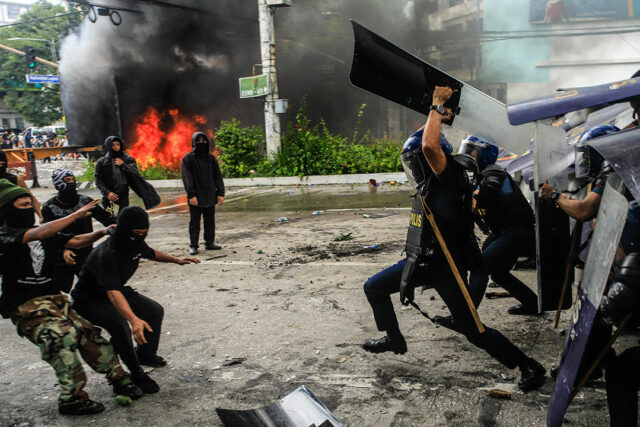
A GROUP of young demonstrators staged a violent act along Ayala Bridge near the Malacañang compound on Sept. 21, 2025. — PHILIPPINE STAR/NOEL B PABALATE

By Erika Mae P. Sinaking, Reporter

THE human rights situation in the Philippines remains defined by a deeply entrenched culture of impunity and the continued occurrence of unlawful killings under the administration of President Ferdinand R. Marcos, Jr., according to the 2026 annual report of London-based watchdog Amnesty International.

At the Manila launch of its report, titled “The State of the World’s Human Rights,” on Tuesday, the Nobel laureate said the high-profile arrest and transfer of former President Rodrigo R. Duterte to the International Criminal Court is a historic step toward accountability. But the group said this exposes the failure of domestic mechanisms to deliver justice, as conditions for activists, journalists, and marginalized communities remain dangerous.

“Here in the Philippines, global crisis of human rights takes on a deeply familiar and deeply alarming form. The Philippines stands at a critical crossroads,” Ritz Lee B. Santos III, section director of Amnesty International Philippines, said in a virtual news briefing from Quezon City.

“Democratic institutions are being eroded, civic spaces are shrinking, and millions of Filipinos, especially those on the margins, are bearing the cost of impunity, corruption, and authoritarian practices,” Mr. Santos said.

The global report, which documents human rights concerns across 144 countries, noted that humanity is at a pivotal moment due to a coordinated assault on the international rules-based order by powerful states, leading to widespread violations.

In the Philippines, unlawful killings in the context of the “war on drugs” persist, with at least 271 drug-related deaths recorded in 2025 at a rate of approximately one person per day. Domestic accountability for these deaths remains minimal, as the group noted that since 2016, only five cases involving nine police officers have resulted in convictions despite thousands of documented killings.

Amnesty flagged the growing use of “red-tagging” as a tool of repression, branding human rights defenders and activists as “communists” and creating a climate of fear.

It also said the Philippines remains deadly for the press, with at least four journalists killed in 2025, including Juan Dayang and Ali Macalintal, while community journalist Frenchie Mae Cumpio has been detained for over five years on disputed charges, despite a murder case dismissal in November.

The Anti-Terrorism Act of 2020 continues to be weaponized against humanitarian and development workers, the group said.

Among its findings, the report detailed excessive police force in Manila during September 2025 anti-corruption protests, with over 200 arrests that included children, while in Cebu, call center workers were forced to continue working during a 6.9-magnitude earthquake.

Indigenous peoples also continue to face human rights abuses as the government allegedly failed to obtain their consent for nickel mining projects that cause deforestation and health problems. Additionally, hearings into the multibillion-peso scam involving infrastructure projects revealed extensive corruption, bribery, and extortion involving politicians and private contractors.

Mr. Santos told reporters that in a six-page response to the group, Malacañang defended its policies and detailed initiatives, but the watchdog maintained that the government’s progress has been insufficient.

Mr. Santos said the response mirrors Amnesty’s findings regarding the contrast between the government’s rhetoric and the actual conditions occurring. He added that while government initiatives exist, they are generally not felt by citizens.

“We need more people to pressure the government to enforce progressive laws,” he said, adding laws that are not as progressive may be repealed or amended.

“As we’ve witnessed for the longest time, that there are so many good laws, particularly here in the Philippines, in terms of civil and cultural rights, in terms of economic and social and cultural rights,” he said. “But the problem is enforcement, and we can’t help but continue to call on the government to do their obligations, do their duty to respect, protect and fulfill human rights.”

VP impeachment trial won’t disrupt legislative work, Sotto says

VICE-PRESIDENT SARA DUTERTE-CARPIO — PHILIPINE STAR/ RYAN BALDEMOR

SENATE PRESIDENT Vicente C. Sotto III on Tuesday said the Senate is prepared to convene as an impeachment court when session resumes once the articles of impeachment against Vice-President (VP) Sara Duterte-Carpio reach the chamber but assured that the trial won’t disrupt legislative work.

In a media briefing, Mr. Sotto said the Senate may convene by May 4 if the articles of impeachment are transmitted once session resumes, eyeing Monday to Wednesday afternoons for the trial schedule.

“Originally, I was thinking of a whole-day session. Senate in the morning, impeachment court in the afternoon,” Mr. Sotto said. “We really need the Senate to keep going because we have sessions until June. We can’t neglect legislative work.”

However, Mr. Sotto also considered Senate President Pro Tempore Panfilo M. Lacson’s suggestion to conduct the impeachment trials on Mondays, Wednesdays, and Fridays, with Tuesdays and Thursdays for legislative work.

Mr. Sotto noted he may call for a caucus before the session resumes to finalize the schedule, noting that the majority of the Senate has also been preparing for the trials in the event that the impeachment reaches them.

“I will act on it with dispatch. Definitely forthwith. As soon as the Senate receives it, I will inform the Senate and refer it to the Committee on Rules,” he told reporters.

Article XI, Section 3 of the 1987 Philippine Constitution gives the Senate the power to convene as an impeachment court provided that at least a third of the House of Representatives affirms the complaint, with trials mandated to “proceed forthwith.”

In February 2025, Ms. Duterte was impeached in the House of Representatives with 215 congressmen signing the impeachment complaint. However, the Senate in August last year voted to archive the impeachment articles following a Supreme Court ruling that declared the proceedings unconstitutional.

While the archived articles of impeachment may be revived with majority approval, Mr. Sotto said it will remain in the archives.

In preparation for impeachment trials, Mr. Sotto, who will sit as the presiding officer, said he is taking a “crash program” on impeachment rules through the assistance of legal experts and at least two justices.

“I’ll have another two programs next week. Just in case. As I said, just in case,” Mr. Sotto said in a mix of English and Filipino. “Because at the moment, we can’t say what the House will send us, and I don’t want to meddle with what’s happening there to preserve my impartiality.”

He also called on his fellow senator-judges to practice impartiality in the proceedings, stressing that the impeachment court’s decision must be based on evidence. — Kaela Patricia B. Gabriel

MARINA cuts tonnage fees, exempts small vessels

MARINA

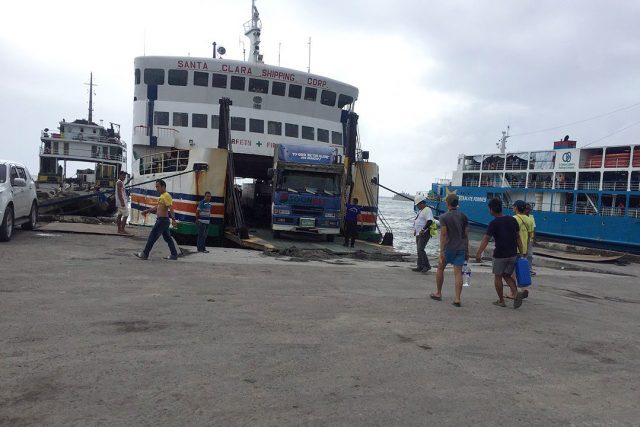
THE Maritime Industry Authority (MARINA) slashed the annual tonnage fee to P1 per gross ton (GT) for Philippine-registered vessels weighing more than 15 GT, while those at 15 GT or less are fully exempt for 2025, the Palace said on Tuesday. 

In a briefing, Palace Press Officer Clarissa A. Castro said MARINA also cut key regulatory fees, covering permits, safety certificates, vessel registration and accreditation, by 75% amid the government’s push to lower food costs by reducing transport costs.

It also suspended its implementation of its January issued schedule of charges for the period starting April 20 and will remain in place for a year or for the duration of the national state of energy emergency.

In a separate statement on Tuesday, Executive Secretary Ralph G. Recto urged national agencies and local government units (LGUs) to help farm-produce truckers make use of lower toll and port fees.

“This begins with the speedy accreditation of farmers and traders who are qualified for the toll fee waiver,” he said.

“Unnecessary and unreasonable stopping and inspection of food trucks by police and LGU checkpoints should also stop because it delays travel and wastes fuel,” he added.

This also comes as the Department of Transportation and the Toll Regulatory Board rolled out a month-long toll-free privilege on expressways on Tuesday.

Under the Department of Agriculture (DA), vehicles carrying food and perishable goods, as well as oil tankers, will be exempted from the morning and evening truck bans in the capital region.

A total of 1,162 private trucks is accredited under the DA’s Food Lane Program, moving up to seven million kilos of food daily to markets.

“The DA’s goal is to encourage the 3,100 truckers previously registered to get their easy-to-renew accreditation,” Mr. Recto said.

If 3,000 trucks benefit from the free road toll program, combined savings will reach between P150 million and P165 million monthly.

Meanwhile, President Ferdinand R. Marcos, Jr. ordered more jobs for returning overseas Filipino workers from the Middle East as he convened an inter-agency meeting tasked to oversee the country’s crisis response on Tuesday at the Palace.

“The President has paid the most attention to those who have already been helped and can still be helped by our countrymen when it comes to providing jobs,” Ms. Castro told a news briefing in Filipino.

The Unified Package for Livelihoods, Industry, Food, and Transport Committee, Mr. Marcos’ inter-agency body tasked with streamlining government response amid the Middle East crisis, met on Tuesday morning at the Palace for its fourth meeting.

Mr. Marcos “insisted” on Energy Secretary Sharon S. Garin on the continuous supply of petroleum products to prevent the economy’s stagnation.

“The President does not want stagnation,” said Ms. Castro.

“Inflation is already occurring because it is a result of the conflict in the Middle East, so he does not want it to reach a state of stagnation, so the supply of crude oil must remain and continue in our country.”

The Department of Migrant Workers is also working on a micro-site to be launched next week containing details about government aid and other related programs.

The Philippines is under a year-long state of national energy emergency due to the Middle East crisis.

The war stoked inflation in March as the prices of oil rose, threatening the prices of basic goods.

Mr. Marcos suspended excise taxes on liquefied petroleum gas and kerosene to cushion Filipino households from rising costs.

He has yet to do the same for diesel and gasoline.

The government is turning on targeted relief to ease the burden of Filipinos, focusing on the vulnerable and transport sectors. — Chloe Mari A. Hufana

ADVERTISEMENT
ADVERTISEMENT