
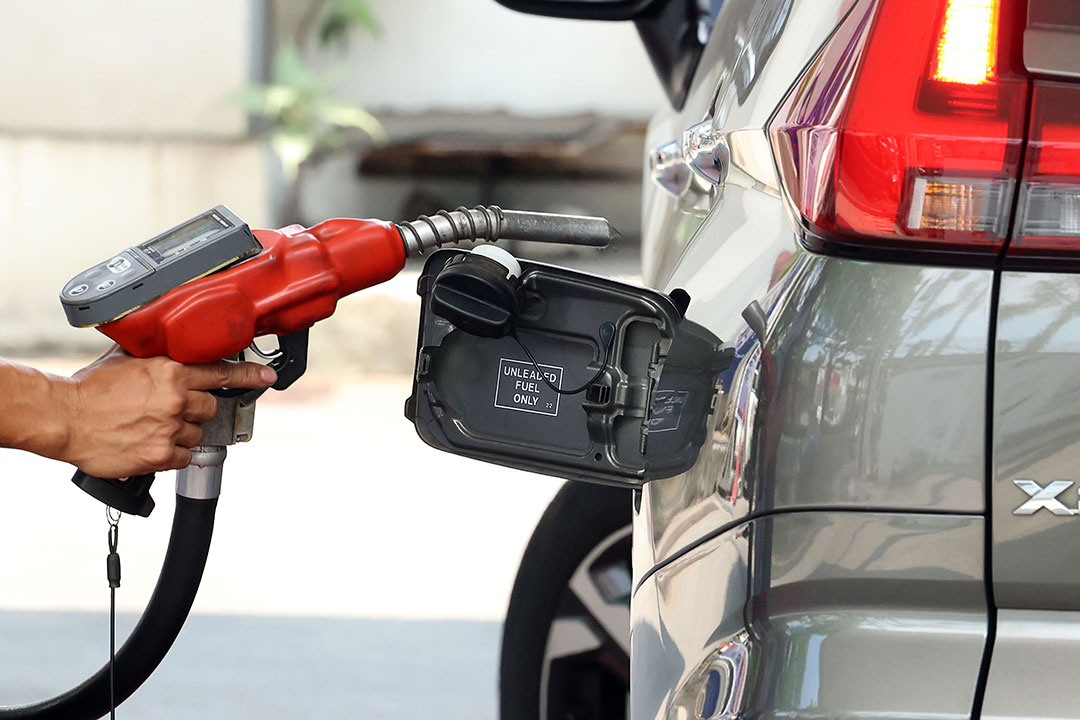
Excise taxes are levied on goods manufactured or produced locally for domestic sales or consumption, imported things, and services performed within the Philippines. These taxes, imposed in addition to the value-added tax, serve to generate revenue, and to discourage the consumption of harmful goods. They are imposed either as a “specific tax” based on a physical unit of measurement, or as an “ad valorem tax” based on the selling price or specified value.
The rate of excise tax on petroleum products has evolved since the 1990s. In the ’90s, the excise tax for unleaded premium gasoline stood at P4.35 per liter. By 2018, our Congress, through Republic Act No. 10963 (the Tax Reform for Acceleration and Inclusion, or TRAIN, Law), increased the excise tax on petroleum products in three tranches from Jan. 1, 2018, to 2020. As a result, the tax on unleaded premium gasoline rose incrementally from P7 to P10.
However, under the TRAIN Law, Congress recognized the risks of rising oil prices. They added that “[f]or the period covering 2018 to 2020, the scheduled increase in the excise tax on fuel shall be suspended when the average Dubai crude oil price based on Mean of Platts Singapore (MOPS) for three months prior to the scheduled increase of the month reaches or exceeds $80 per barrel.”
This safeguard is particularly relevant today as the conflict between the United States, Israel, and Iran continues to unravel. The volatility of the global energy market affects us with the increase of the Dubai crude oil price. In response, the Government has initiated measures to address the fuel price hikes. On March 24, President Ferdinand R. Marcos, Jr. officially declared a State of National Energy Emergency through the issuance of Executive Order (EO) No. 110. Congress, in turn, enacted Republic Act (RA) No. 12316.
REPUBLIC ACT NO. 12316
RA No. 12316 amends the Tax Code by adopting the same parameters found in TRAIN Law where Congress directs the suspension of an increase when the average Dubai crude oil prices, based on MOPS, reach $80 per barrel. However, this time, Congress has: 1.) granted the President the power to exercise this authority upon the recommendation of the Development Budget Coordination Committee, in coordination with the Secretary of Energy; 2.) expanded the power to allow not only the suspension, but also the reduction of taxes; and, 3.) allowed for the power to be exercised if the price reaches or exceeds the threshold for one month immediately preceding the issuance of the order, instead of the three months under the TRAIN Law.
The suspension or reduction may be applied to specific petroleum products, and implemented either as a full suspension or partial reduction as may be warranted by prevailing conditions. In this regard, Congress has provided the President with flexibility to respond swiftly to crises as conditions change. Congress added that any suspension or reduction shall be effective for a period not exceeding three months and that the aggregate period of suspension shall not exceed one calendar year. This specific power of the President can only be exercised until Dec. 31, 2028.
EXECUTIVE ORDER NO. 114
On April 16, acting upon the recommendation of Development Budget Coordination Committee, the President signed EO No. 114 (EO 114). This order mandates a temporary three-month suspension of excise taxes on specific petroleum products, namely liquefied petroleum gas (LPG) and kerosene. However, this relief specifically targets household consumption. EO 114 excludes LPG used as raw materials for petrochemical products or motive power, as well as kerosene used as aviation fuel. This ensures that tax relief primarily benefits vulnerable households.
REVENUE REGULATION NO. 003-2026
To operationalize the relief, the Department of Finance, upon the recommendation of the Commissioner of Internal Revenue, issued Revenue Regulations No. 003-2026 (RR 003-2026) on April 17. The regulation outlines how the suspension of excise taxes will be administered and monitored across the entire supply chain.
The suspension strictly applies to petroleum products removed from the place of production or customs custody after the effectivity of EO 114. This means that existing inventory, for which excise taxes have already been paid but remain unsold, is not covered by the suspension. This effectively precludes any manufacturer or exporter from claiming exemptions on excise taxes already paid for existing stock and avoids the administrative burden for the Bureau of Internal Revenue (BIR) that would otherwise come with processing refund claims.
To ensure that manufacturers of domestically produced LPG and kerosene, as well as importers, adhere to the restrictions, the BIR has established rigorous documentation requirements. Taxpayers must ensure full compliance with these reportorial requirements. Otherwise, they shall be subject to penalties under the Tax Code.
SUBMISSION OF RETURNS AND REPORTS
Manufacturers of domestically produced LPG and kerosene must ensure that their tax returns with the BIR indicate a “zero” tax rate with remarks “EO No. 114, SERIES OF 2026.” In addition, all official register books (ORBs) must be meticulously updated to reflect the removal of LPG and kerosene products. For importers of LPG and kerosene products, they must continue to submit their tax returns to the Bureau of Customs (BoC) and secure the Authority to Release Imported Goods (ATRIG) with remarks “EO NO. 114, SERIES OF 2026.”
STOCK INVENTORY
Under the EO, the Department of Finance, through the BIR and BoC, is directed to conduct an inventory of existing stocks of LPG and kerosene as of the effectivity of EO 114. Consequently, RR 003-2026 requires concerned manufacturers, importers, and lessees of storage depots to submit duly notarized inventories of all covered petroleum products as of April 16. These must be submitted to the relevant offices, either the Excise LT Field Operations Division or to the concerned Excise Tax Area, within 10 days after the effectivity of EO 114. This notarized document, denominated as Certificate of Stock Inventory, serves as the baseline for the BIR officers during the tax suspension period, allowing them to verify exactly when the tax-exempt removals should begin.
ISSUANCE OF WITHDRAWAL CERTIFICATES
RR 003-2026 also mandates that all withdrawal certificates issued for every removal of covered petroleum products covered by the suspension must be prominently stamped with the phrase “STOCKS COVERED BY EO NO. 114, SERIES OF 2026.” This ensures that throughout the supply chain, there is clear trail identifying the exempt petroleum products.
The implementation of EO 114 through RR 003-2026 reflects a pragmatic approach to addressing the crisis. By excluding existing stock from the suspension, the BIR has prioritized the stability of tax administration. This framework ensures that the implementation remains free from the administrative chaos typically associated with tax refunds.
Under RR 003-2026, the excise tax suspension is contingent upon complete and intact record-keeping. It is also stated that the excise tax on fuel products will revert automatically to the rates provided in the Tax Code without need for further legislative or executive action, upon occurrence of any of the following conditions, whichever comes first: a.) one week after the one month average Dubai crude oil price based on MOPS falls below $80 per barrel as duly certified by the Department of Energy; or, b.) after three months. Thus, for manufacturers and importers, meticulous compliance is necessary to ensure that these temporary measures do not lead to future tax complications. n
The views and opinions expressed in this article are those of the author. This article is for general information and educational purposes, and not offered as, and does not constitute, legal advice or legal opinion.
Atty. Princess Rexille V. Liboon is a senior associate of the Tax department of the Angara Abello Concepcion Regala Cruz Law Offices.
8830-8000