Home Blog Page 2394

MPH expands with Cavite acquisition

TOP ROW (L-R): Regina Nava, Metro Pacific Health business development specialist; Alvin John Merced, MPH AVP - Business Development; Ronald Basas, incoming deputy CEO of General Trias Doctors Medical Center (GTDMC). Bottom Row (L-R): Ariel Sandoval, GTDMC founder; Ricardo M. Beroncal, GTDMC founder and president; Jose Noel C. de la Paz, MPH director for corporate development; John Cenica, GTDMC founder; Ronald De Roxas, GTDMC founder and treasurer

METRO PACIFIC Health Corp. (MPH) has expanded its portfolio to 27 hospitals with the recent acquisition of the City of General Trias Doctors Medical Center, Inc. in Cavite.

The 27 hospitals under MPH’s network have 4,400 beds, 11,000 doctors, and 16,000 healthcare staff to accommodate 4.2 million patients a year, the company said in a statement over the weekend.

MPH has 11 hospitals in the National Capital Region, eight in North and South Luzon, two in the Visayas, and six in Mindanao.

“This investment in General Trias is our 16th provincial partnership and the second in the province of Cavite in just a little over a year,” MPH President Augusto P. Palisoc, Jr. said.

The newly acquired hospital, situated along Governor’s Drive in General Trias, is centrally located among the five most densely populated cities in Cavite.

It is also near the Cavite–Laguna Expressway (CALAX) Governor’s Drive toll exit, expected to open in the first quarter of next year.

“As our network expands, we are attracting more hospital owners eager to collaborate with us, probably because of the marked improvements they see in the hospitals MPH invests in,” Mr. Palisoc said.

MPH is the healthcare arm of the Pangilinan-led conglomerate Metro Pacific Investments Corp. (MPIC).

Some of its hospitals include Makati Medical Center, Asian Hospital and Medical Center, Cardinal Santos Medical Center, Davao Doctors Hospital, and Riverside Medical Center. It also has 33 outpatient care centers, two allied health colleges, and a centralized laboratory.

MPIC is one of three key Philippine units of First Pacific, the others being Philex Mining Corp. and PLDT Inc.

Hastings Holdings Inc., a unit of the PLDT Beneficial Trust Fund subsidiary MediaQuest Holdings, Inc., has a majority stake in BusinessWorld through the Philippine Star Group, which it controls. — Revin Mikhael D. Ochave

Singapore’s DBS eyes Malaysian bank stakes in expansion push

PHILSTAR FILE PHOTO

SINGAPORE — Singapore’s biggest lender DBS Group Holdings Ltd. is exploring expanding into Malaysia with potential acquisitions of stakes in banks in its Southeast Asian neighbor, including in one of Malaysia’s smallest banks by assets, two sources said.

DBS is exploring a purchase of Singapore state investor Temasek’s 29.1% stake in Alliance Bank Malaysia Bhd, said the two sources with knowledge of the matter, a slice currently valued at about $460 million.

Temasek is biggest shareholder in DBS with a 28.9% stake, according to LSEG data.

Other options for expanding into Malaysia include buying Kuwait Finance House’s Malaysian retail banking assets, worth more than $500 million and which have been put up for sale, one of the sources said.

Deliberations are in very early stages, however, the sources said, and any formal negotiations for an acquisition of a stake in a Malaysian bank would need approval from the Malaysian central bank, or Bank Negara Malaysia.

The two sources declined to be named as talks on the possible acquisitions were confidential.

“We do not comment on market rumors and speculation,” said a spokesperson for DBS, Southeast Asia’s biggest lender by assets. Temasek declined to comment.

Alliance Bank, the second smallest listed bank in Malaysia by total assets, and Bank Negara Malaysia did not respond to requests for comment after business hours on Friday.

Kuwait Finance House said the process for selling its retail banking portfolio in Malaysia was in preliminary stages, and that it was not able to share additional information.

DBS is the only Singaporean bank without a retail banking presence in Malaysia. Local rivals Oversea-Chinese Banking Corporation and United Overseas Bank both have retail banking operations in Malaysia.

DBS’ plan to foray into Malaysia comes amid improving economic prospects for the Southeast Asian nation, with new infrastructure projects and investments expected to result in a surge in credit growth.

In the second quarter, Malaysia’s economy expanded by an annual 5.9%, its fastest in 18 months, on higher household spending, exports and investment. Its monetary unit, the ringgit, is Southeast Asia’s best-performing currency this year.

‘BOLT-ON ACQUISITIONS’
DBS emerged as a regional banking powerhouse under outgoing Chief Executive Piyush Gupta’s 15-year tenure, bolstered by acquisitions that established significant presences in markets including China, India, Indonesia and Taiwan.

DBS completed the acquisition of Citigroup’s consumer banking business in Taiwan in August last year. In July, Gupta said DBS was looking for bolt-on acquisitions that would support further strategic expansion in the region.

Tan Su Shan, who heads up DBS’ institutional banking group and is deputy CEO, will take over from Gupta in March next year, making her the first woman to lead the bank. On Thursday, DBS posted its highest ever quarterly net profit for July-September on record fee income.

DBS last attempted to buy Temasek’s stake in Alliance Bank in 2012. Those plans did not go through because of regulatory hurdles, according to sources at the time.

The current Malaysian government under Prime Minister Anwar Ibrahim has been more forthcoming and open to ideas and investments with an aim to boost economic growth, said the sources with knowledge of DBS’ plan for Malaysia. — Reuters

Prada outpaces fashion rivals on Miu Miu’s Gen Z appeal

MIU MIU’S Arcadie bag proved especially popular.

PRADA SpA defied a luxury industry slump last quarter as fashion fans snapped up Miu Miu’s Arcadie handbags and cashmere cardigans.

Comparable retail sales at the Italian group grew 18% in the third quarter, the Hong Kong-listed company said last week. Those at its biggest label, Prada, rose 1.7%, while Miu Miu sales more than doubled during the period.

Prada has been outperforming high-end fashion rivals thanks to the success of its products among Gen Z consumers, led by the extraordinary growth rates at sister label Miu Miu, which now makes up about a quarter of group sales.

The brand was the hottest label during the period, rising one notch from the previous quarter on the Lyst index, which tracks searches and social media mentions. Prada remained third. Miu Miu’s Arcadie bag proved especially popular, according to the index. Its mini version starts at €1,850 ($2,004) in France.

Prada noted “more challenging market conditions” during the quarter in Asia Pacific, where sales grew 12%. The zone, hurt by a consumer downturn in China, has been a drag on other fashion competitors, from LVMH Moët Hennessy Louis Vuitton SE to Gucci-owner Kering SA.

Japan saw the highest growth rate among regions thanks to strong tourist spending, Prada said.

The company should be able to a name a new chief executive officer (CEO) for Miu Miu in the next two months after Benedetta Petruzzo left to become managing director of Christian Dior Couture, Prada CEO Andrea Guerra said. Mr. Petruzzo’s new role at the LVMH label was announced early September.

Miuccia Prada, the granddaughter of the group’s founder, is creative director at Miu Miu and splits those duties at Prada with Raf Simons.

The market could be underestimating the growth that Miu Miu can generate in the next 12 to 18 months, Bernstein analyst Luca Solca wrote in a note after the trading update. But Mr. Solca added he’s worried the Prada brand could be “well past its peak growth potential.” —  Bloomberg

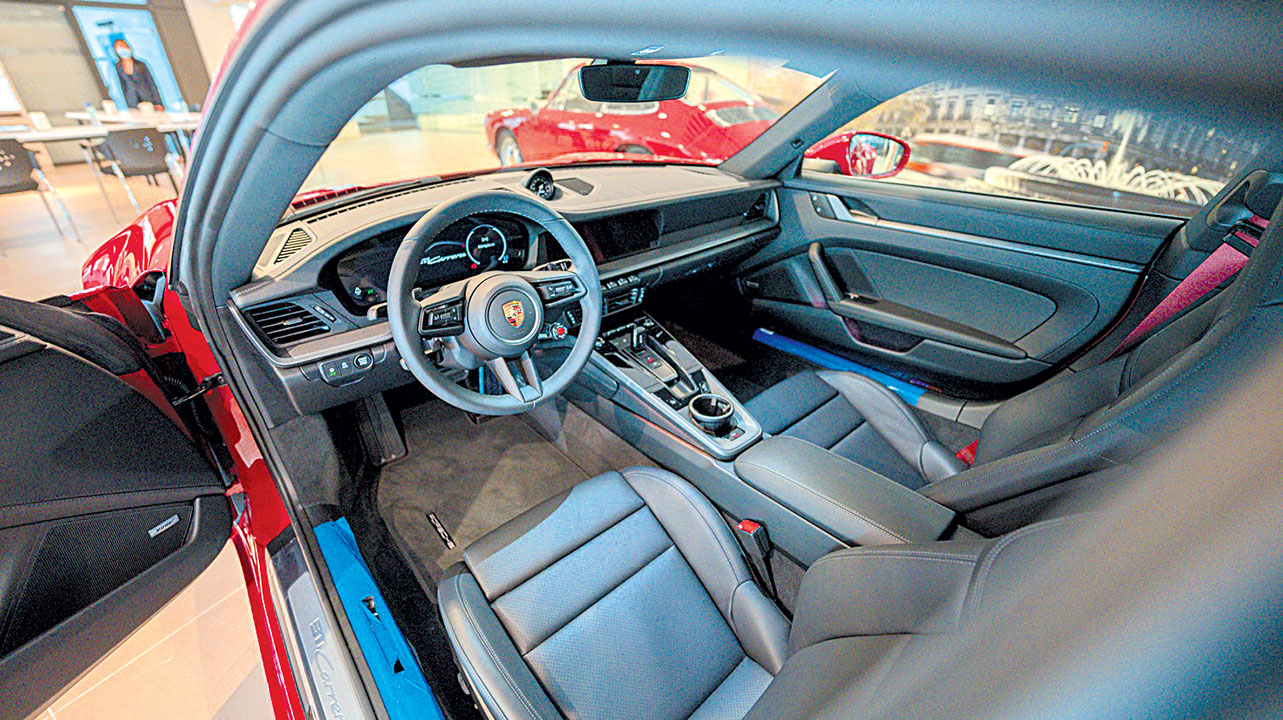
Updated Porsche 911 Carrera now available in PHL

The new Porsche 911 Carrera in Carmine Red — PHOTO BY KAP MACEDA AGUILA

By Kap Maceda Aguila

PORSCHE’S ICONIC NAMEPLATE is back with updates and new toys.

It’s kind of tricky to evolve what is effectively a sacred model line. And while it is technically a rehash of the current generation, there are “comprehensive upgrades” that give the new 911 (or 992.2, if you will) just enough good stuff to draw fans to the Porsche Philippines showroom.

At its core, of course, the coupe version of the 911 remains a rear-engine, rear-wheel-drive, two-door coupe. It’s still driven by the generation’s familiar but “extensively revised” 3.0-liter six-cylinder horizontally opposed engine twin turbo mill — now delivering a maximum output of 394hp at 7,500rpm and 450Nm. This is mated to an eight-speed Porsche Doppelkupplung (PDK) transmission. Standstill-to-100kph speed occurs in 4.1 seconds (trimmed to 3.9 seconds if one opts for a Sports Chrono Package); top rate is claimed to be 294kph. The gains, shared Porsche Philippines Managing Director Stephen Recinto to “Velocity,” were enabled by conscripting the turbochargers from the previous-generation 911 Turbo and GTS models. A charge-air cooler is also situated above the engine and directly under the rear grille.

Up front, the exterior tweaking is immediately apparent. The bumper now, well, bumps off the lighting fixtures which now relocate to the updated headlamps — comprised of Matrix LEDs that sport the signature four-point look, and now appear like parentheses when lit. The turn signals also make their way there. Crucially, because the ancillary front lighting has been nixed from the bumper, Porsche engineers and designers now use the space for larger cooling vents.

The 911 Carrera rolls on mixed Michelin Pilot Sports — 245/35 ZR 20-inchers in front and 305/30 ZR 21s in the rear.

In the back, the Carrera also cuts a marginally changed image — leading off with a redesigned light strip with an integrated light arc and “PORSCHE” lettering. The move helps to accentuate the rump of the vehicle. “It effectively gives a 3D effect,” said Porsche Philippines Senior Sales Executive Patrick To.

Above is a new rear grille with five fins on each side — melding with the rear window to “form a visual unit that merges into the retractable spoiler below.” The location of the rear car plate has been raised.

The dashboard of the Porsche 911 Carrera now, for the first time, features fully digital instrumentation and infotainment. A customizable 12.6-inch curved display “fits elegantly into the new control and display concept” and offers up to seven views. And yes, the classic Porsche display with five round dials is one of the options. Another first: the 911 now gets a start/stop button — still, of course, on the left side of the steering wheel. The Porsche Communication Management (PCM) system is accessed through a high-resolution 10.9-inch central display. The company reports that Apple CarPlay is now “more deeply integrated into the car, displaying information in the instrument cluster and facilitating the operation of vehicle functions by using the Siri voice assistant.”

For more information, contact the Porsche Philippines Concierge at 0917-826-8522.

The Trump card wins the election game

RAWPIXEL.COM

Donald Trump has won in the Nov. 5 general (popular) election for the presidency of the United States of America, to serve a four-year term from 2025 to 2029. He will be proclaimed the 47th President of the United States of America on Jan. 20, 2025, after formal election by the US Electoral College on Dec. 17 this year. (Donald Trump was the 45th president of the United States from 2017 to 2021.)

The popular vote determines which slate the electors will vote for — Republican, Democrat, or a third party.  Each of the 50 states are given a number of electoral votes proportionate to the population density in each state.   Candidates must secure 270 electoral votes, a majority of the 538 at stake, to win the presidency.  In most states, it’s winner-take-all — whoever gets the most votes in the state wins all of its electoral votes. There is no Constitutional provision or federal law that requires electors to vote for the candidate to whom they are pledged, though they almost always do.  “Faithless electors” are rare, since the electors are selected by the parties (cbsnews.com, Nov. 5, 2024).

Five presidents in the history of the US have won the presidency without winning the popular vote — the most recent was Donald Trump (Republican) in 2016. His opponent that year, Hillary Clinton (Democrat), won over 2.8 million more votes than Trump nationwide, but she lost enough key states to be defeated in the Electoral College, 306 to 232 (Ibid.). In a 2023 Pew Research poll, 65% of Americans said the president should be elected through the popular vote, not the Electoral College. But legislation to change the system is difficult because proponents say it keeps less populous states from being underrepresented (Ibid.).

And so, this year’s popular elections point to Trump’s being effectively already officially elected by the Electoral College, as he has secured 301 electoral votes, breaching the 270 needed to win. His opponent, Kamala Harris (Democrat) garnered the equivalent of 226 votes. Trump is the first Republican presidential candidate to win the popular vote since George W. Bush two decades ago. But why, and how, did he trump the game so cleverly?

Trump is the first president in American history to be impeached twice, and the first to run again after impeachment. Trump was first impeached by the Democratic-controlled House of Representatives in December 2019 for abuse of power and obstruction of Congress due to his attempts to coerce Ukraine to provide damaging information on Biden and misinformation regarding Russian interference in the 2016 United States elections by withholding military aid (NPR, retrieved May 31, 2024). Trump’s second impeachment by the House occurred on Jan. 13, 2021, for “incitement of insurrection” owing to his role in the Jan. 6 United States Capitol attack.  As Trump was acquitted by the Senate in both cases, Trump was not barred from seeking reelection to the presidency in 2024 (FiveThirtyEight, ABC News, June 1, 2024).

Trump was elected despite persistently low approval ratings, four criminal indictments and a civil judgment against him for sexual abuse and defamation. In May, Trump became the first former US president to be convicted of a crime when a New York jury found him guilty on 34 felony counts of falsifying business records to cover up hush money paid to a porn star.

Trump’s political career appeared over after his false claims of election fraud led a mob of supporters to storm the US Capitol on Jan. 6, 2021, in a failed bid to overturn his 2020 defeat (against Joe Biden). His efforts to reverse his defeat led to two separate indictments, though all the criminal cases against him are expected to end after his victory (Reuters, Nov. 7, 2024).

“It clearly paid off to aggressively push to delay these cases as long as possible,” said Jessica Levinson, a constitutional law professor at Loyola Law School.  A judge in New York is set to sentence the former president later this month after holding off on handing down the punishment ahead of Election Day to avoid any appearance of affecting the outcome of the presidential race — though Trump’s lawyers are expected to ask the judge to put off the sentencing now that he’s the president-elect (Reuters, Nov. 6, 2024).  Very clever!

Mainstream media unmasked “The Donald” (his “funny name,” as ex-wife Ivana referred to him). After he announced a White House bid for 2024 (CNN, Nov. 16, 2022), newspapers and TV had no qualms about putting him down. “News Analysis: Trump seeks to reclaim spotlight with old playbook of lying, talking smack to media,” the Los Angeles Times said (Aug. 24, 2024). “Trump has a bunch of new false claims. Here’s a guide” (The Washington Post, March 15, 2024).  “With false ‘coup’ claims, Trump primes supporters to challenge a Harris win” (The Washington Post, Aug. 24, 2024). “Trump calls Biden the ‘destroyer’ of democracy despite his own efforts to overturn 2020 election” (Associated Press, Dec. 15, 2023).

Trump’s style and behavior, including his embrace of far-right extremism (New York Times, April 16, 2024) “broke with traditional US political norms in an unprecedented way, marked by a rhetoric they described as authoritarian and dehumanizing toward his political opponents, likening it to populist movements and some drawing parallels to fascism” (ABC News, May 30, 2024). In July, President Joe Biden condemned the videoed, televised assassination attempt on Donald Trump, calling on all Americans to denounce such “sick” violence (BBC News, July 14, 2024).  Was it real, anyway, or staged, as some cynics thought?

Still, Donald Trump won the elections and will be president of the United States of America for a second term. “America has given us an unprecedented and powerful mandate,” Trump said on the day after elections to a roaring crowd at the Palm Beach County Convention Center in Florida (Reuters, Nov. 7, 2024). As if to applaud and cheer — “major stock markets around the world rallied following Trump’s victory, and the dollar was set for its biggest one-day jump since 2020” (Ibid.).

Analyses in mainstream and social media focused on why Kamala Harris lost to Donald Trump. Most were similar to analyst Jon Sopel, who wrote that “the most pressing issues that decided Harris’s defeat were that Biden had been perceived as a failure by the American public; these included the fact that, as part of the global 2021-2023 inflation surge, inflation went up by 20% and real wages had not adjusted to match, as well as the state of the Mexico-United States border. By embracing the Biden agenda, (Harris) was simply tying herself to his unpopularity.” The Democratic Party was out of touch with the popular mood in the US, pointing to its lack of action on illegal immigration, its lack of attention to the economic state, and the majority of Americans’ lack of interest in the Biden administration’s diversity, equity, and inclusion efforts,” Sopel said in, “Kamala’s catastrophe: How it all went so badly wrong,” The Independent, Nov. 7, 2024.

The fatigue and disappointment with the government (i.e., the outgoing Biden administration) has caused widespread “anti-system” sentiment, some socio-political analysts say. And, in the anxieties of the aging Baby Boomers (the US median age is now 38.023 years in 2024 according to database.earth) — income, poverty, and health are critical issues.  Life has been difficult, dragged down by the long-staying COVID pandemic that started in 2020. The impatience for relief and deliverance has peaked — perhaps a bad-ass strongman fascist president like Donald Trump can get things done, and fast!

P.S.:  Does it not all sound so familiar to Filipinos — that sometime back it was thought that “a bad-ass, foul-mouthed, brusque strongman (bugoy, in Filipino) might be president and solve the problems of the country”?  To our American friends:  It didn’t work out!


Amelia H. C. Ylagan is a doctor of Business Administration from the University of the Philippines.

ahcylagan@yahoo.com

Food companies sell less healthy products in poor countries — report

REUTERS

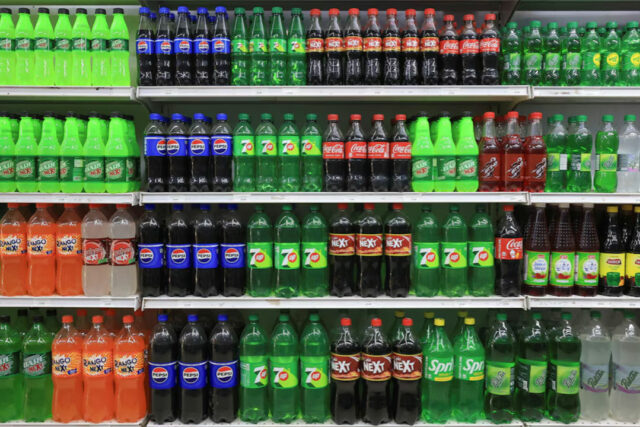
LONDON — The world’s biggest food and beverage companies on average sell products in low-income countries that are less healthy than what they sell in high-income countries, according to a new report.

Products sold by companies including Nestlé, Pepsico and Unilever were assessed as part of a global index published by the Access to Nutrition Initiative (ATNI), its first since 2021. The non-profit group found that across 30 companies, the products sold in low-income countries scored lower on a star rating system developed in Australia and New Zealand than those sold in high-income countries.

In the Health Star Rating system, products are ranked out of 5 on their healthiness, with 5 the best, and a score above 3.5 considered to be a healthier choice.

“In low-income countries, the multinationals’ portfolios rated 1.8 on the system. In high-income countries, where more products were tested, they were 2.3. — a very clear picture that what these companies are selling in the poorest countries in the world, where they are more and more active, are not healthy products,” said Mark Wijne, research director at ATNI, in an interview with Reuters.

“It’s a wake-up call for governments in these countries to be vigilant,” he added.

It is the first time the index has split the assessment into low and high-income countries.

ATNI said the index was important as packaged foods are increasingly playing a part in the obesity crisis that is now a global phenomenon.

More than one billion people worldwide are living with obesity, according to the World Health Organization. The World Bank estimates that 70% of people who are overweight or obese live in low- and middle-income countries.

“We have committed to grow our sales of more nutritious foods, as well as guiding people towards more balanced diets,” a Nestlé spokesperson said by e-mail, adding that Nestlé also fortifies products to help close nutrient gaps in developing countries.

A PepsiCo spokesperson declined to comment.

The company last year set new goals to lower sodium in its potato chips and add ingredients like whole grains into its foods. — Reuters

WalterMart malls go solar with First Gen

WM SHOPPING CENTER Management, Inc., the developer of WalterMart malls, has partnered with First Gen Corp. for solar power projects in Luzon.

First Gen and its sister company Pi Energy, Inc. constructed solar photovoltaic systems for WalterMart malls in Quezon, Zambales, Pampanga, Nueva Ecija, Batangas, Bulacan, and Rizal, the company said in a statement over the weekend.

Building these solar power plants, which have a total capacity of 11.4 megawatts-peak (MWp), is part of the mall chain’s multi-phased program to source a substantial portion of its electricity from clean energy.

“In a span of four years, our partnership has grown in terms of scale and investment, and that shows the level of commitment of WalterMart to integrate renewable energy into its operations,” said Mark Malabanan, Pi Energy’s assistant vice-president for solar and key partners’ growth.

WM Shopping Center Management has 41 community malls in the country with a total solar capacity of 12.3 MWp, which is expected to expand to 27 MWp from 25 solar-powered malls by the end of the year.

The company is targeting to source 20% of its power requirements from solar energy by the end of 2025.

WalterMart first tapped First Gen and Pi Energy in 2019 with the installation of a solar power facility atop a WalterMart mall carpark building in Nasugbu, Batangas.

First Gen has a total of 3,697 MW of installed capacity coming from its portfolio of plants that run on geothermal, wind, hydro, solar energy, and natural gas. — Sheldeen Joy Talavera

Style (11/11/24)


Nuxe releases holiday goodies

CHARM loved ones with Christmas crackers from Nuxe, each containing a dash of glow in iridescent gold or iridescent pink with roll-on versions of Huile Prodigieuse Or and Or Florale. The little boxes are ready to hang on the Christmas tree, with gift boxes made entirely in France and designed with 0% plastic and 100% recyclable cardboard. Additionally, these sets are FSC-certified and sourced from sustainably managed forests. As for gift boxes, there is the original Huile Prodigieuse with the Prodigieux Collection, featuring its scent alongside luxurious additions. Another gift box has the uplifting floral notes of Huile Prodigieuse Florale and Very Rose care products. Nuxe is available at Rustan’s (Makati, Shangri-La Plaza, Alabang); LOOK (SM Aura, SM Mall of Asia); Mitsukoshi Beauty, and select Beauty Bar stores. It’s also available through Rustans.com, Shopee, Lazada, and ZALORA.


Lancôme releases holiday sets

PARISIAN beauty powerhouse Lancôme launched its new holiday collection reminiscent of diamond snow, featuring gift sets. The holiday gift sets showcase the luxury products from the brand’s fragrance, skincare, and makeup portfolio. This holiday season, Lancôme partners with Filipina actress and Lancôme ambassador, Kathryn Bernardo. The Idole Mini Fragrance Sets showcase Lancôme’s Idole fragrance with brand new mini sets. Meanwhile, the Flawless Skincare set is headlined by Lancôme’s Génifique, their most popular anti-aging skincare collection. They are also launching their first ever Makeup Set that gives the gift of holiday-ready glamor with specially curated makeup. All sets come with a discount of up to 50%. Lancôme has also collaborated with artist Sofia Ouares to create packaging that captures the spirit of the season. Ms. Ouares’ designs, featuring the brand’s signature Celestial Rose are intertwined with Parisian landmarks. As part of its holiday celebration, Lancôme will release a video featuring Kathryn Bernardo. Lancôme is making this holiday season even more special with its 12 Days of Extraordinary Christmas Raffle from Oct. 1 to Nov. 15 where shoppers at Lancôme’s Rockwell and Greenbelt 5 locations can enter to win prizes worth up to P35,000 in the holiday raffle. Online shoppers can also enjoy discounts on Lancôme’s holiday gift sets this coming Nov. 11 on their official Lazada and Shopee stores.


Lacoste launches new version of 1984 scent

LACOSTE and global fragrance company Interparfums present its latest creation, Lacoste Original Eau de Parfum, marking the first collaboration between the two companies. With the 1984 Lacoste Original celebrating its 40th anniversary this year, master perfumer Anne Flipo and perfumer Tanguy Guesnet were inspired to create a modern and addictive scent while highlighting the brand’s emblematic codes and distinctive signature. This resulted in a modern and dynamic woody, ambery, fougère eau de parfum. Ms. Flipo said in a statement, “As a brand, Lacoste combines timeless freshness with creative frenzy. The idea behind this sophisticated fragrance is to express movement in all its forms in a unique, powerful creation.” The perfumers worked on citrusy and spicy scents using bergamot, cardamom, and pink peppercorn as the top notes to convey motion. This mixture gives way to an aromatic fougère heart of clary sage and lavender, the common element between the 2024 and 1984 editions. The heart trails off to a base of tonka bean and sandalwood, while amber and patchouli reinforce the masculine side of the fragrance. Pierre Niney, a French actor, director, producer and screenwriter, is the star of the perfume’s ad campaign. Lacoste Parfums are exclusively distributed by Rustan Marketing Corp. and are available in-store in all leading department stores nationwide; and online at Rustans.com and Zalora.

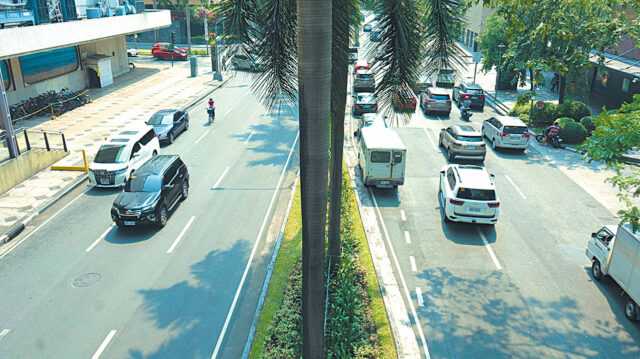
Traffic nightmare before Christmas

PHOTO BY KAP MACEDA AGUILA

Congestion isn’t a simple issue to discuss or solve, but there are ways to mitigate it

HEAVY TRAFFIC in Metro Manila is always news. It never grows tired, no matter that it has been a bane of metro living for decades. This is especially true during this time of the year when — like a trifecta — school, work, and the yearend holidays simultaneously appear to brew a perfect storm. Depending on the day of the week, the time of day, and the season of the year, road congestion arguably goes from bad to worse.

Many have cited the growing mobility needs of the country, the lack of roads, the inadequacy of public transport or a lack of enforcement of traffic rules as reasons for the mayhem. As it turns out, we — the drivers or passengers — are as much at fault. Our driving habits and the way we navigate the thoroughfares of the metro have as much an impact on traffic as the usual culprits we blame. To paraphrase the adage, it is not the car you got but how you use it that matters. Cars do not cause traffic; motorists do.

The dire situation of road congestion will not be denied. The TomTom Traffic Index ranked Metro Manila as the most congested metropolitan area in the world. Average travel time per 10 kilometers across the road network of Metro Manila was reported at 25 minutes and 30 seconds, up by 50 seconds from 2022. During rush hour, the average travel speed was recorded at 19kph.

In 2021, as mobility restrictions from COVID-19 were being lifted, a total of 3.2 million vehicles were reported to be plying the roadways of Metro Manila at an average speed of 30.63kph. In 2023, as businesses and government ramped up the return to office and schools resumed face-to-face classes, the number of vehicles on the roads increased to 3.6 million, moving at an average of 24.5kph.

Though work-from-home arrangements still linger, the resumption of face-to-face life continues to drive vehicles back to the roads. Mobility is, after all, an essential conveyor of economic and social activity. While usage of existing vehicles revert to or exceed pre-COVID-19 levels, traffic congestion is further aggravated by a resurgence in new vehicle sales. The local automotive market peaked at 473,000 units in 2017. It dropped by half to 244,000 in 2020 then trended back up to 438,000 last year. In 2024, sales are expected to reach a new record of close to 480,000. That is almost half-a-million new cars on the road, 40% of which are bought — and used — in Metro Manila. The good news is the government is hard at work building new roads, expressways, peripheral highways, and bridges.

SAFETY FIRST
Road crash incidents — excluding the rising wave of road rage events — are also seen to be rising. From 2016 to 2019, the number of vehicle crashes averaged 114,506 per year, increasing by about 10% per year. This dropped by 61% to 65,032 incidences in 2020 but the 10% spike was again observed in 2021 and 2022. A study by the Metropolitan Manila Development Authority (MMDA) showed this to be a critical occurrence for traffic, since a 30-minute standstill resulting from a road crash incident creates a backlog spanning 2.5 kilometers and requiring 42 minutes to clear.

We’ve all had our fair share of experiences where a fender bender or a vehicle breakdown was enough to result in anarchy on the roads — not only because a lane is taken out of service but also because motorists cannot wait patiently in their lane, resort to creating their own lanes or, worse, make illegal counterflows. Surely, defensive driving and a regular dose of vehicle periodic maintenance service can go a long way in reducing congestion caused by accidents.

According to the MMDA, one cause of delay in the clearing of road accidents is the fact that their deputies need to wait for the police to appear on the scene to issue an accident report. This is apparently required by insurance companies in case of claims. The good news is that the Insurance Commission is now working to allow acceptance of MMDA reports to support insurance claims.

FLYOVERS VS. SERVICE ROADS
Another contributor to traffic is a penchant of motorists to use flyovers and underpasses versus the service roads. Motorists flock to the Shaw underpass on EDSA — cutting from the three right lanes into the two lanes of the underpass even if the service road is open. The MMDA reports that during morning peak hours, there are 49% more vehicles (11,067 vehicles) using the Santolan flyover than the service road (6,681 vehicles). In the afternoon, it is 97% more with 11,600 using the flyover and only 4,030 the service road. I think this is a carryover from before the introduction of the bus carousel lanes. When buses were confined to the rightmost lanes, it was traumatic to use the service roads because of “bus-bullying.” I have taken to using the service roads of EDSA as much as I can.

The MMDA believes that the suspension of the no-contact apprehension policy (NCAP) has also resulted in reduced road discipline and, consequently, increased roadside apprehensions that contribute to traffic. In 2022, a total of 97,000 traffic violations were registered. In 2023, after the implementation of NCAP was suspended by a temporary restraining order from the Supreme Court in August 2022, that number increased to 242,000. Arguably, ill-disciplined motorists have been emboldened due to the shutting of the “big eye in the sky.” Arguably.

Indeed, there are many contributors to our traffic woes. From two-wheelers occupying covered road lanes when it rains, to vendors making use of streets and pavements for business, to pedestrian jaywalking and illegal parking on roadsides. If we all try to get together on the right side of responsible driving and car ownership, though, I think we can help reduce this traffic nightmare that we are as much responsible for as we are victims of.

Crank up urban climate action

PHILIPPINE STAR/RYAN BALDEMOR

It has become easy to blame climate change for every disaster that befalls us. Climate change is a global emergency that suggests no less than urgent and purposive actions. But often we either hide in the belief that the Philippines has a relatively lower carbon footprint compared to highly industrialized countries or blame the latter for not paying up enough for their guilt.

While calling for climate justice, we need to examine our own norths in the domestic north-south divide: cities.

Cities, if not abroad, are where Pinoys go to get jobs and hope to change their lives. According to the Philippine Statistics Authority, as of 2022, 54% of 109.3 million Filipinos have located themselves in cities. Urban density is felt even in small cities like Tagbilaran or Bacolod with densities 10 times the national average of 363 persons per square kilometer. Even more dense are highly urbanized cities like Manila with 73,920 persons per square kilometer. With density, we see cramped living spaces, especially of the poor and unemployed. We also see more transport vehicles to accommodate movement of people and more roads to accommodate vehicles. There are 3.8 million registered vehicles in Metro Manila where the total road length, including barangay roads, is just a little over 3,000 kilometers. Metro Manila is practically a huge parking lot with 1,234 vehicles per kilometer. If they move during rush hours, the speed is about 21 kilometers per hour (kph) in the morning and 17 kph in the evening, according to the 2023 TomTom Traffic Index.

An average driver in Metro Manila spends 240 hours on the road, half of it due to traffic congestion. Each car emits 1,027 kilograms (kg) of carbon dioxide (CO2) each year.

A shift to electric vehicles is still a dream riddled with concerns over affordability and how to securitize and dispose of old vehicles. A 2019 Japan International Cooperation Agency (JICA) study states that Metro Manila transport demand is expected to increase from 18.4 million person trips/day to 22.9 million by 2035. There is not enough space to accommodate vehicles, or for the Department of Public Works and Highways (DPWH) to build roads just to accommodate vehicles; not without impacting living space and land for agriculture and food.

The 2022 report of the Intergovernmental Panel on Climate Change suggests that cities are primarily responsible for global CO2 emissions. It is ironic that what attracts people to move to urban areas perversely creates conditions for more greenhouse gas (GHG) emissions and vulnerability to the problem created.

Cities outside Metro Manila can already telescope their problematic future if there is no change in urban development trajectory. Cherry-picking sectors responsible for GHG emissions is unsound. The approach is to deal with the whole tree of urban development design and planning.

At least three participants (Antipolo, Bacolod, and Tagbilaran) of the Integrated Urban Climate Action for Low-Carbon and Resilient Cities (Urban-Act) jointly implemented by a consortium of the German Development Cooperation, Institute for Climate Smart Cities and Clean Air Asia, and the Department of Interior and Local Government, have opted to crank up climate action. They begin by stirring the enabling environment to further sensitize urban development to climate change.

These cities are smaller than Metro Manila cities, but they foresee similar problems. They still have no count of GHG emissions contributions, but they feel the disaster impacts and other mundane problems such as housing, traffic congestion, and waste disposal, among others. They look beyond flooding and extremes of precipitation and heat. From a series of deliberative policy analysis workshops from May to August this year, they recursively examined the policy environment.

Like other local governments, there are decisions that cities cannot make. In transportation management, they can do road clearing, manage traffic, issue franchises for tricycles or prepare local transport route plans, but they do not have control over the issuance of drivers licenses and franchises of other public transportation vehicles. In housing and settlements, they undertake housing for the poor, informal settlers, and those living in danger zones, but they do not have a handle on the issuance of environmental clearance certificates (ECCs) and subdivision plans of private estates. Some cities have forests, but they do not have control of forest land tenure and resource use permits. They do solid waste management, but the system does not enable public appreciation of how much GHG emission has been avoided and reduced.

What do cities suggest?

First, an explicit policy to formulate medium- and long-term climate action programs. An existing policy enjoins National Government agencies and local governments to climate-tag relevant budget lines of their annual appropriations. While this is good enough, there is a need to think beyond annual appropriations. Reduction and avoidance of GHG emissions and improvements in adaptation capacities of people and ecosystems need medium- and long-term investments.

Government has been able to invest P309 billion on the comprehensive agrarian reform program over 30 years, P581.3 billion for the Risk Resilience Program from 2020 to 2022, and P47.22 billion for the National Greening Program from 2011 until 2019. Purposive climate investment programs can be developed by the National Government and local government units on top of climate-tagged budgets in annual appropriations.

Second, we need clear operational guidelines on resilient and green housing and settlements. Housing and settlements are privatized sectors. Government housing for the poor may not meet the criteria of greenness. There must be a way of influencing market players to go green without losing investments.

Third, local government participation in transportation planning and management must be expanded. Beyond road clearing, traffic management, franchising of tricycles, and route planning, local government units (LGUs) need to share power with the Land Transportation Regulatory Board over franchising of public utility vehicles. At the least, they should have access to franchises and drivers licenses issued by the Land Transportation Office. Most of all, being in charge of their territories, they need what it takes to manage local transportation comprehensively.

Other elements of the enabling environment for urban climate action can be propped up. Cities like Antipolo, Bacolod, and Tagbilaran can take up the challenge bit by bit.


Ed Quitoriano is senior adviser of the Council for Climate and Conflict Action-Asia (CCAA) and is the principal consultant of Visus Consulting.

Famine imminent in Gaza, food security experts say

REUTERS

LONDON/UNITED NATIONS — There is a “strong likelihood that famine is imminent in areas” of the northern Gaza Strip, a committee of global food security experts warned, as Israel pursues a military offensive against Palestinian militant group Hamas in the area.

“Immediate action, within days not weeks, is required from all actors who are directly taking part in the conflict, or have influence on its conduct, to avert and alleviate this catastrophic situation,” the independent Famine Review Committee (FRC) said in a rare alert.

The warning comes just days ahead of a US deadline for Israel to improve the humanitarian situation in Gaza or face potential restrictions on US military aid.

Israel’s mission to the United Nations in New York did not immediately respond to a request for comment.

“If no effective action is taken by stakeholders with influence, the scale of this looming catastrophe is likely to dwarf anything we have seen so far in the Gaza Strip since Oct. 7, 2023,” the FRC said.

The UN Office for the Coordination of Humanitarian Affairs estimates that there are between 75,000 and 95,000 people still in northern Gaza.

The FRC said that it could be “assumed that starvation, malnutrition, and excess mortality due to malnutrition and disease, are rapidly increasing” in north Gaza.

“Famine thresholds may have already been crossed or else will be in the near future,” it said.

Israel began a wide military push in northern Gaza last month. The US has said it is watching to ensure that its ally’s actions on the ground show it does not have a “policy of starvation” in the north.

The FRC reviews findings by the global hunger monitor — an internationally recognized standard known as the Integrated Food Security Phase Classification (IPC).

The IPC defines famine as when at least 20% of people in an area are suffering extreme food shortages, with at least 30% of children acutely malnourished and two people out of every 10,000 dying daily from starvation or malnutrition and disease.

The IPC is an initiative involving UN agencies, National Governments and aid groups that sets the global standard on measuring food crises.

The IPC warned last month that the entire Gaza Strip was at risk of famine, while top UN officials last week described the northern Gaza Strip as “apocalyptic” and everyone there was “at imminent risk of dying from disease, famine and violence.”

The amount of aid entering Gaza has plummeted to its lowest level in a year, according to UN data, and the UN has repeatedly accused Israel of hindering and blocking attempts to deliver aid, particularly to Gaza’s north.

Israel’s UN Ambassador Danny Danon last month told the Security Council that the issue in Gaza was not a lack of aid, saying more than a million tons had been delivered during the past year.

He accused Hamas of hijacking the assistance.

Hamas has repeatedly denied Israeli allegations that it was stealing aid and says Israel is to blame for shortages.

“The daily average number of trucks entering Gaza in late October was about 58 per day,” Jean-Martin Bauer, the UN World Food Programme’s director of food security and nutrition analysis, told Reuters on Friday.

“We were getting about 200 a day in September and August, so that’s really a big, big decline,” he said. — Reuters

Banks eye Trump regulatory reprieve, starting with capital rules

INSIDE the biggest US banks, the mood ranged from cautious optimism to jubilant last week as they eyed the prospect of relief from their common foe: the Biden-era regulators.

Harsher regulation in recent years, led by the proposed higher capital rules known as Basel III Endgame, united the industry in defiance as it fought back like never before. The big banks and the trade associations that represent them poured millions of dollars into a lobbying effort, and scored a concession when the Federal Reserve said it would unveil a softer version.

That version still hasn’t seen the light of day. Now, senior industry executives are viewing it as all but dead, even as regulators have maintained they’d work toward implementing a proposal no matter who won the election.

“In the unlikely event that they could agree on a new proposal, there is no time to put it out and act on it before the new administration gets established,” said Betsy Duke, a former Fed governor who later chaired Wells Fargo & Co.’s board.

The incoming Trump administration would in theory be able to replace heads of the Office of the Comptroller of the Currency (OCC) and the Consumer Financial Protection Bureau on day one, at least on an interim basis. Both of those officials are crucial to the process to propose and enact the new regulations, and banks are already seizing the moment to begin advocating for appointments seen as more friendly to the industry.

Representatives for the Federal Reserve, the OCC and the Federal Deposit Insurance Corp. — the agencies behind the proposal last year — declined to comment.

Fed officials have for months maintained their commitment to getting new rules in place, regardless of the election outcome. Fed Chair Jerome Powell said at a hearing in July that “the point of it is to get it right, not to do it quickly.”

Vice Chair for Supervision Michael Barr echoed that in September: “The Federal Reserve is an independent agency,” he said. “We’re not paying attention to the election cycle in terms of any of our work that we do. And I’m not paying attention to it for this purpose.”

TRANSITION CHATTER
Within hours of Donald Trump’s victory, text chains were alive with chatter about potential transition names, according to one executive, who declined to be identified speaking publicly about the matter. Another described the prospect of Trump regulation compared to the current situation as “night and day.”

Bank stocks soared Wednesday: The 24-firm KBW Bank Index climbed more than 10%. Shares in JPMorgan Chase & Co., which has notched record after record this year, hit yet another one. Wells Fargo’s stock finally broke through a 2018 high it struck before the Fed imposed an asset cap — to close above $70 for the first time ever.

An executive at one top bank said they’re expecting a more predictable regulatory environment that’s less driven by enforcement actions and public campaigns, and more focused on clear rules. However, they cautioned that they expected regulators may push a public agenda that could kneecap diversity and inclusion efforts, as well as investments tied to environmental, social and governance metrics.

The apparent wins for banks weren’t just tied to the presidential election result. Senate Banking Chairman Sherrod Brown, an Ohio Democrat and longtime Wall Street foe, was ousted in favor of Republican Bernie Moreno. That contributed to Republicans winning a Senate majority, and they’re in striking distance of retaining the House of Representatives as well.

NO CAKE WALK
Still, Wall Streeters aren’t expecting a complete cake walk. While the expectation is for a softer touch across the board, some Republicans favor tighter capital rules. The latest plans would require the eight biggest banks to raise their capital by 9% — about half what was originally put forward by regulators.

If the plan is jettisoned or significantly dialed back again, it could complicate matters overseas. The European Union has already delayed a key part of its capital rules that affect banks’ trading activities by a year so that its banks won’t be at a disadvantage. The UK said in September that it would delay its entire package until 2026.

Trump’s election win may pressure both the EU and the UK to relax them or again delay them — which regulators will likely resist, Bloomberg reported. Jurisdictions that signed on to the reforms, which date back to the financial crisis, agreed to meet standards of adoption set by the Basel committee and can later be scored on their compliance.

There’s also the question of populist influences in the incoming Trump administration and the Republican party as a whole.

As a senator, Vice-President-elect JD Vance signed onto legislation that would cap credit card swipe fees — deeply unpopular among big banks. He also used his time in a congressional hearing last year to press the chief executive officers of the largest lenders on what he called “woke actions.”

“Nobody elected you,” Mr. Vance told the group, which included JPMorgan Chief Executive Officer (CEO) Jamie Dimon, Goldman Sachs Group, Inc. CEO David Solomon and Citigroup, Inc. CEO Jane Fraser. “Stay out of public policy unless it affects your core business interests, because if you don’t it’s going to be a lot harder for us to see you guys as neutral arbiters and neutral actors in the American financial system.”

DEALS BOOST
But despite the looming questions, a sense of ebullience emerged across Wall Street as the election results rolled in last week. The Biden administration’s scrutiny on mergers and acquisitions has cast a chill over a long-awaited dealmaking comeback — and the juicy fees banks earn from arranging them.

In each of the last seven quarters, JPMorgan CFO Jeremy Barnum has cited the regulatory environment as a hamper on that business. Now, bankers are expecting an imminent pickup in dealmaking and initial public offerings. For regional banks, that also puts tie-ups with each other back on the table.

Trading desks could also see a boost from client activity around policy shifts. If Trump’s tariff policies — which would slap a 60% levy on goods from China and 20% on everything else — become reality, that could translate to market swings. During his first administration, Mr. Trump would occasionally move markets with a single social media post.

“We’re expecting, broadly, this to be pro-growth and beneficial,” Citigroup CEO Fraser said Friday in a CNBC interview. As for the investment banking environment, “it’s game on.” — Bloomberg