Home Blog Page 2368

Cebu Pacific receives 3 aircraft; restructuring plan gets SEC nod

CEBUPACIFICAIR.COM

By Ashley Erika O. Jose, Reporter

CEBU PACIFIC (CEB) has received three more aircraft, representing more than half of its projected aircraft deliveries for the year, the budget carrier said on Monday.

“Our continuous fleet expansion efforts underscore our commitment to provide safe, affordable, and accessible flights,” Cebu Pacific President and Chief Commercial Officer Alexander G. Lao said in a statement.

The airline said three Airbus jets arrived at the Ninoy Aquino International Airport, including one A330neo, one A320neo, and one A320ceo, representing more than half of its expected 17 aircraft deliveries this year.

“As the demand for air travel continues to rise, we are confident that we will be able to cater to more passengers looking to connect with other people or discover new destinations with Cebu Pacific,” Mr. Lao said.

Airbus’s new-engine option aircraft promise significantly improved fuel efficiency and can use sustainable aviation fuel (SAF). Currently, all Airbus aircraft are certified to operate with an SAF blend of up to 50%.

Cebu Pacific hopes to adopt SAF across its network by 2030.

To date, Cebu Pacific operates a diversified fleet with a total of nine Airbus A330s, 39 Airbus A320s, 22 Airbus A321s, and 15 ATR turboprop aircraft.

Last month, the company announced that it would order up to 152 A321neos worth P1.4 trillion or $24 billion, which is touted as the largest aircraft order in the country.

Separately on Monday, Cebu Air, Inc., the budget carrier’s operator, said that the Securities and Exchange Commission (SEC) has approved the company’s restructuring plan.

On July 17, Cebu Air’s board of directors greenlit the company’s proposal to pursue an equity restructuring of its deficit in 2023.

The company proposed to use its additional paid-in capital of P20.66 billion to clear its deficit amounting to P16.27 billion, leaving it with a capital of P4.39 billion.

“The equity restructuring will not involve a change in the par value of CEB’s shares, nor will it require an infusion of any additional paid-in capital; neither will the equity restructuring result in any change in the number of CEB’s issued, outstanding, or listed shares,” the company told the stock exchange.

For market watchers, this move signifies the company’s intention to improve its balance sheet, allowing it to be attractive to investors.

“This may be aimed at cleaning up its balance sheet ahead of potential fundraising for its massive expansion plan,” Chinabank Capital Corp. Managing Director Juan Paolo E. Colet said in a Viber message.

Globalinks Securities and Stocks, Inc. Head of Sales Trading Toby Allan C. Arce described the proposal as a “significant financial maneuver.”

“CEB aims to clean up its balance sheet. This move can make the company more attractive to investors by presenting a healthier financial position,” he said.

Mr. Arce said that while the restructuring plan does not directly fund its aircraft purchase, it will position Cebu Pacific to potentially raise funds through other means, such as equity or debt, or by simply “improving its financial health and credibility.”

“Cebu Pacific’s decision to restructure now is likely aimed at strengthening its financial position in preparation for significant future investments,” Seedbox Securities, Inc. equity trader Jayniel Carl S. Manuel likewise said in an e-mail.

Mr. Manuel said the restructuring would give the company more flexibility in managing its “substantial commitments.”

“A more stable financial outlook can boost investor confidence, potentially leading to an improved stock price and easier access to capital markets for future funding needs,” Mr. Arce said.
Meralco CSP is about protecting the consumers, indifferent where cheap electricity will come from

Last week, on July 31, a Regional Trial Court (RTC) in Taguig issued Civil Case No. 1039, “Complaint for Injunction with very urgent application for an Ex Parte 72-hour Temporary Restraining Order (TRO); 20-day TRO; and Writ of Preliminary Injunction.” The plaintiffs are Prime Energy Resources Development BV, UC38 LLC, Prime Oil and Gas, Inc., and PNOC Exploration Corp., and the defendant is the Manila Electric Co. (Meralco).

The RTC called on defendant Meralco “from proceeding to select and contract out the 600-megawatt (MW) net and 400-MW net power supply agreements (PSA) under the competitive selection process (CSP) whose terms are flawed, skewed or supplier-driven and grossly violative of existing laws, rules and regulations.”

The CSP should have been conducted last Friday, Aug. 2, for the 600 MW, then on Aug. 9 for the 400 MW, but with the TRO there is an automatic delay in the bidding, and this will mean a higher cost for consumers, with the reasons to be enumerated below.

Two weeks before this TRO was made by an RTC in Taguig, there was a Senate Committee on Energy public hearing (July 18) where Senator Alan Peter Cayetano, who was a former Taguig Congressman, voiced the same argument used in the RTC civil case, and harassed Meralco.

The main complaints made by the plaintiffs are the following: One, “Meralco TOR (terms of reference) does not recognize and, in fact, violates the preference given to Indigenous Natural Gas (ING) under the relevant laws, rules and regulations.”

Two, “the Meralco TOR incorporated terms and conditions which practically deny the power suppliers using ING as a fuel source the opportunity to fairly participate in the Subject CSPs.”

Three, “increased reliance on imported sources of fuel threatens the country’s energy security and energy sovereignty because these are greatly susceptible to a volatile market” as “imported coal and imported ING, the prices of both are notoriously unstable and extremely subject to external shocks in the market.”

While this is largely a legal matter, my economics-trained mind says that the TRO is wrong for the following economic reasons.

One, the CSP’s main goal is to secure the lowest price for consumers regardless of where the electricity will come from. The CSP is about price competition and selection, not environmental selection, not indigenous over imported energy selection.

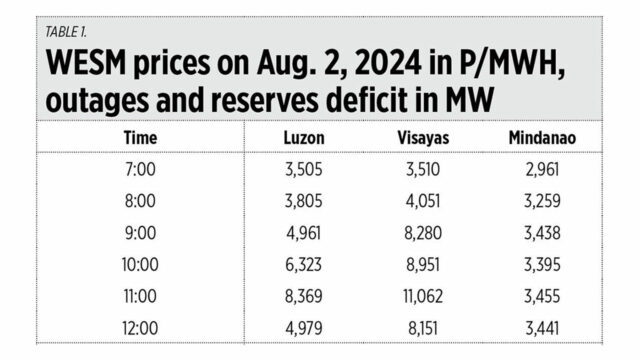
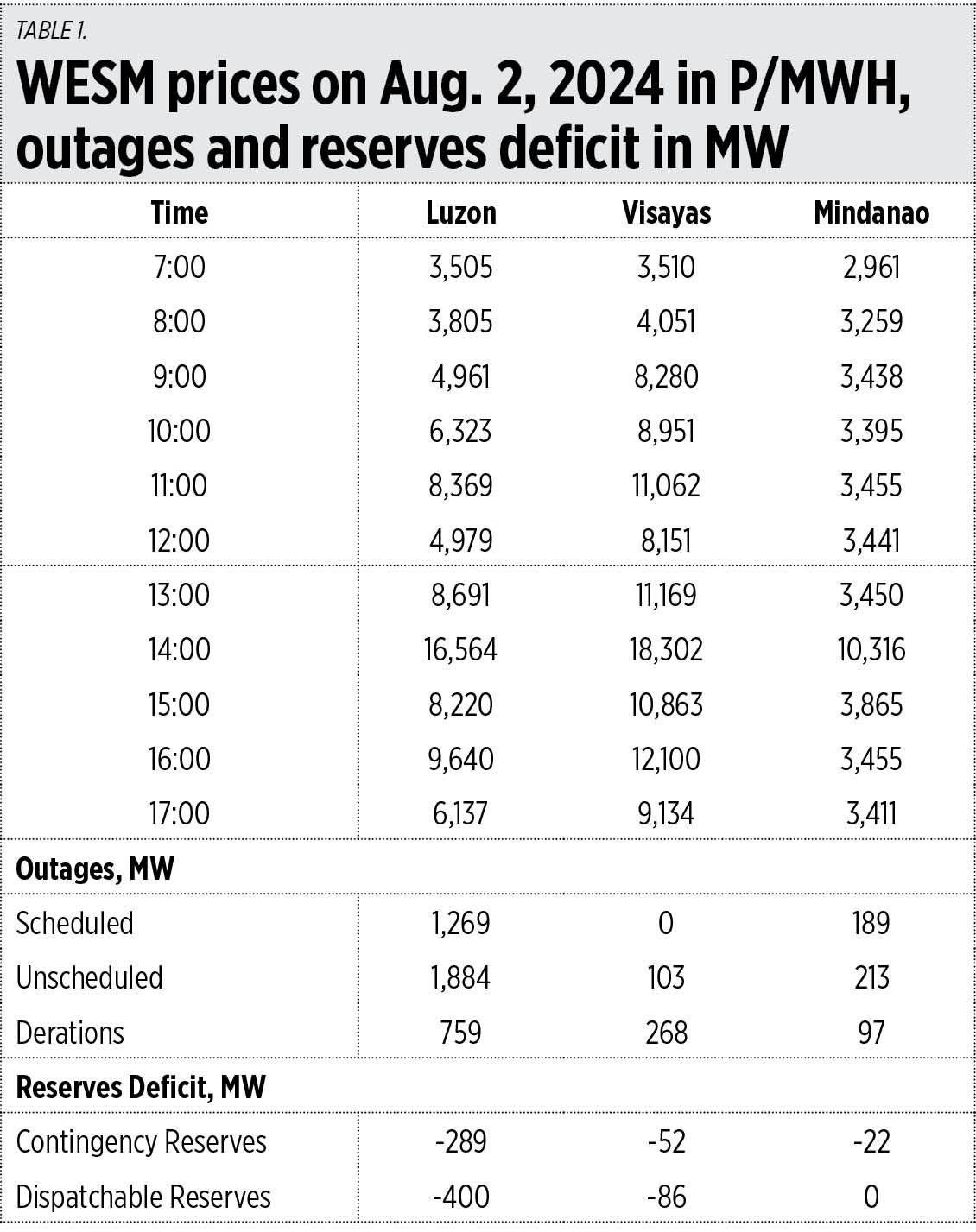
Two, cheaper electricity for consumers means the price should be locked at a stable and low level for many years and not subject to wild price swings at the Wholesale Electricity Spot Market (WESM). On Aug. 2, the day where the CSP for 600 MW should have been held, WESM prices fluctuated wildly in Luzon, from P3.50 per kilowatt hour (kWh) at 7 a.m. to P16.56/kWh at 2 p.m., then P9.64/kWh at 4 p.m.

The main reason was that many power plants had unscheduled or unplanned outages plus derating or reducing output for other plants that continued running. The dispatchable reserves that day were -400 MW (a deficit) in the Luzon grid and -86 MW in the Visayas grid (see Table 1).

Three, delaying the bidding will expose the consumers to an “unnecessary burden in the amount of billions of pesos in the form of higher power rates” as noted by Jose Ronald V. Valles, Meralco SVP and Head of Regulatory Management. The wild swing in prices within a period of 10 hours on Aug. 2 is proof of this.

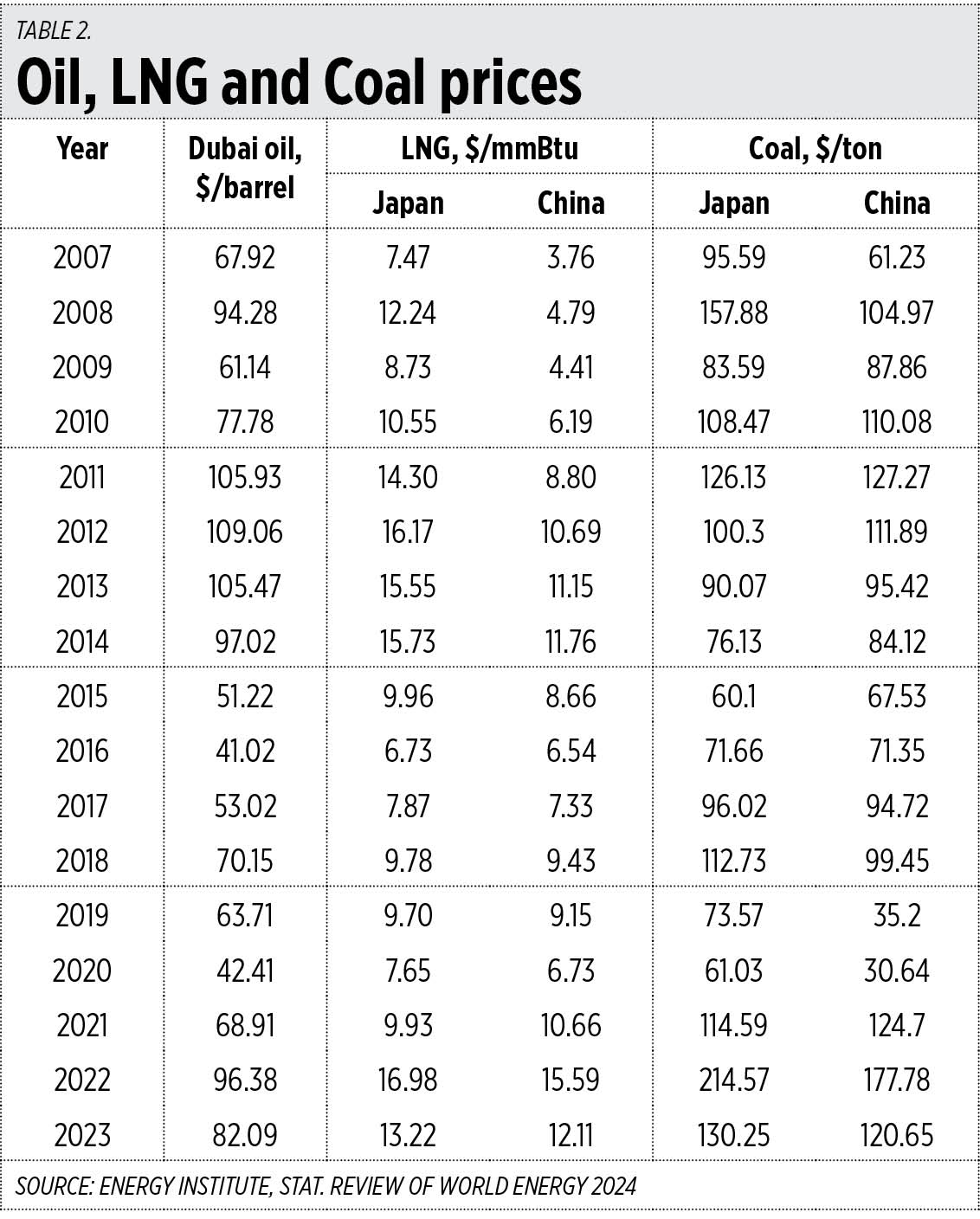
Four, the claim of high price volatility of imported LNG and coal also applies to the ING Malampaya gas price because it is pegged at Dubai crude oil prices. Dubai, WTI, and Brent oil prices have experienced wild price fluctuations and volatility at almost the same periods as the price volatility of LNG and coal, like in 2008, 2011-2014, and 2022 (see Table 2).

So, favoring ING and demonizing imported LNG and coal based on an argument of price volatility is not a valid argument as it has no basis.

Five, the Philippines need long-term cheap electricity to power its industrialization dream. The industry sector comprises 30% of the country’s GDP, the manufacturing sub-sector comprises 20% of GDP, and recently these sectors were growing slowly partly due to expensive electricity. With the ongoing degrowth and deindustrialization in Europe, we should expect that many businesses there will move to Asia — including the Philippines — and cheaper electricity should be one of the attractions we can offer them.

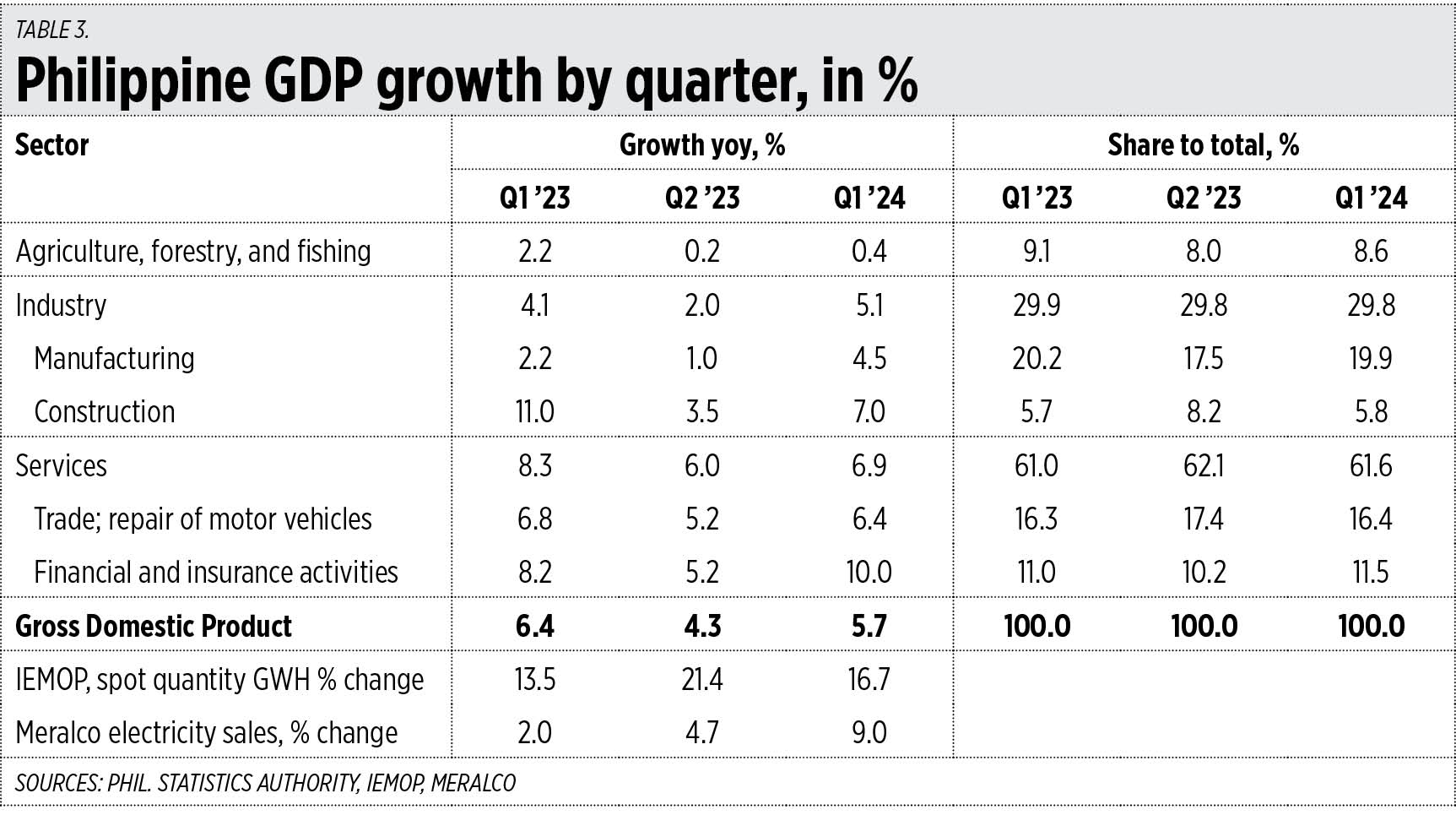
Data from the Independent Electricity Market Operator of the Philippines (IEMOP) shows that electricity generation and consumption in gigawatt/hours (GWh) was growing at 14% to 24% over the last two years. Meralco electricity sales, also in GWh, had muted growth last year but high growth this year (see Table 3).

Related to my projection in this column last week that GDP growth in the second quarter (Q2) of 2024 would range from 6% to 6.2%, the main reason I said so was because of the base effect — the low growth of only 4.3% in Q2 2023 — and this would allow for high growth in the current year. More particularly in the manufacturing and industry sectors (which had only 1% and 2% growth respectively in Q2 2023), I think they should be doing around 4% and 7% this Q2 2024. (The Philippine Statistics Authority will release the Q2 GDP data on Thursday, Aug. 8. — Ed.)

Six, Meralco is not the sole buyer of power from big generation companies (gencos) and big gas producers. WESM is also a big market for gencos with an ample supply of electricity to offer. WESM spot quantity was 4,060 GWh in the first half (H1) of 2022, and this jumped to 7,938 GWh in H1 2023, and further jumped to 12,447 GWh in H1 2024 (data from IEMOP).

Seven, lawyer Paris Real has correctly pointed out that the plaintiffs are not participants in the CSP as they are not gencos that will compete in giving low price offers to Meralco. And the legal entity that should handle this should be the Energy Regulatory Commission (ERC), not an RTC. The lawyer is correct because the ERC, as a quasi-judicial body, has powers similar to the courts on legal matters related to energy.

High inflation is the number one concern of most Filipinos and other people around the world. Not climate, not imported energy, not POGOs, not inequality, and so on — just high consumer prices. The Meralco CSP is meant to secure the lowest bid price for its customers, and sticking to its goal of protecting consumers is the correct path to help fight high inflation in the country. The plaintiffs are wrong in putting their corporate interests over consumer interests. And the Taguig RTC is wrong in issuing the TRO. May these mistakes not happen again.


Bienvenido S. Oplas, Jr. is the president of Bienvenido S. Oplas, Jr. Research Consultancy Services, and Minimal Government Thinkers. He is an international fellow of the Tholos Foundation.

minimalgovernment@gmail.com

Impressions of a boy’s demonic transformation

A STILL from The Gospel of the Beast starring Jansen Magpusao and Ronnie Lazaro.

By Brontë H. Lacsamana, Reporter

Movie Review
The Gospel of the Beast
Directed by Sheron Dayoc
Cinemalaya Independent Film Festival

THE CRIMINAL underworld has featured heavily in Philippine cinema, through detailed glimpses of the poverty that drives people to it and the gritty, violent fates that befall those corrupted by it.

The Gospel of the Beast (2024) situates a character study of a 15-year-old boy in this harrowing landscape. Director Sheron Dayoc brings the audience face-to-face with Mateo, who struggles with the destructive realities of life and death.

Playing this doomed character is Jansen Magpusao, whose acting range is on full display as he transforms from traumatized teen to stone-cold killer in a visual feast that makes use of a dreamy style rather than a realistic one. After accidentally killing a friend, the boy seeks help from his uncle (played by Ronnie Lazaro), who serves as the bridge to a world of violence.

Because the film centers primarily on how Mateo is distorted into a man with beastly morals, there is not much else to discuss in terms of the other characters and events that take place. Scenes tensely edited together, some gruesome and some a seemingly innocent calm before the storm, form a moody playground for Mr. Magpusao to show off his acting chops.

At this point in his career, he proves he has the remarkable ability to embody the struggles of the disenfranchised Filipino youth, from downtrodden hopelessness in the 2019 film John Denver Trending, to a gradual demonic transformation here in The Gospel of the Beast. The most notable thing this film does is bring forth his ability to convey inner turmoil.

While not as narratively strong as Mr. Dayoc’s previous film Women of the Weeping River, it arguably has much stronger visual storytelling. The tightly edited montages present warped reflections of faces on broken mirrors and an unflinching look at the violent scenes and tendencies that become Mateo’s refuge. It’s a dark, impressionistic approach, deciding not to flesh things out and relying on images and actions to push the character’s evolution forward — a shame since it may have needed a bit of balance to the overall brooding tone and pace.

The notes of religious fervor that treat violence as the only way of life in the margins of Philippine society are well-executed. Those who’ve watched quite a bit of Lino Brocka’s oeuvre will notice references to his work, mainly the opening scene that depicts pig slaughter similarly to 1976’s Insiang. Like how the slaughterhouse where Mateo and his uncle work at shows more meat being reeled in, this film enters the realm of Philippine cinema with more of the same that we’ve already seen, albeit with a different treatment.

Mr. Magpusao as Mateo sells us his beastly transformation with mere facial expressions (a sign of a long, remarkable career ahead), but The Gospel of the Beast is focused too much on an aesthetic vision to provide details that will help the audience dive deeper. The other characters in the cast, for example, are unnamed and completely forgettable. The cinematography and editing are striking, full of rich textures and filmic pacing, but always so concerned with the character’s perspective that the world around him feels almost unreal (even though it is real, the film shot entirely in Western Visayas, with the cast actually hailing from that region!).

Mr. Dayoc, who started off as a documentary filmmaker, may have played with a more stylistic approach here, but beneath all that is his advocacy of tapping into the unflinching, cyclical reality of violence in the Philippines, and how it makes beasts out of young boys.

For that, The Gospel of the Beast was a fine choice for the opening film of the 20th edition of the Cinemalaya Independent Film Festival, where Mr. Dayoc made his debut in 2010 and Mr. Magpusao in 2019. Prior to that, the film was well-received in film festivals in Tokyo and Ho Chi Minh.

It echoes the indie scene’s tendencies to tackle similar topics yet attempt to do something different each time — all of varying quality, all turning to the film festival circuit to flourish, all in the name of defining modern Philippine cinema.

Rated R-16

The Cinemalaya 2024 film festival will have 10 full-length and 10 short films in competition. The festival runs from Aug. 2 to 11 at Ayala Malls Manila Bay in Parañaque City. Counting the other exhibition films, retrospectives, and premieres, the festival’s lineup this year totals 200 films. For more details including the screening schedules, visit the CCP and Cinemalaya websites and social media pages.

RLC advances Sierra Valley Gardens with launch of phase 2

RLC RESIDENCES has launched the second phase of Sierra Valley Gardens, a mixed-use development in Cainta, Rizal.

The project is divided into three phases and includes a total of 12 condominium buildings.

The first phase of the development was introduced in 2020.

The initial four buildings are currently 95% sold and have seen a 42% price appreciation, the company said in a statement on Monday.

This prompted the expansion of the second phase with the introduction of the fifth building, it added.

“Over time, we’ve seen how this property answers the needs of our millennial home seekers — whose goals are to seek their personal and financial independence while staying close to their loved ones,” RLC Residences Marketing Head and Chief Integration Officer Karen Cesario said.

Sierra Valley Gardens offers 24-square meter (sq.m.) studio units, one-bedroom units that range from 36 to 41 sq.m., and two-bedroom units that span 67.50 sq.m. with balcony options.

Among the amenities in phase 2 are a three-floor clubhouse, which houses the residence lounge, lap and kiddie pools, game room, function room, theater room, and fitness and wellness center.

RLC also said the building will feature its own viewing deck, hydroponics farm, and rainwater harvesting system.

Located inside the Sierra Valley estate along Ortigas Extension, it has access to commercial establishments within the estate such as a mall, retail spaces, and an office building.

The firm said that, along with soon-to-rise infrastructure such as the Metro Rail Transit Line 4 station, it will connect future residents to key destinations in Rizal while providing convenient access to major business and lifestyle districts in the metro.

Sierra Valley Gardens features smart home technology that offers convenience, energy efficiency, security, and cost savings. All units are equipped with smart locks, audio-video intercoms, smart lights, and switches to enhance security and safety for residents, the company said. — Aubrey Rose A. Inosante

China asks state financial firms to drop auditor PwC — sources

REUTERS

HONG KONG — Chinese regulators have in recent months asked several large state-owned clients of PricewaterhouseCoopers (PwC) to drop the auditor as it braces for penalties over its work for troubled property developer Evergrande, said two sources.

The regulators, mainly the Ministry of Finance (MoF), have given so-called “window guidance,” or unofficial, verbal instructions to big state-owned financial institutions since at least April, said the sources who declined to be identified as the information was confidential.

Bank of China (BoC), China Life Insurance, PICC, China Taiping Insurance and China Cinda Asset Management, are now among the more than 30 listed Chinese companies that have axed PwC as auditor this year, according to a Reuters calculation based on corporate filings.

PwC declined to comment. The MoF did not respond to a faxed request for comment. BoC, China Life, PICC, China Taiping and China Cinda did not immediately respond to a request for comment.

The MoF is the biggest shareholder in more than 20 large state financial institutions including the Big Five banks, four insurers and four bad debt managers, with stakes held directly or via other state entities such as Central Huijin. The ministry is also the primary regulator of auditors in China.

It is not immediately clear if all state firms had received the “window guidance” from the ministry or other government bodies.

The sources said the guidance was one of the main reasons for the client exodus from PwC, putting further pressure on the company that has responded by cutting staff numbers and halving the pay of some senior partners.

BoC, China Life and PICC were among PwC’s biggest clients in terms of accounting fees, which last year paid nearly 200 million yuan ($28 million), 64 million yuan and 41 million yuan, respectively, the filings showed.

CLIENT EXITS
Other state-owned companies including top energy producer PetroChina and leading railway and highway builder China Railway Group have also recently ditched PwC.

China Telecom, another large client, last week said it was looking to appoint KPMG as its external auditor for 2024, replacing PwC in the middle of the financial year.

Non-state clients have also been affected. Shenzhen-listed Mindray Bio-Medical Electronics and Shanghai-listed Eastroc Beverage in May both canceled plans to reappoint the firm as their auditor, according to their filings.

Last year, the MoF and other regulators said state-owned firms and listed companies should be “extremely cautious” about hiring auditors that have received regulatory fines or other penalties in the past three years.

PwC has been under a lot of pressure lately as a result of its work for China Evergrande Group, which was ordered to be liquidated in January after it defaulted on debt repayment obligations.

Chinese authorities have been probing PwC’s role in auditing Evergrande after the securities regulator accused the troubled property developer in March of a $78-billion fraud.

PwC had been Evergrande’s auditor for almost 14 years until it resigned in early 2023.

As auditor for about 110 domestically listed companies as of March this year, per its website, PwC has built a substantial presence in China over the last couple of decades, with business interests ranging from auditing, consulting to tax services.

It was also the market leader among all accounting firms in the country, with main onshore arm PwC Zhong Tian LLP recording revenues of 7.92 billion yuan in 2022, making it China’s top-earning auditor that year, according to official figures. — Reuters

Keppel Philippines records P136.17-M profit for Q2

LISTED Keppel Philippines Properties, Inc. recorded a P136.17-million net income for the second quarter (Q2), an improvement from the P2.68-million net loss last year.

Second-quarter gross revenue climbed by 359% to P55 million compared with P12 million last year, Keppel Philippines Properties said in a recent regulatory filing.

For the first half, Keppel Philippines Properties saw a 279% increase in net income to P215.49 million from P56.92 million a year ago.

“This increase was mainly due to the interest income earned from the proceeds of the sale of investment in a joint venture that was placed in short-term time deposits,” the company said.

Gross revenue increased by 501% to P145.82 million from P24.27 million last year.

Keppel Philippines Properties also grew its other income to P125.8 million from P2.63 million in 2023 due to a realized foreign exchange gain on its dollar-denominated short-term time deposits.

The company also saw a 5.6% decline in general and administrative expenses to P25.2 million due to lower salaries, wages, and benefits from a reduced payroll headcount and lower depreciation from fully depreciated assets.

The lower general and administrative expenses were partly offset by the payment of a one-time remuneration director’s fee and the payment of assessed tax from the tax audit in 2022.

Keppel Philippines Properties holds investments in associates involved in property holding and development and provides property management consultancy services to these associates.

Its completed residential and commercial projects include Palmdale Heights in Pasig City and The Podium Complex mixed-use development in Ortigas.

Keppel Philippines Properties’ ultimate parent company is Singapore-based Keppel Ltd.

On Monday, Keppel Philippines Properties shares rose by 0.33% or one centavo to P3.05 apiece. — Revin Mikhael D. Ochave

Competitive and collaborative: Creating a management classroom atmosphere

JCOMP-FREEPIK

August holds some significance in the Philippine educational system. Aside from being celebrated as Buwan ng Wika since 1997, it also marks the beginning of a new academic year for many schools and universities. For our university, however, it is the end of the last term of an academic year.

Beginnings and endings usually prompt people to reflect on how things have been, and how they would like them to be. This particular term-end, I’m reflecting on the level of competition and collaboration in the classroom.

What exactly is competition in academia? Nicole Brown of University College London aptly described it in a poem she wrote in a peer-reviewed article with Áine McAllister, which was published this year in Qualitative Inquiry, an academic journal.

“Compete”
Meet the essential criteria
Hit the desirables, several
publications. Not enough
experience in research

McAllister and Brown were of course talking specifically about the experiences of academic researchers. But the undergraduate classroom scene isn’t much different. Sometimes, students focus too much on meeting each item in the rubric to get the highest possible grade. This is not to discount the merits of a competitive environment in the classroom. Jonathan R. Anderson of the University of West Georgia, in his 2006 peer-reviewed article, “On Cooperative and Competitive Learning in the Management Classroom,” said that in competitive learning structures, students self-evaluate their abilities to master skills and knowledge relative to other students. This comparison or relative judgment can be a source of motivation. But we don’t need peer-reviewed articles to tell us that too much competition creates a hostile vibe in the classroom and unnecessary stress and anxiety among students.

Collaboration, on the other hand, “offers a space of extraordinary openness, a place of critical exchange, of possibility, creativity, and power” (McAllister, and Brown, 2024). In a college classroom, this usually involves letting students work together in activities such as games or simulations, case study analyses, presentations, and the like. Anderson (2006) confirms that these approaches lend themselves well to promoting knowledge, problem-solving, and innovation, but it also makes social loafing or freeloading so much easier, even with peer evaluation. I have noticed that there are students who still give their freeloading classmates high peer-evaluation grades despite their lack of contribution.

Clearly, there are benefits and detriments to competition and collaboration, and luckily the two are not mutually exclusive. But how do I as a management teacher ensure that I balance both to continually improve the atmosphere in my management classroom? Here are some oldie-but-goodie strategies I’d like to revisit.

Implementing structured cooperative learning activities. Managers and educators have always found structure useful. Encouraging students to clearly define each other’s roles and responsibilities in a group activity promotes interdependence while allowing individual accountability.

Promoting a growth mindset. A growth mindset, according to psychologist Carol Dweck, is the belief that abilities and intelligence can be developed through learning, and that failure can bring opportunities for improvement. This is contrasted with a fixed mindset, or the belief that individuals’ talents and intelligence are static and unchangeable. Promoting a growth mindset in the classroom means being patient with each other through the learning process. This means not abandoning group mates who turn in substandard contributions on the first try, but rather, encouraging those group mates to improve their contributions. A growth mindset also means acknowledging that you can learn and improve from the feedback of others.

Incorporating reflection and feedback. Many academics already include peer and self-evaluations in their grading; however, these evaluations are usually done anonymously to avoid conflict among group members and can be used by students merely as a means to pull up their grades. Incorporating a brief reflection in the self-evaluation will allow students to consider how they could have contributed better to the activity. Hopefully, this will encourage them to rate themselves more fairly. Sharing group mates’ feedback with each student will also allow them to see how their efforts and contributions were viewed, which can serve as valuable input for improvement.

No, I certainly was not able to implement these strategies perfectly in the last academic year. But using a growth mindset, I know that I can make marginal improvements in how I execute them next term.


Liza Mae L. Fumar is a PhD in Business candidate at De La Salle University. This term, she taught Strategic Human Resource Management to undergraduate business students. She believes that marginal improvements are better than none.

liza.fumar@dlsu.edu.ph

Entertainment News (08/06/24)


Free film screenings at Cinemalaya

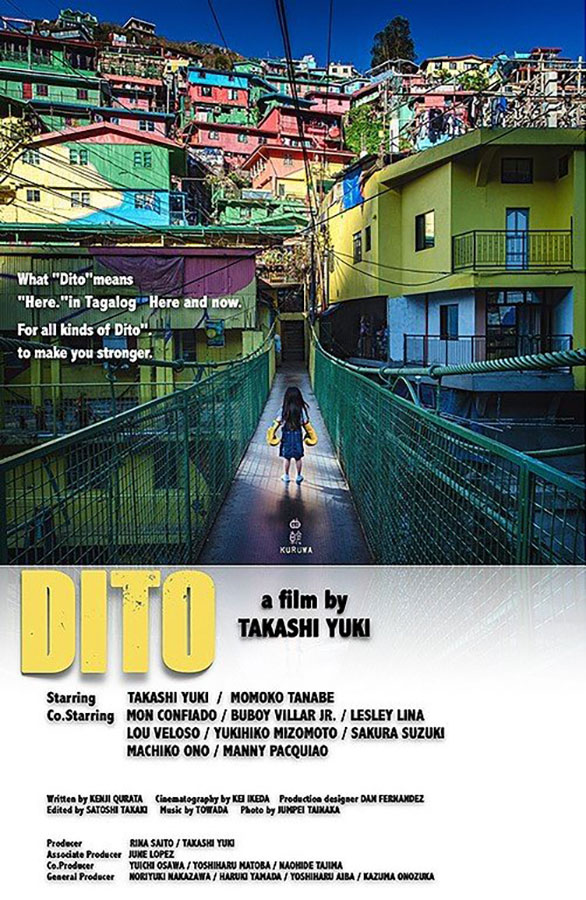
THE CINEMALAYA Philippine Independent Film Festival is screening several free films this week. DitO by Yuki Takashi tells the story of a father in the world of Filipino boxing, starring seasoned actors like Mon Confiado and Lou Veloso as well as boxing legend Manny Pacquiao. In partnership with The Japan Foundation in Manila, it will be shown on Aug. 7 at 2 p.m. at Ayala Malls Manila Bay in Parañaque. On the same day, the Metropolitan Theater in Manila will screen multiple films: a set of Cinemalaya shorts as a tribute to curator and archivist Teddy Co, and the digitally remastered Jose Rizal by Marilou Diaz-Abaya. The former will be shown at 1 p.m. and the latter at 4 p.m. Finally, fans of Fernando Poe, Jr. can catch a special screening of the digitally remastered film Asedillo on Aug. 9, 1 p.m., at the Metropolitan Theater. The Cinemalaya 2024 film festival runs from Aug. 2 to 11 at Ayala Malls Manila Bay in Parañaque City. Counting the films in competition, exhibition films, retrospectives, and premieres, the festival’s lineup this year totals 200 films. For more details including the screening schedules, visit the CCP and Cinemalaya websites and social media pages.


Robinsons Galleria celebrates International Cat Day

THE ROBINSONS Malls Happy Pets Club, together with Quezon City Veterinary Department, is celebrating International Cat Day on Aug. 8. The day will be filled with giveaways, informative pet talks, and a series of free pet services. “Meow Mania: An International Cat Day Celebration” will take place at Robinsons Galleria’s Main Atrium. Some of the services include free spay and neuter, free anti-rabies vaccination, and free vet consultation. One of the anticipated events is The Gift of Furever Home, a pet adoption drive. Renowned veterinarian Dr. Nielsen Donato will also be giving a Cat Health and Wellness talk.


Gateway welcomes Star Wars LEGO display

THE PINOY Lego Users Group (PinoyLUG) has assembled an extensive collection of LEGO portraits of various Jedi and Sith images from the Star Wars film franchise universe. The display is on view at the Activity Area of the Gateway Mall 1 in Cubao, Quezon City. It runs until Aug. 9 and is up all throughout mall hours, from 10 a.m. to 9 p.m., for Star Wars fans to peruse and admire.


Cinemalaya Film Market holds filmmaking talks, book launches

FILMMAKERS and other industry leaders will be at the Cinemalaya Bente: Loob, Lalim, Lakas — the Cinemalaya Film Market, which is part of the ongoing Cinemala Independent Film Festival. The Cinemalaya Film Market events, which will be held at the Ayala Malls Manila Bay’ Japan Town on the fourth floor, kick off on Aug. 6, at 3 p.m., with Mae Caralde of the Cultural Center of the Philippines’ Film Division who will discuss the opportunities that Gawad Alternatibo creates for beginner filmmakers. On Aug. 7, at 2 p.m., GMA journalist Howie Severino will talk about the importance of documentaries and truthful storytelling. On Aug. 8, at 3 p.m., Philippine-Japan co-productions will be discussed by Japanese filmmaker Yuki Takashi, Filipino visual artist Jaime Pacena III, and Japan Foundation president Ben Suzuki. On Aug. 9, Jem Quiambao of CMB Film Services will talk about post-production work at 3 p.m., and Doy Del Mundo will be launching his book, Archival Afterlives, at 4:30 p.m. Finally, a discussion on cinematography and editing will take place on Aug. 10, at 3 p.m.


Tickets for The Bootleg Beatles concert now on sale

FANS of The Beatles in the Philippines will have the chance to watch the tribute band The Bootleg Beatles in their upcoming concert on Oct. 26. Tickets are now available for the show, presented by Concert Republic. The quartet —  Steve White playing Paul McCartney, Stephen Hill as George Harrison, Paul Canning as John Lennon, and Gordon Elsmore as Ringo Starr — aims for a near-authentic sound and uncanny resemblance. Their performance will be at The Theatre at Solaire, Paranaque, on Oct. 26, 8 p.m. Tickets, with prices ranging from P1,850 to P6,850, are available via TicketWorld online and outlets nationwide.


Real Life Fiction screens exclusively at SM Cinemas

THIS August, Black Cap Pictures is opening Real Life Fiction starring Piolo Pascual. The Philippine-produced English language film also stars Jasmine Curtis-Smith and Epy Quizon, with the special participation of Lav Diaz. Directed and written by Paul Soriano, the film is an intense psychological drama about an actor (Pascual) who must come to terms with what’s real and not after years of being one of the most famous actors of his time. It opens Aug. 28 exclusively at SM Cinemas.


Angeline Quinto sings for BTS-based K-drama

THE KOREAN drama series Begins Youth has chosen Angeline Quinto to sing the English version of its theme song “Take It All.” It marks her first notable release after signing with her new record label, Universal Records Philippines. The K-drama, which premiered in April, follows seven boys overcoming personal and family challenges. It is based on the fictional story The Most Beautiful Moment in Life, a narrative that the K-pop boy group BTS has been showcasing through their albums, music videos, and other official content since 2015. The song “Take It All,” originally performed by South Korean artist JEMMA, has been reimagined by Ms. Quinto, and is now available on all digital music streaming platforms.


The Script announces February concert in Manila

THE MULTI-AWARDED and platinum-selling Irish band The Script is returning to Manila on Feb. 11, 2025, in a stop of their Satellites World Tour. Presented by Midas Promotions and Wilbros Live, the concert will be at the Araneta Coliseum in Cubao, Quezon City. Tickets go on sale on Aug. 10, 10 a.m., via TicketNet.com.ph and TicketNet outlets nationwide.


Animé film Look Back in PHL cinemas this August

PRESENTED by Encore Films, the Japanese film Look Back will open in Philippine theaters on Aug. 28. The animated movie, directed by Kiyotaka Oshiyama and starring Yumi Kawai and Mizuki Yoshida in the voice cast, is based on an award-winning manga by Tatsuki Fujimoto, creator of Chainsaw Man. The story of growing up follows two completely different girls — overly confident Fujino and the shut-in Kyomoto — who bond over a love for manga. The tearjerker manga and film about the beauty of friendship were both critically acclaimed and highly popular in Japan.


10cm to perform K-Drama soundtracks live

FANS of the original soundtracks of popular K-drama series such as Queen of Tears are probably familiar with 10cm. The South Korean acoustic-folk indie singer is known for his contributions to K-drama soundtracks. This August, he will serenade fans in the Philippines in the 10cm Closer to You concert on Aug. 31 at the Newport Performing Arts Theater in Pasay City. The singer, whose real name is Kwon Jung-yeol, is known for songs like “But It’s Destiny” (from Crash Landing on You), “Where is Dream” (from Start-up), “Lean on Me” (from Hotel del Luna), “My Eyes” (from Goblin), and many more. Tickets, with prices ranging from P2,000 to P9,000, are now available at all TicketWorld and SM Tickets outlets nationwide.

Philippine peso still 49.7% undervalued against US dollar

(If based on Big Mac prices)

As of July 2024, a Big Mac costs $5.69 in the US compared with P167 in the Philippines, implying an exchange rate of P29.35 versus the dollar. This contrasts with the actual exchange rate of P58.38, which means that the peso is still undervalued by 49.7%. The Economist’s Big Mac Index is based on the theory of purchasing power parity, suggesting that in the long run, exchange rates should adjust to equal the price of a basket of goods and services in different economies. This approach is used to help estimate how much one currency is under- or overvalued relative to another.

Philippine peso still 49.7% undervalued against US dollar

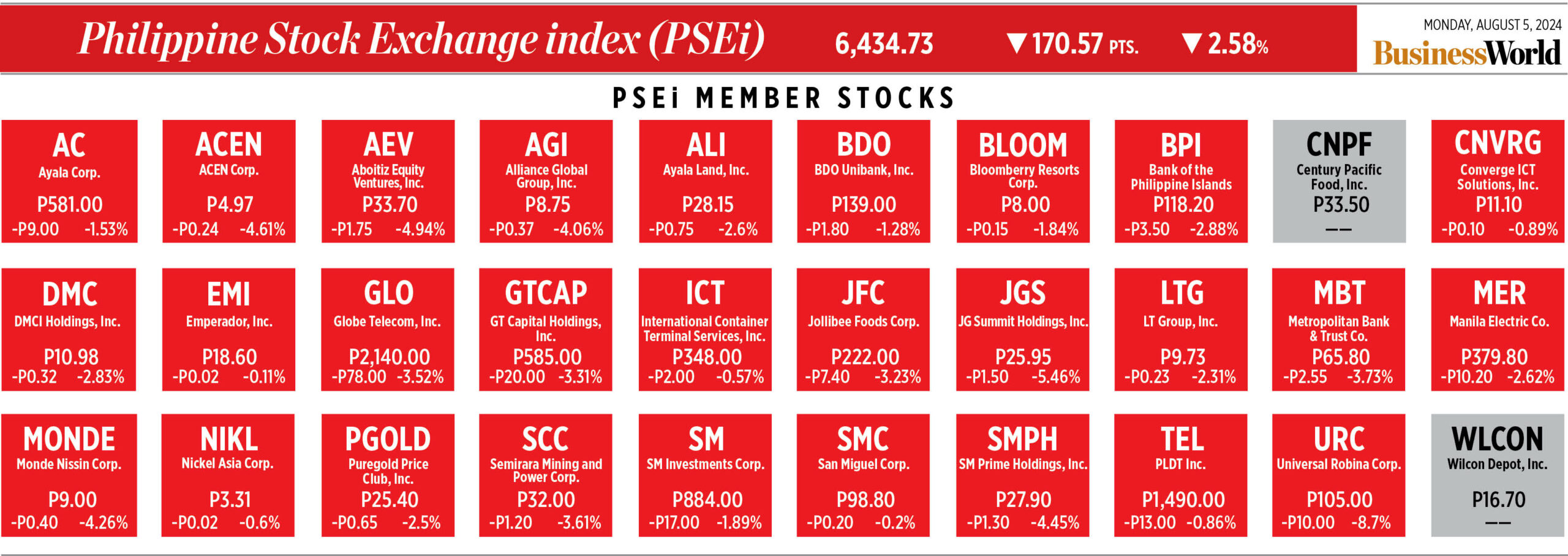
How PSEi member stocks performed — August 5, 2024

Here’s a quick glance at how PSEi stocks fared on Monday, August 5, 2024.


Charges vs Lotilla have potential to drive investors away, PCCI says 

RAPHAEL P.M. LOTILLA — ONENEWS.PH

THE Philippine Chamber of Commerce and Industry (PCCI) said it is concerned about the broader damage that may result from the allegations against Energy Secretary Raphael P.M. Lotilla, threatening the momentum being built up in developing the energy industry.

“We are competing against other countries in the region in enticing foreign direct investment (FDI) to come to our shores; let us not create an air of uncertainty that could dissuade these investments,” the PCCI said in a statement on Monday.

“We recognize the excellent work that Mr. Lotilla is doing. We support the direction he is taking to achieve energy security and affordability for the country, the two key components to bring in investments, expand domestic enterprises, and enhance our productivity and competitiveness,” it added.

Criminal and administrative complaints were filed by the Power for People Coalition (P4P) against Mr. Lotilla for endorsing the Aboitiz-owned Therma Visayas, Inc. Unit 3 expansion in Cebu.

In a statement last month, P4P said that Mr. Lotilla’s endorsement of the project violates the moratorium on greenfield coal-fired power projects declared by the previous administration.

The PCCI noted that the moratorium does not cover existing coal-fired power generation facilities, coal-fired power projects classified as committed, existing power plant complexes with firm expansion plans, or projects that have made significant progress.

“We endorse the holistic energy solution as presented by the Department of Energy, where coal remains an important component for economic growth while waiting for clean, reliable, and affordable baseload technologies,” it said.

“Given that the Philippines is not a major carbon emitter and that it is not a wealthy country, a more pragmatic approach towards climate change needs to be emphasized, focusing our limited resources towards climate adaptation. Let us avoid being distracted by western policies that may be appropriate for their country contexts but not ours,” it added.

The PCCI said that the Philippines should learn from the Panay power outages, the dry-season red and yellow alerts, and Typhoon Carina that downed electricity poles. It called for a focus on energy security to keep factories open and to keep people at work.

“Insecurity of supply causes harm that can affect the lives of consumers and businesses and ultimately hinders our country’s resilience and march toward progress,” it said.

“In light of increasingly inclement weather, we must also be mindful to invest in the greater resilience of our energy systems, of which coal, gas, and other technologies can provide us greater security against high winds and strong rains,” it added. — Justine Irish D. Tabile

Farmers question TESDA capacity to train farmers

ATI.DA.GOV.PH

FARMERS said on Monday that the government needs to allocate more money from the farmer training budget of the Rice Competitiveness Enhancement Fund (RCEF) to specialist agencies run by the Department of Agriculture (DA).

In a statement, the Federation of Free Farmers (FFF) cited the large share of the training funds that go to the Technical Education and Skills Development Authority (TESDA), and questioned TESDA’s capacity to conduct such training.

RCEF provides funding of P1 billion a year to agricultural training programs, with 70% going to TESDA. The remainder is equally shared by the Agricultural Training Institute (ATI), the Philippine Rice Research Institute and the Philippine Center for Postharvest Development and Mechanization.

“The funds should be used to upgrade the training and extension programs of these DA agencies, in line with the DA’s overall strategy and objective to improve farmer productivity and competitiveness,” FFF National Manager Raul Q. Montemayor said.

The Rice Tariffication Law, or Republic Act No. 11203, funds RCEF from rice import tariffs. The law liberalized rice imports but made importers pay an initial 35% tariff on Southeast Asian grain.

The government, via Executive Order No. 62, has since slashed rice tariffs to 15% on grain from all countries until 2028.

Mr. Montemayor added that TESDA does not have the mandate to provide agricultural training to farmers.

The FFF said that TESDA’s primary function is to distribute scholarship vouchers to trainees in farmer field schools and learning sites which are accredited by the ATI.

The group added that some training centers given scholarship slots by TESDA have reported low levels of farmer enrolment.

“Part of the training fund should also be invested in facilities and systems that will enable concerned DA agencies to sustain their activities even after RCEF,” Mr. Montemayor said. — Adrian H. Halili