Home Blog Page 2367

TDF yields slip on BSP, Fed bets

BW FILE PHOTO

TERM DEPOSIT yields slipped on Wednesday as the offer went undersubscribed and with markets anticipating further policy easing by both the Bangko Sentral ng Pilipinas (BSP) and US central bank.

The BSP’s term deposit facility (TDF) attracted bids worth P250.598 billion, below the P280 billion on the auction block and P290.223 billion in bids a week ago for a P250-billion offer.

Tenders for the seven-day debt reached P154.953 billion, lower than the P160 billion auctioned off by the central bank. This was also below the P177.147 billion in bids seen for the P140 billion offered last week.

Banks asked for yields of 5.975% to 6.0815%, narrower than the 5.97% to 6.0825% margin a week earlier. This caused the average rate of the one-week deposits to slip by 0.32 basis point (bp) to 6.0584% from 6.0616% previously.

Meanwhile, bids for the 14-day term deposits reached P95.645 billion, also lower than the P120-billion offer and P113.076 billion in tenders a week ago for the P110 billion placed on the auction block.

Accepted rates ranged from 6% to 6.125%, steady from the margin seen a week ago. Still, the average rate for the two-week deposits decreased by 0.18 bp to 6.0902% from 6.092% last week.

Meanwhile, the BSP has not auctioned off 28-day term deposits for more than four years to give way to its weekly offer of securities with the same tenor.

The central bank uses the term deposits and the BSP bills to mop up excess liquidity in the financial system and to better guide market rates.

Term deposit yields declined amid expectations of further policy easing by the Philippine central bank, Michael L. Ricafort, chief economist at Rizal Commercial Banking Corp., said in a Viber message.

BSP Governor Eli M. Remolona, Jr. last week said the Monetary Board could either keep or cut benchmark rates at its Dec. 19 policy meeting.

Inflationary pressures would warrant a pause, while weaker-than-expected growth would pave the way for another rate cut, he said.

Since August, the BSP has delivered a total of 50 bps worth of cuts, bringing the policy rate to 6%.

Markets are also pricing in further reductions from the US Federal Reserve, Mr. Ricafort added.

Consumers’ average inflation expectations over the next 12 months dropped to 4.9%, the lowest since March 2020, from 5.3% in October, Reuters reported.

Nonetheless, high prices remain a concern, with consumers saying lower prices was their top wish for the new year. Frustration over inflation swept Trump to victory over Vice President and Democratic Party candidate Kamala Harris.

There are, however, concerns that the president-elect’s economic policies could stoke inflation, and slow the pace of interest rate cuts next year.

Minutes of the Federal Reserve’s Nov 6-7 policy meeting published on Tuesday showed officials appeared divided over how much farther they may need to cut rates. The US central bank started lowering rates in September, having hiked them in 2022 and 2023 to combat inflation.

Markets currently see a 63% chance of a 25-basis-point rate cut by the Fed in December, as per the CME group’s FedWatch tool.

Mr. Ricafort also cited the decline in global crude oil prices.

Oil prices steadied on Wednesday, with markets assessing the potential impact of a ceasefire deal between Israel and Hezbollah, and ahead of Sunday’s OPEC+ meeting of producers, Reuters reported.

Brent crude futures rose 5 cents to $72.86 a barrel by 0415 GMT, while US West Texas Intermediate crude futures were up 3 cents at $68.80 a barrel. — Luisa Maria Jacinta C. Jocson with Reuters


VAT exemption for all prescription drugs

ALEXANDER GREY-UNSPLASH

The Food and Drug Administration (FDA) recently updated its list of prescription drugs and essential medicines exempt from value-added tax (VAT), adding 16 new medicines for the treatment of cancer, diabetes, and mental illnesses. The VAT exemption aims to make these medicines more affordable for the general public. However, this piecemeal approach, while commendable, falls short of addressing the broader issue of healthcare affordability.

Seniors and Persons With Disabilities (PWDs) already enjoy VAT exemptions on their prescription medicines, coupled with a 20% discount. This also extends to their vitamins and supplements, if prescribed. Additionally, certain medicines for hypertension, cancer, mental illnesses, tuberculosis, kidney diseases, diabetes, and high cholesterol are now universally exempt from VAT. These measures are steps in the right direction, but they leave significant gaps.

In my opinion, the FDA should abandon its selective exemption process. Instead, Congress should pass legislation to exempt all prescription drugs from VAT. While this may erode tax revenues, it would significantly reduce the financial burden of healthcare on patients, particularly the poor, and lower the public cost of maintaining government inventories of essential medicines.

Healthcare costs are a global concern. Taxing essential medicines exacerbates the financial strain on patients, who may already struggle to afford basic needs. The government should exempt all prescription drugs from all forms of sales tax as a way of ensuring affordability and equity. This universal exemption would prevent inequities in access and demonstrate a strong commitment to public health No one should be forced to choose between buying medicine and meeting other essential needs. Medicine, like food and water, is a basic necessity. Taxing essential medicines is not only regressive but also perpetuates inequality and undermines the principle of universal healthcare. By taxing medicine, we effectively penalize illness — an injustice that disproportionately affects those least able to bear the cost.

Access to medicine is fundamental to the right to healthcare. Universal healthcare demands universal access to affordable medicines. Without VAT exemption for all prescription drugs, we fall short of achieving true universality. The current practice of taxing medicines unfairly punishes those who are sick and amplifies the challenges faced by people with chronic illnesses requiring long-term treatment.

VAT undeniably inflates the cost of medicine. The key question is whether the revenue collected from taxing medicines outweighs the public health benefits of universal VAT exemption. There may be evidence to suggest that it does not. High out-of-pocket costs deter many from seeking timely treatment, leading to poorer health outcomes and higher long-term healthcare expenditures.

Tax exemption should be viewed as an investment in public health rather than a cost. Preventing illness and reducing the need for expensive interventions saves more in the long run than the short-term revenue gained from taxing medicines. Universal exemption would also reduce the administrative burden of maintaining and updating selective exemption lists.

Countries like the United Kingdom and Canada have long recognized the essential nature of medicines by exempting prescription drugs from sales taxes entirely. Australia takes this a step further, combining tax exemptions with subsidies to make medicines even more accessible. These policies have demonstrably improved access and public health outcomes in their respective countries.

In contrast, the United States adopts a mixed approach. While federal laws exempt prescription drugs from taxes, some states still impose sales taxes on medicines. This patchwork system creates disparities in affordability and access. Similarly, India levies a sales tax on medicines, with limited exemptions. However, India’s robust generics industry helps mitigate costs domestically, making medicines more accessible despite the tax burden.

In the Philippines, VAT exemptions apply only to specific medicines. This selective approach creates “unequal relief,” leaving patients with other chronic conditions to bear high out-of-pocket costs. If the government truly aims to achieve universal healthcare, it must move away from piecemeal measures and adopt a comprehensive, universal exemption policy.

Admittedly, transitioning to a blanket VAT exemption for all prescription drugs will require careful consideration of its economic impact. While the government may lose revenue initially, the long-term benefits — including improved public health, reduced hospitalizations, and lower healthcare costs — would far outweigh these losses. Moreover, universal exemptions simplify tax administration, reducing compliance costs and opportunities for fraud.

One concern is the potential fiscal impact. How much VAT revenue does the government collect from medicine sales? This is a question that requires precise data from the Bureau of Internal Revenue (BIR) and the Department of Finance (DoF). A comprehensive cost-benefit analysis would help policy makers weigh the trade-offs and craft a sustainable policy.

The VAT exemption could begin with prescription drugs and expand over time to include other medical essentials, such as diagnostic tools and treatment products. Supplements, while beneficial, can be considered at a later stage. Complementing tax exemptions with subsidies for high-cost medicines would further enhance affordability and access.

Universal VAT exemption for all prescription drugs would be a clear statement of the government’s commitment to social equity and public health. Healthcare savings from reduced medication costs, coupled with the economic benefits of a healthier population, make this policy a win-win for all stakeholders.

As the Philippines continues its transition to universal healthcare, it must address the inequities in its current VAT policy. Universal exemption would bring us closer to the ideal of a healthcare system where no one is left behind due to financial barriers. A selective tax exemption for life-saving medicine is contrary to this ideal.


Marvin Tort is a former managing editor of BusinessWorld, and a former chairman of the Philippine Press Council.

matort@yahoo.com

Innovation dev’t credit quota may cause banks’ bad loans to increase

By Luisa Maria Jacinta C. Jocson, Reporter

THE MANDATED lending quota for innovation development on banks may lead to a surge in nonperforming loans (NPLs) and to banks opting to incur penalties than meet the requirement, analysts said.

“I’m more concerned about the implications on NPLs, which has been trending higher in recent months. Micro, small, and medium enterprises (MSMEs), especially start-ups, have a certain risk profile that might lead to higher NPLs for the banks,” AP Securities, Inc. Research Head Alfred Benjamin R. Garcia said.

Under the Philippine Innovation Act, all public and private banks are required to set aside at least 4% of their total loanable funds for innovation development credit.

The Bangko Sentral ng Pilipinas (BSP) recently released draft implementing rules for the law.

Based on the BSP’s draft rules, borrowers eligible for innovation development credit include “MSMEs, startups, innovation centers, business incubators and other entities that facilitate and support the development of new technologies, product innovation, process innovation, organizational innovation, and marketing innovation.”

Mr. Garcia noted the risk of higher NPLs if banks ramp up lending to small businesses.

Latest data from the BSP showed that the banking industry’s gross NPL ratio slipped to 3.47% in September from the over two-year high of 3.59% in August. However, it was still higher than 3.4% in the same period in 2023.

Bienvenido S. Oplas, Jr., president of a research consultancy and of the Minimal Government Thinkers think tank, said these kinds of mandates are the “bane of innovation and finance liberalization itself.” 

“Take the mandatory 25% of banks loanable amount to be allocated for agriculture via the Agri-Agra law. Banks would rather pay the penalty for not reaching that mandatory 25%,” he said in a Viber message.

Separate BSP data showed that loans extended by Philippine banks to MSMEs reached P488.13 billion as of end-June. This accounted for only 4.52% of their total loan portfolio of P10.8 trillion, well-below the required 10% quota.

Under the Magna Carta for MSMEs, banks must allot 10% of their loan portfolio for small businesses. Broken down, 8% must go to micro and small enterprises while the remaining 2% goes to medium-sized businesses.

However, banks have long opted to incur penalties for noncompliance instead of taking on the risks associated with lending to small businesses.

“This mandatory 4% of loanable amount for innovation is another bane. Some banks can easily fill that while others won’t be able to, so they will be fined by the BSP,” Mr. Oplas said.

He warned against similar mandates and overly regulating banks.

“The government does not need legislation to mandate that people should eat, should sleep, should take vacation. People do it on their own without government mandate because it’s the right thing to do for themselves,” he said.

“So, I do not think this law will achieve its goal without creating economic and (financial) distortion somewhere. The BSP can only minimize the distortions by liberalizing as many sectors as possible to be qualified as ‘innovation’ loans,” he added.

On the other hand, Mr. Garcia said although the 4% quota may be considered small, this is equivalent to more than P700 million.

He also said banks would likely be able to meet the lending quota.

“However, it’s a good thing that the definition of funding provided for innovation development is quite broad and includes investments in equities of startups so it shouldn’t be a problem for banks to meet the quota.”

Under the draft rules, the BSP identified the modes of compliance with the mandatory credit requirement, namely direct and alternative compliance.

Direct compliance covers loans granted to qualified borrowers after Aug. 6, 2019 for innovation development.

Meanwhile, the allowable alternative compliance include investments in bonds issued by the Development Bank of the Philippines and Land Bank of the Philippines with proceeds used exclusively for on-lending for innovation development, as well as in debt securities with proceeds going to innovation development, and loans to or investments in financial entities, excluding banks, that provide supply chain financing for MSMEs that promote innovation.

Investments in the equities of startups can also be counted as compliance with the credit quota, among others.

The draft rules also detail penalties for noncompliance or under compliance with the credit quota.

These penalties shall be computed at one half of 1% (0.5%) of the amount of noncompliance or under compliance and will be directed towards innovation development.

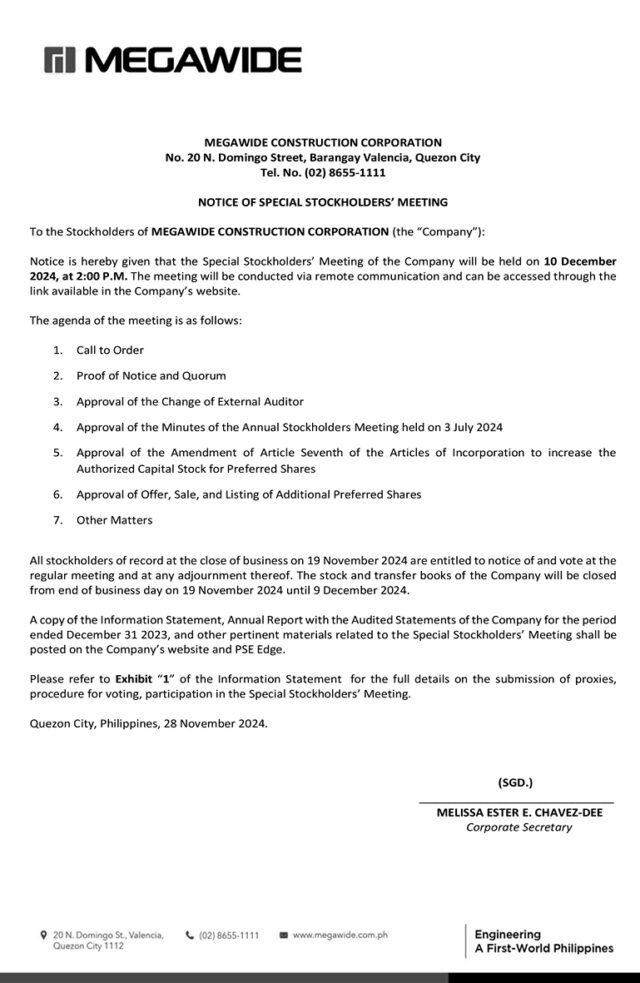
Megawide Construction Corp. announces Special Stockholders’ Meeting on Dec. 10 via remote communication


Spotlight is BusinessWorld’s sponsored section that allows advertisers to amplify their brand and connect with BusinessWorld’s audience by publishing their stories on the BusinessWorld Web site. For more information, send an email to online@bworldonline.com.

Join us on Viber at https://bit.ly/3hv6bLA to get more updates and subscribe to BusinessWorld’s titles and get exclusive content through www.bworld-x.com.

CSB, Game Developer Association sign MoU to upskill students

TRUSTPAIR.COM

THE Game Developer Association of the Philippines (GDAP) and the De La Salle-College of Saint Benilde (DLS-CSB) recently signed a memorandum of understanding (MoU) to provide workshops and seminars for students looking to enter the gaming industry.

“This shared venture seeks to advocate for student internships, along with exposure and immersion trips for the faculty and associates,” GDAP said in a statement.

The partnership is also looking to endorse the micro-credentialing of Benilde courses are relevant to GDAP and the industry.

GDAP serves as the country’s premier digital game development trade association. It aims to support growth in the digital gaming industry by spreading awareness and engaging in academic linkages.

“With GDAP’s expertise in the field, the cooperation intends to provide cooperative workshops, seminars, and conferences for the Benildean community as well as the public,” it said.

GDAP President James Ronald Lo said this is the group’s first MoU with a school, which is expected to help in increasing digital gaming professionals in the country.

The partnership between GDAP and DLS-CSB is about building the future of game development in the Philippines, said DLS-CSB Chancellor Benhur A. Ong.

“We incorporated on a business journey to create the very first full game development education curriculum in the country,” Mr. Ong was quoted as saying.

The school’s game design and development program took 15 years to be finalized, Mr. Ong said.

In 2009, DLS-CSB first introduced gaming design as a program with its Bachelor of Science in Information Technology degree with specialization in Game Design and Development.

The revamped program, the Bachelor of Science in Interactive Entertainment and Multimedia Computing, was launched in 2015.

“We’re not only equipping our students with the skills they need. It’s also about helping them engage with real-world challenges,” Mr. Ong said.

“We hope that the aim is clear — to bring academia into the industry so that our students can be game changers.”

DLS-CSB ROLLS OUT ONLINE ENTRANCE EXAM
Meanwhile, DLS-CSB also announced the implementation of a fully online entrance examination with computer-aided proctoring.

The revamped Benilde Entrance Examination (BEE) aims to offer a flexible and accessible exam option, the school said. The online BEE will be rolled out for the application period for academic year 2025 to 2026.

“To ensure academic integrity and fair assessment, the system translates the traditional paper-and-pencil exam into a timed computerized test format that utilizes advanced technology for delivery and security. It likewise adopts facial and voice recognition technology to evaluate the environment, movement, and behavior of the candidates,” it said in a separate statement.

“Through this new modality, applicants may accomplish the exam remotely provided that they have a laptop or desktop and a stable internet connection. The technical requirements likewise include a webcam, external microphone or headset, and a mobile phone to be used as a secondary camera.”

Applicants will receive exam schedule confirmation and instructions via e-mail and will have to complete a pre-test check prior to the exam.

“For those who need specific assistance or accommodation, the college will offer in-campus examinations to be held at the designated computer laboratory on identified schedules,” DLS-CSB said. “Students are expected to accomplish the BEE without aids and tools, apart from plain bond paper and pencil during the Mathematics Exam.”

Both the online and on-site exams will still be monitored by a human proctor, it added. — Beatriz Marie D. Cruz

SMIC says logistics, RE to drive future expansion

PHILSTAR FILE PHOTO

THE LOGISTICS and renewable energy (RE) sectors will be key drivers for SM Investments Corp.’s (SMIC) future expansion, a company official said.

“The areas of logistics and renewable energy alone have a lot of potential,” SMIC Executive Vice-President for Treasury, Finance, and Planning Erwin G. Pato told reporters on the sidelines of the BusinessWorld Forecast 2025 forum on Tuesday.

“How we look at the investments is that we want to be good at it first before we continue expanding to others. We are at that stage where we understand the logistics business much better, and that is why we continue to invest in that business. It is the same with renewable energy. That’s why, as we understand steam production better, we engage with more concession sites,” he added.

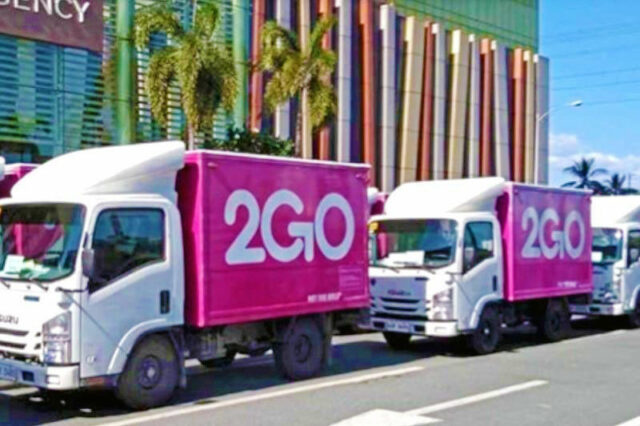
SMIC operates in the logistics sector through 2GO Group, Inc. and in the renewable energy sector through Philippine Geothermal Production Co., Inc. (PGPC).

In June last year, PGPC announced plans to build five new geothermal projects in Luzon.

“Our aim is to essentially increase our steam output supply,” Mr. Pato said.

Mr. Pato said SMIC is open to other renewable energy technologies such as solar and wind projects.

“Clean energy is a space that we’re looking at and has a lot of potential,” he said.

He also said that SMIC’s capital expenditure (capex) budget for 2025 could match this year’s.

The conglomerate announced in April that it had allocated up to P115 billion in capex for this year.

“We have to look at it because with lower interest rates and easing funding, as the Bangko Sentral ng Pilipinas (BSP) has decreased the reserve requirements, there can be opportunities to expand. It will be around the same as we have this year,” he said.

The BSP previously reduced the reserve requirement ratio for big banks and nonbank financial institutions with quasi-banking functions by 250 basis points (bps) to 7% from 9.5%.

It also reduced the ratio for digital banks by 200 bps to 4%; thrift banks by 100 bps to 1%; and rural banks and cooperative banks by 100 bps to 0%.

“How we decide on funding is we ask ourselves which one is more efficient,” Mr. Pato said.

Meanwhile, 2GO Group, Inc. is expected to see growth in its passenger volume next year.

“2GO is already in expansion mode. As we grow our routes in Iloilo, Bacolod, Cagayan de Oro and Manila, it unlocks transfer of goods and services,” Mr. Pato told BusinessWorld.

“But more importantly, as you connect the tourist areas and industrial areas, then it will spur more economic activity, and as that happens 2GO would also be better in terms of financials.”

For now, he said the company will not be exploring new routes as it intends to further grow its services in its current operations.

“There is still a lot of potential within those routes. It is not fully served yet. We are happy with the results right now, but we will look and see how we can essentially grow within those routes,” he said.

In May, 2GO launched its newest roll-on, roll-off vessel — the MV Masigla sailing to Iloilo, Bacolod, and Cagayan.

For 2024, the company had announced it would allocate up to P2 billion for capex, focusing on new containers, material handling equipment, and service enhancements.

Mr. Pato said that for next year, 2GO’s capital expenditure budget will likely be around the same level.

2GO offers multimodal transportation, warehousing and inventory management, distribution, special containers, project logistics, and e-commerce logistics. It also provides sea travel, freight forwarding, import and export processing, and customs brokerage services.

On Wednesday, SMIC stocks fell by 2.44% or P22 to P879 apiece. — Revin Mikhael D. Ochave and Ashley Erika O. Jose

Dining In/Out (11/28/24)


Tatatito unveils new holiday menu

“PAGSASALO,” Tatatito’s holiday feast, encapsulates the flavors of Filipino heritage. The Lemon Garlic Scallops (P850) start the meal with a light and flavorful touch. For a bold twist on a local favorite, the Sizzling Sinigang Scallops (P980) serve up fresh scallops in a sizzling, tangy tamarind broth. Tatatito’s dishes feature locally sourced scallops from Roxas City in the Visayas. The Pinaputok na Chicken Galantina, available in both regular (P980) and sharing size (P1,680), is deboned chicken stuffed with vegetables, spices, and rich chicken mousse. It’s wrapped in fragrant pandan leaves and fired to infuse a smoky depth. Adding a touch of sweetness to the holiday table is the Blooming Hot Tsokolate (P200), made from rich cacao, served with a blooming marshmallow. Tatatito’s Ensaymada (P120) is a buttery fluffy pastry topped with a layer of cheese. Tatatito Home Kitchen is located at the OPL Bldg. along Dela Rosa St. corner Carlos Palanca in Makati. It is open from 7 a.m. to 10 p.m. on Mondays through Thursdays, and Saturdays and Sundays, and from 7 a.m. to 11 p.m. on Fridays. For reservations, book online at https://book.bistrochat.com/tatatito or call 0917-862-4000 or 8809-8055. For updates, visit tatatitoph.com or follow Tatatito on social media @tatatito.ph.


Hendrick’s offers holiday cocktails

No holiday celebration is complete without a lineup of exceptional cocktails, and Hendrick’s Gin offers just that. Hendrick’s gives a few suggestions on cocktail recipes designed to impress. Hendrick’s French 75 is a sophisticated blend of gin, zesty lemon juice, and a splash of champagne. Hendrick’s Cranberry Fizz features gin, tart cranberry juice, andthe drinker’s choice of soda or sparkling wine. Hendrick’s & Tonic showcases the unique botanicals of Hendrick’s Gin with crisp tonic water and a garnish of cucumber. Hendrick’s Gin is available at major retailers, including S&R, The Marketplace, Landmark, Shopwise, Boozeshop, and Boozy.


Eden Cheese, World Vision’s Noche Buena Project

EDEN CHEESE is helping Filipino families and children this holiday season by joining World Vision Philippines with their annual Noche Buena Project. The Noche Buena Project is the charity’s annual Christmas gift-giving campaign, to share hope and bring joy to children and their families by giving them a set of Christmas groceries they can cook and share on Christmas Eve. The project began in 2006 and has since been providing Filipino families with yearly Noche Buena sets. In 2023, World Vision Philippines gave Noche Buena packs to over 23,000 Filipino families. World Vision aims to again distribute Noche Buena packs to 23,000 families this year. Eden has partnered with World Vision to support the effort through a special promo. For every purchase of Bundle of Joy packs on Mondelez Philippines’ Shopee, Lazada, and TikTok Shop, Eden will complete a beneficiary’s Noche Buena package with Eden Cheese. A Bundle of Joy pack contains a two-pack bundle of 160g Eden Cheese. Eden has also been hosting a series of busking events, culminating at the Ayala Azuela Cove in Davao City on Nov. 30. For more information, visit the official Eden Cheese Facebook page at https://web.facebook.com/EdenCheesePH.


Tokyo Bubble Tea unwraps holiday bundles

THIS holiday season, Tokyo Bubble Tea is here to make every gathering a little brighter and a lot more bubbly. Bundle 1 (P800) is meant for two diners. It includes Maki and one main dish, like the Bibimbop, the Teriyaki Chicken Doria, or Gyudon. To complete the meal, each diner gets a drink: one Classic Milk Tea and one Fruit-C. For slightly larger gatherings, Bundle 2 (P1,200) serves three. It has a choice of a starter to share, then two main dishes from Tokyo Bubble Tea’s signature options, and a Classic Milk Tea and a Fruit-C, plus a creamy JCC (Japanese Cheesecake Cream). Bundle 3 (P1,500) serves four, and starts with a shared choice of starter, then three main dishes, and ends with two Classic Milk Teas, a Fruit-C, and a JCC. Tokyo Bubble Tea’s holiday bundles are available at the Banawe, Wilson, and Fort branches, and can also be delivered through Grab and foodpanda. Visit tokyobubbletea.com and follow Tokyo Bubble Tea on social media @tokyobubbletea for updates.


Chowking for holiday parties

CHOWKING’S #OohlalaLauriat Dance Challenge involves dancing to the Chowking jingle, and creating and sharing the dance video on social media. As for the Lauriat itself, it features six Chowking dishes all in one order. Available in Solo and Family Lauriat (good for four or six diners), it is ideal for gatherings. Each order comes with Chinese-style Fried Chicken, Pancit Canton, Siomai, Egg Fried Rice, Chicharap, and Buchi. For the Chowliday Handa promo, which runs from Dec. 1 to 12, customers can avail of a Buy 2 Get 1 Free Promo for Chinese-style Fried Chicken Lauriat and other Chowking products such as Braised Beef, Imperial Chicken Chops, Meaty Wonton-Chunky Asado Siopao Combo, and Halo-Halo Supreme. From Dec. 13 to 31, another Chowliday Handa offer involves buying any two platters, such as the fried chicken and Chao Fan platter, and get one free dimsum platter of the diner’s choice (Crispy Wonton, Lumpiang Shanghai, or Buchi Platter). For more information, visit www.facebook.com/ChowkingPH (Facebook) and @ChowkingPH (Instagram).


Mang Inasal has combo plates for parties

MANG INASAL spreads holiday cheer with its ChristmaSAYA Combo Deals, available nationwide from Nov. 15 to Dec. 31. The ChristmaSAYA Combo Deals involve a PM1 or PM2 Chicken Inasal Unli-Rice Value Meal paired with an Extra Creamy Halo-Halo or Crema de Leche Halo-Halo, made even sweeter with a ₱20 discount. Visit www.manginasal.ph for the latest news, https://manginasaldelivery.com.ph for delivery deals, and follow Mang Inasal on social media.

On gas power, Pacific Light, and coal

SINGAPORE — This small but very rich country is known for its bright lights at night, and huge indoor gardens and tall waterfalls featuring 24/7 lights and aircon like those at the Gardens by the Bay and the Jewell Changi airport, among others. The city-state has huge power generation per capita, about 10 times that of the Philippines.

Singapore is the most natural gas-intensive country in the world, with about 90% of its total power generated in liquified natural gas (LNG) plants, and another 10% generated from diesel. It has no coal or nuclear plants, no solar or wind farms. It is pure 100% fossil fuel power generation with competitive prices. It does not suffer from blackouts or power fluctuations.

Some Middle East Asia and North Africa countries — like Iran, Egypt, and the United Arab Emirates (UAE) — have gas to total generation shares of above 70%. In Asia, Thailand, and Taiwan follow Singapore in having high gas/total generation ratios (see Table 1).

Pacific Light Power (PLP) is one of the six generation companies (gencos) in Singapore that contribute to the country’s bright lights. It is the smallest among the six, with only about an 8% share of installed capacity, but it has a 10% consumer market share, meaning it is efficient and has competitive prices. It is jointly owned by Meralco Power Gen Corp. (MGen) with 58% share and First Pacific Co. Ltd. with 42%.

Singapore has no mandatory competitive selection process (CSP) — long-term supply contracts between gencos and consumers. Singapore’s retail competition and open access (RCOA) style service goes down to the household level, so households can choose their gencos for a contract of at least one year. With consumers’ ability to switch from one genco to another, each genco must be as price competitive as possible. And PLP is exactly doing that.

THE PHILIPPINE SITUATION
The Philippines has five gas plants that use either indigenous Malampaya natural gas or imported LNG. These gas plants supply between 14% to 16% of the total power generation yearly.

MGen is a potentially big player in the Philippines’ gas development, not only for its knowledge about gas power through PLP, but also through Chromite Holdings that will (hopefully) own two huge gas plants — Ilijan and Excellent Energy (EERI) — in a partnership between San Miguel Corp., Aboitiz Power, and MGen. The partnership is still subject to approval by the Philippine Competition Commission though.

Coal plants are the workhorses of the Philippines, they contribute between 60-62% of total power generation yearly. This ratio is similar to that of China, Indonesia, and Vietnam but lower than India’s 75%.

The average marginal increase in the Philippines’ power generation from 2019 to 2023 was about six terawatt-hours (TWh) a year. If the Philippines is to sustain an annual GDP growth of 6%, compounded, and avoid the frequent yellow-red alerts (low power) that we experienced until early this year, I estimate that we will need about seven to eight TWh/year from 2024-2026, then eight to 10 TWh/year from 2027-2032.

To achieve this, we will need new conventional power plants with a combined dependable capacity of 1,000 megawatts (MW) yearly. Since these are new, their projected capacity is up to 90%. To compute the potential output of a 1,000 MW conventional plant, we use this formula: (1,000 MW) x (0.90) x (24 hours/day) x (365 days/year) = 7.88 TWH/year

And to achieve this, gas, coal, or nuclear plants must be commissioned every year from 2028 onwards, and construction should start this year, not two or three years from now.

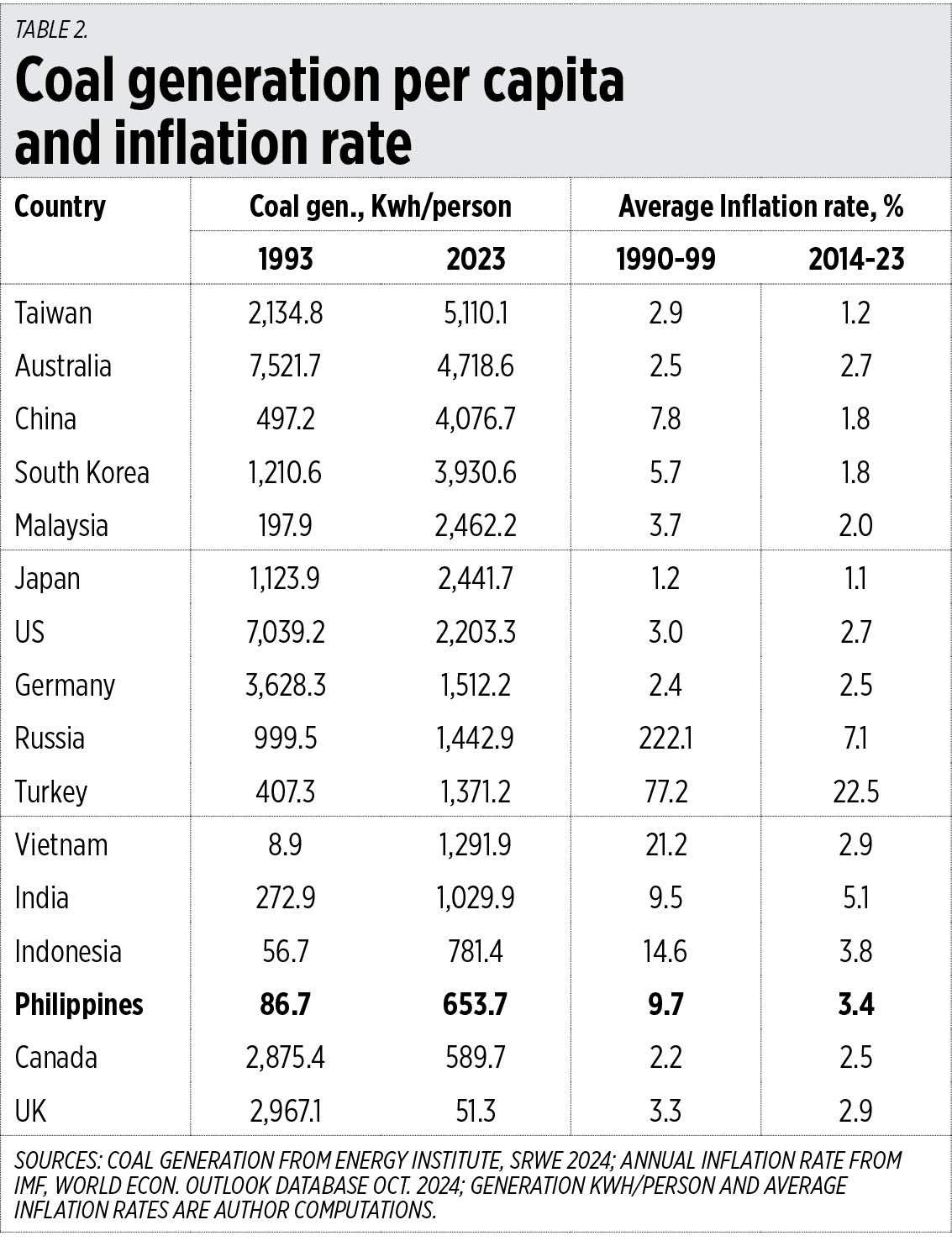
In the experience of many countries, those that shifted away from using coal experienced higher or flat inflation rates — Australia, Canada, Germany, the UK, and the US. Meanwhile, countries that increased their coal use experienced lower inflation rates — Taiwan, China, South Korea, Japan, India, Indonesia, Malaysia, the Philippines, Vietnam, Russia, and Turkey (see Table 2).

The numbers on total coal generation, population, and derivation of coal generation per capita were shown in this column’s previous article, “The Atimonan coal project, energy transition, and the ERC” (Sept. 19).

Despite the increase in the Philippines’ coal power capacity, our per capita coal generation remains the lowest in our neighborhood — it is, for instance, only one-half of Vietnam’s and only one-fourth of that of Malaysia.

We should not accede to the lobbying for the early shutdown of our coal plants unless there are huge gas or nuclear plants ready. If we do, we should be prepared for daily blackouts again like in 1990 and 1991. 


Bienvenido S. Oplas, Jr. is the president of Bienvenido S. Oplas, Jr. Research Consultancy Services, and Minimal Government Thinkers. He is an international fellow of the Tholos Foundation.

minimalgovernment@gmail.com

MPH partners with Intellicare and Avega to expand healthcare access

SIX METRO PACIFIC Health Corp. hospitals will participate in a preferred partnership program with Intellicare and Avega to offer healthcare services.

PANGILINAN-led Metro Pacific Health Corp. (MPH) has partnered with health maintenance organization Asalus Corp. (Intellicare) and Avega Managed Care, Inc., a provider of managed healthcare services, to expand healthcare access for Filipinos.

Under the partnership, six MPH hospitals will participate in a preferred partnership program with Intellicare and Avega to offer healthcare services, the company said in an e-mailed statement on Wednesday.

The participating hospitals include Asian Hospital and Medical Center in Muntinlupa; Calamba Medical Center in Laguna; Our Lady of Lourdes Hospital in Sta. Mesa, Manila; Riverside Medical Center, Inc. in Bacolod; De Los Santos Medical Center and Commonwealth Hospital and Medical Center in Quezon City.

“This strategic alliance combines MPH’s extensive network of top-tier hospitals nationwide, committed to high-quality, compassionate healthcare, Intellicare’s established expertise in managed healthcare, and Avega’s deep commitment to quality care to collectively offer Intellicare members a seamless, efficient, and affordable healthcare experience across the country,” MPH said.

Earlier in the month, MPH grew its portfolio to 27 hospitals with the acquisition of the City of General Trias Doctors Medical Center, Inc. in Cavite.

MPH is the healthcare arm of the Pangilinan-led conglomerate Metro Pacific Investments Corp. (MPIC).

Aside from its hospital network, MPH also has 33 outpatient care centers, two allied health colleges, and a centralized laboratory.

MPIC is one of three key Philippine units of First Pacific, the others being Philex Mining Corp. and PLDT Inc.

Hastings Holdings Inc., a unit of the PLDT Beneficial Trust Fund subsidiary MediaQuest Holdings, Inc., has a majority stake in BusinessWorld through the Philippine Star Group, which it controls. — Revin Mikhael D. Ochave

In Zimbabwe, Starlink’s fast internet gives telehealth a boost

STARLINK.COM

NHEDZIWA, Zimbabwe — In early November, Precious Chinonzura went to a telehealth, or e-health, booth in the local shopping center in her village in Zimbabwe to see if she could get relief from bladder pains that had been bothering her for a month.

The 30-year-old consulted a doctor online and by evening the medication he prescribed had been delivered to her village of Nhedziwa from a telehealth booth in Chakohwa, some 22 km (14 miles) away.

“The doctor told me I had a bladder infection and needed treatment. I had privacy and I spoke freely to the doctor,” Ms. Chinonzura, who runs a small business at the shopping center, told the Thomson Reuters Foundation.

Telehealth — the use of technology to provide and access healthcare services remotely — has been growing around the world but is relatively new in Zimbabwe, where internet services are generally slow, unreliable and among Africa’s most expensive.

This could change after Elon Musk’s Starlink, the satellite unit of SpaceX, received the telecom regulator’s green light in May to operate its internet services in the country.

Starlink first launched in Africa last year as satellite-internet becomes an increasingly popular connectivity solution in the continent, but it has faced teething problems — from complaints about speed to regulatory challenges.

ZimSmart Villages, which has been setting up telehealth services in Zimbabwe since February, has already connected two of its 16 e-health centers to Starlink and plans to connect five more by the end of November, said ZimSmart Villages cofounder and chief operations officer Tawanda Njerere.

There is no countrywide data on how many companies offer telehealth services in Zimbabwe.

Mr. Njerere said Starlink enabled ZimSmart Villages to allow access to its online health platform BatsiHealth, especially in underserved regions where connectivity can be a problem.

“Starlink provides the fast, low-latency connectivity that virtual consultations need for real-time telepresence on BatsiHealth,” he said, adding it is cost-effective.

“Our doctors can conduct video consultations with near in-person clarity, seeing fine visual details essential for accurate diagnoses.”

Zimbabwe’s health sector has been deteriorating for years as the ailing economy has been hit by chronic corruption, mismanagement, economic sanctions, and southern Africa’s worst drought in decades.

There are shortages of basic drugs like paracetamol, public hospitals are struggling and there is a lack of doctors and nurses, forcing people to turn to private health facilities.

As of 2022, Zimbabwe had 1.7 doctors per 10,000 people, according to the World Health Organization, compared to Africa’s average of 2.6 per 10,000 people.

STARLINK KIT TOO COSTLY FOR MOST
After first launching in Nigeria last year, Starlink is now operating in 15 countries in the continent, with Chad becoming the latest to approve the technology.

Starlink’s expansion across Africa has not been without problems — from complaints about cost and speed to regulatory challenges and resistance from local mobile operators.

Admire Mare, head of the communication and media studies department at the University of Johannesburg, said Starlink kits were too expensive despite its services being more reliable and faster than those of local providers.

Starlink’s basic internet package consists of an $170 kit and $30 monthly subscription, while at the high-end, the kit costs $350 and the subscription $50 a month. That is very costly for many in a country like Zimbabwe where a teacher, for example, earns about $350 a month.

By comparison, local provider Liquid Intelligent Technologies sells an equivalent high-end kit for $225, while its monthly subscription costs about $173.

Mr. Mare said there was a risk that the high cost of innovation would reproduce existing inequalities, since only the wealthy would be able to afford the cost of the Starlink kit and therefore be able to benefit from the cheaper internet services it provides compared to local operators.

“The rest of us are unfortunately going to remain locked up in using expensive broadband internet,” he said.

“When we talk about making sure that we bridge the digital divide some of these technologies are often presented as saviors (but they) are not going to save us.”

Some Starlink users in Zimbabwe’s capital city Harare and second-largest city Bulawayo have complained about slow speeds, with some returning to their traditional providers. The kits have also sold out in these cities, meaning new users cannot sign up for now.

Starlink has also faced regulatory challenges and resistance from state monopolies in some countries.

Cameroon ordered the seizure of Starlink equipment at ports earlier this year as Starlink was not licensed to operate in the country.

In Kenya, the country’s biggest telecoms firm Safaricom has urged regulators to consider requiring satellite internet providers such as Starlink to partner with local mobile network operators.

TRANSFORMING LIVES
Starlink’s presence in Zimbabwe already appeared to be helping consumers by connecting remote areas that are not covered by traditional internet service and by pushing local providers to reduce prices, said Dr. Danford Zirugo, assistant professor of journalism at the University of Alabama.

In August, Zimbabwe’s largest mobile operator Econet slashed prices of its SmartBiz package, which offers internet via a portable MiFi or small router, by 25%. It cut the price of its five megabytes per second unlimited package to $45 per month from $70.

Willard Shoko, a Starlink researcher and consultant, said Starlink’s presence in Zimbabwe could revolutionize its health sector though more ground stations were needed to boost services.

“When you connect hospitals and clinics to high-speed internet, it means that doctors from anywhere in the world can collaborate. This can be the difference between a life being saved and a life being lost,” he told the Thomson Reuters Foundation.

Back in Nhedziwa, Chinonzura said the benefits of telehealth centers were already proving to be immense.

If she hadn’t had access to an online doctor, she would have had to close her business and travel to the city of Mutare, 83 km (51.5 miles) away, or to Harare, nearly 350 km (217 miles) away.

“I could not believe it. I did not know that it was possible,” said the mother-of-two. “I will come here whenever I feel sick for consultation and checkups.” — Thomson Reuters Foundation

London’s pie and mash makers say Cockney favorite needs special status

MANZE.CO.UK

LONDON — Rick Poole grew up in his family’s pie and mash shop in London, the oldest of its kind still in operation today. Now a campaign to give the traditional dish protected status is giving him hope his business will continue to flourish for years to come.

Pie with mashed potato and parsley liquor has been enjoyed by the Cockney natives of east London since the first shops appeared there in the 19th century.

Back then, the pies were filled with eels as they were cheap and plentiful in the River Thames.

The eels have long been replaced with minced beef but jellied eels are still available on the side.

“It gives you a good feeling knowing that you are keeping this tradition alive for over 120 years,” said 61-year-old Mr. Poole, director of M. Manze, who owns several shops including the flagship in Tower Bridge which retains its original green tiles and furniture. The family took it over in 1902.

Mr. Poole said protected status would give businesses like his some security as it would stop others from falsely claiming they were making the dish in the traditional way.

Britain, like the European Union, grants protected status to food and drink that come from a defined area or follow a specific recipe as a guarantee of authenticity. Cornish pasties, Melton Mowbray pork pies, and Blue Stilton cheese are well known examples.

Campaigners, including from the Modern Cockney Festival, are calling on the government to grant Traditional Speciality Guaranteed (TSG) status to the London meal.

Rather than being a geographic label, TSG means products must use traditional methods of production or follow a traditional recipe.

All pie shops have their own unique recipes. But environment minister Daniel Zeichner has said that all producers would need to agree on a common recipe in order to receive the status.

Andy Green, founder of the Modern Cockney Festival, said the label would not only give shop-owners a “sense of belief that they are guardians of a culture” but may also boost the dish’s global recognition.

He said he hoped a decision would be made next year.

Mr. Poole’s daughter Emma Harrington, who is also a company director, said generations of Londoners had been brought up on pie and mash. “It’s in their blood and their heritage,” she said. — Reuters

Ateneo mathematicians develop AI tools to forecast money market rates

MATHEMATICIANS from the Ateneo de Manila University have developed artificial intelligence (AI) deep learning tools for predicting secondary market interest rates.

The AI learning models can be used by both the government and businesses to help manage risks and reduce borrowing costs, Ateneo’s Office of the Assistant Vice-President for Research, Creative Work, Innovation said in a statement.

The research paper titled “Deep Learning Approaches in Interest Rate Forecasting” and authored by Ateneo’s Halle Megan L. Bata, Mark Jayson A. Victoria, Wyonna Chezska B. Alvarez, Elvira P. de Lara-Tuprio, and Armin Paul D. Allado was published in the journal AIP Conference Proceedings on Nov. 15.

“Interest rates are among the most important macroeconomic factors considered by both government and private entities when making investment and policy decisions. A reliable forecast is a requisite to sound management of exposure to different types of risk,” the Ateneo researchers were quoted as saying.

The researchers tested two deep learning models for rate forecasting: the Multi-layer Perceptrons (MLP) and Vanilla Generative Adversarial Networks (VGAN).

The MLP model is a type of artificial neural network that passes the data through a series of cells to find complex patterns in data.

Meanwhile, the VGAN is made up of two networks — a synthetic data generator and a discriminator that determines data authenticity — that work opposite each other for analysis.

“Both successfully anticipated changes in Philippine Benchmark Valuation (BVAL) rates before and during the pandemic, showcasing the models’ robust capability to potentially foresee economic fluctuations and market disruptions… The researchers found that both models produced reliable forecasts of one-, three-, six-month, and one-year BVAL rates within the limits of the datasets used. They successfully predicted key trends by incorporating as many as 16 domestic and global economic indicators, including inflation, exchange rates, and credit default swaps,” Ateneo said.

Based on the research, the MLP model performed well with fewer variables and simpler structures, while the VGAN model excelled in analyzing complex scenarios and working with larger datasets.

“The practical implications of these AI deep learning models are substantial, according to the researchers: financial institutions could potentially deploy them to manage market, credit, liquidity, and other risks; and governments could also potentially use these models to optimize debt issuance strategies by reducing borrowing costs,” Ateneo said.

“The study highlights the growing role of AI in financial decision-making and suggests exploring more advanced neural network designs to further enhance forecasting accuracy. It is hoped that businesses and policy makers will come to embrace these technologies in order to gain a competitive advantage in a rapidly evolving data-driven landscape.” — Aaron Michael C. Sy