Home Blog Page 235

About AI and power

STOCK PHOTO | Image by Macrovector from Freepik

(Second of two parts)

In my previous column*, we turned the spotlight on this observation that digitalization and artificial intelligence (AI) are being positioned as the silver bullet, the solution to the issues of corruption, government inefficiencies, and the educational crisis, among others. Any genuine effort to pursue this path, however, will necessarily confront the critical question of energy security. It is not enough, however, that preparations are made to ensure that there is sufficient generation capacity to power a Digitally Connected Philippines, as envisioned in the National Digital Connectivity Plan approved by the President last month. We must ask the much harder, transformational, if not existential, question: What is the shape or form of an electric power industry that fuels a digitally operating, AI-powered economy?

I had identified the first two points in the last column. First is the need to imagine differently. We cannot, for instance, credibly position the country as a location of choice for data centers unless we also prepare for the impact of proper siting and rate or cost allocation design, among others, that these digital storage and processing complexes will have on the larger communities and different consumer bases. In other words, the introduction of digital infrastructure to support an AI-powered economy will make the current systems unrecognizable and unworkable, unless these are likewise transformed. Second is the vital necessity of having our values clarified, articulated, and reinforced as our processes and tools become more digital. What are the beliefs and principles important to us as individuals, as a society, as a nation? How do we draw the lines we should not cross in the adoption of AI? If we are not going to be deliberate about this exercise, there is imminent danger of having the systemic ills (such as corruption, lack of economic mobility, energy poverty) simply becoming more entrenched as we grow increasingly digital.

This leads me now to the three other points.

1. Guard against the temptation to abdicate accountability. The age of AI will truly test the mettle of our policy makers and regulators as they design a new policy and regulatory environment. While regulatory work — in the energy sector and other industries — has always been about balancing competing interests to find a united path forward, the emerging intensely digital era will add another layer of challenge as government leaders try to balance hard-coding compliance without surrendering or abdicating accountability.

In the age of AI, it will be possible to roll out regulatory standards in the power sector to ensure performance metrics are monitored and met by equipment and power systems. Regulations on outage monitoring and even rates implementation can be issued with accompanying software or a digital patch to allow regulators real time access to information, increasing accuracy in data, and reducing reliance on stakeholders’ submissions. In an AI-enabled system, there is a genuine opportunity to make compliance (instead of exceptions) the norm and enforcement non-discriminatory.

Given the ease of enforcement that is possible with AI, however, there is great temptation for regulators and rule enforcers to just let AI do the job and say, “The AI made me do it.”

Professor Richard Susskind, in his book How to Think About AI, which I referenced also in the previous column, underscored this point when he discussed the political risks of AI: “The generic concern is that the technology itself (often insidiously) and those who control AI (often but not always consciously) can exert extensive control over humans’ choices, they can scrutinize our activities, and they can shape our perceptions… Crucially, this dominance is sustained currently by ‘unaccountable power’…” Therefore, he says in a later chapter, “…we should revisit how we allocate responsibility and liability when AI systems lead to blameless humans suffering loss, damage, or injury.”

As we introduce more AI-solutions to handle the increasing complexities of the Philippine power system and power markets, how do we allocate responsibility and liability for any “loss, damage or injury” that may result from the application of these solutions?

2. We need to double down on what makes us human. Not many people have tried to explain the phenomenon around Alex Eala that the world has recognized over the last few months — even the sports writers and observers who tried acknowledge that they cannot fully explain the magic. It is something that extraordinary athletes, artists, and musicians have that simply enrapture us ordinary mortals. In his book, Professor Susskind had this to say about AI in sports and the arts: “It’s not just about speed and accuracy. It’s the inspiration we derive from fellow humans at their peak. The way in which these outcomes are achieved is vital and irreplaceable part of being a spectator…(An) indispensable part of the experience is the knowledge that another human is at the other end.”

In the Philippine power sector, as the base for retail competition grows, we hope to see an AI-enabled environment that will make possible the rise of the super-consumers: those who are equipped with the right tools, the proper training to use the tools, and the maturity to exercise their power of choice wisely to effectively realize their objectives. This will lead to a tectonic shift in industry growth — driven less and less by the objectives of large infrastructure, but increasingly by the specific needs of users of the system and consumers of the goods.

3. “How do you change a wheel in a moving car?” Finally, we have to accept and be comfortable with the fact that this journey to a digitally connected economy will be one that is marked by great disruptions. Systems will need to continue working to the extent that they can, but they will also be upended to integrate better components or be replaced to produce better outcomes.

This kind of disruption will need different kinds of leaders, not necessarily of the mold and make that have been labeled as successful for the last few decades. This kind of future will need Visionary Disruptors: self-confident but flexible, able to hold on to a certain level of optimism in an environment of widespread resistance, quick and wise to seize slivers of possibilities with minimal friction, and (most importantly) willing to be rendered redundant or irrelevant in the role once the vision is achieved.

In the area of dispute resolution, for example, Professor Susskind forecasts the rise of “AI-based dispute resolution and AI-enabled self-representation supported by systems that can help people understand and enforce their entitlements for themselves.” In a limited fashion, we already see this in how our claims for refund or complaints for delays are resolved by food delivery or online shopping platforms. There is no need to file a claim and pay filing fees in any court or government office. Most cases are resolved in a matter of hours via the gadget on your hand. Imagine if consumer complaints for high or unusual power bills were resolved this quickly by our distribution utilities and electric cooperatives!

It is easy to see why we can get enamored by the promise of AI and digital solutions to solve our long-standing issues as a people. The above points are not meant to stop us on our tracks — we just need to be mindful that we cannot anticipate and prepare for tomorrow’s problems if we are locked into today’s thinking. We cannot be in a state of passive surrender as we become increasingly AI-enabled. We need to proceed instead from a point of humble discernment and breed a staging ground for more courageous exploration and purposeful action.

*Read Part 1 here: https://tinyurl.com/26jzqkkm


Monalisa C. Dimalanta is a senior partner at Puyat Jacinto & Santos Law (PJS Law). She was the chairperson and CEO of the Energy Regulatory Commission from 2022 to 2025, and chairperson of the National Renewable Energy Board from 2019 to 2021.


AirAsia X to launch KL-London service via Bahrain hub

NEWSROOM.AIRASIA.COM

AIRASIA X (AAX) Berhad said it will start a one-stop service between Kuala Lumpur (KL) and London via Bahrain, beginning June 26.

The route is part of the airline’s expansion of long-haul operations from Southeast Asia, it said in a statement on Thursday.

“This is a defining step in the next phase of AAX’s growth. Bahrain as our strategic aviation hub allows us to connect Asia with the Middle East and Europe more effectively while creating a scalable platform for future growth,” Capital A Berhad and AAX advisor Tony Fernandes said.

AAX, the medium- to long-haul arm of the low-cost carrier AirAsia Group, said this will be its second fifth-freedom route, signaling expansion beyond Asia to serve international markets.

The airline said the Kuala Lumpur-Bahrain-London service will position Bahrain as a strategic location and set it up as AAX’s Middle East hub.

Mr. Fernandes added that the service strengthens the overall aviation ecosystem by enabling Capital A businesses such as cargo and maintenance, repair, and overhaul (MRO) to grow alongside AAX.

“Looking ahead, we will deepen partnerships with airports, tourism authorities and industry stakeholders to unlock new demand corridors. We are building a growth engine that balances connectivity, commercial performance and operational resilience, while staying true to our value proposition of affordable long-haul travel,” he said.

Last month, AAX completed the acquisition of AirAsia Berhad and AirAsia Aviation Group Ltd. from Capital A. The transaction brings all AirAsia-branded airlines under a single platform, the AirAsia Group, while Capital A will focus on non-aviation businesses.

Kuala Lumpur serves as AAX’s major gateway, linking travelers to 95 destinations across 23 Asian countries with almost 2,000 weekly flights, including routes to Vietnam, Sri Lanka, Australia and Japan. — Ashley Erika O. Jose

In defense of the Holy Fiscal Deficit: Accounting and economics

MACROVECTOR/FREEPIK

Part III: Fiscal discipline and responsibility or nation building?

By Jesus Felipe and Mariel Monica Sauler

(Last of three parts)

WE END with a plea to all the sectors that believe that fiscal deficits damage the economy. While this might be true in some special circumstances, these do not apply to our economy in general. Moreover, our monetary system and overall conditions are very different from those of the 1980s. Let’s abandon once-and-for-all the orthodoxy that has prevailed in the country for decades.

The business community should understand that a deficit increases the net worth of the private sector, as it receives more than it pays in taxes. Don’t shoot yourself in the foot. Also understand what terms such as “debt” and “interest payments” really mean for you when you purchase T-bills. The fiscal partner can be a great partner if you understand her.

Government officials should understand the economics behind the sectoral balances, gain a holistic view of what all relevant agencies and the Bangko Sentral ng Pilipinas (BSP) do, and understand that their job is not to match spending and taxes. Bond issuance is part of it. Bond dealers in the private sector will purchase the bonds that the Treasury offers them. As a consequence, lowering the fiscal deficit to 3% of GDP is not a meaningful target as it will reduce the nation’s policy space, as long as we run a current account deficit.

Finance professionals should go beyond the financial side of the economy (interest rates, exchange rates) and understand the role their sector plays when the Treasury and BSP auction T-bills, the reason why their institutions buy T-bills, and what these do on their balance sheet.

Economics journalists have a responsibility to gather, verify, and report accurate, unbiased, and timely information to the public. Tell those who watch your programs or read your newspapers that the average Filipino does not owe P130,000 to anybody.

Fellow academics must stop using models that do not correspond to reality, in particular those based on the idea that the government has a budget constraint like that of a family. The neoclassical intertemporal budget constraint framework, an accounting identity in reality, that we all learned, appears to be rational, reasonable, and consistent with development, when in practice it has been used so often in irrational, unreasonable ways that have frequently stunted growth and made existing recessions worse in many countries.

If all the above contribute, the average Filipino will have a better understanding of the state of the economy and this will be a great step toward progress.

Myths about budget deficits and debt have damaged our economy for a long time. We need a fiscal deficit because our economy does not have firms that export (we export people instead), hence we run a current account deficit. The only way for the domestic private sector to run a surplus and to avoid a crisis, is for the government to run a deficit, like many other economies. The only solution, if we do not want to run fiscal deficits permanently, is to change the structure of our economy and try to run current account surpluses. Easier said than done.

Double-entry accounting tells us that a fiscal deficit is an increase in the net worth of the private sector. We also have to understand how governments spend and tax. Government spending is needed for nation building: this requires infrastructure, schools, hospitals, and to eradicate malnutrition, without financial returns considerations. Certainly, the government can financially afford them if they are denominated in pesos. The recent corruption case does not imply that government spending must be curtailed. What we need is better governance. Debt in pesos is just an accounting record of the Treasury bills in circulation in the hands of the private sector, and issued as an interest maintenance operation, not for government borrowing.

Unless we understand these, and use them for nation building, we will continue facing headwinds in our development quest. It is a mistake to think that developed countries waited to get basic public goods until they reached a high income.

We have shared these views with all kinds of audiences and have written about them. Many have started understanding them but they fear eating the forbidden apple. Under the standard view, policy makers, the public, the voters, authoritarians… all of them… will destroy the economy if they begin the policy design process from the point of view of a correct operational understanding, like we propose. So, to make sure nobody will ever “bite the apple,” the neoclassical framework used by academics, and the textbooks written for millions of economics students, pretend that the apple does not exist. If somebody does come to understand that “the apple exists,” the neoclassical response is to invoke fear (of economic consequences like hyper-inflation), or pass the knowledge off as irrelevant (“pay no attention to the man behind the curtain”).

The economic argument must be understood: What is the cost of building a school, a hospital, or a flood control project? Public goods such as these cost “nothing.” They are paid for in pesos as described earlier — if the project requires foreign currency, this has to be earned or borrowed. While a government cannot be forced into default on debt in its own currency, it is true that it might be forced into a default on its foreign obligations. Public goods like these must be valued in terms of the real resources the country dedicates to building them. What are these resources? The workers, machines, and materials used. These are real resources that the nation has, possibly underutilized. The real cost of building additional infrastructure through a government-sponsored employment program is the extra consumption that formerly unemployed workers could enjoy and the extra capital equipment that the workers would use in their productive pursuits. These projects generate income and employment. This is their value. Government programs have to be appraised by how they use real resources rather than in terms of the nominal money values involved. If the government and society at large continue thinking about them as a cost, we will always be behind.

How much can the government spend? The answer is a policy choice: does the government want to eliminate poverty and malnutrition, build schools and hospitals, or does it believe in fuzzy terms like fiscal discipline? None of our arguments contradict the idea that government spending has to be judicious. We are not saying either that the national budget has to triple next year. What we argue is that fiscal responsibility must be about addressing the pressing concerns of our society (isn’t this the role of the government?), then the government can use its power as the issuer of the national currency (together with the BSP) and pay for them. The private sector will certainly benefit because construction companies, for example, will be awarded contracts, again corruption aside. A currency-issuing government can have “monetary sovereignty,” though there is a spectrum. Certainly, the Philippine peso does not play the role of the US dollar (or of other reserve currencies) in the international payments system. But to claim that we cannot afford the basics is technically and morally wrong.

There are only two limits to this. One is inflation. Government spending will contribute to improving our economy and, ideally, we should move in the direction of full employment of the nation’s resources. Inflation will appear then. This is a simplification but no further spending is needed. That’s the time to tax. Our proposal is to bind the government deficit to outcomes like an inflation target rather than to a debt ratio value. Such a strategy would call for a smaller primary fiscal deficit (or a larger primary fiscal surplus, depending on the circumstances) if inflation were above (or projected to be above) target. Second, the economy may face bottlenecks of different kinds, for example no Philippine company is able to supply materials to build schools (a real constraint), hence they need to be imported; or lack of public sector capacity and capabilities to implement projects. These are acknowledged but they do not undermine the thesis we have developed.

Read Part 1 and 2 here: https://tinyurl.com/22orcztj and https://tinyurl.com/285b94uw


Jesus Felipe is a distinguished professor and research fellow at the Carlos L. Tiu School of Economics, De La Salle University. Mariel MonicA Sauler is an associate professor and chair of the Carlos L. Tiu School of Economics, De La Salle University. The authors are grateful to Eunice Gerenia, economics student, De La Salle University, for her excellent research assistance.

Collins Aerospace to expand facility in Batangas industrial park

FPIP.COM

COLLINS AEROSPACE is set to open a new facility at the First Philippine Industrial Park (FPIP) in Tanauan City, Batangas, by the third quarter to meet rising global and domestic demand.

“FPIP has been instrumental as Collins has incrementally grown its Philippine-based operations, capabilities, and expertise since 2012,” said Mary DeStaffan, general manager of Collins Aerospace’s Philippines campus, in a statement on Thursday.

“This growth is critical for Collins to best support the rapidly growing aviation industry in-country and region, as well as airliners and airframers around the globe,” she added.

A member of US-based aerospace conglomerate RTX Corp., Collins Aerospace will add 7,846 square meters to its Batangas facility. The expansion will enable the company to “improve its operational efficiency, increase production output, and meet rising demand in the aerospace sector.”

Collins Aerospace manufactures airplane cabin interior products, including galleys, galley inserts, lavatories, and seating. It also produced new economy-class seats for the newly refurbished Philippine Airlines Airbus A321ceo fleet.

FPIP Senior Vice-President and Head of Industrial Business Group Yutaro Kuryu said the expansion marks a major milestone for both Collins and the industrial park.

“It not only reflects the growing demand for advanced aerospace manufacturing in the country. It also highlights FPIP’s ability to support companies like Collins Aerospace in growing operations while generating employment for Filipinos,” he said.

“This is not just about having a bigger space or bigger operations. It is about the impact they are helping the Philippines make in the global aerospace industry, and more importantly, the opportunities they are making for the Filipino workforce,” he added.

Developed by a joint venture between First Philippine Holdings Corp. and Japan’s Sumitomo Corp. in 1996, FPIP is a 600-hectare industrial park that currently houses over 150 locators and employs around 80,000 people.

RTX is the world’s largest aerospace and defense company, which includes Collins Aerospace, Pratt & Whitney, and Raytheon. — Justine Irish D. Tabile

Teachers warn of job losses as WB reviews CHED

TEACHERS said they are worried about possible mass layoffs and privatization at the Commission on Higher Education (CHED) that could result from a World Bank (WB) review of the commission’s operations.

In a statement on Thursday, the Alliance of Concerned Teachers (ACT) Philippines said the review of CHED’s structure, staffing and operations should be closely followed.

“The World Bank’s track record of promoting neoliberal, anti-labor policies is a reason for concern. Why the World Bank? The choice is suspicious at the least,” ACT Vice Chairman Carl Marc L. Ramota said.

ACT said World Bank-backed reforms in developing economies have included workforce reduction, wage and benefit restraint, and measures affecting job security, often framed as austerity or rationalization.

Mr. Ramota said rationalization policies could translate into job cuts and employment uncertainty.

Such policies “mean layoffs and job insecurity. These are part of earlier recommendations by the World Bank and other international financial institutions that have not benefited countries in the Global South, including the Philippines,” he said.

He added that such measures are frequently coupled with moves to shift government functions to the private sector, which ACT claims may prioritize corporate interests over public service delivery.

ACT said the CHED review should be viewed in the context of the Marcos administration’s broader “rightsizing” or optimization program, which seeks to streamline and reorganize the bureaucracy. ACT described the initiative as an approach that could weaken public institutions and further burden remaining personnel.

“Employees are overworked, and contractualization is widespread at CHED and in many government agencies,” Mr. Ramota said, arguing that the solution should be direct consultation with unions rather than top-down reorganization.

CHED officially launched an agency-wide “functional review” on Feb. 4, calling it a step toward quality assurance.

The World Bank review aims to map workflows, align staff competencies with roles, and identify overlapping functions with other agencies. — Erika Mae Sinaking

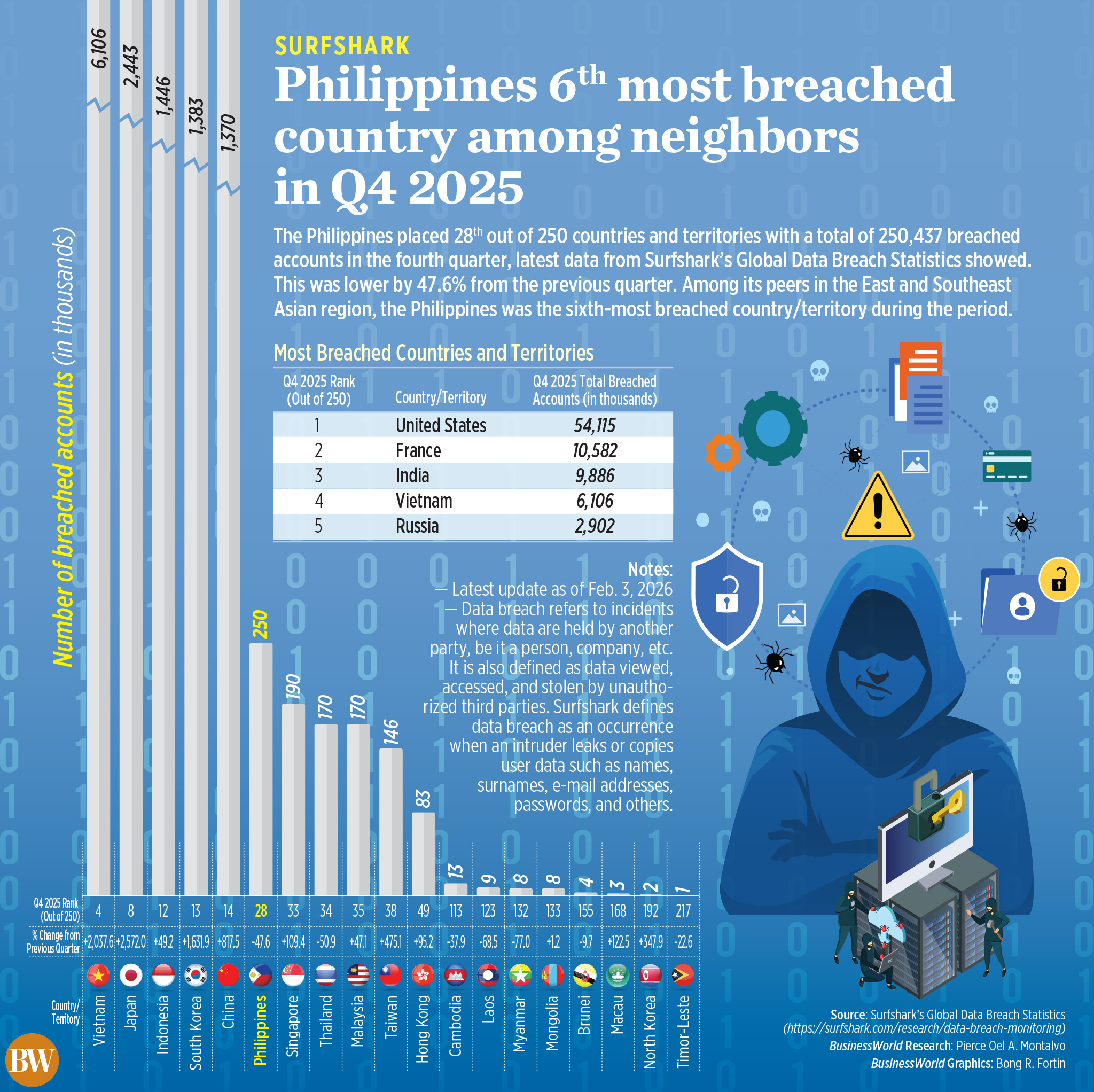
Surfshark: Philippines 6th most breached country among neighbors in Q4 2025

The Philippines placed 28th out of 250 countries and territories with a total of 250,437 breached accounts in the fourth quarter, latest data from Surfshark’s  Global Data Breach Statistics  showed. This was lower by 47.6% from the previous quarter. Among its peers in the East and Southeast Asian region, the Philippines was the sixth-most breached country/territory during the period.

BSP tweaks reserve requirement rules

BW FILE PHOTO

THE BANGKO SENTRAL ng Pilipinas (BSP) has lowered the minimum amount of certain deposit and deposit substitutes that banks and nonbanks are required to hold as reserves, which could further boost liquidity in the financial system that can be used for lending activities.

In a circular dated Feb. 11 signed by BSP Governor Eli M. Remolona, Jr., which amends reserve requirement regulations in both the Manual of Regulations for Banks (MORB) and Manual of Regulations for Non-Bank Financial Institutions (MORNBFI), the BSP cut the percentage of required reserves against specific types of peso deposit and deposit substitute liabilities of banks effective on the reserve week starting Feb. 27.

It lowered the required ratio for long-term negotiable certificates of time deposits (LTNCTDs) to 0% for universal, commercial, thrift, rural, and cooperative banks from 4% previously.

It also brought the rate of required reserves against mortgages/chattel mortgage certificates issued by thrift banks down to 0% from 6%.

For other bonds, the mandated percentages were lowered to 2% for universal, commercial, and digital banks and to 0% for thrift banks from 3% previously.

The rate of required reserves against trust and fiduciary accounts-others was also set at 0% for all banks and nonbanks. Based on the latest updated MORB and MORNBFI, this rate was at 17% for big banks and nonbanks, 9% for thrift banks and 4% for rural banks.

Reserve requirements are the percentage of peso deposit and deposit substitutes that banks and nonbanks may not lend out and need to set aside with the BSP or in eligible government securities.

The BSP adjusts these minimum ratios as part of its liquidity management operations.

Reservable liabilities include demand, savings, and time deposits, as well as deposit substitutes like LTNCTDs.

The reserve requirement ratio (RRR) for big banks and nonbanks is currently at 5%, while the ratio for digital banks stands at 2.5%. Meanwhile, thrift, rural, and cooperative banks’ reserve ratio is at 0%.

The BSP has said that reducing RRRs helps lessen frictions that hinder financial intermediation, enabling banks to channel their funds more effectively toward productive loans and investments.

The latest circular also updated rules on the computation of banks’ reserve positions, sanctions for deficiencies, and compliance reporting.

Under the amendments, the central bank said required reserves for the current reserve week are still computed using the previous week’s levels of deposit, deposit substitutes and all other reservable liabilities, but available reserves now include banks’ actual deposits in BSP Demand Deposit Accounts plus alternative compliance options within the current reserve period.

The reserve position shall be calculated by deducting required reserves from available reserves, the BSP added.

Meanwhile, for penalties on reserve deficiencies, the BSP said it will observe a “single reserve period” for certain instances. This means that a non-reserve day falling on a Friday or any two days in a reserve period other than Saturday and Sunday will be combined with the next reserve period.

The central bank also imposed a flat rate of 0.1% of the reserve deficiency as penalty for banks or quasi-banks that would fail to meet the required minimum reserve position.

The BSP likewise shortened the redemption period for erring lenders to just one reserve period or a week from at least two consecutive weeks of compliance. — Katherine K. Chan

Stuff to Do (02/13/26)


Pick up flowers at the mall

ARANETA CITY is celebrating the Valentine’s weekend by putting up floral installations, arches, and garlands all across its malls to serve as backdrops for romantic photos. At Gateway Mall 1 and 2, there will be ready-made bouquets, complete with ribbons and dedication cards, as well as exclusive horse-drawn carriage rides that couples can avail themselves of. A 360-degree camera photobooth and interactive flower bar with personalized arranging activities can help visitors bring home romantic memories. At Ali Mall, Pop QC will have booths with gift items like pressed-flower art, floral perfumes, and flower-scented candles. Finally, Farmers Plaza will have a lineup of P-pop artists on Feb. 14 to serenade couples on their flower adventures.


Get your fortune told and ride a carousel

SHOPPERS at Robinsons Department Store Galleria can enjoy a free in-store Chinese New Year-themed whimsical horse carousel ride with a minimum single-receipt purchase of P500 from Feb. 13 to 17. Drop by the Prosperi-tree and get a chance to win up to P500 in Robinson’s Department Store Gift Certificates for a minimum single-receipt purchase of P3,500. Discover what 2026 has in store and get insights into the year ahead with a free Fortune Reading for every P2,000 purchase on Feb. 1 to 17 from 1 p.m. to 5 p.m.


Attend the PPO’s romantic concert

THE PHILIPPINE Philharmonic Orchestra (PPO) ushers in the season of romance with Concert VI: Romanza, an evening devoted to the language of romance expressed through music. The concert will be held on Feb. 13, 7:30 p.m., at the Samsung Performing Arts Theater in Circuit Makati. The PPO, under the baton of PPO music director and principal conductor Grzegorz Nowak, is joined by violin virtuoso Bartek Nizioł and pianist Junhee Kim. The evening’s repertoire starts with Mozart’s unfinished classic, Concerto for Violin and Piano in D major, K. Anh. 56/315f, which has been completed by the PPO’s composer-in-residence, Jeffrey Ching. This newly realized version receives its world premiere in Concert VI: Romanza. The rest of the evening features Wieniawski’s Violin Concerto No. 2 in D minor, Op. 22, and Ravel’s Daphnis et Chloé: Suite No. 2. PPO concert tickets are available at TicketWorld and range in price from P1,500 to P3,000. Season subscribers get an exclusive 20% discount. E-mail salesandpromotions@culturalcenter.gov.ph or call the CCP Box Office (0931-033-0880) for details.


Go on an Art FriDate

IN CELEBRATION of National Arts Month this February, the National Commission for Culture and the Arts (NCCA) is holding a series of cultural programs nationwide under the theme “Ani ng Sining: Katotohanan at Giting.” As part of the celebration, the NCCA is mounting Art FriDates, a series of cultural events scheduled every Friday of February, to be held at the Likhang Filipino Exhibition Halls, Center for International Trade Expositions and Missions (CITEM), Roxas Blvd. corner Sen. Gil J. Puyat Ave., Pasay City. The program serves as a platform for participating local government units (LGUs) to showcase their distinct art forms, traditions, and cultural initiatives, with the aim of fostering artistic excellence and strengthening cultural appreciation. Art FriDates will feature the Province of Bulacan on Feb. 13, followed by Biñan, Laguna on Feb. 20, Quezon Province on Feb. 27, and Muntinlupa City on March 6.


Donate a book on Valentine’s Day

THE VALENTINE’S DAY book donation drive initiated by National Artist for Literature Virgilio S. Almario is now in its third year. This year, Mr. Almario has dubbed the campaign as “Aklat ng Pagmamahal” (“Book of Love”) which has seen local publishers and Filipino writers come together to bequeath books to the Quezon City Public Library and its branches, as well as to the libraries being built at the Quezon City Jail. The various publishers and writers will be at the Quezon City Public Library on Feb. 14, 9 a.m. to give books. The general public is invited to come to the event to donate books and reading materials.


Bid on art at an auction

THE Asian Cultural Council Philippines Foundation, Inc. (ACC Philippines), in partnership with Leon Gallery, will hold its annual benefit art auction on Feb. 14 at the Leon Gallery in Makati City. The auction marks the first in a series of fundraising initiatives this year in support of the ACC Philippines Fellowship Program. The benefit auction will feature a selection of works by distinguished and emerging Filipino artists. Proceeds will directly support the ACC Philippines Fellowship Program, which enables Filipino artists, scholars, and arts professionals to pursue research, creative work, and cultural exchange projects in the Philippines and abroad. Bidding begins at 2 p.m. at Leon Gallery, Eurovilla 1, Rufino corner Legazpi Streets, Legazpi Village, Makati City. For auction details, visit www.leon-gallery.com. For more information on ACC programs and fellowships, visit www.asianculturalcouncil.org.


Attend a Valentine’s Day concert

CELEBRATE THE DAY at the Newport World Resorts with music as Champions of the Heart, a Valentine’s concert featuring some of the Philippines’ most celebrated vocalists (Martin Nievera, Sofronio Vasquez, Jed Madela, Jona, and Klarisse de Guzman) takes place on Feb. 14 at 8 p.m. at the Marriott Grand Ballroom. Tickets are available at all TicketWorld outlets and the Newport World Resorts Box Office, with tickets ranging in price from P3,800 to P13,500. For inquiries, contact Customer Care at 7908-8888 or info@fhtcentertainment.com.


Experience art and music at the museum

COUPLES can experience the Ayala Museum in a different light on Feb. 14 with “Mezcla at Night,” a Valentine’s evening where the museum opens its doors after hours for rare nighttime access to the Mezcla: Interwoven Cultures and the Mantón de Manila exhibitions. There will be activities including a scavenger hunt through the gallery, live flamenco performances with the Angel Flamenco dance organization and guitarist Carlo Antonio B. Juan, and food by Terry’s Bistro & Gourmet Store. Regular tickets are P1,300, while seniors and PWDs get a rate of P1,040. The program starts at 6 p.m. on Feb. 14.


Enter The M for the price of one

TO ENJOY ART for two, couples can purchase two all-access pass tickets to the Metropolitan Museum of Manila (The M) for the price of one on Feb. 14 and 15. For P550, two people can enter the museum, exclusively over the Valentine’s weekend. This “Art For Two” offer is available online and onsite.


Go on a blind date with a book

ALLIANCE FRANÇAISE DE MANILLE (AFM) is hosting a blind date event — with books. Until Feb. 14, members can come to the AFM in Makati to pick out a book on the display table, read it, rate it using the book card, then return it in the same condition a month later, from March 10 to 14. Interested participants must first become a member of AFM to join in the book date. Membership includes access to freebies, French entertainment, private events, early-access tickets, and other news.  


Test music taste compatibility on Spotify

THIS VALENTINE’S SEASON, Spotify is putting a playful spin on modern dating by turning musical taste into a compatibility test. Through “Match Made in Spotify,” a new in-app experience, users can test their compatibility with a crush or partner, based on the music they actually listen to on Spotify. Each result comes with a personalized playlist created for the pairing, making it easy to share results and playlists with friends or on social media. It’s available exclusively on the Spotify app.


Get double the fries at Potato Corner

FROM FEB. 13 TO 16, Potato Corner will have a “Buy One, Free One” deal. Customers can enjoy a free large container of flavored fries with every purchase of a Mega size of fries. Also, every purchase of Giga or Tera fries comes with free jumbo-sized flavored fries. This promo runs at all Potato Corner outlets nationwide.


Watch Wuthering Heights in cinemas

THE FILM Wuthering Heights, directed by Emerald Fennell and starring Margot Robbie and Jacob Elordi, is now in cinemas. The adaptation of Emily Brontë’s classic novel is meant to be “twisted, provocative, romantic,” according to lead actress Ms. Robbie. It follows the forbidden passion between Cathy and Heathcliff, reimagined with a soundtrack by Charli xcx.

The world is healing

STOCK PHOTO | Image from Freepik

For a while, many (not all) vaccinated people simply bullied those refusing to take the COVID-19 vaccine, demanding that the unvaccinated lose their jobs, be banned from schools, be prohibited to travel, and even lose the right to live (by saying that the unvaccinated be refused treatment in hospitals).

But times changed: more and more reports are recently coming out pointing to COVID vaccines’ connection to increased myocarditis and “turbo cancer” incidences. With that, these same pro-COVID vaccine people now shamelessly claim they doubted the vaccines’ safety all along, with some even claiming to never have taken them at all.

And yet this craven behavior is not limited to the COVID vaccination instance. In politics, the not-so-distant past saw woke progressives — from the academe to government to business — strutting around as if the world issued them a blank check. Corporations turned to DEI (Diversity, Equity, and Inclusion) and (Environmental, Social, and Governance) frameworks, universities policed thought. Dissent was dismissed as hateful ignorant bigotry.

Nevertheless, the pendulum has swung and conservatives are winning and winning massively again. Worldwide, the progressive momentum has stalled and, in many places, reversed. And this happened through the sheer brutal force of reality asserting itself.

Predictably, the conservative rise was initially passed off as a mere passing fancy of ordinary citizens for populism, which has been described as ultimately undemocratic. Democracy being perceived as standing for institutions and the rights of the minority vis-à-vis the majority. But this is misleading.

What is conveniently ignored is that leftist politicians are very much populist themselves. How else can they win elections? Hence, you have Bernie Sanders, Alexandria Ocasio-Cortez, Jeremy Corbyn, Tarō Yamamoto, Hugo Chávez, and Evo Morales to name a few. These Leftists are classic populists — by the popular definition of the term in that they’re not great respecters of the institutions of property, speech, freedom of religion, and even the democratic process where the majority gets to set the political agenda.

And yet many a political commentator or member of the academe would disingenuously label rightwing politicians as populists simply because they have been winning recent elections, all the while forgetting the fact that these are precisely the leaders that have been upholding public institutions, inherent rights, and law and order — rather than burning down those same institutions as Black Lives Matter or Antifa have done.

Thus, one sees the welcome rise of France’s Le Pen, Italy’s Meloni, Netherlands’ Wilders, UK’s Farage, Japan’s Takaichi, and, of course, the US’ Trump. Then there is Switzerland’s SVP/UDC, Germany’s AfD, Austria’s Freedom Party, Chile’s Kast, Czech Republic’s ANO 2011, and Portugal’s AD.

Notably, Philippine social media is rife with increasing numbers of expanding conservative groups, mostly run and led by young Filipinos.

Thus, now the Left’s attempt — as the pro-COVID vaccine people tried — to coopt the increasingly prevailing judgment of history: that woke progressivism was utter nonsense and the rise of conservatism shows a world healing and unifying itself back with reality.

But any attempt by the Left to coopt the gains of the Right will fail simply because people will have nothing to do anymore with the Left.

The first reason is fatigue. Woke politics runs on constant drama. Every institution is “systemically” broken, every disagreement is violence, every compromise is betrayal. That level of hysteria cannot be sustained indefinitely. Ordinary people — workers, parents, business owners — eventually tire of being accused of being oppressors or bigots. They want stability and solutions, not rallies or slogans.

Second, woke ideology collapsed under its own contradictions and irrationality: claiming “equality” while obsessively categorizing people by race, sex, and identity; demanding tolerance while practicing ruthless exclusion; and celebrating “lived experience” but silencing actual lived dissent.

When an ideological movement cannot define what a woman is or explain why free speech must be curtailed to protect democracy or justify why criminals deserve more empathy than victims, it deserves to be trashed.

Third, economic reality broke progressive fantasy. Woke governance can only survive in times of abundance, as inefficiency can be disguised as compassion. Inflation, energy shortages, crime, and uncontrolled migration strip away that disguise. When groceries cost more, streets feel unsafe, jobs disappear, lectures about pronouns ring stupidly empty.

Fourthly, conservatives rightly insisted that progress must be real, not rhetorical. That words and the law must mean something. That rights come with responsibilities. More than sexual or racial identity, conservatives correctly intuited that families matter, work matters, order matters, and truth matters.

Finally, conservatives learned discipline. Not every insult deserves a response. The woke playbook relies on emotional escalation; conservatives have learned to engage as adults. Calm, reasoned insistence on facts and reason disarmed a wokeism addicted to drama, making the latter look superficial and theatrical.

Of course Leftism won’t vanish. It retreats, regroups, and rebrands. But the woke era of unquestioned dominance is over. Conservatives are ascendant because they reconnected politics to reality, morality to self-responsibility and humility, and power to accountability. They rightly declared the truth that politics is not performative but existential.


Jemy Gatdula is the dean of the UA&P Law School and is a Philippine Judicial Academy lecturer for constitutional philosophy and jurisprudence. The views expressed here are his own and not necessarily of the institutions to which he belongs.

https://www.facebook.com/jigatdula/

Twitter @jemygatdula

Britney Spears sells rights to music catalog

Britney Spears — FACEBOOK.COM/BRITNEYSPEARS

LONDON — Pop star Britney Spears has sold her rights to her music catalog to independent music publisher Primary Wave, the latest artist to strike a deal for her work.

Entertainment site TMZ, citing legal documents it had obtained, first reported the news, saying the “Oops!… I Did It Again” and “Toxic” singer had signed the deal on Dec. 30.

It quoted sources as saying it was “in the ballpark” of Canadian singer Justin Bieber’s reported $200-million agreement to sell his music rights to Hipgnosis in 2023.

A person familiar with the situation said news of the Spears and Primary Wave deal was accurate. No further details were given.

Primary Wave, which is home to artists including Whitney Houston, Prince, and Stevie Nicks, did not immediately respond to a request for comment. Ms. Spears has not commented publicly.

The 44-year-old, one of the most successful pop artists of all time, has topped charts around the world, starting off with “…Baby One More Time” in 1998. The deal includes her songs such as “(You Drive Me) Crazy,” “Circus,” “Gimme More,” and “I’m a Slave 4 U,” TMZ said.

Ms. Spears’ ninth and last studio album, Glory, came out in 2016.

In 2021, she was released from a 13-year court-ordered conservatorship set up and controlled by her father, Jamie Spears. The arrangement had governed Ms. Spears’ personal life, career, and $60-million estate from 2008 until it was terminated in November 2021.

Ms. Spears follows artists such as Sting, Bruce Springsteen, and Justin Timberlake who have struck deals to cash in on their work. — Reuters

Sponsoring workers for a Mobile Legends tournament

Some employees are asking management to support their participation in a Mobile Legends tournament. This is new to us. Please advise. — Jazz Night.

In many organizations, having an active engagement program is a key strategy towards employee motivation and retention. This means organizing sports and social activities, including traditional games like basketball, tennis, and bowling.

In addition, companies administer interest clubs that cultivate the workers’ hobbies and extra-curricular activities. That’s why it’s common for some companies to have a camera club, chess club, cooking sessions, even sponsoring dancing and singing contests.

Company-sponsored sports and social events are great opportunities for employees to bond with their managers over food, shared stories, and laughter. So, when some employees propose to send a team to an online Mobile Legends tournament, it often comes with the question: “Is it appropriate?”

It’s fair to ask. Company extra-curricular events are typically limited to physical, face-to-face events. However, management can’t ignore online gaming. Mobile Legends has endeared itself to many young workers, even some executives who quietly play it.

Management doesn’t have much choice but to modernize engagement in a digital workforce. Ignoring this reality creates a disconnect between engagement programs and actual employee behavior.

Worse, it signals that management does not understand how young Filipino workers unwind, connect, and build friendships. If management support is absent, the Filipino values of pakikisama (getting along) and hiya (social sensitivity) could be slowly destroyed.

FORMAL POLICY
Management may need to consider modernizing subject to formal policies regulating employee participation in online gaming. Such activities must affirm and promote corporate values like teamwork, respect, and camaraderie, among others.

If properly established, it can reinforce bayanihan, encourage proactive communication across all levels, provide stress relief and connection, particularly in an environment where the company employs hybrid or remote work arrangements. Here are some basic guidelines you should take into consideration:

One, define the purpose. The goal is to ensure that workers’ participation in online gaming or esports-based initiatives must be aligned with corporate values, engagement goals, and operational priorities.

Two, declare a general policy. This includes a declaration that a company recognizes online gaming as part of structured engagement activities that contribute positively to morale, teamwork, and cross-functional collaboration.

Three, keep it voluntary. No employee should be pressured or disadvantaged if they don’t want to participate, especially those whose duties make participation impractical.

Four, be clear that gaming must not disrupt operations. It must be done only during lunch breaks or after office hours. If after work hours, gaming inside the office must take place during approved periods and subject to IT safety regulations.

Five, observe high standards of professionalism. Employees representing the company in internal and external competitions are required to communicate respectfully and behave ethically consistent with company values and standards.

Six, consider alternative activities for non-gamers. For inclusivity, management should consider parallel or other engagement activities for non-gaming employees. This means continued support for traditional sports like basketball and tennis for all genders.

Seven, promote online gaming as an engagement program. This must be emphasized clearly so that anyone’s involvement is not mistaken as a credit towards career advancement, transfer to a desirable position, or substitute for formal training.

Eight, remind participants to observe data privacy rules. Be clear that participants are responsible for complying with internal and external data privacy requirements, cybersecurity regulations, and platform-specific conditions.

Nine, appoint HR as the online gaming administrator. The task of the human resource department is to communicate, administer, and regulate established policies and practices. They must ensure its alignment with employee engagement and motivation.

Ten, conduct a brief post-activity review for any proposed improvements to the program. This ensures that participants maintain proper decorum and professionalism. This must be done by HR in a post-activity assessment to determine alignment with organizational values.

CAUTION
These guidelines must not be written in stone. What works during the first few months of implementation does not guarantee that the program will be successful over the long term. Therefore, HR must be sensitive to red flags like managerial favoritism towards gamers to the exclusion of non-gamers.

Another issue is when managers dominate online gaming to the detriment of ordinary workers. In some cases, excessive gaming may distract from operational priorities. This alone is enough reason for management to rethink the continuation of online gaming.

After each tournament, HR must reflect on the result with the following questions: Who participated and who didn’t? Did it build connection or division? What feedback emerged? What can be improved next time? Reflection reinforces trust. It shows that HR listens, adjusts, and respects employee sentiment.

In the Philippine workplace, a Mobile Legends tournament is not inherently inappropriate. When used reasonably, it shows management respect for evolving norms and trust in employees. Used carelessly, it can undermine credibility and workplace harmony.


Consult Rey Elbo on your workplace issues for free. E-mail elbonomics@gmail.com or DM Facebook, LinkedIn, X or via https://reyelbo.com. Anonymity is guaranteed.

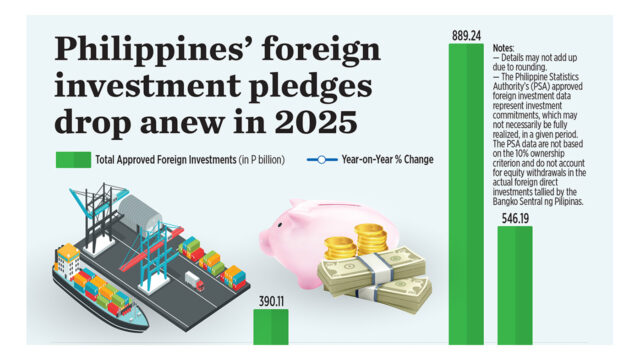
Philippines’ foreign investment pledges drop anew in 2025

APPROVED foreign investments in the Philippines plunged by 50.1% year on year to P272.38 billion in 2025, its sharpest fall in five years, the Philippine Statistics Authority (PSA) reported on Thursday. Read the full story.