Home Blog Page 2256

Inflation likely to settle within target this year

Crowds flock to Divisoria to look for bargains ahead of the holiday season. — PHILIPPINE STAR/RYAN BALDEMOR

PHILIPPINE headline inflation is expected to settle within the Bangko Sentral ng Pilipinas’ (BSP) 2-4% target band this year despite the slight uptick in November and the impact of recent typhoons on prices, Metropolitan Bank & Trust Co. (Metrobank) Research said.

“Despite the acceleration of prices in November, the latest inflation print is consistent with our forecast that inflation will remain below the 3% level in the last few months of 2024,” Metrobank Research said on Monday.

In November, headline inflation picked up to 2.5% year on year from 2.3% in October, but it was slower than 4.1% in the same month a year ago. This brought average inflation to 3.2% in the 11 months.

“The year-to-date inflation confirms that full-year inflation will likely settle within the 2-4% BSP target this year even with supply-side shocks brought by typhoons and geopolitical tensions,” Metrobank said.

A series of storms hit the Philippines in November, resulting in around P10 billion worth of agricultural damage according to the Department of Agriculture.

National Economic and Development Authority Secretary Arsenio M. Balisacan earlier said the series of typhoons likely had a “sharp” impact on fourth-quarter growth, particularly the agricultural sector.

Metrobank Research said inflation will still be “target consistent” until 2026.

It kept its average full-year forecast at 3.2% this year and in 2025, as it “expects higher demand-side pressure as the BSP continues to reduce policy rates.”

“We maintain our 3% full-year average forecast for 2026, barring any supply-side shocks,” Metrobank Research said.

The BSP expects inflation to average 3.1% this year, 3.2% in 2025, and 3.4% in 2026.

“Recent sentiments from BSP Governor Eli M. Remolona, Jr. suggest he retains his dovish stance, emphasizing that the Philippines is ‘still in the easing cycle’ and signaling the possibility of another cut in the December meeting,” Metrobank Research said.

“Moreover, the lower-than-expected gross domestic product (GDP) print in Q3 provides more reason for the BSP to deliver another 25-basis-point (bp) cut to further maintain momentum in consumption and investment growth.”

In the third quarter, GDP growth slowed to 5.2% from the revised 6.4% growth in the second quarter and 6% a year ago. This was also the weakest growth in five quarters or since the 4.3% expansion in the second quarter of 2023.

For the first nine months of the year, GDP growth averaged 5.8%, slower than the 6% print a year ago.

Economic managers last week revised its growth target range to 6-6.5% this year, narrower than the previous 6-7% goal.

“As the inflation projection continues to remain within target, Metrobank Research maintains its forecast of another 25-bp cut in the BSP’s meeting in December, bringing its year-end forecast for the Reverse Repurchase (RRP) rate to 5.75% in 2024,” it said.

BSP began its easing cycle with a 25-bp cut in August, followed by another 25-bp cut in October, bringing the benchmark rate to 6%.

The Monetary Board is set to have its final policy-setting meeting for the year on Dec. 19.

Metrobank also expects the RRP rate to settle at 5% by 2025 and 4.25% by 2026. — A.R.A.Inosante

PHL ranks second-most attractive emerging market for RE investment

A wind turbine is seen in this file photo. — REUTERS

By Sheldeen Joy Talavera, Reporter

THE PHILIPPINES ranked as the second-most attractive emerging market for renewable energy (RE) investment, according to the 2024 Climatescope report by BloombergNEF.

The Philippines climbed two spots to second spot out of 110 emerging markets in the 13th annual edition of the Climatescope report.

It received an overall score of 2.65 out of 5, based on three parameters: fundamentals, opportunities, and experience.

“The Philippines has been on a growth path since 2021, and for the first time has entered second place in the ranking, knocking mainland China down a slot,” according to the report by BloombergNEF, which is a strategic research provider covering global commodity markets.

This was the country’s highest ranking after placing fourth in 2023, 10th in 2022, and 20th place in 2021.

“The government has established a target of 35% renewable energy in power generation by 2030, and the Philippines stands out as the only emerging market in the Asia-Pacific region (APAC) to have all of the renewable energy policies surveyed by Climatescope — auctions, net-metering schemes, tax incentives and a clean energy target — in force,” BloombergNEF said.

India emerged as the most attractive emerging economy for the second year in a row with a score of 2.73 due to its “bold renewable energy target” and its ongoing efforts to achieve the goal.

The Philippines was ahead of China (2.61), Kenya (2.59) Romania (2.57), Brazil (2.54), Chile (2.51), Nigeria (2.51), Namibia (2.51), and Guatemala (2.50).

Investor interest in the Philippines’ renewable energy sector received a boost after the government allowed full foreign ownership in the sector starting November 2022.

Foreign nationals and foreign-owned entities are now allowed to explore, develop and use RE resources such as solar, wind, biomass, ocean or tidal energy in the Philippines. Foreign ownership of RE projects was previously limited to 40%.

According to the Climatescope report, the Philippines had a score of 3.83 on fundamentals, the highest among emerging markets. This measures the foundational mechanisms for renewable energy development in a market, including its clean energy policies, operating rules and incentives, and batteries to the deployment of investment.

In terms of opportunities, the Philippines ranked 8th with a score of 2.11. This parameter focuses on identifiable traits that mark a market’s attractiveness to investors.

Over the past five years, the Philippines has attracted $5.2 billion in RE investments, but only 7% of the total came from foreign investment, according to the report.

With the power demand increasing and the Philippine market still heavily reliant on fossil fuels, there is still a need to grow its renewable energy capacity, BloombergNEF said.

According to BloombergNEF, peak demand rose 63% from 2014 to 2023, reaching 19.2 gigawatt-peak in 2023.

The Department of Energy (DoE) said that the ranking reflects “the growing confidence of the global community in our country’s commitment to clean energy transition and sustainable growth.”

“This recognition inspires the DoE to further intensify its efforts in achieving our renewable energy goals, ensuring that our nation remains a global beacon of progress in the energy transition,” the department said in a statement on Monday.

While most of the RE investments are from domestic investors, the DoE said it is looking forward to realizing the potential of increased foreign participation as it allowed full foreign ownership in renewable energy projects.

“The journey, however, is far from over. With the peak demand growth assumptions of around 5.3% annually from 2024 to 2028, the need to further accelerate renewable energy development is still crucial to address the energy needs of the country’s expanding economy,” the agency said.

Asked to comment, Michael L. Ricafort, chief economist at Rizal Commercial Banking Corp., said that there are opportunities for RE investors in the Philippines.

“RE, especially solar and wind, also suitable for an archipelago such as the Philippines, especially off grid areas,” he said in a Viber message. “This is manifested by the fact that REs are the biggest foreign investments in recent years.”

As of November, the Board of Investments has approved a total of P1.5 trillion in investment pledges, of which P1.35 trillion are primarily in the renewable energy sector.

As of end October, a total of 17,248.53 megawatts (MW) of committed power projects and an additional 1,870 MW are expected to be operational from 2024 to 2030, including those with commercial operation dates that are yet to be determined by the power generators.

ERC approves Meralco’s RE power supply deals

RENEWABLE ENERGY is expected to account for 22% of Meralco’s supply portfolio by 2030. — PHILIPPINE STAR/RYAN BALDEMOR

THE ENERGY REGULATORY Commission (ERC) has approved Manila Electric Co.’s (Meralco) power supply agreements (PSAs), enabling the power distributor to meet its renewable energy (RE) supply requirement starting February next year.

The regulator granted provisional authority to Meralco to implement its power supply deals with San Roque Hydropower, Inc. (SRHI) and Gigasol3, Inc., according to a document posted on its website.

SRHI and Gigasol3 emerged among the winning bidders during the competitive selection process (CSP) conducted in July for Meralco’s 500-megawatt (MW) renewable energy supply requirement.

SRHI offered the lowest rate of P7.10 per kilowatt-hour (kWh) for 340 MW of the total requirement.

Gigasol submitted a rate of P8.1819 per kWh for 139 MW, while Santa Cruz Solar Energy, Inc. (SCSEI) covered the remaining 21 MW at a rate of P8.1998 per kWh.

All offers were below the P8.2380 per kWh reserve price set for the CSP.

SRHI, formerly known as Strategic Power Development Corp., is a subsidiary of San Miguel Global Power Holdings Corp., the power arm of San Miguel Corp. (SMC).

The SMC unit is the administrator of the 345-MW San Roque Hydroelectric Power Plant in Pangasinan.

Meanwhile, Gigasol3 owns, operates, manages, and maintains the Palauig Solar Power Plant in Zambales, and administers the output of the Alaminos Solar Power Plant in Laguna.

Gigasol 3 and SCSEI are subsidiaries of ACEN Corp. under the Ayala Group.

The ERC, however, approved a lower fixed rate for SRHI and Gigasol3 at P5.1908 per kWh “without any escalation or adjustment.”

“The rates provisionally approved by the Commission were based on average rate of other mid-merit supply to Meralco,” ERC Chairperson and Chief Executive Officer Monalisa C. Dimalanta said in a Viber message.

“We need to further evaluate the higher rates in these PSAs (more than P8/kWh), as well as the reserve price set by Meralco, and these will all be covered in the final authority to be issued after evaluation,” she added.

The ERC has yet to release its decision on the power supply deal between Meralco and SCSEI.

The 10-year PSAs resulting from the CSP will cover Meralco’s 350-MW mid-merit requirement starting February 2025 and will increase by 150 MW starting February 2026.

Renewable energy is expected to account for 22% of Meralco’s supply portfolio by 2030.

Meralco’s controlling stakeholder, Beacon Electric Asset Holdings, Inc., is partly owned by PLDT Inc.

Hastings Holdings, Inc., a unit of PLDT Beneficial Trust Fund subsidiary MediaQuest Holdings, Inc., has an interest in BusinessWorld through the Philippine Star Group, which it controls. — Sheldeen Joy Talavera

Udenna signs deal with EEI for Mactan casino project 

IN JULY, Okada Manila operator Tiger Resort Leisure & Entertainment, Inc. (TRLEI) ended talks to acquire a majority stake in the Emerald Bay project. — PHRESORTS.COM

By Revin Mikhael D. Ochave, Reporter

DENNIS A. UY-LED Udenna Corp. has signed a memorandum of understanding (MoU) with the listed construction company EEI Corp. for a potential partnership in the planned Emerald Bay Resort and Casino Project in Mactan, Cebu.

The MoU allows for a potential partnership between EEI and PH Resorts “upon the execution of the definitive agreements and subject to the fulfillment of conditions precedent and regulatory approvals, if any,” Udenna’s listed gaming and hospitality subsidiary PH Resorts Group Holdings, Inc. said in a disclosure on Monday.

“The MoU also paves the way for EEI to execute an agreement with PH Resorts and/or its subsidiaries, Lapulapu Leisure, Inc. and Lapulapu Land Corp., to finance, construct, and complete the Emerald Bay Project, upon the execution of definitive documentation,” PH Resorts said.

In July, Okada Manila operator Tiger Resort Leisure & Entertainment, Inc. (TRLEI) ended talks to acquire a majority stake in the Emerald Bay project.

TRLEI is the third group to withdraw its investment plan from the Emerald Bay project, after Razon-led Bloomberry Resorts Corp. and Cebu-based AppleOne Properties, Inc.

The Yuchengco group currently owns about 20.9% of EEI. Its listed conglomerate, House of Investments, Inc. (HI), previously sold its 20% stake in EEI to the Romualdez family-led firm RYM Business Management Corp. for P1.25 billion.

HI also sold its 14.346% stake in EEI to Industry Holdings and Development Corp. for about P1.08 billion.

EEI is one of the largest construction and contracting firms in the Philippines.

“It looks like PH Resorts finally found a white knight to save its Emerald Bay project. From the limited details disclosed, it appears that EEI might ultimately end up taking control and substantial ownership of the project, with PH Resorts probably left with a minor economic stake,” China Bank Capital Corp. Managing Director Juan Paolo E. Colet said in a Viber message.

“Naturally, one of the questions in the minds of public shareholders is whether this MoU will see the light of day, as attempts to do a deal with previous suitors all fell through. Hopefully, this one will be realized to unlock the value of the Cebu property,” he added.

On the other hand, AP Securities, Inc. Research Head Alfred Benjamin R. Garcia said investors should exercise caution following the announcement.

“I think it’s a bit too early to be excited about any prospects for PH Resorts given its history of failed deals,” he said.

“At this point, too many details of the supposed deal are unclear. For example, the disclosure stated that EEI will finance, construct, and complete the project but it is unclear what they will get in exchange: ownership stake, or eventual payment,” he added.

On Monday, PH Resorts shares fell by 20.25% or 16 centavos to 63 centavos apiece, while EEI shares rose by 2.77% or nine centavos to P3.34 each.

PHINMA Education enters Cavite market with St. Jude acquisition

STJUDE.EDU.PH

PHINMA Education Holdings, Inc. has acquired St. Jude College (SJC) Dasmariñas Cavite for P431.8 million, adding 3,000 students to its network.

PHINMA Education now has 167,000 students across its school network following the acquisition, the company said in a statement on Monday.

“Our newest school expands PHINMA Education’s presence in Southern Luzon and nearby regions,” PHINMA Education Country Chief-Philippines Christopher “Happy” A. Tan said.

The two entities signed a share and asset purchase agreement on Dec. 6 to acquire controlling shares of stock of SJC Dasmariñas Cavite for P85 million, as well as investment in additional shares to acquire land and buildings of the campus and pay debt amounting to P344 million.

“The first closing of the transaction was completed Dec. 6, with the acquisition of shares of the controlling stockholders and payment of P85 million for the said shares,” PHINMA Education said.

“This will be followed by a second closing in January 2025 when the investment, acquisition of the land and buildings, and payment of debt will occur in accordance with the terms of the agreement,” it added.

SJC Dasmariñas Cavite is PHINMA Education’s tenth school in the Philippines and twelfth in its regional network.

Established in 1968, SJC Dasmariñas Cavite offers a variety of tertiary and graduate programs such as Nursing, Radiologic Technology, Psychology, Hospitality Management, and Computer Science.

“We will continue growing our network as we find more ways to reach learners that need education the most. The more students we can serve, the more individuals and families we will uplift through education,” PHINMA Education President and Chief Executive Officer Chito B. Salazar said.

Other schools within the PHINMA Education network include PHINMA Araullo University in Nueva Ecija, PHINMA Cagayan de Oro College, PHINMA University of Iloilo, PHINMA University of Pangasinan, PHINMA Saint Jude College Manila, PHINMA Saint Jude College Quezon City, PHINMA Rizal College of Laguna, PHINMA Union College of Laguna, and Southwestern University PHINMA.

The company also has a presence in Indonesia through Horizon Karawang.

PHINMA Education is the education services sector subsidiary of the Del Rosario-led conglomerate PHINMA Corp.

In October, Phoenix Investments II Pte. Ltd. completed its P2.52-billion initial investment in PHINMA Education. The amount is equivalent to 70.22% of KKR’s total investment worth P3.59 billion. Phoenix Investments is an investment vehicle of funds managed by global investment firm KKR. The funds will be used to finance PHINMA Education’s growth plans.

On Monday, PHINMA Corp. shares were unchanged at P19.40 per share. — Revin Mikhael D. Ochave

Treasury bill rates rise as market eyes BSP move

BW FILE PHOTO

THE GOVERNMENT made a full award of the Treasury bills (T-bills) it offered on Monday even as rates rose across all tenors on expectations that the Bangko Sentral ng Pilipinas (BSP) could pause its easing cycle this month after headline inflation picked up slightly in November.

The Bureau of the Treasury (BTr) raised P15 billion as planned from the T-bills it auctioned off on Monday as total bids reached P56.463 billion, almost four times as much as the amount on offer. However, this was slightly lower than P57.8 billion in tenders seen the previous week.

Broken down, the Treasury borrowed the programmed P5 billion from the 91-day T-bills as tenders for the tenor reached P13.973 billion. The three-month paper was quoted at an average rate of 5.774%, up by 14.4 basis points (bps) from the 5.63% seen last week, with accepted bids yields ranging from 5.629% to 5.82%.

The government likewise made a full P5-billion award of the 182-day securities, with bids reaching P16.38 billion. The average rate of the six-month T-bill stood at 5.922%, up by 1.7 bps from the 5.905% fetched last week, with accepted rates at 5.875% to 5.94%.

Lastly, the Treasury raised P5 billion as planned via the 364-day debt papers as demand for the tenor totaled P26.11 billion. The average rate of the one-year debt increased by 3.1 bps to 5.968% from the 5.937% quoted last week, with the tenders accepted having rates ranging from 5.938% to 5.988%.

At the secondary market before the auction, the 91-, 182-, and 364-day T-bills were quoted at 5.6955%, 5.9724%, and 6.0804%, respectively, based on PHP Bloomberg Valuation Service (BVAL) Reference Rates data provided by the Treasury.

“The higher awarded T-bill rates today reflected increased investor preference for higher short-term returns and growing expectations that the BSP might hold its policy rates steady in the Monetary Board meeting next week,” a trader said in an e-mail on Monday.

“The Treasury bill average auction yields mostly went up for the 10th straight week after the latest pickup in the local headline inflation,” Rizal Commercial Banking Corp. Chief Economist Michael L. Ricafort said in a Viber message.

Mr. Ricafort added that the BTr made a full award of its offer as demand remained strong and as T-bill yields were mostly lower compared to BVAL rates despite the week-on-week increase.

Philippine headline inflation quickened to 2.5% in November from 2.3% in October as typhoons caused higher prices of vegetables, meat and fish, the government reported last week.

Still, this was slower than the 4.1% print in the same month a year ago and was within the central bank’s 2.2%-3% forecast for the month. The November print also matched the median forecast yielded in a BusinessWorld poll of 15 analysts.

For the first 11 months, headline inflation averaged 3.2%, a tad faster than the BSP’s 3.1% full-year baseline forecast but well within its 2-4% annual goal.

The Monetary Board will hold its last meeting for the year on Dec. 19. BSP Governor Eli M. Remolona, Jr. has said that the BSP could opt to pause its easing cycle or deliver another 25-bp rate cut at this month’s review.

Mr. Remolona said inflationary pressures may prompt them to keep rates steady, while a cut is likely if economic growth remains weak.

The BSP has cut benchmark borrowing costs by a total of 50 bps since kicking off its easing cycle in August, bringing its policy rate to 6%.

On Tuesday, the BTr will offer P15 billion in reissued 10-year Treasury bonds (T-bonds) with a remaining life of nine years and one month.

The Treasury is looking to raise P90 billion from the domestic market this month, or P60 billion via T-bills and P30 billion through T-bonds.

The government borrows from local and foreign sources to help fund its budget deficit, which is capped at P1.52 trillion or 5.7% of gross domestic product this year. — Aaron Michael C. Sy

Relaxation, quality time, activities among travel trends in Asia for 2025

FREEPIK

THE MAIN drivers that will shape the travel landscape in Asia next year focus on relaxation, spending time with friends and families, and discovering new destinations and activities, according to a survey by a digital travel platform.

According to Agoda, the seven travel trends and motivations for travelers next year involve family-driven trips, getting away from the hustle and bustle of daily life, travel applications, combining work and leisure, budget travel, new destinations, and theme parks.

“Travel inspiration can come from many sources including personal interests and hobbies, great value deals, and recommendations from friends and family,” the platform said in its 2025 travel trends report.

The Philippines has also successfully captured global interest for inbound travelers, according to Skyscanner, a portal for travelers.

Panglao, Bohol, which ranked 8th in the top trending destinations for 2025 according to Skyscanner, has attracted travelers due to its pristine beaches and diverse tourism offerings. The top trending destinations are: Reggio Calabria, Italy; Tartu, Estonia; Siem Reap, Cambodia; Baltimore, USA; Portsmouth, Dominica; Córdoba, Spain; Tromsø, Norway; Panglao, Bohol, Philippines; Stuttgart, Germany; and, Thiruvananthapuram, India.  

TOP DIVING DESTINATION
Further, the country also won its 6th leading dive destination from the 2024 World Travel Awards (WTA), underscoring the Department of Tourism’s commitment to sustainable dive tourism.

“The Philippines holds the distinct privilege of being one of only 18 mega biodiverse countries in the world,” Tourism Secretary Ma. Esperanza Christina G. Frasco said in a statement.

“If we do not prioritize conservation and shepherd the sustainable industry — that is diving — then we pose the risk of not only losing these marine wonders but also of depriving future generations of sources of income and livelihood,” she added.

As of Nov. 1, the Department of Tourism reported 4,879,022 international visitors to the Philippines. This is less than 3 million away from the department’s yearend target of 7.7 million visitors.

By 2028, tourist arrivals in the Philippines are projected to reach 9.7 million visitors, the Fitch Solutions unit BMI reported. — Almira Louise S. Martinez

The journey from the C suite to the B suite

FREEPIK

For companies seeking individuals to appoint as members of their Board of Directors, a common source is the pool of CEOs approaching retirement. Many professionals, including entrepreneurs, often assume that “there is no life after retirement.” In reality, vast opportunities exist to leverage one’s skills and experiences in boardrooms.

Are these roles equal or similar?

Both roles involve leadership, strategy, analytical skills, and decision-making responsibilities, However, while they may appear similar, transitioning from the C suite to the B suite necessitates a significant mindset shift. This transition requires moving from a focus on operational concerns to adopting a broader oversight role, given the change in responsibilities.

Here are some key differences:

Operational vs Strategic: A CEO is primarily concerned with executing the strategies for the organization outlined by the board, while the board must “think big” and monitor the overall progress and direction of the long-term strategy to ensure growth and sustainability.

Day-to-day vs Comprehensive: CEO decisions are “hands-on” and made to keep operations moving, whereas board decisions are broader and impact long-term progress.

Individual vs Collective: A CEO’s authority is individual and hierarchical, flowing from top down. In contrast, board decisions are collective, requiring each member to deliberate on issues and provide input that can integrate with others’ perspectives.

Direction vs Guidance: CEOs ensure alignment with the organization’s goals, while the board provides oversight, balancing the interest of management and its stakeholders, guiding management without directly leading the organization.

HOW TO TRANSITION FROM CEO TO BOARD MEMBER?
The journey from CEO to board member is not merely a change in title but a profound shift in role, responsibilities, and perspectives. How does one prepare to be a board member?

Ernst & Young (EY), one of the world’s largest professional services organizations with over 400,000 people across 150 countries, has recognized the potential of its partners to become board members. To support this transition, they launched the “EY Journey to the Boardroom” program in partnership with Harvard Business Publishing. This program aims to equip EY partners with the necessary skills to prepare for and pursue corporate board positions while enhancing their existing client and advisory relationships. The course focuses on global and corporate issues within the context of today’s boards. Participants engage with EY experts, HBS faculty, and peers to complete individual and group assignments. As an Alumni Partner of SGV & Co., a member practice of EY Global, I had the privilege of participating as a resource person on several panels alongside EY alumni partners from other countries.

A question frequently posed to the panel is, “What mindset shift is necessary when transitioning from EY Partner to board member?” My response to this question encompasses my five C’s below.

Challenge. Especially for non-executive and independent board members with limited involvement in day-to-day operations, it is good practice to challenge “elegantly and with respect” matters presented and discussed for decision-making. While it requires experience and preparation to ask difficult questions, this should not deter you from doing so, as it enhances board discussions and ensures that all aspects of the matter are considered. However, board members must also be open to being challenged on their positions and opinions, allowing others to share their views.

Contribute. Posing challenges in board discussions is only valuable if they are constructive and contribute potential solutions. Taking on a board role involves redefining one’s contribution to the organization, fostering a supportive environment for management, and championing a strategic rather than operational outlook. Remaining engaged without overstepping your bounds allows you to contribute effectively to the board discussions while respecting the boundaries of the CEO and executive team.

Collaborate. Board members act as checks and balances, ensuring the company remains accountable to shareholders and maintains a clear direction. To fulfill this role, you need to work with management and other board members towards achieving a common goal. Understanding the intricate dynamics of group decision-making and consensus-building is crucial, as intertwining your expertise with others enhances your ability to contribute effectively to discussions. Establishing strong relationships fosters a more harmonious and productive board.

Communicate. Effective communication is essential for the success of any board. Ideally, boards should promote transparency and accountability in their communication channels, define clear objectives, and encourage active listening and constructive dialogue. Leading communication expert Dianna Booher gives two tips to be a better communicator: 1. “Listen for what is not said in a conversation or document”; 2. “Listen discriminately and probe with questions to help draw conclusions about what you hear so you can make sound decisions.”

Be Curious. Walt Whitman, the American poet and essayist, advised us to “be curious, not judgmental.” PwC’s recent survey of over 1,000 CEOs indicates that “curiosity” and “open-mindedness,” or the “curiosity quotient,” are becoming increasingly critical leadership traits in challenging times and in managing complexity. Psychologist Diane Dreher notes that “curiosity is positively correlated with creativity, intelligence, problem-solving ability, autonomy, a sense of personal control, and a willingness to challenge the status quo,” all of which are foundational to a director’s role.

Transitioning from the C Suite to the B Suite presents new personal challenges that require the development of knowledge and skills tailored to the new position. While this shift may seem daunting, it represents a tremendous opportunity for seasoned leaders to impart wisdom and guide a company from a fresh vantage point, ensuring its enduring success and integrity.

The journey from the C suite to the B suite is not merely a change in title; it is a transformation in perspective and responsibility. Embracing this transition with the right mindset, coupled with the five C’s — Challenge, Contribute, Collaborate, Communicate, and be Curious — will equip you to navigate your new role effectively. By fostering a culture of open dialogue and mutual respect, you can enhance the board’s effectiveness and help steer the organization toward a sustainable future.

This article reflects the personal opinion of the author and does not reflect the official stand of the Management Association of the Philippines or MAP.


Ma. Aurora “Boots” D. Geotina-Garcia is a member of the MAP Diversity, Equity & Inclusion Committee. She is the founding chair of Philippine Women’s Economic Network or PhilWEN, and chair of the Governing Council of the Philippine Business Coalition for Women Empowerment or PBCWE. She is also president of Mageo Consulting, Inc., a corporate finance advisory firm.

map@map.org.ph

magg@mageo.net

AirAsia PHL may miss 2024 goal of 8 million passengers

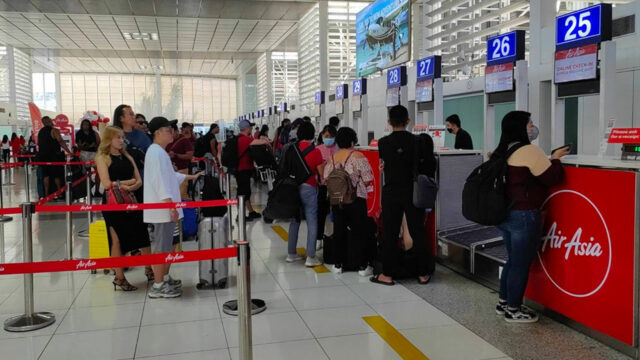
GUESTS IN QUEUE at the AirAsia check-in counters at NAIA Terminal 2. — NEWSROOM.AIRASIA.COM

PHILIPPINES AIRASIA, Inc. (AirAsia Philippines) is projecting to end the year with 7.2 million passengers flown, a 9.09% increase from last year’s 6.6 million, but falling short of its eight million target for 2024.

“As of November, the low-cost carrier already reached seven million passengers,” said Ricardo P. Isla, chief executive officer of AirAsia Philippines.

He said the company’s target of over seven million by yearend is conservative, as it has already reported 528,031 bookings for Christmas and New Year’s Day, with 367,455 for domestic travel and 160,576 for international destinations.

At the same time, the airline said some routes are under assessment for possible launch.

The low-cost carrier will be more aggressive in 2025, Mr. Isla said, adding that it is considering expanding its hub in Manila.

“Coming from 2024, Manila is our most important hub. And when you say the most important hub, the second thing to discuss is the optimization of Manila and our 16 aircraft. [We will] concentrate on that,” he said.

He said the company’s strategy is to focus on strong routes, including leisure destinations like Boracay, Puerto Princesa, and Bohol, as well as non-leisure domestic routes such as Negros, Bacolod, and Iloilo.

“If we are building our core competencies on these domestic routes, we will also keep our international presence,” Mr. Isla said, noting that it is most strong in North Asia, such as Japan, but is seeing slow pick-up in China routes.

AirAsia Philippines said it is planning to explore new territories or points of destinations, but it will depend on the strengthening of its Manila hub, Mr. Isla said.

For 2025, the company aims to retain its fleet of 16 aircraft, he said.

However, AirAsia Philippines Communications and Public Affairs Head Steve F. Dailisan said the airline’s fleet size would depend on the result of the integration of its parent company, Capital A Bhd., which trades as AirAsia, with the group’s aviation business to AirAsia X.

“Whatever exciting developments will come out of the integration since we are part of Capital A or AirAsia Group in the Philippines. We will also benefit from the developments,” Mr. Dailisan said.

Malaysian-based airline group Capital A Berhad, operator of budget carrier AirAsia Philippines, is transferring its aviation business to AirAsia X Berhad to improve its aviation operations and strengthen financial performance. — Ashley Erika O. Jose

Philippine banks fail to meet lending quota for small businesses

BW FILE PHOTO

PHILIPPINE BANKS continued to fall short of the mandated lending quota for small businesses at end-September, data from the central bank showed.

Loans extended by the banking industry to micro, small and medium enterprises (MSME) reached P500.809 billion as of end-September, accounting for only 4.55% of their total loan portfolio of P10.99 trillion, according to the latest Bangko Sentral ng Pilipinas (BSP) data, well below the 10% requirement under the Magna Carta for MSMEs.

Under the law, 8% of these loans must go to micro and small enterprises, while 2% must go to medium-sized businesses.

At end-June, banks’ credit to MSMEs stood at just 4.52% of their loan book.

Broken down, banks’ loans to micro and small enterprises stood at P204.886 billion at end-September, equivalent to just 1.86% of their total loan portfolio and well below the 8% quota. Still, this was up from the 1.82% share seen as of June.

Meanwhile, credit disbursed to medium enterprises reached P295.923 billion in the period, accounting for 2.69% of their loan book and exceeding the 2% quota. This inched down from the 2.7% ratio at end-June.

By type of bank, universal and commercial banks lent P127.083 billion to micro and small enterprises at end-September, or 1.385% of their total loans worth P10.06 trillion

Big banks’ loans to medium enterprises stood at P240.7 billion, or 2.39% of their total lending.

Meanwhile, thrift banks extended loans worth P36.69 billion to micro and small enterprises or 3.79% of their P681.28-billion portfolio, while credit to medium enterprises hit P35.18 billion or 5.22% of the total.

On the other hand, only rural and cooperative banks met the overall MSME lending requirement in the period as they extended loans worth P40.7 billion to micro and small enterprises at end-September, equivalent to 17.38% of their P225.79-billion loan book.

They also disbursed loans worth P20 billion to medium-sized enterprises or 8.86% of the total.

Lastly, loans granted by digital banks to the micro and small enterprise sector stood at P410 million in the first nine months, accounting for only 2.08% of their loan portfolio of P19.72 billion, while they lent P40 million to medium enterprises or just 0.22% of the total. 

For years, most banks have opted to incur penalties for noncompliance with the MSME lending quota instead of taking on the risks associated with lending to small businesses.

Rizal Commercial Banking Corp. Chief Economist Michael L. Ricafort said most banks prefer to pay penalties as they want credit guarantees to reduce the risk of lending to the MSME sector.

There is a need for “better credit information to address asymmetric information on MSME borrowers,” Mr. Ricafort said, which could be addressed by having a central credit information bureau.

Enrico P. Villanueva, a senior lecturer at the University of the Philippines Los Baños Economics Department, added that financial technology companies and nonbank entities may serve MSMEs’ funding needs better than traditional banks.

“Some banks are making serious efforts to reach out to MSMEs through their main bank or their subsidiaries. Many banks may have willingness but no expertise to handle this market segment,” Mr. Villanueva said. — Aaron Michael C. Sy

Musical film puts a new twist on the classic Himala

THIS YEAR, Isang Himala, an entry to the Metro Manila Film Festival (MMFF), aims to breathe new life into the beloved Filipino story about miracles — in the form of a musical. While based on the 1982 film Himala directed by National Artist Ishmael Bernal and penned by National Artist Ricky Lee, but is actually a direct adaptation of the 2003 musical of the same name.

Musicals are able to convey characters’ inner emotions, which makes this version of Himala a special one since it “combines that musical aspect with the visual medium,” said director Pepe Diokno at a press conference in Quezon City.

Mr. Diokno, who won Best Director at the MMFF last year for the historical film Gomburza, added that he “tries not to pay attention” to the pressure of being expected to repeat that feat. “My goal is not to get any awards, but to give the audiences a new experience,” he said.

Isang Himala follows the young orphan Elsa, who gains the power to heal the sick in her small village of Bario Cupang. In the midst of a drought and famine, people flock to the newly minted symbol of hope to witness her miracles, revealing a society consumed by faith, greed, and deceit.

“I had seen the film as a film student and it really left an indelible mark on me,” Mr. Diokno told the press, “But when I watched the staging [of the musical] in 2018, it was the most powerful experience I’ve ever had in a theater. It made me laugh; it made me cry; it gave me goosebumps.”

The staging he saw was by 9 Works Theatrical and The Sandbox Collective, and many of its cast members are reprising their roles in the upcoming film.

“I was thinking about the play long after I had seen it. That’s the same experience that I’d like to share with the audience with this film,” he said.

UNDERDOG FILM
As the writer of the original film, Ricky Lee told BusinessWorld that it was also “an underdog” when it was released in 1982.

Masaya akong makakita ng kwento na nanganganak sa iba’t-ibang medium dahil nagiging mas rich ito (I’m happy to see a story that is reborn in different mediums because it becomes much richer),” he said. “It shows that Himala is an experience worth re-experiencing.”

He added that people can look forward to the musical film being more “expressionistic,” compared to the original film’s “minimalistic” approach.

Actress Aicelle Santos, who is stepping into the iconic role of miracle worker Elsa, said that she hopes Filipinos will come and watch. “We have something new to offer, being the only musical among the 10 [MMFF] entries,” she said.

Like the film’s director, she expressed an aversion to pressure, especially if audience members come into the movie theater with National Artist Nora Aunor’s portrayal of Elsa in the 1982 film in their minds. “I like to think of it as excitement instead of pressure,” Ms. Santos told BusinessWorld.

She also remembered how Ms. Aunor praised and embraced her after seeing the 2018 musical staging. “That was a memorable moment for me,” she said.

Other members of the cast are Bituin Escalante as Elsa’s mother Aling Saling, Kakki Teodoro as Nimia, Neomi Gonzales as Chayong, and David Ezra as Orly. The musical direction and songs are by Vincent A. De Jesus.

Ms. Escalante said at the press conference that Filipinos are “an intelligent audience” that can be receptive to the musical’s layers of family, community, and faith. “We should never underestimate the audiences. Box office is not our basis for happiness or joy; it’s a part of it, of course, but this is about having an audience to reach with this story,” she said.

“We do have an intelligent audience, so let’s keep making great art.” — Brontë H. Lacsamana

The US health insurance industry is broken. Don’t let it break us

FREEPIK

WHEN news broke that UnitedHealth Group executive Brian Thompson had been fatally shot on a street in Midtown Manhattan, the public responded with the kind of vitriol usually reserved for our most polarizing politicians.

I found myself wincing at the tone of the messages rolling in on my various group threads and social media sites — including from people whose opinions I usually deeply respect. My compass on these things is always how I’d want my daughter to hear me react in such a moment. Would I want her to think it’s okay to dance on the grave of someone whose sons are now fatherless?

I unequivocally do not. Nor would I want her to get the idea that this craven act was justified.

And yet, we can’t ignore the ferocity of the response — or the fact that no one’s gut told them to check it. It lays bare a ground truth: If there’s anything our fractured country seems to agree on, it’s that the healthcare system is tragically broken, and the companies profiting from it are morally bankrupt. And it shows that most of us have felt harmed by a system that puts profits before patients.

Thompson became a proxy for the healthcare industry writ large (It does not help that the company he led has repeatedly been shown to be one of the worst offenders when denying claims.)

Nearly everyone has a story of their insurance company denying basic care. Raise your hand if you’ve ever been brought to tears while on a call with your insurance company. Keep it up if your stomach has ever dropped on opening the mailbox to find a bill from your insurer; if you’ve walked up to the pharmacy counter wondering if you can afford your prescription; if you’ve gone into debt because of medical costs; if you’ve watched a family member suffer because they’ve been denied treatment.

I suspect a lot of hands are up.

Those indignities hit us at our most vulnerable moments: when we are grappling with a life-changing diagnosis, when our children are struggling with depression, or when we need a medication that we’ve always relied on — one that has made it possible to be a functional member of society. Those moments stick with you for life.

My compass still points me to civility because I fundamentally don’t believe in celebrating personal tragedy. And I certainly don’t believe in condoning violence. I don’t like the idea of living in a world where a killer (whose motives, by the way, still are unknown) is elevated to the level of folk hero.

Yet I desperately want this rage to be channeled into something productive.

My worry is that it will not and, by design, cannot under the US’ current healthcare infrastructure. That instead of prompting healthcare companies to introspection about their most egregious, profit-driven behaviors, they will simply go quiet and hope we move on.

We’re hearing about how companies had beefed up security even before this event. They have since removed executives’ photos from their websites and canceled in-person investor events. Those are rational changes to protect their employees. We have yet to hear whether they will make any changes to protect their customers’ access to care.

Instead of sparking an honest reckoning about the structural fixes needed to arrive at a more functional and humane system, we are being primed for an administration whose approach to healthcare will make it so much worse. President-elect Donald Trump’s administration seems keen to find cuts in ways that will directly harm Americans’ access to care, whether by making insurance less affordable or through deep cuts to Medicaid. People won’t have insurance companies to be mad at because millions more won’t have insurance at all.

I also worry that the rage is causing more people to gravitate toward ideas that ultimately are dangerous. There seems to be a growing attitude that real change can only come by burning it all down. Or that we need to be open to extreme approaches to fixing our system — even if they involve sacrificing bedrock tenets of public health. One needs only look at the positive caveats many suddenly seem to be finding in the incoming administration’s picks to lead the nation’s top public health agencies as a guide.

I hope my cynicism is off base. But I fear there are dark days ahead for so many of us. And especially for the two kids who just lost their dad.

BLOOMBERG OPINION