Home Blog Page 2252

Peso returns to P57 level after CPI data

BW FILE PHOTO

THE PESO climbed back to the P57-a-dollar level on Thursday to post its best finish in more than six weeks as November inflation accelerated in line with expectations, which could affect the Bangko Sentral ng Pilipinas’ (BSP) policy decision this month.

The local unit closed at P57.88 per dollar on Thursday, strengthening by 35 centavos from its P58.23 finish on Wednesday, Bankers Association of the Philippines data showed.

This was the peso’s best close in more than six weeks or since it ended at P57.59 on Oct. 21.

The peso opened Thursday’s session at P58.18 against the dollar. It traded stronger than Wednesday’s close the entire session, as intraday best was at P57.855, while its worst showing was at just P58.21 versus the greenback.

Dollars exchanged decreased to $1.61 billion on Thursday from $1.72 billion on Wednesday.

“The peso resumed its recovery supported by stronger local CPI (consumer price index),” a trader said by phone.

Philippine CPI picked up to 2.5% in November from 2.3% in October, the government reported on Thursday.

Still, this was slower than the 4.1% print in the same month a year ago and was within the BSP’s 2.2%-3% forecast for the month.

The November inflation print matched the median estimate in a BusinessWorld poll of 15 analysts conducted last week.

For the first 11 months, headline inflation averaged 3.2% in the 11-month period, a tad faster than the BSP’s 3.1% full-year baseline forecast but well within its 2-4% annual goal.

The BSP Monetary Board will hold its last policy meeting for the year on Dec. 19.

The peso strengthened amid the seasonal increase in remittances ahead of the holidays, Rizal Commercial Banking Corp. Chief Economist Michael L. Ricafort added in a Viber message.

For Friday, the trader sees the peso moving between P57.70 and P58.10 per dollar, while Mr. Ricafort expects the peso to range from P57.75 to P58. — A.M.C. Sy

European firms see growth in PHL trade, investment over next 4 years

MOST European firms doing business in the Philippines are expecting trade and investment to increase in the next four years, according to a report by the European Chamber of Commerce of the Philippines (ECCP).

The ECCP, in its 2024 Business Sentiment Survey Report released, collected 150 responses from ECCP member companies between November and early December.

According to the report, 85% of the respondents said that they expect the level of their trade and investment to increase in the next four years.

Meanwhile, 11% expect no change, and 3% are projecting a decline.

Around 81% of the respondents also expressed plans to expand over the next four years, while 7% said they expect to contract.

According to the ECCP, 69% of the respondents cited the Philippine economic recovery and growth opportunities as factors behind expansion plans.

“This optimism is supported by the country’s strong economic fundamentals, including positive GDP growth in recent years and in the first three quarters of 2024,” the ECCP said.

Some 63% of the respondents also cited the stable government and political system as behind any expansion plans.

Some 64% of the companies surveyed said the Philippines has increased importance in terms of revenues in the last two years.

The survey also examined the Philippines’ attractiveness as an investment destination, supplier market, and end-user market over the last two years, with 59% saying conditions have generally improved compared to elsewhere in the region.

According to the report, respondents have an overall positive expectations for the Philippines over the next four years.

“They anticipate continued economic growth driven by initiatives such as public-private partnerships, robust private consumption, rising investment spending, a growing population, and improved infrastructure, among other factors,” it said.

“Respondents also expected foreign investments to come in with the passage of several economic liberalization laws, such as the amendments to the Public Services Act, Retail Trade Liberalization Act, and the Foreign Investment Act,” it added.

However, the report cited the need for the government to “adopt a more proactive approach” in addressing corruption, accelerating digitalization, and streamlining regulations.

In particular, 75% of the respondents cited significant barriers to investment and business activity in the Philippines.

“This suggests that addressing these obstacles is crucial for further economic growth and attracting foreign direct investment,” the report concluded. — Justine Irish D. Tabile

Index drops to 6,600 level on inflation pickup

BW FILE PHOTO

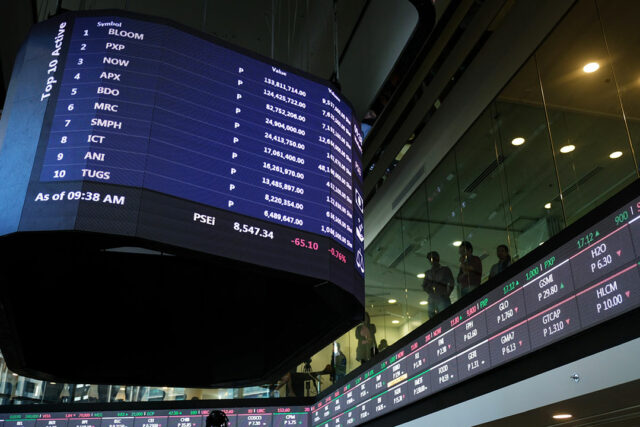
PHILIPPINE SHARES dropped to the 6,600 level on Thursday as headline inflation accelerated in November.

The main Philippine Stock Exchange index (PSEi) fell by 0.58% or 39.19 points to end at 6,690.77 on Thursday, while the broader all shares index dropped by 0.41% or 15.59 points to close at 3,776.89.

“Philippine shares slid below 6,700 once again with investors selling on news after the November consumer price index came in slightly higher than the previous month,” Regina Capital Development Corp. Head of Sales Luis A. Limlingan said in a Viber message.

Headline inflation picked in November as typhoons pushed up prices of vegetables, meat and fish, the Philippine Statistics Authority reported on Thursday.

The consumer price index (CPI) rose to 2.5% year on year in November, faster than the 2.3% print in October but slower than 4.1% in the same month a year ago.

This was within the Bangko Sentral ng Pilipinas’ (BSP) 2.2%-3% forecast for the month and matched the median estimate in a BusinessWorld poll of 15 analysts.

For the first 11 months, headline inflation averaged 3.2% in the 11-month period, a tad faster than the BSP’s 3.1% full-year baseline forecast but well within its 2-4% annual goal.   

“Wall Street edged higher Wednesday as investors awaited Friday’s US employment data, with forecasts of 214,000 new jobs in November,” Mr. Limlingan added.

On Wednesday, the Dow Jones Industrial Average rose by 0.69% or 308.51 points to 45,014.04; the S&P 500 gained by 0.61% or 36.61 points to 6,086.49; and the Nasdaq Composite surged by 1.3% or 254.21 points to 19,735.12.

“The local market extended its decline as investors maintained a cautious stance while waiting for new key catalysts,” Philstocks Financial, Inc. Senior Research Analyst Japhet Louis O. Tantiangco said in a Viber message.

“The exit of foreign funds also continued to weigh on the market,” he added.

Net foreign selling declined to P468.59 million on Thursday from P537.32 million on Wednesday.

Majority of sectoral indices closed lower on Thursday. Services declined by 1.86% or 39.33 points to 2,073.69; property went down by 0.64% or 16.37 points to 2,507.87; industrials dropped by 0.59% or 54.97 points to 9,180.33; and financials sank by 0.29% or 6.72 points to 2,255.88.

Meanwhile, holding firms rose by 0.39% or 22.38 points to 5,730.61, and mining and oil increased by 0.16% or 12.54 points to 7,494.05.

Value turnover dropped to P6.33 billion on Thursday with 862.86 million shares changing hands from the P7.96 billion with 507.68 million issues traded on Wednesday.

Market breadth was negative as decliners outnumbered advancers, 118 versus 87, while 50 names closed unchanged. — Revin Mikhael D. Ochave

Industrial firms see AI as priority but lack of readiness an issue — analysts

FREEPIK

ARTIFICIAL INTELLIGENCE (AI) is considered a priority item by industrial companies, Bain & Co. said, citing the results of a study, though companies worry about unpreparedness to deploy the technology and lack of resources.

“More than half the leaders of industrial companies we surveyed say that AI is a top three priority, but many companies lack the vision, resources and data to capitalize on it,” Bain said in a statement on Wednesday.

Bain views AI use in “supply chain planning, procurement enhancements, manufacturing optimization, and engineering augmentation” to be “emerging AI opportunities.”

By utilizing AI in the supply chain, Bain said companies could gain a 15%-20% productivity boost and improve forecast accuracy.

In procurement, a 5% to 7% increase in sourcing savings can be expected, it said, along with higher compliance at 2% to 10%. Maintenance expenses can also be lowered by 10% with a 5% to 10% yield improvement.

In addition, a 50% to 80% increase in productivity and 20% to 25% costs savings in engineering can be achieved with the help of AI, Bain said.

Separately, 96% of Philippine organizations surveyed by Cisco, said they have a ‘highly defined’ AI strategy in place or are in the process of developing one.

“Nothing can be deployed effectively in an organization without a clear strategy, and the same is true for AI,” Cisco said in its 2024 AI Readiness Index report.

However, the technology company noted that organizations’ AI readiness in multiple areas, such as talent and data, across the Asia-Pacific, Japan, and Greater China region declined this year.

“This means that despite the focus and investment, business leaders do not feel they have made enough progress towards their AI ambitions,” Cisco said.

In terms of adapting, deploying, and fully leveraging AI, 44% of respondents in the Philippines reported ‘high readiness,’ it added.

Further, the talent readiness of organizations in the country fell to 30% from 32% last year.

“The challenge for most organizations may lie in the lack of knowledge and skill to ensure compliance with the policies and protocols in place,” Cisco said. — Almira Louise S. Martinez

Worries about fund scrutiny behind gov’t spending slowdown — Sun Life

PHILIPPINE STAR/EDD GUMBAN

THE Sun Life of Canada (Philippines), Inc. (Sun Life) said the government needs to spend aggressively following weaker-than-expected growth this year, with government agencies reluctant to spend because of the intense scrutiny of their fund usage.

“The government (needs to be) more aggressive on spending. Because one of the key factors that drove lower-than-consensus GDP was really the lack of government spending,” Michael Gerard D. Enriquez, president of Sun Life Investment Management and Trust Corp., told reporters.

Mr. Enriquez said many agencies are “quite scared because they’re very scrutinized by how they spend the money.”

Sun Life said on Thursday that it expects the economy to grow 5.6% this year, picking up to 6.2% in 2025.

The Development Budget Coordination Committee (DBCC) set an economic growth target for this year of 6-6.5% but widened the target band to 6-8% for 2025 until 2028.

Growth in government spending slowed to 5% in the third quarter from 11.9% in the prior quarter, the Philippine Statistics Authority said.

Mr. Enriquez also added that consumer spending also fell because “inflation has really eroded a lot of their purchasing power.”

Sun Life forecast inflation to average 3.3% in 2024 and 2.8% in 2025.

“We see inflation returning to more stable ranges as well as stable supply for rice in 2025. Risks are another food supply problem or commodity price spikes,” it added.

The PSA reported on Tuesday that consumer price index growth accelerated to 2.5% year on year in November from 2.3% in October. The inflation reading in November 2023 had been 4.1%.

November inflation matched the median estimate of a BusinessWorld poll of 15 analysts conducted last week.

“With inflation starting to go down and the BSP (Bangko Sentral ng Pilipinas) very supportive in lowering policy rates, we hope to revive consumer spending,” he said.

When asked whether the 8% high end of the government growth target band can be achieved, he said: “They need to really spend on the critical infrastructure projects that they’ve identified.”

Mr. Enriquez also said manufacturing and the business process outsourcing industries to benefit from the Philippine and Canadian governments’ exploratory talks for a possible free trade agreement.

He also noted that the BPO industry flourished during the first term of President-elect Donald J. Trump.

Sun Life Philippines currently manages the equivalent of 6.2 billion Canadian dollars worth of assets, Benedict C. Sison, chief executive officer at Sun Life Philippines, said.

“We’re targeting, once we finish with the consolidation of all the assets, probably closer to 8 billion Canadian in assets under management,” Mr. Sison said. — Aubrey Rose A. Inosante

More funding sought for farm soil rehab

PHILSTAR FILE PHOTO

THE Department of Agriculture (DA) said it is seeking more funding to support the rehabilitation of farm soil.

“We really need to step up our organic fertilizer, soil ameliorants, and bio-fertilizer (treatments) in order for us to rehabilitate and rejuvenate our soil,” Agriculture Undersecretary Roger V. Navarro told reporters on Thursday.

He added that the DA’s programs include expanding soil ameliorant tests in crop production areas.

Mr. Navarro said that the DA is looking to test soil additives across 100 hectares of farmland to evaluate their effectiveness in boosting production and rejuvenating deteriorated soil.

He added that the continued use of inorganic fertilizer has degradated soil quality in farmed areas.

“We need to let (farmers) understand that the degradation of soil is through abuse of inorganic fertilizer… if the soil is no longer healthy it cannot absorb any more. (Fertilizer) will just evaporate and leach in the streams and waterways,” he said.

He added that the DA is now pushing for the adoption of organic fertilizer to reduce soil deterioration.

“The problem is our interventions are only good for a number of hectares,” he said.

In a speech delivered by Mr. Navarro, Agriculture Secretary Francisco P. Tiu Laurel, Jr. said that the DA is raising funds for loans and subsidies to support “the adoption of sustainable practices for both smallholder and commercial farmers.”

The DA has said that it is planning to establish composting facilities to reduce the dependence of farmers on inorganic fertilizers.

It said this would also reduce the vulnerability of marginal farmers to the high cost of chemical fertilizers. — Adrian H. Halili

ERC allows collection of P3-B deferred payments to reserve market suppliers 

PHILSTAR FILE PHOTO

THE Energy Regulatory Commission (ERC) said it allowed the collection of the remaining P3.05 billion owed by consumers to power generators that supplied the power reserve market in February and March.

In a statement, the ERC said that it approved the recovery of the 70% recalculated reserve trading amounts which will be collected starting with the January billing period.

Trading participants in the Luzon and Mindanao Wholesale Electricity Spot Market (WESM) stand to recover P0.124 per kilowatt-hour (kWh) over a three-month period.

WESM trading participants in Mindanao will collect P0.033 per kWh over six months.

The reserve market allows the system operator to procure power reserves from the WESM to meet the reserve requirements of the energy system.

In March, the ERC suspended billing and settlement at the reserve market after significant price increases in reserve power for the month, compared to February.

The regulator ordered the settlement of 30% of the amounts in May to allow power generators to partially recover their costs.

The ERC then lifted the suspension in July and allowed the resumption of full operations of trading of reserves in the WESM for contracted and merchant plants.

It, however, ordered the Independent Electricity Market Operator of the Philippines (IEMOP), which operates the WESM, to recalculate the resulting reserve trading amounts for the billing periods of February and March.

The IEMOP was also told to adjust the value for the remaining 70% for the March billing period. The ERC then reviewed the recalculation submitted by the operator.

“As a result, the reserve trading amounts were further recalculated and, after deducting for non-compliance, was reduced by P725 million,” the ERC said.

Lawrence S. Fernandez, vice-president and head of utility economics of Manila Electric Co., said that the power distributor is estimating an increase of around P0.40 per kWh in the transmission charge.

“Considering that total transmission charge right now is around P0.90 per kWh, (the increase) is almost half. Impact is mitigated by spreading recovery over three months,” he said via Viber. — Sheldeen Joy Talavera

PHL, EU agree on green economy, digitalization as joint priorities

REUTERS

THE PHILIPPINES and the European Union (EU) said the green economy, digital transformation, peace, and good governance remain their key areas of cooperation in 2025-2027.

“The Philippines showcased its strategic priorities and commitment to development, highlighting the country’s economic performance and growth outlook,” the Department of Finance (DoF) said in a statement on Thursday.

In turn, the EU discussed updates to its program following the mid-term review of the EU’s Multiannual Financial Framework (MFF) for 2021-2027.

The MFF is the long-term budget plan of the EU spanning at least five years of its own resources.

“Both parties reaffirmed that the green economy, digital transformation, peace, and good governance remain key priority areas for cooperation,” it said.

The DoF said key ongoing cooperation programs were reviewed — the Mindanao peace process, and the development of the green and digital economy.

“Ongoing investment operations on Disaster Risk Reduction and Water/Waste facilities were also reviewed,” it said.

“Possible new investments in the green economy were mentioned as a priority area for prospective loan financing with EU grants (blended finance) and guarantees.”

In addition, the meeting also tackled possible future cooperation in the sustainable use of critical raw materials and green finance. — Aubrey Rose A. Inosante

Rice inventory up 24% in November

PHILIPPINE STAR/KRIZ JOHN ROSALES

THE national rice inventory rose to 2.46 million metric tons (MMT) in November, up 24.4% year on year, according to preliminary data from the Philippine Statistics Authority (PSA).

Rice stocks consisted of 57.6% held by commercial traders, 36.6% by households, and 5.8% by the National Food Authority (NFA).

NFA and commercial warehouses grew their holdings, while household rice stocks fell during the month.

Rice held by commercial establishments in November amounted to 1.42 MMT, up 57.4%.

NFA reserves more than doubled to 141,680 MT from 60,230 MT a year earlier.

Rice held by households declined 11.4% year on year to 901,210 MT.

Month on month, rice stocks rose 7.9% from October.

“Increments were noted from the commercial sector by 17.2% and in the households by 0.3%. Meanwhile, rice stocks held by NFA depositories decreased 17.9%,” it added.

The Department of Agriculture has said it is targeting a year-end national rice inventory of 3.83 MMT, despite the projected drop in rice production. This is equivalent to about 100 days’ demand.

The PSA reported that corn stocks fell 20.6% year on year to 619,160 MT.

Corn held by commercial establishments accounted for 87.3% of the total, while households held the rest.

“Corn stocks recorded annual decreases of 21.3% in the commercial sector and 14.7% in households. — Adrian H. Halili

Spot prices up slightly in November

ELECTRICITY PRICES at the Wholesale Electricity Spot Market (WESM) rose in November as margins narrowed between supply and demand, the Independent Electricity Market Operator of the Philippines (IEMOP) said.

Citing preliminary data, IEMOP said WESM prices system wide rose 0.6% month on month to P4.42 per kilowatt-hour (kWh).

Between Oct. 26 and Nov. 25, available supply fell 2% to 19,492 megawatts (MW). Demand, on the other hand, fell 2.2% to 13,659 MW.

“Although both the system supply and demand decreased this month, its margin remained a factor in the price’s slight increase as the supply margin for the November billing period is lower than October,” according to Arjon B. Valencia, corporate planning and communications manager for IEMOP.

“This is driven by the supply-demand situation in Luzon which has an effect in the system collectively,” he added.

On Luzon, spot prices increased 8.9% month on month to P4.24 per kWh.

The grid’s supply dropped 2.4% month on month to 13,645 MW. Demand likewise decreased 2.5% to 9,663 MW.

WESM prices in the Visayas fell 18.6% month on month to P4.82 per kWh.

Available supply dipped 4.6% month on month to 2,394 MW. Demand fell 1.6% to 1,971 MW.

Spot prices in Mindanao during the period averaged P4.85 per kWh, down 6.6% from a month earlier.

Power supply increased 1.3% month on month to 3,453 MW while demand declined 1.2% to 2,030 MW.

IEMOP operates the WESM, where energy companies can buy power when their long-term contracted power supply is insufficient for customer needs. — Sheldeen Joy Talavera

Manila to file protest vs Beijing over latest water cannon incident

ENRIQUE A. MANALO — DFA.GOV.PH

THE PHILIPPINES will file a diplomatic protest against China over the latest incident in the South China Sea that involved a Chinese Coast Guard vessel firing water cannons at a Philippine boat around Scarborough Shoal, according to the Philippine Foreign Affairs secretary.

“We will be submitting our protest,” Philippine Foreign Affairs Secretary Enrique A. Manalo told reporters on the sidelines of the exchange of notes for Japan’s pledge of P611-million official security assistance to the Philippines in Pasay City, based on a transcript sent to reporters via WhatsApp.

“Certainly, we don’t understand why China again is repeating these actions which are clearly illegal,” citing Wednesday’s incident in Scarborough Shoal.

The Chinese Embassy in Manila did not immediately reply to a Viber message seeking comment.

In a joint statement on Wednesday, the Philippine Coast Guard and the Bureau of Fisheries and Aquatic Resources said the Chinese Coast Guard vessel fired a cannon at the BRP Datu Pagbuaya, “aiming directly at the vessel’s navigational antennas” while it was located 16 nautical miles south of Scarborough Shoal.

The Philippines under President Ferdinand R. Marcos, Jr. has so far filed 193 diplomatic protests over China’s actions in the South China Sea, 60 of which being filed this year, Philippine Foreign Affairs Spokesperson Ma. Teresita C. Daza told reporters in a WhatsApp message on Thursday.

Chinese Foreign Ministry Spokesperson Lin Jian in a news briefing in Beijing late Wednesday, reiterated China’s claim that Scarborough Shoal was within its territory and that its coast guard did “what was necessary” to protect Chinese maritime rights.

“China calls on the Philippines to stop those infringement activities and provocations at once and not to challenge China’s firm resolve to defend our lawful rights and interests,” he said.

A 2016 arbitral ruling that invalidated China’s expansive claims in the South China Sea said Scarborough Shoal, which Beijing has effectively controlled since 2012, is a traditional fishing ground for Filipino, Chinese, and Vietnamese fishermen.

China and the Philippines have sparred repeatedly this year over disputed areas of the South China Sea, including the Scarborough Shoal, one of Asia’s most contested features.

About $3 trillion worth of trade passes through the South China Sea annually, and it is believed to be rich in oil and natural gas deposits, apart from fish stocks.

Meanwhile, France has expressed concern over Wednesday’s water cannoning incident, citing the need for countries to abide by international law, according to the French Embassy in Manila.

“France renews its call for the respect of the United Nations Convention on the Law of the Sea (UNCLOS) and freedom of navigation,” it said in a statement late Wednesday.

“We oppose any threat or use of force contrary to international law and recall the importance of resolving disputes through dialogue.”

France also reaffirmed the 2016 ruling by the Hague-based Permanent Court of Arbitration’s ruling that voided China’s expansive claim of more than 80% of the waterway.

The European Union (EU) is looking to work with the Philippines on maritime routes awareness, cybersecurity, among other efforts to ensure stability in the Indo-Pacific region, EU External Action Service Managing Director Niclas Kvarnström told a news briefing in Manila on Wednesday.

“Any escalation, here you are talking about the Philippines, which of course has a Mutual Defense treaty… the two largest militaries (China and US) in the world, goes without saying that that’s dangerous to have escalation so we would not like to see that,” he said.

The United States has also condemned China for its “unlawful use of water cannons and dangerous maneuvers” in the South China Sea, its top envoy to Manila said on Wednesday.

China’s actions disrupted Philippine maritime operations and put lives at risk, Ambassador MaryKay Carlson said on social media platform X, adding that the US stands with likeminded allies in support of a free and open Pacific. — John Victor D. Ordoñez

PHL’s military pact with Japan likely to be ratified next week — Escudero

ARMED FORCES OF THE PHILIPPINES

By John Victor D. Ordoñez, Reporter

THE PHILIPPINE Senate is likely to approve and ratify Manila’s Reciprocal Access Agreement (RAA) with Tokyo next week even as lawmakers try to reconcile their respective budget versions, according to the Senate president.

At news briefing on Thursday, Senate President Francis “Chiz” G. Escudero said the Senate can do away with the three-day rule in approving measures since the pact is a treaty.

“The RAA has been sponsored (before the floor) by Senator Maria Imelda R. Marcos and we are expecting to approve it on second reading next week… and if we really need to, we can approve it on final reading on the same day or the next day,” he said in Filipino.

“This is a treaty ratification, and you can argue that you do not treat this as passing a law, but so that there won’t be any issues, we usually treat these like how we pass bills.”

The Senate president his colleagues cannot propose amendments to treaties.

Congress is in the middle of harmonizing their versions of the P6.352-trillion national budget for 2025, in time for their self-imposed Dec. 9 target. Senate Finance Committee Chairperson Mary Grace Natividad S. Poe-Llamanzares earlier said lawmakers aim to submit the budget to the Palace by Dec. 19 for the President’s signature.

The Senate’s final version of the national budget restored a previously slashed P10-billion funding from the P50-billion allocation for the Revised Armed Forces of the Philippines Modernization Plan in 2025. The Department of National Defense will also get a P266.28-billion budget amid the continuing tensions in the South China Sea.

Both countries signed the deal in July to ease the entry of military equipment and troops for combat training from Japan. Mr. Escudero earlier said the Senate aims to ratify the RAA before the year ends.

The agreement is the first of its kind to be signed by Japan in Asia and coincides with increased Chinese assertiveness in the South China Sea, where Beijing’s expansive claims conflict with those of several Southeast Asian nations.

A United Nations-backed tribunal based in the Hague in 2016 voided China’s expansive claims in the sea for being illegal. Beijing has ignored the ruling.

The Philippines has a visiting forces agreement with the US and Australia. Tokyo, which hosts the biggest concentration of US forces abroad, has a similar deal with Australia and Britain, and is negotiating another with France.

Japanese Foreign Minister Yoko Kamikawa has said her country’s partnership with Manila is not targeted against any country but aims to boost efforts towards peace and stability in the region.

P611-M SECURITY ASSISTANCE
Meanwhile, Manila and Tokyo on Thursday finalized Tokyo’s official security assistance (OSA) worth about P611 million in radar systems, inflatable boats and other maritime equipment to boost Manila’s capacity to patrol its waters, according to the Japanese Embassy in Manila.

In a statement, the embassy said Japanese Ambassador to the Philippines Endo Kazuya and Philippine Foreign Affairs Secretary Enrique A. Manalo on Thursday signed and exchanged diplomatic notes on the security assistance, which comes amid rising tensions with China in the South China Sea.

“It will support the Department of National Defense, and Armed Forces of the Philippines (AFP) efforts in securing the Philippines and improving the country’s capabilities to deter threats to peace, stability and security in the Indo-Pacific region,” the Philippine Department of Foreign Affairs (DFA) said in a statement.

In separate statement, the Embassy of Japan in the Philippines said the Philippine Air Force would receive an Air Surveillance Radar System to improve the surveillance capabilities of the Philippines.

The aid is in the form of OSA, which provides equipment and supplies to the armed forces of the recipient country, according to the embassy.

“OSA aims to strengthen our security cooperation with the recipient countries, to create a desirable security environment for Japan, and to contribute to maintaining and strengthening international peace and security,” it said.

Japan, which last year announced its biggest military build-up since World War II in a step away from its post-war pacifism, does not have any claims to the South China Sea, but has a separate maritime dispute with China in the East China Sea, where they have repeatedly faced off.

It has supported the Philippines’ position in the South China Sea and has expressed serious concern over China’s actions.

“The assistance reflects the two countries’ shared commitment to maritime stability and regional peace,” the DFA said.