
How PSEi member stocks performed — February 24, 2026
Here’s a quick glance at how PSEi stocks fared on Tuesday, February 24, 2026.
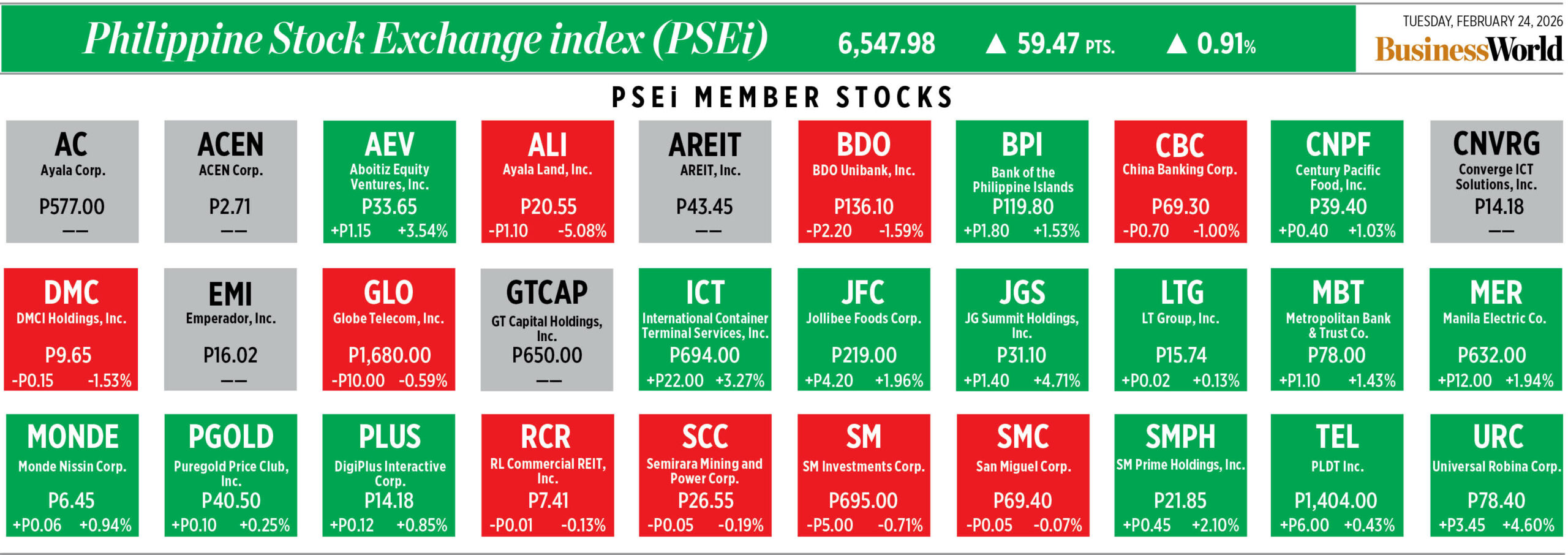

Here’s a quick glance at how PSEi stocks fared on Tuesday, February 24, 2026.

THE PHILIPPINES improved in two of the three pillars in the World Bank’s Women, Business, and the Law (WBL) 2026 report, with scores surpassing the global and East Asia and Pacific averages.
The report, released on Tuesday, measures how laws, policies, and practices shape women’s economic opportunities. It studied 190 economies’ performance in three indices: legal frameworks, supportive frameworks, and enforcement perceptions.
In the 2025 report, the Philippines scored 72.53 in legal frameworks, 77.43 in supportive frameworks, and 53.97 in enforcement perceptions.
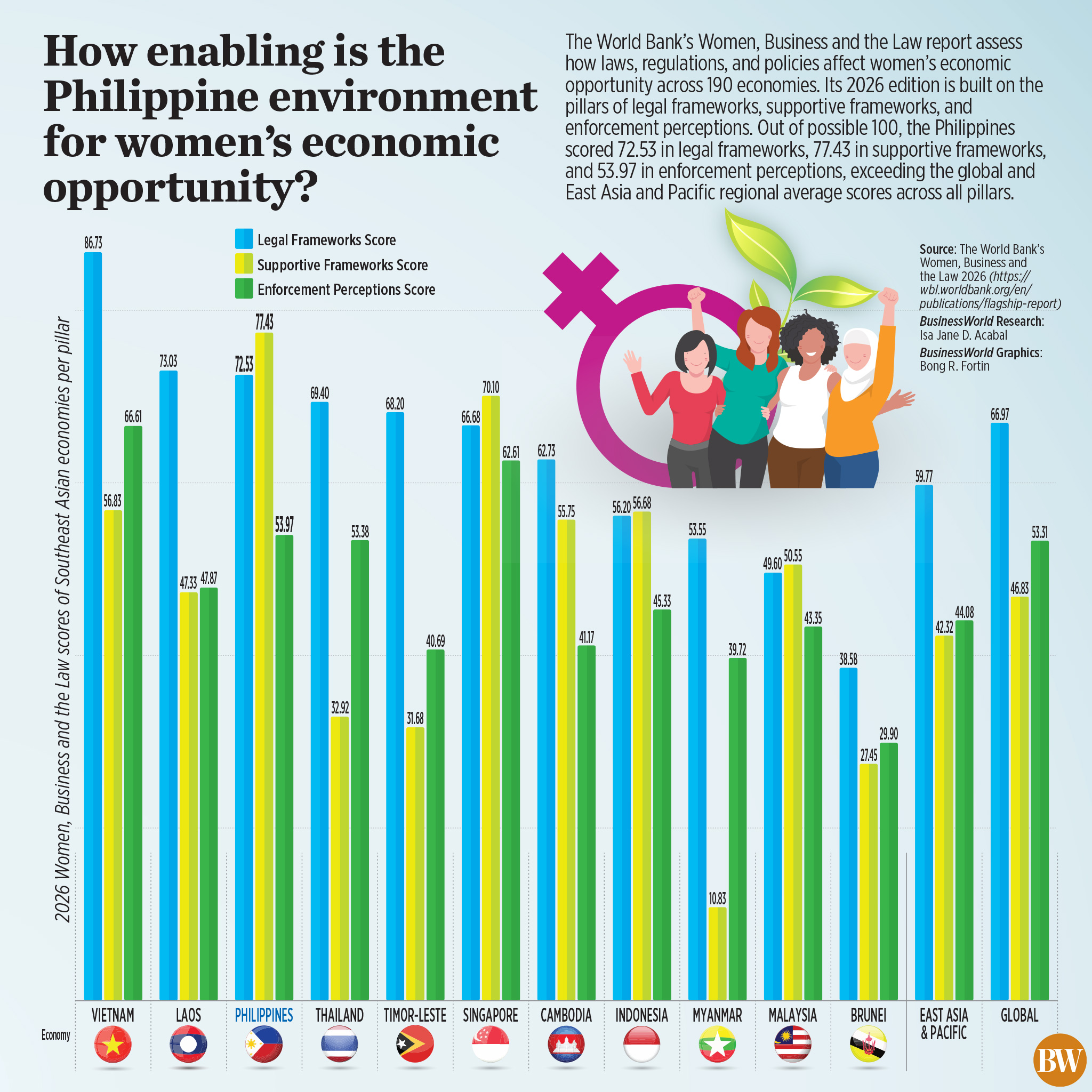
Compared to 2024, the Philippines scored higher in both legal frameworks and supportive frameworks, from 70 and 54.2 points, respectively. Its score fell in enforcement perceptions from 58.8 two years ago.
“In the Philippines, the legal frameworks score is 73, the supportive frameworks score is 77, and the enforcement perceptions score is 54, showing that gaps still persist between law and practice,” the World Bank said.
Nevertheless, the Philippines’ performance outperformed global and the East Asia and Pacific averages across all pillars and topics, except for mobility, marriage, and childcare.
The report covered 10 topics — safety, mobility, work, pay, marriage, parenthood, childcare, entrepreneurship, assets, and pension.
“On paper, most countries are doing reasonably well: the average country scores 67 out of 100 on the adequacy of laws to enable economic equality between women and men,” said Indermit Gill, World Bank chief economist and senior vice-president for development economics.
“But when it comes to enforcing the laws, the average score drops to 53. And when the systems needed to implement those rights are assessed, the adequacy score is just 47,” he added.
He said lower averages in law enforcement and implementation “reflect huge opportunity gaps.”
On the WBL 1.0 index, the Philippines scored 81.9 in 2026, higher than 78.8 in 2024. It measures 35 data points across 8 indicators.
This score is middle-of-the-road in Southeast Asia, exceeded by Vietnam (88.1), Timor Leste (86.3), Cambodia (84.4), Singapore (82.5), and Laos (82.5) but better than Thailand (78.1), Indonesia (70.6), Myanmar (61.9), Malaysia (60.06), and Brunei (53.1).
The report also found that the Philippines was the only economy to have enacted reform toward legal gender equality on the topic of mobility, via the Philippine Passport Act.
“The Philippine Passport Act allows married women to choose whether to adopt their husband’s surname, removing the blanket requirement for all married women to present a marriage certificate,” the World Bank said.
In total, the report tallied 68 economies that have implemented reforms toward legal gender equality from 2023 to 2025.
“Over the past two years, 68 economies enacted 113 positive legal reforms across most areas of women’s economic life, with the greatest progress in entrepreneurship and safety from violence,” the World Bank said.
“Seven countries also expanded paternity leave to help redistribute caregiving and support women’s employment,” it added.
Women, Business, and the Law assesses the global state of women’s economic participation across 10 key areas, including safety from violence, access to childcare, entrepreneurship, employment protections, asset ownership, and retirement security.
Norman Loayza, director of the World Bank Policy Indicators Group, said the report identifies safety from violence as a key shortcoming, as it makes women less able to work consistently.
“True equality begins with safety. Whether at home, at work, or in public, women deserve protection to thrive,” he said.
“Globally, we’re falling short. We have only a third of the safety laws we need, and even then, enforcement is failing 80% of the time,” he added. — Justine Irish D. Tabile

By Chloe Mari A. Hufana, Reporter
PRESIDENT Ferdinand R. Marcos, Jr. ordered the Department of Agriculture (DA) to procure fertilizer, seed and other inputs and pre-position them to minimize distribution delays.
Speaking at the 2026 National Confederation of Irrigators Associations general assembly in Quezon City on Tuesday, Mr. Marcos said he instructed Agriculture Secretary Francisco P. Tiu Laurel, Jr. to front-load procurement of farm supplies ahead of planting.
Mr. Marcos warned that last-minute procurement — particularly of imported supplies — could result in months of shipping and inland transport delays before goods reach farms.
“I told them to buy early so that when planting season comes, everything is already there,” Mr. Marcos said.
The government is seeking to raise farm productivity and stabilize food supply amid persistent price pressures and weather disruptions.
Stockpiling and pre-positioning, he added, would allow the government to distribute assistance more efficiently and cushion farmers from price spikes or delivery lags.
The administration is seeking to modernize agriculture, including the operations of the National Irrigation Administration. Proposed measures include of a command center capable of real-time telemetry and satellite-fed weather monitoring.
Former Agriculture Secretary William D. Dar said the strategy is sound risk management.
“This is a very good strategy of DA procuring the needed inputs way ahead for better and on time distribution of the same,” he said via Viber.
Mr. Dar added that early procurement would not necessarily fuel food inflation. With timely input assistance and proper agricultural practices, productivity could rise, potentially boosting farmer incomes and stabilizing supply.
However, other analysts highlighted structural issues in the food value chain.
Jayson H. Cainglet, executive director of the Samahang Industriya ng Agrikultura, pointed to the persistent gap between farmgate and retail prices, and argued that inflationary pressures stem largely from distribution markups and intermediary costs.
“There is a disconnect between production/farmgate price and retail prices,” he said via Viber. “Farmers are always blamed for food inflation or price pressures when the real drivers are distribution markups, weak price transmission, and high intermediary margins.”
“Front loading as a concept is a positive development as farm input distribution has always been late and in other instances, substandard — thereby impacting yield and productivity.”
Mr. Cainglet supports early distribution but proposed alternative mechanisms, such as vouchers, allowing farmers to purchase supplies directly from dealers based on their specific needs.
Former Agriculture Undersecretary Fermin D. Adriano cautioned that centralized procurement assumes an efficient bureaucracy capable of competitive pricing and accurate demand forecasting.
“This is under the assumption that the bureaucracy is efficient; that it can buy stocks at a competitive price; that they know the demand for inputs by the rice farmers for each province; the time farmers need them; with the DA capable of properly stocking them,” he said via Viber.
He advocated direct cash assistance instead of centralized input procurement, arguing that cash transfers would reduce logistical risks and corruption while allowing farmers to choose inputs tailored to their operations.

THE Department of Energy (DoE) announced the proposed permit approval flowchart for nuclear power developers, which it said streamlined key stages by allowing some approvals to take place in parallel instead of sequentially.
Two of the stages — business registration and the environmental clearance certificate (ECC) — are common to most projects, while the nuclear and energy-related approvals cover the siting plan, licensing and provisional permitting by the Philippine Atomic Energy Regulatory Authority (PhilAtom); and energy industry-specific approvals and licenses like testing and commissioning approvals, the DoE said.
The Philippines is hoping to integrate nuclear power into the national power mix by 2032.
In a statement on Tuesday, the DoE said the regulatory pathway for new nuclear projects, which covers seven major phases, requiring sequential and parallel approvals.
The end-to-end licensing framework incorporated the results of a focus group discussion led by the Nuclear Energy Program Inter-Agency Committee (NEP-IAC), which took in input from the private sector and academia.
“We must ensure that every nuclear power plant project in our country meets the rigorous standards required for its safe and secure operation, in adherence to International Atomic Energy Agency (IAEA) requirements,” NEP-IAC Secretariat Head and DoE Director Patrick T. Aquino said.
The government hopes to present the NEP-IAC-validated flowchart to prospective nuclear power project proponents seeking to invest in the Philippines, alongside key policies and investment incentives.
Energy Secretary Sharon S. Garin said the government hopes to begin accepting nuclear power plant license applications by this year to stay on track for the 2032 target.
“By finalizing this harmonized licensing roadmap, we are sending a clear signal that the Philippines is preparing for nuclear energy with discipline and foresight,” Ms. Garin said.
“Our commitment is straightforward: strong safety oversight, predictable processes, and transparent public engagement, so that when proponents are ready to invest, government is ready to evaluate, regulate, and deliver our 2032 target responsibly,” she added.
The Philippine Energy Plan calls for at least 1,200 megawatts (MW) of nuclear capacity by 2032, doubling to 2,400 MW by 2045 and to 4,800 MW by 2050. — Sheldeen Joy Talavera

FARMERS’ groups said they are seeking the withdrawal of a directive issued by Agrarian Reform Secretary Conrado M. Estrella III removing his department’s approval powers for the transfer or sale of certain types of private agricultural land.
In a joint statement on Tuesday, the Magsasaka Party-List (MPL) and the Federation of Free Farmers (FFF) said the administrative order (AO), dated Jan. 27, could affect an estimated 1.2 million agrarian reform beneficiaries (ARBs) cultivating about 1.8 million hectares.
They said the order removing the requirement for Department of Agrarian Reform (DAR) sign-off could undermine decades of social justice gains and facilitate the reconcentration of land ownership.
“It eases the pathway to massive conversions of farmland by real estate and other commercial interests and, in the process, endangers farmers’ livelihoods and the nation’s food security,” MPL President Argel Joseph T. Cabatbat and FFF Chairman Leonardo Q. Montemayor said in the statement.
The AO removed the requirement for DAR approval for the transfer, sale, or conveyance of privately owned agricultural land not covered by a notice of acquisition as of the June 30, 2014 deadline set by Republic Act No. 9700 or the Comprehensive Agrarian Reform Program with Extension and Reforms Law.
The policy also applies to land awarded through Emancipation Patents or Certificates of Land Ownership Awards after completion of the 10-year holding period.
The groups said that while the order restates the rights of farm tenants and workers to security of tenure, preemption, and redemption, it does not provide enough protections.
“DAR must actively shield our agrarian reform beneficiaries from predatory market forces and forcible evictions resulting from expedited land transfers or conversions,” they said.
They also called on DAR to work with the Land Bank of the Philippines to ensure that beneficiaries have access to financing to exercise their rights.
Mr. Estrella did not immediately respond to a Viber message seeking comment. — Vonn Andrei E. Villamiel

THE PHILIPPINES is dialing back plans to ease its free float requirements, after neighboring Indonesia contended with a market meltdown following concerns over ownership of tightly-held listed firms.
The Securities and Exchange Commission has set a minimum free float of 15% for large listings, according to a newly released circular on Tuesday. It had initially aimed to bring the floor down to 12% from the current level of 20%, based on a draft it circulated to market participants in December.
The adjustment comes as index compiler MSCI Inc. in January cracked down on Indonesia over the investability of its stocks, partly due to tightly-held ownership of its listed firms. Indonesian stocks saw their worst two-day rout in nearly three decades at one point after MSCI warned it could be downgraded to frontier market status.
According to the new rules, Philippine companies that have an expected market capitalization of more than P50 billion ($865 million) at the time of listing must have a minimum initial public ownership of 15%.
Regulators could allow a lower minimum IPO requirement for “exceptionally large” listings if it determines that this wouldn’t impair market liquidity, investor protection and orderly trading. Such accommodation should not go lower than 12%, it said.
In the earlier draft, the regulator had considered allowing a minimum 12% float for companies with an expected market capitalization of over P150 billion. The SEC has now set the threshold at no less than P200 billion in the latest rules.
The SEC has scrapped its “one-size-fits-all” approach in the new rules, adjusting the required free float based on the size of the listing, subject to a minimum offer size.
The overhaul caps months of public debate as companies say stringent requirements deter them from going public, while authorities look to encourage better investor participation in the stock market.
The move could clear the way for the IPO of local fintech leader GCash, which had argued that a 20% minimum float was too high for a potential offering that would value the e-wallet provider at at least $8 billion. The company previously called for the easing of float rules as it weighs a possible IPO, potentially in the second half of 2026, Bloomberg News reported earlier, citing people with knowledge of the matter. — Bloomberg

THE Department of Agriculture (DA) said state-run Food Terminal, Inc. (FTI) will begin buying onions this week to help arrest falling farmgate prices as the harvest starts to peak.
In a statement on Tuesday, Agriculture Secretary Francisco P. Tiu Laurel, Jr. said an FTI team has been dispatched to Nueva Ecija, the leading production area, to obtain cold storage space for onion purchases.
“They’ve secured space for 50,000 28-kilo bags, and we can expand that if needed,” Mr. Laurel was quoted as saying in the statement.
Nueva Ecija produces more than half of the country’s onion output, with Bongabon accounting for roughly 15% of total production, the DA said.
According to the DA, FTI President Joseph Rudolph C. Lo inspected markets in Nueva Ecija and reported farmgate prices rebounding to as high as P45 per kilo.
“Our goal is to buy at prices that are fair to farmers, at levels that are enough to make onion farming profitable and sustain their planting intentions,” Mr. Lo was quoted as saying in the statement.
The DA said FTI is also looking at purchasing onions from other major production areas such as Occidental Mindoro, Pangasinan, and provinces in the Cagayan Valley.
The DA said it is also building cold storage facilities to extend the shelf life of vegetables to keep supply and prices stable throughout the year. — Vonn Andrei E. Villamiel

THE Department of Information and Communications Technology (DICT) said it wants to capture any overflow of artificial intelligence (AI) projects from India by establishing a dedicated AI lab in New Clark City.
“We want to explore how we can take advantage of the overflow of BPO (business process outsourcing) in India… We are putting a framework together on that (and it will involve establishing a hub) in New Clark City,” Information and Communications Technology Secretary Henry Rhoel R. Aguda told reporters on the sidelines of Association of Southeast Asian Nations (ASEAN) Editors and Economic Opinion Leaders forum on Tuesday.
The DICT is working on possible partnerships with major Indian BPOs like Infosys and Wipro, which already have Philippine operations, Mr. Aguda said.
“Their DR (disaster recovery) sites are here already, as well as their overflow. These companies have AI initiatives, so maybe they can establish AI hubs in Clark,” he noted.
The target is to create about 50,000 “high value” jobs in the next five years, he said.
Further, Mr. Aguda said collaborations with India are also planned for cybersecurity training, semiconductor workforce development, and mutual recognition of digital certifications. — Ashley Erika O. Jose

THE Philippine Competition Commission (PCC) said the Mobile Number Portability (MNP) Act has encouraged more competitive behavior among mobile service providers (MSPs) by expanding consumer choices.
“The assessment shows that the MNP Act has encouraged more competitive behavior among MSPs in attracting and retaining subscribers,” the antitrust regulator said in a statement on Tuesday.
Republic Act No. 11202, or the MNP Act, was signed in 2019. The law enable network subscribers to retain their mobile numbers for free when switching between MSPs.
Citing its competition impact assessment (CIA) study of the law, the PCC said the MNP Act provides sufficient safeguards against the abuses of dominant position by MSPs.
The law also has safeguards against discriminatory practices due to self-regulation, and the illicit access and use of personal information that may lead to anti-competitive conduct.
To attract users, MSPs developed online channels where subscribers can find information on the benefits of switching to their services, the PCC added.
Citing Telecommunications Connectivity, Inc. (TCI), PCC noted the significant influx of subscribers switching to the third player (DITO Telecommunity Corp.) during the first 10 months of implementation.
However, this trend declined in the coming months, the PCC noted.
TCI reported that less than 0.1% of registered mobile numbers switched from one MSP to another, during the first three years of implementation.
TCI is a joint venture formed by MSPs — Smart Communications, Inc., Globe Telecom, Inc., and DITO Telecommunity — to facilitate MNP services.
It serves as a clearing house that manages MNP services. This includes ensuring that subscribers can switch between MSPs without changing their mobile numbers.
However, the PCC noted issues with the law’s implementation that could indirectly affect competition.
This includes the low number of porting applications during first three years of MNP implementation, which could reflect subscribers’ limited knowledge of the MNP Act.
“If subscribers are unaware of their freedom to switch to another MSP when dissatisfied, they may not realize the full benefits of the bargaining power offered by RA 11202,” PCC said.
It also noted that the National Telecommunications Commission is in “proximal position” to advise the TCI and MSPs on competition matters.
The CIA study recommended the creation of joint awareness campaigns to reintroduce the MNP Act to the public. It also called on the need to revisit current porting capacities to minimize costs associated with unused slots.
The PCC conducts CIA studies to assess laws, regulations, and proposals that may potentially harm competition. — Beatriz Marie D. Cruz

REGULATORY REFORM centered on digitizing at the local level should be the focus areas in bringing the Philippines to upper middle-income status, officials said.
Speaking at the Makati Business Club’s Business-Government Forum on Tuesday, Ernesto V. Perez, director general of the Anti-Red Tape Authority, said innovation at the local government unit (LGU) level is key to improving the ease of doing business and expanding the tax base.
“To really develop the economy, we have to prioritize innovation at the local level because this is where businesses start,” he said.
Mr. Perez cited the rollout of the Electronic Business One-Stop Shop (eBOSS), a platform that streamlines and digitalizes business registration and related processes in LGUs.
He said the system encourages voluntary compliance by making it easier for enterprises to register and pay the correct taxes.
Mr. Perez said LGUs that have implemented eBOSS show substantial increases in both revenue collection and business registrations.
“When businessmen know that it is easier for them to register their business, and at the same time they can not engage in business illegally without being caught, then they will voluntarily register their business,” he added.
However, Mr. Perez said adoption remains limited, with only a fraction of the 1,642 LGUs having fully complied with or integrated the system.
He said scaling up implementation would require collaboration with the private sector.
“The problem is huge. We cannot cover the entire country on our own. By partnering with the private sector, we are able to tackle the problem,” he said.
Meanwhile, acting Budget Secretary Rolando U. Toledo said fiscal consolidation and sustained infrastructure spending will be critical to achieving income targets.
“One of the indicators that we are looking at is how we are going to implement our fiscal consolidation strategy,” he said.
Mr. Toledo said the government is monitoring growth trends and the debt-to-GDP ratio as part of its strategy.
He said the government is also seeking to improve investment in infrastructure projects, which he said will boost the economy and employment.
“This actually has a multiplier effect not only in terms of the growth of the economy, but also in job generation,” Mr. Toledo said. — Vonn Andrei E. Villamiel

THE Department of Transportation (DoTr) said it plans to offer the runway re-paving contract for the airport in Antique province at an indicative price of nearly P100 million.
In a bid notice dated Feb. 21, the DoTr said the runway asphalt overlay contract for Antique Airport, also known as Evelin B. Javier Airport in San Jose de Buenavista, is expected to cost P96.44 million.
The winning bidder will get 120 days to complete the project, the DoTr said, adding that bidders must have completed a project of a similar type in the last 10 years to pre-qualify to bid.
Interested parties have until March 16 to submit proposals.
The auction is restricted to Filipino citizens, sole proprietorships, cooperatives, and partnerships or organizations with at least 60% interest or outstanding capital stock belonging to Filipinos.
The DoTr this week invited potential bidders to redevelop the airports in Naga City, Ormoc, Tacloban, and Kalibo, with the contracts valued at a combined P1.65 billion.
The DoTr’s airport upgrade program is focused on improving many provincial airports to accommodate at least narrowbody jets to handle the growing passenger capacities. The capacity to handle Boeing 737 or Airbus A320 aircraft — the most prevalent single-aisle jet models — also suggests upgrades to attract direct international flights. — Ashley Erika O. Jose

A HOUSE of Representatives committee approved on Tuesday a measure seeking to make digital payment systems in government and merchants more mainstream.
The House Banks and Financial Intermediaries committee said it will consolidate 15 bills proposing that kiosks and shops include digital payment platforms to help keep the government from further falling behind its digitization targets.
“This would make (digital payments) available as an option for consumers,” Bangko Sentral ng Pilipinas (BSP) Deputy Governor Mamerto E. Tangonan told BusinessWorld on the sidelines of the Committee hearing. “We’re going to mobilize the government to (become) the lead adopter of digital disbursement and collections.”
The Philippines is at risk of failing to hit its digitalization target by 2028 as outlined in the Philippine Development Plan (PDP).
The committee approved House Bill 7672, or the proposed e-Bayad Act, as the consolidated substitute bill for the various pending measures. The proposal was identified by the Legislative-Executive Development Advisory Council (LEDAC) last year as a priority bill.
The bill requires all government agencies to adopt digital payments for disbursements and collections either via in-house payment solutions or employing payment service providers that facilitate the real-time receipt of funds.
For merchants, the bill orders local government units (LGUs) to encourage and incentivize merchants via reduced fees, as well as assist small and micro-merchants in becoming more capable users of digital payments.
“The Bangko Sentral ng Pilipinas (BSP), Department of Trade and Industry (DTI), Department of Interior and Local Government (DILG), and the Department of Information and Communications Technology (DICT) shall also facilitate measures to provide capacity building for the covered agencies and merchants on the use of digital payments,” according to the bill.
Mr. Tangonan said the bill will help the government meet its 60-70% target for the share of digital payments in retail by 2028, which is one of the PDP goals.
BSP Governor Eli M. Remolona, Jr. said on Friday that the government could fail to reach its payments digitalization targets by the deadline due to slower-than-expected adoption due to worries about cyber risks.
In 2024, online payments accounted for a 57.4% share by volume and 59% by value of retail transactions, according to the BSP’s 2024 Status of Digital Payments in the Philippines report. These are up from 52.8% and 55.3%, respectively, in 2023.
Mr. Tangonan said that while the government has successfully enabled early adopters of digital payments, a growth driver is needed to boost late-stage adapters.
“We’re trying to find a second wind, the next breakthrough that will push our sales towards more growth. But without that… it’s really going to be hard,” he said.
“We need to start encouraging the late majority to adapt. Meaning, in the innovation lifecycle, we got the early adopters, the early majority, I think we got that. So we’re now working on the late majority.”
The BSP also continues to work with industry to lower fees to further boost digital payment adoption, Mr. Tangonan said.
He noted that among lower income users, fees serve as a “disincentive.”
He added the central bank is looking at implementing a pricing mechanism to lower fees, but noted that it is not feasible for banks to go to zero fees.
“In other countries, they can set zero fees. It’s not as feasible here. So, we have to work with something that can be successful.” — Aaron Michael C. Sy
