Home Blog Page 2196

A crypto optimist’s guide for 2025
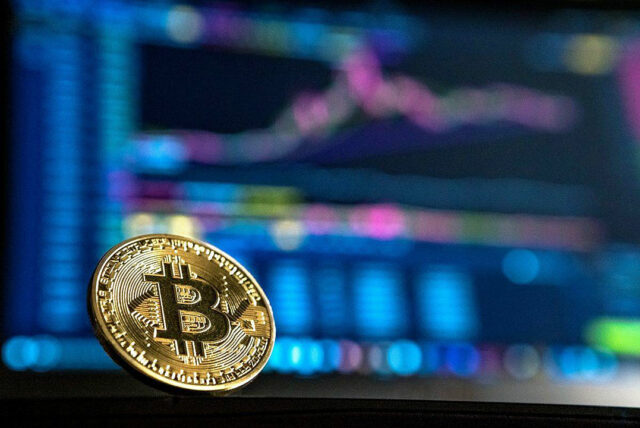
STOCK PHOTO | Image by Diana.Grytsku from Freepik

BEFORE I undertake the hard task of predicting where the crypto industry will go in 2025, let’s take a minute to recall where it has been. The bout of exuberance we are currently experiencing was preceded by three episodes of crypto summers followed by crypto winters — roughly three years of generally rising Bitcoin prices, and increasing capital flows and popular interest, followed by 14 months or so of sliding Bitcoin prices and serious questions about the future of crypto.

It’s tempting to assume this is the eternal pattern — in which case Bitcoin’s price might increase to around $500,000 in 2025, followed by a crash around the end of the year to a low around $100,000 in 2026 — but that misses the main point. The industry has made substantial progress. In 2014, many people thought Bitcoin and other cryptocurrencies would not survive, and that the underlying blockchains would never be more than a minor technology for niche applications. In 2018, most assumed crypto would not disappear, but that it would never deliver a social revolution comparable to the internet. In 2022, the question was whether the sector could integrate with existing regulation and financial markets or survive as an outlaw alternative similar to the dark web.

2025 will go a long way toward answering that last question. There are reasons to think the Cold War between crypto innovators and governments will end, allowing capital to move more freely between traditional and crypto sectors. Bitcoin and the “respectable” crypto projects, backed by major venture capital firms and traditional financial institutions, could emerge into full sunlight, with projects developed by “two gals in a garage” and shadowy groups of hackers, anarchists and libertarians still in the shadows but perhaps out of the crosshairs of law enforcement. This would lead to further Bitcoin appreciation. Or crypto could remain in legal limbo with the associated volatility, with only Bitcoin and projects controlled by traditional companies having clear rules. This would not crash Bitcoin prices, but it might limit the upside.

Even in the bull scenario, crypto will continue to experience the booms and busts of technology stocks, but perhaps not the long and deep winters of the past, nor the dizzying returns of the summers. If peace negotiations fail, which also seems a plausible outcome, crypto is now mature enough to survive and even to gain strength from regulatory repression. (Disclosure: I am an active crypto investor and have venture capital investments and advisory relations with companies in the space.)

Here are five technologies that have been around for some time and are actively employed today that could see widespread adoption in 2025. If they fail, the historical pattern will probably repeat, and we can expect another crypto winter.

DECENTRALIZED DIGITAL IDENTITIES
The dream is for individuals to store all their personal information in encrypted form on a blockchain that ensures both privacy — so that only the individual can authorize someone to see the information; and trustworthiness — authorized viewers can be confident any shared information is accurate. A decentralized system requires some type of valuable crypto tokens to pay for processing power, and to underwrite security and accuracy. Not only would this be a major crypto achievement in itself, it would make many other crypto projects feasible.

In a world where personal information is tracked in centralized conventional databases and is often inaccurate, relying on things such as photo IDs and signatures, traditional institutions have an advantage. But in a DDI world, crypto is the natural way to handle transactions, give permissions, enforce contracts and organize collective activity.

I don’t expect everyone to get a decentralized digital identity in 2025, but it will be a major plus for crypto if one or more DDI systems such as Polygon ID or World ID can sign up a few million users. If not, if such an obviously good idea can’t attract a critical mass of technophiles, perhaps crypto isn’t all it’s cracked up to be.

ORACLES
A related idea is crypto solutions to getting trustworthy information online. This is a different kind of trust than that given to traditional sources such as government information, news media or textbooks — it’s information that will pay you if it’s wrong. Instead of evaluating the source of the information — its credentials, track record and incentives — your trust is based on the amount you collect if it turns out to be false.

Oracles such as Chainlink and Band already exist and are used in many crypto systems. In 2025, we may see some emerge for general information that gets widespread attention. Like DDIs, this would be a major application on its own, and one that opens the door for progress in other applications.

ZERO-KNOWLEDGE PROOFS
This is another approach to getting trustworthy information online and accelerating crypto acceptance. Zero-knowledge proofs have been used to prove the solvency of crypto exchanges since 2023, and 2025 could be the year they emerge for noncrypto applications. (Disclosure: I am a paid adviser to a crypto ZKP provider.) ZKPs do not merely promise money if information is wrong, they prove mathematically that it is true. Their scope is more limited than oracles. An oracle can answer any question while existing ZKPs can only answer questions about blockchain-encoded information. They can tell you a crypto exchange is solvent or, with the help of DDIs, that a social media platform has no users under the age of 13, but not whether the Los Angeles Dodgers won the 2024 World Series.

SYNERGY WITH AI
AI can benefit from the accurate information supplied by oracles and ZKPs, and also exploit DDIs to make better decisions without endangering individual privacy. There is a benefit in the other direction; AIs could become major users of crypto services in 2025. Moreover, human consumers of AI information, such as a farmer relying on an AI tool to integrate weather reports, agriculture price forecasts and other data to select an optimal planting scheme, will likely want the trust services available in crypto. They’ll want to know that the proposed crop allocation really came from the AI and that it is either provably true or backed by a significant financial bond. The two technologies together could be far more powerful and socially transformative than either on its own.

Major breakthroughs in this area are unlikely in 2025, but we could see crossover projects announced. If increasing numbers of decisions are turned over to computers, these computers will need the kind of communication and coordination tools offered by emerging crypto applications. Moreover, as more activity is coordinated by crypto, human users will likely rely more on AI to manage things.

CHIPS AND DATA CENTERS
Hardware issues may seem out of place among the sophisticated abstract software ideas above, but crypto requires massive computing power, as do AI and other emerging fields that link naturally with crypto such as computational biology. We have shortages of chips, and data centers to support the chips, and there are real questions about how to get enough electricity to run it all. Moreover, the processing sector raises sensitive national security issues.

How these questions play out in 2025 will have a major impact on the future direction of crypto and other processing-intensive sectors. Increasing supply of increasingly powerful chips, with plenty of capital and regulatory support for building and connecting data centers, and abundant electricity should accelerate progress. Without those things, we could see progress slowed or halted.

A related question is who will own the data centers. Will large providers and users such as Amazon.com, Inc. supply their own processing needs and rent out processing to smaller users? Will independent data centers sell to the highest bidders? Will governments impose controls on the market? The answers to these questions in 2025 will help us understand the future direction of crypto.

BLOOMBERG OPINION

‘Toughest’ phone HONOR X9c 5G set for Jan. 10 launch in the Philippines

HONOR is attempting a 500-feet drop test for its HONOR X9c 5G smartphone.

HONOR PHILIPPINES is set to unveil in the country its “most durable” and “toughest” smartphone, the HONOR X9c 5G, on Jan. 10.

The X9c 5G, which the company dubs as “the toughest phone of 2025,” will be launched on HONOR’s Facebook page next week, it said in a statement.

The smart devices provider said it expects higher sales and a stronger market presence this year, with the HONOR X9c 5G’s launch set to kick off 2025.

“HONOR’s expectation for next year is to achieve higher sales and expand its market presence in the Philippines. With its innovative technology and consumer-focused approach, HONOR anticipates significant growth,” it said in an e-mail to BusinessWorld.

“The company is confident that the launch of its most durable smartphone yet in January 2025, equipped with durability, long-lasting battery life, Google Mobile Services, and advanced AI (artificial intelligence) features, will drive higher sales and strengthen its position in the competitive market.”

The HONOR X9c 5G is the latest device in the brand’s X9 series and aims to solve durability and performance issues found in modern smartphones, it said.

“Designed for active individuals and professionals, it addresses the demand for robust, long-lasting devices with seamless 5G connectivity, advanced camera capabilities, and extended battery life,” HONOR said.

The target market for the phone includes tech-savvy users, professionals seeking reliable devices, and consumers looking for premium features while remaining budget-friendly, it said.

The new smartphone’s all-angle triple defense feature has an SGS 5-Star rating for drop resistance and can withstand up to two-meter drops. It also has an IP65M water resistance rating.

“It can be submerged up to 25cm deep for a maximum of five minutes,” HONOR Philippines said.

“The biggest surprise of HONOR for the HONOR X9c 5G is the boiling test… With its heat resistance, the toughest phone can take extreme temperatures ranging from -40°C cold to 70°C hot,” it added.

The HONOR X9c 5G’s front screen and back camera are made with super double tempered glass said to be harder than steel, with the back cover featuring anti-drop technology and its screen having shock-absorbing material to reduce drop impact.

It has a three-layer protection design and metal monitoring system.

2025 OUTLOOK
As it looks to capture a larger share of the Philippine smartphone market, HONOR plans to continue introducing durable and feature-rich smartphones at competitive prices that address consumers’ needs, it said.

The company is looking to replicate its success in China in the Philippine market, it added.

“HONOR remains committed to its core mission of upgrading and innovating the technology it offers. We ensure that our Filipino market can connect with and enjoy the best features of our latest devices.”

For this year, smartphone sales will likely be influenced by technological advancements, consumer preferences, market competition, pricing strategies, and economic conditions such as inflation, HONOR said.

“HONOR plans to address these challenges by offering competitive pricing, maintaining high-quality standards, and emphasizing the value proposition of its devices to appeal to budget-conscious consumers.”

The company saw a spike in its shipments in 2024 compared with the previous year, signaling its growing regional presence, it added. — Beatriz Marie D. Cruz

Bitcoin more than doubles in 2024 on spot ETF approval, Trump euphoria

ANDRÉ FRANÇOIS MCKENZIE-UNSPLASH

BITCOIN more than doubled in 2024 driven by the US markets regulator’s approval for exchange-traded funds (ETF) tied to its spot price, and optimism over easing regulatory hurdles with Donald J. Trump set to return to the White House.

The world’s largest and most well-known cryptocurrency hit $100,000 earlier in December, a milestone that has ignited ‘animal spirits’ among supporters of the once-nascent asset class.

A more than 120% surge in Bitcoin last year and a nearly 50% jump in ether, the second-largest cryptocurrency, have propelled the sector’s market value to roughly $3.5 trillion, according to CoinGecko data.

More gains are in store for 2025, according to analysts.

“We remain convinced $100,000 is not the final milestone. We expect Bitcoin to hit a cycle-high of $200,000 in late 2025,” analysts at brokerage Bernstein wrote in a client note earlier in December.

MicroStrategy, a software firm that has become the world’s largest corporate holder of Bitcoin, had seen its shares surge nearly five-fold in 2024.

The stock, which joined the benchmark Nasdaq-100 index recently, is now seen as a proxy for Bitcoin, with its movement closely tied to sentiment towards the digital asset. Several smaller companies are following its playbook and allocating portions of their cash to Bitcoin.

“We expect Bitcoin to emerge as the new-age premier ‘store of value’ asset eventually replacing gold over the next decade and becoming a permanent part of institutional multi-asset allocation and a standard for corporate treasury management,” the Bernstein note said.

Much of the optimism began in January 2024 when the US Securities and Exchange Commission approved the first ETFs to track the spot price of Bitcoin, marking a watershed moment for the broader crypto industry.

The move gave the sector institutional legitimacy and improved its mainstream appeal as traditional finance heavyweights including BlackRock and Fidelity launched the products.

The victory of Mr. Trump, who has promised to make the United States the “crypto capital of the planet,” further bolstered the industry’s position later last year. Crypto advocates donated millions during the election, hoping to elect candidates that favor the sector.

Most crypto stocks have also benefited from the industry-wide rally. The big winners of 2024 are MicroStrategy, crypto exchange Coinbase and Bitcoin miner Hut 8.

On the other hand, several other crypto miners have reeled under shrinking margins due to higher energy and hardware costs, missing last year’s rally.

Shares of Riot Platforms, Marathon Digital and Bit Digital lost between 26% and 32% last year. — Reuters

LRTA 11-month revenue tops P1 billion

PHILIPPINE STAR/MIGUEL DE GUZMAN

THE LIGHT Rail Transit Authority (LRTA), which operates Light Rail Transit Line-2 (LRT-2), posted P1.17 billion in revenue in January to November 2024, surpassing 2023 sales.

The amount was 7.33% higher than a year earlier, according to data posted on its website. Passenger traffic reached 48.58 million, 8.05% higher than a year ago.

For November, LRTA gross revenue climbed 9.8% to P115.47 million from a year earlier. Passengers reached 4.81 million, up 10.3%.

For the first three quarters of last year, LRTA had already surpassed pre-pandemic revenue levels.

In the nine months to September, the operator of the LRT-2 generated a gross revenue of P934.47 million from fare collection, climbing 21.34% from a year earlier.

In the January to September, LRTA said passenger volume rose to 38.91 million from 35.91 passengers a year earlier. The volume was still below the 47.16 million passengers recorded from January to September 2019. — AEOJ

Liam Payne’s manager, hotel staff failed ‘vulnerable’ singer before death, judge says

Liam Payne in a scene from 2013’s One Direction: This Is Us. — IMDB

AN ARGENTINE judge argued that the manager of former One Direction singer Liam Payne and employees of the hotel where he was staying failed the popstar in the moments before his death and allowed charges against them to proceed, according to a statement from the prosecutor’s office on Monday.

Mr. Payne fell to his death from a hotel balcony in Buenos Aires in October last year.

Mr. Payne’s manager as well as the manager of the hotel and its head of reception are charged with manslaughter in relation to the former pop superstar’s death. They face up to five years in prison if convicted.

A hotel employee and a local waiter are accused of plying Mr. Payne with cocaine during his stay, and face up to 15 years in prison. The judge in her decision on Friday ordered them jailed ahead of their trial.

“Taking Payne up to his room in the state he was in was to put his life at risk,” the judge said in her decision, which was released with the prosecutor’s statement. “It was obvious that he was vulnerable.”

Mr. Payne’s autopsy showed that at the time of his death he had “large quantities” of cocaine and alcohol in his system, according to the statement.

Mr. Payne allegedly purchased cocaine at least four times from the hotel employee and waiter over a three-day period.

Footage from the lobby of the Casa Sur hotel in the posh Palermo neighborhood showed that minutes before Mr. Payne’s death on Oct. 16, 2024 he was seen unconscious and being carried up to his room by three people.

The hotel receptionist headed the group, and was then seen with the hotel manager in the hallway outside Mr. Payne’s room, according to the statement.

“Payne’s consciousness was altered and there was a balcony in the room. The proper thing to do was to leave him in a safe place and in company until a doctor arrived,” the judge said.

She added that evidence showed that Mr. Payne attempted to leave his room through the balcony but due to the state he was in he fell.

Mr. Payne’s manager, identified only by his initials “RLN,” left the hotel less than an hour before the fall. The judge argued that he should not have entrusted the hotel employees with Mr. Payne’s wellbeing.

The judge barred the manager, who is a US citizen, from leaving Argentina. — Reuters

A new calendar

MARISSA GROOTES-UNSPLASH

ONLY OLD-FASHIONED (aka “analog”) people still keep desk diaries with two pages in one week for noting appointments and other transactions like purchase of stocks. So what if it’s lately been mostly blank since the cellphone notes all the appointments and reminders, with alarms. The calendar is still like comfort food — nice to have around.

Economists note the market optimism that a new calendar brings. It is called the “January Effect.” There is the accountant’s report for the just finished fiscal year when all the assets are booked “at market.” Then, there are the new challenges for the business, maybe a change in leadership. All these are captured in the “annual report” that comes out after the first quarter of the new year.

Even if January is not really a new beginning but just a continuation of time, the artificial divide of a new year turns the page. The feeling of a new start is psychological, even if it is an accounting divide as well. Current problems linger and somehow the new month does not start from zero but some other big number, sometimes negative. The new year is not like the old magic slate where you just lifted the page and the blank one was restored, waiting to be written on.

It is not just corporations that are affected by the January Effect. Relationships too have the illusion that the year is a new starting line, even when unresolved issues of fiscal irresponsibility, thoughtlessness, and verbal cruelty persevere. That’s why couples sometimes make joint new year’s resolutions — I will not forget to send you flowers on Valentine’s even if it costs me a week’s salary. Since there is no formal review of these promises like the budget process in a corporation, commitments slide and come up only when a fiery exchange of words occurs. Also, there is no variance analysis acceptable to justify why something has been done or not done.

The January Effect provides a healthy dose of optimism. It gives a boost of energy, a sense of temporary invincibility that this new year, contrary to the historical evidence of other years, will somehow be different in a positive way. The goal of fireworks is not just to exorcise the bad things of the outgoing year (even if the loud noise and staccato bursts disturb the neighbors more than the evil elves) but also to build a firewall between one year and the next.

We seldom now see the old representation of the old man exiting the scene wearing the sash of the old year — how did he get so ancient-looking in one year? That guy needs some AI uplift — and the baby, often with a horn for blowing, walking forth as the personification of the new year. Both characters wear sashes to denote the old and new year.

The January Effect often refers to the stock market and the economy. It seems that listed companies naturally get a bump in price and volume in the first month. It’s not all about Trump.

Still, on a personal basis, the January Effect can refer to a list of to-dos including such goals as weight loss, eating healthier, and restarting relationships that blew up when gifts were opened. These lists are not necessarily written down or even adhered to. By April the resolutions may have already been forgotten.

The new calendar also ushers in elections. The busy five months ahead will fill billboards and airwaves with names and faces of candidates and their slogans, along with the advocacies of never-before-heard causes to accommodate celebrities with no links at all with what their parties seem to be promoting, including safe mining, clean air, health coverage. Dynasties too will again slug it out with each other.

January is named after the Roman deity Janus with his two faces joined back-to-back, looking back and looking ahead. This original January Effect may be more realistic. We may only have the illusion of a fresh beginning… just the change of a new year to remember when writing checks to pay for condominium dues and car stickers.

A new milestone does not always start with a new calendar. Maybe things turn for the better just before Easter… or the next calendar.


Tony Samson is chairman and CEO of TOUCH xda

ar.samson@yahoo.com

Beijing unveils plans to boost driverless vehicle use in capital

Self-driving Car | Adobe Stock Photo

BEIJING — China’s capital Beijing passed new regulations on Tuesday to encourage autonomous driving technology in the city, with authorities planning to eventually allow driverless public buses and taxis.

Autonomous vehicles that pass road testing and safety assessments will be allowed to apply for road trials, the state-backed Beijing Daily newspaper reported, which said the new regulations take effect from April 1.

The city supports the use of autonomous vehicles for private cars, urban buses, trams and taxis, it said, adding that it wants to encourage the construction of intelligent road infrastructure to support such transport.

In a separate notice published on Monday, the central Chinese city of Wuhan also said it had approved regulations to promote the development of intelligent connected vehicles.

Chinese authorities have been aggressively greenlighting trials for self-driving technology with at least 19 cities conducting robotaxi and robobus tests, Reuters reported in August.

Companies with large robotaxi fleets in use in China include Apollo Go, a subsidiary of technology giant Baidu, which planned to deploy 1,000 robotaxis in Wuhan by end-2024.

Pony.ai, which floated in the US market in November, plans to expand its robotaxi fleet nationwide to over 1,000 by 2026 from 250 in 2024.

Other firms exploring robotaxi opportunities in the world’s largest auto market include WeRide, AutoX and SAIC Motor.

US electronic vehicle giant Tesla also aims to bring full self-driving (FSD) to China in the first quarter of 2025, pending regulatory approval, and has said it will start producing its own robotaxi in 2026. — Reuters

Citigroup, BofA join other US lenders in exiting Net-Zero Banking Alliance

US BANKS Citigroup and Bank of America (BofA) said on Tuesday they are exiting the Net-Zero Banking Alliance (NZBA), a group of global banks that have pledged to curb greenhouse gas emissions.

They follow Wells Fargo and Goldman Sachs, which both left the alliance earlier in December.

Financial firms, historically criticized for their connections to the fossil fuel industry, have made efforts to incorporate net-zero standards more prominently into their operations.

However, they have begun scaling back on some initiatives to avoid irking Republican policy makers who are opposed to limiting the financing of fossil fuels.

Citi said it had made progress toward its own net-zero goals and decided to leave the NZBA.

BofA, in an e-mailed statement to Reuters, said: “We will continue to work with clients on this issue and meet their needs.”

The NZBA aims to bring down carbon emissions from the lending and investment portfolios of its members to zero on a net basis by 2050.

Last month, BlackRock, Vanguard and State Street were sued by Texas and 10 other Republican-led states, which said the large asset managers violated antitrust law through climate activism that reduced coal production and boosted energy prices. — Reuters

Aboitiz completes 5 warehouses for FAST Logistics

ABOITIZ Construction recently finished the construction of five warehouses in Cebu in Central Philippines for FAST Logistics Group, it said in a statement on Wednesday.

The project, spanning a total construction floor area of 17,315 square meters, was delivered in less than a year, it said.

The company used pre-engineered building steel materials and a steel formwork system, an innovative approach to delivering durable and efficient construction solutions.

“The warehouse complex marks a significant milestone in FAST Logistics Group’s expansion efforts,” Aboitiz Construction said. “As one of the Philippines’ leading logistics and distribution solution providers, FAST continues to diversify its footprint to meet growing market demands.”

Aboitiz Construction employed about 300 workers for the project, with 80% of hired workers based in Cebu. It also recorded more than 800,000 safe man-hours, showing the company’s commitment to community development, economic growth, as well as safety and quality, it said.

The project was completed in partnership with property developer MVC Development Corp. and Hearn & Hearn Consulting.

Aboitiz Construction will continue expanding its portfolio in the light industry sector through quality warehouses to support the growth of the country’s logistics industry, the company said. — Beatriz Marie D. Cruz

Empty desks and tears mark five colleagues killed in South Korean plane crash

THE LOGO of Jeju Air is seen at its office near Gimpo Airport in Seoul, South Korea, Aug. 21, 2017. — REUTERS

EMPTY DESKS and a calendar marking days off after Christmas sit in a South Korean office where five co-workers once planned a holiday to Thailand which ended in tragedy on Sunday when their return Jeju Air flight crashed.

The five female colleagues, who flew to Bangkok to celebrate promotions, were among the 179 people killed when flight 7C2216 crashed at the Muan International Airport in the deadliest air disaster on South Korean soil.

Still in shock at the loss of their co-workers and friends, colleagues wearing black ribbons cried at their desks in the public education office on Tuesday, as they watched over a victim’s empty desk.

White chrysanthemums had been placed on the desk in mourning, while boxes with books and stationery awaited another victim who was supposed to move desks in the new year.

“It doesn’t feel real,” said Lee Dae-keun, an official at the Jeollanamdo Office of Education who worked in the same department as one victim.

“She is still lingering in my eyes. Whenever seeing flowers on that empty desk, ah, sadness rushes in.”

Reuters is not naming the victims at the request of colleagues who asked for privacy.

The dead employees were an old group of work friends who had been looking forward to their long-awaited trip, said their co-workers.

“As a colleague, she was really hard-working and nice, a kind colleague to others,” Mr. Lee said with a sigh. “She always told me to stay happy and positive.”

Mr. Lee said he had gone to the airport with other co-workers to provide food or charge phones for their colleagues’ bereaving families who were camping out.

At the office, officials set up an altar where colleagues and neighbors came to pay condolences.

Bowing in tears at the altar, Lee Kwi-sun, a school chef, vividly remembered her last moment of holding hands with another victim.

“Our names are similar. We were like lost siblings that just met now. So we said to meet again, and held each other’s hands and laughed and parted ways,” she recalled.

“I talked to her a lot personally and professionally, so this just breaks my heart,” she said. — Reuters

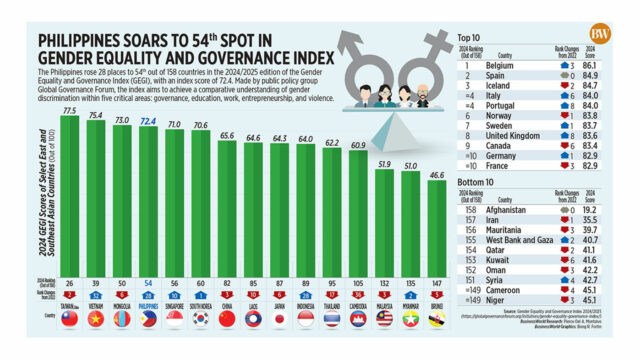
Philippines soars to 54th spot in Gender Equality and Governance Index

The Philippines rose 28 places to 54th out of 158 countries in the 2024/2025 edition of the Gender Equality and Governance Index (GEGI), with an index score of 72.4. Made by public policy group Global Governance Forum, the index aims to achieve a comparative understanding of gender discrimination within five critical areas: governance, education, work, entrepreneurship, and violence.

Philippines soars to 54<sup>th</sup> spot in Gender Equality and Governance Index

Trump 2.0, monetary policy to drive PHL stocks

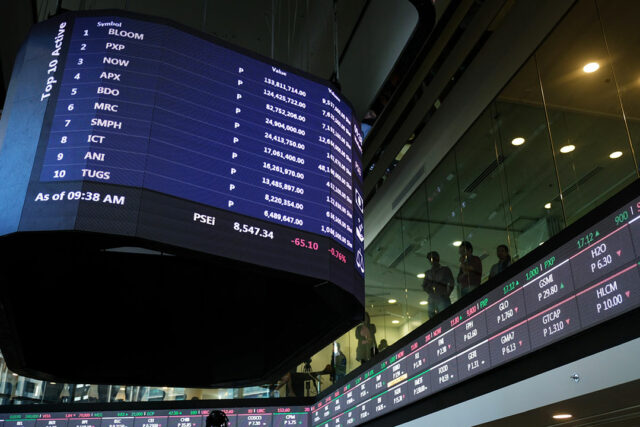
BW FILE PHOTO

By Revin Mikhael D. Ochave, Reporter

THE Philippine Stock Exchange index (PSEi) could trade at 7,000-8,000 this year, with the start of US President-elect Donald J. Trump’s second term, the direction of global monetary policy, and the midterm elections in the Philippines to dictate the market’s movement.

The PSEi closed 2024 at 6,528.79, rising by 1.2% or 78.75 points from its end-2023 finish of 6,450.04. This marked the first time since 2019 that the index posted a year-on-year increase.

The local stock barometer could peak at just 7,600 this year amid market caution as Mr. Trump begins his second term as US President, China Bank Capital Corp. Managing Director Juan Paolo E. Colet said in a Viber message.

“[This] year presents a complicated picture. While we remain positive about the growth prospects of the Philippine economy and the earnings strength of many listed companies, we approach 2025 with caution as there is a lot of uncertainty around Trump 2.0. Just like his first term, we expect that Trump’s social media posts will again move markets, so investors should be ready to manage that volatility,” Mr. Colet said.

The upcoming Philippine midterm elections and geopolitical issues could bring additional uncertainties, he added.

“We are wary of the impact of potential natural disasters and geopolitical stress on our country’s economy. Investors will likewise keep a close eye on the midterm elections as the outcome thereof could either ensure stability or create uncertainty.”

BDO Capital & Investment Corp. President Eduardo V. Francisco said in an interview that the market could trade between 7,000 to 7,500 this year.

“Even if the US announces a rate cut, it is not necessarily good. Also, when the peso depreciates, the foreign investors will get hurt because the hot money wants the peso to be strong and stable,” he said.

AP Securities, Inc. Research Head Alfred Benjamin R. Garcia held a “cautiously optimistic outlook” for Philippine stocks for this year, citing the market’s potential despite headwinds.

“We think that the fundamentals are there to lift the market higher, but we do acknowledge that we face numerous headwinds like shallower rate cuts and the probability of another global trade war,” he said in a Viber message.

“Despite concerns about both international and local factors – such as macroeconomics, geopolitical situations, and the new United States president — the numbers and valuations of PSEi present a positive outlook,” Luna Securities, Inc. Research Officer and Market Strategist Annika Gabrielle S. Angeles said in a market report.

Ms. Angeles said under their baseline scenario, the PSEi could trade between 7,030 and 8,080 this year.

COL Financial Group, Inc. Chief Equity Strategist April Lynn C. Lee-Tan said market drivers for 2025 include lower inflation and interest rates, as well as the midterm elections.

She added that the market’s “attractive valuations” and the recently signed Corporate Recovery and Tax Incentives for Enterprises to Maximize Opportunities for Reinvigorating the Economy Act could provide an investment boost.

However, Ms. Tan said the US market’s volatility is a potential risk as this could spill over to the Philippines.

“The Philippines suffers from contagion when it comes to the volatile US market,” she said.

“Any improvement in local and external market conditions, especially if the PSEi goes up to 7,000-8,000 levels, would help encourage more fundraising activities in local stock markets such as initial public offerings, follow-on offerings, preferred shares offerings, stock rights offerings, private placements, among others,” Rizal Commercial Banking Corp. Chief Economist Michael L. Ricafort said in a Viber message.

ADVERTISEMENT
ADVERTISEMENT