Home Blog Page 2179

Gearing for a renewed strategic competition with China: Possible roles for the QUAD in the Indo-Pacific region

THE Japan-US-Australia-India Summit held on May 24, 2022 in Tokyo. — KANTEI.GO.JP/QUAD-LEADERS-MEETING-TOKYO2022

The most consequential foreign policy achievement of the first Trump Administration was engaging China in strategic competition. It admitted that the era of America’s unipolar movement was over. In its place is an emerging multipolar world where great powers compete for wealth, influence, security, and prestige under uncertainty, anarchy, and possible armed conflicts.

The Trump Administration’s 2017 National Security Strategy (NSS) did away with the post-Cold War legacy of engagement, enlargement, and cooperation with all states worldwide. Instead, it recognized that China and Russia are challenging and ending the period of America’s unrivaled military, diplomatic, and economic preponderance. The Trump Administration’s 2017 NSS was followed by the Department of Defense’s (DoD’s) 2018 National Defense Strategy (2018 NDS), which geared American strategic thinking into a possible armed conflict with China and Russia in the light of the Great Power Competition. The US is currently engaging China and Russia in political, economic, strategic, and military competition.

The incoming second Trump Administration will likely continue what it started in 2017. This is premised on several indications: Donald Trump’s threat to impose very high tariffs on Chinese goods, his appointment of China hawks to key national security and diplomatic positions, the American public’s general distrust and hostility toward China, and the bipartisan animosity against Beijing in the US Congress. Analysts and pundits also believe this, given his peace overtures to Russian President Vladimir Putin. Trump will focus on China’s policy without any distraction from other regional conflicts such as those in Syria and Ukraine.

THE TRUMP ADMINISTRATION AND THE REVIVAL OF THE QUAD
The Trump Administration accepted the stark realities that America’s unipolar moment is over and that it faces multi-faceted challenges from China and Russia. Nevertheless, it recognized America’s comparative advantage vis-à-vis its two competitors: its experience and skill in forging and managing multilateral defense and security alliances and partnerships. Despite President Trump’s unilateralist mantra “Make America Great Again,” his administration quickly and skillfully utilized this advantage. It moved to deepen historical multilateral security alliances such as the North Atlantic Treaty Organization (NATO), expand existing bilateral alliances to multilateral networks, extend security partnerships as more tightly coupled alliances, and forge new security partnerships. The most significant among these new security partnerships was the Trump administration’s revival of the Quadrilateral Security Dialogue (QUAD) with Australia, India, and Japan.

The QUAD was initially formed in 2007 as the four countries’ tentative response to the growing security uncertainty generated by China’s emergence as a regional power. Unfortunately, Australia and India were reluctant to institutionalize the QUAD because of their diplomatic and economic relations with China. The QUAD’s diplomatic momentum as a regional security organization was lost.

In 2017, the US, under President Trump, and Japan, under the late Prime Minister Shinzo Abe, revived the QUAD. Its revival stemmed from the Trump Administration’s concerns over China’s assertive and aggressive behavior in the South and East China Seas. It accepted the reality that there was an unfolding power transition in the Indo-Pacific region with the US capability to act as the regional off-shore strategic balancer being diminished in the face of China’s emergence as a competing center of power that is actively seeking to unravel the region’s balance of power and normative order. The Trump Administration considered the QUAD a useful security forum to constrain Chinese revisionist behavior and agenda as it incorporated its Indo-Pacific strategy (The Free and Open Indo-Pacific) with Japan.

During the Trump Administration, the QUAD became more institutionalized as the four member-states regularized their senior and ministerial meetings. They also established working groups on relevant international issues such as the climate crisis, the COVID-19 pandemic, emerging and critical technologies, and infrastructure development. Unfortunately, diverging strategic interests remained despite shared security interests. Consequently, they engaged in a waiting game to determine when their strategic interests would converge. This caused QUAD meetings to remain ad-hoc as they failed to produce joint declarations. The member-states had difficulty generating and accepting an agenda for traditional military cooperation that could have transformed the QUAD from a security forum to a formal multilateral alliance.

AGENDA FOR THE 2ND TRUMP ADMINISTRATION
The Biden Administration continued the Trump Administration’s efforts to engage China in a strategic competition. In March 2021, it held the first QUAD summit online. This resulted from the common concern about China’s vaccine diplomacy in Southeast Asia and renewed assertiveness in the South China Sea. After the summit, the leaders of the member-states met regularly.

The second Trump Administration will likely continue its predecessor’s efforts to strengthen the QUAD to balance the scale of China’s strategic challenge in the Indo-Pacific region. This will entail pursuing the following policies relative to the QUAD, namely: 1.) continuing the regular summit meetings among the member-states; 2.) focusing the forum’s efforts on regional order building by establishing institutional rules and norms for emerging issues and challenges such as digital connectivity, cybersecurity, maritime domain awareness, and infrastructure development; 3.) offering to Southeast Asian countries choices to counter China’s efforts to dominate the regional agenda in the development of transparent, high standard infrastructure, and an open, accessible, and secure technological ecosystem; and, 4.) assuring the Association of Southeast Asian Nations (ASEAN) that it recognizes its centrality in regional security affairs and that its members’ Free and Open Indo-Pacific (FOIP) strategies converge with the ASEAN Outlook on the Indo-Pacific (AOIP).


Dr. Renato Cruz De Castro is a trustee, convenor, and non-resident fellow of the think tank Stratbase ADR Institute. He is also a distinguished full professor at the Department of International Studies at De La Salle University-Manila.
Inflation rates in the Philippines

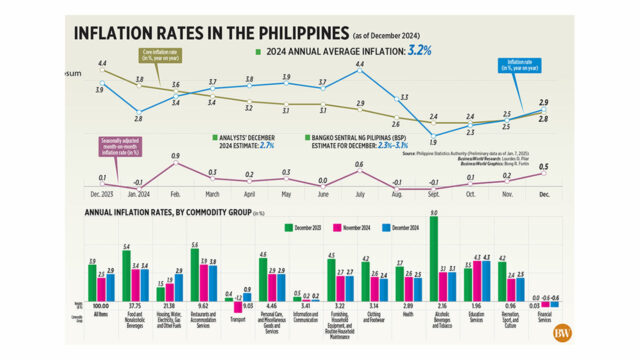
INFLATION accelerated for a third straight month in December amid a faster rise in food, utility and transport prices, the Philippine Statistics Authority (PSA) said. Read the full story.

Inflation rates in the Philippines

Roberto Jimenez steps down from PSE

THE Philippine Stock Exchange, Inc. (PSE) said that seasoned Finance Executive Roberto Jose R. Jimenez has stepped down as the market operator’s assistant vice-president and finance division head due to retirement.

Mr. Jimenez’s retirement took effect on Jan. 1, the PSE said in a stock exchange disclosure on Tuesday.

According to the PSE, Mr. Jimenez joined the company in February 2019. He had been in the finance field for close to two decades.

Mr. Jimenez was the director of engineering fleet management, commercial, and finance of Cebu Air, Inc. from August 2010 to January 2019.

From 2002 to 2010, Mr. Jimenez was the finance and administration head of various Citadel Holdings Inc. subsidiaries, including Textron Corp., Citadel Shipping Services, Inc., and Rapid, Inc.

He has a master’s degree in business management from the Asian Institute of Management and a bachelor of science degree in industrial engineering from the University of the Philippines.

For 2025, the PSE expects to have six initial public offerings and P120 billion in raised capital.

The bellwether PSE Index lost 1.2% or 79.79 points to 6,545.38, while the broader all shares index shrank by 1.14% or 43.34 points to 3,750.69 on Tuesday. — Revin Mikhael D. Ochave

A full theatrical calendar in 2025’s first half

YIZACK RANGEL-UNSPLASH

IT will be yet another full year in the theater, dance, and music scene. Here are some shows — some new, others restagings — that will fill up theater lovers’ calendars in 2025.

JANUARY–FEBRUARY

Clara and The Nutcracker Prince
Jan. 11

The Ballet Academy of Cebu presents a ballet by Meghan Samonte at Centerstage, SM Seaside City. It follows Clara, who embarks on a magical Christmas journey with her Nutcracker doll, and features Tchaikovsky’s music.

CAST PH’S Staged Reading Festival
Jan. 12, 19, 26, Feb. 2

To kick off 2025, CAST PH is bringing back its annual staged reading festival, this year with the theme of “Theoria Omnium” (Theory of Everything). The four unnamed plays — the name of the play is announced just before the performance — for this edition will be scientific dramas, each to be shown on a Sunday at 3 and 8 p.m., starting Jan. 12. Play No. 1 is directed by Jaime Del Mundo; Play No. 2 by Sarah Facuri; Play No. 3 by Nelsito Gomez; and Play No. 4 by Topper Fabregas. Among the performers this season are Cathy Azanza-Dy, Dean Daniel Rosen, Jenny Jamora, Ron Capinding, Roselyn Perez, and Dolly de Leon. All performances will be at the WHYNoT Culture Hub at Karrivin Studios, 2316 Chino Roces Ave., Makati.

Europa
Jan. 17

The Philippine Philharmonic Orchestra (PPO) begins the year with an evening of majestic melodies. For Europa, the 4th concert in its 40th season which started last year, the PPO will perform Zoltán Kodály’s Dance of Galanta, Tchaikovsky’s Violin Concerto No. 1, and Dvořák’s Symphony No. 8, op. 88, G Major. Cleveland concertmaster David Radzynski will be a guest for this symphonic journey. The concert will take place at the Samsung Performing Arts Theater in Circuit, Makati.

Jepoy And The Magic Circle
Jan. 25 and 26

Repertory Philippines presents a fantasy musical which introduces children to legendary Filipino characters and rare Filipino animals through costumes, songs, dances, simple dialogue, and puppetry. The performance includes audience participation. The production is held at the Eastwood Theater, Quezon City.

MSO’s 99th Anniversary Concert: A Tribute to Burt Bacharach
Jan. 25

As the Manila Symphony Orchestra (MSO) celebrates its 99th anniversary, the MSO under the baton of National Artist for Music, Ryan Cayabyab pays tribute to American composer and songwriter Burt Bacharach with a grand concert. They will perform orchestral renditions of Bacharach’s hits such as “What The World Needs Now Is Love,” “Raindrops Keep Falling On My Head,” and more, together with The Ryan Cayabyab Singers, Lara Maigue, Gian Magdangal, and Alice Reyes Dance Philippines. This is the last concert of the 2024-2025 MSO Concert Series: In Pursuit of Excellence. It will be held at the Samsung Performing Arts Theater, Circuit, Makati City.

FEBRUARY-MARCH

Next To Normal
Feb. 1

The Sandbox Collective’s 11th season begins with Next to Normal, an award-winning Broadway musical about love and loss, credited with launching the discussion of mental health in mainstream theater. The musical will be under the direction of Sandbox’s managing artistic director Toff de Venecia, with Ejay Yatco as musical director and Stephen Viñas as choreographer. It will run throughout February at the PowerMac Center Spotlight Blackbox Theater, Circuit Makati.

Gabi ng Piyano Konsyertong Pilipino
Feb. 6

Renowned Filipino pianist Dr. Raul Sunico and the Manila Symphony Orchestra, under the batons of maestros Jeffrey Solares and Herminigildo Ranera, will perform three seminal Filipino piano concertos for this concert. The repertoire will highlight Filipino composers of the 20th century. The concert will be held at the Metropolitan Theater in Manila.

Control + Shift: Changing Narratives
Feb. 6-23

Back for its second year is the Philippine Educational Theater Association (PETA) Control + Shift: Changing Narratives Festival, which will restage three plays at the PETA Theater Center in Quezon City. These are the revival of Melvin Lee’s Kumprontasyon, composed of three one-act plays; Dominique La Victoria’s Kislap at Fuego; and Mixkaela Villalon’s Children of the Algo. There will also be eight experimental Studio Theater performances divided into sets: Set A (Unboxing), Set B (Time and Tide), Set C (Codes of Corruption), and Set D (Breaking Free).

Hope
Feb. 14

Soloist Malgorzata Trojanowska will lend her golden voice while pianist Konrad Binienda will grace the piano for the Philippine Philharmonic Orchestra’s 5th concert for its 40th season, Hope, on Feb. 14.  They will perform Richard Addinsell’s Warsaw Concerto, Andrzej Panufnik’s Heroic Overture and Tragic Overture, a commissioned work by Roxanna Panufnik titled Wings of Hope, Chopin’s Allegro de concert, and Henryk Górecki’s Symphony of Sorrowful Songs. There will also be music from the Manila Peace Tribute and visuals by Adam Ustynowicz. The concert will take place at the Metropolitan Theater in Manila.

Sintang Dalisay
Feb. 14-16

Areté and Tanghalang Ateneo will be restaging Sintang Dalisay, a Filipino adaptation of Shakespeare’s Romeo and Juliet by the late Dr. Ricardo Abad. Staged in July last year, it returns to continue telling the story of Rashiddin and Jamila, star-crossed lovers in a Muslim community in Southern Philippines. Directed by Guelan Varela-Luarca, performances will be held at the Hyundai Hall in Areté, Ateneo de Manila University, Quezon City.

I Love You, You’re Perfect, Now Change
Feb. 14-March 9

Repertory Philippines will be bringing back the Off-Broadway musical I Love You, You’re Perfect, Now Change, which they initially staged in June last year. This time, it will be performed at the new REP Eastwood Theater in Quezon City. The play is made up of a series of vignettes on love and relationships involving a wide cast of characters, just in time for Valentine’s season, with returning cast members Gian Magdangal, Krystal Kane, Gabby Padilla, and Marvin Ong reprising their roles. Director Menchu Lauchengco-Yulo and her creative team will also be back to finesse the rerun.

Ang Panaginip
Feb. 28-March 2

An original Filipino full-length ballet, Ang Panaginip will be presented by Ballet Philippines this year at The Theatre at Solaire in Parañaque City. Serving as a finale to the company’s 55th season, it aims to be “a salute to the woman who values her worth and boldly redefines her own happy ending,” according to a company statement.

MARCH

Othello
March 7-16

CAST PH will restage last year’s hit production of Shakespeare’s Othello. Artistic director Nelsito Gomez will return to direct, along with Tarek El Tayech as Othello, Gab Pangilinan as Desdemona, Maronne Cruz as Emilia, and Reb Atadero as Iago. The run will be divided into two, from March 7 to 9 and March 14 to 16, at The Mirror Studios in Makati City. It follows the company’s sold-out staging of the same play last October.

Kisapmata
March 7-30

Tanghalang Pilipino’s final production of its 38th season is Kisapmata, an adaptation of Mike de Leon’s film of the same name and Nick Joaquin’s The House on Zapote Street. The musical will star Jonathan Tadioan, Marco Viaña, Lhorvie Nuevo-Tadioan, and Toni Go-Yadao. It will be directed by Guelan Luarca and staged at CCP’s Tanghalang Ignacio Gimenez.

Homecoming
March 14

Homecoming, the Philippine Philharmonic Orchestra’s penultimate concert of the season, will welcome laureate pianist Rowena Arrieta to the stage. It will be a tribute to Lithuanian composer Mikalojus Konstantinas Čiurlionis, in time for his 150th anniversary. The orchestra will play Franz Liszt’s Totentanz and Johannes Brahm’s Symphony No. 4 op. 98, E minor, under the baton of Grzegorz Nowak. The performance will take place at the Samsung Performing Arts Theater in Circuit Makati.

Liwanag Sa Dilim

Theater company 9 Works Theatrical will be debuting a new original Filipino musical titled Liwanag sa Dilim, featuring the music of Rico Blanco. It is written and directed by the company’s artistic director Robbie Guevara. Details about the cast, exact dates and location have yet to be announced.

Anino Sa Likod Ng Buwan

Filmmaker Jun Robles Lana’s award-winning play Anino sa Likod ng Buwan will be staged live at the PETA Theater Center in Quezon City this March (set dates still to be announced), for the first time in 30 years. Presented by IdeaFirst Live (the theater arm of the IdeaFirst Company) and directed by Tuxqs Rutaquio, it stars Martin del Rosario, Elora Españo, and Ross Pesigan.

Mga Anak Ng Unos

Dulaang UP will be staging Mga Anak ng Unos, which is described as a twin bill about the climate crisis. It will be presented at the IBG-KAL Theater at the University of the Philippines Diliman, Quezon City. More details will be released soon.

APRIL

Finale
April 11

The Philippine Philharmonic Orchestra’s 40th season shall culminate with its 7th concert for the season, Finale, on April 11. The orchestra will perform a commissioned work by Jeffrey Ching along with Dmitri Shostakovich’s Violin Concerto No. 1 and Witold Lutosławski’s Concerto for Orchestra. Violinist Diomedes Sazara, Jr. will be the guest performer and Grzegorz Nowak will conduct the orchestra. The concert will take place at the Samsung Performing Arts Theater in Circuit Makati.

Delia D: A Dragtastic Musical

Another original jukebox musical is coming to the Newport World Resorts stage this year. Delia D: A Dragtastic Musical will be performed at the Newport Performing Arts Theater in Pasay City, featuring the music of songwriter-producer Jonathan Manalo. Its cast will be led by Phi Palmos, with other details to be announced soon. The show will open in April.

JUNE

Virgin Labfest

The CCP’s annual theater festival, Virgin Labfest (VLF), which is usually held around June, has announced that it has selected 12 one-act plays for its 20th edition this year. The 12 untried, untested, and unstaged plays were chosen from over 200 submissions received early last year. The selection committee was composed of festival directors Tess Jamias and Marco Viaña, together with VLF founder The Writer’s Bloc, Inc.’s Rody Vera. Details will be released later this year.

Brontë H. Lacsamana

BTr fully awards bond offer as rates drop before key US data

BW FILE PHOTO

THE GOVERNMENT made a full award of the reissued Treasury bonds (T-bonds) it offered on Tuesday at a lower average rate amid strong demand from the market and before the release of key US data that could affect the pace of the US Federal Reserve’s easing cycle.

The Bureau of the Treasury (BTr) raised P30 billion as planned via the reissued seven-year bonds it auctioned off on Tuesday as total bids reached P71.236 billion, or more than double the amount on offer.

This brought the total outstanding volume for the series to P154.7 billion, the Treasury said in a statement.

The bonds, which have a remaining life of five years and six months, were awarded at an average rate of 6.06%. Accepted yields ranged from 6.03% to 6.75%.

The average rate of the reissued papers decreased by 17.7 basis points (bps) from the 6.237% fetched for the series’ last award on March 26, 2024. This was also 31.5 bps lower than the 6.375% coupon for the issue.

This was likewise 9 bps below the 6.15% seen for the same bond series and 1.8 bps lower than the 6.078% quoted for the five-year bond at the secondary market before Tuesday’s auction, based on PHP Bloomberg Valuation Service Reference Rates data provided by the BTr.

The Treasury fully awarded its T-bond offer as the average rate was lower than prevailing benchmark rates at the secondary market, it said.

“Tendered T-bonds rates fetched lower today in anticipation of a softer US nonfarm payrolls report on Friday,” a trader said in an e-mail on Tuesday. “However, the demand was somehow subdued as investors waited for clarity on US and Philippine economic releases this week.”

US labor market data has been volatile in recent months following aerospace industry strikes and hurricanes, Reuters reported. November data showed growth of 227,000 jobs that rebounded from a tepid rise in October.

The report for December, due out on Jan 10, is expected to show growth of 150,000 jobs with the unemployment rate at 4.2%, according to a Reuters poll of economists.

The data could help clarify the Federal Reserve’s interest rate plans after the central bank last month rattled markets by reducing its projected rate cuts for 2025.

The Fed at its December meeting lifted its forecast for expected inflation in 2025, paving the way for higher interest rates than it previously forecast.

After lowering its benchmark rate at three straight meetings, the Fed is expected to pause its easing cycle when it next meets at the end of January before making further cuts of about 50 basis points over the rest of the year.

Meanwhile, Rizal Commercial Banking Corp. Chief Economist Michael L. Ricafort noted that the reissued bonds auctioned off on Tuesday fetched an average rate that was slightly higher than what was quoted for the BTr’s most recent offering of five-year papers on Nov. 26 due to the pickup in December headline inflation.

At the Nov. 26 auction, the Treasury made a full P15-billion award of reissued seven-year bonds that had a remaining life of four years and five months at an average rate of 5.954%.

Philippine headline inflation picked up to 2.9% in December from 2.5% in November due to higher utility and transport costs, the government reported on Tuesday.

This marked the third consecutive month of faster inflation and was higher than the 2.7% median estimate in a BusinessWorld poll of 13 analysts.

Still, this was slower than the 3.9% print in the same month a year prior and was within the 2.3%-3.1% forecast of the Bangko Sentral ng Pilipinas (BSP).

The December rate brought the full-year 2024 inflation average to 3.2%, slower than 6% in 2023 and marking the first time since 2021 that the consumer price index settled within the BSP’s 2-4% annual target. This also matched the central bank’s baseline forecast for the year.

The BTr plans to raise P213 billion from the domestic market this month, or P88 billion via T-bills and P125 billion through T-bonds.

The government borrows from local and foreign sources to help fund its budget deficit, which is capped at P1.54 trillion or 5.3% of gross domestic product this year. — AMCS with Reuters

Kaya Founders to invest in 15 startups in 2025

PEDDLR.IO

PHILIPPINE-BASED venture capital firm Kaya Founders is looking to invest in 10 to 15 startups this year, citing growth opportunities in digitalization and financial inclusion.

“We invested in a total of nine companies [last] year, including follow-on investments into existing portfolio companies,” Raya Buensuceso, managing director at Kaya Founders, said in an e-mailed reply to questions.

Startups that Kaya Founders supported last year include WyzAuto, Esse Vida, Mobee, Kindred, Netbank, EDGE Tutor, GoEden, Peddlr and Swiftclaims, she told BusinessWorld.

“As an early-stage, sector-agnostic fund, we are open to pre-seed to series A startups from all industries, for as long as they are actively serving or poised to launch in the Philippine market in the near future,” Ms. Buensuceso said.

Kaya Founders is looking to further deploy its second set of funding.

“We are currently deploying our second set of funds, which have a collective target assets under management of $25 million (P1.46 billion),” Ms. Buensuceso said. “We plan to deploy the remainder of these funds over the next two to four years.”

The firm’s investment strategies are guided by the emergence of artificial intelligence (AI)-driven platforms, technology-enabled solutions and integrated financial services.

Ms. Buensuceso said the digitalization of businesses makes the Philippine startup market exciting. “There is an ongoing generational shift in business leadership, with younger and digitally native leaders more willing to adopt new software solutions,” she said.

“AI, which we believe is the defining technological shift of our time, is already driving concrete benefits for businesses,” she adding, noting how AI helps cut costs and improve employee productivity, operational efficiency and product development.

Kaya Founders is also bullish due to the growing consumer class and the growth of digital lending platforms.

“Many of the startups that have raised significant funding rounds in the past year like BillEase, Salmon, Asialink, First Circle, etc. are operating in the lending space, yet the unmet need remains vast,” Ms. Buensuceso said.

Suburban and rural Filipinos are behind their urban counterparts in terms of credit knowledge and perception, according to the 2024 Credit Perception Index by TransUnion.

To bolster the growth of Philippine startups, Ms. Buensuceso cited the need for legislation that would improve the ease and attractiveness of doing business in the country.

The government should also focus on attracting local and global talent to start and join Philippine startups, Ms. Buensuceso said.

It should help facilitate capital flows in Philippine startups, both from within the country and across the globe.

Lawmakers should likewise have clearly defined key performance indicators to track state agencies’ progress and accountability measures in supporting the growth of startups, she added. — Beatriz Marie D. Cruz

Breaking point

BW FILE PHOTO

Last week I woke up from a dream, and in a few minutes was saddened to realize that it was just wishful thinking. In my dream, I was observing a group of young people in their 20s and 30s, organizing a movement to get people in communities to wake up to the abuses by government officials, elected and appointed.  And to become angry enough to begin marching in the streets and expressing their disgust in various ways.

We seem to have reached the point of our government being “run like hell by Filipinos,” as expressed by the late President Quezon as preferable to being a colony.

How did we get here? Our tolerance for thievery, greed, lying, and authoritarianism seems to have risen to such heights that it seems to have become indifference. Is there a way to mobilize, even little by little, what in Latin America they called “conscientization”?

Our Vice-President righteously refuses to account for her billions of disbursed “intelligence funds.” The President has signed a P6-trillion budget that provides more funding for infrastructure (more pork barrel) than for social services (health, education, disaster assistance, etc.) for our majority of citizens. The education sector, which under the Constitution should have the largest share of the National Budget, has been reduced in favor of public works. Wasn’t the Maharlika Investment Fund (MIF) supposed to fund infrastructure projects?   

Ferdinand Marcos, Sr. succeeded in keeping power for 20 years with support from a corrupted military and controlled media. When he was first elected, economically we were second only to Japan among nations in our part of the world. Today, since no one of consequence has been jailed for corruption since then, our economy ranks just above Myanmar among nine ASEAN countries. Half of our families experience involuntary hunger at any time. And the malnutrition and poor support for the education sector have consistently led to the ranking of our children in international tests for ability in reading, mathematics and sciences as the least capable in the world! And yet our President has signed a reduction in the education budget!

Is there a breaking point? Does a heroic leader have to die before our consciences say “Tama na, sobra na?” (enough already, that is too much).

Jose Rizal had to die to rouse us into a revolution against the Spaniards. And Ninoy Aquino had to be killed upon returning from self-imposed exile to sensitize us to the abuses of Martial Law.

There is just so much abuse by our government that we have probably been desensitized to the shamelessness of our politicians and their appointed bureaucrats. Even the justice system, all the way to the Supreme Court, has lost its respectability. Convicted felons among our politicians, including the Marcos family, have had their hundreds of multimillion peso cases dismissed for reasons like “too much delay.”

Thank God there is a minority of so-called “left-leaning” nationalist and liberal democrats who still speak out on economic and political issues affecting our people. And thank you, former Senate President Franklin Drilon for trying to help clarify some issues on the national budget, which even I still cannot understand!

It took us several years, and some compromises among various sectors, from small groups to larger and larger public demonstrations, but we did succeed in getting rid of the dictator in 1986.

I think our group of less than 50 liberal democrats, once organized, began marching in the “confetti revolutions” on Ayala Avenue every Friday. We faced fire trucks and policemen, and some were arrested, and one was shot in the back; but the movement grew gradually. Our professionals and business executive marchers were protected on the side by left-leaning activists in soiled T-shirts and rubber slippers. Courageous journalists like Joe Burgos moved their typewriters and copying machines from hideout to hideout whence they distributed their papers.

There were no cellphones yet at the time, but groups managed to form rallies here and there.

The snap elections and their dubious vote counting systems caused Comelec employees to run to the Baclaran Church to expose and protest the cheating they were being made to employ. For whatever their motives, the so-called Reform the Armed Forces Movement (RAM) boys, led by then Defense Secretary Juan Ponce Enrile, ended up on EDSA after being betrayed to Malacañang by one of their own. Jaime Cardinal Sin called on the people to come to their rescue, and Butch Aquino and his barkada in ATOM (the August Twenty-One Movement) began to march from Cubao towards the camps on EDSA, and throngs followed to what became the EDSA Revolution.

This bloodless revolution began with little groups of various persuasions, getting together to form and express their objections to the status quo. God provides unexpected triggers that mobilize national revolutions.

What will it take to bring about another bloodless revolution in our country?

The majority of the people are too poor, too hungry, and too ignorant to take to the streets against government abuses. The EDSA Revolution was mobilized by the middle class. Social media has become super-powerful. And it is the young who are competent in it. These young people never experienced Martial Law.

Can we learn from these developments? What, how, and when will we reach our breaking point?


Teresa S. Abesamis is a former professor at the Asian Institute of Management and fellow of the Development Academy of the Philippines.

tsabesamis0114@yahoo.com

Annual Inflation Rates (2014-2024)

INFLATION accelerated for a third straight month in December amid a faster rise in food, utility and transport prices, the Philippine Statistics Authority (PSA) said. Read the full story.

Annual Inflation Rates (2014-2024)

NexGen boosts stake in SPARC to 95.56%

FREEPIK

LISTED renewable energy firm NexGen Energy Corp. (NexGen) has increased its stake in subsidiary Solar Powered Agri-rural Communities Corp. (SPARC) to 95.56% from 77.78%.

“This initiative allowed SPARC to raise funding for various corporate purposes, which include its expansion plans,” NexGen said in a statement on Tuesday.

The company purchased 80 million shares at P1 each, totaling an infusion of P80 million, said NexGen President Eric Peter Y. Roxas.

The company said that the additional investment came after SPARC increased its authorized common stock to P140 million from P10 million.

“SPARC’s increase in its authorized capital stock reflects the company’s confidence and commitment to grow its portfolio of solar farms, hand in hand with NexGen’s other solar subsidiaries,” Mr. Roxas said.

SPARC owns and operates three solar farms in Luzon with a total capacity of 13.86 megawatts-peak (MWp). This comprises the 3.82 MWp Bulacan Solar Power Plant, the 5.02 MWp Zambales Solar Power Plant, and the 5.02 MWp Bataan Solar Power Plant.

NexGen said it plans to develop another solar farm with a capacity of up to 10 MW, adjacent to its Zambales solar farm.

For 2024, the power plants generated revenues from the sale of electricity worth around P116 million.

“As the parent company, [NexGen] will be a proactive partner in helping SPARC produce clean and reliable energy for the communities it serves,” Mr. Roxas said.

In July last year, NexGen made its stock market debut, raising P504 million from its initial public offering of primary common shares.

Proceeds from the sale of shares will be used for the company’s construction and development of its solar project in Zambales and wind projects in Cavite, as well as for the development and acquisition of renewable energy projects.

Its parent company, Pure Energy Holdings Corp., is a publicly listed holding company which has assets in hydropower, solar, wind, geothermal, as well as bulk water and distribution facilities. — Sheldeen Joy Talavera

PHL digital lending market seen growing to $1 billion this year

CHRISTINA WOCINTECHCHAT-UNSPLASH

THE PHILIPPINES’ digital lending market could surpass $1 billion by the second half of the year, with growth to be driven by high demand for online financial services, a study by Digido showed.

This is bigger than Digido’s estimate of a $796-million value at end-2024 and the $693 million recorded in 2023, it said in a statement on Tuesday.

The Philippines’ digital lending market has been growing at an average of 28% or $68 million annually from 2013 to 2023, it added.

“Our latest findings affirm the majority of Filipinos’ growing pivot towards digital sources of credit as part of their personal finance management. We are optimistic that these lending segments will be able to maintain their high growth rates in view of its accessibility for the financially underserved, progressive government support and various projects promoting further digitalization,” Digido Business Development Manager Rose Arreco said.

“This growth trend is also largely determined by the fact that a third of the country’s population is from Generation Z — a segment certainly ready to fully accept innovative solutions in the field of financial technologies for mobile applications,” Ms. Arreco added.

The online lending market includes digital banks and non-bank digital lenders.

Broken down, nonbank digital lenders are expected to make up 55.2% of the market by the second half of this year for a $556.5-million value.

On the other hand, digital banks are seen to have a 44.8% share equivalent to $451 million.

Meanwhile, Digido said the total number of application downloads for both nonbank digital lenders and digital banks likely grew by 56.4% year on year to 73.5 million in 2024 as app downloads in the first 10 months already hit 58.9 million. — AMCS

My research on the politics of smell divided the internet — here’s what it’s actually about

IN NOVEMBER, I celebrated finishing my PhD. After three and a half years of writing and research, it was an occasion I wanted to share with my academic network, so I posted a photo of myself holding a physical copy of my PhD thesis on X. The post amassed 120 million views and sparked a lot of anger in response to its title: Olfactory Ethics: The Politics of Smell in Modern and Contemporary Prose.

The title received criticism from those who were wilfully misrepresenting the nature of the research. “Smells are racist,” became a misguided refrain. One user commented that it was a study of “why it’s racist and/or classist to not like it when people exhibit body odors consistent with poor hygiene.”

My thesis studies how certain authors of the past century used smell in literature to indicate social hostilities, such as prejudice and exploitation. It also connects this to our real-world understanding of the role the sense plays in society.

For instance, in The Road to Wigan Pier (1936), George Orwell states that “the real secret of class distinctions in the West” can be summed up in four frightful words: “The lower classes smell.” Orwell proceeds to unpick the harm that this kind of messaging causes and how we might combat it.

It is well-documented that smell has been used as a justification for expressions of racism, classism, and sexism. Since the 1980s, researchers have been assessing the moral implications of perceptions and stereotypes related to smell.

My thesis adds to this work by assessing the contributions of a selection of books and films that take smell seriously. In each of the texts I considered, smell takes on a role beyond mere sense perception.

I include examples from well-known works by George Orwell, Vladimir Nabokov, J.M. Coetzee, and Toni Morrison, as well as notable recent examples, such as Bong Joon-ho’s film, Parasite.

I suggest that smell very often invokes identity in a way that is meant to convey an individual’s worth and status. In Parasite, for instance, a working-class man overhears his employer say that his “smell crosses the line,” which the director describes as a moment when “the basic respect you have for another human being is being shattered.”

Some authors draw on a long history of discrimination based on smell to explore its relevance in contemporary society. For example, during the transatlantic slave trade, Black slaves were said to emit a foul smell, a misconception that contributed to their dehumanization.

In Toni Morrison’s novel, Tar Baby (1981), which is set in the present day, one of the protagonists uses these racist associations, stating “I know you’re an animal because I smell you” to a Black female character.

I’ve found that it is hard to counter such ideas that people have about certain smells being associated with particular identities. This might be down to the strong emotional and bodily reactions produced by smell.

We tend to think that our desire to avoid bad smells is an instinctual, protective mechanism, but evidence suggests that we are taught which smells to find disgusting, since, the disgust response is almost entirely lacking in children under the age of two. The sense of smell, then, is shaped by society and is influenced by the prejudices that pervade it.

I also make a case for the personal and social functions of reading and critically engaging with literature in which authors closely engage with smell. The texts I consider in my thesis introduce readers to new ways of understanding their own sense of smell.

For example, in Sam Byers’ 2020 novel, Come Join Our Disease (2021), the characters thoroughly embrace bad odors and draw attention to the harmless nature of doing so.

I suggest, then, that books and films don’t just record political aspects of smell, they can also foster and test new insights into our own sense of smell.

That many commenters were initially unconvinced that smell could possibly be a fruitful topic of academic discussion speaks to the widespread devaluing of smell. Ultimately, smell is one of the main ways almost all of us engage with the world and it deserves more of our attention. — The Conversation via Reuters Connect


Amelia Louks is a research supervisor in English Literature at the University of Cambridge.

MTek to boost partner hospitals to 100 this year

FACEBOOK.COM/MTEKLABS

BIOTECHNOLOGY STARTUP Manila HealthTek, Inc. (MTek) seeks to bring its precision medicine diagnostic services to 100 local hospitals and standalone laboratories this year through unit PrimeDx, Inc., according to its founder.

“PrimeDx is paving the way for exceptional healthcare partnerships,” Raul V. Destura, founder and chief executive officer at MTek, said in a Viber message.

The unit is working with 47 hospitals and standalone laboratories and would expand to 100 partners by 2025, he added.

Set up in 2013, MTek develops and makes portable diagnostic kits for infectious diseases such as the coronavirus, African swine fever, salmonella, dengue and typhoid fever.

PrimeDx is known for its molecular and personalized genetic testing, including next-generation sequencing and whole exome sequencing.

“Aside from us developing the technology, we can also provide the service attached to the technology, and then we partner with all of these labs,” Mr. Destura told BusinessWorld on the sidelines of an event last month.

“Independently setting it all up makes it very expensive, and that’s one way to make diagnostic testing more accessible to a lot of people,” he added.

Laboratory tests cost as much as P6,050, depending on the type of test, according to online platform PinoyMedical. Prices are higher for more sophisticated procedures.

Also part of MTek, Inc.’s healthcare service providers is Neural Mechanics, Inc., which uses artificial intelligence-based image analytics for chest X-rays and mammography.

Neural Mechanics supports tertiary hospitals with its precision health intelligence system, which helps improve their diagnostic capabilities and promote timely and accurate treatment.

Meanwhile, Genamplify Technologies, Inc., serves as MTek’s principal sales and distribution arm.

In November, MTek launched its state-of-the-art Industry 4.0-enabled manufacturing facility focused on molecular diagnostics and point-of-care technologies.

“This comprehensive business expansion reflects Manila Healthtek, Inc.’s commitment to evolving healthcare delivery through innovation, technology and strategic partnerships,” the company said. — Beatriz Marie D. Cruz