Home Blog Page 2122

Workers refusing annual medical exam

Some workers are refusing to undergo the annual physical exam (APE) for various reasons, including those who claim they work from home. What can we do about this? Can we impose disciplinary action? — Half Moon

You can do many things to force or persuade workers to undergo the APE, including the last option of disciplining them. But first, you have to understand what makes it difficult for them to undergo the APE. For one, it’s a bother to visit a designated clinic, which is usually some distance away from the office.

While excuses like fear of needles are flimsy, another issue is the time involved in visiting a clinic. Employees could be spend as much as a half day doing so. That’s why many companies allow their workers to claim such visits as compensable time.

In some companies with hundreds of workers, the human resource (HR) department can arrange for a mobile clinic to be sent to its headquarters to accommodate as many employees as possible. You must overcome such basic challenges.

Organizations, big or small regardless of the nature of their businesses, cannot do without an APE. It’s a legal obligation and responsibility of all employers to ensure safe and healthy working conditions. This is outlined under Articles 156-161 of the Labor Code, which requires employers to provide medical and dental services to their workers.

All workers regardless of their employment status, job title, nature, and place of work must undergo APE. That means those working from home or doing field work are not exempt. It’s the job of employers to force the issue to ensure that their workplaces are free from unsafe and unhealthy workers.

In doing that, employers must observe the following requirements:

One, APE must be done after one year of employment. Consider that new employees have undergone their pre-employment examination preparatory to their onboarding. As such, new hires should be scheduled for their APE on the anniversary of their hiring.

Two, APE as a condition for availing of medical benefits. With or without a health insurance plan, like those offered by a health maintenance organization (HMO) or a preferred provider organization (PPO), employers should require an annual medical exam as a precondition before they can avail of medical, dental, and hospitalization benefits.

Three, APE ensures the protection of all workers. It works both ways. It helps promote the company by guaranteeing a safe and healthy work environment where illness do not deteriorate or infect others, including customers.

Four, APE must not be used as a discriminatory tool. Regardless of the employee’s medical results, including those showing drug abuse, alcoholism, sex-related disease, or any mental health issue, such employees must not be treated like second-class citizens.

Further, any adverse medical result should not result in the transfer of a worker to an undesirable task, location, or any unpleasant work environment to force a resignation.

DISCIPLINARY ACTION
Assuming that you’ve already exhausted all friendly and persuasive means to get workers to undergo the APE, what can you do? That’s the time to proceed to disciplinary measures as outlined in your company’s code of conduct (CoC).

Unfortunately, you may not find a specific provision against people refusing to take the APE in your CoC, if we go by the hundreds of company policies that I’ve read, reviewed, and revised.

If this is the case, your option is to charge the employee with either simple or gross insubordination depending on the circumstances of each case and as defined by the CoC. It’s simple insubordination when the act of an employee consists of mere refusal without a valid reason to undergo the APE.

It becomes gross insubordination when a worker uses foul language or acts disrespectfully against the employer, line managers, or the organization as a whole.

Another possible provision that you can use to charge employees is the policy on disobedience or misconduct. Read your CoC to discover its exact definition. In the event that your CoC fails to contain any provision on simple or gross insubordination or even about employee misconduct, the next best thing for you is to consider labor jurisprudence.

One notable case is that of Villanueva vs. North Star Manufacturing Corp. (G.R. No. 127731). Specifically, the Supreme Court ruled “that medical examinations required by the company for legitimate business reasons, such as ensuring the health and safety of its employees, do not constitute a violation of the employee’s right.”


Send your comments or questions to elbonomics@gmail.com or via https://reyelbo.com. You may also contact Rey Elbo on Facebook, LinkedIn, or X. Receive free insights that we may publish in this space. Anonymity is guaranteed.

One-China Principle brooks no challenge and distortion

THE SO-CALLED “Representative of Taipei Economic and Cultural Office in the Philippines” Wallace Minn-Gan Chow recently authored a letter titled “Global Goals and Peace: Chip in with Taiwan” in several Philippine newspapers. In this opinion piece Chow questions UN General Assembly (UNGA) Resolution 2758, challenges the one-China principle, and even claims that “Taiwan nor the PRC is subordinate to the other.” These blatant “Taiwan independence” remarks not only mislead the general public, but also undermine regional peace and stability, and go even further to violate the Anti-Secession Law of China. They need to be strongly refuted and condemned.

Taiwan has been Chinese territory since ancient times.

From 1895 to 1945, Taiwan had been occupied and colonized by Japan. In 1945, the Chinese people won the great victory of the War of Resistance Against Japanese Aggression, ending Taiwan’s half-century of humiliation under Japanese slavery. The Cairo Declaration issued by China, the United States, and the United Kingdom in December 1943 states that it was the purpose of the three allies that all the territories Japan had stolen from China, such as Northeast China, Taiwan, and the Penghu Islands, should be restored to China. The Potsdam Proclamation, signed by China, the United States, and the United Kingdom in July 1945 and subsequently recognized by the Soviet Union, reiterates, “The terms of the Cairo Declaration shall be carried out.” On Oct. 25, 1945 the Chinese government announced that it was resuming the exercise of sovereignty over Taiwan, and the ceremony to accept Japan’s surrender in Taiwan Province of the China war theater of the Allied powers was held in Taipei. The return of Taiwan to China constitutes an important component of the post-World War II international order.

The Taiwan question is essentially a remnant of China’s civil war. Shortly after the WWII, a civil war broke out in China, and Kuomintang (KMT) led by Jiang Jieshi (Chiang Kai-shek) retreated to Taiwan after its defeat. With the support of external forces, the KMT set up a regime in Taiwan and the two sides of the Taiwan Straits have fallen into a state of protracted political confrontation. On Oct. 1, 1949, the People’s Republic of China (PRC) was founded. The Government of the PRC became the sole legal government representing the whole of China and the sole legitimate representative of China in the international community. As a natural result, the government of the PRC should enjoy and exercise China’s full sovereignty, which includes its sovereignty over Taiwan. The Taiwan question has nothing to do with democracy, health, or global supply chains stability as claimed by Mr. Chow, but bears on China’s sovereignty and territorial integrity. The “Taiwan independence” forces are using these rhetoric to cover up their hidden agenda of dividing the country. Their attempt is doomed to failure.

The one-China principle is clear cut. There is but one China in the world. Taiwan is part of China. The Government of the People’s Republic of China is the sole legal government representing the whole of China. UNGA Resolution 2758 fully reflects and reaffirms the one-China principle. On Oct. 25, 1971, the 26th session of the UN General Assembly adopted Resolution 2758 with an overwhelming majority. It states in black and white that the General Assembly “decides to restore all its rights to the People’s Republic of China and to recognize the representatives of its Government as the only legitimate representatives of China to the United Nations, and to expel forthwith the representatives of Chiang Kai-shek from the place which they unlawfully occupy at the United Nations and in all the organizations related to it.”

Once and for all, UNGA Resolution 2758 has resolved, politically, legally, and procedurally, the issue of the representation of the whole of China, including Taiwan, at the UN and all the organizations related to it, and has made it clear that there is only one China in the world and that Taiwan is a part of China, not a country. It has also made clear that there is only one seat of China in the United Nations, and the Government of the People’s Republic of China is the sole legal representative, precluding “two Chinas” or “one China, one Taiwan.” Therefore, as part of China’s territory, Taiwan has no basis, reason, or right to participate in the UN or any other international organizations where membership is exclusive to sovereign countries.

The one-China principle is a universally recognized basic norm governing international relations and a prevailing international consensus. It is the political foundation on which China establishes and develops bilateral relations with 183 countries including the Philippines. On June 9, 1975, the then Chinese Premier Zhou Enlai and Philippine President Ferdinand Marcos, Sr. signed in Beijing the Joint Communiqué on the establishment of diplomatic relations between China and the Philippines. In this Communiqué, the Philippine Government recognizes “the Government of the People’s Republic of China as the sole legal government of China, fully understands and respects the position of the Chinese Government that there is but one China and that Taiwan is an integral part of Chinese territory, and decides to remove all its official representations from Taiwan within one month from the date of signature of this Communiqué.” Such commitment is also enshrined in Philippine Executive Order No. 313 and Memorandum Circular No. 148. In the 49 years since the establishment of our diplomatic relations, successive Philippine governments have adhered to the one-China policy. In January this year, President Ferdinand R. Marcos, Jr. publicly reiterated that the Philippines adheres to the one-China policy, Taiwan is a province of China but the manner in which they will be brought together again is an internal matter.

“Representative” Chow also lets loose of much nonsense about the South China Sea issue in an attempt to implicate the Taiwan question in the maritime disputes between China and the Philippines. [The] Taiwan question, starkly different in nature from the maritime differences between China and the Philippines, is purely an internal affair of China. The maritime differences between China and the Philippines can be compared to spat between neighbors, while the Taiwan question is completely domestic. [The] distinction between the two must not be blurred. The attempt to confuse the domestic issue with neighborhood dispute shows exactly that he not only forgets his Chinese roots, but also tries to sow discord between China and the Philippines.


Counselor Ji Lingpeng
Spokesperson of the Chinese Embassy in the Philippines
October 8, 2024

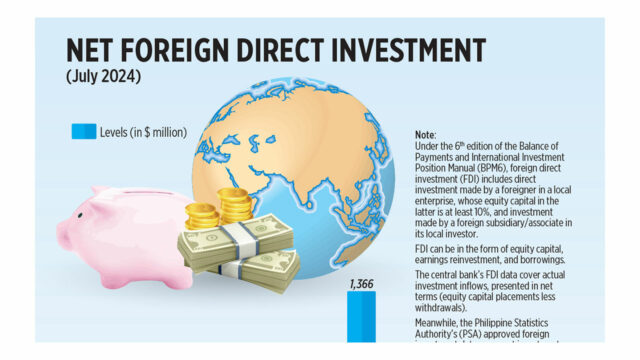
Net Foreign Direct Investment

NET INFLOWS of foreign direct investments (FDIs) into the Philippines rose by 5.5% year on year in July to hit a five-month high, the Bangko Sentral ng Pilipinas (BSP) said on Thursday. Read the full story.

Net Foreign Direct Investment

Diego Luna, Gael Garcia Bernal bring boxing drama to Hulu

IMDB
IMDB

Mexican actors and childhood friends Diego Luna and Gael García Bernal have paired up again, to deliver Hulu’s first Spanish-language series, La Máquina.

Mr. Luna and Mr. Garcia Bernal have been best friends since childhood and have worked on several projects including Y Tu Mamá También in 2001 and Rudo y Cursi in 2008.

After a decade of creating and producing, Mr. Luna believes the timing is perfect.

“Ten years now make sense in a way, you know, because we couldn’t be more ready, basically and … it feels like the right moment,” Mr. Luna said. “It means a lot, you know, it’s … the time to do it.”

La Máquina delves into the world of professional boxing, with Mr. Garcia Bernal playing Esteban, a boxer who, despite his knowledge and passion for the sport, is grappling with the realities of retirement due to his body’s limitations. Mr. Luna plays his manager Andy, who places a higher value on success and money than life.

The show began streaming on Hulu on Wednesday.

The actors reflected on their friendship and the opportunities that have come their way.

“There is that little moment of, well, this is crazy. Like … who would have thought that we were … riding on the bicycles together and all of a sudden we’re doing this. It’s crazy,” Mr. Garcia Bernal said.

Mr. Luna added that “it’s important to allow that, you know, to come. … There’s something beautiful about having another opportunity to tell another story.”

Director Gabriel Ripstein said the chemistry between the two actors on set was both a benefit and a drawback.

“It became a challenge at certain points, where we had to like hit the dramatic scenes and these guys would just go off and it was very contagious,” Mr. Ripstein said. “It became like a snowball of comedy and my job many times was — OK guys, let’s bring it down because … we need to shoot.” — Reuters

DoE: Green energy auction finished within the year

FIRSTGEN.COM.PH

THE Department of Energy (DoE) has assured lawmakers that the third round of the green energy auction (GEA-3) will be completed before the end of the year, anticipating additional renewable energy capacities.

“Our target for the Green Energy Auction 3 is to finish it before the end of the year such that the pumped storage hydro, [more than] 3,000 megawatts, will be able to come in five years from now,” Energy Undersecretary Rowena Cristina L. Guevara told a Senate budget hearing on Wednesday.

The GEA program aims to promote renewable energy as one of the country’s primary sources of energy through competitive selection.

Renewable energy developers compete for incentivized fixed power rates by offering their lowest price for a certain capacity.

“We’re going to be issuing the terms of reference soon… the performance or nonperformance of projects will be included,” Ms. Guevara said.

Sen. Pilar Juliana “Pia” S. Cayetano said that investors are anticipating the upcoming round of GEA.

“I understand we have investors who are ready to get it done. And we need it because this will address Senator Risa’s (Hontiveros) and my concern, and all the other renewable energy advocates’ concern because we’ll have the storage,” she said.

“We keep on saying that is the problem why we cannot fully embrace renewables as fast as we want to,” she added.

The DoE staged GEA-1 in 2022 and attracted 1,966.93 MW worth of bids for renewables, while GEA-2 was held last year, where 3,440.76 MW worth of service contracts were awarded.

In February, the department said that it would auction off renewable energy technologies worth a total capacity of 4,399 MW.

GEA-3 will cater to non-feed-in-tariff (non-FIT) eligible renewable energy technologies such as geothermal, impounding hydro, and pumped storage hydro.

The upcoming auction will also cater to run-of-river hydro, which is a FIT-eligible renewable energy technology.

Broken down, estimated capacities for non-FIT eligible renewable energy technologies are 699 MW from impounding hydro, 3,120 MW from pumped storage hydro, and 380 MW from geothermal.

Capacities from impounding hydro and pumped storage hydro are targeted to be delivered by 2028 to 2030 and 2024 to 2030 for geothermal.

An estimated 200 MW of capacity is expected to be auctioned from run-of-river hydro, with a target delivery starting in 2026 to 2028. — Sheldeen Joy Talavera

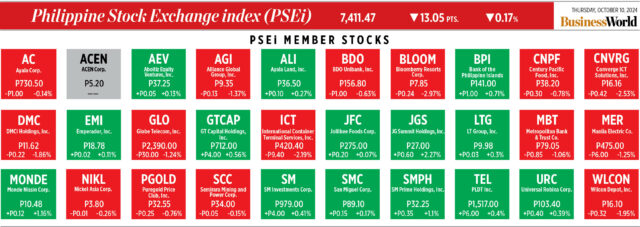
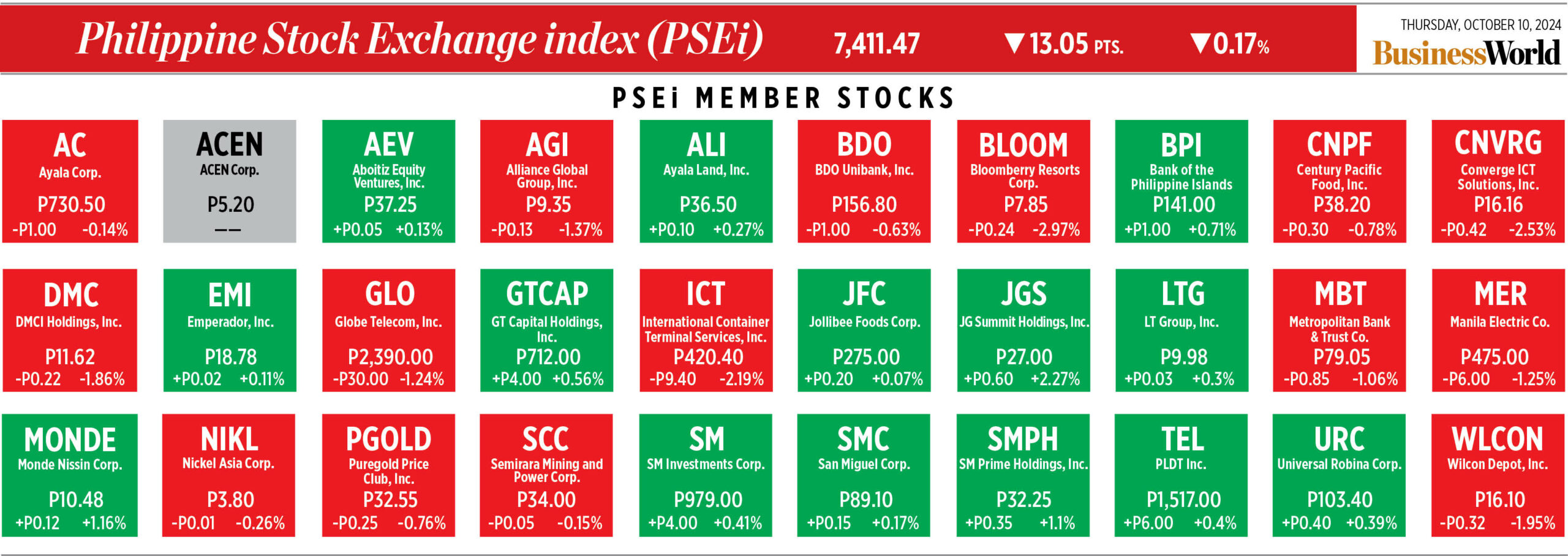
How PSEi member stocks performed — October 10, 2024

Here’s a quick glance at how PSEi stocks fared on Thursday, October 10, 2024.


Marcos urges ASEAN, China to speed up dialogues on sea code of conduct

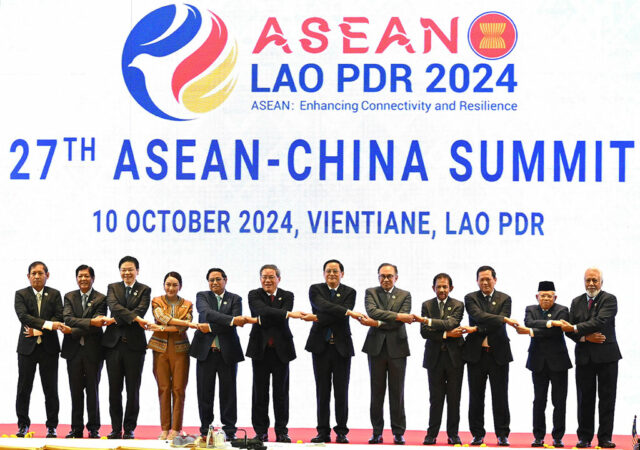
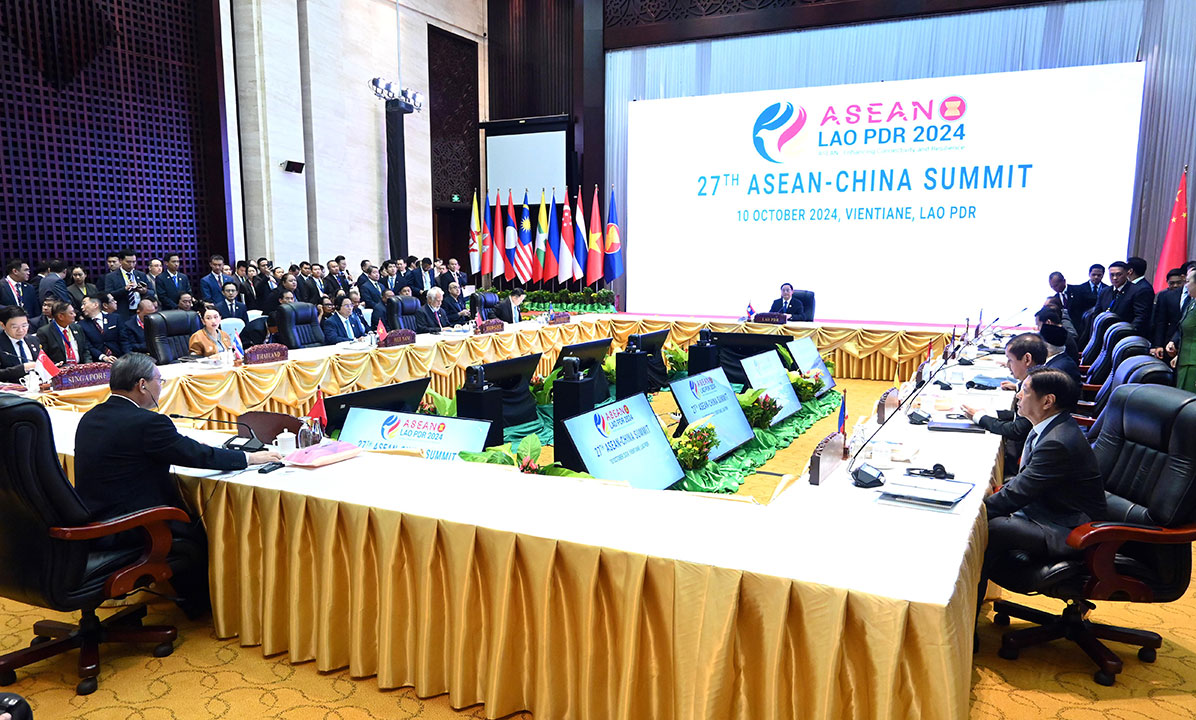
PRESIDENT Ferdinand R. Marcos at the 27th Asean-China Summit at Lao National Convention Center in Lao PDR October 10, 2024. — REVOLI S. CORTEZ/PPA POOL

PHILIPPINE President Ferdinand R. Marcos, Jr. pressed Southeast Asian leaders and China at a regional summit on Thursday to urgently speed up negotiations on a code of conduct for the South China Sea, while accusing Beijing of harassment and intimidation.

Speaking in Laos to leaders of the Association of Southeast Asian Nations (ASEAN) and Chinese Premier Li Qiang, Mr. Marcos said substantive progress needed to be made and all parties must “be earnestly open to seriously managing differences” and reducing tension.

China and US ally, the Philippines have been at loggerheads over a succession of confrontations near disputed features in the South China Sea, with Manila accusing China’s coast guard of aggression and Beijing furious over what it calls repeated provocations and territorial incursions.

The rows have been heated and have raised regional concerns of an escalation that could eventually involve the United States, which has a 1951 defense treaty that commits it to defend the Philippines if it is attacked.

“There should be more urgency in the pace of the negotiations of the ASEAN-China code of conduct,” Mr. Marcos told the meeting, according to a statement from his office.

“It is regrettable that the overall situation in the South China Sea remains tense and unchanged. We continue to be subjected to harassment and intimidation.”

In a statement, House Speaker Martin G. Romualdez said Mr. Marcos cited “recent harassment and aggressive actions” by the China Coast Guard against Philippine vessels and aircraft.

Mr. Marcos stressed the need for a “concerted and urgent effort to adopt measures to prevent their recurrence.”

The Bureau of Fisheries and Aquatic Resources (BFAR) on Tuesday confirmed reports that Chinese vessels fired water cannons at its two ships delivering supplies for Filipino fishermen in Scarborough Shoal, which Manila calls Bajo de Masinloc.

Mr. Marcos said despite China’s aggression, his country would continue to exhaust all diplomatic means to manage the tensions.

“The House of Representatives stands solidly behind President Marcos in his steadfast efforts to secure a common ground for all stakeholders towards greater cooperation and security in the South China Sea,” said Mr. Romualdez, who was present at the summit.

“This summit isn’t just about foreign policy. The President is working hard to safeguard our natural resources, which directly affects our fishermen and the communities that depend on them for their livelihood.”

On the basis of its old maps, China claims sovereignty over almost the entire South China Sea and has deployed a fleet of coast guard deep into Southeast Asia, including the exclusive economic zones of Malaysia, Brunei, the Philippines and Vietnam.

The idea of a maritime code was first agreed between China and ASEAN in 2002 but the formal process of creating one did not start until 2017.

Progress has since been painstakingly slow, with years spent discussing the framework and modalities for negotiations and guidelines issued to try to speed it up. Some ASEAN members are concerned the code of conduct will not be legally binding.

Marcos voiced frustration that parties involved could not agree on many things, adding “the definition of a concept as basic as ‘self-restraint’ does not yet enjoy consensus.”

ASEAN leaders will be joined on Thursday by US Secretary of State Antony Blinken, Indian Prime Minister Narendra Modi, Japan’s new Prime Minister Shigeru Ishiba, and Russian Foreign Minister Sergei Lavrov, before Friday’s East Asia Summit plenary gathering.

South Korean President Yoon Suk Yeol and Japan’s Ishiba were scheduled to hold their first summit in Laos on Thursday, as the neighbors seek to deepen security and economic ties. 

TYPHON MISSILE SYSTEM
Meanwhile, Senate President Francis G. Escudero on Thursday said there are no plans yet to “permanently” keep Washington’s midrange missile system left in Manila in April, following joint exercises between their militaries amid growing tensions with Beijing.

“My understanding of the US defense system was only in connection with exercises being conducted with the United States here and that there is no intention as of yet to keep it here permanently,” he told a news briefing.

Reuters reported in September that the US has no immediate plans to withdraw its Typhon missile system from the Philippines and is studying its use in a regional conflict.

The US Army flew the Typhon, which can launch missiles including SM-6 missiles and Tomahawks with a range exceeding 1,600 kilometers (994 miles), to the Philippines in April in what it called a “historic first” and a “significant step in our partnership with the Philippines.”

Philippine Defense Secretary Gilberto Eduardo Gerardo C. Teodoro, Jr. has said Manila is considering all security options that would deter Chinese aggression in the South China Sea.

Beijing and Moscow have criticized the move to keep the missile system in Manila, saying it could fuel an arms race in the region.

DIPLOMATIC ROUTE
Also on Thursday, Senator Ana Theresia N. Hontiveros pushed for the government to double its efforts to pursue diplomatic solutions.

“If I’m not mistaken, all members around the South China Sea are in favor of a code of conduct,” she told a separate news briefing in mixed English and Filipino.

“It is just China that is against a multilateral process since they want a bilateral process.”

Leaders of the ASEAN discussed progress toward a South China Sea code of conduct and agreed that the United Nations Convention on the Law of the Sea (UNCLOS) should be followed in settling sea disputes, Thailand Foreign Ministry spokesman Nikorndej Balankura said on Wednesday.

A 2016 arbitral ruling that voided China’s claims in the South China Sea said the shoal is a traditional fishing ground for Filipino, Chinese and Vietnamese fishermen. China has controlled the shoal since 2012.

The Philippines has been unable to enforce the ruling and has since filed hundreds of protests over what it calls encroachment and harassment by China’s coast guard and its vast fishing fleet.

Ms. Hontiveros also agreed the country should boost domestic defense capabilities over keeping Washington’s missile system, citing the recently signed Republic Act No. 12024, Self-Reliant Defense Posture Revitalization Act.

Mr. Marcos on Tuesday signed into law a bill requiring the Philippine government to pursue a defense posture reliant on local manufacturers.

Senator Joseph Victor G. Ejercito on Wednesday pushed funding of at least P100 billion for the Philippine military’s modernization program to acquire more missile systems and fighter jets to deter Chinese aggression at sea.

This also comes amid the Philippines’ two-week military exercises with the United States, and four other countries, Australia, Japan, Canada, and France, which is seen building the Philippines’ capacity to act in its own defense. — John Victor D. Ordoñez and Kyle Aristophere T. Atienza with Reuters

ASEAN leaders explore new ways to address Myanmar political crisis

PRESIDENT Ferdinand R. Marcos during the opening ceremony of 44th and 45th Asean Summit in Lao PDR. — REVOLI S. CORTEZ/PPA POOL

PRESIDENT Ferdinand R. Marcos, Jr. on Thursday said Southeast Asian leaders were exploring new strategies including informal talks to address the political crisis in junta-led Myanmar.

While a five-point consensus has been pushed for since 2021, it has “not been very successful” in improving the situation in Myanmar, he told Philippine reporters on the sidelines of the 44th and 45th summits of the Association of Southeast Asian Nations (ASEAN) in Laos, based on a transcript from his office.

“So, we are trying to formulate new strategies.”

Mr. Marcos said the Philippines’ position on the consensus remains the same, there should be new ways to “move forward.”

The consensus called for an immediate end to violence in Myanmar, dialogue among all involved parties, the appointment of a special envoy, humanitarian assistance from ASEAN, and a visit to the junta-led country by a special envoy.

The ASEAN has barred Myanmar’s junta from attending its summit after the 2021 coup, which saw the arrest of democratically elected leaders, including Nobel laureate Aung San Suu Kyi, due to its failure to comply with the consensus.

In an unexpected development, the Myanmar junta sent a “non-political” delegate to the high-level talks this week.

STABILIZING FORCE
The ASEAN bloc remains a “stabilizing force” in Southeast Asia despite making only incremental progress on key issues, including Myanmar’s civil war and the drafting of a code of conduct for the South China Sea, its secretary-general said.

Leaders of the 10-member ASEAN are meeting in Laos this week with heads of government and top diplomats from partners including the United States, China, Japan and Russia.

The bloc, home to over 685 million people and representing around 8% of global exports, has been unable to push resolutions on difficult regional issues, which analysts say risks undermining ASEAN’s central role in its backyard.

But ASEAN’s Secretary-General Kao Kim Hourn insisted the grouping has constantly pushed for dialogue and diplomacy, ensuring that negotiations move ahead.

“ASEAN has been, I would say, the stabilizing force,” the former Cambodian diplomat told Reuters in an interview late on Wednesday.

“We take the issues head on,” he said. “People always put too much emphasis on problems, but the way I look at ASEAN, we have come a long way.”

For instance, Kao Kim Hourn said, with member economies increasingly integrated and trade agreements in place with many external partners, ASEAN attracted $230 billion in new investments in 2023. 

“The fact that there is confidence and trust in ASEAN, that’s why the $230-billion investment moves into ASEAN,” he said. “The future is here.”

MYANMAR IS ‘COMPLEX’
ASEAN has made little progress with its “Five Point Consensus” peace plan for Myanmar, unveiled months after a 2021 coup, but Kao Kim Hourn said the leaders of ASEAN remain adamant that the grouping will stay engaged with Myanmar.

“We need time and patience,” the secretary-general said. “Myanmar is such a complicated, a complex issue… We should not expect a quick fix.”

Conflict has raged in Myanmar, with an expanding armed resistance against the military government. Some 18.6 million people, more than a third of the population, are estimated to be in need of humanitarian assistance.

Despite losing control of wide swathes of territory and being pinned down across multiple frontlines, the junta appears to be pushing ahead with plans for an election next year, which has been widely derided as a sham.

ASEAN will continue to push for “inclusive political dialogue” among all conflicting parties in Myanmar, said Kao Kim Hourn, even as leaders look to scale up humanitarian assistance.

Thailand has offered to host an “informal consultation” on Myanmar in December among ASEAN members, some of whom are divided between those who want the junta to do more and those calling for more talks among warring parties.

SOUTH CHINA SEA DISPUTE
Another major concern for ASEAN is tension in the South China Sea, where confrontations in disputed waters continue between China and the Philippines, and more recently Vietnam.

The situation has brought renewed attention to ASEAN’s protracted negotiations with Beijing towards creating a code of conduct for the vital waterway, a process in motion since 2017.

“Until now, there have been ongoing negotiations,” Kao Kim Hourn said, “It’s not static, it’s not standstill, but things are still moving ahead.”

China claims almost the entire South China Sea, a conduit for $3 trillion of trade annually, and has deployed an armada of coast guard deep into areas claimed by ASEAN members Vietnam, the Philippines, Indonesia, Malaysia and Brunei.

While some ASEAN countries hope the code can be concluded in a few years, prospects for a legally binding text remain distant, analysts say.

“The good part is that as long as there are still dialogue and diplomacy on the table and moving forward, I think there’s a lot of hope there,” Kao Kim Hourn said. — Kyle Aristophere T. Atienza with Reuters

Over 400 PHL repatriation applications pending in Lebanon

Smokes rise, amid ongoing cross-border hostilities between Hezbollah and Israeli forces, in Tyre, southern Lebanon Sept. 23, 2024. — REUTERS

OVER 400 Philippine applications for repatriation from war-torn Lebanon have yet to be processed by authorities there, according to Manila, as Israel continued to launch airstrikes on its Middle Eastern neighbor.

“We have around 413 pending (applications) — still to be processed by Lebanese immigration authorities,” Migrant Workers Secretary Hans Leo J. Cacdac said at a news briefing on Thursday.

He said a total of 192 Filipinos in Lebanon were ready for repatriation and were booked in different commercial flights spanning Oct. 11 to 28. Eleven of them may arrive in the Philippines as early as the weekend, he added.

There are about 11,000 documented overseas Filipino workers (OFWs) in Lebanon.

Mr. Cacdac said the Philippine government had put up 179 temporary shelters for Filipinos in Lebanon.

“The capacity is not yet filled so definitely our four shelters can still accommodate some more stayers or occupants.”

Philippine President Ferdinand R. Marcos, Jr. on Wednesday held a Zoom conference with Cabinet officials on the repatriation of Filipinos from Lebanon, which has seen over 1,000 citizens killed and 1.5 million people displaced since Israel launched its ground incursion and intensified airstrikes earlier this month.

Mr. Cacdac said the Philippine government was eyeing to raise the Alert for Lebanon to Level 4, which would trigger mandatory evacuation.

He said many overseas Filipino workers were hesitant to be repatriated because of their nature of work.

“Most of our OFWs are domestic workers running up to nearly 100%, I would say about 98% of OFWs in Lebanon are domestic workers,” he said.

“Therefore, their places of work would be the employer’s households. So, they are, should I say, devoted to or in daily service of their respective employers,” he explained.

“They might have served long enough to have a sense of loyalty and commitment to serve and to work for their employer households,” he added. “The emotional ties may be a little stronger.”

He said it’s “almost similar” to the situation in Israel, where most OFWs were caregivers.

To address concerns on loss of income, Mr. Cadac said the Department of Migrant Workers and  the Overseas Workers Welfare Administration — combined — are offering as high as P150,000 upon OFWs’ arrival in the Philippines. 

“That’s good for four to six months’ salary.”

Israel has vowed to conduct raids against “Hezbollah terror targets” that it said were “immediate threat” to northern Israeli communities.

The group had said it was “ready for a direct confrontation with the enemy forces that dare or attempt to enter Lebanese territory and to inflict the greatest losses on them.”

The Philippine presidential palace on Wednesday said Israeli warplanes launched over 30 overnight air raids on the southern suburbs of Beirut on Oct. 6. But there were no reported injuries or casualties among Filipinos as of Oct. 7, it added, noting that the airstrikes were focused on southern Lebanon and the southern suburbs of Beirut.

The Philippines last month joined 123 other countries in favoring a United Nations resolution urging Israel to end its occupation of Palestinian territories within a year.

Israeli settlement activities involved the transfer of its nationals “into the occupied territories, the confiscation of land, the forced transfer of Palestinian civilians, including Bedouin families,” according to the November resolution. 

The settlements also involved “the exploitation of natural resources, the fragmentation of territory and other actions against the Palestinian civilian population,” among other issues. — Kyle Aristophere T. Atienza

DENR eyes at least 4,200 new mining permits, contracts next year

FREEPIK

THE DEPARTMENT of Environment and Natural Resources (DENR) is planning on issuing at least 4,211 mining permits and contracts next year, with its focus on securing more deals on smart mining, according to the Environment secretary.

“The agency wants to strengthen public and private sector collaboration in emerging knowledge and technology-intensive industries such as smart mining,” DENR Secretary Maria Antonio J. Yulo-Loyzaga told a Senate budget hearing on Thursday.

She said that by 2028, her agency aims to have 85% of surface metallic mines to be compliant with safety and health, and environmental standards.

For next year, the DENR plans on issuing at least 715 mining contracts that comply with work program, safety, environment, and social development programs.

Citing government data, Ms. Yulo-Loyzaga said the mining industry contributed about P56.5 billion to the country’s gross domestic product in the first quarter this year, or about 0.53%.

Senators are set to deliberate on a measure that would boost the government’s share in the mining industry’s profits through a simplified five-tier royalty tax system.

Senate Bill No. 2826, sponsored by Senator Joseph Victor “JV” G. Ejercito, proposes a five-tier windfall profit system that ranges from 1- 10%. It will require large-scale miners inside mineral reservations to pay a royalty rate of 5% based on gross output.

The House of Representatives approved its version of the bill in September last year. The Department of Finance has said the government could generate about P6.26 billion in additional annual revenues from the new mining tax regime.

Mining companies currently pay corporate income tax, excise tax, royalty, local business tax, real property tax, and fees to indigenous communities. — John Victor D. Ordoñez

P10B to power rural areas pushed

A CONGRESSMAN on Thursday pushed to lodge an additional P10 billion under the National Electrification Administration’s (NEA) 2025 budget to boost nationwide rural electrification efforts.

The NEA earmarked P2.6 billion for next year’s spending, 89% lower than its P23.7 billion funding proposal to the executive branch, according to Cagayan de Oro Rep. Rufus B. Rodriguez.

“I am urging the Senate to augment the NEA budget for next year,” he said in a statement, adding the House of Representatives could push for his budget adjustment request once Congress convenes in a bicameral conference committee.

President Ferdinand R. Marcos, Jr. said during his state address last year that he is aiming to electrify all households nationwide by the end of this term. Budgetary constraints, however, could delay Mr. Marcos’ electrification goal by two to three years, Mr. Rodriguez said.

Providing more NEA funding would allow rural areas to economically prosper, he added. “Like roads, electricity is an important factor in developing country, especially remote barangays.” — Kenneth Christiane L. Basilio

DoH secretary resignation sought

THE PHILIPPINES’ top health official should step down if he fails to uphold the commitment to make healthcare affordable for Filipinos, a congressman said on Thursday, urging the Department of Health (DoH) to stay true to the promises it made to Congress before yearend.

Health Secretary Teodoro J. Herbosa and Emmanuel R. Ledesma, Jr., president of state-run Philippine Health Insurance Corp. (PhilHealth), promised the House of Representatives last month they’ll make medical care cheaper by increasing health insurance benefits while expanding its coverage, according to Party-list Rep. Wilbert T. Lee.

“What should be focused on now is the implementation of the commitment that DoH Secretary Ted Herbosa and PhilHealth Chief Mandy Ledesma signed, aimed at significantly lowering the hospital expenses of Filipinos,” he said in a statement in Filipino.

“If Secretary Herbosa has no intention of fulfilling the agreement, he should resign now,” he added.

PhilHealth and the DoH promised to institute a 50% across-the-board health benefit increase and to cover at least 80% of cancer treatment and heart operation expenses by November 2024, according to a commitment letter signed by Mr. Herbosa and Mr. Ledesma.

They also agreed to make various health diagnostic scans, such as Computed Tomography (CT) and Magnetic Resonance Imaging (MRI) free, making it part of outpatient services rendered by PhilHealth.

Meanwhile, Iloilo Rep. Janette L. Garin said amendments to the Universal Health Care Act should be taken up instead of replacing the heads of Philippine health agencies, noting the need to review “restrictive” provisions.

“We can change the PhilHealth chief a hundred times but unless we amend the law as soon as possible, Universal Health Care can never be achieved,” Ms. Garin, a former Health secretary, said. “I call on the leadership of both Houses to make the amendment… a priority.”

She cited the need to ease clinical trial restrictions on drugs and medical devices entering Philippine markets. Only a Phase III clinical trial approval would suffice for most medicines, enough to consider it “safe and efficacious.”

Clinical trials are studies to determine the effectiveness and safety of new medicines and other forms of medical treatment.

Sec. 34 of the 2019 health law mandated that pharmaceutical products and medical procedures should undergo a Phase IV clinical trial before being allowed in the country.

“With this requirement of Phase IV, Filipinos will have no recourse but to go to other countries to gain access to any breakthrough in science,” she said. “This Section 34… is just one of the many provisions deemed restrictive and detrimental to health care accessibility.” — Kenneth Christiane L. Basilio