
Auto Sales (December 2024)

NEW VEHICLE SALES in the Philippines hit a record-high 467,252 in 2024, but fell short of the full-year target, according to an industry group. Read the full story.

NEW VEHICLE SALES in the Philippines hit a record-high 467,252 in 2024, but fell short of the full-year target, according to an industry group. Read the full story.
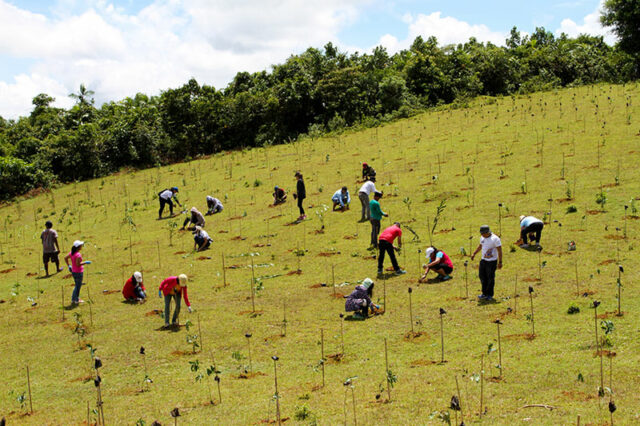
THE Department of Environment and Natural Resources (DENR) said it is preparing the terms for investing in reforestation programs taking place on 1.2 million hectares of land.
Environment Secretary Maria Antonia Yulo-Loyzaga told reporters on the sidelines of the Japan-Philippines Environment Week ceremony that the reforestation pitch will be directed to potential foreign investors that need to offset their emissions.
“We expect that there will be interest on the part of foreign corporations that are willing or need to offset what they are emitting. The overall goal for us is to reforest,” she said.
“What we want to do is within this administration build our way towards releasing up to 3 million hectares for investment in reforestation, for agroforestry, for other uses related to sustainable use of our forest land,” she added.
With regard to environmental projects involving Japan, Ms. Yulo-Loyzaga said she is looking forward to a Japanese role in developing an electronic waste management system for the Philippines.
“We don’t have a system really in place for e-waste,” she said.
She added that there will be discussions on technology that would be available for the Philippines to address its broader solid waste problem, with waste-to-energy under consideration.
According to the World Bank, waste-to-energy solutions have been identified as a sustainable alternative to landfills.
Undersecretary Jonas R. Leones added that the DENR is currently finalizing a framework between the DENR and Japan’s Ministry of Environment.
“We are just hammering out the details of collaboration,” Mr. Leones said.
Ms. Yulo-Loyzaga added that the Japanese government is willing to provide technical assistance, scientific cooperation, financing, and official development assistance.
“We’re looking at how all of these can actually deliver on our own goals in terms of decarbonization, sustainable communities, and ecological preservation, by way of different types of technology and interventions,” she said. — Adrian H. Halili

THE Department of Budget and Management (DBM) said guidelines for the Ayuda Para sa Kapos ang Kita Program (AKAP) are likely to be released by the Department of Social Welfare and Development (DSWD) next week.
AKAP provides one-time cash assistance worth P3,000 to P5,000 to workers whose income falls below the poverty threshold.
“Sinusulat nalang ng DSWD. Nagbigay na po ng komento ang dalawang ahensiya na tutulong sa pagbabalangakas, ang DoLE (Department of Labor and Employment) and NEDA (National Economic and Development Authority) (The DSWD is drafting it with input from DoLE and NEDA),” Budget Secretary Amenah F. Pangandaman told a radio program on Tuesday.
“Expect that by next week, these new guidelines might be signed,” she said.
President Ferdinand R. Marcos, Jr. placed AKAP in conditional implementation status when he signed the P6.326-trillion budget for 2025.
It requires that the P26-billion AKAP to “only be disbursed after clear guidelines that are put in place to ensure proper use of the funds,” the DBM said.
However, Ms. Pangandaman said the guidelines were just one of the documents that DSWD needs to pass before the Office of the President can approve the AKAP releases.
“Kailangan makapag provide sila ng bagong physical target, financial target, special budget request.” (They need to submit physical and financial targets and a special budget request.)
The DBM said that the P757-billion budget adjustments, which include the funding for AKAP are subject to a process called For Issuance of SARO (Special Allotment Release Orders) or FISARO.
The SARO will only be released once agencies meet the requirements and secure approval from the President.
Ms. Pangandaman said the release of funds might take a while as the guidelines have yet to be finalized with comment from economic managers.
Among the AKAP’s new provisions is the involvement of DoLE and NEDA.
NEDA will also conduct a Monitoring and Evaluation Study on AKAP with the Philippine Statistics Authority.
She also said that the beneficiaries have now been “defined” as those with incomes below the regional minimum wage. She added that there will be no “middle man” as DSWD social workers will be present.
The list of beneficiaries will be posted on the DSWD website monthly. — Aubrey Rose A. Inosante

THE PHILIPPINES can meet growing global demand for workers in the offshore wind industry, the German Embassy in Manila said.
David Klebs, economic counselor at the German Embassy, said more broadly that expertise possessed by Philippine workers will be in higher demand worldwide.
“As you know, the Philippines is a nation of seafarers. And if you think about offshore wind, many of the skills used in constructing or maintaining offshore wind turbines are (transferable from shipboard jobs),” Mr. Klebs said in a briefing late Monday.
“There’s a bonus for the Philippines because it already has an advantage of being a seafaring nation. With some additional skills, workers here can do (offshore wind turbine) maintenance, which is in high demand worldwide,” he added.
He said the Philippines can also employ such workers once it builds its own offshore wind farms.
“If you look at the Philippine Energy Plan that the Department of Energy released in 2023, they are on the road to doing this, and they have identified humongous potential offshore wind capacity that is more than any energy currently produced in the Philippines,” he said.
“For offshore wind you do need the skills, the sets of tools and requirements, and by getting ready now you’ll be ready later for the future,” he added.
The German Embassy, in collaboration with the German-Philippine Chamber of Commerce and Industry (GPCCI), said that it will be hosting a sustainability forum on Jan. 31 that will focus on green infrastructure and green jobs.
“This forum represents an important step forward in addressing the most urgent challenges… The Philippines stands at a very critical juncture in its commitment to sustainability as reflected in its national development contribution under the Paris Agreement,” Marie Antoniette E. Mariano, president and chairman of the GPCCI, said.
Previously, the GPCCI, citing its World Business Outlook Survey, said businesses in the Philippines see efforts to meet sustainability requirements as a competitive advantage.
Yves Aguilos, head of government affairs and data protection officer at GPCCI, said that to tap this potential, the Philippines will have to look at green jobs and new technology.
“In order to explore this potential that we are seeing in the Philippines, we have gathered some experts here in the forum that will address which specific industries the Philippines can explore in terms of green jobs transformation and also identify some challenges,” Mr. Aguilos said.
“Sustainability comes with new technologies that would be introduced to the workforce. These are the things that we may have to inquire about, for example, with the Department of Labor, if they have a roadmap, and then also from industry experts,” he added. — Justine Irish D. Tabile

BILLS seeking to impose a legislated national wage hike have been sidelined at the House of Representatives, with the House Labor committee focusing its efforts on exercising oversight over an aid for displaced workers program.
The House labor committee also faces limited time to discuss the bills with the approach of the 2025 midterm elections, Rizal Rep. Juan Fidel Felipe F. Nograles, the committee’s chairman, said.
“We haven’t had a vote yet because we’re currently wrapping up. We’ll adjourn by the end of February, so there’s very limited time to hold another committee hearing for a vote,” Mr. Nograles told BusinessWorld on the sidelines of a hearing.
When asked if the wage hike bills will not be revisited, he said: “Not really. It’s just that time is limited because the 19th Congress is wrapping up. But if we find more time, we’ll include it in the next agenda.”
The 19th Congress is scheduled to end on July 27. Both the Senate and House will go on a four-month break between February and June for the midterms.
Separate House bills are seeking to increase wages of private-sector workers by between P150 and P750 have been filed. The Senate has approved a bill increasing the daily minimum wage in the private sector by P100.
“For now, we’re giving the wage boards an opportunity to review their existing wage orders before we hold a (wage hike) hearing. The review by all the wage boards has not yet been completed,” Mr. Nograles said.
The Philippines adjusts salaries through regional wage boards, though labor groups have called the hikes insufficient.
“I’m saddened that the salary or national wage increase for our workers cannot be discussed at the moment because it is one of the major concerns of our people today, second only to inflation,” Deputy Minority Leader and Party-list Rep. France L. Castro, a member of the House labor committee, told BusinessWorld.
“We will still encourage and enjoin the labor committee to finalize the (wage hike) hearing and report on the salary increase bill,” she added.
Mr. Nograles said his committee will focus on overseeing TUPAD (Tulong Panghanapbuhay sa Ating Disadvantaged or Displaced Workers) in the remaining days of the 19th Congress. TUPAD is an aid program providing emergency and temporary employment for laid off or underemployed workers.
“We will still push for the salary increase,” Ms. Castro said. “If we need to mobilize our organizations and lobby, we will do it.” — Kenneth Christiane L. Basilio
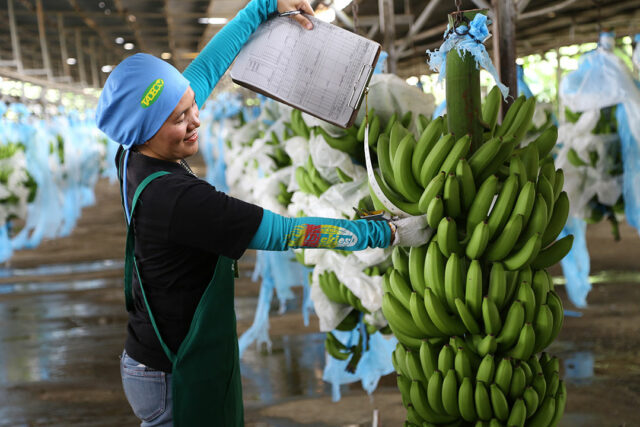
PHILIPPINE banana exports fell 2.97% in 2024, with the industry currently dealing with Fusarium wilt, also known as Panama disease, the Food and Agriculture Organization (FAO) said.
In its Banana Market Review, the FAO said that preliminary data indicate that exports of Philippine bananas dropped to 2.28 million metric tons (MMT) in 2024.
The Philippines has ceded its position as the third-leading banana exporter in 2023 and is now fourth.
Fusarium wilt is a soil-borne fungal disease that blocks the banana plant’s vascular system and deprives it of minerals, nutrients, and moisture. Affected plants turn yellow and die.
The Tropical Race 4 (TR4) strain of fusarium wilt was first detected in Davao City in 2009 and continues to threaten the Cavendish banana, the main export variety.
“Supplies from the Philippines, the main exporter from the region, reportedly continue to be affected by the spread of TR4,” the FAO added.
The United Nations agency said that the spread of the disease has continued to cause production losses, with disease containment efforts also adding to the industry’s financial burdens.
“Producers faced added difficulty stemming from unfavorable exchange rates amid the depreciation of the dollar in the first half of (2024),” the FAO added.
Citing the Pilipino Banana Growers and Exporters Association, it added that about 51,000 hectares out of the 89,000 hectares of land available for banana cultivation continued to be operational amid the spread of TR4.
The group had also said that the rising geopolitical tensions in the South China Sea additionally affected some exports of Philippine bananas.
Manila and Beijing have repeatedly clashed in the disputed waterway, with both sides accusing each other of raising tensions.
China claims over 80% of the waterway, but the Permanent Court of Arbitration voided its claim in 2016, which Beijing rejects.
Despite tensions China remained among the Philippines’ top Cavendish banana markets.
Chinese imports of Philippine bananas dropped 39% year on year over the first nine months of 2024.
Additionally, the FAO said global banana exports declined 1% to 19.1 MMT.
“Developments in the first half of 2024 showed strongly diverging trends among global banana exporting countries, with most suppliers affected by declines, in several cases even at double-digit rates, and only a few seeing large increases,” it added. — Adrian H. Halili

THE Department of Trade and Industry (DTI) warned importers and manufacturers of the certification requirements for vaporized nicotine and non-nicotine products covered by Department Orders 22-06 and 24-02.
In a statement, the DTI said that all businesses involved with vaporized nicotine and non-nicotine products are required to secure a valid Philippine Standard license.
“Non-compliance with these certification requirements will result in formal charges under Section 23(c) of Republic Act (RA) 11900 or the Vaporized Nicotine and Non-Nicotine Products Regulation Act,” the DTI said.
According to the DTI, a manufacturer or importer’s first offense will merit a fine of P100,000, while the second offense triggers a fine of P200,000.
For the third offense, the business will be fined P400,000 or be subject to imprisonment of up to three years, or both, at the court’s discretion.
“Business permits and licenses may also be revoked or canceled,” the DTI said, referring to third offenses.
On Jan. 2, the DTI issued a department order stating that it will no longer recognize import commodity clearances (ICCs) as a licensing scheme for vaporized nicotine and non-nicotine products.
The DTI, however, noted that products with valid ICCs will be allowed to still be distributed and sold until supplies are exhausted.
The DTI said that the requirement will be applied to covered products intended for import, distribution, and sale in the Philippines be they via online platforms, digital marketplaces, and bricks-and-mortar stores.
“Manufacturers, importers, and distributors that have failed to meet the certification deadline are in violation of Section 18 of RA 11900, which sets forth technical standards to guarantee the safety, consistency, and quality of these products,” the DTI said.
“In line with Section 18, Section 19 provides that only duly registered vaporized nicotine and non-nicotine products, and their devices, or novel tobacco products are allowed to be sold, advertised, or distributed through whatever means,” it added. — Justine Irish D. Tabile

THE PESO rebounded slightly against the dollar on Tuesday, with US President-elect Donald J. Trump’s administration’s planned tariff policies in focus.
The local unit closed at P58.62 per dollar on Tuesday, strengthening by eight centavos from its P58.70 finish on Monday, Bankers Association of the Philippines data showed.
The peso opened Tuesday’s trading session stronger at P58.60 against the dollar. It climbed to as high as P58.47, while its intraday low was its closing level of P58.62 versus the greenback.
Dollars exchanged rose to $1.42 billion on Tuesday from $1.35 billion on Monday.
The peso was supported by a report that said Mr. Trump’s economic team is studying a slower increase in tariffs, Rizal Commercial Banking Corp. Chief Economist Michael L. Ricafort said in a Viber message.
“The peso appreciated following news that the incoming Trump administration may consider a gradual increase of tariffs rather than a one-time major imposition of tariffs. This has somehow eased potential inflationary concerns from higher tariffs,” a trader likewise said in an e-mail.
For Wednesday, the trader said the peso could weaken on expectations of faster US inflation.
The trader said the peso may move between P58.50 and P58.75 per dollar on Wednesday, while Mr. Ricafort expects it to range from P58.50 to P58.70.
The dollar hovered near its highest level in more than two years on Tuesday as traders scaled back bets on US rate cuts in 2025 after strong economic data, Reuters reported.
With Mr. Trump set to step back into the White House next week, the focus has been on his policies which analysts expect will boost growth but add to price pressures.
The threat of tariffs along with the Federal Reserve’s stated measured approach to rate cuts this year has lifted Treasury yields and the dollar, putting the euro, pound, yen and yuan under pressure.
However, on Tuesday, market focus returned to the chance that US tariffs may be raised gradually, after a media report suggesting the US could take a measured approach.
The dollar index, which measures the US currency versus six other units, was 0.05% higher at 109.44, not far from the 26-month high of 110.17 it reached on Monday. — A.M.C. Sy with Reuters

THE MAIN INDEX extended its losing streak on Tuesday, dropping to the 6,200 level for the first time in nearly seven months, before the release of key US inflation reports that could affect the Federal Reserve’s policy easing cycle.
The benchmark Philippine Stock Exchange index (PSEi) dropped by 0.68% or 43.43 points to close at 6,299.67, while the broader all shares index fell by 0.46% or 17.05 points to 3,687.86.
This was the PSEi’s worst finish in nearly seven months or since it ended at 6,299.05 on June 25, 2024.
“The local market continued to decline as investors maintained a cautious stance while waiting for fresh leads. Investors are primarily waiting for the US’ December 2024 inflation rate, which could provide clues on the Federal Reserve’s policy outlook,” Philstocks Financial, Inc. Senior Research Analyst Japhet Louis O. Tantiangco said in a Viber message.
December US producer price index data was set to be released overnight, while the consumer inflation report will come out late on Wednesday.
Tuesday’s close put the PSEi near bear territory, which is a decline of at least 20% from its recent peak. The bellwether index reached 7,604.61 intraday before closing at 7,554.68 on Oct. 7, its highest close last year.
“At 6,299.67, we are 17.16% down from the 7,604.61 peak,” Mr. Tantiangco noted.
“We’re still seeing the market pricing in the likelihood of a more hawkish Fed and buyers are still hesitant to step in and support prices ahead of tomorrow’s inflation report from the US,” AP Securities, Inc. Research Head Alfred Benjamin R. Garcia said in a Viber message.
First Metro Investment Corp. Head of Research Cristina S. Ulang likewise said in a Viber message that expectations that the Fed will not cut rates in its policy meeting later this month are putting pressure on Philippine stocks.
“Bonds and equities are on correction mode in the US, resulting in a negative backdrop for the local market,” Ms. Ulang said.
The majority of sectoral indices closed lower on Tuesday. Industrials sank by 1.56% or 142.20 points to 8,948.42; financials dropped by 0.85% or 18.49 points to 2,152.36; services retreated by 0.62% or 13.07 points to 2,071.38; and holding firms went down by 0.29% or 15.89 points to 5,331.96.
Meanwhile, mining and oil rose by 1.03% or 80.24 points to 7,816.50 and property went up by 0.11% or 2.54 points to 2,310.74.
Value turnover climbed to P5.75 billion on Tuesday with 705.91 million shares exchanged from the P4.96 billion with 806.77 million issues traded on Monday.
Market breadth was negative as decliners outnumbered advancers, 114 versus 68, while 60 names closed Tuesday’s session unchanged.
Net foreign selling rose to P886.66 million on Tuesday from P696.26 million on Monday. — Revin Mikhael D. Ochave

By Kyle Aristophere T. Atienza, Reporter
MANILA on Tuesday accused China of intimidating Filipino fishermen near a disputed shoal in the South China Sea and normalizing its “illegal presence” after Beijing sent its biggest coast guard ship into the Philippines’ 200-nautical-mile (370.4 kilometers) exclusive economic zone (EEZ).
National Security Council spokesman Jonathan E. Malaya said the deployment of the 165-meter China Coast Guard 5901, the largest in the world, was meant “to intimidate our fishermen and intimidate us.”
“We can clearly see that the intimidation tactics are not successful and that we remain resolute in supporting our Filipino fishermen,” he told a news briefing, adding that the presence of the “monster ship” near the coast of Zambales province in northern Philippines is an “escalation and provocative.”
He reiterated a call for China to withdraw from Manila’s waters the “monster ship” that he said was deployed to intimidate its Filipino fishermen around Scarborough Shoal.
“We were surprised about the increasing aggression being shown by the People’s Republic of China in deploying the monster ship,” he said.
“Huang YanDao (Scarborough Shoal) is China’s territory,” the Chinese embassy in Manila told BusinessWorld in a Viber message. “We have delimited the territorial sea baselines. The China Coast Guard conducts its patrols and law enforcement activities in relevant waters in full accordance with the law. It is fully justified.”
The monster ship, first detected near the Zambales coast on Jan. 4, was last spotted 77 nautical miles west of Capones Island, according to Philippine Coast Guard (PCG) spokesman Jay Tristan Tarriela.
Two PCG vessels — the flagship BRP Teresa Magbanua and BRP Gabriela Silang — have been dispatched to challenge the monster ship’s presence. An aerial asset of the PCG was also patrolling the area.
BRP Teresa Magbanua had to temporarily return to the port of Bataan on Monday for repairs after its auxiliary engines overheated. It has returned to the location of China’s monster ship to prevent it from inching closer to Zambales.
Mr. Tarriela said the monster ship’s presence near the Zambales coast could not be considered an innocent passage and does not fall under the principle of freedom of navigation because its movement is “not continuous and it is not expeditious.”
“Meaning, it has erratic movements — sometimes it goes up, goes down, turns left and turns right arbitrarily. There is no specific reason why they are doing that,” he said.
The Chinese government wants to “normalize” the presence of its coast guard vessels in Zambales in a bid to change the status quo at Scarborough Shoal, he added.
“This is something new based on our observation with the other China Coast Guard vessels,” Mr. Tarriela said. “Before, they were only patrolling in those areas that are pretty much contested and there is always a support from Chinese maritime militia’s swarming.”
A United Nations-backed tribunal based in the Hague in 2016 voided China’s expansive claims in the South China Sea, as it ruled Scarborough Shoal, which Beijing has controlled since 2012, is a traditional fishing ground for Filipino, Chinese and Vietnamese fishermen.
The shoal, which Manila calls Bajo de Masinloc, is 124 nautical miles off Masinloc, Zambales and is within the Philippines’ EEZ.
“This time around, the behavior of the China Coast Guard is intentional and focused only at a certain distance off the coast of Zambales — either 60 to 90 nautical miles,” Mr. Tarriela said.
There have been suspicions of a reclamation attempt by China after the sighting of a big pipe installed at the shoal last year.
The Philippine Navy has also discovered five submersible drones in different parts of Philippine waters since last year, two of which were on Kalayaan Island, one off the coast of Pasuquin in Ilocos Norte and another one in Initao, Misamis Oriental. The most recent one was discovered by fishermen in Masbate province on Dec. 30.
Navy spokesman Roy Vincent T. Trinidad said the recovered drones had been used to gather and understand water temperature, the water depth and salinity. They could be used for commercial, academic and military purposes, he said at the same briefing.
The Philippine Navy has been patrolling the area continuously, he said, adding that any reclamation activity is considered by the Philippine government as a “red line” that China or other nations should not cross.
“We’re not going to allow China to normalize the illegal deployment of the China Coast Guard because that is what they have being doing,” Mr. Tarriela said. “They’re going to normalize and change the status quo and operationalize and claim that they have been doing this for the past months or years.”
The Philippine Coast Guard is documenting the illegal presence of China’s Coast Guard and “telling the world that the Philippine government is against this unlawful presence of China Coast Guard-5901,” he added.
President Ferdinand R. Marcos, Jr., outgoing US President Joseph R. Biden and Japanese Prime Minister Ishiba Shigeru held a virtual trilateral summit on Monday “to advance our continuing cooperation in the Indo-Pacific region,” according to a White House readout.
Among the participants of the first-ever trilateral summit in April last year, only Mr. Marcos will remain in power by Jan. 20, the day Mr. Biden’s term ends this month. Mr. Ishiba took over in September 2024 after Fumio Kishida’s resignation amid corruption issues within the ruling Liberal Democratic Party (LDP).
‘COMMON ADVERSARY’
Mr. Marcos earlier had a phone call with Mr. Biden and was set to have one with outgoing Vice-President Kamala Harris on Tuesday evening.
He is set to meet with Japanese Foreign Minister Takeshi Iwaya on Wednesday to boost the two nations’ “strategic partnership,” the Department of Foreign Affairs said last week.
Joshua Bernard B. Espeña, who teaches international relations at the Polytechnic University of the Philippines, said the two nations should boost their security ties by stepping up their “defense industry linkages.”
The Philippine Senate last month ratified the nation’s reciprocal access agreement with Japan, which will facilitate the exchange and combined training of their troops.
“It is easy to suggest that deterring China is a commitment until you can sustain and support each other in sustaining the logistical and production aspects of deterring a common adversary,” Mr. Espeña said.
“This is most crucial as Japan confronts trinity threats from North Korea, China and Russia on its home islands, and the Philippines is in need of more international support at strategic and operational levels of concern,” he added.
Hansley A. Juliano, who teaches political science at the Ateneo de Manila University, said Tokyo would likely continue its free and open Indo-Pacific policy, “which has been consistently the case for the LDP throughout the early 2020s.”
“Even if a more interventionist Japan isn’t exactly on the table for Prime Minister Shigeru Ishiba, we can expect it’s still on his mind and it’s still going to animate much of the strategic considerations of the Japanese government,” he said in a Facebook Messenger chat.
“With the Japanese economy’s continued reliance on tourism and foreign labor, our relationship is becoming more and more equalized over the years, which is something the Philippine government hasn’t yet fully maximized due to our relative weakness in hosting industrial and service economic activities from Japan, to the point that Vietnam, Thailand and even Malaysia and Indonesia have overtaken us,” Mr. Juliano said.
“Our government’s further expansion and strengthening of our Japanese ties should primarily focus on making us as strong and as viable as our Southeast Asian neighbors for Japan to consider further integrating us into their global supply chain,” he added.

THE LAND Transportation Franchising and Regulatory Board (LTFRB) on Tuesday said it is keeping an eye on the roadworthiness of jeepneys under its modernization program through private emission testing centers.
This after Senator Mary Grace Natividad Poe-Llamanzares asked the agency to tap state lenders to help fund the modernization program.
At a Senate public service committee hearing, LTFRB Chairman Teofilo E. Guadiz III said the government would use these testing centers to certify jeepneys for road safety ahead of cooperatives’ vehicle modernization obligations once transport routes are finalized by 2026.
“We should also focus on the Clean Air Act,” he told senators. “These are the private emission testing centers and private motor vehicle inspection centers. How do these jeepneys pass registration? They emit harmful black smoke.”
LTFRB Undersecretary Jesus Ferdinand D. Ortega told DZBB radio at the weekend his agency aims to come up with at least half of the final transport routes for modern jeepneys by the end of this year and finish these routes by 2026. He said about 15% of routes have been completed.
The routes will determine the number of public utility vehicle units that will serve each route.
“After the route rationalization, which is scheduled for 2025 to 2026, that’s when the obligation for them to modernize will come in,” Mr. Ortega said. “We can’t modernize them now because we’re not yet sure how many vehicles are actually needed on the routes.”
In August last year, Philippine President Ferdinand R. Marcos, Jr. rejected a proposal to suspend the government’s jeepney modernization program, rejecting criticisms that the plan had been rushed.
Transportation Secretary Jaime J. Bautista earlier said suspending the modernization program would waste investments that have been made to roll out the plan.
Senate President Francis “Chiz” G. Escudero earlier sought to halt the program since operators are finding it difficult to buy expensive modern jeepneys that cost at least P2.6 million.
The deadline for jeepneys to consolidate into cooperatives lapsed on Dec. 31, 2023 but public utility vehicles were allowed to keep operating until a month later. The President later extended the deadline to April 30 last year.
The modernization program started in 2017, aiming to replace traditional jeepneys with units that have at least a Euro 4-compliant engine to cut pollution.
Meanwhile, Mr. Guadiz said his agency might release a memo requiring ride-hailing operators and owners to bear the 20% discount for persons with disabilities, senior citizens and students instead of passing these on to the drivers.
“Definitely, the driver should not be included in the equation. The driver should not need to shoulder any of the discounts,” he said at the same hearing.
Based on data from the LTFRB, ride-hailing services such as Grab Philippines absorb about 40% of the discount, while the operator shoulders 60%. — John Victor D. Ordoñez
