Home Blog Page 2066

Manila Water enters contestable power market

PHILIPPINE STAR/GEREMY PINTOLO

EAST ZONE concessionaire Manila Water Co., Inc. has entered the contestable market, allowing it to select its own power supplier for 10 of its facilities under the expanded retail aggregation program (RAP), according to the Energy Regulatory Commission (ERC).

In a statement on Sunday, the ERC said Manila Water’s move marks the first pilot switch under the expanded RAP, which was implemented in August last year.

“It is exciting to see more consumers gaining access to the benefits of exercising their power of choice,” said ERC Chairperson and Chief Executive Officer (CEO) Monalisa C. Dimalanta. “This inspires us at the ERC to work even harder toward promoting this power and protecting consumer interests.”

Last year, the ERC issued a resolution enhancing the implementation of the RAP.

The expanded RAP allows loads from multiple end-users consuming below the 500-kilowatt threshold, located within the same franchise area and under specified conditions, to be aggregated to contract with their preferred supplier at a negotiated purchase price.

As the first-ever switched customer under the expanded RAP, Manila Water aggregated the demand from 10 facilities, primarily sewage treatment plants located within the Manila Electric Co. (Meralco) franchise area, to meet the threshold.

“Manila Water is proud to be trailblazing with the government to improve the lives of its customers. By working with the ERC to introduce innovative amendments to the retail aggregation program, we have expanded customer choice and lowered power rates through negotiated tariffs,” said Manila Water President and CEO Jose Victor Emmanuel “Jocot” A. de Dios.

“By leading this breakthrough, we not only secure cost-efficient energy to run our water and wastewater treatment plants — which will ultimately benefit our customers — but also pave the way for a more sustainable and competitive energy market that benefits the country,” he added.

Citing its records, the ERC said that retail market prices in 2024 averaged P5.77 per kilowatt-hour (kWh), with the lowest price recorded at P3.50 per kWh.

“With this pilot switch, more groups are expected to transition to the contestable market under the RAP in the coming weeks, further advancing retail competition in the energy sector,” the commission said. — Sheldeen Joy Talavera

Amazon cuts reference to diversity from annual report as Trump wages war on DEI

REUTERS

AMAZON.COM removed a reference to “inclusion and diversity” in its annual report filed on Thursday, after it told employees in a December memo that it was winding down its programs as part of corporate America’s broader retreat from such policies.

Some of America’s biggest businesses have been scaling back diversity initiatives, years after pushing for more inclusive policies in the wake of protests against the police killings of George Floyd and other Black Americans in 2020.

President Donald J. Trump and his administration have targeted diversity, equity and inclusion (DEI) policies inside and outside the government. Attorney General Pam Bondi on Wednesday in a note to staff said the Justice Department would “investigate, eliminate, and penalize” illegal diversity programs in the private sector.

For the last two years, Amazon’s “human capital” section of its annual report said: “As we strive to be Earth’s best employer, we focus on investment and innovation, inclusion and diversity, safety, and engagement to hire and develop the best talent.”

In the 2024 version, that sentence has been cut.

The company also cut a reference to a goal to “promote equity” in a sentence about continuing efforts to refine employee hiring and development.

Amazon’s website states it is “committed to creating a diverse and inclusive company.

In December, Amazon executive Candi Castleberry said in a letter to employees that it is “winding down outdated programs and materials” related to DEI by the end of 2024. As part of the change, individual groups would no longer be responsible for building programs and initiatives would be integrated into “existing processes.”

“Rather than have individual groups build programs, we are focusing on programs with proven outcomes — and we also aim to foster a more truly inclusive culture,” Ms. Castleberry said in the note.

Amazon did not comment on whether it would remove or rename DEI employee positions.

Big technology companies Meta Platforms and Alphabet’s Google are among those rolling back programs in the face of attacks from conservative groups, who have threatened to sue firms over them.

Disney’s annual report, which was published in September, removed mentions of its “Reimagine Tomorrow” program, which was an online space for “amplifying underrepresented voices” featuring some of Disney’s diversity, equality and inclusion commitments and actions. However, it added a DEI initiative to hire US military veterans.

Twelve state attorneys general, including New York, California and Washington, last week issued a joint statement in opposition to Mr. Trump’s characterization of DEI saying they are “committed to enforcing federal and state civil rights laws to protect” workers from discriminatory practices. — Reuters

US farmers turn to Airbnb to outlast agricultural downturn

REUTERS

BLANCHARDVILLE, Wisconsin — A dead end dirt road cutting through rural Wisconsin leads to a pasture dotted with shaggy-coated Highland cattle, fluffy Icelandic sheep and a vintage Airstream trailer that farmer Brit Thompson turned into an Airbnb to capitalize on an explosion of urbanites looking to spend time in the countryside.

Her guests, mostly Chicago-area professionals, offer a steady flow of income in an increasingly unstable agricultural economy.

Ms. Thompson, who also raises animals for meat at her farm, Pink River Ranch, is one of many farmers turning to the $4.5-billion agricultural tourism industry, according to US Department of Agriculture (USDA) data, and offering activities and overnight stays as consumer demand for rural experiences grows and farm income declines.

Farmers whose crops are used to make food, feed livestock and produce vegetable oils are struggling to turn a profit after corn and soy prices sank to four-year lows in 2024.

Revenue from Ms. Thompson’s Airbnb has helped her endure volatile commodities markets and far outpaced what she made from selling beef and lamb to restaurants and directly to consumers, she said. Free-roaming tabby cats on her property are now accustomed to the sound of guests’ tires crunching on the gravel driveway and come running toward those bringing in the extra income — and the extra affection.

The guests arrive nearly every weekend during her peak season, drawn by the area’s spring-fed and trout-rich streams, forested hiking trails and unpolluted night skies. Ms. Thompson’s bookings soared as nearby cities shut down during the pandemic.

Agritourism boomed during COVID as people chose to vacation on farms and in rural areas, drawn by the promise of socially distanced fun in the countryside. The industry has continued to grow since, driven by increasing numbers of city dwellers seeking peace and solitude and farmers seeking additional ways to infuse their farms with much-needed cash.

“Now that we’re back to normal, people are still remembering those experiences and they’ve brought those activities into their family traditions,” said Suzi Spahr, director of the International Agritourism Association.

Nationally, about 7% of farms offer agritourism opportunities, which also includes sales of farm products to visitors, said Lisa Chase, an extension professor at the University of Vermont.

Many increased their revenue by $25,000 to $100,000 per year through agritourism enterprises, and some farms can make upwards of $1 million a year from running bed-and-breakfasts, pick-your-own apple orchards and other farm experiences, she said.

The number of farmstays, an accommodation at a farm, listed on short-term rental platforms in the US increased by 77% over the past five years, roughly twice the increase in overall listings, data firm AirDNA said. Airbnb, as well as popular campsite booking websites HipCamp, Harvest Hosts and The Dyrt, also said their platforms have seen substantial increases in farmstay listings over the past few years.

Agritourism dollars are a welcome boon in the face of low crop prices, high interest rates, and steep costs for seeds, fertilizer and labor, farmers and industry experts said. Farm income has dropped 23% from 2022 in one of the biggest declines in history, according to the USDA, and the American Farm Bureau says the agricultural economy is in a recession.

While US farm income is expected to improve this year, the upturn is largely due to federal government aid. Income from selling crops has continued to decline.

This year could bring further financial pain for farmers if trade wars with Canada, Mexico and China are prolonged. President Donald Trump announced tariffs on goods from the three countries on Feb. 1, but later offered a 30-day reprieve to Canada and Mexico after those countries offered some concessions.

“We’re able to weather some of these tighter or negative margin years because we’ve diversified the way we earn money,” said Kaylee Heap, 35, co-manager of Heap’s Giant Pumpkin Farm, a sprawling corn and soybean farm in Illinois.

“It’s the reason we diversified. If we just focused on row crops, we’d be having a different conversation.”

In the fall, Heap’s customers can pick sunflowers, mums and pumpkins; bump along on hayrides; and wander through a corn maze. The farm also produces commodity corn and soy, often for international export.

Not all farms are suited for tourism. Some have inaccessible locations or owners who are unwilling to open their property to strangers. Insurance and compliance with government regulations can also be costly.

But income from recreation and tourism can help families maintain ownership of their farms, pay off debt and provide jobs to younger generations, who sometimes prefer curating Airbnbs and building websites over monitoring soil moisture and grain futures prices, farmers said.

“You cannot survive as a family farm only farming,” said Catherine Topel, 56, a North Carolina hog producer who hosts an Airbnb cabin and campsites through HipCamp.

“The cabins, the camping — it makes you sustainable and resilient in hard times, and it gives you flexibility to enter into other enterprises instead of toeing the line of what your dad did and what your dad’s dad did.”

The desire to raise children in a rural setting and share their agricultural lifestyle with visitors also motivates farmers to open their property to the public, farmers said.

Ms. Thompson, 33, says she enjoys teaching guests about sustainable grazing, as well as fishing from her riverbank with her five-year-old daughter, who reels in fat catfish with a miniature hot-pink fishing rod.

“The younger generation finds the farm doesn’t have to be this long litany of depression and bad prices,” said Ryan Pesch, an extension educator at the University of Minnesota.

“They say: ‘Why don’t we do this other thing?’ They see opportunities and entrepreneurship,” he said. — Reuters

Boats, bikes, and automobiles

Suzukis on two and four wheels — PHOTO BY DYLAN AFUANG

‘One Suzuki’ event marks 50th year of mobility brand in PHL

By Dylan Afuang

ABOARD speed boats traveling further away from the shore, we beheld a beautiful sight: To our right, the hilly coastline of Nasugbu, Batangas lined by trees and rows of huts, houses, and low buildings. Below us and to our left, the sea seemed to extend endlessly until it met the sky, which the sunset had painted purple and orange, and washed the horizon with a hazy hue.

This was the “One Suzuki Kick-Off Ride” event, staged by Suzuki Philippines, Inc. (SPH) to mark its 50th anniversary in the country. It brought together media practitioners and content creators covering the automobile and motorcycle industries to see and feel the Batangas land- and waterscapes, by way of Suzuki’s machines across its three divisions — motorcycle, vehicle, and marine engine.

The Japanese car maker’s local arm also took to the two-day trip to announce its achievements and hint on plans — such as its 2024 sales growth and the introduction of electrified vehicles. In 1975, Suzuki Japan established a joint venture with a Philippine-based company that began distributing automobiles in 1988.

At SPH’s manufacturing plant in Canlubang, Laguna, motorcycle media donned their helmets and safety jackets and automotive media buckled up, before riding and driving Suzuki bikes and cars along provincial highways and mountain roads going to Nasugbu, Batangas. At our seaside destination, we hopped aboard Suzuki engine-powered boats and met the calm waters.

“Suzuki Automobiles (Philippines) achieved 10% growth in 2024, surpassing the industry average,” SPH Automobile Division Director and General Manager Norihide Takei announced. “This reflects the trust and love Filipinos have for Suzuki vehicles, from the iconic Jimny Three-Door to our latest innovations, the Jimny Five-Door and the XL7 Hybrid,” Mr. Takei added.

Four-wheel media relished the climate-controlled comforts of that five-door SUV and seven-seat crossover, while the two-wheel gearheads enjoyed the agility of the Raider R150 Fi, Smash Fi, the Burgman and Gixxer series, and the V-Strom 250 SX. Our speed boats were powered by Suzuki Twin DF300 and DF350s engines.

Based on the executive’s message, we can speculate that the 50-year-old company could introduce an electrified Suzuki car this year. “During the (2024) Philippine International Motor Show (PIMS), we showcased the eVX, our electric vehicle concept. Now known as the eVitara, this represents our vision of a sustainable and exciting future of mobility. This year, as (SPH celebrates) 50 years, expect surprises and opportunities as we continue to grow and evolve,” Mr. Takei promised.

As for the transport brand’s momentum, SPH Managing Director Norminio Mojica said, “Suzuki is within the top five automotive brands in the Philippines across all divisions, with over 4,200 network outlets nationwide. This success is not just due to our quality products, but also to the strong relationships we’ve built with our dealer network.”

Motorcycles remain at the core of the company’s growth. “Suzuki’s journey in the Philippines started with motorcycles in the 1950s,” SPH Motorcycle Division Head Jose Salavarria began. “Today, we have 30 models in our lineup, 12 of which are proudly manufactured in the Philippines. Our Laguna plant caters not only to local demand, but also to export markets in neighboring Asian countries.”

Suzuki Marine in the Philippines, meanwhile, had organized coastal cleanup drives to rid local waters of plastic waste. The Clean Ocean Project had been conducted in Manila Bay, and oceans in La Union, Bohol, and Davao, company promotions revealed.

SPH begins its year-long celebration of its 50th with the One Suzuki Kick-Off Ride, and it’s “gearing up for an even bigger anniversary event in the middle of 2025,” the company teased.

Real GDP per person employed in the Philippines in 2024

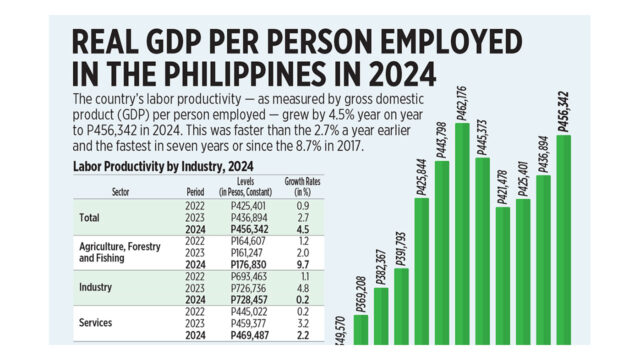
The country’s labor productivity — as measured by gross domestic product (GDP) per person employed — grew by 4.5% year on year to P456,342 in 2024. This was faster than the 2.7% a year earlier and the fastest in seven years or since the 8.7% in 2017.

Real GDP per person employed in the Philippines in 2024

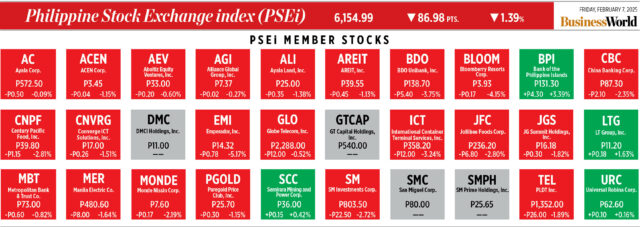
How PSEi member stocks performed — February 7, 2025

Here’s a quick glance at how PSEi stocks fared on Friday, February 7, 2025.


PHL stocks may climb with BSP likely to cut rates

PHILIPPINE STAR/KRIZ JOHN ROSALES

PHILIPPINE SHARES may rise this week as the Bangko Sentral ng Pilipinas (BSP) is expected to cut benchmark interest rates for a fourth straight meeting.

On Friday, the benchmark Philippine Stock Exchange index (PSEi) fell by 1.39% or 86.98 points to close at 6,154.99, while the broader all shares index dropped by 0.63% or 23.41 points to 3,663.64.

Week on week, however, the PSEi went up by 5% or 292.4 points from its 5,862.59 close on Jan. 31.

“The PSEi managed to bounce back to the 6,000 zone the week after a reconstitution of the main index,” online brokerage 2TradeAsia.com said in a market note.

Changes to the 30-member PSEi took effect on Feb. 3. The market operator added AREIT, Inc. and China Banking Corp., replacing Nickel Asia Corp. and Wilcon Depot, Inc. after the 2024 index review.

Bargain hunting following the market’s decline to bear market territory on Jan. 31 also boosted the PSEi last week.

For this week, the market’s focus will be on the BSP’s first policy meeting of the year on Feb. 13 (Thursday), Philstocks Financial, Inc. Senior Research Analyst Japhet Louis O. Tantiangco said in a Viber message.

“A cut in policy rates together with a dovish outlook is expected to give the market a boost,” Mr. Tantiangco said.

Recent dovish signals from BSP Governor Eli M. Remolona, Jr. have fanned expectations of another rate cut as early as this week’s policy review, Rizal Commercial Banking Corp. Chief Economist Michael L. Ricafort said in an e-mail.

A BusinessWorld poll showed that 19 out of 20 analysts expect the Monetary Board to reduce benchmark rates by 25 basis points (bp) this week, which would bring the policy rate to 5.5% from the current 5.75%.

Mr. Remolona earlier said that a rate cut is “on the table” at the Monetary Board’s Feb. 13 meeting.

He said they may slash benchmark interest rates by a cumulative 50 bps this year as “policy insurance” against risks, with the reductions likely to be done in 25-bp increments each in the first and second half.

The BSP has cut borrowing costs by 75 bps since kicking off its easing cycle in August last year, bringing the policy rate to 5.75%.

Mr. Tantiangco added that the peso’s recent rebound could also help boost the local bourse.

“This past week, we saw an appreciation of the peso against the dollar as well as a decline in our long-term Treasury yields. A continuation of this is expected to help the local market in advancing further,” he said.

On Friday, the peso closed at an over one-month high of P58.03 per dollar. Week on week, it climbed by 33.5 centavos from its P58.365 close on Jan. 31.

Mr. Tantiangco put the PSEi’s support at 6,150 and resistance at 6,400, while Mr. Ricafort pegged support at 6,000 and resistance at 6,275-6,530.

For its part, 2TradeAsia.com placed the market’s immediate support at 6,000 and resistance at 6,300-6,400. — R.M.D. Ochave

Peso may trade sideways amid fresh concerns over US tariffs

BW FILE PHOTO

THE PESO may continue to trade at the P57 to P58 levels this week as markets await clarity regarding US President Donald J. Trump’s tariff policies.

The local unit closed at P58.03 per dollar on Friday, strengthening by 15 centavos from its P58.18 finish on Thursday, Bankers Association of the Philippines data showed.

This was the peso’s best close in more than a month or since its P57.91-per-dollar finish on Jan. 2.

Week on week, the local unit rose by 33.5 centavos from its P58.365 close on Jan. 31.

“The peso closed stronger on higher jobless rate data from the US… The dollar weakened against most currencies, which was tracked by the local market. However, there was some market caution ahead of the US manufacturing data. Trading volume was also lower,” a trader said by phone on Friday.

Hawkish signals from the Bank of Japan also dragged the dollar down against most Asian currencies on Friday, Rizal Commercial Banking Corp. Chief Economist Michael L. Ricafort said in a Viber message.

For this week, the trader said markets will continue to monitor developments in the Trump administration’s trade policies.

The trader sees the peso moving between P57.80 and P58.30 against the dollar this week, while Mr. Ricafort expects it to range from P57.70 to P58.20.

The dollar rose in choppy trading on Friday after data showed that US job growth slowed in January but that the unemployment rate edged down to 4%, giving the US Federal Reserve cover to hold off cutting interest rates until at least June, Reuters reported.

The US currency was also boosted by comments from Mr. Trump that he plans to announce reciprocal tariffs on many countries this week, without specifying which countries.

The dollar index, which measures the US currency against the yen, sterling and other peers, was last up 0.353% at 108.04. It was on track for a weekly fall after investor fears about a global trade war receded.

Nonfarm payrolls increased by 143,000 jobs last month after rising by an upwardly revised 307,000 in December, the Labor department’s Bureau of Labor Statistics said in its closely watched employment report.

Economists had expected the survey to show 170,000 jobs added.

Investor nerves about global trade wars returned on Friday after Mr. Trump pledged to impose more tariffs as part of a broad effort that he said could also help solve US budget problems.

Mr. Trump made the announcement during a meeting with visiting Japanese Prime Minister Shigeru Ishiba. He said auto tariffs remained on the table amid reports that the White House was weighing potential exemptions.

The dollar fell 0.09% against the yen to 151.365 after falling below 151 yen for the first time since Dec. 10 in early Asian trade on bets that the Bank of Japan will raise rates more than previously expected this year, supported by wage data earlier last week.

Adding to the higher rate expectations were comments by Bank of Japan board member Naoki Tamura, one of the board’s most hawkish members, who said on Thursday the central bank must raise rates to at least 1% in the latter half of fiscal 2025.

The early days of the Trump administration have kept investors on edge. Mr. Trump last week suspended planned tariff measures against Mexico and Canada at the last minute, but imposed additional 10% levies on imports from China, which quickly announced measures of its own on US imports. — AMCS with Reuters

Trump’s aid freeze keeps life-saving programs shut, sparks ‘mayhem’

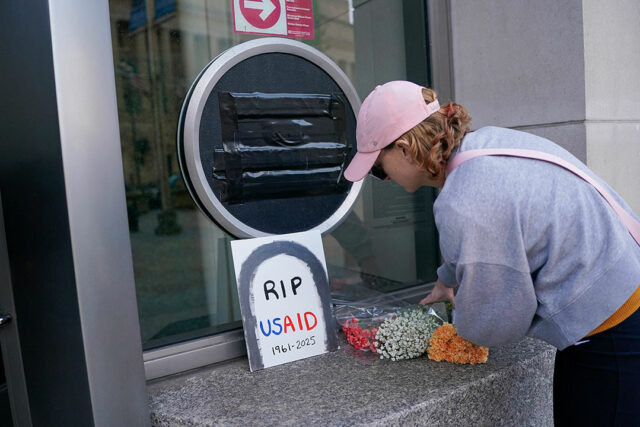
A PERSON leaves flowers, next to a covered United States Agency for International Development (USAID) sign, at the agency’s headquarters in Washington, US on Feb. 7, 2025. — REUTERS

IN GHANA and Kenya, insecticide and mosquito nets sit in warehouses because US officials haven’t approved urgent anti-malaria campaigns.

In Haiti, a group treating HIV patients awaits US permission to dispense medicines that prevent mothers from giving the disease to their children.

In Myanmar, where famine looms and the US is the single largest aid donor, one humanitarian worker described the situation as “mayhem.”

Nearly three weeks into US President Donald Trump’s sweeping freeze on foreign aid, life-saving programs across the globe remain shut as humanitarian workers struggle to secure US government waivers meant to keep them open, dozens of aid workers and United Nations (UN) staff told Reuters.

After Mr. Trump announced the 90-day freeze on Jan. 20, US Secretary of State Marco Rubio issued waivers for what he called “life-saving humanitarian assistance,” which included “core life-saving medicine, medical services, food, shelter, and subsistence assistance.”

But aid workers and UN officials said the waivers had sparked widespread confusion, along with fears that their US funding would never be restored.

They said they couldn’t restart work without first confirming with their US counterparts whether specific programs qualified for exemption. This was proving nearly impossible, they said, due to a communication breakdown with US officials, some of whom had been fired or barred from talking.

The breakdown appeared partly by design. On Jan. 31, staff at the United States Agency for International Development (USAID), once the main delivery mechanism for American largesse, were told not to communicate externally about the waiver and what it may or may not include, according to a previously unreported recording of the meeting reviewed by Reuters.

The US State Department and White House did not respond to requests for comment.

The spiraling consequences of the aid freeze in developing countries underline the real-world harms from Mr. Trump’s upending of decades-old US initiatives designed to build global alliances by making America the world’s most generous superpower and largest single aid donor.

Aid workers had a list of urgent questions going unanswered. Among them: Which programs could continue? What qualifies as life-saving aid? Food? Shelter? Medicine? And how do they keep people from dying when almost every aid service has been shut at once?

With little guidance from US officials, aid workers said their organizations erred on the side of caution and closed programs rather than incur expenses that the US government might not reimburse, the aid workers said. Some described how US partners — often people they had worked with for years — no longer answered their phones or e-mails.

One Geneva-based aid official who reached US officials was stunned by their response. “We asked: Can you tell us exactly which programs we need to stop? Then we got a message saying ‘no more guidance is forthcoming’. This leaves us in a situation where you have to make a choice of which program is ‘life-saving’,” the official said. “We don’t have money to pay for it ourselves. We can’t spend money we don’t know if we have.”

The turmoil was particularly acute at USAID, now in disarray and targeted for closure as a “criminal organization” by Mr. Trump’s government efficiency tsar, the billionaire Elon Musk.

In his executive order, Mr. Trump said the US “foreign aid industry and bureaucracy” were “in many cases antithetical to American values.” He ordered the 90-day pause pending a review on whether aid was consistent with his “America First” foreign policy.

Most of those who spoke to Reuters requested anonymity, fearful of antagonizing the Trump administration and jeopardizing the possible restoration of aid.

Two workers with aid organizations in Myanmar told Reuters they didn’t know whether US-funded food distribution in the country was covered by a waiver and would continue. One of the workers described the situation as “mayhem.” Myanmar faces a severe food crisis due to natural disasters and a spiraling civil war. An estimated two million people in the country are on the brink of famine, according to the UN.

In Africa, humanitarian workers were due to start anti-malaria spraying campaigns this month in Ghana and Kenya before mosquito populations explode during the rainy season, but insecticide and mosquito nets are stuck in warehouses, said a USAID contractor.

A USAID memo, dated Feb. 4 and seen by Reuters on Saturday, said “life-saving activities” to address malaria, tuberculosis and other diseases and conditions would be exempt from the freeze. But campaigns to protect millions of people appeared on hold as aid workers sought clarification on when funding would resume and specific malaria programs in Africa could restart, the contractor said.

Malaria, a preventable disease, is caused by parasites transmitted to people by the bites of infected mosquitoes. The vast majority of the world’s 597,000 malaria deaths in 2023 were African children aged under five years old, the World Health Organization said in December.

“There is a small window to do those campaigns which is going to close rapidly,” said the USAID contractor.

Millions of US taxpayer dollars already spent on supplies to fight malaria in Africa could go to waste, aid workers said. Malaria No More, a global nonprofit based in Washington, said the freeze could prevent the distribution of 15.6 million life-saving treatments, nine million nets and 48 million doses of preventative medicine.

The US is the top donor in the global fight against malaria, mostly through the President’s Malaria Initiative, known as PMI, set up under former President George W. Bush in 2005. PMI’s website — which included information on populations at risk of malaria — has been taken down and replaced with a brief statement: “In order to be consistent with the President’s Executive Orders, this website is currently undergoing maintenance as we expeditiously and thoroughly review all of the content.”

“It’s as if all the work . . . has just been erased,” said Anne Linn, a USAID staffer who worked remotely from Montana as a technical advisor and was fired on Jan. 28. “It’s so cruel and senseless,” she said. “The wastefulness of it is staggering to me.”

TURMOIL AT USAID
The problems were exacerbated by turmoil at USAID, whose leaders Mr. Trump has described as “radical left lunatics.”

Mr. Trump’s administration plans to keep 611 staff at USAID out of its worldwide total of more than 10,000, according to a notice sent to the agency on Feb. 5 and reviewed by Reuters.

Washington’s primary humanitarian aid agency has been a target of a government reorganization program spearheaded by Mr. Musk, a close Trump ally, since the Republican president took office on Jan. 20. Staff have been shut out of the agency’s headquarters in Washington. Mr. Rubio has appointed himself the agency’s acting administrator.

An expert in water and sanitation spoke of “mass confusion” at the USAID’s global health bureau after she and dozens of others were fired on Jan. 28. “It happened so quickly that I had no way of saving e-mails, contacts,” she said. “We were all just thrown away and bulldozed over.”

In Thailand, the aid freeze forced the International Rescue Committee (IRC), which funds health clinics with US support, to quickly shut down the hospital and clinics it ran in seven refugee camps on the Myanmar-Thai border. IRC was told by US officials they couldn’t reopen before receiving another notification, which hasn’t arrived, said an aid worker.

Many were discharged from the IRC facilities, leaving people including pregnant women and children unable to access medication or medical equipment, said Francois Nosten, director of the Shoklo Malaria Research Unit, a field station in the border camps run by Bangkok’s Mahidol University.

An elderly woman, who had been hospitalized with lung problems and was dependent on oxygen, died four days after being discharged, according to her family. Reuters couldn’t independently confirm her cause of death.

An IRC spokesperson said some refugees had “self-organized” to provide critical services for themselves until aid support was “transitioned” to Thai authorities.

If “you cut all the activities then some people are going to die,” said Mr. Nosten. — Reuters

Japan PM Ishiba, after meeting Trump, voices optimism over averting tariffs

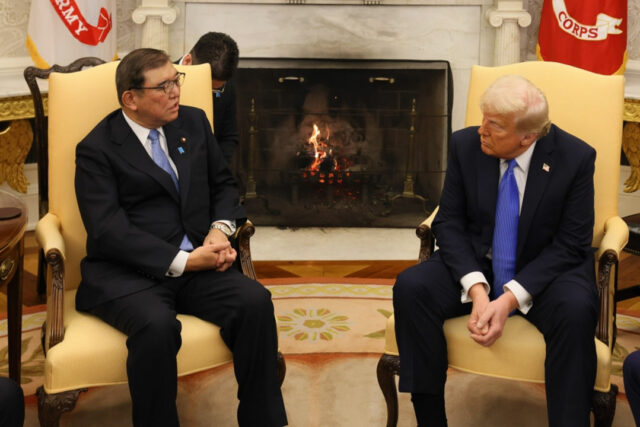
JAPANESE Prime Minister Shigeru Ishiba (L) with US President Donald Trump. — MOFA.GO.JP-CABINET PUBLIC AFFAIRS OFFICE

TOKYO — Japanese Prime Minister (PM) Shigeru Ishiba expressed optimism on Sunday that his country could avoid higher US tariffs, saying President Donald Trump had “recognized” Japan’s huge investment in the US and the American jobs that it creates.

At his first White House summit on Friday, Mr. Ishiba told public broadcaster NHK, he explained to Mr. Trump how many Japanese automakers were creating jobs in the United States.

The two did not specifically discuss auto tariffs, Mr. Ishiba said, although he said he did not know whether Japan would be subject to the reciprocal tariffs that Mr. Trump has said he plans to impose on imports.

Tokyo has so far escaped the trade war Mr. Trump unleashed in his first weeks in office. He has announced tariffs on goods from Canada, Mexico and China, although he postponed the 25% duties on his North American neighbors to allow for talks.

The escalating trade tensions since Mr. Trump returned to the White House on Jan. 20 threaten to rupture the global economy.

Mr. Ishiba said he believes Mr. Trump “recognized the fact Japan has been the world’s largest investor in the United States for five straight years, and is therefore different from other countries.”

“Japan is creating many US jobs. I believe (Washington) won’t go straight to the idea of higher tariffs,” he said.

Mr. Ishiba voiced optimism that Japan and the US can avoid a tit-for-tat tariff war, stressing that tariffs should be put in place in a way that “benefits both sides.”

“Any action that exploits or excludes the other side won’t last,” Mr. Ishiba said. “The question is whether there is any problem between Japan and the United States that warrants imposing higher tariffs,” he added.

Japan had the highest foreign direct investment in the United States in 2023 at $783.3 billion, followed by Canada and Germany, according to the most recent US Commerce Department data.

Mr. Trump pressed Mr. Ishiba to close Japan’s $68.5-billion annual trade surplus with Washington but expressed optimism this could be done quickly, given a promise by Mr. Ishiba to bring Japanese investment in the US to $1 trillion.

On Sunday, Mr. Ishiba identified liquefied natural gas, steel, AI and autos as areas that Japanese companies could invest in.

He also touched on Mr. Trump’s promise to look at Nippon Steel investing in US Steel, as opposed to buying the storied American company — a planned purchase opposed by Mr. Trump and blocked by his predecessor, Joseph Biden.

“Investment is being made to ensure that it remains an American company. It will continue to operate under American management, with American employees,” Mr. Ishiba said. “The key point is how to ensure it remains an American company. From President Trump’s perspective, this is of utmost importance.”

On military spending, another area where Mr. Trump has pressed allies for increases, Mr. Ishiba said Japan would not increase its defense budget without first winning public backing. “It is crucial to ensure that what is deemed necessary is something the taxpayers can understand and support,” he said. — Reuters

Far-right leaders hold rally to ‘Make Europe Great Again’

A European Union flag is seen in Stockholm, Sweden, July 17, 2023. — REUTERS

MADRID — Leaders of far-right parties in the European Parliament’s third-largest voting bloc, Patriots for Europe, praised Donald Trump’s return to power at a gathering in Madrid on Saturday held under the slogan “Make Europe Great Again.”

The event featured Hungarian Prime Minister Viktor Orban and Italian deputy premier Matteo Salvini, as well as the leaders of France’s National Rally  Marine Le Pen, and the Netherlands’ PVV party, Geert Wilders.

“The Trump tornado has changed the world in just a few weeks … yesterday we were heretics, today we’re mainstream,” Mr. Orban told around 2,000 supporters, most of whom waved Spanish flags.

All the speakers railed against immigration and most called for a new “Reconquista,” a reference to the Medieval re-conquest of Muslim-controlled parts of the Iberian Peninsula by Christian kingdoms.

Earlier, former Estonian Finance Minister Martin Helme kicked off the rally following a video message by Venezuelan opposition leader Maria Corina Machado. His speech excoriating what he called “leftists” was interrupted by a topless activist from feminist group Femen chanting “Not one step back against fascism” in Spanish before she was ejected.

Other themes included frequent right-wing targets such as “wokism” — a term used pejoratively by some to describe left-leaning political views on race, gender and sexuality — migrant rescue NGOs, European Commission’s Ursula von der Leyen and Spanish Prime Minister Pedro Sanchez, whose names were met with loud jeers.

Patriots was formed after the May 2024 European election and consists of 86 MEPs from 14 countries, representing a combined 19 million votes. Madrid was chosen as venue for their first official summit so that Patriots’ president Santiago Abascal, who leads Spain’s Vox party, could host.

Spain’s ruling Socialist Party said in a statement it rejected what it described as a “coven of ultras”, adding: “They won’t succeed in making their black-and-white world view prevail in this country.”

Vox has steadily gained ground in several polls over the past months. According to the Centre for Sociological Studies, it garners the strongest support among young men, members of the military and law enforcement.

Despite Patriots’ stated goal of unifying Europe’s nationalist conservatives, some of the EU’s most influential parties in that camp — such as Italian Prime Minister Giorgia Meloni’s Brothers of Italy, Alternative for Germany and Poland’s Law and Justice — have refused to join. — Reuters

New Zealand to loosen visa rules to lure foreign investors

SULTHAN AULIYA-UNSPLASH

SYDNEY — New Zealand will relax visa rules to attract more foreign investors, in efforts to stimulate economic growth, its center-right government said on Sunday.

Immigration Minister Erica Stanford said the country’s investor visa category would be made “simpler and more flexible” to encourage investors to choose New Zealand for their “capital, skills and international connections.”

“These changes will turbocharge our economic growth, bringing brighter days ahead for all Kiwis,” Ms. Stanford said in a statement announcing that two new visa categories — for “higher-risk investments” and “mixed investments” — would be created.

The changes, to take effect from April 1, follow the government’s recent relaxation of visa rules allowing holidaymakers to work remotely while visiting the country, aimed at boosting its tourism sector.

After slipping into a technical recession in the third quarter of 2024, the New Zealand government is seeking ways to bolster growth. In January, it announced plans to set up Invest New Zealand, part of the government’s international economic development agency, to serve as a one-stop-shop for overseas investment. — Reuters