Home Blog Page 2045

House limits P200 hike to low-income workers 

PHILIPPINE STAR/RUSSELL A. PALMA

By Kenneth Christiane L. Basilio, Reporter 

The House of Representatives on Monday night approved on second reading a bill that seeks to give minimum wage workers a P200 daily increase. 

In a voice vote, congressmen passed House Bill No. 11376, which is a departure from the across-the-board hike for private sector workers endorsed by the House labor committee. 

“The regional wage board system, which for over three decades, has failed Filipino workers and their families with almost all minimum wages falling below the poverty line,” Deputy Speaker and Party-list Rep. Raymond Democrito C. Mendoza, who authored the bill, told the House floor. 

Philippine minimum wages are set by regional wage boards, which drew criticism from lawmakers due to what they perceive as its slow and meager increases amid spiraling prices. The Senate approved a counterpart bill for a P100 daily wage increase for private-sector workers in February last year. 

“The daily rate of all minimum wage workers in the private sector, regardless of employment status, including those in contractual and sub-contractual arrangements, whether agricultural or nonagricultural, shall be increased by P200,” according to a copy of the House bill. 

Microenterprises in the service sector including retail with 10 workers or fewer may apply for an exemption from the proposed wage increase. 

The House also approved on final reading a measure pegging the contribution rate of members of Philippine Health Insurance Corp. (PhilHealth) to 3.5% from 5% now, while also requiring the state-owned insurer to consider expected healthcare spending and socioeconomic factors in setting the contribution rate. 

In a 191-3-0 vote, lawmakers approved House Bill No. 11357, which requires PhilHealth to secure congressional approval before being allowed to tweak its contribution rates. It is a priority measure of President Ferdinand R. Marcos, Jr.’s government. 

“Premium contributions for direct and indirect contributors shall be derived from actuarially-adjusted rates, considering but not limited to the projected healthcare utilization, cost trends and demographic and economic factors,” according to a copy of the bill. 

“The actuarially-adjusted premium rates, as determined by the annual actuarial review, shall be subject to the approval of Congress,” it added. 

The bill keeps PhilHealth’s premium rate at 3.5% until an actuarial review of its operations is submitted to Congress. 

The 2025 monthly contribution rate for members with an income floor and ceiling of P10,000 and P100,000 stands at 5%. 

“An independent body shall review the annual actuarial report prior to its submission to Congress to ensure transparency and accuracy in the findings,” according to the bill. 

Meanwhile, the House also passed on final reading a measure that seeks to strengthen cigarette tax administration by implementing a track-and-trace system for all tobacco products. 

With 177 congressmen in favor, four against and zero abstention, the House passed House Bill No. 11286, which is supposed to curb cigarette smuggling. 

“A tracking and tracing system shall be established for the manufacturing, importation, storage, removal, distribution and sale of tobacco products, cigars, cigarettes, heated tobacco products, vapor products and novel tobacco products,” according to a copy of the bill. 

Lawmakers also approved on final reading House Bill No. 11360, which seeks to curb tobacco smuggling by reducing excise taxes. 

In a 190-4-0 vote, the House passed the bill setting a P41 tax per package of heated tobacco products, while harmonizing the tax of vapes and cigarettes at P66.15. 

The Philippines imposes a tax of P57 per milliliter (ml) on salt nicotine products, P6.30/ml on freebase nicotine products and P65/10 ml on classic nicotine products, according to the excise tax rates prescribed by the Bureau of Customs for 2024. 

It amends the Philippine Internal Revenue Code by imposing a 2% tax on tobacco products every even-numbered year starting in 2026; and 4% every odd-numbered year starting in 2027. 

The increase will be enforced until Dec. 31, 2035. 
House OKs bills banning POGOs, online cockfighting

PHILIPPINE STAR/IRISH LISING

By Kenneth Christiane L. Basilio, Reporter

THE HOUSE of Representatives on Monday approved on second reading separate bills that seek to ban Philippine offshore gaming operators (POGO) and online cockfighting amid their perceived negative effects on society.

In a voice vote, lawmakers approved House Bill (HB) No. 10987, which outlaws the operations of any offshore gaming operations in the country, putting teeth into President Ferdinand R. Marcos, Jr.’s order last year to ban them.

“It is still necessary to enact legislation to address illegal POGOs as they have been tied to numerous different unlawful activities,” Cavite Rep. Antonio A. Ferrer, who heads the House committee on games, told the House plenary in his sponsorship speech.

“While an executive order has been issued by the President, no penalties have been provided other than just prohibiting the same,” he added.

Mr. Marcos in his State of the Nation Address last year ordered a total ban on POGOs, citing their ties to illicit activities such as money laundering, prostitution and human trafficking.

All offshore gaming operators, support staff and local gaming agents must settle all taxes before winding down.

People caught operating POGOs face a jail term of up to eight years and may be fined as much as P5 million under the bill.

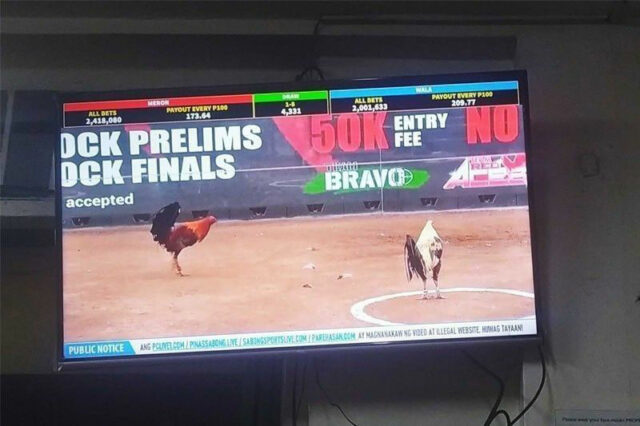
The House also approved on second reading a measure that seeks to ban online cockfighting or e-sabong operations and penalize illegal operators.

“All permits and licenses of e-sabong operators issued by the Philippine Amusement and Gaming Corporation (PAGCOR) are declared invalid and the PAGCOR shall make an accounting of any financial obligation due to and from e-sabong operators,” according to House Bill No. 11254. “No permits or licenses for the operation of e-sabong may be issued by PAGCOR upon the effectivity of this act.”

Mr. Marcos issued an order in 2022 that kept the ban on online cockfighting operations imposed by his predecessor.

Violators face a jail term of up to 20 years and a maximum fine of P500,000.

Also on Monday, lawmakers approved on second reading a bill that seeks to strengthen the Energy Regulatory Commission’s (ERC) charter.

House Bill No. 11373 seeks to make the agency an “independent, accountable, quasi-judicial and rule-making regulatory body,” allowing it to better police the power sector.

“The ERC shall determine the benchmark for the range of prices and rates that are deemed reasonable for both the end-user and the operations of generation, transmission and distribution entities,” it added.

DSWD told to publish list of aid beneficiaries to prevent misuse of funds

PHILIPPINE STAR/ BOY SANTOS

THE Department of Social Welfare and Development (DSWD) should publish the list of beneficiaries of a multibillion-peso financial assistance program for minimum wage earners affected by rising prices before distributing the aid amid concerns of potential misuse, according to a former Philippine Supreme Court justice.

“Publishing the name, the amount of the tax money that was given and the name of the person who recommended it — there’s nothing confidential about that,” retired Supreme Court Associate Justice Antonio T. Carpio told a Senate hearing looking into the agency’s aid initiative for workers whose income falls below the poverty threshold.

“These are public funds,” the former magistrate said. “The Constitution says there is a right to information by the people on matters of public concern and of course, the number one concern of the public is how their tax money is disbursed.”

Social Welfare Secretary Rexlon T. Gatchalian in December dispelled criticisms that the program is a form of pork barrel that could be an avenue for corruption, noting that funds for the Ayuda sa Kapos ang Kita Program (AKAP) go the agency and not to lawmakers.

Congress has appropriated P26 billion for the program this year, but President Ferdinand R. Marcos, Jr. placed it under conditional implementation when he signed the P6.326-trillion budget for 2025.

This means the budget will only be released “after clear guidelines are put in place to ensure proper use of the funds,” according to the Budget department.

Executive Secretary Lucas P. Bersamin earlier said the DSWD would implement strict guidelines on the AKAP program, which provides a one-time cash assistance of as much as P5,000 for workers under the poverty threshold.

Budget Secretary Amenah F. Pangandaman said last month the guidelines would define beneficiaries as those whose incomes fall below the regional minimum wage. She added that there would be no “middle man” because DSWD social workers would be present during the distribution of aid.

She said the National Economic and Development Authority would monitor and evaluate the program with the Philippine Statistics Authority. — John Victor D. Ordoñez

Senate chief backs Agriculture department’s plan to declare food emergency

Workers unload sacks of rice in this file photo. — PHILIPPINE STAR/RYAN BALDEMOR

SENATE PRESIDENT Francis “Chiz” G. Escudero on Monday backed a plan by the Agriculture department to declare a food emergency to address rising food prices, as he cited the need for the state to step up efforts to lower rice prices.

“We must do everything we can to lower the price of rice which, to a large extent, is responsible for a big chunk of our inflation numbers,” he told reporters in a Viber group message.

The Federation of Free Farmers in a statement on Sunday urged the Department of Agriculture (DA) to study a national food emergency declaration since lowering rice prices could risk cutting farmgate prices and affect farmers.

“If the concerns of the [federation] are indeed proven correct, I am sure the DA can make the corresponding adjustments to rectify its unintended ill-effects,” the Senate president said.

Agriculture Secretary Franciso P. Tiu Laurel, Jr. earlier said that his agency is likely to declare a nationwide food security emergency on Feb. 4 to lower rice retail prices.

According to the DA’s price monitoring of Metro Manila markets as of Jan. 31, a kilo of imported special rice costs P52 to P61 compared with P57 to P65 a year ago.

He has said imported rice prices are stubbornly elevated even after the government slashed import tariffs on the staple. President Ferdinand R. Marcos, Jr. lowered the tariffs on imported rice to 15% from 35% until 2028.

The price of imported premium rice was P51-P58 per kilo as of Jan. 31 from P54-P62 a year earlier. Imported well-milled rice costs P44 to P52, while imported regular milled is P40 to P48 per kilo.

The declaration of a national emergency on rice would let the Agriculture department flood the market with rice held by the National Food Authority (NFA).

The NFA had said it was planning to release 300,000 metric tons of rice held in warehouses to make way for the harvest season. — John Victor D. Ordoñez

House Speaker to get impeachment complaints vs VP Duterte this week

VICE-PRESIDENT SARA DUTERTE-CARPIO — PHILIPINE STAR/ RYAN BALDEMOR

PENDING impeachment complaints against Vice-President Sara Z. Duterte-Carpio would be transmitted to House Speaker Ferdinand Martin G. Romualdez’s office this week, a top official of the chamber said on Monday.

“[It’s] still with me, but we have to act on it this week. We will act on it this week,” House Secretary-General Reginald S. Velasco told reporters.

Ouster complaints against Ms. Duterte have languished at Mr. Velasco’s office since their filing in December.

The three impeachment raps, filed by civil society groups, activists, and clergymen, alleged that the vice-president committed graft, corruption, bribery, and betrayal of public trust. This is in connection with her failure to account for the alleged “anomalous disbursements” of more than P600 million worth of confidential and intelligence funds in 2022 and 2023.

Mr. Velasco said the transmittal of the first three complaints was delayed as his office awaited the filing of a fourth complaint.

Ouster complaints against Ms. Duterte face an uphill battle as lawmakers have questioned whether there is enough time to deliberate with the country’s midterm elections just less than four months away.

Congress is set to go on a four-month break next week for the midterm elections on May 12. It will resume sessions on June 2-13 before the 19th Congress officially closes.

“Anything is possible,” said Mr. Velasco, noting that impeachment complaints against Ms. Duterte could still move forward before lawmakers go on break for the election campaign period.

He said some congressmen are looking to “fast-track” the impeachment process by collecting “103 or more” signatures from lawmakers, allowing it to be directly transmitted to the Philippine Senate.

Any member of the chamber or citizen, through the endorsement of a House member, may file an impeachment complaint at the House of Representatives.

The chamber needs a vote of at least one-third of all members, or in this case at least 103, before it is elevated to the Senate for trial.

The Constitution provided that no impeachment proceedings should be initiated against the same official more than once within one year. — Kenneth Christiane L. Basilio

NGCP rate reset completed by March

THE Energy Regulatory Commission (ERC) is set to complete the National Grid Corporation of the Philippines’ (NGCP) transmission rate reset by March, the regulatory body’s chief said on Monday.

“We started our deliberations as a commission last week, and we will deliberate it because we received so many comments from stakeholders,” ERC Chairperson Monalisa C. Dimalanta told reporters in Filipino after a House of Representatives hearing.

“We will finish it this month, [and] we will release the decision by March of this year,” she added.

The ERC conducts a rate reset process for power companies to help ensure that rates are fair for both consumers and power utilities by looking into the proposed project costs and projected expenditures over a five-year regulatory period.

Ms. Dimalanta said the National Transmission Corp. (TransCo) commented that NGCP has not paid a part of its grid operation earnings to the state-owned corporation.

“TransCo says there is a portion of the collection by NGCP that should go to them because they have assets being used by NGCP, such as land,” she said. 

TransCo is a government-owned and -controlled corporation which owns the country’s transmission assets, while the NGCP is the private corporation that won the concession to operate and maintain the transmission system.

Meanwhile, the NGCP is set to release its rate reset for Manila Electric Co. (Meralco) by June, which would take effect a month later, said Ms. Dimalanta.

“They should file [their updated application] this week,” she said. “The commission already decided that they should file for the fifth regulatory period because we need to finish this by June,” she said in Filipino.

Ms. Dimalanta also said the regulatory body would deliberate Meralco’s P19-billion refund proposal on March 1. “We will feel the impact of the refund just in time for the summer months.” — Kenneth Christiane L. Basilio

POGO reopening a scam — PAGCOR

BW FILE PHOTO

THE Philippine Amusement and Gaming Corporation (PAGCOR) condemned the spread of supposed official letters and text messages falsely claiming that Philippine Offshore Gaming Operations (POGOs) will reopen.

During his State of the Nation Address in July, President Ferdinand R. Marcos, Jr. banned all offshore gaming operations, citing POGO links to illegal activities such as money laundering and financial scams.

“It has come to our attention that some people are enticing potential investors into paying huge amounts for supposed limited slots of POGO licenses, and saying POGOs will be supposedly operating directly under PAGCOR,” PAGCOR Chairman and Chief Executive Officer Alejandro H. Tengco said in a statement on Feb. 2. He said POGOs remain banned, and has no plans for their return now or in the foreseeable future.

The ban officially took effect on 1 Jan. this year after Mr. Marcos signed Executive Order No. 74 on Nov. — Aubrey Rose A. Inosante

US-PHL Society to convene on Feb. 10

THE US-PHILIPPINES Society will meet in Manila on Feb. 10-11 to discuss key issues pertinent to both nations, marking the first private sector-led forum on US-Philippines relations since the recent electoral transition in Washington.

In a statement on Monday, Ayala Corporation said a session in the event, titled “Outlook 2025,” will feature presentations on global and regional trends, American diplomacy in the Asia Pacific region, and the priorities of the Philippine government.

The session also aims to explore the implications of the second round of President Donald J. Trump’s administration’s policy actions and discuss the upcoming Philippine midterm elections on May 12.

Co-Chair Jaime Augusto Zobel de Ayala will host the 2025 board meeting, while Co-Chair Ambassador John D. Negroponte will lead the US delegation.

The co-chairs will also introduce new board members, including leaders from business, professional, and civic sectors.

Founded in 2012 and headquartered in Washington, the US-Philippines Society aims to enhance and strengthen bilateral relations while raising awareness of contemporary Philippines through programs focused on business, governance, culture, shared history, education, strategic issues, and conflict resolution. — Chloe Mari A. Hufana

Probe of project delays sought

JCOMP-FREEPIK

A RESOLUTION seeking an investigation into the implementation delays of foreign-funded infrastructure projects was filed at the House of Representatives on Monday.

In a statement, Party-list Rep. Eduardo J. Villanueva, Jr. said he filed House Resolution No. 2215 to raise concerns about the billions worth of commitment fees paid by the Philippine government to multilateral lenders.

“We are wasting billions of pesos on loans that remain unused,” he said.

In December, the Commission on Audit flagged the Public Works department for failing to implement P84 billion worth of foreign-assisted projects, resulting in the restructuring of loan terms which could lead to higher construction costs.

Mr. Villanueva said the House probe would allow lawmakers to review procurement and foreign loan use policies, helping introduce safeguards to prevent loans from incurring additional charges.

“Every peso that can be saved from commitment fees can be redirected to funding pressing needs such as healthcare, education, and social services,” he said. — Kenneth Christiane L. Basilio

Digitalizing legal services pushed

WIKIMEDIA/PATRICKROQUE01

THE Philippine Chief Justice underscored the need for technology-driven transformation to enhance efficiency and uphold ethical standards at the 20th National Convention of Lawyers organized by the Integrated Bar of the Philippines (IBP) last Jan. 30.

In his speech at the opening of the three-day event in Cebu City, Chief Justice Alexander G. Gesmundo said artificial intelligence (AI), blockchain, and data analytics can potentially improve the efficiency and accessibility of legal services.

“We realize that the next frontier can only be reached if we fully embrace the benefits that today’s advancements bring while ensuring that proper safeguards are placed,” he said in his keynote address.

He warned that while technology can enhance legal practice, it remains only a tool. “[It] enhances our functions but cannot replace the critical thinking and moral responsibility intrinsic to our profession.”

He further noted the use of these tools must align with ethical standards and dictates of fairness and justice.

Senior Associate Justice Marvic M.V.F. Leonen also detailed the judiciary’s shift to digital case management via eCourt PH 2.0. He stressed that AI could enhance, but not replace, human judgment in legal decision-making.

“By digitizing the complete process from filing to adjudication and providing real-time updates on case status, our lawyers can work more efficiently, hopefully alleviating their clients’ suffering promptly,” Mr. Leonen said in his lecture.

“Transitioning to a digital system allows these delays to be minimized, making the judicial process more transparent and equitable.” — Chloe Mari A. Hufana

PAGCOR shuts down Cebu Casino after posting net losses

CASINOFILIPINO.PH

THE Philippine Amusement and Gaming Corporation (PAGCOR) on Monday announced the closure of its Casino Filipino branch in Talisay, Cebu amid significant losses.

Meanwhile, another site in Tagum, Davao del Norte will likewise be shut down as part of the agency’s ongoing rationalization plan, it said in a statement on Monday.

“Given the sustained financial strain, continuing operations at these sites is no longer feasible,” PAGCOR Chairman and Chief Executive Officer Alejandro Tengco said in a statement.

PAGCOR said Casino Filipino Talisay, operated by Casino Filipino Cebu, posted net losses of P49.56 million last year after it lost P39.32 million in 2023.

On the other hand, P36.93 million in net loss has been recorded from the Casino Filipino Grand Regal-run Tagum location in 2024, following a P31.65-million net loss a year earlier.

Mr. Tengco said no employees will be displaced and assured that they will be transferred to different branches instead. — Aubrey Rose A. Inosante

Peso sinks as Trump’s tariffs roil markets

PHILSTAR FILE PHOTO

THE PESO fell against the dollar on Monday after US President Donald J. Trump followed through on his threats to impose tariffs on Canada, Mexico, and China.

The local unit closed at P58.66 per dollar on Monday, weakening by 29.5 centavos from its P58.365 finish on Friday, Bankers Association of the Philippines data showed.

The peso opened Monday’s session weaker at P58.44 against the dollar, which was already its intraday best. Its worst showing was at P58.72 versus the greenback.

Dollars exchanged decreased to $1.27 billion on Monday from $1.51 billion on Friday.

The peso weakened as the dollar was stronger after Mr. Trump on Saturday said he would impose 25% import tariffs on Canada and Mexico and 10% on China starting on Tuesday, Rizal Commercial Banking Corp. Chief Economist Michael L. Ricafort said in a Viber message.

“The peso closed lower on dollar strength as Trump made good of his tariff threats, implementing tariffs on Mexico, Canada, and China. He also threatened to impose 100% tariffs on BRICS countries,” a trader said by phone.

For Tuesday, the trader expects the peso to move between P58.50 and P58.58 per dollar, while Mr. Ricafort sees it ranging from P58.55 to P58.75.

The dollar surged on Monday, pushing its Canadian counterpart and Mexican peso to multi-year lows, while China’s yuan slumped to a record trough in offshore trade after Mr. Trump’s sweeping tariffs kicked off a trade war, Reuters reported.

The US dollar’s gains were broad, with the euro also dropping to a more than two-year low and the Swiss franc — despite typically acting as a safe haven — sliding to the weakest since May.

Investors also pared expectations of rate cuts from the Federal Reserve, trimming about 6 basis points, with futures roughly pricing a 54% chance of two cuts this year and 44% for just one in the wake of the tariff news.

The US dollar advanced 0.4% to 7.3462 yuan in the offshore market, having earlier pushed to a record high of 7.3765 yuan. Markets in China remained closed for the Lunar New Year and will resume trading on Wednesday.

The Mexican peso fell to its lowest in nearly three years at 21.2882 per US dollar and was last down 2.7% at 21.2583, while the Canadian dollar slumped to C$1.4755, a level not seen since 2003.

The Australian dollar hit a five-year low, while the New Zealand dollar fell to its lowest since October 2022. The two Antipodean currencies are often used as liquid proxies for the Chinese yuan.

The euro plunged as much as 2.3% to $1.0125 — the lowest since November 2022 — investors braced for tariffs on Europe from the Trump administration. The single currency was last down 1.25% at $1.02325.

The greenback added as much as 1.1% to 0.9210 per Swiss franc, the highest since last May, before trading at 0.9142 franc. Sterling fell 1% to $1.2264. Japan’s yen was more resilient, down slightly at 155.59 per dollar.

That left the dollar index, which measures the US currency against six other units, 0.11% firmer at 109.65. It had touched a three-week high in early trading. — A.M.C. Sy with Reuters

ADVERTISEMENT
ADVERTISEMENT