Home Blog Page 203

Mitsubishi, Intellicare partner to serve Japanese firms in Philippines

[L-R] AVENTUS MEDICAL CARE, INC. Vice-President Sally Gaspar; Mitsubishi Corp. Manila Branch General Manager Harutaka Ishikawa; Mitsubishi Corp. General Manager of Healthcare Department Yutaka Suzuki; Asalus Corp. (Intellicare) President Jeremy Matti; The Intellicare Group Chairman Mario Silos; and Avega Managed Care, Inc. Senior Vice-President & Chief Operating Officer Jerico Dela Cruz. — INTELLICARE

MITSUBISHI CORP. (MC) has signed a partnership with healthcare provider The Intellicare Group to deliver data-based healthcare solutions for Japanese firms operating in the Philippines.

Under the agreement, Intellicare said the partnership will roll out comprehensive health maintenance organization (HMO) solutions, clinic-based services, educational workshops, third-party administration (TPA), and fully customized healthcare structures tailored for Japanese companies in the country.

The partnership allows Mitsubishi to support Intellicare in providing data-driven healthcare services nationwide, the company said in a statement.

It also follows Mitsubishi’s recent investment in Fullerton Health, Intellicare’s parent firm.

“Our partnership with Mitsubishi Corp. marks a new chapter of growth for Intellicare,” Asalus Corp. (Intellicare) President Jeremy G. Matti said in a statement.

“We also hope this expands our partnerships, allowing for more companies and lives to experience the true meaning of our healthcare delivery,” he added.

The collaboration aims to expand Intellicare’s engagement with Japanese medical networks and health technologies to support long-term growth and operational efficiency, it said.

“Mitsubishi’s extensive network and Japan-derived healthcare intelligence will also assist the Intellicare Group in developing integrated services, cost optimization, and data-driven healthcare management to improve healthcare accessibility in the Philippines,” the company added.

Intellicare and its subsidiary Avega are the sole HMOs in the Philippines with strategic collaborations with Japanese companies under Mitsubishi’s global network, the statement said.

“By leveraging our complementary strengths, we are dedicated to building a data-driven platform that enables companies to manage medical costs more effectively and intelligently, while contributing to a more sustainable healthcare ecosystem in the country,” said Yutaka Suzuki, general manager of Mitsubishi’s healthcare department.

The Intellicare Group comprises Asalus Corp. (Intellicare), Aventus Medical Care, Inc., and Avega Managed Care, Inc. Intellicare, part of Fullerton Health Group, offers end-to-end healthcare services across the Asia-Pacific region, including managed care, diagnostics, specialty care, and ancillary services. — Beatriz Marie D. Cruz

GCash waives transaction fees for overseas Filipinos in the Middle East

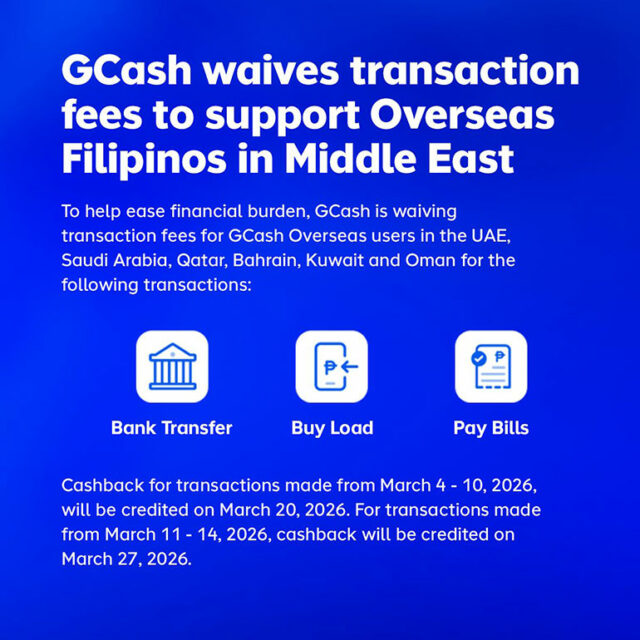
GCash is waiving transaction fees on bank transfers, bill payments, and mobile load purchases for GCash Overseas users in the United Arab Emirates, Qatar, Bahrain, Kuwait, Saudi Arabia, and Oman to help ease their financial burden amid the ongoing developments in the Middle East.

This initiative allows overseas Filipinos in affected areas to stay connected with loved ones back home and to receive assistance without added costs. This supports the national government’s continuing efforts to prioritize the safety and welfare of overseas Filipinos.

Waived transaction fees will be credited back via in-app cashback. No registration is required, and eligible fees will be automatically returned to GCash user accounts, and users will receive an in-app notification confirming that the cashback has been successfully credited.

For transactions made from March 4-10, 2026, cashback will be credited back to users on March 20, 2026. Transactions from March 11-14, 2026 will receive cashbacks on March 27, 2026.

GCash will continue to closely monitor developments in the region and assess the need for a possible extension of these financial relief measures as necessary.

GCash encourages overseas Filipinos requiring urgent assistance to coordinate directly with the nearest Philippine Embassy or Consulate, or contact the Department of Foreign Affairs and the Department of Migrant Workers through their official hotlines and channels for emergency support.

Emergency assistance contact information:

  • GCash Help Center: Visit help.gcash.com by chatting with Gigi or by call the official GCash hotline at 2882 

For more information, please visit: 

https://gcash.com/promos/gcash-waves-transactionfees-for-ofws-in-middle-east.


Spotlight is BusinessWorld’s sponsored section that allows advertisers to amplify their brand and connect with BusinessWorld’s audience by publishing their stories on the BusinessWorld Web site. For more information, send an email to online@bworldonline.com.

Join us on Viber at https://bit.ly/3hv6bLA to get more updates and subscribe to BusinessWorld’s titles and get exclusive content through www.bworld-x.com.

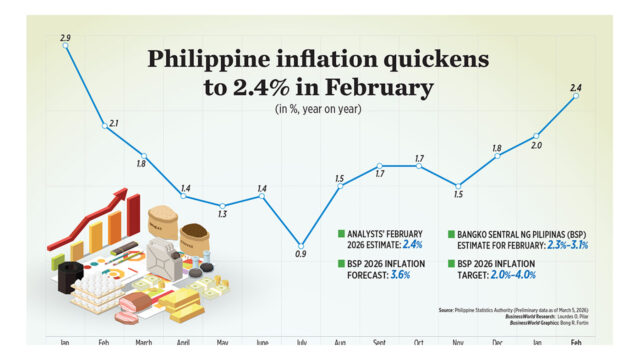
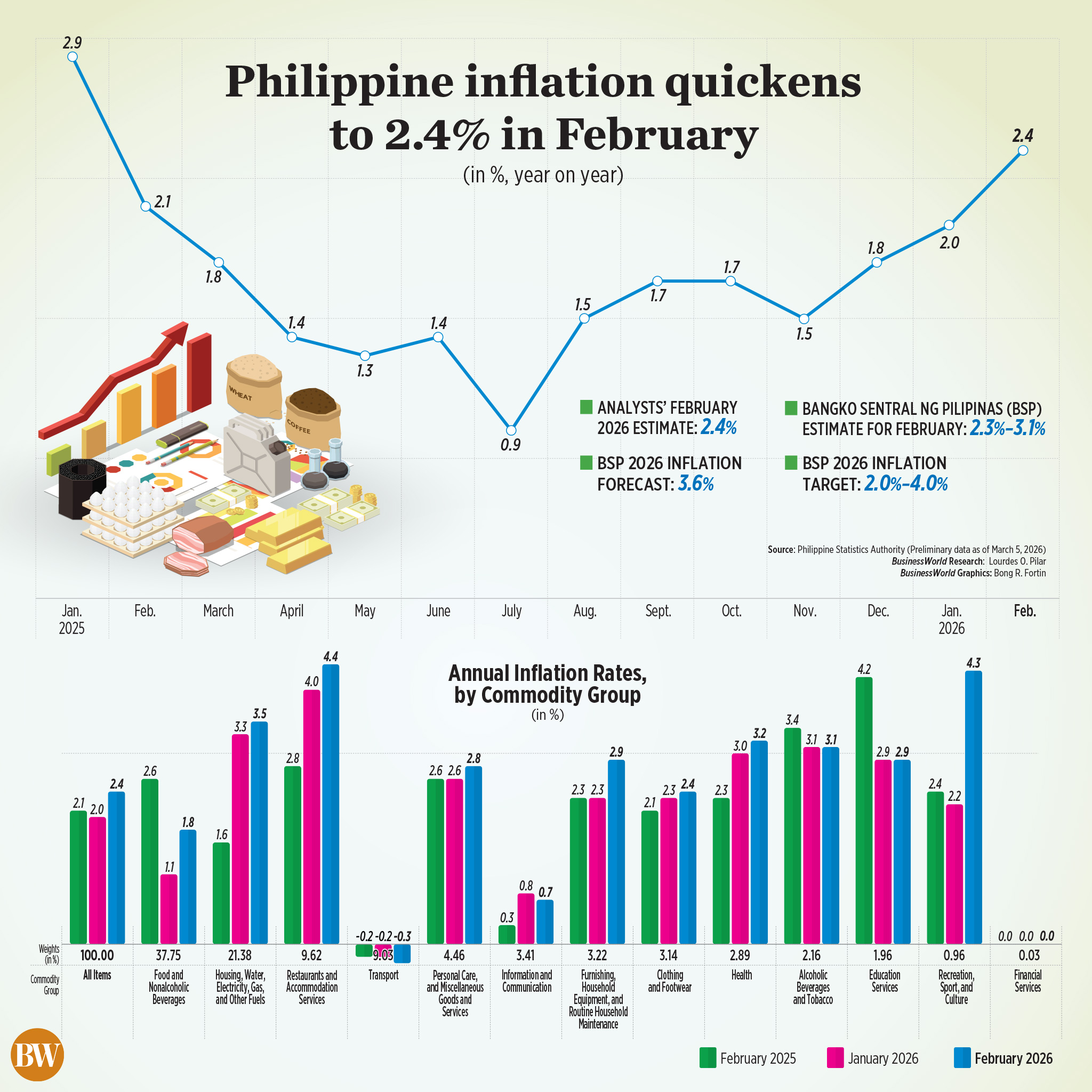
Philippine inflation quickens to 2.4% in February

PHILIPPINE INFLATION accelerated to a 13-month high in February as rising costs for rice, fuel, electricity and other utilities added pressure on household budgets, the Philippine Statistics Authority said on Thursday.Read the full story.

The reality of today

FREEPIK

It may take a long time to process and to reach the point of awakening. Then we discover what is important in life — the value of creating, giving, and contributing. Happiness and abundance come from sharing.

It is time to stop hoping and waiting for something or someone to change. Happiness, safety and security do not come galloping over the next horizon. There are no fairytale endings (nor beginnings). There is no guarantee of “happily ever after.” It must begin with oneself.

We begin making “our way through the reality of today rather than holding out for the promise of tomorrow.”

We all have been subjected to a lifetime of social conditioning on appearances and behavior.

We mistakenly believe that we must live up to a certain standard to be acceptable. The social pressure is there — the look, style, fashion, weight, job, car, home, partner, children.

It is reinforced by traditional and social media.

Consumerism is all about accumulating and obtaining. And having the new, the best, the “in” thing. The consumer fix from buying the latest gadget and status symbol is just a passing “high.” The novelty eventually wears off.

It takes maturity to realize that one is not perfect and cannot have everything. People will not always love, appreciate, or approve of whatever we do. One must take a long look in the mirror.

When one learns to accept certain things, it is possible to achieve a sense of serenity.

It is necessary to reassess and redefine the self and what one believes in. We should not be influenced by what others say we should believe in. They are entitled to their own opinion.

A sense of confidence is born of self-approval.

A process of sifting through the “doctrines” is necessary. These are the old habits, notions, ways of thinking and doing that we have to unlearn. We must learn to discard those that are no longer relevant. Only the essential values should be kept.

There is joy in giving rather than accumulating. Contentment comes from creating, producing, and contributing.

The lesson here is gratitude for all the blessings, big and small, that millions on earth do not have but wish they could have. Among them — a home, food, clean running water. Above all, peace, freedom of choice, and the opportunity to pursue our dreams.

A balanced lifestyle and diet with plenty of water and regular exercise. It has been said that fatigue drains the spirit. The body needs rest. Laughter is very good for the body and the spirit. One needs time to play and relax.

We learn, over the years, about love and relationships.

How to love and how much to give. When to stop giving and when to walk away.

We get hurt by insincere “friends” who are not reliable. Toxic people and situations should be avoided.

Then we should control the Ego — to acknowledge and diffuse destructive emotions such as anger, jealousy, envy, and resentment.

Humility is a quality we should cultivate. We should be able to say, “I was wrong.” In the same manner, we must forgive people, build bridges, and remove walls. Communication is an important tool for enhancing relationships.

We must distinguish between guilt and responsibility. We set boundaries and know when to say “NO.”

We should try to see people as they are and not project qualities that are not there. They grow and change. Real love is one given freely without conditions or limitations.

One should stop looking for guarantees. Change happens both slowly and suddenly. One must conquer fear and deal with the unexpected.

Solitude does not mean being lonely. It is a joyful discovery — to spend time with oneself. It leads to a deepening spirituality, healing, and growth.


Maria Victoria Rufino is an artist, writer and businesswoman. She is president and executive producer of Maverick Productions.

mavrufino@gmail.com

Berlin Film Festival director to stay in role after Gaza tensions

BERLIN — Berlin Film Festival director Tricia Tuttle will remain in her role but has been given a set of new guidelines, a statement said on Wednesday, after tensions over Gaza overshadowed the event in February.

Ms. Tuttle’s future as head of the festival, known as the Berlinale, was in the spotlight last week, with Germany’s government convening an emergency meeting to discuss the matter.

German media reports suggesting that Ms. Tuttle could be ousted prompted a number of directors, writers, and producers to rally around her.

It capped a politically charged festival that pitted anger over Israel’s actions in Gaza and concerns over free speech against historical sensitivities in Germany, which remains one of Israel’s staunchest supporters due to guilt over the Nazi Holocaust.

The supervisory board of the federal body responsible for the Berlinale recommended creating an advisory forum for the event and a new code of conduct for all federal cultural events.

Ms. Tuttle said in the statement she would carefully consider the recommendations.

In the same statement, the government’s Commissioner for Culture and Media, Wolfram Weimer, said the new guidelines would boost public acceptance of the festival, adding: “Art and artists should once again be at the heart of the Berlinale.”

TENSIONS AT THE FESTIVAL
Germany is particularly sensitive to discussion about Israel and what constitutes antisemitism, which has become more acute following the Oct. 7, 2023, attack by Hamas militants.

During the festival, Ms. Tuttle issued a statement defending artists’ right not to comment on politics after actors and directors — including jury president Wim Wenders — were perceived to avoid such questions at press conferences.

An open letter to organizers signed by over 80 former participants that the festival should take a clear stance on Gaza amplified previous criticism by pro-Palestinian activists.

Tensions culminated during the closing ceremony with a speech by Palestinian-Syrian film director Abdallah Al-Khatib accusing Germany of being “partners in the genocide in Gaza by Israel,” prompting a German minister to walk out.

Israel has strongly denied that its actions in Gaza amount to genocide and says they are justified as self-defense. — Reuters

FINEX Sustainability Handbook

In a time when climate risks are no longer distant threats but daily realities, the FINEX Foundation Environment Committee chaired by Land Bank of the Philippines (LANDBANK) Director Gaudencio “Goody” Hernandez, Jr. launched the Sustainability Handbook, a timely and expanded version of the earlier publication called Primer on Climate Change and Natural Farming. The event signaled a renewed call for collective responsibility and practical action toward building a climate-resilient Philippines.

Held in the boardroom of LANDBANK, President and CEO Lynette Ortiz was the main guest and sponsor who underscored the urgency of embedding sustainability into everyday decision-making.​

“The FINEX Sustainability Handbook is a timely and meaningful contribution to our shared efforts in building a more resilient and responsible future for the Philippines,” she said at the launch event. “Sustainability is neither an abstract ideal nor a policy buzzword. It is shaped by deliberate decisions made daily.” She noted that farmers, cooperatives, and rural communities across the country are already confronting the harsh realities of climate change. What they need, she emphasized, are tools that transform awareness into action, something the handbook seeks to provide through clear, practical guidance grounded in real-world experience.

Ms. Lynette also cited LANDBANK’s recent issuance of the ASEAN Sustainability or ASENSO Bonds, which successfully raised P50 billion to finance projects supporting agriculture and rural development, accelerating green and climate-resilient initiatives, and expanding economic opportunities. Demonstrating the bank’s institutional commitment, she introduced Sustainability Officer Celine “Pips” Pastor, reinforcing that sustainability is firmly embedded in LANDBANK’s strategy.

I have a specifial affinity with LANDBANK and the launch brought back memories. As a former undersecretary of Finance, I used to attend LANDBANK board meetings as alternate to then Finance Secretary Jose Pardo. My late father, Benjamin Gozon, once served as governor of the Land Authority, the predecessor of the Department of Agrarian Reform, and as Secretary of Agriculture and Natural Resources. He too had been a member of the LANDBANK board.

The handbook is comprehensive. It covers climate change, the science, risks, and strategies for increasing resilience in a changing climate, natural farming principles and benefits, environmental awareness, and good governance. It emphasizes that sustainability rests on three pillars: environmental stewardship, social inclusion, and sound governance.

Among the distinguished guests were 2026 FINEX Foundation Environment Liaison Trustee Michael Arcatomy Guarin; handbook contributor Katrina Francisco; LANDBANK director and former Philippine National Bank President Omar Byron Mier; LANDBANK EVP Charlotte Conde (National Development Lending Sector Head); EVP Marilou Villafranca (Branch Banking Sector Head); FVP Nardo Masa (Branches Group Head); FVP May Dar-Arizabal (SME and Mid-Market Lending Group Head); VP Marissa Pineda (Branch Banking Management Group Head); FVP Ann Marijell Ong (Corporate Banking Group); and EVP Eden Japitana (Agriculture and Sustainability Group).

A heartfelt message came from 2026 Environment Committee Chair Karla Rufino, who authored the handbook’s natural farming section. Coming from a financial risk background, she shared how writing the chapter deepened her appreciation of stewardship. “Sustainability is about stewardship,” she reflected. “Everything we need to cultivate healthy plants and good soil, God has provided in abundance around us.” Her insights echoed the handbook’s core message: that nature itself offers solutions when treated with respect.

FINEX Foundation Chair 2026 Edmund “EJ” Qua Hiansen broadened the perspective further. Sustainability, he said, extends beyond environmental protection. It also encompasses the social dimension, uplifting communities, expanding access to education, and fostering inclusive opportunities and the governance dimension, which demands transparency, accountability, and ethical leadership. He said that Dr. Noemi Villaruz put it best when she said in the handbook: “The fight for a clean environment is not one of convenience. It is one of courage. Every day of delay means more damage, more species lost, more polluted air, and more lives disrupted by disaster. The Earth is not a gift from our ancestors; it is a loan from our children. To neglect it is to betray their future. To care for it is to give them hope, life and dignity.”

Special thank you to FINEX Foundation Environment Committee Chair Goody Hernandez for strengthening the partnership between FINEX and LANDBANK, and also to editor-in-chief Wilma Miranda and copy editor Albert Gamboa, the contributors, and secretariat whose collective effort made the publication possible.

Ms. Miranda hopes that the handbook moves everyone to take care of the planet now so that future generations will have a better place to live. 2025 FINEX Foundation Chair Augusto “Toti” Bengzon urged everyone to read, reflect, and embrace the lessons within the handbook. He encouraged that it become a transformative guide aligning commitment to planet, people, and profit. Sustainability begins not with grand gestures, but with deliberate steps taken today. The handbook is not merely a publication; it is an invitation to act.”

The FINEX Sustainability Handbook is available for free via https://finex.org.ph/sustainability-handbook.

The views expressed herein are the author’s own and do not necessarily reflect the opinion of her office as well as FINEX.


Flor G. Tarriela is a banker, a gardener, and an environmentalist. She founded Flor’s Garden in Antipolo. She was the 2025 FINEX Foundation Liason Trustee for Environement.

Legislator claims 160 votes for nat’l minimum wage

PHILIPPINE STAR/ANDY G. ZAPATA JR.

HOUSE SUPPORT for a national minimum wage bill numbers 160 legislators, a party-list representative said.

In a statement, Rep. Elijah R. San Fernando said the bill would scrap the region-based wage system with a national wage-setting mechanism.

“For our other colleagues, there is still an opportunity to join us,” he said, claiming momentum after supporters numbered 123 on Monday. Bills need support from 159 legislators to pass on final reading.

Minimum wages are set by regional wage boards, which have been criticized for acting slowly and allowing wages to lag the cost of living.

Mr. San Fernando said House Bill No. 8081, which seeks to peg the initial national minimum wage to the highest current regional rate, has drawn support from both majority and minority blocs, including Speaker Faustino Dy III.

The bill also includes a three-year transition period to align regional wages with the national standard. Thirty percent of the wage gap will be addressed in the first year, 35% in the second and the remainder in the third.

After the transition, all regions will have a minimum wage equal to the initial national rate. Workers could still negotiate wages above the minimum, and a national commission will review rates annually.

Mr. San Fernando urged House Majority Leader Ferdinand Alexander A. Marcos III to schedule the bill for second reading.

“There is momentum and unity now,” he said. “Now, we just need to finish this.”

Passing the bill before May would send a “powerful signal” that legislators are committed to supporting workers, he said.

“We already have the numbers in Congress and the support of the public,” Mr. San Fernando said. — Kenneth Christiane L. Basilio

AboitizPower core earnings dip to P33.1 billion on GNPower costs

ABOITIZPOWER.COM

ABOITIZ POWER CORP. (AboitizPower) saw its core earnings decline 1.7% to P33.1 billion in 2025, due to depreciation and interest expenses from GNPower Dinginin Ltd. Co. (GNPD).

Excluding the financial impact of GNPD, AboitizPower’s earnings would have risen 2%, the company said in a disclosure on Thursday.

Reported net income fell 43% year on year to P19.5 billion, driven by one-time losses of P13.9 billion from the acquisition of GNPower Mariveles Energy Center Ltd.

Meanwhile, the company’s generation and retail supply business recorded a 21% increase in energy sales to 43,718 gigawatt-hours (GWh).

As a result, earnings before interest, taxes, depreciation, and amortization (EBITDA) rose 11% year on year to P73.7 billion.

Energy sold from AboitizPower’s distribution business increased 4% to 6,927 GWh. Excluding one-off items, the EBITDA contribution from the distribution segment rose 2% to P8.9 billion.

AboitizPower remains the Philippines’ leading power producer, with a 23.86% market share in the national grid as of July 2025, according to the Energy Regulatory Commission. — Sheldeen Joy Talavera

Does international law still matter?

BLACK BODY BAGS at Shajareh Tayyebeh girls’ elementary school in southern Iran, Feb. 28, 2026. — IRAN’S MINISTRY OF CULTURE AND ISLAMIC GUIDANCE/ZUMA PRESS WIRE

The strike on the girls’ school in Iran shows why we need it

By Shannon Bosch

AS THE US and Israel began their joint assault on Iran, reports emerged from Iran that a strike hit the Shajarah Tayyebeh girls’ elementary school in the southern city of Minab.

The school was reportedly packed with young pupils at the time. Iranian authorities say more than 150 people were killed, including children, and 60 more injured (these figures are yet to be independently verified).

Videos verified by international media show rescue workers digging through collapsed concrete, school bags being pulled from the debris, and scorch marks along the remaining walls.

The New York Times says it has verified videos that show the school next to a naval base belonging to the Iranian Revolutionary Guards Corps, or IRGC, and a strike hitting that base.

Iranian representatives at the United Nations have characterized the strike as a deliberate targeting of civilian infrastructure and labeled it a war crime and a crime against humanity.

Neither the United States nor Israel have publicly confirmed hitting the school. The US military’s Central Command (Centcom) said: We are aware of reports concerning civilian harm resulting from ongoing military operations. We take these reports seriously and are looking into them. The protection of civilians is of utmost importance, and we will continue to take all precautions available to minimize the risk of unintended harm.

At present, we do not have enough verified facts to reach a firm legal conclusion about what happened.

But given the questions about the legality of the US and Israeli strikes on Iran — and deeper questions about whether we’re witnessing the “death of international law” more broadly — incidents like this illustrate the continuing importance of the law, especially in times of conflict.

WHICH TARGETS ARE PROTECTED UNDER THE LAW?
In armed conflict, international humanitarian law applies. International humanitarian law is built on foundational principles that must inform all decisions by armed forces concerning what they target:

• distinction

• proportionality

• military necessity

And precautions must be taken to avoid incidental harm to civilians.

So what do these terms mean?

The principle of distinction requires parties to an armed conflict to always distinguish between civilian objects and military objects.

Attacks may only be directed against combatants and military objects. Civilians and civilian objects, such as schools, hospitals, and public transport, are protected and may not be directly targeted.

If there is any doubt about whether a target is military or civilian in nature, it must be presumed to be civilian.

Schools are not merely buildings. They are protective spaces, and their destruction can cause immediate loss of life and long-term societal damage.

Children under 18 also enjoy special protection under international humanitarian law. They, too, may not be directly targeted.

This protection is not absolute, however. Any civilian object (including schools) can lose their protected status if they become military objectives. A school used as a military base, artillery position, or command post could meet that definition.

So far, we have no evidence the school in Minab was being used for military purposes or that it was intentionally targeted.

PROPORTIONALITY AND PRECAUTIONS IN ATTACKS
What, then, if the school was not intentionally targeted, but was incidental collateral damage from an attack directed at the IRGC barracks nearby?

International humanitarian law recognizes civilian objects may be affected by attacks on military objectives.

Incidental harm to civilians and civilian objects is only lawful if it satisfies the test of proportionality and military necessity under the law. All feasible precautions must also have been taken to minimize harm to civilians.

So, if a school near a military target is hit, the legality of that strike turns on whether the expected harm to children and the school was excessive compared to the military advantage gained by striking the target.

Also important: did the military commanders take all feasible precautions to assess the effect of the attack on nearby civilians or civilian infrastructure? This includes the specific weapons that are used and the timing of the attack.

WHY INTERNATIONAL LAW MATTERS
In recent years, we have witnessed a number of countries and their leaders openly flouting international law and the rules-based order. Yet, it would be a profound mistake to conclude that international law has ceased to matter. Even grave breaches do not negate the system itself.

As renowned American international law scholar Louis Henkin famously wrote in 1979: Almost all nations observe almost all principles of international law and almost all of their obligations almost all of the time.

Henkin’s point was not naïve optimism. Daily compliance of international law remains the norm in diplomacy, trade, aviation, maritime navigation, treaty compliance, and peaceful dispute settlement.

Violations do occur — sometimes brazenly — but they are exceptions to an overwhelmingly compliant pattern of behavior.

The fact that some states breach foundational rules such as the prohibition on the use of force in Article 2(4) of the United Nations Charter does not render international law illusory.

Rather, it underscores the importance of naming breaches for what they are and defending the legal order that most states, most of the time, continue to respect.

If the strike on the Minab school is ultimately shown to have violated the principles of distinction, proportionality, and military necessity, it would not prove Henkin wrong; it would prove his point.

International law matters precisely because departures from it can be identified, judged, and condemned.

The rubble of a girls’ school is not evidence that the law is meaningless; it is a stark reminder of why the law exists, and why insisting on compliance remains essential.

THE CONVERSATION VIA REUTERS CONNECT


Shannon Bosch is an associate professor (Law) at the Edith Cowan University.

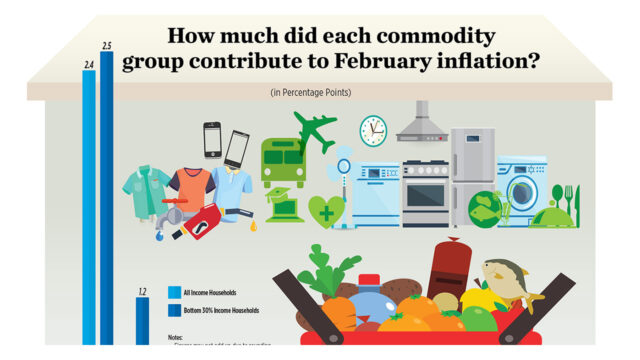
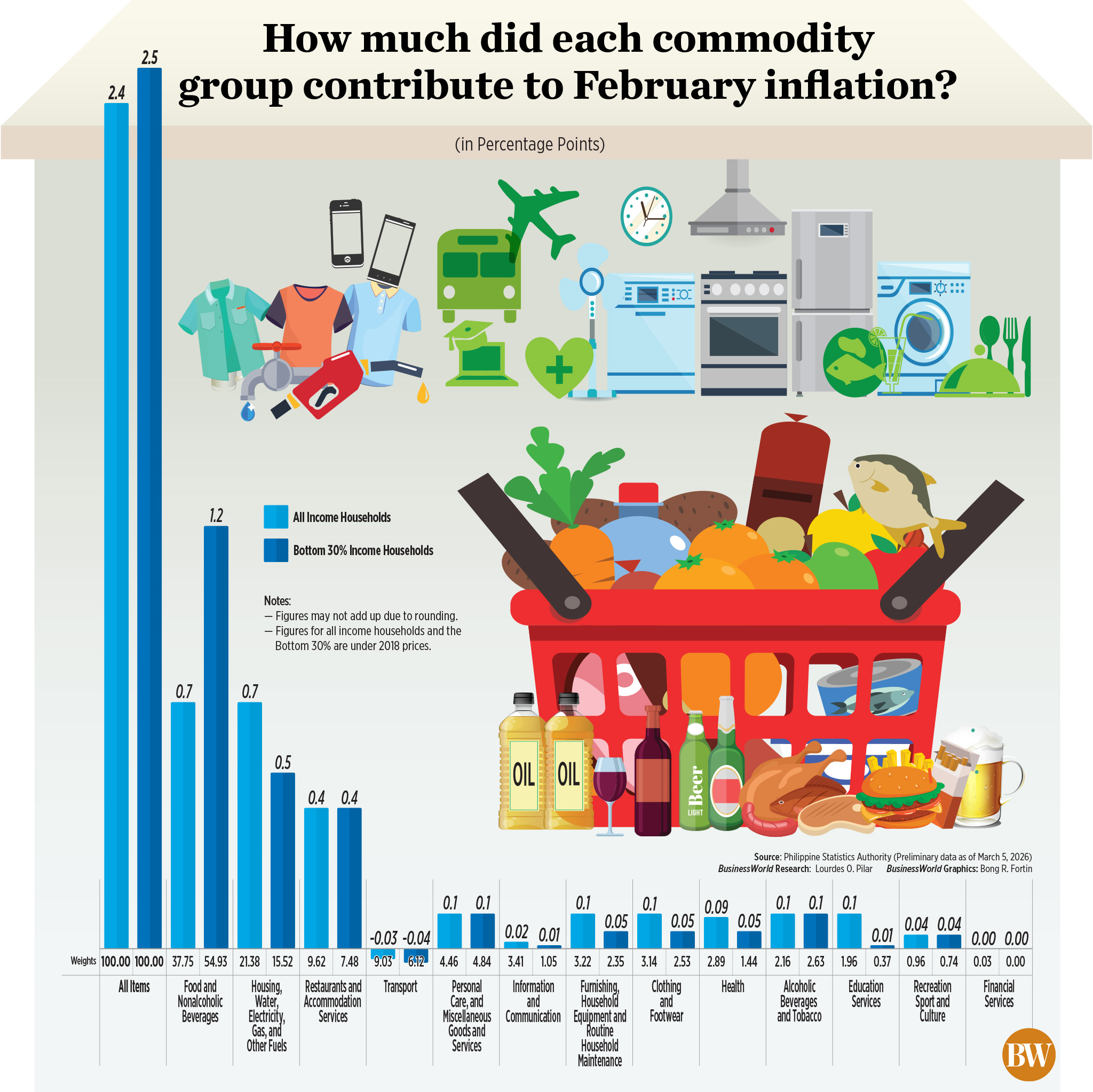
How much did each commodity group contribute to February inflation?

PHILIPPINE INFLATION accelerated to a 13-month high in February as rising costs for rice, fuel, electricity and other utilities added pressure on household budgets, the Philippine Statistics Authority said on Thursday.Read the full story.

Italy basilica bust re-attributed to Michelangelo after centuries in obscurity

A MARBLE BUST that has stood in the Roman basilica of Saint Agnes Outside the Walls for centuries without attribution is displayed after being identified as a work by Michelangelo Buonarroti, following a decade of archival research, in Rome, Italy, March 4, 2026. — REUTERS/REMO CASILLI

ROME — A marble bust that has stood for centuries in one of Rome’s basilicas has been re-attributed to Michelangelo after nearly 200 years of obscurity, following a document-based investigation.

The sculpture, which depicts Christ the Savior, has been preserved in the Basilica of Sant’Agnese fuori le mura on Rome’s ancient Via Nomentana by a Catholic religious order of canons regular.

Originally attributed to Michelangelo until the early 19th century, the work later lost its association with the Renaissance master and remained unnamed until the present day.

Italian independent researcher Valentina Salerno — a member of the Vatican committee for the celebrations marking the 500th anniversary of Michelangelo’s birth — has re-attributed the sculpture to the Tuscan artist.

“We have lived here since 1412, and the monumental complex of Sant’Agnese always holds surprises — this is one of them,” Franco Bergamin, of the Order of Lateran Canons Regular, told a press conference.

Ms. Salerno’s research is based on long-term archival work rather than stylistic analysis alone, drawing on notarial records, posthumous inventories, and indirect correspondence linked to Michelangelo’s final years in Rome.

“I am not an art historian — in fact, I don’t even have a university degree — but the strength of my research lies in its reliance on public archival documents,” she said, describing herself as something of an investigator.

A LOCKED ROOM WITH MULTIPLE KEYS
The documents challenge the long-held narrative that Michelangelo, who lived until he was 88, systematically destroyed works late in life. Instead, the sources suggest that drawings, studies, and some marble sculptures were carefully transferred within a trusted circle after the artist’s death.

“At Michelangelo’s death, every powerful ruler would have wanted to claim something of the master. But the artist carefully devised the transfer of the material in his possession so that his art could be passed on to his pupils and thus to future generations,” Ms. Salerno said.

One document refers to a locked room, accessible only with multiple keys, that had been created to safeguard valuable materials. While the room itself was later emptied, its contents can be traced through subsequent transfers.

The research outlines a discreet network through which unattributed works were moved to religious institutions and secondary storage sites, where they remained embedded in functional settings rather than entering the art market.

The Sant’Agnese bust appears to be part of this process. Long integrated into the basilica’s liturgical space, the sculpture was preserved in a building shaped by centuries of renovations and additions.

The data that have emerged will form the basis of a broader attribution process aimed at progressively returning other forgotten works to Michelangelo’s hand and presenting the findings to the international scholarly community.

The gleaming white sculpture now stands on an altar in a side chapel of the basilica and is protected by an alarm system. — Reuters

US dollar surge since start of war on Iran unlikely to last, say FX strategists

US one hundred dollar notes are seen in this picture illustration taken in Seoul, Feb. 7, 2011. — REUTERS

BENGALURU — The US dollar’s bounceback since the start of the US-Israel war with Iran may be short-lived due to lingering doubts about the safe-haven appeal of US assets, according to foreign exchange (FX) strategists polled by Reuters who broadly still expect two US Federal Reserve rate cuts later this year.

Traders have been positioned short the dollar — meaning they expect it to fall — since December, with the currency down against a basket of currencies around 12% since the start of 2025.

The greenback is up about 1.5% since Monday, in large part as short positions were covered, with surging oil prices triggering the move.

JUNE FED CUT NO LONGER PRICED IN
Interest rate futures are no longer pricing a June Fed rate cut, lending some near-term support to the dollar, though contracts are still priced for roughly two cuts by yearend.

Most FX strategists in the monthly Reuters poll, which was almost entirely conducted this week after the first missiles dropped, broadly stuck to calls for the dollar to weaken.

Poll medians from 60 analysts showed the euro up about 2% to $1.18 at end-March. It was then predicted to rise to $1.19 in three months and $1.20 in six — medians broadly unchanged from last month.

“We haven’t changed our stance. We’re still continuing to expect euro-dollar and various dollar crosses to trade choppily this year,” said Jane Foley, head of FX strategy at Rabobank.

“But is the dollar as safe as it used to be? Probably not, because if it was, we wouldn’t be having this debate over the last year or so in the first place,” she said.

The dollar rally this week has not been a typical “flight to safety” one, given short dollar positioning ahead of the war, which began early on Saturday.

“We had highlighted two weeks ago that some deleveraging signals were appearing in our flows data, perhaps partially linked to US-Iran risk. It was therefore not surprising to see more such deleveraging Monday,” JPMorgan FX strategists wrote in a note this week.

“Were dollar shorts to be more broadly covered back to flat…this would imply support worth +1.5-2% to the dollar from current levels, though much of that depends on the trajectory of the new conflict.”

OIL PRICE SPIKE HITS EMERGING CURRENCIES
Asked how positioning would shift by end-March, about half the currency strategists in the survey, 21 of 45, said there would not be much change, or shorts would increase. While 19 said net-shorts would decrease, only five predicted a reversal to net-longs.

While stocks have sold off across the globe this week, traditional safe-havens such as US Treasuries have underperformed and gold, though still up about 20% this year, has slipped.

Brent crude has jumped nearly 15% since Friday on concerns about supply disruptions and is now up around 37% in 2026.

Most emerging market (EM) currencies have broadly declined, particularly in Asia, hit by higher oil prices and rising bond yields.

“EM and Latam (Latin American) currencies are suffering from risk-off exacerbation with the double whammy of higher oil and the new jump in real yields… For now, more defensiveness is likely before any attempt of dip-buying,” said Alejandro Cuadrado, global head of FX and Latam Strategy at BBVA.

Markets also remain cautious given widespread uncertainty over which US tariffs will eventually apply and when. Concerns about central bank independence have been only partly eased since Kevin Warsh’s nomination as the next Fed Chair.

Forecasts a year out are reflecting heightened uncertainty. While the year-ahead median showed the euro strengthening to $1.21, the range of forecasts was about 18 cents, the joint-widest in Reuters polls since October.

“I’ll constantly have these client calls where one person on the team is dollar-bullish, one is dollar-bearish and the other person just decides, ‘I’m not even going to look at the dollar,’” said Dan Tobon, head of G10 FX at Citi, among the few contrarians who expect the greenback to strengthen.

“This uncertainty on how the US economy and labor market in particular will evolve from here — the range of outcomes — is tremendous. And that uncertainty for now is actually keeping the euro-dollar effectively pegged in a range.” — Reuters