Home Blog Page 2007

Paint the town red on Valentine’s


HERE are several ways for couples to paint the town red on Valentine’s Day, from up in the skies to next to each other, cooking together.


The Pen takes love to new heights

When was the last time you did something unexpected and spectacular for Valentine’s Day? Launch your love for each other high above the Manila skyline at The Peninsula Manila with the Old Manila x Air Taxi Fly & Dine Epic Date Helicopter Tour. This VIP-style private tour (a minimum of two guests, and a maximum of six) will take you on a romantic 15-minute helicopter journey of the iconic sites of Metro Manila where, as you fly high above the exciting landscape, you and your partner will enjoy quality time together making unforgettable memories. Upon your return, an indulgent six-course set dinner paired with a bottle of Peninsula Deutz Champagne awaits at Old Manila. To make the experience even sweeter, there will be a tin of Old Manila chocolate caviar pearls to take home. The chopper journey starts with a pre-departure at 4 p.m., departs at 4:45 p.m., then lands back for dinner at 6:30 p.m. It costs P19,880 per guest, inclusive of helicopter journey, dinner, Champagne, and taxes. A lower-priced option is at P8,200 per guest, inclusive only of dinner, a complimentary flute of Moscato d’Asti, and taxes.

On Feb. 14, from 7 to 10 p.m., The Lobby will transform into a romantic musical haven where lovers can enjoy a  four-course menu of Mosaic of Salmon and Tuna, Seafood Bisque, Grilled Angus Tenderloin or Maine Lobster, and a dessert of Rouge Craquelin. Guests booking a dinner table on Valentine’s Day will be serenaded by the acclaimed Battig Chamber Singers and Peninsula Strings. Music and Romance at The Lobby is P5,990 per guest, inclusive of taxes.

At Escolta from 6:30 to 10:30 p.m., a dinner buffet unfolds like a love letter written with Valentine-themed seasonal treasures. It’s at P4,490 per adult guest, inclusive of taxes, with an additional P1,500 when enjoying Escolta’s extensive selection of free-flowing wines (and at P2,290 per guest under 12).

Meanwhile, The Peninsula Boutique’s popping up at The Lobby with a display of chocolate hearts, love-inspired cakes, and armfuls of flowers, from 10 a.m. to 6 p.m. For inquiries or more information on dining at The Peninsula Manila on Valentine’s Day, call 8887-2888 ext. 6694, or e-mail diningPMN@peninsula.com.


Casa Buenas’ love, Filipino-style

This Valentine’s Day, Casa Buenas at Newport World Resorts invites guests to celebrate at La Serenata with a nine-course meal designed to take guests on a journey through the metaphorical stages of love, all paired with a selection of red, white, or sparkling wines.

The evening begins with Primera Vista, a story of tapas, with chorizo patatas bravas to lowa salmon. After that first interaction, delve into Tomarse Manos, a Filipino classic, kinilaw na isda (raw fish ceviche). Molo Soup, a comforting hot soup with dumplings and meat, represents the warmth and security of an embrace. The Cariño course is a tropical love affair with grilled marinated tuna and prawns, complemented by a creamy coconut and pumpkin purée, and finished with heirloom red rice. The Pasión course features wagyu beef in a Filipino-style “hotpot” served with vegetables, bone marrow, beef tenderloin, and beef jus. Other courses include a grilled pompano fillet, served with a smoky eggplant ensalada; Kare-kare (slow-roasted US beef rib-eye and braised Angus beef short ribs in a peanut sauce, paired with a pita glazed in shrimp paste), and Corazón, a hearty burnt Basque cheesecake served in a pot plant, with coffee custard, and strawberry semifreddo. Couples can reserve the Couple’s Table for P13,000 net (for two persons).

For a magical evening under the delicate wings of butterflies, the La Cupula gazebo offers a romantic setting for P52,000 net (for six persons). Or, for a grander affair, the Pamilya Table accommodates up to eight guests for P65,000 net, perfect for sharing the love with family and close friends. Singles can also enjoy the meal for P7,000 net.

For reservations and inquiries, contact 7908-8988 or 0917-878-8312, or e-mail casa.buenas@newportworldresorts.com.


Date and decorate with Honeybon

Honeybon’s Date and Decorate, scheduled for Feb. 15 at 4 p.m. at Gringo Greenhills, is a decorating workshop where you can create a cake as sweet as your love story.

For P1,430, participants will enjoy a package that includes one petite cake of one’s choice to decorate, a serving of pasta, snacks, and drinks. Participants can choose from a lineup of petite cakes: Tres Leches Cheesecake, Red Velvet Cake, or Honeybon’s new Strawberry Matcha Mousse Cake. The registration fee covers up to two participants per cake, making it ideal for couples, families, or friends. Solo participants can also enjoy this event as a chance to treat themselves.

To reserve a spot, message Honeybon on their social media accounts (@honeybonph). Gringo Greenhills is located at G/F, O Square 2, Greenhills Shopping Center, San Juan, Metro Manila.


Valentine’s cooking class through time

Guava Sketches and Robert Villarcabral of the Histolinarya Collective (the heritage cooking content creator) will collaborate on a Valentine’s Cooking Class called “For The Love of Food and Country.”

Mr. Villarcabral will guide participants in making a six-course meal, featuring Red Adobo Pate, Pan de Sal Antiguo (crusty, like your ancestors had it), Oysters Kinilaw, Pollo con Chocolate, “Rose Beef” Mechado, and Tibuk-tibok (a traditional carabao milk pudding).

Aprons and recipe booklets will be included for a fee of P5,000 per person. The cooking class will be held on Feb. 8, from 9 a.m. to 1 p.m. at Karrivin Studios, 2316 Chino Roces Ave., Makati. For inquiries, message Guava Sketches on Facebook and Instagram at Guava Sketches and @GuavaSketches, respectively.


Monica Ang-Mercado appointed CFO of SMFB

SAN MIGUEL Food and Beverage, Inc. (SMFB) has named Monica L. Ang-Mercado as its new chief finance officer (CFO), effective Wednesday.

Ms. Ang-Mercado is the daughter of tycoon Ramon S. Ang, chairman of SMFB’s parent company, San Miguel Corp. (SMC).

She succeeds Ildefonso B. Alindogan as part of “SMC’s management reorganization,” the listed food and beverage company said in a regulatory filing on Wednesday.

SMFB also appointed Emmanuel B. Macalalag as the chief operating officer of the company’s food division, replacing Francisco S. Alejo III.

Mr. Alejo will remain one of SMFB’s directors, alongside Ms. Ang-Mercado and Mr. Alindogan.

SMFB has three business groups: beer and non-alcoholic beverages, spirits, and food. Some of its subsidiaries include San Miguel Brewery, Inc., San Miguel Foods, Inc., and Ginebra San Miguel, Inc.

On Wednesday, SMFB shares fell by 0.19%, or ten centavos, to P51.20 per share, while SMC stocks rose by 6.67%, or P5, to P80 per share. — Revin Mikhael D. Ochave

Defending Philippine mobile banking apps against Trojan attacks

TRUSTPAIR.COM

By Jan Sysmans

MOBILE BANKING is revolutionizing financial services in the Philippines, offering unmatched convenience and accessibility to millions of users. According to Statista, the banking market in the Philippines is projected to have reached a net interest income of $8.18 billion in 2024 amid a surge in digital banking services.

However, this rapid digital adoption brings significant risks as cybercriminals deploy increasingly sophisticated tactics to exploit vulnerabilities in mobile banking applications. The most dangerous among them are Trojans — malicious programs specifically designed to infiltrate devices, steal sensitive data, and commit fraud.

According to the National Privacy Commission, there were a total of 6.8 billion security incidents in the Philippines from 2018 to 2024, with Trojans cited as a one of the causes of data breaches.

Banking Trojans like Blankbot, Godfather, ToxicPanda, GoldPickAxe, and Sharkbot have emerged as powerful tools in the cyber criminal arsenal. This type of malware employs advanced tactics, such as overlay attacks, keylogging, and remote desktop exploits, to deceive users and compromise app security.

For instance, overlay attacks trick users into entering their credentials on fake interfaces that mimic legitimate banking apps, while keylogging records keystrokes to capture passwords and PINs. Trojans also exploit accessibility services to monitor screen activity and perform unauthorized actions, further escalating the threat.

The impact of banking Trojans can be profound in the Philippines, where mobile banking adoption is high. A 2023 report by the Bangko Sentral ng Pilipinas (BSP) on the status of digital payments in the Philippines found that the share of digital payment transactions to total monthly retail payments grew to more than 50% in 2023 from 42.1% in 2022. For consumers, the risks include drained accounts, identity theft, and loss of personal data. For banks, these attacks lead to fraud, reputational damage, and regulatory penalties.

The growing risk of banking fraud has even spurred the Philippine government to launch the Financial Services Cyber Resilience Plan, a framework to enhance cyber resilience in the sector by creating and promoting holistic cybersecurity best practices and standards, building a strong cybersecurity culture, and implementing incident response protocols.

A concerning trend in cybersecurity is the growing collaboration between banking Trojans and on-device fraud (ODF). Unlike traditional fraud tactics that rely on external systems, ODF uses compromised devices to execute fraudulent transactions directly. By bypassing traditional security measures, this partnership between Trojans and ODF creates an almost impenetrable threat, leaving software development kit-based and legacy mobile app security solutions ineffective.

COMPREHENSIVE DEFENSE
In order to effectively protect against banking trojans, banks and fintechs in the Philippines need to take a very different approach to mobile app defense. They need to leverage artificial intelligence- and machine learning-powered defense automation to protect their mobile banking apps against ever more sophisticated threats.

Key minimum protections required to offer a comprehensive defense against banking trojans include:

• RASP (runtime application self-protection) — ensures app operations remain tamper-proof, preventing Trojans from executing malicious actions during runtime;

• code obfuscation — shields app code from reverse engineering, protecting sensitive app logic from attackers;

• root detection — blocks apps from running on rooted or jailbroken devices, where security vulnerabilities are heightened;

• man-in-the-middle attack prevention — encrypts data in transit, safeguarding sensitive user information from interception;

• keylogging prevention — protects user inputs, such as credentials and PINs, from being captured by malicious programs;

• blocking overlay attacks — detects and prevents fake/malicious screen overlays from displaying on top of the app screen and concealing the legitimate app screen, which is used to trick users into revealing sensitive information or performing harmful actions inadvertently;

• blocking accessibility services malware — prevents unauthorized use of accessibility services, closing a critical attack vector for Trojans;

• preventing remote desktop exploits — secures apps against unauthorized remote access and manipulation;

• Google Play Store signature validation — ensures only authentic app versions can run, mitigating the risk of Trojan-laden impostor apps; and

• SMS, two-factor authentication, and one-time pin interception prevention — secures in-app communications and protects against the interception of authentication mechanisms.

Traditional defenses are rendered ineffective against the dynamic nature of modern banking Trojans. The Philippine banking sector needs to build a future-proof security model capable of addressing both existing and emerging threats to ensure comprehensive protection for both users and financial institutes in this ever-evolving threat landscape.

To do this, they need an advanced security platform such as Appdome that provides benefits across the board. For consumers, this means ensuring safe and fraud-free banking experiences by protecting their sensitive data and funds. For banks and fintechs, such a platform prevents account takeovers, unauthorized transactions, and large-scale fraud attempts, ultimately preserving customer trust and reducing operational risks.

As the Philippines’ mobile banking and fintech sector continues to expand, the sophistication of Trojans like Blankbot, ToxicPanda, and Godfather serves as a stark reminder of the evolving cyber threat landscape. Financial institutions need to stay ahead of these challenges, delivering the robust security needed to protect customers and their businesses.


Jan Sysmans is a mobile app security evangelist of Appdome.

On PhilHealth’s excess funds again, and Open Government Partnership

Last Tuesday, Feb. 4, the Counsel of Government-owned and -controlled corporations (GOCCs), Solomon M. Hermosura, went to the Supreme Court to defend the transfer by the Philippine Health Insurance Corp. (PhilHealth) of excess funds to the National Treasury — saying that it was lawful and that it does not impair the constitutional right to health, and thus petitions against it should be dismissed by the Court.

It is lawful, he said, because it complies with the Department of Finance (DoF) Circular 003-2024. It affirms the Filipinos’ right to health because in 2024, PhilHealth increased the all-case rates package by at least 95%, and enhanced outpatient packages for chronic conditions with greater coverage for critical and life-saving treatments.

Despite remitting P60 billion in excess funds last year, Mr. Hermosura pointed that PhilHealth’s operating budget for 2025 has been increased to P284 billion — P25 billion more than its 2024 budget, and P118 billion more than its 2022 budget of P166 billion.

Good arguments, Mr. Hermosura. And a good initiative, Finance Secretary Ralph G. Recto. I have argued before and I will argue again that between health parochialism (and education or social work parochialism, etc.) and fiscal realism, the latter should prevail.

Health and social welfare spending by both national and local governments jumped a great deal from 2020-2024, even if the virus scare has simmered starting February 2022 when the election campaign period started.

The budget deficit averaged P1.54 trillion/year in 2020-2023, from only P0.52 trillion/year in 2017-2019. Financing or borrowings averaged P2.20 trillion/year in 2020-2023, from only P0.81 trillion/year in 2017-2019.

But in 2024, some fiscal “mini-miracles” happened.

One, non-tax revenues jumped from an average of P333 billion/year in 2020 to 2023, to P555.3 billion from January-November 2024 alone. This was mainly because Mr. Recto increased the mandatory remittances of GOCCs from 50% to 75%.

Two, financing or borrowing decreased from P2.2 trillion/year in the last four years to only P1.24 trillion in January-November 2024. This was mainly because the DoF avoided new borrowings to finance certain expenditures by tapping the excess funds of PhilHealth and the Philippine Deposit Insurance Corp. or PDIC.

Again, I support the DoF and the rest of economic team, and the GOCCs Counsel for arguing the legal and fiscal rationality of transferring the excess funds of PhilHealth and PDIC to the National Government.

Government should cut not only borrowings but also expenditures. Many subsidies must be cut and discontinued, people should go back being self-reliant and not dependent on the state for their household needs. In exchange, the state should cut income tax and other taxes to allow the people to keep more of their money and savings for themselves and their households.

OGP MEETING
The Open Government Partnership (OGP) Asia and Pacific Regional Meeting Philippines 2025 kicked off this week, Feb. 3 to 7, with events mostly held at UP Bonifacio Global City (BGC) and the Grand Hyatt Manila in BGC. Among the many topics discussed were transparency in public procurement, digital governance, anti-corruption and public integrity.

I attended the panel on “Leveraging strategic collaborations to address corruption” yesterday, Feb. 5, at the Grand Hyatt. It was sponsored by Stratbase and Democracy Watch and the keynote speaker was Budget Secretary Amenah F. Pangandaman.

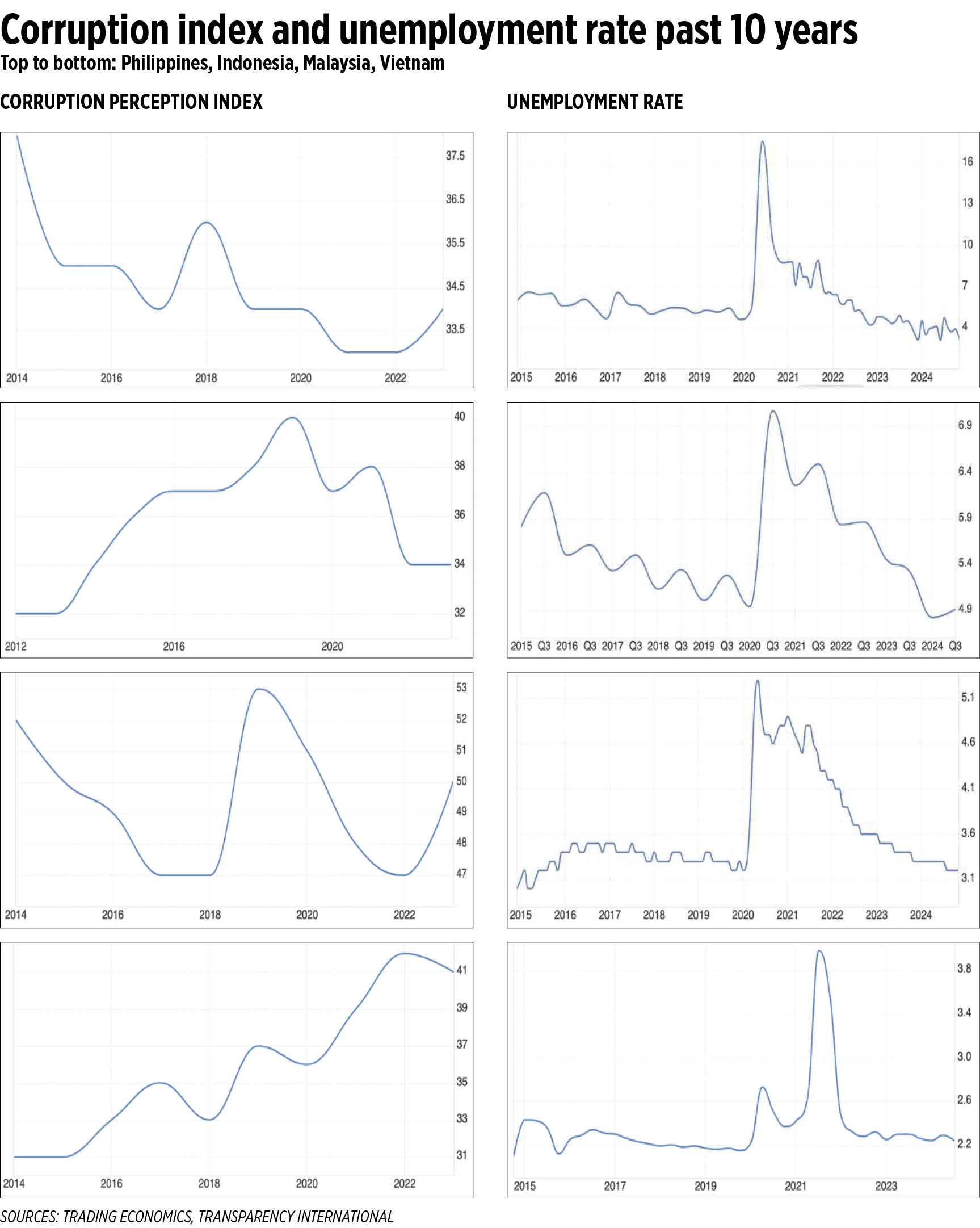
Corruption is a perennial issue in practically all governments around the world, from multilateral agencies to national down to local governments. I checked Transparency International’s corruption index, and limited my comparison to four ASEAN countries. I then compared their index scores with their employment data to test the hypothesis that “high corruption is equal to low job creation and high unemployment.”

The Philippines has been declining on the corruption perception index over the last 10 years, and its unemployment rate was also declining (except during 2020-2021 lockdown dictatorship). Indonesia exhibits the same pattern.

Malaysia has had wild fluctuation in the corruption index while its unemployment rate has been falling back to pre-lockdown levels. Vietnam has a weird situation: it is rising on the corruption index yet has declining unemployment (see the accompanying chart).

So, open government is good and should ultimately lead to more transparency and less corruption. But it will take time because the corrupt personnel and officials will always find ways to cover up their acts.

To effectively cut down on corruption, we should move towards cutting down the size of government, and cutting the government’s spending, bureaucracies, and subsidies. And we should cut the taxes and borrowings needed to sustain big government.

In December 2023, Argentina’s President Javier Milei’s first month in office, he cut the number of government ministries or departments from 19 to nine and quickly achieved a budget surplus after two months, and slowly stabilized prices. There was no civil war as predicted by the anti-deregulation lobbyists and activists.

US President Donald Trump and Department of Government Efficiency (DOGE) czar Elon Musk are also doing a similar quick and big cuts in federal agencies, bureaucracies, and expenditures. Milei’s pace of deregulation and his results have inspired Trump and Musk to do their own deregulation and spending cuts, borrowing cuts, and, very soon, another tax cut.


Bienvenido S. Oplas, Jr. is the president of Bienvenido S. Oplas, Jr. Research Consultancy Services, and Minimal Government Thinkers. He is an international fellow of the Tholos Foundation.

minimalgovernment@gmail.com

EU lays out guidelines on misuse of AI by employers, websites and police

REUTERS

BRUSSELS — Employers will be banned from using artificial intelligence (AI) to track their staff’s emotions and websites will not be allowed to use it to trick users into spending money under European Union (EU) AI guidelines announced on Tuesday.

The guidelines from the European Commission come as companies grapple with the complexity and cost of complying with the world’s first legislation on the use of the technology.

The Artificial Intelligence Act, binding since last year, will be fully applicable on Aug. 2, 2026, with certain provisions kicking in earlier, such as the ban on certain practices from Feb. 2 this year.

“The ambition is to provide legal certainty for those who provide or deploy the artificial intelligence systems on the European market, also for the market surveillance authorities. The guidelines are not legally binding,” a Commission official told reporters.

Prohibited practices include AI-enabled dark patterns embedded in services designed to manipulate users into making substantial financial commitments, and AI-enabled applications which exploit users based on their age, disability or socioeconomic situation.

AI-enabled social scoring using unrelated personal data such as origin and race by social welfare agencies and other public and private bodies is banned, while police are not allowed to predict individuals’ criminal behavior solely based on their biometric data if this has not been verified.

Employers cannot use webcams and voice recognition systems to track employees’ emotions, while mobile CCTV cameras equipped with AI-based facial recognition technologies for law enforcement purposes are prohibited, with limited exceptions and stringent safeguards.

EU countries have until Aug. 2 to designate market surveillance authorities to enforce the AI rules. AI breaches can cost companies fines ranging from 1.5% to 7% of their total global revenue.

The EU AI Act is more comprehensive than the United States’ light-touch voluntary compliance approach while China’s approach aims to maintain social stability and state control. — Reuters

Author Neil Gaiman and estranged wife sued for sexual assault

WILMINGTON, Delaware — The best-selling author Neil Gaiman and his estranged wife were sued by a New Zealand woman who is seeking millions of dollars for alleged sexual abuse and human trafficking while she worked for them as a nanny and babysitter, according to three lawsuits filed on Monday.

Scarlett Pavlovich said Mr. Gaiman, author of The Sandman comic book series and the novel American Gods, repeatedly raped her while she worked for him and Amanda Palmer in 2022, causing physical, mental, and emotional harm.

Ms. Palmer was accused of knowing that Ms. Pavlovich was vulnerable, and failing to warn that Mr. Gaiman had a history of predatory behavior, according to court papers.

The couple were named as defendants in Ms. Pavlovich’s lawsuit filed in the federal court in Madison, Wisconsin. Ms. Palmer is the sole defendant in Ms. Pavlovich’s federal lawsuits filed in Manhattan and Boston.

Mr. Gaiman owns a property in Wisconsin and Ms. Palmer is a resident of either New York or Massachusetts, according to the lawsuits.

Mr. Gaiman denied allegations of inappropriate sexual relations in a January blog post, following media reports on the allegations.

“I have never engaged in non-consensual sexual activity with anyone. Ever,” he wrote. Mr. Gaiman has not been criminally charged.

Ms. Palmer’s representative did not immediately respond to requests for comment on Tuesday.

The lawsuits seek unspecified damages that are “reasonably believed” to exceed $1 million on multiple claims.

According to court papers, Ms. Palmer met Ms. Pavlovich in Auckland, New Zealand in 2020, when Ms. Pavlovich was 22 and homeless, and was aware Ms. Pavlovich suffered from mental health problems.

Then in 2022, when Ms. Palmer and Mr. Gaiman were living separately on Waiheke Island near Auckland, Ms. Palmer allegedly asked Ms. Pavlovich to begin babysitting the couple’s child.

Desperate for money and housing, Ms. Pavlovich agreed, but soon Mr. Gaiman began sexually abusing her, including by raping her, choking her, and assaulting her in the presence of his child, according to court papers.

The abuse allegedly lasted several weeks, until Mr. Gaiman and his child left for Europe.

Ms. Pavlovich said Ms. Palmer told her that more than a dozen women, including several former employees, had complained to her about abusive sexual encounters with Mr. Gaiman.

According to court papers, Ms. Pavlovich filed a police report accusing Mr. Gaiman of sexual assault, but the police did nothing because Ms. Palmer refused to talk with them.

Misconduct allegations against Mr. Gaiman began to surface publicly in 2024, and Dark Horse Comics said last month it would no longer publish his works.

Mr. Gaiman’s comic books and novels include Coraline, The Graveyard Book, Good Omens, and How to Talk to Girls at Parties. — Reuters

Construction begins for New Cebu Int’l Container Port

THE DEPARTMENT of Transportation (DoTr) announced on Wednesday the start of construction for the P16.93-billion New Cebu International Container Port, which is expected to be completed by the second quarter of 2028.

“This redistribution will pave the way for a seamless flow of goods and services, ensuring our economy remains robust and dynamic,” said Transportation Secretary Jaime J. Bautista in a statement.

The New Cebu International Container Port is expected to create space for vessels and cargo, leading to faster turnaround times for commercial ships, the DoTr added.

“The benefits of this project extend far beyond its physical structure. It is expected to generate a wide array of advantages for users, the local community, and the public sector,” the DoTr said.

This port project is one of the department’s major initiatives and is targeted for completion by 2028.

The cargo port is being developed under an official development assistance scheme from the Export-Import Bank of Korea with transaction advisory services from the International Finance Corporation of the World Bank.

It marks the first public-private partnership (PPP) project of the DoTr in the maritime sector. Last year, the civil works contract was awarded to HJ Shipbuilding Construction Co., Ltd.

Located in Tayud, Consolacion, Cebu, the port will have a capacity of 2,500 twenty-foot equivalent units and will be equipped with four quay cranes.

In 2018, the Department of Finance signed a $172.64-million loan agreement with the Export-Import Bank of Korea for the project.

The port will feature a 500-meter berth and a water depth of negative 12 meters, as well as a 1,365-meter access road connecting the new port to the 300-meter offshore bridge. — Ashley Erika O. Jose

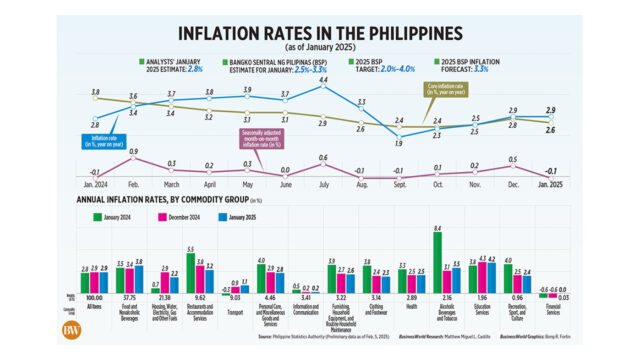
Inflation rates in the Philippines

HEADLINE INFLATION remained steady in January as lower utility costs offset a spike in food prices, preliminary data from the Philippine Statistics Authority (PSA) showed. Read the full story.

Inflation rates in the Philippines

BDO launches Visa travel card with instant rebates

BW FILE PHOTO

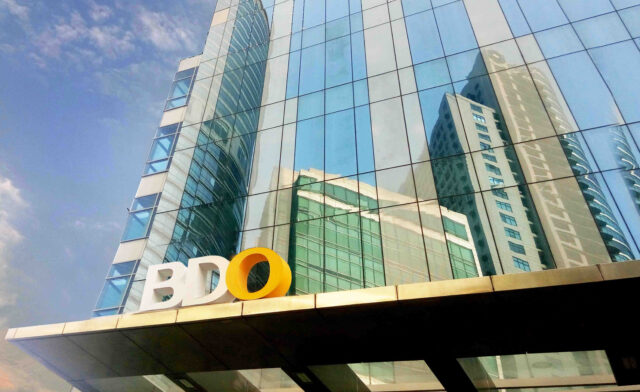
BDO UNIBANK, Inc. has partnered with Visa to launch a credit card with travel-related rewards and rebates that caters to the affluent segment as demand for travel is expected to continue growing.

The BDO Visa Signature credit card features a 1.7% foreign exchange conversion rate for overseas purchases, a 3% travel rebate on overseas and airline spending and 0.3% on everything else, as well as up to P2,500 rebate per month.

The credit card also offers up to P20 million in travel insurance coverage and complimentary access to over 1,600 VIP airport lounges worldwide.

“Over the last year, there was 22% more global travel that we see through the Visa network than there was in prior years. And when we spoke to Filipino travelers, 57% of them are planning to travel overseas in the coming year,” Visa Asia Pacific Regional President Stephen Karpin said at the launch event on Tuesday.

Unlike other travel credit cards in the market, the Sy-led bank said BDO Visa Signature offers instant rebates.

“No one gives you an instant rebate on travel and airline spends. So, this is one of them (benefits)… that and the low foreign exchange rate,” BDO Senior Vice-President and Consumer Lending Group Marketing Head Maria Nanette R. Regala told reporters on the sidelines of the launch.

Cardholders will also have access to over 900 luxury hotels partners worldwide via the Visa Luxury Hotel Collection website, including perks such as best available rate guarantee, automatic room upgrades, VIP guest status, late checkout, and complimentary breakfast, BDO said.

The card likewise has shopping, dining, and travel offers locally and internationally.

New cardholders will receive a P15,000 welcome bonus with a minimum P75,000 ($1,300) spend.

“We seek ways to provide our cardholders better benefits and experiences. BDO Visa Signature is the perfect credit card for the elite traveler… Our cardholders can expect to travel in style and comfort with these exclusive perks and privileges,” BDO Senior Executive Vice-President and Consumer Banking Group Head Rolando C. Tanchanco was quoted as saying in a statement.

“We are thrilled to celebrate this milestone in our partnership with BDO through the launch of BDO Visa Signature, marking Visa’s first product launch with BDO since they began issuing Visa cards,” Visa Philippines Country Manager Jeffrey Navarro said. “BDO Visa Signature is designed to transform the travel experience for affluent Filipino travelers… BDO Visa Signature offers a world of privileges that cater to the sophisticated tastes and demands of our cardholders.”

BDO’s net income grew by 13.26% annually to P21.18 billion in the third quarter of 2024, bringing its nine-month net profit to P60.62 billion, climbing by 12.47% year on year.

Its shares climbed by P2.50 or 1.73% to end at P147 apiece on Wednesday. — Aaron Michael C. Sy

Alphabet plans massive capex hike, reports cloud revenue growth slowed

REUTERS

ALPHABET said on Tuesday it will spend $75 billion on its artificial intelligence (AI) buildout this year, 29% more than Wall Street expected, and investors signaled disappointment at a missed cloud revenue target and began showing impatience over profitability.

Shares of the Google parent fell 9% in extended trading. Alphabet has gained about 9% so far this year.

Wall Street had been expecting 2025 capital expenditures of about $58 billion, according to LSEG data. That would have marked a modest increase over the $52.5-billion spending in 2024.

Chief Executive Officer Sundar Pichai defended the dramatic increase on a conference call with analysts, who are raising new questions about capital spending by Google and US rivals following the emergence of China’s DeepSeek, which offers cut-rate AI. He said Google’s Gemini family of AI models is comparable in efficiency to DeepSeek.

“The cost of actually using (AI) is going to keep coming down, which will make more use cases feasible,” Mr. Pichai said. “The opportunity space is as big as it comes, and that’s why you’re seeing us invest to meet that moment.” Still, the company posted a deceleration in cloud revenue growth.

Alphabet has been spending heavily on infrastructure development to support AI research and integration into products such as search and cloud services. The majority of capex for 2025 would go into building servers and data centers, Chief Financial Officer Anat Ashkenazi said on the call. She attributed the fourth-quarter results in part to capacity constraints on cloud AI offerings.

Alphabet plans to spend $16 billion to $18 billion in the first quarter, a far bigger number than the roughly $6 million DeepSeek said it spent on the final training run to develop its AI model.

To be sure, developers at leading US AI firms said the total training cost was likely magnitudes larger. But revelations around DeepSeek’s training cost in January shocked tech stocks, contributing to Nvidia’s record one-day drop of $593 billion in market value.

“It’s very hard to defend Google after the earnings report,” said Dave Wagner, portfolio manager at Aptus Capital Advisors, which holds Alphabet stock. He pointed to the cloud revenue miss and Google’s poor track record on utilizing cash for profitability.

“DeepSeek has started to teach the market that maybe some things can be done a little bit more efficiently,” he said. “Maybe we’re starting to see the market dislike the continued increase in capex.”

LEVELING OFF
Google Cloud had previously grown fast enough to offset concerns around increased spending, said Brian Mulberry, client portfolio manager at Zacks Investment Management, which holds Alphabet shares.

“When you start to see that revenue level off or at least the growth start to top off a little bit, how you’re going to finance the future growth of the company becomes an issue,” he said.

Google’s cloud business posted a 30% rise in revenue to $11.96 billion in the fourth quarter, slowing down from the 35% increase in the September quarter. Analysts were expecting a rise of 32.3% to $12.16 billion, according to data compiled by LSEG.

The soft cloud numbers come even as Google has built out AI features within its cloud computing platform. Mr. Pichai said on the conference call that developer usage on Gemini had doubled in six months to 4.4 million users.

Larger cloud rival Microsoft also reported weaker-than-expected growth in its Azure cloud platform last week. Shares of Amazon, the largest cloud provider, which will publish quarterly results on Thursday, were down 1.8% in after-hours trade.

Alphabet’s mainstay ad business, which represents about three-quarters of its overall revenue, has been facing rising competition as more advertisers eye social media platforms such as Meta’s Facebook and Instagram or ByteDance’s TikTok.

Advertising revenue rose 10.6% to $72.46 billion in the fourth quarter. That beat the third quarter’s 10.4% growth and topped analysts’ estimates of $71.84 billion, according to LSEG.

Ad revenue from YouTube grew 13.8% to $10.47 billion in the fourth quarter, compared with the 12.2% growth in the third quarter. Chief business officer Philipp Schindler said the growth was helped by US election advertising, with combined spending by Democrats and Republicans nearly doubling compared with the 2020 election.

The ad tech products and ad-driven search business are both facing scrutiny from US regulators seeking to break up the company, though policy may change under the Trump administration.

Overall, Google’s revenue rose 12% to $96.47 billion in the fourth quarter, compared with the average analyst estimate of $96.56 billion, according to data compiled by LSEG.

The company reported a profit of $2.15 per share, beating estimates of $2.13 per share.

Search revenue rose 12.5% to $54.03 billion. Pichai said that AI Overviews, the AI-generated summaries for search queries displayed above Google’s traditional links to the Web, had increased search usage.

The monetization rate on ads for AI Overviews, introduced last October, was approximately the same compared to traditional search ads, chief business officer Philipp Schindler said.

Self-driving car unit Waymo will debut internationally in Tokyo in the coming weeks, Mr. Pichai said. Reuters

Negative thoughts

FREEPIK

OPTIMISTS seem to be defined as people who have a positive outlook on life. What drives their actions is the thought that things will turn out positively — stocks they hold will move positively, careers they’re in will move up, and changes in life will be about addition, not subtraction.

Negative thoughts are often dismissed as inappropriate.

A boss who is always shooting down proposals because of doubts and perceived risks is considered “too negative.” A person always posing obstacles and challenges to any initiative is considered “nega.” Bad vibes accompany him like a dark cloud.

Is negativity always unwelcome?

In medicine, negative results are welcomed with a sigh of relief, followed by a big celebration. Tests are done on lumps in the body or X-rays are taken of one’s lungs. The best news a doctor can give his nervous patient is that the results turned out to be negative — that the suspected condition is not present. (It’s just muscle tightness.)

For travelers, the customs office of a country provides a negative list. These are items that are not allowed entry. Anything else outside the list is allowed.

Still, being negative is the opposite of affirming and supportive.

Advertising sometimes does comparative demonstrations of products to highlight the advantages of its client’s offering. The ad may not mention the other brand by name, except maybe as “Brand X.” The negative comparison is intended to highlight the positive attributes of the brand being endorsed.

The cosmetic industry too uses a “before” and “after” presentation of its product or service. The negative features in the former are replaced by glowing improvements “after” the treatment.

Negative campaigning in politics is publicly denounced as inappropriate. Still, the negative attack is embraced as a way out of low ratings in the polls. “Opposition research” is intended to flush out all the negatives about a candidate, even going to the extent of manufacturing non-existent problems. Even candidates themselves use oppo research to check for their vulnerable spots.

Demolition jobs are not just for building construction.

Negative thinking is quite prevalent. Why are objects defined by what they are not? History and current affairs are referred to as “non-fiction.” Fresh faces in politics that have no chance of winning the election even when they are surging in the surveys are called “non-traditional.” Healthy food is not nutritious but “non-fattening.”

Even the commandments are mostly expressed in prohibitions (Thou shalt not kill) rather than encouragement — honor thy father and thy mother.

People define themselves by what they don’t like. Hate objects are specified and categorized as hate objects. CEOs are known for what irritates them — do not call him on his golf day. He is pissed off by tardiness. Getting along entails avoiding negative traits that are known to be “pet peeves.”

Architects interview customers and elicit only what they abhor. Shown a home design, the negative thinker can pick the nits and say that there are too many arches, or the shelves are too small. Maybe the design of the windows makes the rooms too shadowy. But asked what design the client has in mind, she draws a blank. In the construction stage for such a client, there are continuous change orders, with walls being torn down and floors ripped up, even before the cement has dried. Of course, this adds to the project cost.

The default position in politics is to launch attacks on everyone in the guise of promoting the public good. Crusading types claim to represent the little people in their fight against corruption and abuse of power. What attributes do they like? Is it better to give a negative list of what to avoid?

A negative list, because it is always shorter, seems easier to remember and follow. With a diet, food types to avoid (high fat, sugar, carbo) are a small slice of the food pyramid. Food not on the null list is therefore allowed. Rules for visa application (must not have a reason to stay indefinitely) or literary contests (must not have been previously published) also tend to be negatively phrased.

For organizations and high-profile individuals always covered by media, no news is good news. Negative thoughts have entered social discourse. When asked how our day has gone, the best answer is a double negative… not bad.


Tony Samson is chairman and CEO of TOUCH xda

ar.samson@yahoo.com

How much did each commodity group contribute to January inflation?

How much did each commodity group contribute to January inflation?