Home Blog Page 1939

Sonak Retail Group names new president, plans new ventures

MARIA AURORA “AC” C. LEGARDA

SONAK Retail Group has named Maria Aurora “AC” C. Legarda as its new president.

“Ms. Legarda’s extensive experience in both commercial and residential real estate will be instrumental in amplifying Sonak’s current presence in the Philippines, which currently retails ASICS and Onitsuka Tiger,” the company said in a statement on Tuesday.

Sonak said Ms. Legarda is also committed to onboarding new ventures, which include a large Japanese retail brand, further solidifying Sonak’s position in the sports, lifestyle, and fashion sectors.

“I am honored to join Sonak Retail and contribute to its continued growth and success,” said Ms. Legarda.

She has over 32 years of experience in the local real estate industry, with a track record in property operations, management, and business development, the firm said.

“I look forward to leveraging my expertise to expand our portfolio and strengthen our relationships with partners and customers at a time of rapid growth for the company,” she added.

Ms. Legarda previously held a key leadership position at Ayala Malls.

“We are thrilled to welcome AC to the Sonak family. Her extensive experience and proven leadership will be invaluable as we continue to expand our presence,” Anil Buxani, chief executive officer of Sonak Corp., said.

Sonak Retail Group is a retailer of sports, lifestyle, and fashion brands in the Philippines. It has more than 40 stores nationwide with brands such as Onitsuka Tiger and ASICS. — Aubrey Rose A. Inosante

Sun Life Philippines launches insurance product with guaranteed cash benefits

SUN LIFE of Canada (Philippines), Inc. (Sun Life Philippines) has launched a life insurance policy with guaranteed annual cash benefits, it said on Monday.

Sun Life Secure Income is a limited-pay whole life insurance product that provides coverage equivalent to 200% of the policy’s face value from the first day of coverage until age 100, the insurer said in a statement.

The product also has a centenarian bonus component, where the policyholder will receive a portion of the life insurance benefit equal to 25% of the face amount on policy anniversaries.

Sun Life Secure Income gives clients guaranteed annual cash benefits equal to 6% of the face amount starting at the end of the sixth policy year up to the age of 100, which can serve as a regular stream of income for the policyholder, the life insurer said.

“The regular guaranteed cash benefits would allow them to grow or preserve their wealth and enjoy it up to their retirement years to fund financial goals and milestones,” Sun Life Philippines Chief Client Experience & Marketing Officer Carla Gonzalez-Chong said in a statement.

“Meanwhile, the life insurance coverage will give them peace of mind that their dreams for their loved ones will be realized no matter what happens,” she said.

Sun Life Philippines said its own study showed that only 14% of the Filipinos it surveyed are currently preparing for retirement even as they consider it a financial priority.

“Planning for the future can be overwhelming, especially as Filipinos strive to meet the needs of the present. The good news is more and more people are starting to recognize its importance. To leverage this, Sun Life was inspired to create a financial solution that will make financial planning for the future a more delightful experience. That is how our latest protection and savings plan, Sun Life Secure Income, was born,” Ms. Gonzalez-Chong added.

Sun Life Philippines booked a premium income of P55.79 billion in 2023, while its net income was at P8.8 billion.

TECH FEEDER FUNDS
Meanwhile, Sun Life Grepa Financial, Inc. has launched feeder funds that allow its clients to invest in global technology companies.

The SLG Peso Global Tech Funds can be added to any Sun Life Grepa investment-linked insurance plan, Sun Life Grepa said in a statement on Tuesday. There are two variants available, namely the SLG Peso Global Tech Growth Fund and the SLG Peso Global Tech Payout Fund.

Initial investments into these feeder funds will be placed in the Invesco Nasdaq-100 Exchange-Traded Fund, which mirrors the performance of the NASDAQ-100 Index.

“The technology sector has been one of the biggest drivers of growth and innovation globally. Through the SLG Peso Global Tech Funds, we are giving our clients access to this dynamic sector and the chance to benefit from its long-term potential,” Sun Life Grepa President Richard S. Lim said.

“By offering these new funds as part of our life insurance products, clients enjoy the dual benefits of investment growth potential and the safety net of guaranteed life insurance coverage, ensuring financial security and peace of mind for their loved ones.”

Sun Life Grepa’s premium income last year stood at P13.48 billion and its net income was at P1.05 billion. — A.M.C. Sy

Live Nation must face consumer lawsuit over ticket prices, US appeals court rules

LIVE NATION ENTERTAINMENT and its subsidiary Ticketmaster have failed to persuade a US appeals court to block a proposed class action accusing them of charging artificially high ticket prices.

The San Francisco-based 9th US Circuit Court of Appeals on Monday upheld a lower judge’s 2023 ruling that said Live Nation could not enforce contract provisions that required ticket buyers to arbitrate their claims rather than sue in federal court.

The appeals panel said the arbitration rules were unfair to consumers and “overtly” beneficial to defendants. The rules, which placed the ticketholders’ claims in the hands of a new arbitration body called New Era ADR, were “unconscionable and unenforceable,” the court said.

Beverly Hills-based Live Nation did not immediately respond to a request for comment.

New Era chief executive Rich Lee in a statement said the company, which is not a defendant, was disappointed by the court’s decision. Mr. Lee said New Era’s rules are “objective, easy to understand, and, most importantly, highly advantageous for any party with meritorious claims or defenses.”

The closely watched appeal tested the scope of companies’ power to compel buyers to arbitrate their disputes, including through “mass” arbitrations involving hundreds or thousands of claims.

Warren Postman, a lawyer for the consumers, welcomed the decision in a statement. He criticized what he called “corporate attempts to impose novel group procedures to gain tactical advantages over consumers and employees.”

The appeals panel found a key 2005 California Supreme Court opinion protecting class actions applied to the antitrust case against Live Nation and was not preempted by the Federal Arbitration Act.

New Era’s arbitration rules were an “inadequate vehicle” for the plaintiffs to resolve their claims, the three-judge panel said, with rules “so dense, convoluted and internally contradictory to be borderline unintelligible.”

Live Nation has defended New Era, calling its rules “sensible, fair, and similar” to those at other platforms.

In May, the US Justice department and a group of states asked a US judge in Manhattan to break up Live Nation for allegedly violating antitrust law, claiming the company “suffocates its competition” in its control over ticket sales and pricing.

Live Nation in a statement then said there was more competition than ever before in the live events market. — Reuters

Leveraging One Health to build a resilient Philippines

FREEPIK

THE PHILIPPINES is already preparing to handle the next pandemic.

The country has just reached a critical milestone in the pursuit of global health security by securing a significant grant from The Pandemic Fund. Thanks to the joint efforts of the Department of Agriculture (DA), Department of Health (DoH), Department of Finance (DoF), and key stakeholders such as the World Bank and the Emergency Center for Transboundary Animal Diseases (ECTAD) of the Food and Agriculture Organization of the United Nations (FAO), the country’s proposal stood out in this year’s competitive funding round. The $24.9-million grant under the Resilient Philippines project will enhance the country’s health systems, from bolstering disease surveillance and early warning systems, to strengthening laboratory networks and cross-sectoral collaboration.

This success is very timely for the Philippines, a country topping the World Risk Index for the third consecutive year. The rapid decline in biodiversity — driven by deforestation, ecosystem destruction, and habitat loss — has triggered the emergence and re-emergence of transboundary animal diseases (TADs) and zoonoses, or diseases transmitted between species, such as from animal to human. In addition, the misuse of antimicrobials has also fueled the rise of antimicrobial resistance (AMR) — a hidden yet growing threat. Often called the “silent pandemic,” AMR continues to advance unnoticed until its devastating effects are felt, compounding food security risks and socioeconomic challenges.

This project will thus mark a pivotal step in fully implementing the One Health approach in the Philippines. One Health is a framework that recognizes the interconnectedness of human, animal, and environmental health. It is crucial because diseases don’t respect borders — whether geographical, species, or ecological. By fostering collaboration across sectors, from agriculture to health and environmental management, One Health approach helps to better detect, prevent, and respond to health threats like zoonoses, antimicrobial resistance, and transboundary animal diseases. Ultimately, One Health is not just about addressing health risks but about building a resilient system that protects the well-being of people, animals, and ecosystems alike.

This success is also a collective achievement, a testament to the power of collaboration. By building on the shared expertise of its national stakeholders, the Philippines has harnessed the mutual enrichment of public health and sustainable agricultural practices. With FAO’s leadership in sustainable agriculture, and the World Bank’s strategic investments support, this partnership has also created a powerful synergy, culminating in the awarding of the grant to the consortium.

The Pandemic Fund was launched in 2022 by the G20 composed of the world’s biggest economies as a direct response to the global vulnerabilities exposed by the COVID-19 pandemic. It finances critical investments aimed at strengthening pandemic preparedness and resilience in the most at-risk countries. More than just a funding mechanism, this initiative provides governments with a crucial opportunity to institutionalize and sustain their efforts towards building long-term pandemic resilience and health security. 

For us, this is just the beginning. Now is the time for all sectors — government, private industry, and civil society — to rally behind this momentum and invest in sustainable, resilient systems that will protect our future. We must scale up our efforts to integrate One Health principles and the Sustainable Development Goals of the Agenda 2030 across all levels, strengthen partnerships, and secure more innovative funding to face the evolving threats to human, animal, and environmental health. The success of this project shows what is possible when we act collectively, but the real test will be our ability to sustain and expand this progress for generations to come, leaving no one behind.


Dr. Lionel Dabbadie is the FAO representative in the Philippines. ECTAD is the unit of the FAO founded in 2004 and established in the Philippines in 2022 that implements relevant initiatives in attaining economic, social, and health security from TADs and other health threats.

Smart Recycle PH rewards recycling with actual trees

SVEN SCHLAGER-UNSPLASH

By Edg Adrian A. Eva

SMART RECYCLE PH is supporting the country’s reforestation efforts by planting trees in exchange for points earned through partners’ recyclable waste contributions.

“This initiative helps keep recyclables away from landfills but, at the same time, contributes to reforestation efforts in the country,” Noelle Anne Cubacub, communications manager at Smart Recycle PH, said in an interview.

Smart Recycle PH offers an app where partners can monitor their recycled waste contributions, earning Smart Recycle points that can be converted into real trees through the “Recycling for Trees” campaign.

For every kilo of lightweight materials, such as paper and plastics contributed, partners earn one Smart Recycle point, while five kilos of heavyweight materials, like metal, are required for one point. Every 100 points can then be converted into trees planted in designated areas covered by its ground partner, Ramon Aboitiz Foundation, Inc.’s (RAFI) One to Tree program.

Companies and residential areas can contribute all types of recyclable wastes such as paper, plastics, cartons and metals. They can do this by availing themselves of Smart Recycle PH’s waste collection services through the company’s website or social media pages.

Recyclable waste can also be disposed of at local recycling drop-off centers, including those in SM City Cebu, H&M, and Globe Telecom, Inc. all of which can also be found on the company’s website.

Through this campaign, the company has planted more than 2,500 guyabano seedlings in the village of Luca, Balamban in Cebu, in partnership with the Luca Farmers Multi-Purpose Association and RAFI-One to Tree.

As it enters its third year, the Recycling for Trees campaign seeks to expand its impact by seeking to plant 1,500 mangrove trees at the RAFI-One to Tree sites in Batangas.

Although the initiative operates through a reward system, Ms. Cubacub told BusinessWorld she hopes more companies would join them to protect the environment, rather than simply focusing on vested gains.

“We want to encourage our current and future partners… to focus on collective reforestation efforts,” she said. “We want to work together for larger environmental goals rather than competing for individual recognition.”

Since its rebranding in 2021, Smart Recycle PH has seen a growing number of companies adopting sustainable waste management practices, recognizing the need to adapt to rising consumer environmental awareness.

“It’s closely linked to the long-term viability of their brands or companies. They invest more in sustainable practices so they can be better positioned to thrive in the future,” Ms. Cubacub said.

The company now has 35 partners across the waste value chain, including major corporations in business districts and residential areas, most notably in Cebu City and Manila. This expansion has increased its nationwide presence from just 20 partners.

Since 2021, the company has diverted around 883,946 kilos of waste that could have gone to landfills.

Ms. Cubacub said there is still much work to be done.

For plastic waste alone, the Philippines has a low recycling rate of 9%, according to a 2020 report by the World Wildlife Fund. Each Filipino consumes an average of 20 kilos of plastics annually, 15.43 kilos per capita of which become waste.

Ms. Cubacub cited the need for companies to take steps toward sustainable waste management, while encouraging communities and households to cut their waste.

New homebuilding platform targets 1,000 homes in first year

HOMEQUBE Pte. Ltd., a Singapore-based homebuilding platform powered by blockchain and artificial intelligence (AI), plans to construct 1,000 houses in its first year of operations following its launch in November.

“We want 1,000 (housing) orders,” Homeqube Founder and Chief Executive Officer Jose Paolo Calma said during a media briefing in Makati City on Tuesday.

With Homeqube’s home kits, Mr. Calma said a house can be built for as low as P1 million as long as the buyer has land.

Homeqube invested $1 million to establish its operations, logistics, and sourcing of materials.

It also established an online home delivery service that covers the permitting phase, the acquisition of materials, installation, and delivery of the units.

The company has tapped a contractor based in Pampanga to execute the housing orders.

“Sustainable development has become a common talk among government and business leaders worldwide, and we are bringing that concept to the Philippine property sector with our homebuilding committed to regenerative living,” Mr. Calma said.

For building materials, Homeqube is utilizing glass fiber reinforced polymer (GFRP) that allows for easy configurations and adaptations in constructing houses. It produces lower carbon emissions and environmental footprint for building projects.

GFRP can withstand winds as fast as 310 kilometers per hour while also being rust-proof.

“By choosing materials that regenerate, we can create a more resilient and adaptable environment, ensuring that our built environment remains a testament to our evolving needs. In short, we can build regenerative homes anywhere and our homes can follow where we go,” Mr. Calma said.

He said Homeqube can also help address the country’s 6.5 million housing backlog since the company can build houses at a faster rate.

The company also plans to expand into Indonesia and Brazil.

“The abundant use of steel and cement for homebuilding, which is too bulky and complex for transportation, leads to elevated land prices as demand shoots up with more people moving to urban areas. Tapping these building materials also exposes homeowners to a longer lead time of about 18 months, and more expensive project costs due to logistics and middleman fees,” Mr. Calma said.

Homeqube aims to make homebuilding faster and more affordable with an all-in-one platform. The company uses new generation internet, new generation commerce powered by AI and blockchain technology, and pre-engineered buildings and lightweight materials to build houses. — Revin Mikhael D. Ochave

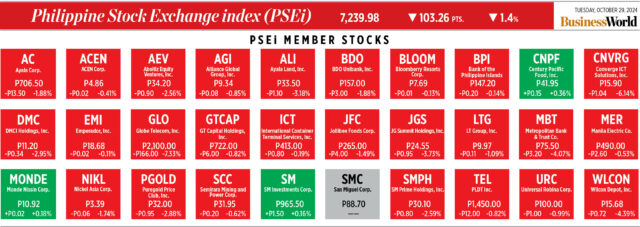
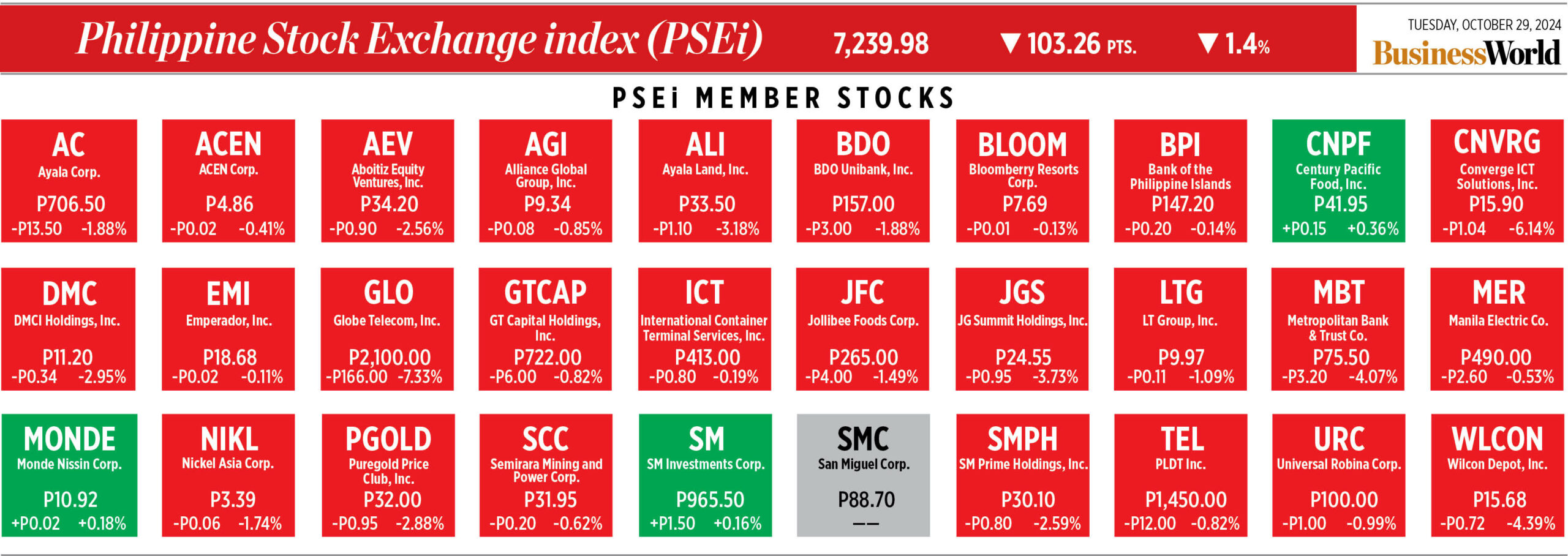
How PSEi member stocks performed — October 29, 2024

Here’s a quick glance at how PSEi stocks fared on Tuesday, October 29, 2024.


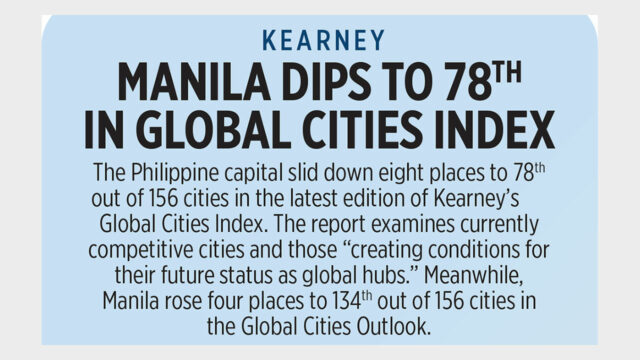
Kearney: Manila dips to 78th in Global Cities Index

The Philippine capital slid down eight places to 78th out of 156 cities in the latest edition of Kearney’s Global Cities Index. The report examines currently competitive cities and those “creating conditions for their future status as global hubs.” Meanwhile, Manila rose four places to 134th out of 156 cities in the Global Cities Outlook.

AT Kearney: Manila dips to 78<sup>th</sup> in global cities index

Peso weakens with dollar near 3-month high

BW FILE PHOTO

THE PESO weakened on Tuesday as the dollar stayed near its three-month high ahead of the US presidential vote next week.

The local unit closed at P58.275 per dollar on Tuesday, weakening by five centavos from its P58.225 finish on Monday, Bankers Association of the Philippines data showed.

The peso opened Tuesday’s session stronger at P58.20 against the dollar. Its intraday best was at P58.13, while its worst showing was at P58.335 versus the greenback.

Dollars exchanged went down to $1.17 billion on Tuesday from $1.33 billion on Monday.

The peso was dragged down by a generally stronger dollar as markets awaited the US presidential elections on Nov. 5, Rizal Commercial Banking Corp. Chief Economist Michael L. Ricafort said in a Viber message.

“The dollar-peso traded within a tight range as players were cautious ahead of the release of US gross domestic product and jobs data this week,” a trader added in a phone interview

For Wednesday, the trader sees the peso moving between P58 and P58.50 per dollar, while Mr. Ricafort expects it to range from P58.15 to P58.35.

On Tuesday, the dollar drifted not far from a three-month high with one of the Federal Reserve’s preferred employment gauges — the Job Openings and Labor Turnover Survey or JOLTS job openings report — due on Tuesday, ahead of highly anticipated monthly nonfarm payrolls data on Friday, Reuters reported.

The dollar was little changed against a basket of six major peers, which includes the yen and euro. The dollar index stood at 104.29, after reaching 104.57 overnight, matching the high from Wednesday of last week, a level previously not seen since July 30.

Recent robust US economic data, including evidence of a resilient job market, have seen bets pared back for easing this year by the Federal Reserve, boosting the dollar.

The dollar slipped 0.23% to 152.92 yen, but that followed a rally to the highest since July 31 at 153.885 yen on Monday. — Aaron Michael C. Sy with Reuters

PSEi sinks to one-month low on peso weakness

BW FILE PHOTO

THE MAIN INDEX dropped to the 7,200 level anew on Tuesday, hitting an over one-month low, due to the peso’s decline against the dollar, which has strengthened amid market bets on the results of the US presidential election.

The bellwether Philippine Stock Exchange index (PSEi) fell by 1.4% or 103.26 points to 7,239.98 on Tuesday, while the broader all shares index sank by 1.45% or 58.89 points to 3,977.31.

This was the PSEi’s lowest close in over a month or since it ended at 7,202.16 on Sept. 19.

“The local market declined this Tuesday. The bourse was weighed by the weakness of the local currency against the dollar and the rise in local treasury yields. Investors are also taking a cautious stance amid the uncertainties caused by the upcoming US election,” Philstocks Financial, Inc. Senior Research Analyst Japhet Louis O. Tantiangco said in a Viber message.

“Foreign investors were net sellers for the day, adding to the market’s decline,” he said. Net foreign selling surged to P933.59 million on Tuesday from P47.81 million on Monday.

The local unit closed at P58.275 per dollar on Tuesday, down by five centavos from its P58.225 finish on Monday, according to Bankers Association of the Philippines data.

The US election has entered its final stretch, with opinion polls still too close to call a winner, despite some betting sites and financial markets leaning toward a win for Republican Donald Trump over Democrat Kamala Harris, Reuters reported.

Recent robust US economic data, including evidence of a resilient job market, have seen bets pared back for easing this year by the US Federal Reserve, boosting the dollar.

The US currency has also been buoyed by rising market expectations for an election win for Mr. Trump, whose tariff, tax and immigration policies are seen as inflationary, thus negative for bonds and positive for the dollar.

The dollar slipped 0.23% to 152.92 yen, but that followed a rally to the highest since July 31 at 153.885 yen on Monday.

“Local equities snapped their two-day winning streak as traders locked in their gains ahead of the All Souls’ Day holiday and further assessed the latest corporate earnings reports,” Regina Capital Development Corp. Head of Sales Luis A. Limlingan said in a Viber message.

All sectoral indices closed lower on Tuesday. Property declined by 2.29% or 65.43 points to 2,791.84; financials slumped by 1.55% or 37.36 points to 2,370.96; services went down by 1.53% or 34.47 points to 2,211.82; mining and oil retreated by 0.98% or 85.76 points to 8,598.36; holding firms dropped by 0.93% or 57.63 points to 6,133.13; and industrials lost 0.74% or 74.06 points to end at 9,852.87.

Value turnover rose to P6.17 billion on Tuesday with 565.64 million issues traded from the P4.13 billion with 873.27 million shares that changed hands on Monday.

Decliners overwhelmed advancers, 147 versus 55, while 51 names were unchanged. — Revin Mikhael D. Ochave with Reuters

Duterte remarks may push ICC to build up ‘crimes vs humanity’ case

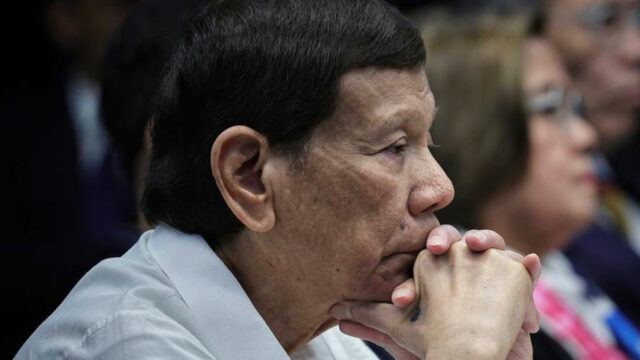
FORMER PRESIDENT Rodrigo R. Duterte — OFFICIAL FACEBOOK ACCOUNT OF THE SENATE OF THE PHILIPPINES

By Chloe Mari A. Hufana, John Victor D. Ordoñez and Kenneth Christiane L. Basilio, Reporters

FORMER PRESIDENT Rodrigo R. Duterte’s remarks about his deadly drug war before a Senate probe is likely to give impetus to the International Criminal Court’s (ICC) own investigation of the firebrand leader for alleged crimes against humanity, political analysts said.

“The ICC will now become more motivated in its investigation of the war on drugs,” Josue Raphael J. Cortez, a diplomacy instructor at the School of Diplomacy and Governance of De La Salle-College of St. Benilde, told BusinessWorld in a Facebook Messenger chat on Tuesday.

Mr. Duterte’s testimony at the Senate Blue Ribbon Committee hearing on Oct. 28 “fortified” claims of human rights violations by the international tribunal, he added.

The tough-talking leader said he offers “no apologies, no excuses” for his war on drugs, as he appeared for the first time at a Senate hearing probing the crackdown, where thousands of drug suspects died.

“Do not question my policies, because I offer no apologies, no excuses. I did what I had to do, and whether you believe it or not, I did it for my country,” he told senators.

He also admitted having told cops when he was still Davao City mayor to goad drug suspects to draw their guns and fight back to give cops a reason to retaliate.

“However, one must bear in mind that it is the law of the land that would still dominate, and it is our very own government who will be deciding whether or not they will be permitting the ICC to undertake their investigation regarding the matter,” Mr. Cortez said. 

Despite both Houses of Congress having started separate investigations of the drug war, only President Ferdinand R. Marcos, Jr. could decide if the government would cooperate with the ICC probe, he added.

The President has said his government would not cooperate with the ICC investigation because the country has a working justice system.

The states estimates that at least 6,117 people died in Mr. Duterte’s drug war between July 1, 2016 and May 31, 2022, but human rights groups say the death toll could be as high as 30,000.

The Philippines under Mr. Duterte withdrew from the ICC in March 2018 amid criticisms that his government had systemically murdered drug suspects in police raids. It took effect a year later. 

Meanwhile, Senate President Francis “Chiz” G. Escudero said the ex-President’s order for cops to goad criminals and suspects to fight back was unbecoming of a civilized government that should ensure due process for all Filipinos.

“We have what we call due process, and we cannot just forget about this and set it aside,” he told a news briefing in English and Filipino on Tuesday. “As a lawyer, he should know that. A civilized government can do nothing less than provide and ensure due process to anyone and everyone.”

During the hearing, Mr. Duterte admitted having used a hit squad that killed criminals in Davao, but denied giving out rewards for these killings.

Mr. Escudero said he would leave it to Senate Minority Floor Leader Aquilino “Koko” L. Pimentel III, who heads a subcommittee of the Blue Ribbon Committee looking into the drug war, to decide on whether to invited ICC representatives to answer questions about Philippine withdrawal from the tribunal.

“I leave it up to the chairman first of the committee and I leave it up to the House [of Representatives] as well,” he said.

The drug war led to more than 12,000 deaths, mostly urban poor, according to Human Rights Watch. It added that at least 2,555 killings have been attributed to the national police.

‘AS POWERFUL AS EVER’
“Presuming the hearings to be conducted would be in aid of legislation or policy to be conducted by the Marcos administration vis-a-vis our relationship with the ICC, it makes perfect sense to have them (representatives) there,” Hansley A. Juliano, who teaches political science at the Ateneo de Manila University, said in a Facebook Messenger chat.

“Based on the rules of procedure for inquiries of both Houses, there’s nothing barring them from inviting international personages,” he added.

“The ICC has to step in because the mastermind of the drug war and perpetrators remain as powerful as ever,” Fides M. Lim, convenor of the human rights and political prisoners support group Kapatid, said in a Facebook Messenger chat. 

Arjan P. Aguirre, who also teaches political science at the Ateneo, said only Senator Ana Theresia Hontiveros-Baraquel managed to stand her ground and call out Mr. Duterte for his vulgar statements at the hearing.

He said Mr. Pimentel was not assertive enough as a committee chairman to keep the former President from dominating the discussions.

“Senator Risa was assertive and was able to keep herself calm and objective,” he said. “No one was telling him to stick to the questions. He kept on digressing, which was his strategy to enthrall the crowd.”

Also on Tuesday, Sta. Rosa City Rep. Dan S. Fernandez said the Department of Justice (DoJ) should not mishandle the case against Mr. Duterte once it decides to prosecute him for alleged crimes against humanity under the law.

“If the DoJ fails to do their job on this matter, then the ICC will take more cognizance of it,” he said. “It’s really up to the DoJ to do their work. The international community is really watching,” said Mr. Fernandez, a co-chairman of the House of Representatives quad committee investigating Mr. Duterte’s war on drugs.

Manila Rep. Bienvenido M. Abante in a separate statement noted that by taking full responsibility for the thousands of extrajudicial killings under his watch, Mr. Duterte “has admitted to a level of command responsibility that the law considers criminal.”

The House quad committee would cooperate with the DoJ should it file a case against Mr. Duterte, Mr. Abante, a co-chairman of the House quad committee, told the news briefing.


Kong-rey strengthens into typhoon, may reach super typhoon class — PAGASA

PAGASA.DOST.GOV.PH

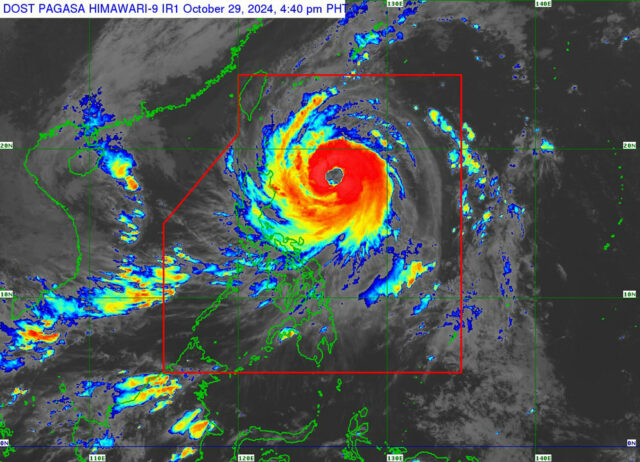
THE STATE weather bureau on Tuesday said Kong-rey, locally named Leon, has intensified into a typhoon as it moved along the east coast of Cagayan province.

In a bulletin, the Philippine Atmospheric, Geophysical and Astronomical Services Administration (PAGASA) said Kong-rey had a high likelihood of becoming a super typhoon as it passes over the Philippine Area of Responsibility.

It said the storm would be closest to Batanes province by Oct. 31. A landfall in the province was not ruled out. “Leon will likely be at or near super typhoon intensity during its closest point of approach to Batanes,” it added.

As of 5 p.m., Kong-rey was last seen 505 kilometers (km) east of Tuguegarao City or 515 km east of Aparri, Cagayan province. It was moving in a west-northwestward direction at 10 kilometers per hour (kph).

The storm was packing maximum sustained winds of 150 kph near the center and gustiness of up to 185 kph.

Due to “rapid intensification,” the weather bureau hoisted tropical wind signal No. 2 over the provinces of Batanes, Babuyan Islands, mainland Cagayan, the northern and eastern portions of Isabela, Apayao, the northern portion of Kalinga, the northern portion of Abra and Ilocos Norte.

Meanwhile, signal No. 1 was raised over the rest of Isabela, Quirino, Nueva Vizcaya, the rest of Kalinga, Mountain Province, Ifugao, Benguet, the rest of Abra, Ilocos Sur, La Union, the eastern portion of Nueva Ecija, Aurora, the northern and eastern portions of Quezon including Polillo Islands, Camarines Norte, Camarines Sur, Catanduanes, Albay and the northern portion of Sorsogon.

“The highest wind signal which may be hoisted during the occurrence of Leon is wind Signal No. 3 or 4, especially in Batanes and Babuyan Islands. The hoisting of wind Signal No. 5 is also not ruled out,” the agency added.

PAGASA also issued a gale warning over the coastal areas of Northern Luzon and the eastern seaboards of Central and Southern Luzon. — Adrian H. Halili